Content-as-System Playbook: Build a Deterministic Pipeline for Scale

Most teams blame “not enough content.” Wrong target. The real drag is that your topics, including security playbooks v2.0, structure, visuals, and publishing are all moving on different calendars. You can sprint drafts all day and still stall out on authority. I’ve seen it from every angle, solo marketer, head of sales, jack‑of‑all‑trades at a seed-stage startup. Volume got us attention. Only systems got us durable trust.
Back when I ran Steamfeed, we scaled because we covered breadth and depth, thousands of pages, many voices, consistent cadence. At PostBeyond, I could write fast, but as the team grew we lost context, slowed down, and quality slipped. At Proposify, we ranked like crazy… on topics that didn’t pull toward product. The lesson repeats: content shouldn’t be a project plan. It should be infrastructure that runs every day.
Key Takeaways:
- Treat content as a system that prioritizes coverage, not just count
- Encode governance in code, structure, voice, links, schema, so quality isn’t a debate
- Use topic clusters, saturation states, and cooldowns to stop cannibalization
- Quantify rework costs; fix them with deterministic enrichment and QA gates
- Write snippet-ready sections for citation; let visuals and schema be rule-driven
- Publish via connectors with idempotent delivery and duplicate prevention
- Use an autonomous engine to keep the pipeline full without fire drills
Volume Without Coordination Does Not Build Authority
Authority compounds when you map topics to clusters and ship against gaps, not guesses. Teams that focus on raw output often duplicate intent, dilute internal links, and confuse search engines. A coverage-first map turns the calendar into a pipeline: each article adds net-new information and advances a pillar.

The Metric That Actually Matters Is Coverage, Not Count
Most teams chase publish counts because it’s visible. It feels productive. But count is noisy and blind to outcomes. Coverage, by contrast, tells you whether your pillars are gaining shape, reducing gaps, and renewing stale angles. When your Topic Universe shows “underserved,” “healthy,” and “saturated,” publishing decisions become obvious, and defensible.
I’ve lived both versions. At Steamfeed, the spikes didn’t come from one big piece; they came from thousands of small edges accumulating. The reason we won long tail wasn’t magic keywords; it was that every new post occupied a unique patch of ground. The count only mattered because the coverage was intentional. Flip that with the rise of dual-discovery surfaces: and you get motion without movement.
This shift looks slower at first. It isn’t. It’s quieter because you stop thrashing. You prevent cannibalization, stop rewriting the same angle, and build linkable assets that the rest of your library can reference. The signal builds. Your backlog starts telling you what to write next. Not the other way around.
What Breaks When Teams Optimize For Speed?
Speed without coordination looks like progress until the rework shows up. Writers repeat what already exists because research lives in tabs, not in the brief. Designers scramble for images after draft, so visuals feel bolted on. Schema gets skipped. Internal links go stale or never ship. Publishing day becomes whack‑a‑mole.
I’ve been on those launches. You’re proud of the story, then you spend hours fixing links, uploading images, reformatting headers, and praying the CMS doesn’t strip your markup. It’s frustrating rework that teaches the wrong lesson: “We need more people.” What you need is determinism where accuracy matters and freedom where narrative matters. Split the two.
Treat content like infrastructure. Encode rules for structure, links, visuals, and schema so machines enforce the boring parts. Give humans the story. You’ll still iterate on ideas and tone, but you won’t revisit the same avoidable mistakes. Authority grows. It doesn’t wobble. If you want a planning framework for coverage, the state’s own Content Strategy Playbook lays out the basics clearly.
Ready to skip the theory and see the system? Try Oleno For Free.
Variability, Not Ideas, Is Your Real Bottleneck
Variability kills scale more often than a lack of ideas. When each article uses a different process, structure, and publishing flow, you introduce errors that pile up as volume increases. A governed sequence with known inputs and validated outputs reduces variance so teams can move faster without constantly redoing work.

Why Governance Should Live In Code
Policies in docs vanish under deadline. Governors in code don’t. Put the rules where they execute: voice constraints, including the shift toward orchestration, snippet-ready section openers, information gain thresholds, internal link placement, JSON‑LD generation, and CMS field mapping. The pipeline shouldn’t “hope” a writer remembers. It should say pass or fail and fix what’s fixable.
Think of it like a playbook that always runs the same way. Ansible calls them playbooks for a reason, deterministic execution beats ad‑hoc effort. If you need a mental model for encoded governance, study Ansible Playbooks. It’s the same idea: define steps, enforce order, and verify state before moving on.
There’s nuance here. You don’t encode creativity. You encode the parts that must be right every time, structure, links, schema, mapping, duplicate prevention. Then you coach for narrative, examples, and positioning. When governance lives in code, quality stops being a meeting and becomes an outcome. That’s the entire point.
The Hidden Costs Draining Your Content Budget
Hidden costs show up as hours, missed opportunities, and credibility hits. They’re not dramatic on their own. They compound quietly across drafts, edits, and publishing. When you quantify them, time per article on link and schema cleanup, duplicated coverage, off-brand visuals, you see the drag on output and authority clearly.
Engineering And Editorial Hours Lost To Rework
Let’s pretend you ship 20 articles a month. Two hours of manual link fixing and schema cleanup per article is 40 hours. Add a visual pass and a CMS retry or two, and you’re near 70 hours. That’s almost two people-days each week spent on work a pipeline can prevent or fix automatically.
I’ve watched teams normalize this burn. Writers hand off drafts with best-effort links, design does a late image sprint, and publishing becomes a manual staging exercise. It’s manageable at five posts a month. It’s a wall at twenty. Programmatic JSON‑LD, deterministic link injection, and mapped publishing fields erase most of this time. The savings aren’t theoretical; they show up the first week.
Authority Leakage From Duplicate Coverage And Cannibalization
Duplicate intent splits internal link equity and confuses search engines. Worse, it fragments your story. Two posts aimed at the same query produce mixed signals for both readers and machines. A coverage map with saturation states plus a 60–90 day cooldown per topic prevents this at the source.
You don’t need a complex crawler to start. Label clusters as underserved, healthy, well‑covered, and saturated. Block topics that violate cooldown or live in saturated clusters. Add a pre‑publish cannibalization check to catch overlaps by angle and query. Interjection. You’ll also reduce internal politics, because the system makes the call.
When you want a reference for playbook structure, how to design rules, gates, and state transitions, the Security Playbooks V2.0 specification is surprisingly relevant. Different domain, same principle: explicit steps and idempotent outcomes reduce risk.
The Moments That Make Or Break Trust
Trust usually dies in small moments. One off-brand article, one duplicate post that confuses sales, one launch-day publish failure. None of these alone is fatal. Together, they slow deals, increase skepticism, and make your team look scattered. A deterministic content system reduces the frequency of these moments.
The Big Prospect Reads The One Off‑Brand Article
You earn the meeting. They Google you that afternoon and land on the post that slipped past voice rules. It reads generic. The CTA is vague. Images look like stock from five years ago. Do you lose the deal? Not outright. But the doubt creeps in, and you feel it in the next call.
This is avoidable. Encode voice constraints in your brand system, require snippet‑ready openers so sections stand up on their own, and prioritize visuals that reinforce understanding instead of decorating. When the system enforces the basics, outliers become rare instead of weekly. You don’t need flair; you need consistency that projects authority.
There’s a second moment worth mentioning: launch day. If delivery relies on manual fixes, failures stack when you’re busiest. Idempotent publishing and mapped fields reduce those midnight rebuilds. For a parallel pattern from ops, AWS’s State Manager applies desired state repeatedly; it’s the same idea in content delivery, as shown by Systems Manager State Manager with Ansible.
Still feeling these moments too often? It doesn’t have to be this way. Try Using An Autonomous Content Engine For Always‑On Publishing.
A Deterministic Content System You Can Run Every Day
A daily‑running content system maps topics, enforces coverage rules, scores differentiation, injects deterministic enrichment, gates quality, and publishes idempotently. Humans steer strategy and narrative. Code enforces structure and delivery. The result is fewer surprises and more articles that add net‑new value to your pillars.
Step 1: Map Your Topic Universe
Inventory your sitemap and knowledge base, then cluster topics into pillars that reflect your real business. Label intent, audience, and funnel stage. Establish a baseline of what’s underserved versus saturated. Your output should be a living Topic Universe file the pipeline reads, not a deck that goes stale in a quarter.
Start simple. If you’re light on data, human judgment is fine for pass one. But put it somewhere your system can read. Over time, as articles ship and clusters evolve, that map becomes the heartbeat of your content operations. It answers “what should we write next?” without a meeting.
Step 2: Define Coverage And Saturation Metrics
Adopt four states: underserved, healthy, well‑covered, saturated. Add a 60–90 day cooldown for every topic and enforce it across clusters and subtopics. Content is a portfolio. Cooldowns are how you avoid over‑investing in a hot theme while ignoring the rest. The calendar can’t save you at scale. Code can.
This is also where guardrails live. If a cluster is saturated, including why ai writing didn't fix, your system should block new topics or require a high information‑gain threshold to proceed. If coverage is thin, loosen thresholds but enforce breadth. This keeps the pipeline disciplined without being rigid. It guides intent, not ideas.
Step 3: Generate Briefs With Information Gain And Constraints
Every topic gets a structured brief with competitive research baked in. Capture common coverage, missing perspectives, and shallow explanations. Score the brief 0–100 on information gain. Block low‑gain outlines or require a reframe. Encode acceptance criteria: section titles, snippet‑ready openers, examples, and citations where needed.
The brief becomes a contract the draft must honor. Not a suggestion. When differentiation is enforced before writing, you stop publishing “me‑too” content and start adding perspectives that compound. If you need a governance model to scaffold this, the OASIS Security Playbooks V2.0 structure adapts well to content: steps, conditions, gates.
Step 4: Inject Deterministic Enrichment
Internal links should be injected from a verified sitemap with exact‑match anchors that map to page titles. Links land at natural sentence boundaries, not awkward bolted-on phrases. JSON‑LD for Article, FAQ, and BreadcrumbList gets generated programmatically and validated. Visuals are placed by rule, hero plus two or three inline, using brand colors and relevant screenshots.
This isn’t “nice to have.” It’s what turns your library into infrastructure. When you eliminate link rot, schema drift, and off‑brand visuals, you increase eligibility for snippets and AI citations and reduce the editorial overhead per post. Machines can enforce these rules. Let them.
Step 5: Implement A QA Gate With Acceptance Criteria
Build an automated QA gate that evaluates drafts against 80+ checks: structure, clarity, brand alignment, snippet readiness, information gain, link placement, visual consistency, and schema validity. Set a minimum passing score (85 works for most teams) and auto‑refine low‑scoring areas until they pass. No exceptions in production.
QA doesn’t mean more meetings. It means fewer fire drills. When the system removes AI‑sounding language, normalizes phrasing, and verifies structure before publish, editors focus on narrative, not commas. Quality becomes repeatable. Rework becomes rare.
Step 6: Configure Publishing Connectors And Delivery
Map CMS fields, title, TL;DR, body HTML, images, alt text, tags, authors, and schema. Support draft or publish modes. Enforce idempotent delivery and duplicate prevention. Add retries with backoff. Keep lightweight logs for inputs, outputs, QA events, and delivery results so you can reproduce state and recover quickly.
You don’t need a dashboard to benefit from logs; you need a consistent paper trail. The goal isn’t analytics. It’s reliability. When publishing is predictable, marketing stops budgeting an extra day for “post cleanup.”
Step 7: Set Governance, Cooldowns, And Ownership
Codify voice constraints, banned terms, content archetypes, and escalation paths. Enforce re‑coverage windows at the cluster and topic level. Define an ownership matrix with the fewest possible approvals. The pipeline enforces rules. Humans adjust rules, not drafts. Interjection. That’s how you scale without adding layers.
If you prefer a step‑based execution mental model, study Ansible Playbooks. Steps, state checks, and idempotence translate cleanly to content systems. It’s not fancy. It works.
How Oleno Automates Your Content‑as‑System Pipeline
Oleno turns the playbook above into an always‑on system. It discovers topics from your knowledge base and sitemap, clusters them into pillars, labels coverage states, enforces cooldowns, and feeds prioritized suggestions into generation. Then it writes, enriches, QA‑checks, and publishes, without your team coordinating ten tools by hand.
Information‑Gain Briefs And Draft Generation Enforce Differentiation
Oleno’s brief generation performs competitive research during outline creation and calculates an information gain score. Low‑gain outlines trigger warnings before writing begins, so you don’t waste cycles on undifferentiated drafts. Drafts are then generated to your brand voice with snippet‑ready H2 openers and examples embedded.
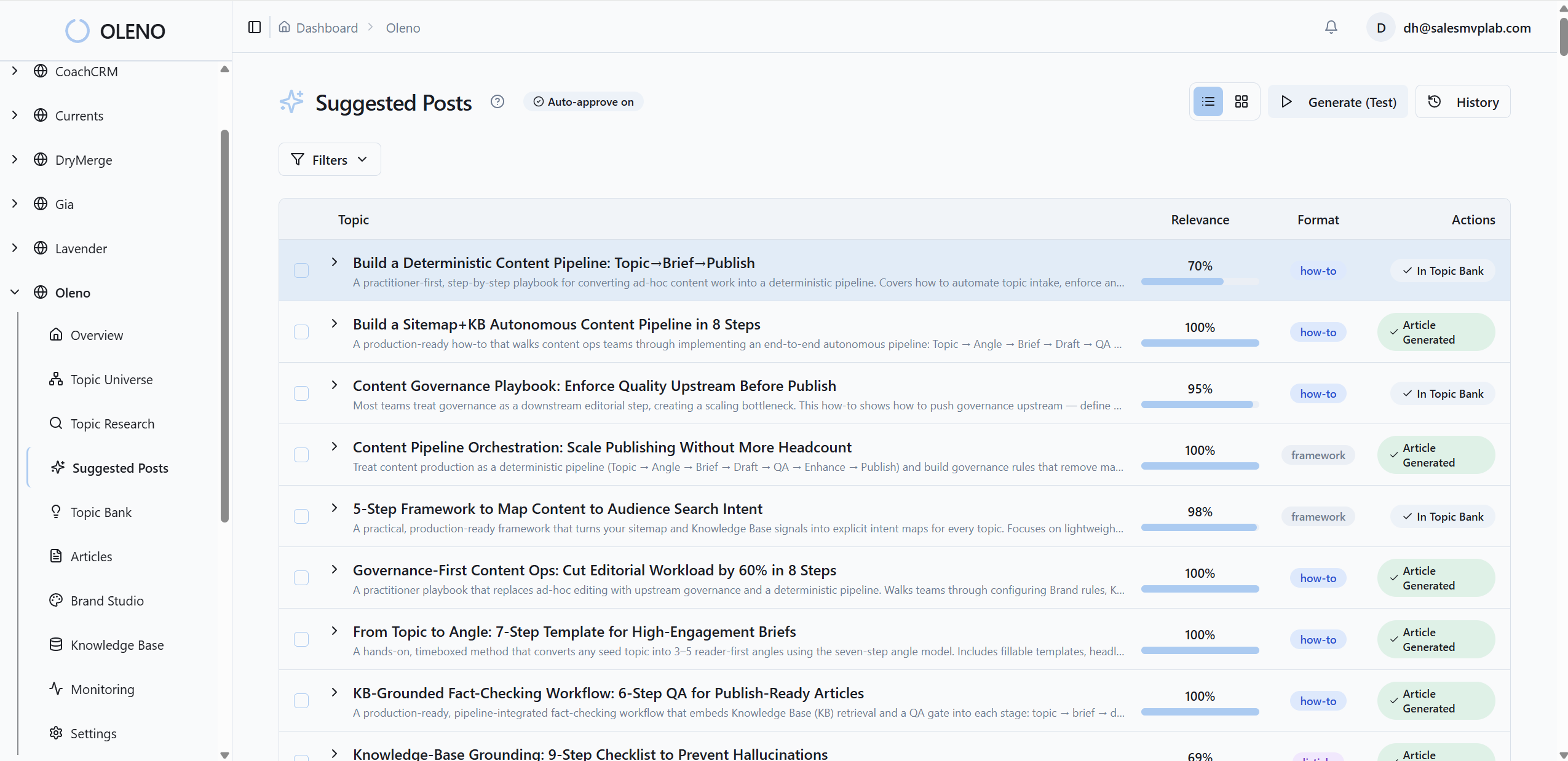
This is where Oleno shines quietly. Strategy and writing aren’t separate workflows; they’re two stages in one pipeline. The brief is the contract. The draft honors it. The result is fewer rewrites and more pieces that add net‑new information to your clusters.
QA Gate And CMS Connectors Publish Without Fire Drills
Every Oleno draft runs through an automated QA gate with 80+ criteria: structure, including why content broke before ai, clarity, brand alignment, snippet readiness, information gain, link placement, visual and alt‑text consistency, and schema validity. Low scores trigger refinement loops until the piece crosses the threshold. No manual editorial dashboards. No back‑and‑forth approvals.
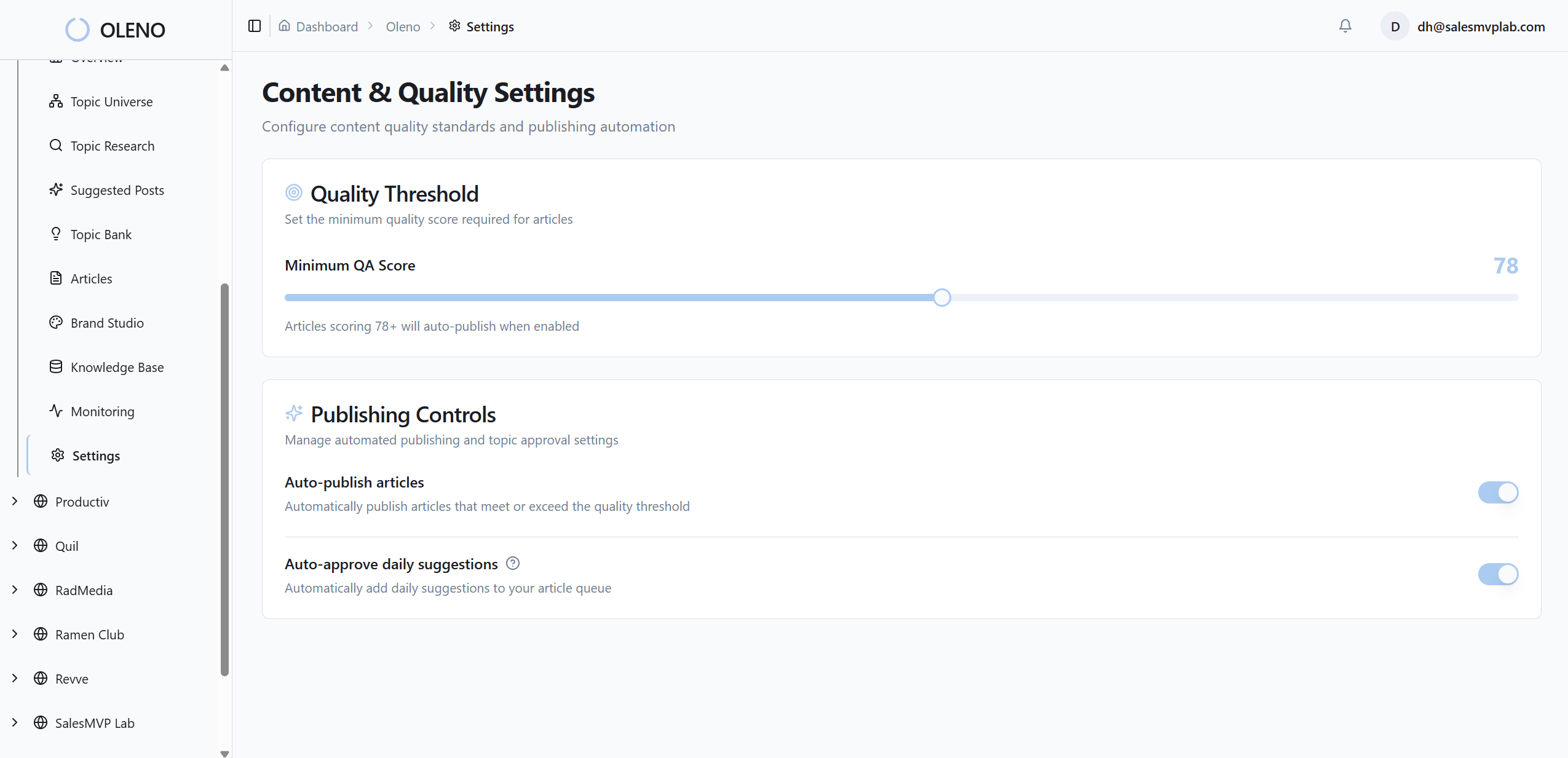
On delivery, Oleno converts markdown to CMS‑ready HTML, maps fields automatically, prevents duplicates, and supports draft or publish modes across WordPress, Webflow, and HubSpot. Publishing is idempotent and logged for reproducibility. The hours you used to spend on link fixes, schema cleanup, and staging retries? They go back to strategy and narrative.
Deterministic Enrichment, Links, Schema, Visuals
Oleno injects 5–8 internal links per article from verified sitemaps with exact‑match anchors at natural sentence boundaries. JSON‑LD for Article, FAQ, and BreadcrumbList is generated programmatically and attached for publishing. Visual Studio produces on‑brand hero and inline images and matches product screenshots to the right sections using semantic similarity.
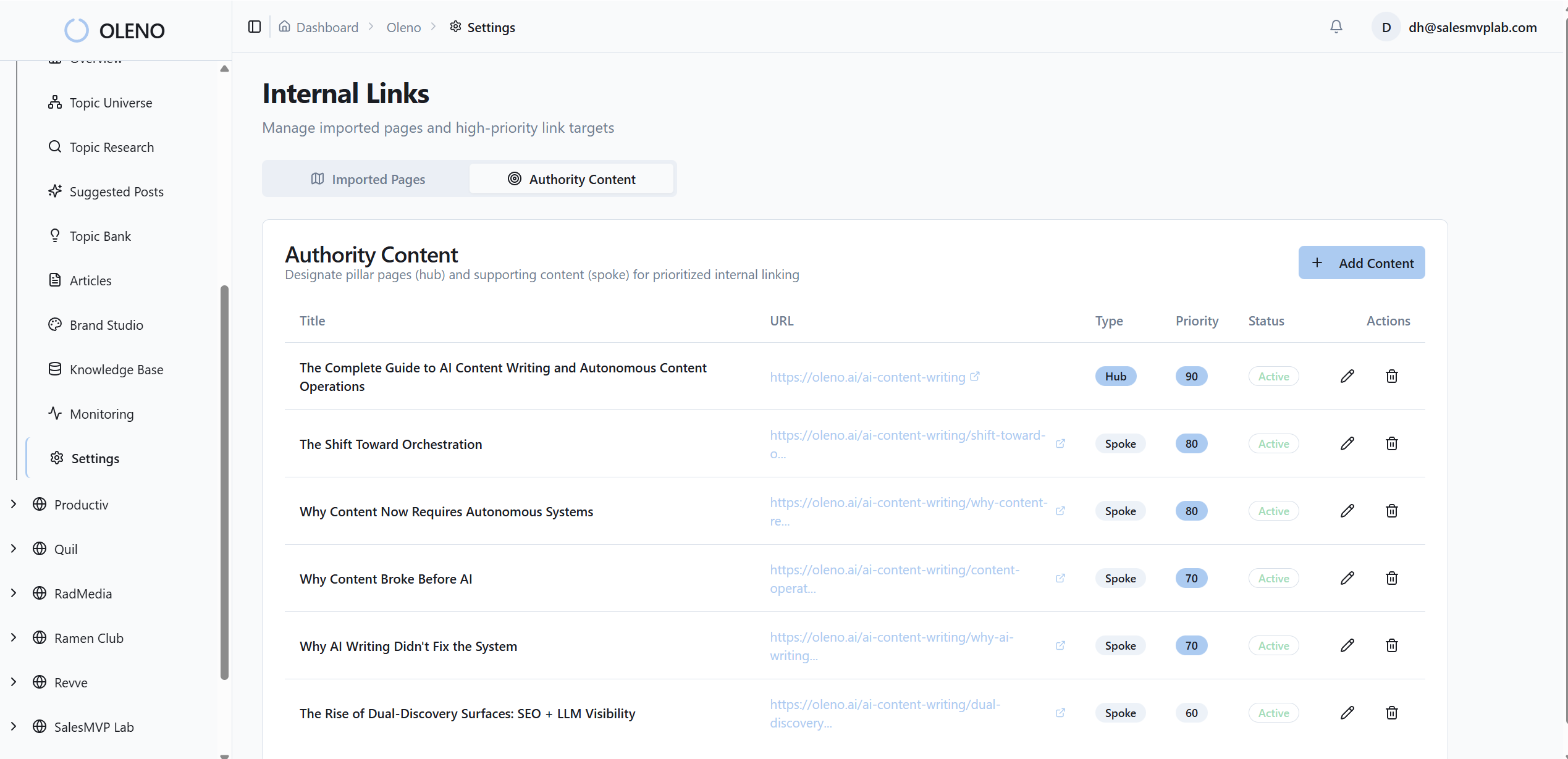
When optimizing ai content writing, accuracy lives in code. Creativity lives in the narrative. Oleno enforces the parts that must be right so your team can focus on story. That’s the tradeoff that scales.
Oleno exists to reduce rework, not promise miracle rankings. But the operational gains are immediate. Want to see it end‑to‑end? Try Generating 3 Free Test Articles Now.
Conclusion
Authority isn’t a viral post. It’s a system that runs daily. When you encode governance in code, coverage maps, cooldowns, information‑gain briefs, deterministic enrichment, QA gates, and idempotent publishing, you stop arguing about basics and start shipping pieces that actually add something new.
You can stitch this together yourself. Or you can let Oleno run the pipeline while you steer the narrative. Either way, move from projects to infrastructure. Your future self, and your pipeline, will thank you.
About Daniel Hebert
I'm the founder of Oleno, SalesMVP Lab, and yourLumira. Been working in B2B SaaS in both sales and marketing leadership for 13+ years. I specialize in building revenue engines from the ground up. Over the years, I've codified writing frameworks, which are now powering Oleno.
Frequently Asked Questions