Content Clustering Playbook: Map Clusters to Authority Gains in 90 Days

Clusters don’t win authority. Systems do. I learned that the hard way—twice. At PostBeyond, I could write fast and publish often, but without a production system, we created volume that didn’t compound. Later at Proposify, the team wrote gorgeous content that crushed SEO, but much of it sat too far from the product. Ranking went up. Pipeline didn’t.
Here’s the real pattern. Teams name clusters, sketch a few hubs on a whiteboard, then drift back into ad hoc publishing. It looks organized. It isn’t. If you want authority gains in 90 days, you need rules. Coverage-first prioritization. Cooldowns. Differentiation checks. Deterministic linking. When those are in place, the output becomes predictable—and sales finally sees the throughline.
Key Takeaways:
- Treat clusters as a production system, not an org chart
- Prioritize by coverage gaps, saturation, and information gain—not keyword volume alone
- Enforce boundaries: one canonical hub, intent-tagged spokes, no duplicate intents
- Add pre-brief cannibalization checks and a 90-day cooldown to prevent waste
- Standardize snippet-ready structure and deterministic internal linking
- Map clusters to sprints with link quotas and weekly health checks
Ready to skip the theory and see how this works end-to-end? Try Oleno For Free.
Why Cluster Strategy Stalls Without a Production System
Clusters stall when teams stop at taxonomy and never operationalize publishing. The fix is turning clusters into rules your pipeline enforces: tie every topic to a cluster, a canonical hub, and a publish window. Then let coverage, saturation, and information gain determine what ships next.

The trap of taxonomy without execution
Naming clusters feels like progress. It isn’t, unless those names drive what gets written this week. The moment you let writers pitch topics without checking coverage and intent lines, duplication creeps in. Two posts chase the same query, internal links get fuzzy, and you burn cycles fixing structure after the fact.
We used to do this by “best guess.” Editorial calendar here. Keyword spreadsheet there. Useful, but brittle. The simple, boring rule that changed the game: every approved topic must point to a hub, declare the intent it serves, and explain the net-new information it adds. If it can’t do that, it waits. Fewer near-duplicates. Fewer late edits. More authority concentrated on the right pages.
When your process gets this strict, output slows slightly at first. Then you realize the rework vanished and throughput actually went up. Less noise, more signal.
What is a Topic Universe and why does it matter?
Think of a Topic Universe as your working inventory of coverage. It’s a living map that pulls from your sitemap and knowledge base, groups everything into clusters, and labels each one underserved, healthy, well-covered, or saturated. You stop guessing what to write next. The system tells you.
This matters because clusters don’t fail at writing; they fail at prioritization. A Topic Universe turns “we should do more AI posts” into “that AI cluster is saturated; move to sales-enablement onboarding where we’re thin.” It removes the debate-y meetings and replaces them with a queue tied to reality.
If you need a primer on hub-and-spoke fundamentals, skim the topic cluster model. Then translate it into an operational list: cluster → hub → spoke intents → coverage labels → cooldowns.
Why conventional keyword scoring misleads prioritization
Keyword volume and difficulty tell you market size and competitiveness. Helpful. But they don’t tell you if your cluster is over-covered or if you’re adding anything new. That’s how teams end up shipping ten posts that say the same thing in slightly different ways.
Shift your primary inputs to coverage, saturation, and information gain. Use keywords to shape angles and headers, not to justify production. High volume is meaningless if it cannibalizes your own spokes. A quick sanity check: if the draft doesn’t add a new perspective or example beyond what you already have, it’s not ready. For a broader view on cluster-driven planning, see Topic Cluster Content Strategy Explained.
The Root Causes Blocking Authority Gains in 90 Days
Authority gains stall when cluster boundaries are fuzzy, cannibalization sneaks in, and coverage decisions hinge on opinion instead of labels. Tighten hub-spoke rules, tag intent at the brief level, and measure saturation directly. The first 90 days are about discipline, not velocity.

What traditional approaches miss in cluster boundaries
Clusters get leaky when “hub” and “spoke” are loose ideas instead of rules. Pick one canonical hub for the head term. Write it to answer the core question thoroughly. Then define which intents qualify as spokes, and what belongs as a section within the hub instead of its own URL.
The boundary rule I like: ban duplicate intents across URLs inside a cluster. If a new angle competes with an existing spoke, fold it into that spoke or refresh it. Don’t create siblings that fight. This one practice concentrates equity, clarifies navigation, and makes internal linking deterministic rather than improvisational.
Want a simple checklist to codify this? Borrow patterns from a structured approach like the Content Cluster Strategy Checklist, then strip it down to the few checks you’ll actually use every week.
The hidden complexity behind cannibalization
Cannibalization rarely looks obvious. It hides in near-identical H2s, listicles with vague titles, and intros that frame the same intent three different ways. You think you’ve published distinct posts; Google and your readers disagree.
Tag every brief with a single, explicit intent and add a one-line differentiation note in the intro. Then set a cluster-level threshold for cannibalization risk (for example, flag anything with three or more overlapping H2s against a live spoke). When in doubt, consolidate. It’s cheaper than letting two URLs limp along for months.
Documenting this upstream feels bureaucratic. It’s not. It’s paying a small tax once instead of a big tax forever.
How do you quantify coverage and saturation?
Keep it simple. Coverage is the count of distinct intents served in a cluster. Saturation is coverage divided by the planned intent list. As that ratio approaches 1, you’re saturated. When it’s low, you’re underserved. Tie publish decisions to these labels, not moods.
Two practical moves: publish to clusters labeled underserved first, and enforce a cooldown on saturated clusters except for genuine refreshes. When a new sub-intent emerges, promote it into the plan and adjust the denominator. Clean math. Clean decisions.
The Costs You Do Not See Until It Hurts
The costs show up as rework, link sprawl, and opportunity loss. Duplicate topics split signals. Manual linking burns hours. Over-publishing in familiar clusters crowds out net-new coverage. The total isn’t catastrophic, but it compounds. Small leaks sink quarters.
Frustrating rework from duplicate topics
Duplicate topics quietly drain time. Two pieces competing for the same query force editors to merge, redirect, or retitle after publish. You also confuse internal linking—do you point to Article A or Article B when both say the same thing?
Add a pre-brief step that checks for matching intent and overlapping H2s. If the overlap is heavy, stop and consolidate before writing. This isn’t red tape; it’s cost control. One hour of diligence upfront saves five downstream. You’ll feel it most in fewer “we need to fix this” Slacks.
I’ve burned weekends on consolidation. You don’t need to.
Engineering time lost to ad hoc internal linking
Manual linking looks easy until it isn’t. Writers guess anchor text, editors adjust for consistency, and half of the links get missed when deadlines crunch. Multiply that by 16 posts in a month, and you’ve got a silent tax on delivery.
Set deterministic link quotas per article and define anchors from page titles. Require each spoke to link to its hub and two adjacent spokes. Then make it programmatic or at least checklist-driven. Linking shouldn’t be a debate. It should be a rule.
Even a basic rule makes link equity compounding, not accidental.
What does a month of over-publishing cost?
Let’s pretend your team ships 16 posts in four weeks. Four collide with existing spokes, three don’t add new information, and internal links are applied in only half. At six hours per post, you just spent roughly 42 hours on work you’ll partially undo, plus future consolidation time. Not the end of the world. Still avoidable.
A few guardrails cut that number fast: intent tags, an information-gain check before drafting, and a 90-day cooldown per cluster. If you want a primer that pairs cluster thinking with quality depth, skim the Content Clustering SEO Guide and pull two rules you’ll enforce every week.
Still fixing this by hand each month? You don’t have to. Try Using An Autonomous Content Engine For Always‑On Publishing.
What It Feels Like When Content Ops Runs on Guesswork
Guesswork feels busy but unstable. Writers move fast, editors chase structure, and clusters drift. You can rank here and there yet miss demand-gen entirely. When you slow down to prioritize coverage and information gain, the work gets calmer and the narrative tightens around your product.
When your best writer ships two articles that compete
I’ve been there. At a past SaaS, our two smartest posts fought each other. They ranked, sure, but pipeline didn’t budge because the cluster was noisy and the throughline to the product was weak. That’s the sting—great writing, fuzzy system.
Once we bound topics to clusters, enforced intent lines, and consolidated overlaps, the cannibalization headache dropped. Sales started using content in calls. Prospects stopped bouncing between pages that said the same thing differently. Simple boundaries created real traction.
Good writers don’t need handcuffs. They need lanes.
The 3am edit cycle no one budgeted for
Late edits are rarely about commas. They’re about structure arriving too late. When you decide snippet-ready openers, FAQs, and schema after drafting, you pay with nights and weekends. I’ve lived that life. It’s not fun.
Flip the order. Use snippet-ready H2 openers and have the required FAQs pre-committed in the brief. Articles ship predictable, and editors stop redesigning in the eleventh hour. If you want an overview of AI-assisted clustering tactics that reinforce this discipline, the AI content clustering playbook is a decent framing.
The day after you standardize structure? Lighter.
Who benefits when you slow down and prioritize?
Everyone. You, because every article has a job. Sales, because content points back to the solution without hand-waving. Readers, because pages stop repeating themselves and start answering questions cleanly. Slowing down to prioritize coverage and information gain isn’t a drag. It’s the fast path to credibility.
And yes, you still track keywords. They’re just not in the driver’s seat anymore. Systems are.
A 90-Day, Cluster-First Production Pipeline You Can Run
A 90-day plan focuses on intentional coverage, not sheer output. Build your Topic Universe, enforce boundaries, and rank work by coverage gaps and information gain. Then map production into weekly sprints with deterministic linking. Simple rules compound quickly when you actually follow them.
Build a Topic Universe from your sitemap and KB
Start with what you have. Export your sitemap (URL, H1, H2s, last modified) and list the relevant knowledge base titles and entities. Normalize titles, tag primary intent, and group into clusters. Then label each cluster underserved, healthy, well-covered, or saturated.
Now lock it. For 90 days, write from this map. Track weekly: coverage count change, new unmatched intents, and saturation shifts. If it’s not on the list, it doesn’t ship. You’ll publish less guesswork and more useful coverage.
This is the backbone. Treat it that way.
Rank work with a coverage, saturation, and information gain matrix
Score each candidate topic on three axes: coverage gap size, saturation state, and estimated information gain. Prioritize high-gap, low-saturation, high-gain items first. If a topic sits in a well-covered cluster with middling gain, pause or re-brief until the differentiation is clear.
Here’s the key—write the score into the brief. Don’t let it live in a PM tool only. Writers make sharper decisions when they see the why. For a tactical checklist to keep prioritization honest, review the Content Cluster Strategy Checklist and adapt the scoring fields to your workflow.
The more you use the matrix, the fewer debates you’ll have.
Map delivery into weekly sprints and internal link targets
Assign clusters to weekly slots. Define link quotas per article (hub + two adjacent spokes minimum) and pre-approve anchor text directly from page titles. Require a quick pre-publish check to confirm links actually landed. Measure completion as a checklist, not a vibe.
This turns internal linking from “we’ll add later” into “it’s part of the job.” Over a quarter, hubs thicken with consistent, meaningful links. That’s compounding authority in practice, not theory.
How Oleno Operationalizes Cluster Production in 90 Days
Oleno turns the cluster-first approach into a closed-loop system. It discovers topics from your sitemap and knowledge base, labels cluster saturation, enforces information gain during briefs, structures for snippets, injects internal links deterministically, and publishes to your CMS—without manual handoffs or ad hoc cleanup.
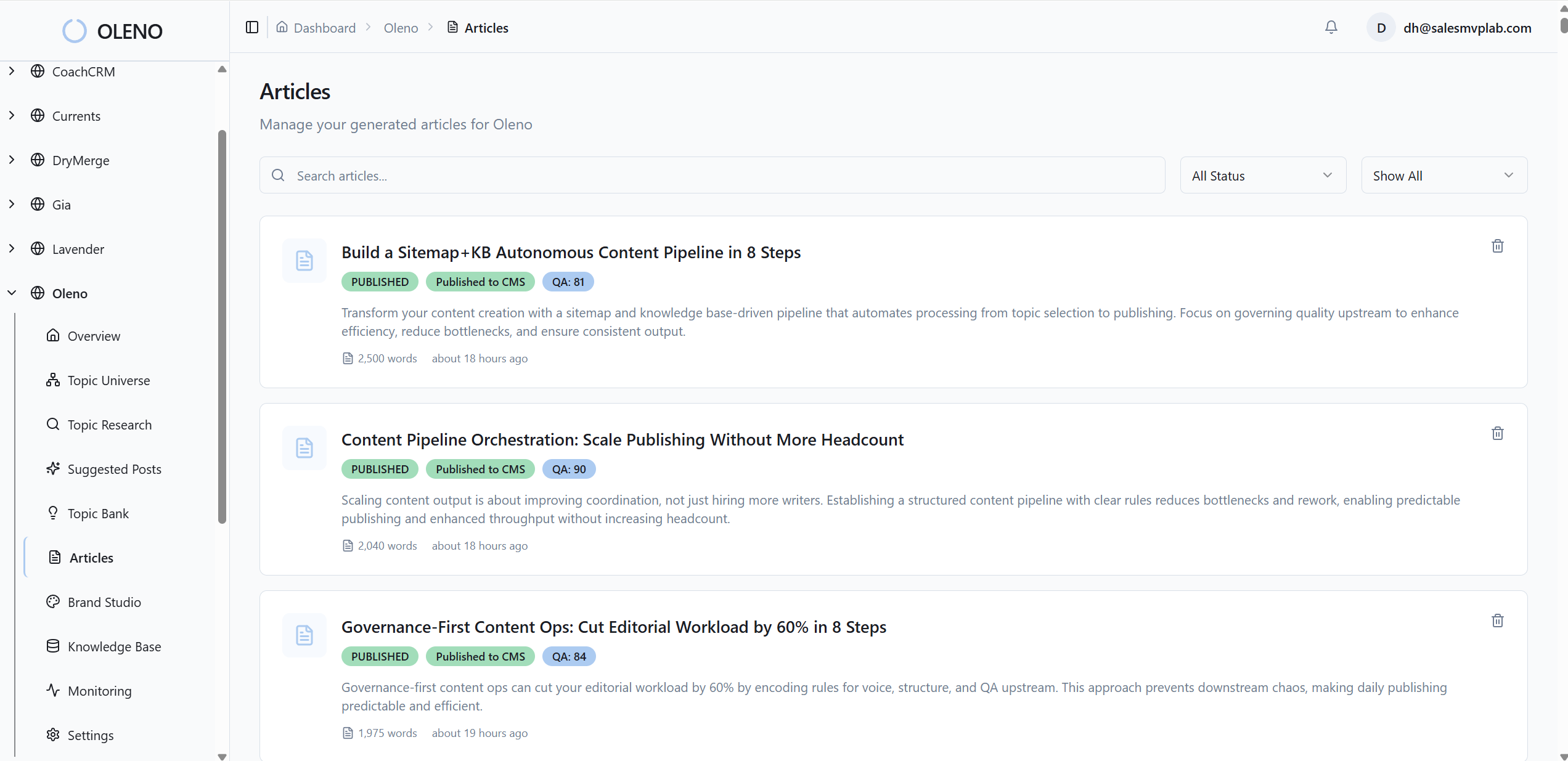
Oleno starts with Topic Universe. It maps your landscape, groups topics into clusters, and labels each one underserved, healthy, well-covered, or saturated. That becomes your source of truth for what to write next, with a 90-day cooldown to prevent over-publishing. You stop guessing and start following an inventory.
Then Oleno applies Information Gain Scoring during brief generation. It analyzes common coverage among top results, flags shallow outlines, and scores uniqueness from 0–100. Low-differentiation briefs trigger rework before a word is drafted—so editors review additive angles, not patch holes later. That saves the “frustrating rework” you’re worried about.
On the page, Oleno enforces snippet-ready structure and schema. Every H2 opens with a tight, 3-sentence paragraph. JSON-LD for Article, FAQ, and BreadcrumbList is generated automatically and passed through supported connectors. Sections stand alone cleanly, which improves eligibility for citations and cuts down on those 3am edits.
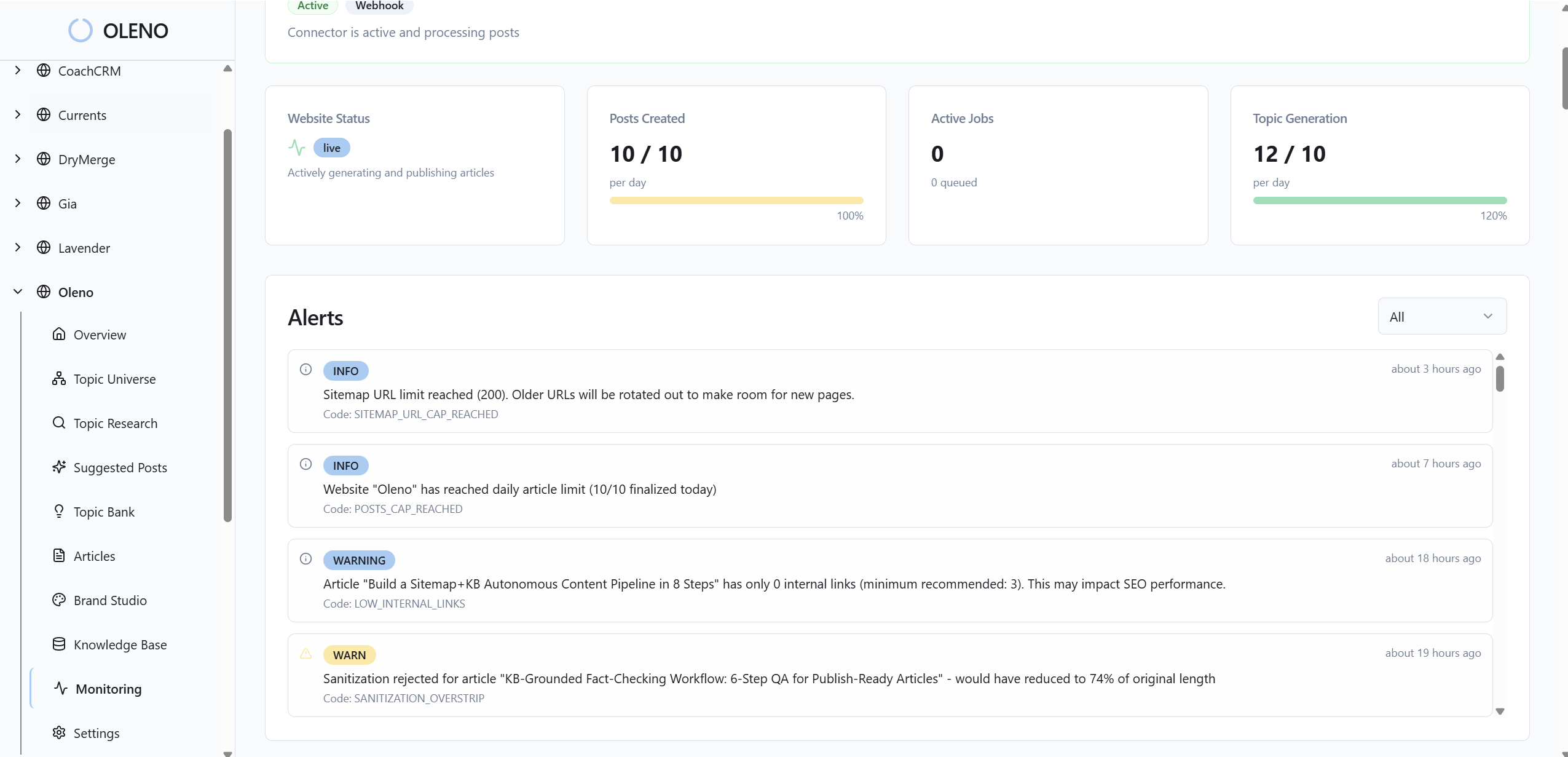
Links and shipping aren’t manual either. Oleno injects internal links from verified URLs with exact-match anchors and pushes directly to WordPress, Webflow, or HubSpot with mapped fields and duplicate-prevention. No improvising anchors. No fragile copy-paste into the CMS. Publishing stops being a cliff and becomes a step.
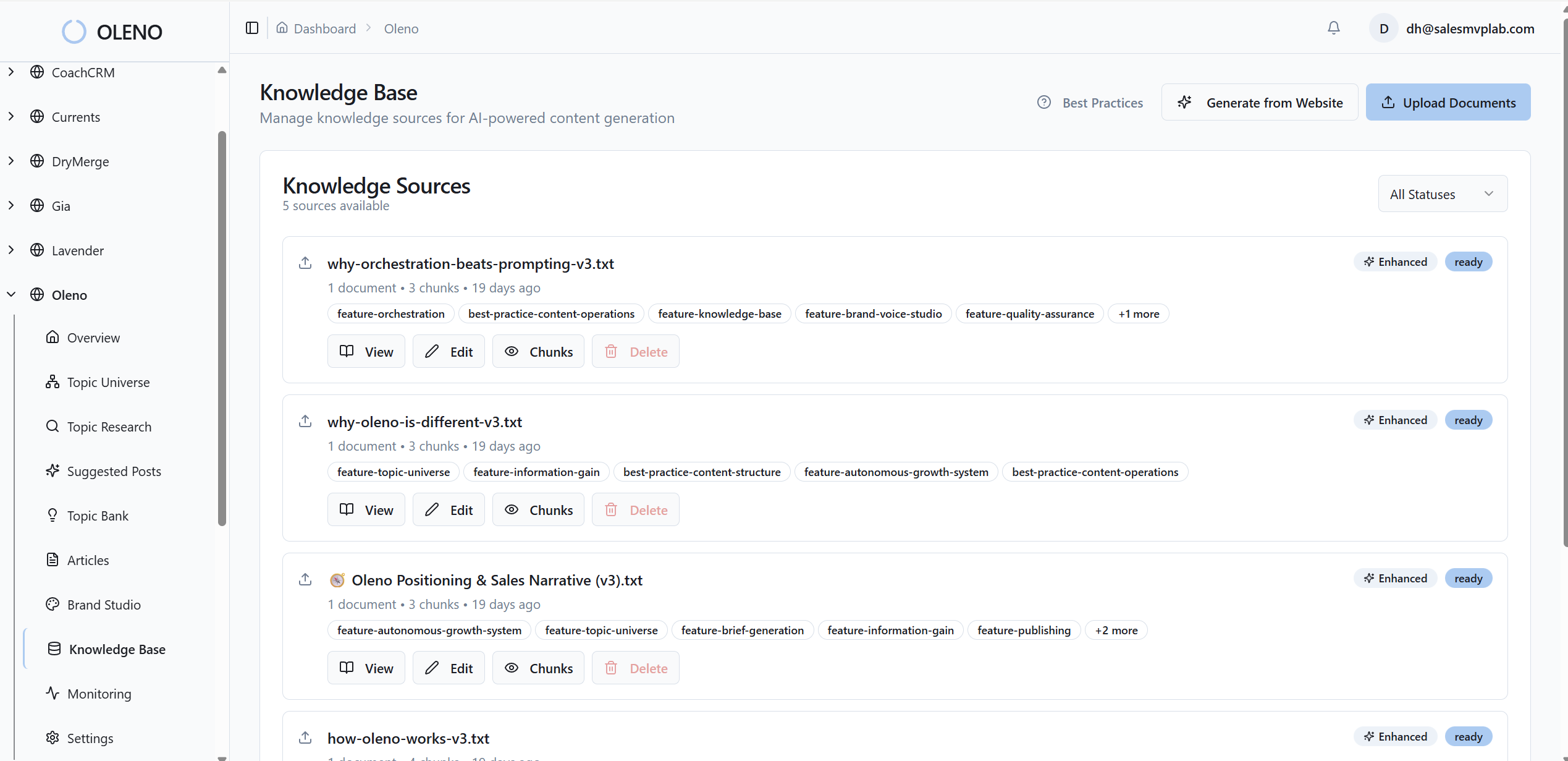
Finally, visuals. Oleno’s Visual Studio generates brand-consistent hero and inline images and matches product screenshots to the right sections. It prioritizes solution areas, generates alt text automatically, and keeps your cluster looking like it came from one brand—not ten freelancers.
If clusters stalled because execution was fragmented, Oleno reconnects the pieces: Topic Universe for strategy, Information Gain for originality, snippet-ready structure and schema for reference, deterministic linking and connectors for delivery, and Visual Studio for trust. Want to see it run on your site? Try Generating 3 Free Test Articles Now.
Conclusion
You don’t need more content. You need a system that decides what’s next, enforces differentiation, and ships consistently. Clusters become reliable when you tie them to rules: coverage-first prioritization, cooldowns, snippet-ready structure, and deterministic linking. Whether you run this manually or let Oleno handle the execution, the outcome is the same: less rework, clearer authority, tighter narrative back to your product. That’s how you make 90 days count.
About Daniel Hebert
I'm the founder of Oleno, SalesMVP Lab, and yourLumira. Been working in B2B SaaS in both sales and marketing leadership for 13+ years. I specialize in building revenue engines from the ground up. Over the years, I've codified writing frameworks, which are now powering Oleno.
Frequently Asked Questions