Content Differentiation Playbook: 7 Tactics to Beat Saturation in 90 Days

Most teams think sounding “unique” will pull them out of content sameness. It won’t. Voice helps you get remembered after you’ve delivered actual, differentiated value. If the substance matches what’s already on page one, personality just makes the echo louder. The fix isn’t better adjectives. It’s upstream discipline.
I learned that the hard way scaling and then shrinking teams. When you’re the one writing, context lives in your head and quality stays high. As you grow, context fragments. Writers chase topics the product doesn’t serve. Work ships faster, but it’s duplicative or off-intent. Authority stalls quietly. You feel it as frustrating rework and missed demand signals.
Key Takeaways:
- Treat differentiation as a testable hypothesis tied to jobs-to-be-done—not a vibe
- Enforce originality before drafting with an information gain check on every brief
- Map Topic x Audience to spot overlap, cannibalization, and missing jobs
- Set a 90-day cooldown per topic to prevent reflex re-coverage
- Run 7 small experiments in 90 days, then scale winners and kill the rest
- Design snippet-ready sections so humans and machines can cite your work
- Use deterministic publishing steps (links, schema, QA) to reduce rework
Why Voice Alone Will Not Differentiate Your Content
Voice won’t rescue content that restates what’s already out there. Differentiation proves an audience gets unique, practical value in less time than alternatives. Structure and evidence matter more than adjectives. Think direct answers, new angles, and grounded examples—like a teardown with data instead of another top-10 list.

What does differentiated content prove in 90 days?
Differentiation is not a personality contest—it’s an outcome. In 90 days, you’re proving a specific segment consistently gets more value, faster, from your content than anywhere else. You validate with lift against comparable baselines, not vibes. Pick the audience, define the outcome, set the timeframe, then instrument a few lead indicators you can move in a sprint.
Most teams skip the “prove it” part. They publish more, hope voice carries, and call it a strategy. If you can’t point to a meaningful lift—time-on-section for the teardown, replies that reference a new framework, non-brand impressions tied to a fresh angle—then you don’t have differentiation yet. You have output. That’s fine as a starting point, just don’t confuse it for progress.
The trick is choosing indicators you can influence quickly without inventing new tooling. Section-level clicks are enough. Reply quality is enough. A short attribution note from sales is enough. Keep it lightweight. Keep it honest. If it works, double down. If it doesn’t, change the angle, not the adjectives.
Differentiation Is a Measurable Hypothesis, Not a Vibe
Treat “be different” like an experiment. Write a one-sentence claim tied to a job-to-be-done, a timeframe, and a metric you can move. Guardrails keep you from drifting back into copycat patterns. This is less art than most teams admit, and more discipline than most teams practice.
How do you turn “be different” into testable claims?
Translate opinions into hypotheses tied to jobs-to-be-done. For example: For RevOps managers switching CRMs, a benchmark teardown will drive 2x deeper time-on-section than generic migration guides within 30 days. Predefine your KPI, minimum sample, and acceptance threshold. If you can’t measure it, it’s not a hypothesis—it’s a wish.
Don’t overcomplicate measurement. Use the smallest viable signal per channel: time-on-section for long-form, saves and qualified comments for social, click-to-content and replies for email/community. Keep baselines visible, run a single differentiator per test, and hold the CTA constant where possible. You want a clean read on the angle, not a bundle of confounding variables.
One nuance: segment specificity beats universal claims. Borrow a page from education’s segmentation playbooks—different groups value different supports at different moments. The core idea maps well to content. If you want a quick primer on designing for distinct learner needs, skim the principles in Differentiated Instruction: 7 Key Principles and How Tos. Then convert that thinking into jobs-to-be-done language for your segments.
The Costs of Guesswork You Can Measure This Quarter
Guesswork burns time, morale, and budget you already have. Overlap and cannibalization slow authority compounding; rework steals cycles from original research or product-aligned narratives. You don’t need a new line item—just stop paying the rework tax and redeploy the same dollars.
The hidden drag of overlap and cannibalization
Let’s pretend your team ships 12 posts this month and 5 cannibalize existing pages. You spend 40 hours writing for net zero visibility, then burn another 8 hours fixing internal links. That’s a full week of work with no upside. Add design tweaks and you’re paying a tax for duplication.
Volume then masks the decay. Traffic may hold temporarily, but average rank and non-brand assisted conversions soften when you re-cover ideas without new information. Search engines and assistants prefer clearer sources with citable sections. If your H2s don’t open with direct answers, and briefs don’t force unique angles, you’re signaling “same” at the exact moment you need “different.”
What does that look like in hard dollars? If a fully loaded content hour is 120 dollars, and 30 hours per month go to duplicates and fix-ups, you’re sitting on 3,600 dollars you could redeploy into one differentiating asset—a data cut, a benchmark, a teardown. That prioritization lens shows up in executive playbooks too; see the impact-effort cadence outlined in the T50 BL CSO Playbook. The budget is there. It’s trapped in rework.
Want to see this approach turn into output without adding headcount? Consider running a small pilot alongside your current calendar. If it works, scale the method. If it doesn’t, you’ve learned cheaply.
When Your Content Blends In, Everything Gets Hard
Indistinguishable content creates invisible work. Sales ignores it. Support can’t link it. Organic trickles. The writing isn’t “bad”; it’s just not uniquely useful. You can’t edit your way out of that problem. You need new information and a cleaner structure.
A quick story about missing demand signals
I’ve watched teams rank with personality-rich pieces that never convert because topics were off-core. At one company, we dominated terms the product didn’t serve. Gorgeous graphs, witty voice, strong rankings—and zero pipeline. It wasn’t the team’s fault. Inputs were off. We re-anchored to jobs customers actually hired us to solve and moved on.
Earlier in my career, we transcripted the CEO’s videos to get words on the page fast. It helped us publish, but we missed structure and search intent. The posts read like smart talks, not citable sections. Without topic coverage rules and originality checks, we were sprinting on a treadmill. Clear fixes—coverage mapping, snippet-ready sections, and a simple cooldown—broke that cycle.
When differentiation fails, the blast radius is wide. Writers chase shifting priorities. Designers juggle last-minute requests. Leaders feel pressure to add budget. The remedy isn’t “more content.” It’s a tighter hypothesis, a smaller experiment, and a weekly decision rule. Give the team clarity, not another draft.
A 90-Day Playbook to Prove Differentiation With 7 Tactics
Proving differentiation in 90 days requires small, disciplined experiments. Start with a coverage audit, write seven hypotheses, and run lightweight tests across SEO, social, and email. Use a simple effort-impact matrix to scale winners and kill the rest. Keep structure consistent so signals are clean and citable.
Tactic 1: Audit overlap with a Topic x Audience matrix
List your top 50 pages, primary queries, and target segments. Then mark duplicates, cannibalization risk, and missing jobs-to-be-done. Add competitor URLs for the same queries and color code by overlap and performance. The output becomes a prioritized gap list and a 90-day cooldown plan that protects focus.
Why this matters: without a map, duplication hides at idea intake, brief creation, and internal linking. You’ll repeat yourself accidentally, then lose hours unwinding it. A lightweight matrix surfaces those traps in an afternoon. Equally important, it gives writers permission to ignore off-core topics that look tempting but won’t compound authority.
Use the output as guardrails, not handcuffs. You’re not banning creativity; you’re concentrating it. When a strong new idea appears, ask where it fits by audience job and cluster. If it doesn’t, park it or rewrite the angle until it does.
Tactic 2: Write 7 hypotheses tied to jobs-to-be-done
For each segment, write one sentence that connects a differentiator to a KPI and a timeframe. Example: For first-time RevOps hires, a teardown template will increase template downloads by 25 percent in 14 days. Add a simple measurement plan, a minimum sample size, and an acceptance threshold.
Keep language plain. Avoid stacking tests. If you’re testing the angle, keep the CTA steady; if you’re testing the CTA, hold the angle. The point is to isolate what drives value for that job, on that channel, within two weeks. Complexity kills signal. Simple wins.
Meet weekly. Decide whether to scale, tweak, or stop. The worst outcome isn’t a miss; it’s an inconclusive test that lingers and soaks up attention for another month.
Tactic 3: SEO differentiators to test in weeks 1 to 3
Run information gain boosts across 5 to 8 pages. Add original data, a decision framework, or a head-to-head teardown. Open each H2 with a direct answer and a specific example. Instrument section-level clicks and time-on-section so lift shows up where the new information lives.
You’re not chasing rankings—yet. You’re testing whether the new angle changes reader behavior and eligibility for citation. If non-brand impressions and section click-through rise on pages you upgraded, you’ve got a winner. If not, change the differentiator, not the structure.
Avoid cosmetic edits. A new subhead without new substance won’t move anything. The lift comes from content that’s genuinely useful and easier to quote.
Tactic 4: Social differentiators to test in weeks 2 to 5
Package the same insight three ways for one channel. On LinkedIn, test a contrarian opener, a numbered framework, and a short video clip with on-screen text. Hold the CTA constant so the only variable is the angle and format. Measure saves and qualified comments, not just likes.
Channel-native packaging matters. If you want inspiration on what travels on LinkedIn (and why), study patterns in The Viral LinkedIn GTM Playbook Frameworks. Then bring those learnings back to long-form: add the winning social angle as a supporting section on your core page, with a direct answer and an example built in.
Treat social as R&D for long-form, not the other way around. It’s faster to learn what resonates in the feed. When you find it, codify the angle in your canonical page so your site earns the compounding benefit.
Tactic 5: Email and owned community tests in weeks 3 to 6
Run two micro-experiments per hypothesis. Version A is your current pattern; Version B carries the differentiator. Keep subject lines constant when you’re testing content, and focus on click-to-content and replies. In communities, measure reply quality. If people reference the differentiator, you’ve got a live wire.
Email and community give you qualitative texture you can’t get from search alone. Record a few sales anecdotes if prospects mention your new framework or teardown. One sentence from the field is worth a dozen dashboards. Then decide whether to scale or shelve.
The throughline: rapid learning. No multi-quarter campaigns. No sprawling calendars. Just small bets with clear reads.
Tactic 6: Minimum viable experiment blueprint and KPIs
Use a one-page template: hypothesis, audience, channel, creative spec, baseline, KPI target, sample size, timeframe, and a decision rule. Add a short notes field for qualitative signals from sales or community. Cap each experiment at two weeks. If you can’t learn in two, reduce scope until you can.
A strict decision rule keeps you honest: go, hold, or kill. If lift exceeds the threshold with clean attribution and reasonable effort, scale. If it’s inconclusive, iterate once. If it misses with good data, end it and move on. Weekly cadence, tight loops.
If you need a simple rubric for prioritization and cadence, the T50 BL CSO Playbook offers a clear framing you can adapt without ceremony.
Tactic 7: Prioritize, scale, or kill with an effort-impact matrix
Score each experiment on impact, confidence, and effort. Plot them, stack rank into a 90-day roadmap, then protect it from ad hoc requests. Roll out proven differentiators to 3 to 5 pages or formats. Kill or archive low-signal ideas so they don’t soak up oxygen.
This is where discipline compounds. Scaling a winner across a small cluster beats chasing a dozen unproven ideas. Consistency in the method, variety in the angles. That’s how authority builds without extra budget.
As a final check, ask: Does this angle add new information, open with a direct answer, and tie back to a job a real buyer has right now? If the answer is “sort of,” you already know what to do.
How Oleno Enforces Differentiation From Brief to Publish
Differentiation sticks when it’s enforced before writing and protected after. Oleno builds that enforcement into the pipeline: strategy, originality checks, snippet-ready structure, visuals, links, schema, and QA—handled deterministically. You get fewer duplicates, more citable sections, and less cleanup between draft and publish.
Information gain scoring stops lookalike drafts
Oleno analyzes top results during brief generation and flags low-differentiation outlines before anyone writes. You see a uniqueness score, explicit gap notes, and warnings when a section adds nothing new. That nudge arrives upstream, where it’s cheap to fix, rather than downstream, where edits become a headache.
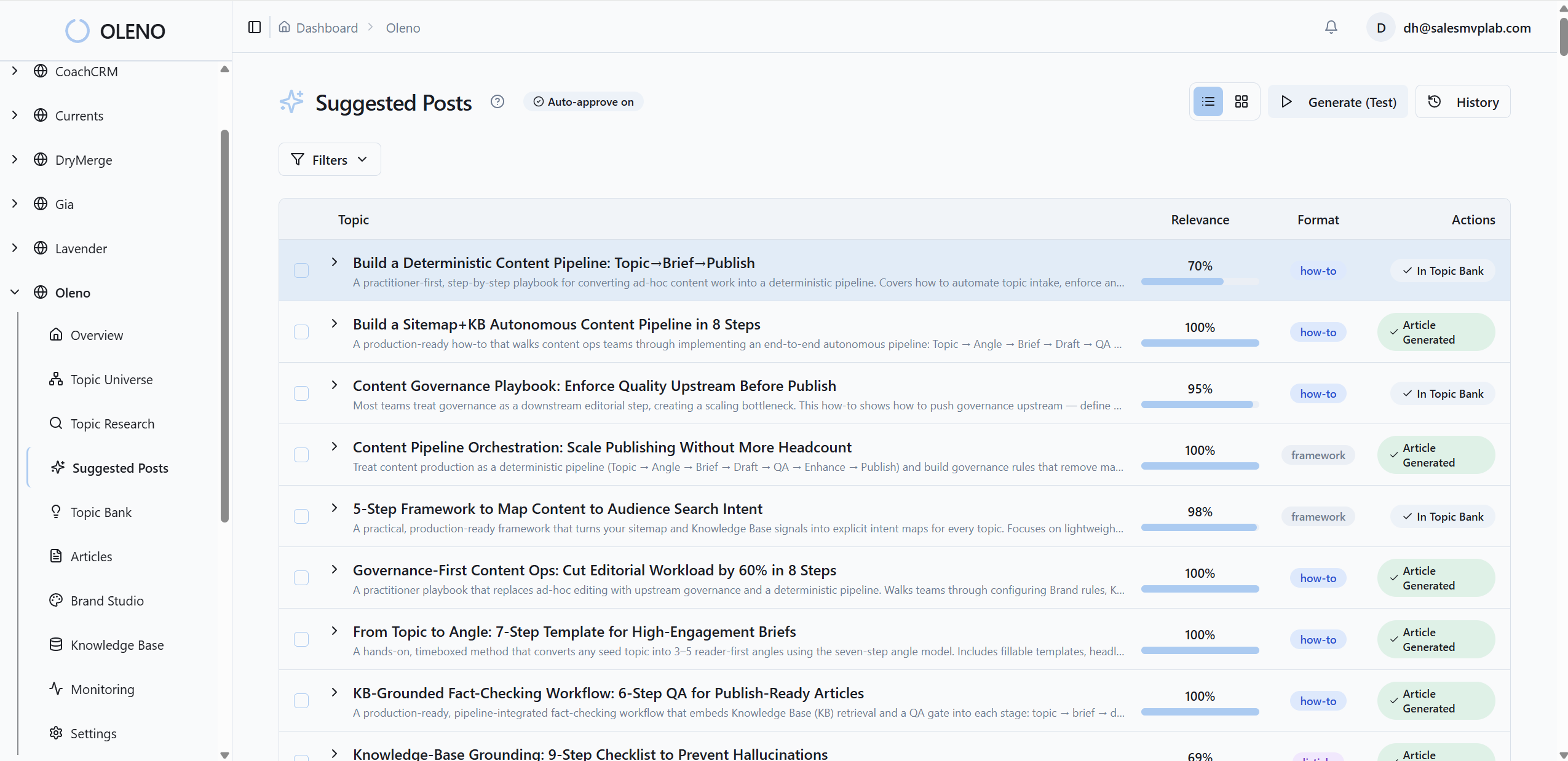
Practically, this pushes teams to add original data, sharper decisions, or better examples so readers feel the difference. It also aligns with your 90-day plan: when a hypothesis calls for a teardown or a benchmark, the brief will enforce that structure instead of letting the draft drift back to generic summaries.
Because the check happens pre-draft, you’re saving hours of rework per article. Fewer lookalike drafts means fewer cannibalization risks and a cleaner signal when you test.
Topic Universe and saturation cooldowns prevent repeat coverage
Oleno’s Topic Universe tracks coverage and saturation across clusters in real time. It enforces a 90-day cooldown before you re-cover the same topic, which prevents reflexive repeats that dilute authority. When a topic’s healthy or saturated, suggestions shift focus to underserved areas instead of piling on.
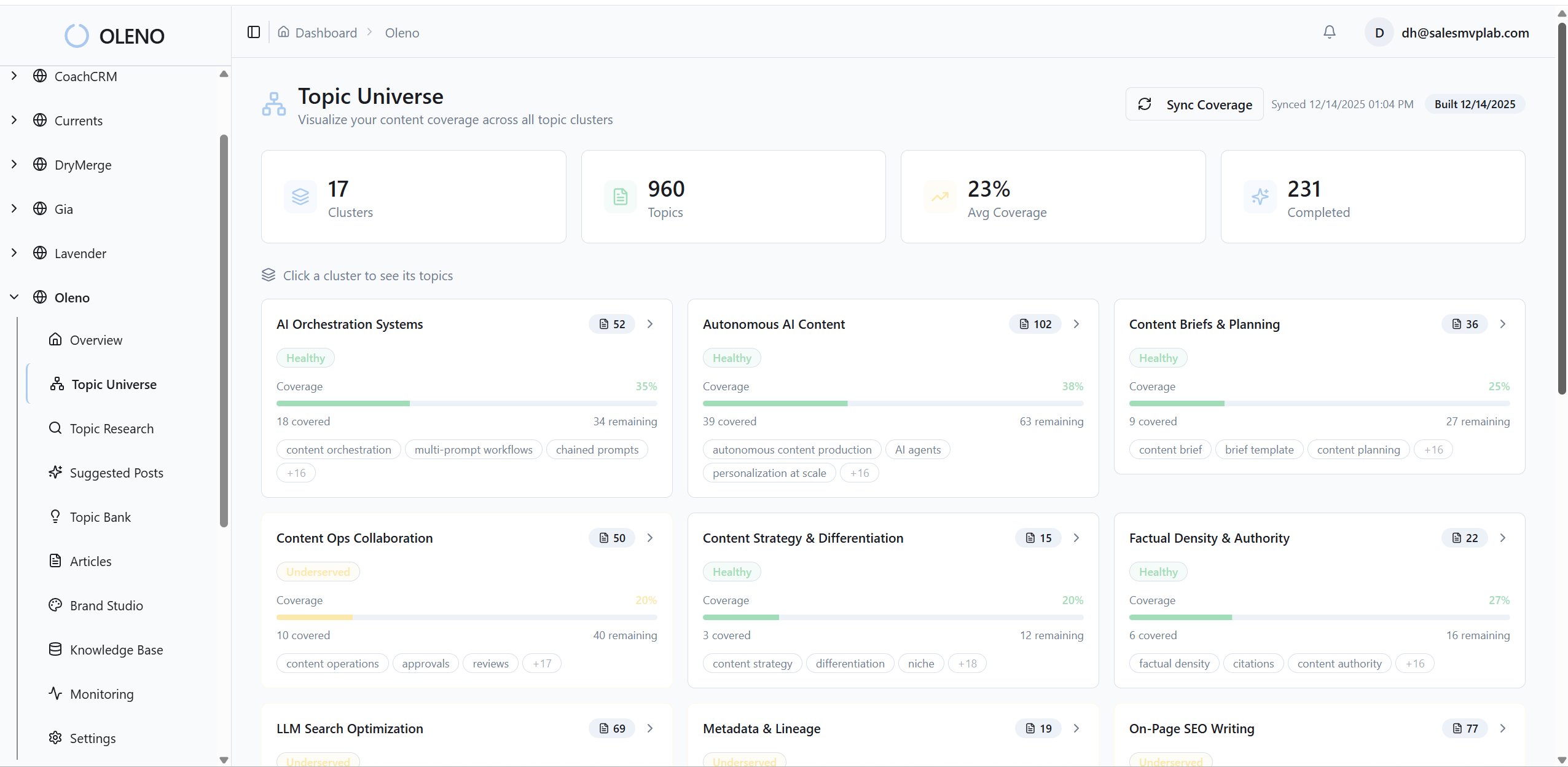
That gives your experiments a fair shot. You’re not racing last month’s article for the same query. You’re aiming at real gaps, on purpose. It also helps you maintain the Topic x Audience matrix without living in spreadsheets. The guardrail is baked into the system.
Outcome: fewer cannibalization headaches, a roadmap that compounds, and more week-to-week clarity for the people doing the work.
Deterministic linking, schema, and QA reduce rework
Oleno injects internal links from verified sitemaps with exact-match anchors, generates valid Article and FAQ schema automatically, and runs a QA gate across structure, voice, information gain, and snippet readiness. These steps happen after drafting, but before publishing, and they’re rule-driven—no guesswork.
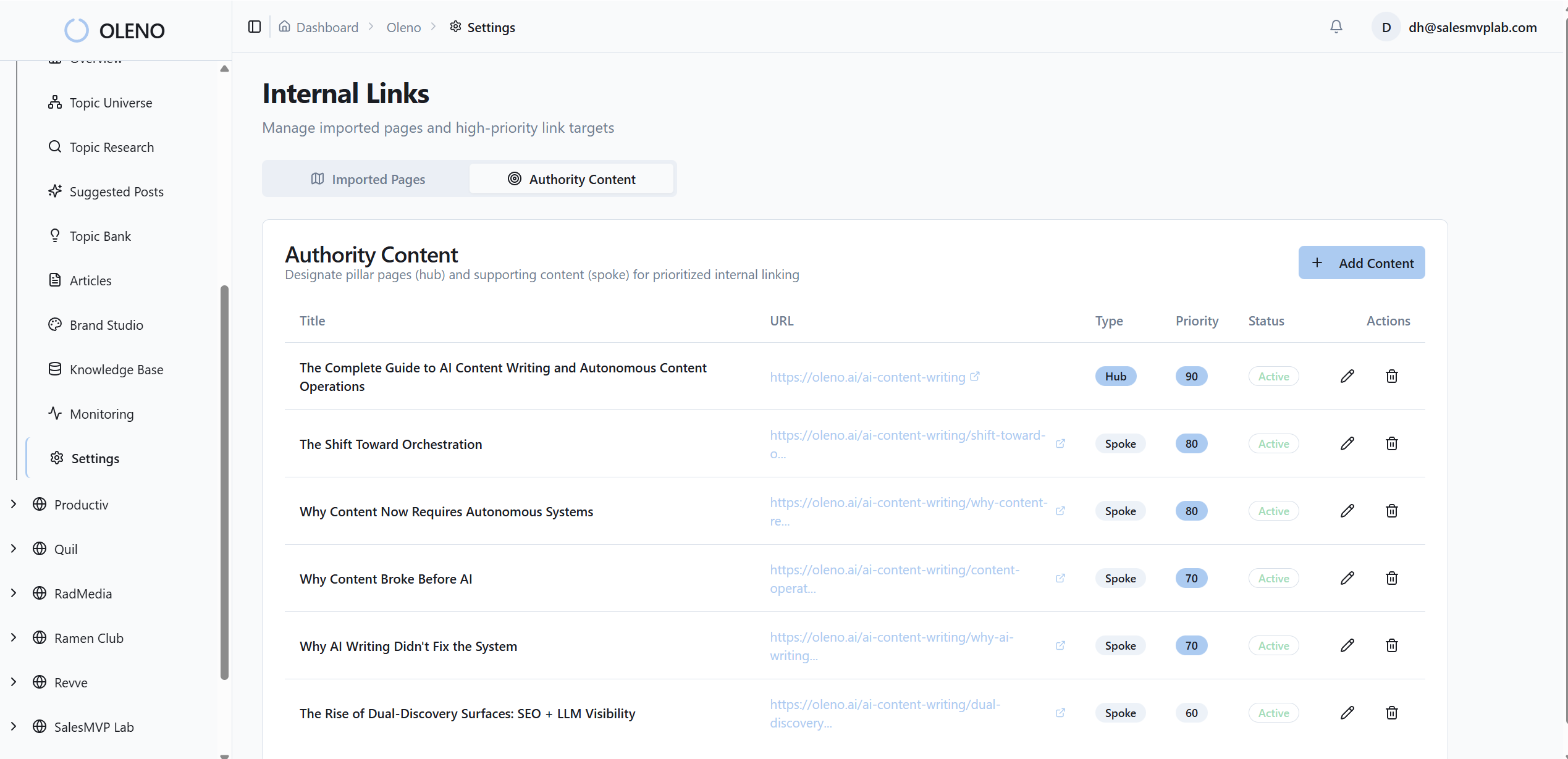
Why this matters: cleanup is expensive and demoralizing. When links are correct, schema is present, and sections open with direct answers, your content is easier to cite and harder to ignore. It also ties back to the costs you felt earlier—those 30 hours of duplication and fix-ups shift into building assets that actually differentiate.
Want to see how this pipeline feels without committing your entire calendar? Spin up a small test. If you’re ready to compare side by side, you can Try Generating 3 Free Test Articles Now. It’s a low-risk way to validate the method against your current workflow.
Oleno isn’t trying to be an analytics platform or a rank tracker. It’s a system that ensures what ships is correct, differentiated, and on-brand—so your 90-day experiments have a stable foundation to run on. If that’s the kind of environment you want to build, Try Using An Autonomous Content Engine For Always-On Publishing.
Conclusion
You don’t beat saturation with adjectives. You beat it by changing inputs, enforcing originality before writing, and running small experiments you can decide on weekly. Keep the structure citable, the angles specific, and the roadmap protected. Do that for 90 days and you’ll feel the difference—in fewer edits, clearer signals, and content your team actually uses.
About Daniel Hebert
I'm the founder of Oleno, SalesMVP Lab, and yourLumira. Been working in B2B SaaS in both sales and marketing leadership for 13+ years. I specialize in building revenue engines from the ground up. Over the years, I've codified writing frameworks, which are now powering Oleno.
Frequently Asked Questions