Content Effectiveness Over Time: Cohort & Decay Model Playbook

You can’t manage content by vibes and week-one spikes. I’ve done it. Early wins feel good and then your dashboard goes cold and no one can explain why. The fix isn’t more posts. It’s lifecycle math, cohorts, and a cadence that turns decay from random worry into planned work.
Back when I was running Steamfeed, we watched traffic jump when we hit new volume thresholds—500 pages, 1000, 2500. Those moments taught me something uncomfortable: volume creates spikes, but only structure and staying power create authority. If you don’t measure half-life and retention by cohort, you’re grading fireworks, not heat.
Key Takeaways:
- Stop judging content on spikes; measure half-life and retention by cohort
- Use publish, cluster, and referral cohorts together to remove bias
- Set 90/180/365-day windows with inclusion thresholds to avoid noise
- Quantify refresh cost and opportunity cost to reduce churn
- Fit simple decay curves, compute half-life, and score pages by retained value times information gain
- Turn decisions into a weekly queue, then let a system handle execution
Short-Term Spikes Hide Long-Term Decay
Short-term spikes hide long-term decay because distribution effects inflate week-one and week-two traffic. Half-life and cohort retention reveal whether a page sustains attention beyond the initial push. For example, a launch post can peak on day three and still have a 45-day half-life—very different stories.

Why traffic spikes can be false positives
A spike mostly tells you how well you distributed, not how durable the content is. That’s fine for headlines and energy, but it’s not a signal you can run a program on. Durability shows up when the curve settles and still holds a meaningful base of daily value.
If your team celebrates day-seven pageviews, you’ll overbuild on topics that won’t compound. I’ve seen the pattern: great launch, then a cliff. Once you shift to half-life and cohort retention, the conversation changes—from “why did it drop?” to “what actually sticks past 90 days?” That’s a business question, not a vanity metric.
You can’t see compounding in rank snapshots. You’ll need lifespan metrics. Concepts like decay rates and cohort curves are common in product analytics; the same logic applies in content. For a deeper primer on decay math, this walkthrough on cohort decay rates is a useful frame.
What is content half-life and why it matters?
Content half-life is the time it takes for a page’s daily value to fall to half of its peak. It compresses a messy curve into a single number you can compare across pages and clusters. Lower half-life suggests urgency. Higher half-life suggests you can let an asset run and focus elsewhere.
Here’s why it helps. Half-life normalizes different starting points and hype cycles. A post with a huge launch can still be fragile; a slow starter can be a steady earner. When you attach refresh rules to half-life bands, your team stops debating and starts operating. You’ll also catch “quiet winners” that never spiked but refuse to die.
Use half-life alongside retention percentages by cohort (day 30, 90, 180). That combination is simple, explainable, and defensible in leadership reviews. You can keep the math light and still make better calls in less time.
The metrics that actually signal compounding authority
Compounding shows up when retention-adjusted value stays positive and your library’s median half-life creeps up, not down. Track three things: retention-adjusted sessions by cohort, median half-life by cluster, and a compound content score that multiplies retained value by information gain. Together, they tell you if you’re building depth or just adding inventory.
Retention-adjusted sessions by cohort prevent the “long tail” from looking better than it is. Median half-life by cluster reveals which topics support durable interest. The compound content score nudges resources toward pages that add new information—because originality tends to age better. Want a broader analytics primer? See Adjust’s take on cohort analysis fundamentals.
Ready to turn spikes into staying power, not rework? If you already know which pages to prioritize, you can push them through a complete, on-brand pipeline. Try Oleno For Free.
Treat Content Like A Product With Cohorts And Lifespan Modeling
Treating content like a product means grouping pages into cohorts so decay patterns become obvious and actionable. Publish cohorts show age-related decay. Cluster cohorts reveal pillar durability. Referral cohorts expose channel-driven volatility. Use at least two in parallel to reduce bias.

How cohort definitions change decisions
Cohorts act like lenses. Each lens sharpens a different kind of decision. Publish cohorts answer, “Is our aging curve getting healthier?” Cluster cohorts answer, “Which pillars deserve refresh or consolidation?” Referral cohorts answer, “Are our launch channels creating artificially rosy week-one numbers?”
When you don’t cohort, you overreact to outliers. A post might look flat because one channel dried up, not because the topic lost fit. A cluster might look strong because one page went viral, masking weak median half-life. Cohorts decompose the problem and—more important—reduce meetings. People trust the slices.
We used this approach at small teams where bandwidth was tight. It removed drama. Each Monday, we’d look at three cohorts, agree on two moves, and get back to shipping. No one argued with the definitions because we kept them stable for the quarter.
When should you use publish, cluster, or referral cohorts?
Use publish cohorts when you want a clean view of age-related decay across all new content. That’s your “are we getting better?” baseline. Use cluster cohorts when you need to prioritize pillar-level refreshes or decide whether to merge overlapping pages. Use referral cohorts when channel mix shifts—the silent killer—start to distort your reads.
Start simple. Publish + cluster is plenty for most teams. Add referral cohorts when you change distribution or see weirdness in week-one inflation. And resist the urge to tweak cohort rules midstream. A 90-day freeze on definitions keeps comparisons honest and stops you from chasing noise.
If you need a refresher on cohort modeling mechanics, the Runway guide on modeling cohorts offers clean definitions you can adapt to content.
Cohort windows that avoid noisy reads
Short windows overreact to randomness. A lucky newsletter placement, a social bump, or a sales enablement push can skew everything. Anchor on 90, 180, and 365-day windows. Require minimum samples—say 100 sessions per page or 200 impressions—to reduce false alarms that trigger unnecessary refresh work.
Rolling up to cluster medians before making a call calms the room. Outliers are helpful anecdotes; they’re terrible policy. When you enforce windows and sample floors, you avoid a common trap: churning on pages that look “down” because last week was unusually good, not because decay accelerated.
One more nuance. Keep the same window set across quarters. Consistency matters more than precision. Changing your lens too often creates its own kind of noise.
The Hidden Costs Of Content That Dies Early
Content that dies early taxes your team with constant refresh churn, burns time in saturated clusters, and hides behind flattering 30-day reads. Quantify the cost and you’ll refresh less, ship smarter, and spend time where half-life can actually extend.
Editorial rework and refresh churn
When half-life is short, you’re on a treadmill. Let’s pretend your team spends six hours per refresh and touches 30 posts in a quarter. That’s 180 hours—roughly a full month of one person’s time—poured into rework. And for what? Often, to recover week-one optics that fade again in a month.
Decay modeling breaks the cycle. By targeting refreshes only where you see compounding potential—pages with decent retention and a path to higher information gain—you reduce churn and increase hit rate. You also stop punishing your best writers with edits that won’t move the curve.
I’ve been on both sides. As a lone marketer, I could produce 3–4 strong pieces per week. As the team grew, refresh bandwidth got swallowed by cleanup. It’s demoralizing. Decay rules pull you out of that trap.
Opportunity cost in saturated clusters
Refreshing saturated topics feels productive. It isn’t. If a cluster is over-covered and information gain is low, another pass rarely creates durable lift. The real cost is the net-new cluster you didn’t start—the one with longer half-life and healthier retention dynamics.
Use cluster-level decay and saturation together. If median half-life is sliding and you’ve published six versions of the same idea, step away. Redistribute time to underserved clusters. You’ll see fewer spikes and more steady baselines. That’s where authority builds.
Interjection. It also saves budget. Fewer edits means fewer design tweaks, fewer stakeholder reviews, and fewer Slack threads.
Why do 30-day windows distort retention?
Thirty-day windows are mostly launch dynamics and distribution quirks. They flatter almost everything and under-diagnose decay. If your dashboard stops at 30 days, you’ll think you’re winning while your library quietly erodes.
At minimum, add 90-day retention checks and a 180-day half-life estimate. That’s where signal starts to emerge. You’ll still have outliers, but they won’t dominate your roadmap. For a marketer-friendly take on retention cohorts, this overview from Userpilot on cohort retention analysis is practical, even if you adapt it for content.
If you’re worried about volatility at 180 days, you’re right to be cautious. Use medians, not means. Require sample floors. And breathe. Slow views are the point.
Still dealing with refresh churn because last month’s winners fell off? There’s a better way to keep shipping without the manual cleanup. Try Using An Autonomous Content Engine For Always-On Publishing.
When Winners Fade And Teams Lose Confidence
When winners fade, teams lose confidence because success feels random. Decay metrics turn the conversation from opinion to operation. You move from midnight dashboard panic to a weekly cadence with rules, owners, and predictable work.
When your best post collapses after 90 days
We’ve all seen it. Big spike. High fives. Then, a cliff in month three. Without a decay lens, arguments become emotional—creative vs. SEO, brand vs. performance. With half-life and retention lines, it’s just math. You either refresh with intent or consolidate to a canonical URL and redirect authority.
The power here is speed. If the page has a short half-life but strong retained value through day 90, it’s a refresh candidate. If half-life is short and information gain is low, it’s likely a consolidation move. No guesswork. Document the rubric and reduce the back-and-forth.
It also helps to publish the rulebook to leadership. Expectations matter. “This is what we do when curves look like this.” Confidence returns.
The 3am dashboard spiral you know too well
I’ve done the 3am check. Week-over-week dips. Slack pings. It’s a trap. Most of that movement is noise within a short window. The fix is a ritual: weekly cohort snapshots, monthly half-life updates, and quarterly triage. Same views. Same decisions. Less panic.
This rhythm changes how your team spends time. Analysts prep cohorts. Editors brief work. Writers ship. Nobody argues about last Tuesday. You’ll still get surprises, but they won’t hijack the quarter.
And yes, you can include a simple “stoplight” view for stakeholders. Red means triage. Yellow means watch. Green means keep shipping. Simple works.
Who should own decay risk?
Someone should own decay like a product surface. Give a single owner the rubric and the queue. Pair them with an SEO partner for data prep and a managing editor for message integrity. Decay isn’t a silo—strategy, distribution, and production all touch it.
Ownership cuts cycle time. When decay risk has no owner, refreshes linger, consolidations stall, and writers sit idle waiting for clarity. When it does, weekly calls turn into a prioritized list. That’s the point.
This doesn’t need a big team. Just clear roles and a schedule.
A Practical Cohort And Decay Model You Can Run This Week
You can run a practical cohort and decay model with basic daily page data, light regression, and simple thresholds. Start with publish, cluster, and referral cohorts. Freeze definitions for 90 days. Use half-life and retained value to triage refresh, reoptimize, consolidate, or retire.
Set success metrics and pick cohort definitions
Decide the metrics first so the math doesn’t drive the meeting. Use retained sessions by day (cohort-adjusted), median half-life by cluster, 90-day retention, and a compound content score. Define three cohorts upfront: publish, cluster, and referral. Set inclusion thresholds—minimum 100 sessions per page and 30 pages per cohort—to avoid noisy reads.
Write down the rules. “Refresh if half-life under 60 days and score in top 40 percent of cluster.” “Consolidate if overlapping intent and low information gain.” Document once, reuse weekly. That’s how you reduce editing by opinion.
Freeze these definitions for 90 days. Changing rules mid-quarter is how teams create fake wins.
Export and prepare time-series data with sample SQL
You need page-level daily sessions or impressions, publish date, a primary cluster tag, and a top referral source. In BigQuery (or your warehouse), pull a page-day table and join page metadata. A simple starting query looks like: SELECT page_path, publish_date, date AS day, sessions, primary_cluster, referral_source FROM project.dataset.page_sessions_daily WHERE publish_date >= DATE_SUB(CURRENT_DATE, INTERVAL 18 MONTH).
Normalize by days since publish so curves align across pages. Aggregate by cohort. If you don’t have clusters yet, a lightweight taxonomy will do. Keep it simple—three to five pillars is enough to start. Over-fitting the taxonomy is another way to miss the signal.
If you want a broader primer, Adjust’s guide on cohort analysis covers the basics you’ll reuse here.
Fit decay curves and compute half-life
Fit an exponential or log-linear model to each page, then roll up to the cohort level. For exponential decay, E(t) = E0 × e^(−λt). Half-life t1/2 = ln(2)/λ. Use robust regression to reduce outlier impact from one-off campaigns and syndication spikes.
Store page-level λ and t1/2 for sorting. Flag curves that don’t fit—say, R² below a threshold—for manual review. Those oddballs often reveal distribution quirks or tag issues you should fix anyway. Keep the math explainable. No need for a PhD to make this work.
And yes, some pages are seasonal. That’s fine. Your 365-day view will catch it.
Calculate a compound content score and triage decisions
Calculate a score that rewards durability and originality. One version: retained sessions through day 180 multiplied by an information gain multiplier (e.g., 0.8–1.3 from your brief process). Then apply triage rules you can defend in a meeting, not just a model.
Triage thresholds:
- Refresh: half-life under 60 days and score in top 40 percent of cluster
- Reoptimize: half-life 60–120 days with a weak referral mix
- Consolidate: overlapping pages with similar intent and low information gain
- Retire: half-life under 45 days and bottom 20 percent score
Document decisions in a queue. Interjection. Don’t skip the comment field—future you will want to know why you did it.
For another angle on decay modeling, Tym Lewtak’s note on cohort decay rates pairs well with this simple scoring approach.
How Oleno Turns Decay Insights Into Repeatable Action
Oleno turns your decay insights into repeatable action by operationalizing strategy, writing, visuals, and publishing—without adding manual cleanup. You bring the triage queue; the system enforces structure, differentiation, internal links, and delivery so refreshed pages ship consistently and new coverage compounds.
Prioritize topics and refreshes with Topic Universe
Feed your prioritized list into Topic Universe. Mark clusters as underserved, healthy, well-covered, or saturated. Cooldowns and coverage tracking prevent over-publishing the same idea while neglecting others. The output is a conflict-free roadmap that balances refreshes with net-new gaps.

Here’s the shift: decisions move out of spreadsheets and into a system that won’t forget or drift. Oleno reflects your coverage states in the writing queue automatically. When you approve a refresh, it flows into a structured brief—no extra tabs, no hunting for context.
This is where small teams win. One strategic owner can steer a whole program with confidence.
Use Information Gain Scoring to bias toward compounding pages
When pages are flagged Refresh or Reoptimize, Oleno re-briefs with Information Gain Scoring. Competitive research is performed during brief generation, and low-differentiation outlines get flagged early. Pages that clear a higher gain threshold move first because they’re more likely to extend half-life after a refresh.
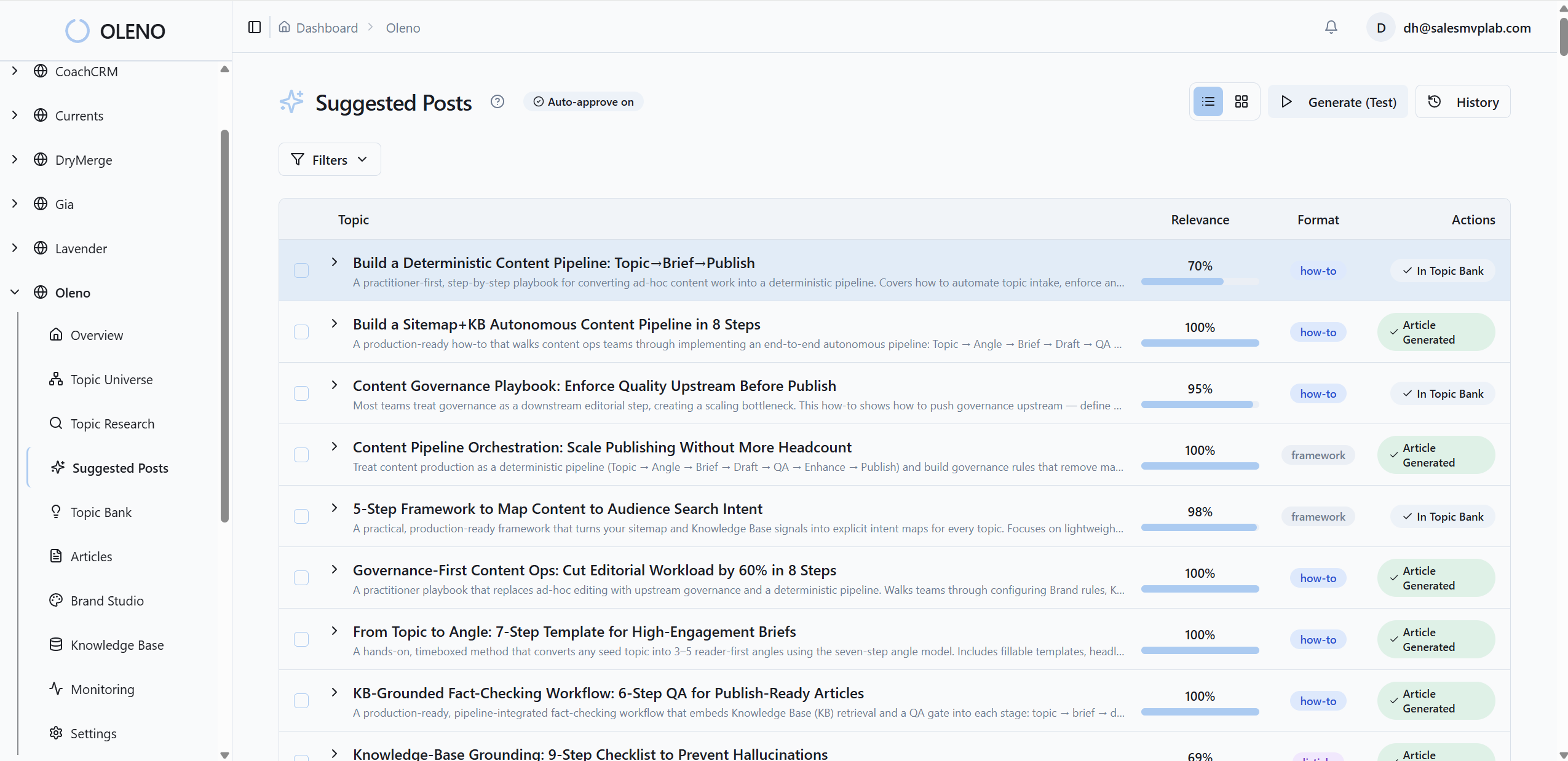
This does two things. It prevents low-gain rewrites that churn without lifting retention. And it aligns editing time with impact—exactly what you wanted when you built the compound score. The system does not measure performance; it enforces differentiation so what ships adds something new.
Oleno’s goal here is simple: protect your writers from rework that won’t stick.
Operationalize decisions with QA gates and publishing cadence
Oleno’s QA gate enforces structure and clarity before anything ships. Every H2 opens with a direct answer. Paragraphs are sized for snippet capture. Deterministic internal linking routes authority back into healthy clusters using verified URLs and exact-match anchors. Schema is generated programmatically. Publishing connectors deliver to WordPress, Webflow, or HubSpot without manual cleanup.

Pair that with your weekly cohort snapshot. Decisions from your decay model become scheduled entries that the system executes—text, visuals, links, and schema handled end to end. You stay out of the formatting weeds and keep your attention on the triage queue.
Want to put this into motion without spinning up a big team? Try Generating 3 Free Test Articles Now. See how decisions turn into complete, on-brand articles in one run.
Conclusion
Short-term spikes are noise. Half-life, cohorts, and a simple compound score turn content into an operating system you can trust. You’ll refresh less, ship smarter, and move resources to pages and pillars that actually sustain attention. Do the math once a week. Let a system handle the rest. That’s how authority compounds over time.
About Daniel Hebert
I'm the founder of Oleno, SalesMVP Lab, and yourLumira. Been working in B2B SaaS in both sales and marketing leadership for 13+ years. I specialize in building revenue engines from the ground up. Over the years, I've codified writing frameworks, which are now powering Oleno.
Frequently Asked Questions