Content Effectiveness Scorecard: 7 Metrics That Predict Authority Growth

Most teams stare at traffic charts and breathe a little easier when the line points up. I’ve done it. It feels like progress. But authority growth doesn’t behave like that. It creeps. It compounds when you close topic gaps, say something genuinely new, and make each section quote-ready for humans and machines.
If your scorecard starts and ends with sessions and average position, you’ll chase noise. Rank is a lagging signal. Eligibility is the leading one. The moment you measure what makes content citable, you start steering the system, not reacting to a dashboard.
Key Takeaways:
- Measure eligibility, not just exposure, snippet-ready openers, clean schema, and consistent visuals earn citations
- Use coverage planning over rank tracking to prevent whiplash and reduce duplicate effort
- Enforce information gain before drafting to avoid frustrating rework and late rewrites
- Tie internal links and brand visuals to trust, not just aesthetics or navigation
- Build a scorecard with seven leading indicators that teams can influence weekly
Ready to operationalize this instead of chasing spikes? See how an autonomous system handles the heavy lifting. Try Oleno For Free.
Why Most Teams Misread Content Success
Most teams misread content success because they equate traffic spikes with authority growth. Authority compounds when you close topic gaps, enforce differentiation, and structure sections for citation. For example, a clean H2 opener plus valid schema often wins the snippet even when you don’t have the biggest domain.

Eligibility beats exposure
Exposure is a wave. Eligibility is a foundation. When every H2 opens with a direct answer and every section stands on its own, you’re easy to cite. That’s the test: could a search engine or assistant lift a paragraph and feel confident it’s the answer? If not, you’re leaving compounding gains on the table.
I learned this the slow way. Years ago, we shipped plenty, good writing, solid design, but inconsistent structure. Some sections rambled, others buried the thesis. We’d hit a page-one win, then lose it with the next update. Once we standardized openers and schema, volatility dropped. Eligibility went up. That created room to focus on better ideas, not formatting triage.
One more nuance. Eligibility isn’t only a content question; it’s a process choice. If structure varies by writer, your “chance to be cited” stays random. You don’t need a bigger team. You need rules you actually enforce. Frameworks beat pep talks.
For a simple scoring approach to structure and writing quality, I like how the importance-performance scorecard model frames priorities you can act on now.
What Conventional Dashboards Miss About Authority
Conventional dashboards miss authority because they track outcomes you can’t control this week. Authority rises when topic coverage normalizes, information gain increases, and structure becomes citable. Measuring these inputs shows progress immediately. For example, mapping coverage gaps predicts ranking stability better than any daily SERP check.

The structural levers that compound
Three levers keep paying back: coverage, differentiation, and structure. Coverage prevents cannibalization and gives your site semantic breadth. Differentiation adds net-new value to a crowded topic. Structure makes sections quote-ready, which nudges snippets and citations in your direction. Layer deterministic internal links and consistent visuals, and trust compounds without big swings.
I like to think of this like governance for content operations. You don’t need a fancy dashboard to weight what matters; you need clear metrics and thresholds. The balanced scorecard approach gives a useful template for weighting and normalization without overcomplicating it, see the Balanced Scorecard weighting guidance for ideas you can adapt.
Notice what’s missing: rank screenshots and traffic volume worship. Those are outputs. If your inputs are weak, thin outlines, inconsistent openers, off-brand visuals, no dashboard fixes that. Fix the inputs and your outputs become less dramatic and more predictable.
The Costs Hiding Behind Vanity Metrics
Vanity metrics hide costs because they mask rework, missed snippets, and inconsistent brand execution. Each missed differentiation creates downstream edits. Each weak H2 opener hands the snippet to a competitor. Each off-brand image erodes trust. For example, a single rework loop can easily burn three hours across writer, editor, and designer.
Engineering hours lost to rework
Let’s pretend you ship 12 posts this month. Six repeat existing angles. You’ll pay the edit tax later, new briefs, rewrites, image swaps. If each rework costs 3 hours across roles, that’s 54 hours gone. It’s not glamorous, and it rarely shows up on a dashboard. But it’s why teams feel busy while results stall.
I’ve sat in those post-mortems. We argue quality. We debate tone. We miss the structural culprit: low information gain and no pre-flight checks. When we added a simple uniqueness threshold before drafting, the rewrite queue dropped. Fewer “can you make this different” messages. More forward motion. That’s the kind of cost your CFO actually cares about.
If you need a broader list of cost-related content metrics to spark discussion with finance, this overview of content marketing effectiveness metrics has helpful framing, even if you adopt just a few.
Still estimating edits on gut feel? There’s a better way to work. Move to a system that enforces differentiation and structure before writing starts. Use An Autonomous Content Engine.
The Friction You Feel When Content Does Not Compound
Content that doesn’t compound creates quiet friction, exec skepticism, last-minute edits, and campaigns that look fine but don’t move people. A better scorecard shows leading indicators leaders can trust. For instance, rising snippet-ready pass rates and coverage closure explain stability when rankings wobble overnight.
You ship more, results stall
I’ve lived this. At one company, we cranked output. The voice drifted, content detached from product, and the scoreboard looked busy. It did not compound. Sales would nod, then ask for “something more practical.” The fix wasn’t more posts. It was guardrails: coverage planning, differentiation checks, and snippet-ready structure.
Here’s the shift. When your scorecard includes inputs you can influence weekly, coverage labels, information gain, snippet readiness, teams stop arguing taste and start improving signals. And when a ranking drops at 3 a.m., you can point to eligibility and coverage trends and avoid whiplash decisions that make things worse.
If you need a research-backed nudge on how to design and test changes, this primer on experiment design and bias control is a useful sanity check as you iterate your scorecard.
Build The Scorecard: The 7 Metrics That Predict Authority
The right scorecard prioritizes leading indicators you can influence now. Seven metrics consistently predict authority growth: coverage gap closure, information gain, snippet eligibility, internal link equity, visual consistency, qualified publishing velocity, and next-step conversion. For example, raising snippet-ready pass rates from 40% to 80% often correlates with steadier organic traffic.
Metric 1: Coverage gap closure
Coverage gap closure is the percent of priority subtopics covered in a cluster this quarter. It predicts authority because semantic breadth stabilizes eligibility and reduces cannibalization. To measure, export your sitemap, map pages to a topic universe, and label each subtopic covered or not. As shorthand: Underserved under 40%, Healthy 60–80%, Saturated 90%+.
Two practical notes. First, enforce cooldowns so you don’t pile articles against the same term while ignoring adjacent queries. Second, publish a simple coverage heatmap for the team. When the gaps are visible, planning gets easier and “what should we write next” arguments fade.
Weight suggestion: 20%.
Metric 2: Information gain score
Information gain scores the uniqueness and depth of your outline versus what already exists. It predicts authority because new information is what people and machines cite. Measure by comparing your brief to top results and your knowledge base; score 0–100 and set a “no publish below X” rule. A common pattern: publish above 70, rework 50–69.
Here’s the hidden benefit. Raising average information gain reduces post-publish edits and increases snippet eligibility, because your sections actually add something worth quoting. It also clarifies reviewer feedback. “Not enough new insight” is no longer subjective when you have a score to improve.
Weight suggestion: 20%.
Metric 3: Snippet eligibility rate
Snippet eligibility rate is the share of H2 sections that pass snippet-ready checks: direct-answer openers, clean lists, and valid schema. It predicts authority because eligibility leads to citations and steadier traffic. Audit on-page schema and section openers monthly. Underserved is under 40%, Healthy is 60–80%, Target is 80%+.
One caveat. Don’t chase snippets at the expense of readability. The best openers answer the question directly without sounding robotic. You can sound human and still be citable. It’s a craft and a checklist.
Weight suggestion: 15%.
Metric 4: Internal link equity
Internal link equity tracks the ratio of inlinks to key cluster pages plus anchor accuracy. It predicts authority because consistent internal links push equity and clarify meaning for machines. Crawl your sitemap, compute inlinks per page, and compare anchor text to exact page titles. Aim for 5–8 links per new article. Reduce orphan pages to under 5%.
Anchors matter more than most teams admit. The anchor tells machines what the destination is about. Get sloppy, and you blur the signal you just worked to earn. Keep it exact where possible.
Weight suggestion: 15%.
Metric 5: Visual consistency index
The visual consistency index measures adherence to brand palette, logo usage, and product screenshot placement. It predicts authority because consistent visuals increase perceived trust and reduce bounce. Track a simple checklist pass rate across images per article and percent of solution sections with a relevant screenshot. Raise the pass rate to 85%+ within 60 days.
I’ve watched sales teams feel this in their bones. Off-brand images seem small until buyers reference them as a credibility wobble. Fixing visuals is one of the fastest trust gains you can make without rewriting a sentence.
Weight suggestion: 10%.
Metric 6: Published content velocity
Published content velocity is the number of high-quality, differentiated articles shipped per week. It predicts authority because reliable cadence compounds coverage and internal links. Count only pieces that meet information gain and snippet checks. Early-stage teams: 2–3 per week. Mature teams: 1–2 with deeper coverage and updates.
Velocity without standards is a trap. Your team looks productive while you quietly build a rewrite backlog. Tie velocity to quality gates so the metric means something.
Weight suggestion: 10%.
Metric 7: Content to next step conversion rate
Content-to-next-step conversion measures the percent of readers who take the next action, demo view, calculator use, related guide. It predicts authority because useful content moves people. Measure with event tracking and CRM assist signals. Baseline your current CTR, then target a 20–40% lift in 90 days with better placement and clearer anchors.
Small changes move this number: earlier CTAs, clearer link copy, tighter alignment between the promise of the header and the next step. It’s rarely a redesign. It’s clarity.
Weight suggestion: 10%. For more framing on which metrics matter and why, skim this primer on effective content effectiveness metrics.
How Oleno Helps You Hit These Metrics Without Adding Tools
Oleno helps you hit these metrics by enforcing strategy, differentiation, and structure inside the writing pipeline. Topic Universe plans coverage, information gain scoring raises uniqueness before drafting, and snippet-ready structure plus schema increases eligibility. For example, deterministic internal links and brand visuals add trust without manual cleanup.
Topic Universe keeps coverage honest
Oleno’s Topic Universe maps your landscape, tracks cluster coverage, and labels saturation so you stop guessing. Suggestions prioritize gaps and enforce cooldowns, which lifts coverage gap closure and stabilizes velocity. You still choose what to write next. The system makes tradeoffs visible and repeatable, so planning becomes weekly, not quarterly.
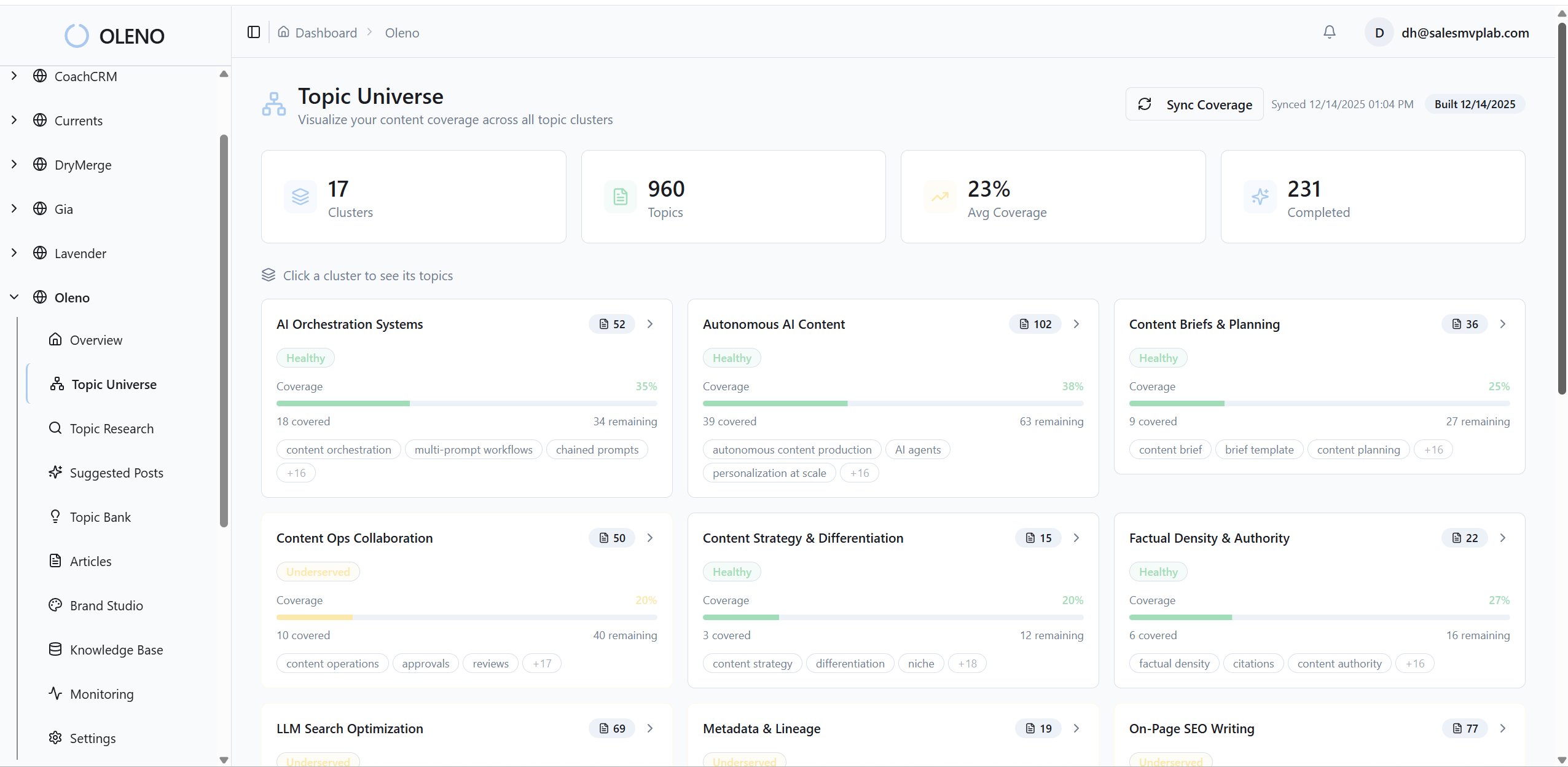
Two outcomes tend to follow. First, cannibalization drops because clusters spread out naturally. Second, “we’re over-publishing this idea” arguments vanish. The labels handle the debate, and your team ships with more confidence.
Information gain scoring raises differentiation before you write
Oleno’s brief generation includes competitive research and an Information Gain Score. Low-gain outlines are flagged early, so you refine before drafting. That nudges your average score up across the quarter and reduces frustrating rework. It also improves snippet eligibility because sections add something worth quoting.
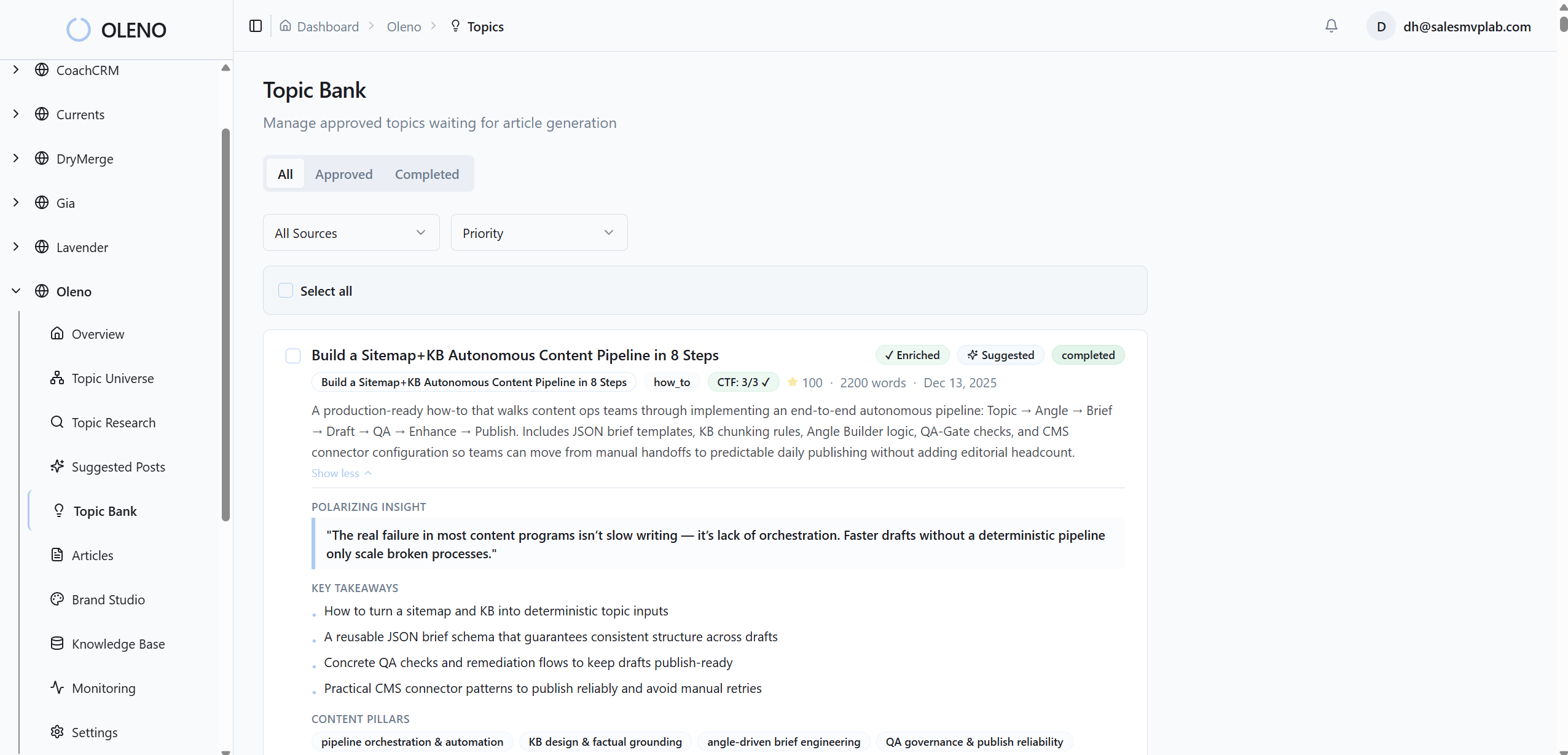
This isn’t a dashboard. It’s a gate. Articles don’t move forward until the brief clears a minimum score you define. The result is fewer rewrites and a clearer editorial standard that new writers can learn quickly.
Snippet-ready structure, schema, links, and visuals increase eligibility and trust
Every H2 in Oleno opens with a direct answer. JSON-LD is generated automatically. Internal links are injected from your verified sitemap, with anchor text matching page titles and no fabricated URLs. Visual Studio generates brand-consistent images and places product screenshots where they help, especially in solution sections.
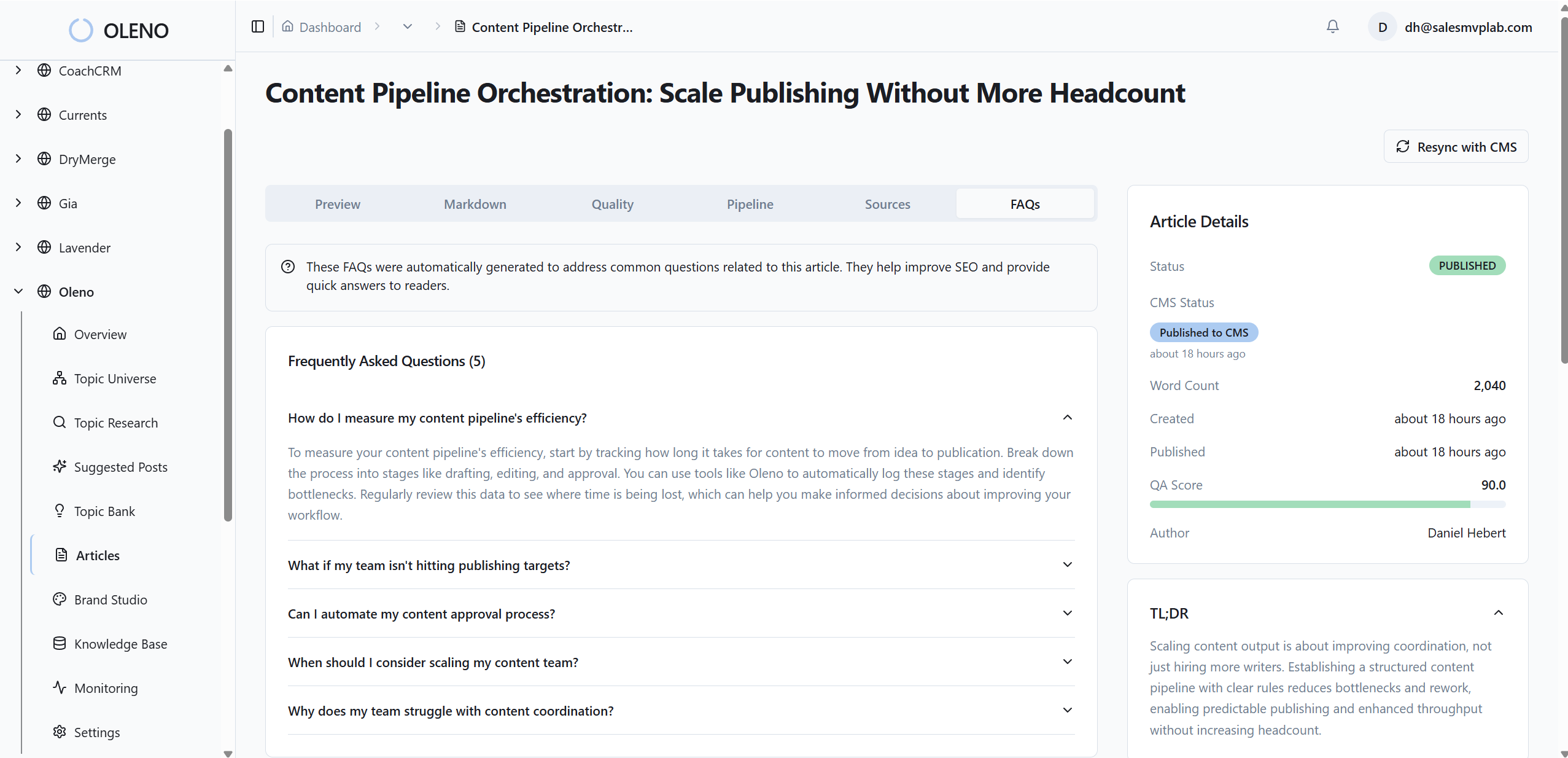
Together, these raise your snippet-ready pass rate, increase internal link equity, and improve the visual consistency index, three metrics from the scorecard without adding tools or headcount. And because publishing connectors deliver CMS-ready output, your time goes to narrative decisions, not formatting checks.
Want to see the difference a governed pipeline makes in a week? Try Generating 3 Free Test Articles Now.
Let Oleno handle the structure and enforcement so your team can focus on the story. Try Oleno For Free.
Conclusion
Authority isn’t a traffic graph. It’s the outcome of a system that closes coverage gaps, enforces differentiation, and structures content to be cited. When your scorecard reflects those inputs, things get clearer. Less rework. Fewer surprises. More compounding trust. Build the scorecard, enforce the gates, and let eligibility, not headlines, guide the work.
About Daniel Hebert
I'm the founder of Oleno, SalesMVP Lab, and yourLumira. Been working in B2B SaaS in both sales and marketing leadership for 13+ years. I specialize in building revenue engines from the ground up. Over the years, I've codified writing frameworks, which are now powering Oleno.
Frequently Asked Questions