Content Gap Audit: 7-Step Framework to Prioritize Topics

Most teams start with a keyword spreadsheet and a sense of urgency. It feels productive. It also quietly sets you up to copy what already exists, ship near-duplicates, and wonder why nothing moves. I’ve been there, great writers, strong brand voice, but the calendar outpaced strategy and the output diluted itself.
The fix isn’t more content. It’s better rules up front. Decide what you’ll cover, how you’ll differ, and when you’ll hold back. Then make sure every new page adds net-new detail to your domain. Authority compounds when each piece earns its slot. Not because you wrote it fast, because you wrote the right thing next.
Key Takeaways:
- Prioritize topics by information gain, not keyword volume or competitor lists
- Normalize to topic units, apply saturation labels, and enforce 90‑day cooldowns
- Score briefs for differentiation before drafting to prevent repetitive outlines
- Quantify waste: count duplicate drafts, cannibalized links, and post‑publish rework
- Use a 7‑step audit to select 10–20 high‑impact topics per quarter
- Structure sections for snippet‑ready openings to increase citation odds
Why Keyword Gaps Alone Mislead Topic Priority
Keyword gap tools identify where competitors rank and you don’t, but they don’t tell you what new value you’ll add. That missing signal is information gain, the delta of net-new detail versus what’s already public. If your H2s mirror the top results, you’re repeating, not differentiating.
The metric that matters is information gain, not volume
Volume is deceptive. You can publish 20 posts and still get overshadowed if they repeat conventional outlines. Information gain is a practical test: does this draft introduce new angles, data, or structure that clarify the topic beyond current results? If it doesn’t, it won’t be cited, shared, or linked, even if it’s cleanly written. A quick heuristic we use: skim the top three ranking pieces and list their H2s. If your outline matches line for line, your delta is near zero. Adjust the angle until your structure and examples materially diverge in useful ways. For baseline context on gaps, keyword lists help, but treat them as inputs, not the scoreboard. A simple primer from Backlinko on content gaps will get your team on the same page, then you layer information gain on top.
What is a content gap audit and why should you care?
A content gap audit evaluates your corpus against a defined slice of your Topic Universe, labels saturation at the cluster level, and scores information gain for candidate topics. You care because that is how authority builds, consistently adding net-new detail where your coverage is light. In practice, the audit isn’t a spreadsheet exercise; it’s an operating rule. You assign clusters as underserved, healthy, well‑covered, or saturated, and you enforce cooldowns so “fresh ideas” don’t pile up in the same corner. When we ran lightweight audits without labels, we shipped pleasant reads that didn’t move pipeline. With labels and information gain scoring, even a modest publishing cadence created noticeable lift.
Ready to skip theory and see the process run end‑to‑end? If you want a quick proof-of-concept, you can Generate 3 Free Test Articles.
The Real Bottleneck Is Uncoordinated Coverage Decisions
Content stalls when topic choices are ad hoc and rules are optional. The work looks busy, the calendar looks full, but coverage decisions lack constraints. Without a governed system, the same ideas get re-covered in slightly different ways.

What traditional approaches miss
Most teams rely on three artifacts: a keyword list, a backlog, and a calendar. Useful, but incomplete. What’s missing are the guardrails: canonical topic units, saturation labels per cluster, a 90‑day cooldown, and a pre‑draft differentiation check. Without them, audits degrade into one‑off debates, and writers recreate familiar outlines because familiar feels safe. The root issue isn’t talent; it’s governance. If the pipeline can’t enforce information gain before writing, you’re optimizing for activity, not authority. Incidentally, classic gap analysis methods show how constraints drive better prioritization, see ProjectManager’s take on gap analysis in project management for the general pattern you can adapt.
The hidden complexity in topic units
URL-level thinking is too coarse. Real audits normalize to topic units: short, stable phrases mapped to canonical URLs and clustered by meaning. That lets you measure coverage precisely, spot cannibalization early, and calculate information gain with fewer false positives. Embeddings help de‑duplicate near‑synonyms that otherwise slip through (“employee onboarding plan” vs. “new hire onboarding plan”). If you can’t measure at this level, your labels get noisy and your prioritization matrix tilts toward head terms that look big but don’t add anything new.
The Hidden Costs Draining Your Content Budget
Duplicate drafts and saturated topics drain hours you don’t see on dashboards. The immediate cost is writer time. The secondary cost is design and QA. The biggest cost is lost opportunity, topics you didn’t cover while you re‑covered familiar ground.
Engineering hours lost to repetition
Let’s pretend your team ships 12 articles this month and four land inside a saturated cluster with overlapping outlines. At 6 hours per draft, you’ve just burned 24 hours on content that can’t move authority. Add design, QA, and publishing overhead and the real cost easily doubles. That’s at least one workweek you could’ve invested in a smaller, underserved cluster with higher information gain. We’ve also seen teams spend an extra hour per post on post‑publish fixes, internal link changes, schema edits, canonical updates, because repetition creates structural headaches.
The cascading impact on discovery
Repetition dilutes discoverability. Internally, near‑duplicates compete for links and relevance, which weakens anchor clarity and topical authority. Externally, cannibalized pages confuse SERPs and muddy LLM retrieval because every section says the same thing. You’re not just missing a featured snippet, you’re training machines to ignore you. If your roadmap still chases head terms because they “look big,” skim this overview on operational tradeoffs from SearchStax’s content gap analysis. The short version: head term obsession often hides the long‑tail opportunities your brand can actually win. Still managing this manually and feeling the drag? It might be time to Use An Autonomous Content Engine.
When Your Team Ships 20 Posts And Nothing Moves
It’s demoralizing when output climbs and impact stays flat. You start questioning the strategy, the writers, the whole thing. The issue usually isn’t talent. It’s inputs and rules. You need clearer rules so each piece moves the needle, not just fills the calendar.
The frustration of busywork that looks productive
Your calendar is full. Drafts flow through review. Slack is buzzing with thumbnails and headlines. Yet pipeline, signups, and authority signals barely twitch. I’ve seen this play out across teams, strong writing voice, polished visuals, and still a plateau. The problem isn’t lack of effort; it’s that the work is detaching from your system’s goals. When roadmaps aren’t anchored to topic units, labels, and cooldowns, busywork takes over. People are juggling revisions rather than deciding what deserves to exist next.
A quick story from the field
At Proposify, our content team was excellent, great writers, stand‑out visuals. We ranked well for broad topics, but some themes sat too far from the product’s core and didn’t feed demand‑gen. At PostBeyond, I could write 3–4 posts per week using a strict framework, but as the team grew, context drifted and velocity dropped. And at LevelJump, with three people wearing five hats, writing time evaporated. The pattern rhymes: when topic selection and differentiation rules aren’t enforced, you can work hard and still feel like you’re shouting into the void.
Run The 7-Step Content Gap Audit That Picks High-Impact Topics
A practical audit prioritizes the next 10–20 topics that build authority in defined clusters. It sets scope, labels saturation, scores information gain, and enforces cooldowns. Then it turns those picks into briefs that block repetition upstream.
Step 1: Define scope and inputs
Decide the boundary, usually 60–90 days, then list focus areas and desired outcomes. Import your knowledge base and sitemap, and write exclusion rules for off‑market topics. Identify stakeholders who can approve topics without dragging timelines. Lock scope before scoring so you’re not moving goalposts while you evaluate. This single choice reduces drift, cuts debate, and protects the audit from “just one more” ideas.
Step 2: Extract and normalize topic units
Pull canonical URLs and map each to a short, stable topic phrase. Cluster semantically similar phrases with embeddings to prevent accidental duplication. Normalize slugs, collapse near‑synonyms, and confirm each topic’s canonical destination. The output is a clean topic table: unit, cluster, URL, and status. This becomes your source of truth for coverage and information gain math downstream.
Step 3: Compute coverage and saturation labels
For each cluster, tally how many distinct topics you cover and how deep each page goes. Set simple thresholds to label underserved, healthy, well‑covered, or saturated. Flag suspected cannibalization pairs and mark them for consolidation review. This gives you a red‑yellow‑green overlay that makes prioritization far less political. If you need a refresher on content inventory mechanics, NN/g’s content audit guide is a solid foundation.
Step 4: Score information gain
Evaluate your pages against your corpus and the top public results, looking for net‑new detail and angles. Use a 0–100 scale, where 40–60 likely needs a fresh angle or consolidation and below 30 often indicates a rewrite candidate. Notes matter, document what’s missing, not just the score. This turns “make it better” into “add these three specifics and change the structure.”
Step 5: Build a prioritization matrix
Combine business impact, coverage gap, information gain potential, effort, and cooldown rules into a weighted score. Example: 35% impact, 30% gap, 20% information gain, 15% effort. Exclude anything under a 90‑day cooldown to avoid self‑competition. Sort, sanity‑check with stakeholders, and select the next 10–20 topics. Resist the temptation to jam pet topics back in.
Step 6: Create action-ready briefs
Turn each selected topic into a brief that enforces differentiation. Capture the angle, thesis, outline with snippet‑ready openers, evidence requirements, and must‑include unique elements. Add internal link targets and a schema plan. If a brief tests low on information gain, block the draft and refine before any writing happens. One interjection: do not skip this gate, it’s the cheapest place to prevent waste.
Step 7: Close the loop with cadence and cooldowns
Run the audit monthly for the active clusters. Re‑score saturation and information gain, and enforce 90‑day cooldowns before re‑covering the same topic. Track rejected drafts and reasons (low information gain, cannibalization risk, off‑scope) so you can improve upstream. Feed everything back into your topic table. This is how the system gets smarter, without burning people out.
How Oleno Turns This Audit Into A Repeatable System
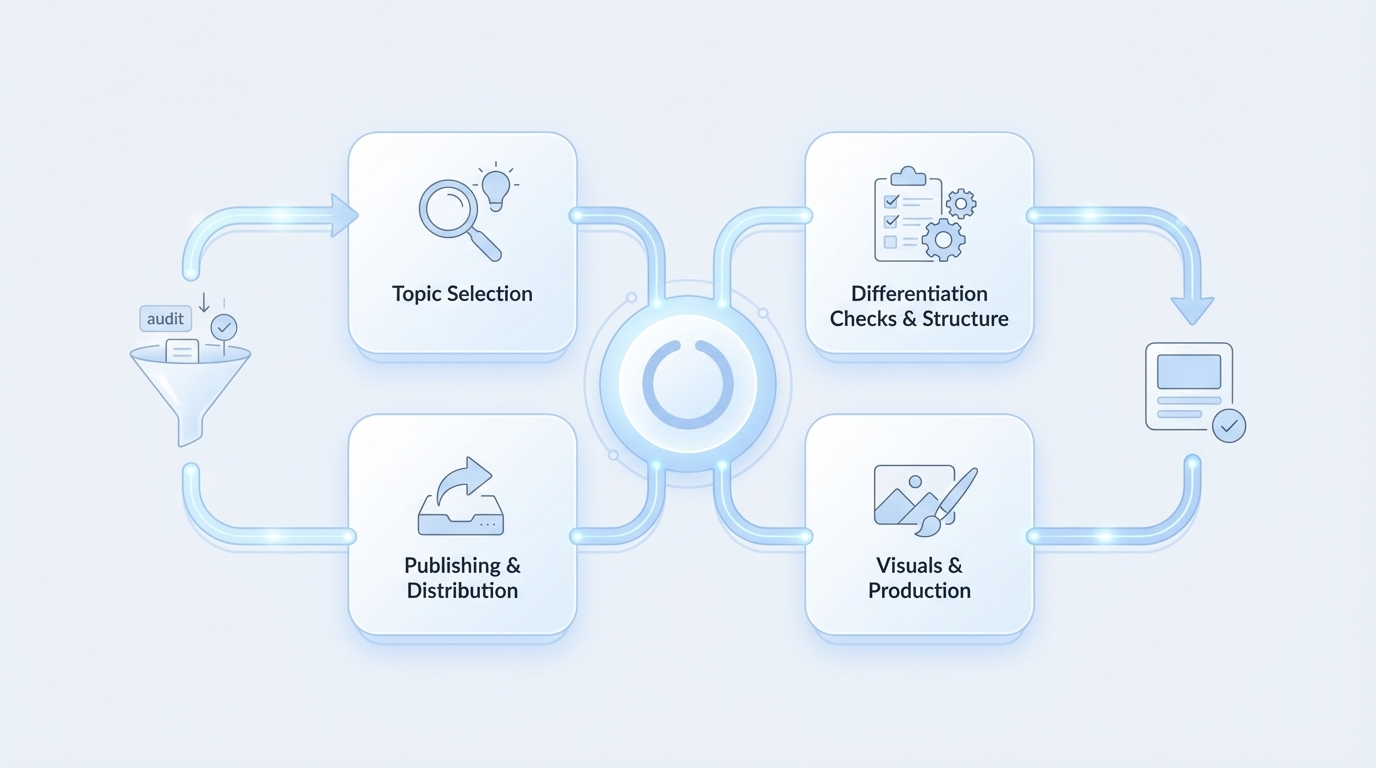
A repeatable system handles topic selection, differentiation checks, structure, visuals, and publishing without spreadsheet drift. It doesn’t promise miracles; it removes avoidable mistakes and enforces your rules. That’s where Oleno fits. It helps teams run the audit reliably so the right ideas rise and obvious duplicates get stopped early.
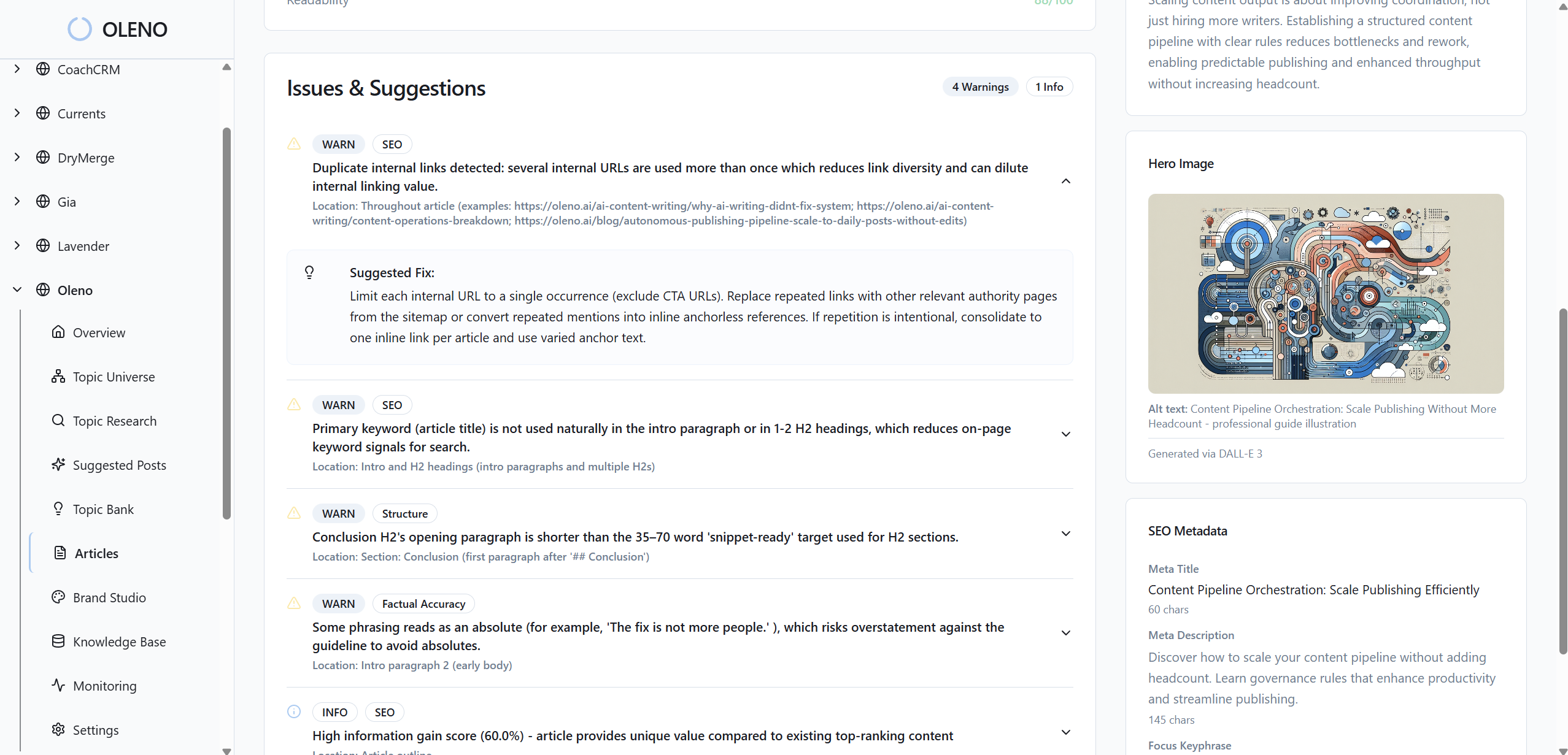
Oleno operationalizes the audit by mapping your Topic Universe automatically from your knowledge base and sitemap, clustering topics, labeling coverage as underserved, healthy, well‑covered, or saturated, and enforcing 90‑day cooldowns. That alone reduces accidental over‑publishing and lowers the number of repetitive drafts that reach editorial review.
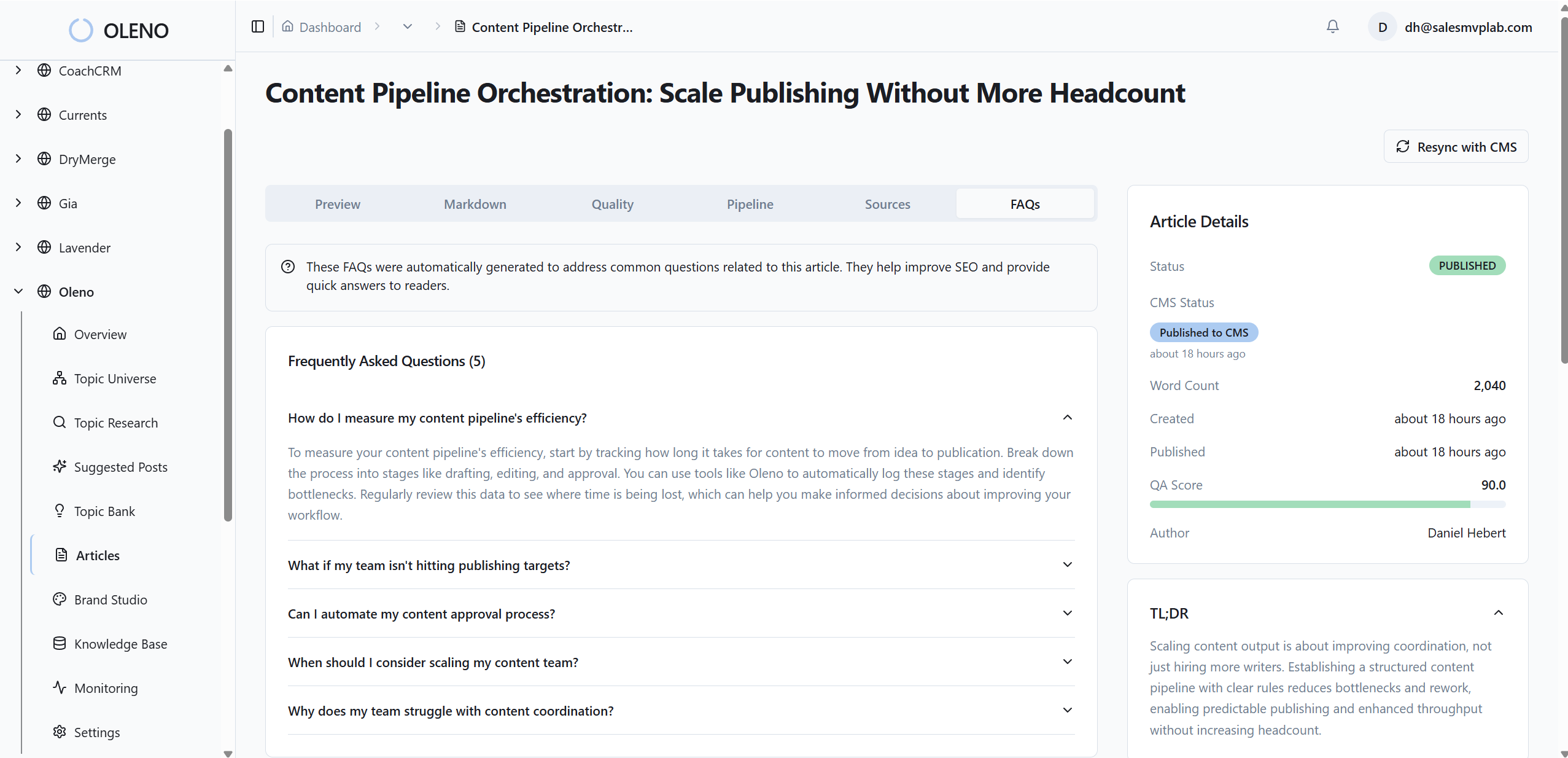
Brief generation in Oleno analyzes common coverage across ranking content, identifies missing perspectives, and calculates an Information Gain Score from 0 to 100. Low‑differentiation outlines are flagged before anyone writes. You get fewer wasted drafts and a higher likelihood that each new page adds something citable by humans and assistants alike.
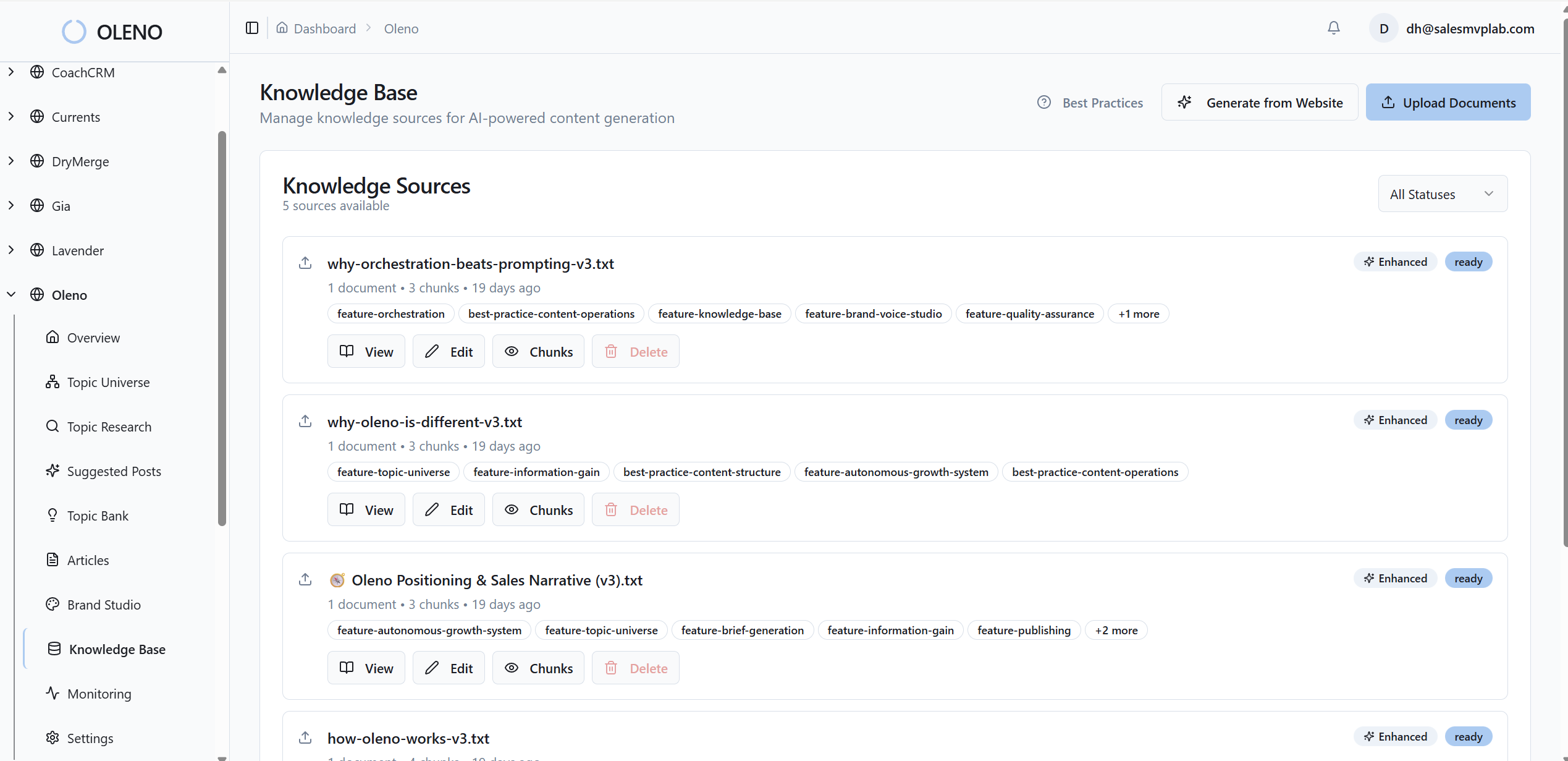
Publishing is deterministic. Oleno opens every H2 with snippet‑ready paragraphs, injects internal links using only verified sitemap URLs with exact‑match anchors, and generates JSON‑LD for Article, FAQ, and BreadcrumbList schema. Visual Studio generates brand‑consistent hero and inline images, prioritizes solution sections for product visuals, and writes alt text and filenames automatically. When the system ships, it ships on‑brand.
Here’s the point. You don’t need more hands; you need guardrails that run daily. Oleno provides those guardrails. If you want to see how quickly this feels different in your workflow, Try Oleno For Free.
Conclusion
If your content calendar is busy and your outcomes are flat, the problem isn’t effort. It’s coordination. Normalize to topic units, label saturation, enforce cooldowns, and score information gain before writing. Then let a system run those rules consistently. You’ll publish less noise, more signal, and finally see movement where it counts.
About Daniel Hebert
I'm the founder of Oleno, SalesMVP Lab, and yourLumira. Been working in B2B SaaS in both sales and marketing leadership for 13+ years. I specialize in building revenue engines from the ground up. Over the years, I've codified writing frameworks, which are now powering Oleno.
Frequently Asked Questions