Content Gap Audit: 7-Step Playbook Using SERP + Analytics

You don’t have a content problem. You’ve got a connection problem. Inventory lives in spreadsheets, SERP lives in tabs, analytics lives in dashboards—and none of them talk. So teams default to “more.” More keywords. More drafts. More meetings. And the gaps you actually need to close keep leaking pipeline.
I’ve been on both sides. At PostBeyond, I could write fast because I had context in my head. As we grew, quality slipped because the context didn’t scale. At Proposify, we ranked like crazy—but on topics too detached from the product. Great traffic. Meh pipeline. The fix isn’t “write harder.” It’s aligning what you have to what the market wants and what your business needs—at the page level.
Key Takeaways:
- Connect inventory, SERP patterns, and analytics at the URL level before chasing new keywords
- Map dominant intent and winning formats per query to prevent mismatches that quietly drain conversions
- Build a canonical inventory once, then run quarterly gap passes to cut rework
- Use a 7-step gap audit to detect thin coverage, format gaps, and misaligned CTAs
- Score gaps with a 70/30 impact-to-effort rubric and brief everything before writing
- Treat content as a system: enforce differentiation, structure for citation, and reduce manual stitching
Why Guesswork Fails When Inventory, SERP, And Analytics Are Disconnected
Guesswork fails because disconnected systems hide obvious fixes. Your site likely has pages close to fit that don’t match SERP intent or winning formats. Aligning inventory, SERP, and analytics exposes quicker wins than net-new content. For example, a MOFU comparison query won’t reward a thought-leadership essay, no matter how well-written.

The Trap Of Chasing New Keywords
New keywords feel like progress. It’s motion, not momentum. The reality, most teams already own pages with decent traffic that underperform because the format, section order, or CTA fights intent. When you connect the SERP snapshot to that URL’s analytics, you’ll find refreshes and re-covers that beat launching new topics.
I’ve made this mistake. At LevelJump, we tried to “add volume” while juggling a tiny team. We were busy, sure. But we weren’t fixing what the market was actually rewarding on key queries. The moment we anchored decisions in SERP patterns—what formats and answers won—we shipped less and moved more.
Where Teams Undercount Coverage And Cannibalize Impact
Inventories lie when they’re not canonical. Near-duplicate URLs, programmatic variants, old paths—these inflate breadth and hide thin clusters. You think you’ve covered the topic. You haven’t. Not with the depth and format the SERP shows it prefers. Group by topic, normalize to canonical, and visualize cluster depth. The gaps get obvious.
When we built large libraries, the miscount was always worse than expected. One topic showed “10 pages.” After normalization, it was four real pages and six ghosts. That changes prioritization quickly—especially when analytics confirms one thin post captures most traffic but converts worst. Focus matters.
For more on the role of intent, see Siteimprove’s overview of search intent.
The Real Root Cause Of Missed Opportunities Is Intent Mismatch, Not Volume
Missed opportunity comes from intent mismatch and format misalignment, not lack of output. SERPs telegraph what they want—comparisons, checklists, tables, FAQs, recency. Your page either meets that standard or it doesn’t. If it doesn’t, traffic may come, but pipeline usually won’t. A comparison SERP wants a comparison page. Simple example. Big impact.

What Traditional Audits Miss
Traditional audits weigh titles, word count, and metadata. Useful, but incomplete. The SERP layer matters more. Classify top results by dominant intent, content type, answer structure, and freshness. Then hold your page next to that. If the SERP is “best X vs Y,” your manifesto won’t compete. It’s not personal. It’s pattern matching.
Do this consistently and you’ll stop guessing. You’ll also stop rewriting pages that aren’t fixable in their current format. That single shift—matching page to SERP pattern—turns random acts of content into a predictable process.
For a primer on gap thinking, skim Backlinko’s content gap approach.
How Do You Reconcile SERP Intent With Business Outcomes?
Start with the keyword. Grab the live SERP. Label dominant intent, winning page patterns, and recurring answer blocks. Now map the closest URL from your inventory and attach GA4 conversions or assisted conversions. If traffic is decent but pipeline is soft, you’re likely misaligned on format or CTA. Decide: re-cover, refresh, or retire.
Tie it back to pipeline targets, not vanity metrics. If the SERP wants a comparison and your solution shines in head-to-heads, re-cover with that format and put proof front-and-center. If your explainer attracts top-funnel readers, link it into a conversion-capable asset rather than forcing a demo CTA. Fit first. Then scale.
The Hidden Costs Of Manual, Tool-Siloed Audits
Manual audits burn hours because data isn’t standardized. You export from GA4, GSC, rank trackers, and the CMS, then spend days deduping URLs and guessing at intent. Multiply by clusters and you’re underwater for weeks. The cost isn’t just time. It’s delayed fixes that keep draining conversions from otherwise healthy pages.
Editorial Hours Lost Stitching Exports Together
You know the routine. Four CSVs. Three ID formats. Someone copies the wrong date range. You reconcile landing pages to canonical URLs, then hand-label SERP intent one keyword at a time. By the time it’s “clean,” the SERP changed. Meanwhile, the team is still writing because they have to ship something. This is how rework sneaks in.
The fix is boring and effective: one canonical ID per URL, normalized inventory, and an automated way to attach SERP patterns and analytics signals. Do it once, then maintain. It’s not fancy. It’s the foundation. If you want a structured view of gap identification, glance at seoClarity’s guidance on closing gaps.
Let’s say you want to see a system do the heavy lifting on structure and delivery while you stay focused on decisions. When you’re ready, Try Using An Autonomous Content Engine For Always-On Publishing.
Shipping Content That Does Not Move Metrics Is Exhausting
Stagnant dashboards aren’t about “bad content.” They’re about misaligned content. If the SERP wants a checklist and you hand it a thought piece, readers won’t behave the way you want. Pre-align page format and CTA to intent, and your scorecard becomes predictive. You’ll know if a page can convert before publishing.
A Short Story From The Trenches
At Proposify, our content team was world-class. Voice, visuals, the whole package. We ranked for huge terms. And yet, some of those wins barely touched pipeline because the topics sat too far from the product’s path to value. I’ve shipped hundreds of posts. The ones that worked connected search intent to solution paths, then placed the right CTA.
Sometimes the humble support doc with a side-by-side table out-converts your most polished explainer. That’s not a failure. It’s a signal. The market wanted proof and a comparison. Build the page the SERP expects, then route your explainers into it. If you want a broader lens on pragmatic KPIs, CXL’s coverage of programmatic SEO and measurement is useful context: CXL on programmatic SEO.
A Reproducible New Way To Run A Content Gap Audit In 7 Steps
A reliable content gap audit starts with a canonical inventory, then layers SERP patterns and analytics at the URL level. The method is simple: standardize inputs, classify SERP intent and structure, map performance, then prioritize via impact-to-effort. A real example is a comparison SERP triggering a re-cover with proof blocks and table schema.
Step 1: Build And Normalize A Canonical Content Inventory
Start with your CMS export, sitemap, GA4 landing pages, and GSC top pages. Normalize everything to canonical URLs. Collapse programmatic variants and outdated paths. Add a primary key per URL, and tag by topic, format, publish date, and owner. This standardizes joins and prevents inflated coverage counts that distort prioritization.
Two lessons here. First, if you can’t trust your inventory, you can’t trust your decisions. Second, normalization is a one-time heavy lift that pays back constantly. After this, adding or updating a page becomes a predictable operation—no detective work required.
Step 2: Extract Target SERP Intent And Competitor Top-10 Pages Per Keyword
For each priority query, capture the live SERP. Label dominant intent (informational, commercial investigation, transactional), note content types that win, and record recurring answer structures. Log the top-10 URLs and freshness patterns. This becomes your “market spec” for what a winning page must include.
Keep this lightweight. You aren’t writing a thesis—just a clear snapshot that informs structure. If every winner includes a comparison table and a short FAQ, don’t fight it. Build to spec, then differentiate on content that actually helps users decide.
If you need a framework for audits, see StoryChief’s content audit overview.
Step 3: Link Analytics Signals To Each Content Item
Attach GA4 sessions, engaged sessions, and conversion or assisted conversion events to each URL. Add GSC clicks, impressions, and position where relevant. Use rolling 90-day windows to avoid chasing noise. Then flag pages with decent traffic but weak conversion, or the reverse. These become your highest-leverage fixes.
You’ll start seeing patterns fast. Pages matching SERP format with weak CTAs. Pages with strong CTAs stuck in the wrong format. When analytics and SERP views align, “what to do next” stops being an opinion and becomes a checklist.
Step 4: Detect Coverage Gaps, Thin Content, And Intent Mismatches
Cross-reference your inventory and SERP snapshots. Missing formats indicate re-cover candidates. Thin pages against deep competitors signal refresh. Mismatches—where CTAs fight top-funnel intent—usually require splitting one page into two: one to rank, one to convert. Label the exact gap type per URL so briefs turn into action, not vagueness.
This is where teams speed up. Because now you’re not guessing or rewriting whole articles. You’re closing a labeled gap with a known format and expected sections. It’s less about “creativity” and more about fit, clarity, and proof.
Step 5: Score And Prioritize Gaps With A 5-Factor Rubric
Use a simple rubric that weights impact at 70% and effort at 30%. Score SERP opportunity fit, business relevance, current performance delta, depth required, and implementation effort from 1 to 5. Translate the result into a 2x2 matrix for leadership. This keeps work honest—high-value, realistic, sequenced.
You’ll notice something. The high-impact, low-effort work is rarely net-new content. It’s refreshes or re-covers aligned to what the market is already rewarding. That’s the point. Reduce blind spots. Reduce rework.
Step 6: Create Tactical Briefs For Top-Priority Gaps
Convert each high-priority gap into a brief that spells out target query, intent, competing section patterns, required structure, product visuals, internal links, and CTA placement. Include a direct-answer intro and FAQ if the SERP suggests it. Good briefs make the draft almost a formality.
I’ve seen teams cut cycles in half just by insisting on briefs that mirror SERP reality. Writers stop wandering. Editors stop guessing. The output ships faster and lands closer to business outcomes.
Step 7: Monitor Closure And Iterate With Lightweight Guardrails
Track gap status, refreshed vs. re-covered pages, and whether intent-specific CTAs are present. Set a QA checklist: structure intact, internal links in place, schema added, product visuals placed where they support decisions. Revisit high-impact clusters quarterly. Keep it lean. No reporting empire needed.
Guardrails don’t slow teams down. They remove the avoidable errors—like publishing a comparison without a table or skipping the direct-answer intro the SERP clearly favors.
If you want a deeper dive on originality and briefs, Backlinko’s perspective pairs well with this process: Backlinko on content gaps.
How Oleno Accelerates Gap Detection And Execution Without Adding Headcount
Oleno speeds this whole motion by running a continuous system. It maps your topic universe, enforces differentiation in briefs, structures content for citation, and reduces manual stitching with internal links, visuals, schema, and publishing handled. You still make the calls. The system handles the busywork. A simple example is re-covering a comparison with the right format on the first pass.
Topic Universe Prevents Redundancy And Highlights Underserved Clusters
Oleno’s Topic Universe maps your landscape from your knowledge base and sitemap, then labels clusters as underserved, healthy, well-covered, or saturated. This means you don’t over-publish the same idea or miss obvious gaps. It aligns naturally with your rubric because priority reflects actual coverage, not hunches.
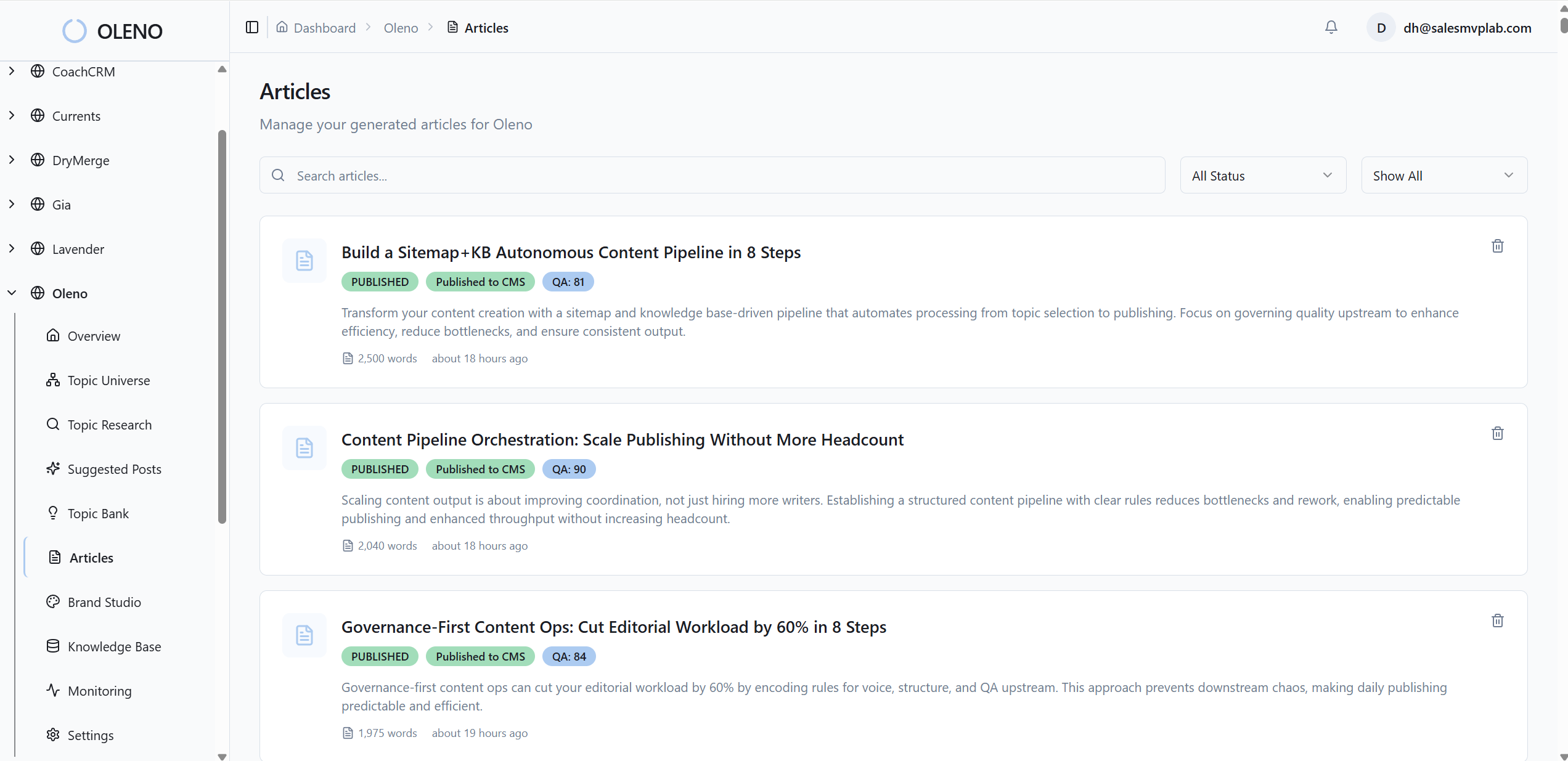
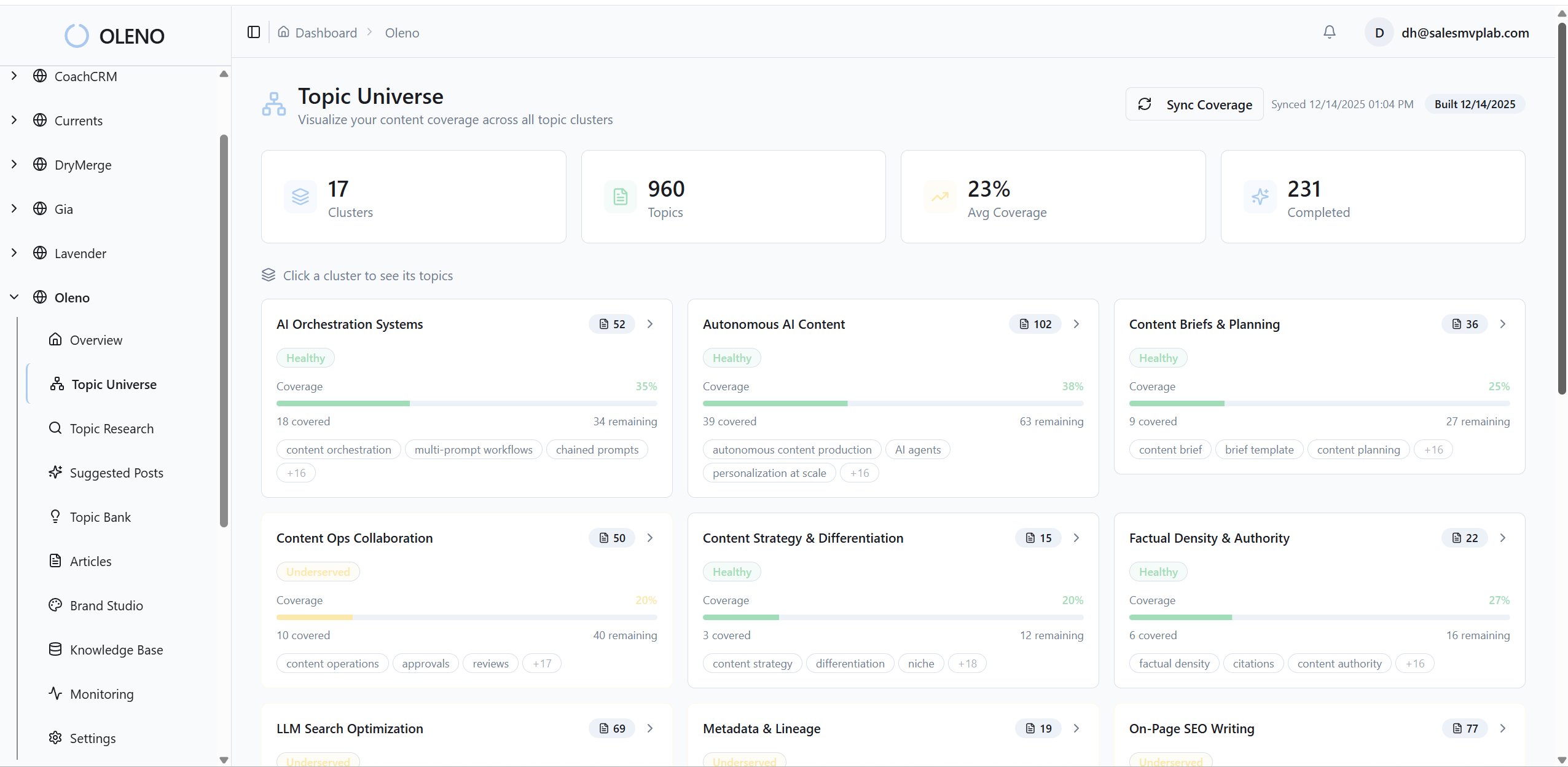
In practice, this trims waste. You stop spinning up content in saturated clusters while thin but commercially relevant topics sit untouched. That’s where pipeline hides.
Snippet-Ready Structure And Deterministic Links Reduce Rework
Every H2 opens with a direct-answer, snippet-ready paragraph, and sections are designed to stand alone cleanly. Oleno injects internal links from verified sitemaps only, with exact-match anchors placed at natural sentence breaks. No fabricated URLs. No scavenger hunts. Just consistent structure that matches SERP expectations and reinforces the right cluster paths.
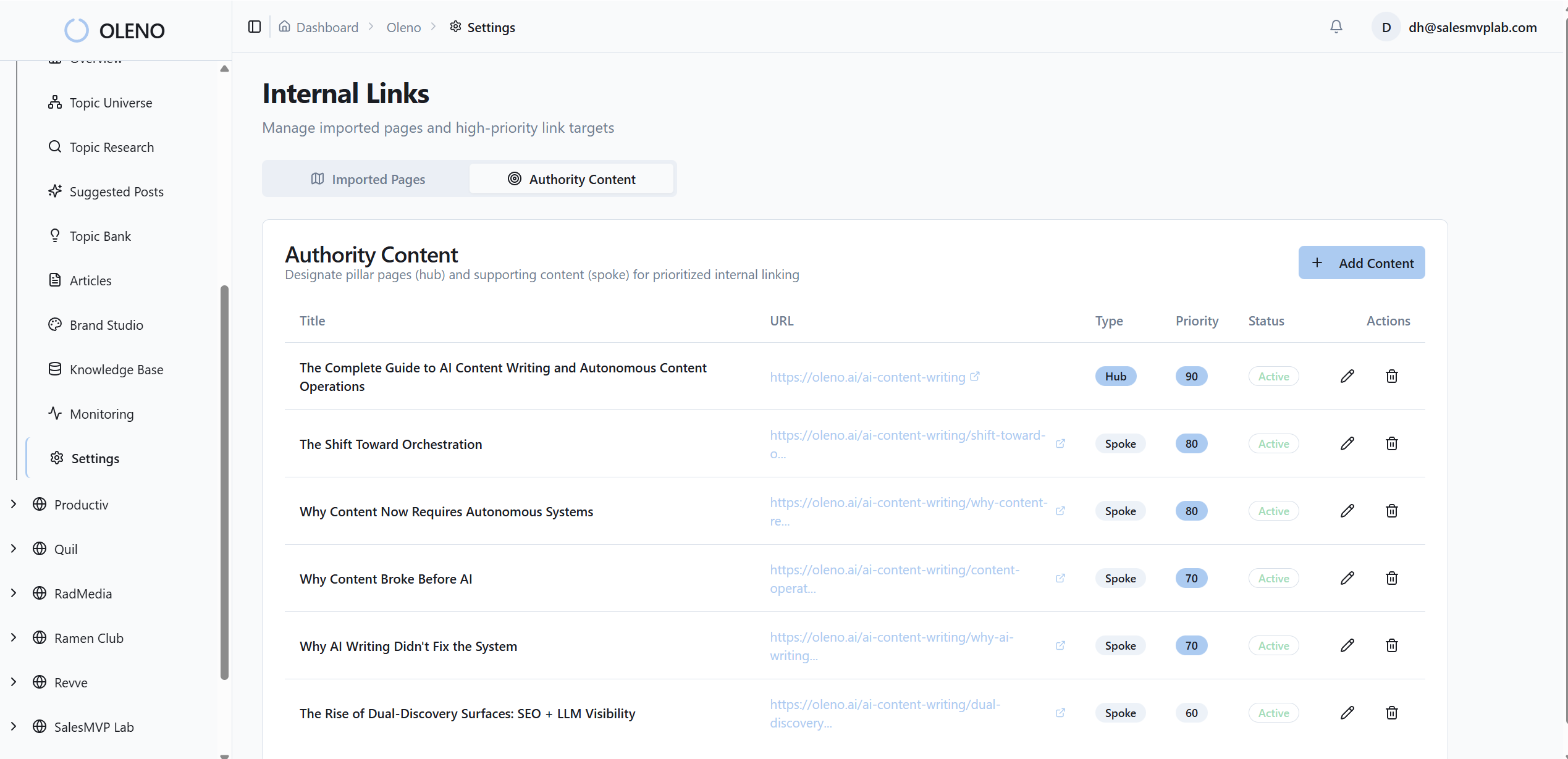
This is especially useful for re-covers and refreshes. You get the format right, the links right, and the structure right—without editing marathons.
Oleno exists to help here, not to add tools to manage. When it’s useful, Try Generating 3 Free Test Articles Now.
Conclusion
Content scales when the system is connected. Inventory normalized. SERP patterns captured. Analytics mapped. From there, the 7-step gap audit turns into a repeatable loop—re-cover what the SERP rewards, refresh where you’re thin, retire what won’t align, and brief everything worth doing. You’ll publish less guesswork and see more movement where it counts.
Solution: How Oleno Accelerates Gap Detection And Execution Without Adding Headcount
Oleno enables the “new way” by eliminating fragmentation. It centralizes Topic Universe (so you write where authority compounds), enforces differentiation with Brief Generation and Information Gain Scoring, and ships articles with snippet-ready structure that machines and humans can reference. The result isn’t hype—just fewer manual stitches and faster, safer execution.
Briefs, Differentiation, And Structure You Can Trust
Oleno generates structured briefs with competitive research and an Information Gain Score before any draft is written. Low-gain outlines are flagged early, protecting you from publishing “another summary of the SERP.” Drafts follow snippet-ready patterns by default—direct-answer openings, clean sections, and FAQ when appropriate. This aligns naturally with your re-cover and refresh work.
Because the structure is consistent, your team spends time on decisions—what to re-cover, where to place proof—not on formatting or rewrites. If you want to see it generate end-to-end drafts you can evaluate against your rubric, Try Oleno For Free.
Delivery Without The Stitching: Links, Visuals, Schema, Publishing
Oleno handles deterministic internal linking from verified sitemaps, brand-consistent visuals via Visual Studio, and JSON-LD schema generation for articles, FAQs, and breadcrumbs. QA checks 80+ criteria—structure, tone, information gain, snippet readiness—before anything ships. Then publishing to WordPress, Webflow, or HubSpot maps fields automatically and prevents duplicates.
Remember the costs we walked through—hours spent stitching exports, thin pages dragging conversion, mismatches requiring rewrites? This is where Oleno pays off: you fix the right gaps faster, with the system handling the repeatable work. When you’re ready to evaluate it against a live gap backlog, Try Using An Autonomous Content Engine For Always-On Publishing.
About Daniel Hebert
I'm the founder of Oleno, SalesMVP Lab, and yourLumira. Been working in B2B SaaS in both sales and marketing leadership for 13+ years. I specialize in building revenue engines from the ground up. Over the years, I've codified writing frameworks, which are now powering Oleno.
Frequently Asked Questions