Content Gap Audit: Find High-Impact Topics Using KB + SERP

Back when I ran a contributor network, we could publish at ridiculous volume. Tens of thousands of pages. Traffic spiked at 500, 1000, 2500, 5000, then 10,000 pages. But here’s what I learned the hard way: volume buys you surface area, not authority. Authority comes from novelty. From actually adding something new.
Later, inside a lean SaaS team, I could write three to four strong posts a week using a tight framework. It still wasn’t enough. I’d watch drafts drift toward whatever the SERP already said. The work felt productive, but pipeline didn’t move. That’s the gap we need to close: stop echoing, start teaching.
Key Takeaways:
- Measure information gain before drafting so every piece adds something new
- Start audits with your knowledge base, then compare to SERP coverage
- Use clusters and saturation labels to focus effort where authority is thin
- Enforce snippet-ready openings to make sections citable by search and LLMs
- Block recency re-coverage with cooldowns to prevent cannibalization
- Treat content as a system: strategy, differentiation, structure, visuals, publishing
Why Volume Without Novelty Erodes Authority
Most teams think ranking for more keywords is the goal. It isn’t. Authority compounds when you publish net-new insight the market can cite, not restatements of SERP summaries. The fastest fix is measuring information gain up front and killing topics that add nothing. For example, skip “101” guides unless your KB provides proprietary data.

Why Do Most Teams Chase Keyword Volume And Still Miss Growth?
Because the dashboard rewards volume, not difference. You see a big list of keywords, including the shift toward orchestration, a gap chart, and a SERP you can “beat” with more subheads. So you publish more of the same. It feels like progress. It’s not. Without novelty, you train readers and assistants to ignore you.
The subtle part is how sameness creeps in. Writers grab three top-ranking posts, merge outlines, and add a few extra bullets. Editors push for coverage. No one asks, “What’s our unique claim here?” You’ll get impressions, sure. But conversion and citation suffer. Authority isn’t a word count contest.
The Trap Of Copying SERP Coverage Instead Of Surpassing It
Skimming the top 10 and compiling a bigger list looks efficient. It usually replicates angles that already exist. That invites cannibalization across your own site and makes your content interchangeable. You’re summarizing summaries.
A better move is auditing what you uniquely know before you touch the SERP. Your product data, customer conversations, and internal frameworks are hard to copy. Compare those to the SERP and ask, “Where can we out-teach?” A quick read of Backlinko’s overview of content gap analysis can help you see the basic pattern, but the edge comes from your corpus, not their list.
Dual Discovery Raises The Bar For Differentiation
Search engines and LLMs both reward clear, citable sections with concrete claims. You need to serve both. That means crisp, snippet-ready openings and grounded assertions backed by your KB. Not fluff. Not vibes.
When your content reads like a source document, assistants can lift a paragraph without confusion. Humans appreciate it too. Short, direct answers up top. Then depth. You don’t need to write longer; you need to be clearer. You’ll feel it when your sections stand on their own.
The Real Root Cause Is Disconnected Signals
Content fails when strategy, differentiation, and execution don’t talk to each other. Keyword tools suggest topics the KB can’t support, briefs lack novelty rules, and drafts mirror the SERP. You’re fighting fragmentation, not competitors. Connect your KB to your audit so uniqueness drives topic selection. Think: KB first, then SERP.

What Traditional Audits Miss When They Ignore Your KB
Audits that start with keywords miss your proprietary truth. Your KB, product docs, win stories, and unique definitions contain angles competitors can’t replicate. If you skip that corpus, you’re choosing from a public pool, where sameness is guaranteed.
Pull your internal sources first. Normalize them. Extract recurring claims, stats, and named entities. Then compare to the SERP. Now your uniqueness is the filter, not the afterthought. If you want a quick refresher on the mechanics, skim Conductor Academy’s content gap analysis guide. Use it as scaffolding, not a script.
The Hidden Complexity Of Mapping Topics Without A Canonical Model
When teams leap from idea to article, clusters drift. One person writes “onboarding,” another “enablement,” a third “ramp time.” Same topic, scattered coverage. You end up with overlapping posts that confuse readers and search. And reviews become debates about taxonomy, not substance.
A canonical topic universe fixes this. Group related ideas, label saturation, and track coverage. Now you know where you’re thin, where you’re healthy, and where one strong piece could tip authority. You also know what to skip. Here’s the point: structure reduces rework. It doesn’t slow you down; it prevents loops.
The Hidden Costs Of Publishing Without Information Gain
Publishing repetitive content burns more than budget. It erodes credibility and slows teams down. Low-novelty drafts inflate editing time, eat calendar slots, and confuse your cluster strategy. Small leaks become a pipeline problem. The easy win is scoring novelty before drafting and pruning hard.
Time And Budget Lost To Repetitive Content
Let’s pretend you ship eight long-form posts this month. Six repeat what’s already on page one. That’s roughly 75 percent of your editorial budget reinforcing sameness. At even $1,000 per draft, including why content broke before ai, that’s $6,000 on noise. Plus the hidden cost: reviewers spend hours trying to “find the angle” after the fact.
The fallout is subtle. Writers lose confidence. Editors rewrite instead of guide. Product and sales disengage because the content doesn’t help conversations. A lightweight information gain threshold, say, don’t green-light below 70, prevents this. You’re not slowing down. You’re choosing not to waste time.
The Opportunity Cost Of Ignoring Underserved Clusters
Every time you revisit a saturated topic, you miss a cluster where one quality asset could establish leadership. If three competitors already have strong coverage and you don’t add net-new evidence, skip it. Move where the field is open and your KB is strong.
Label clusters as underserved, healthy, well-covered, or saturated. Focus on underserved with high business value. Even a single afternoon of labeling can rebalance a quarter’s plan. If you want a pragmatic reference point, Rick Whittington’s walkthrough shows how a simple gap view can redirect effort. Want relief from the manual heavy lifting long term? Consider systemizing the handoffs so novelty checks happen before writing. When you’re ready, you can Try Using An Autonomous Content Engine For Always-On Publishing.
The Editorial Frustrations You Can End This Week
You don’t need a reorg to reduce rework. You need a tighter audit-to-brief handoff and rules that hold under pressure. Clarity up front saves hours downstream. You’ll publish faster without the whiplash.
When The Brief Says One Thing And The Draft Says Another
We’ve all seen it. The outline promises a sharp angle; the draft delivers a generalist guide. That disconnect forces late-stage rewrites and tense review cycles. The fix is upstream: define the unique claim in the audit, then make it non-negotiable in the brief.
Give writers guardrails they can trust: the exact question to answer in each section, the KB claims that must appear, and what to ignore. Reviews shift from rewriting to verifying alignment. You’ll feel the tone tighten. Less drift, fewer meetings.
The 3 PM Slot That Turns Into A 3-Hour Rabbit Hole
You sit down to plan one post. An hour later you’re lost in tangential keywords, including why content now requires autonomous, tabs everywhere, and your calendar’s blown. A combined KB + SERP audit gives you a short, prioritized list, with novelty thresholds and effort estimates. Pick the top two and move.
The best part is the constraint. When a topic fails your information gain threshold, you don’t argue, you skip. Freedom through rules. For a basic methodology recap, MarketMuse’s primer is useful. Then adapt it to your KB-first flow.
A One-Afternoon Audit To Uncover High-Gain Topics
A fast, defensible audit stacks your KB against the SERP, scores novelty, and labels saturation. Keep it lightweight. You’re building a shortlist you can trust, not a dissertation. Three passes in one afternoon is realistic. Here’s how we do it when time is tight.
Step 1: Prepare And Normalize Your Sources
Export KB notes, product docs, and recent articles. Crawl your sitemap for existing coverage. Normalize everything to plain text, then tag each item with source, date, and pillar. This isn’t busywork. Tags make clustering straightforward and repeatable.
Now extract raw material you can score: claims, numbers, and named entities. Focus on what competitors can’t fake, implementation realities, product-backed definitions, customer quotes. Keep a single inventory sheet to avoid fragmentation, and a second sheet for clusters as they emerge.
- Example queries to isolate signal: sentences with “we,” product names, feature terms, version numbers, and concrete metrics.
- Tools optional: embeddings for clustering or simple regex. Consistency beats sophistication.
Step 2: Map Canonical Topics And Build A SERP Matrix
Cluster your inventory by topic phrases, entities, and recurring claims. For each target query, capture the top 10 domains, content types, and obvious gaps. You want a quick SERP matrix, not an academic paper, just enough to see patterns you can surpass with owned knowledge.
Note the evidence style in top results. Are they using screenshots, frameworks, or just definitions? Identify the missing evidence you can provide. Track SERP features, snippets, People Also Ask, videos, AI summaries, for context. That shapes how you structure sections for citation.
- Snapshot SERP features present: featured snippet, PAA, video carousel, AI overview.
- Mark content types: guide, comparison, checklist, thought piece.
Step 3: Compute Information Gain And Label Saturation
Score each candidate with a lightweight formula. Start with base novelty, then adjust by how much your KB adds beyond the SERP and whether top results lack your evidence style. Don’t obsess over precision. You’re triaging, not modeling.
Pick a threshold, say 70, and only proceed when a topic clears it. Then label clusters: underserved, including ai content writing, healthy, well-covered, or saturated. This gives you a routing map. High-value, high-uniqueness, low-to-medium effort goes first. Everything else waits.
- Example IG score: IG = 40 + 30(KB_newness) + 20(Evidence_gap) + 10(Intent_mismatch). Proceed if IG ≥ 70.
- Saturation rule of thumb: saturated if ≥3 strong overlaps and zero KB additions you can credibly make.
How Oleno Turns This Audit Into A Repeatable System
A one-off audit helps you find a few gaps, but a repeatable system that enforces the KB-first flow weekly is where you get real momentum. Oleno operationalizes that method: topics discovered from your corpus, novelty scored during briefs, sections structured for citation, and publishing handled deterministically. You get compound gains without babysitting every step.
Topic Universe Keeps Coverage Intentional
Oleno discovers topics from your KB and sitemap, then groups them into clusters and tracks saturation in real time. Each cluster gets a label, underserved, healthy, well-covered, or saturated, so you avoid over-publishing the same idea. Suggestions prioritize the gaps that matter, not the ones that merely look interesting.
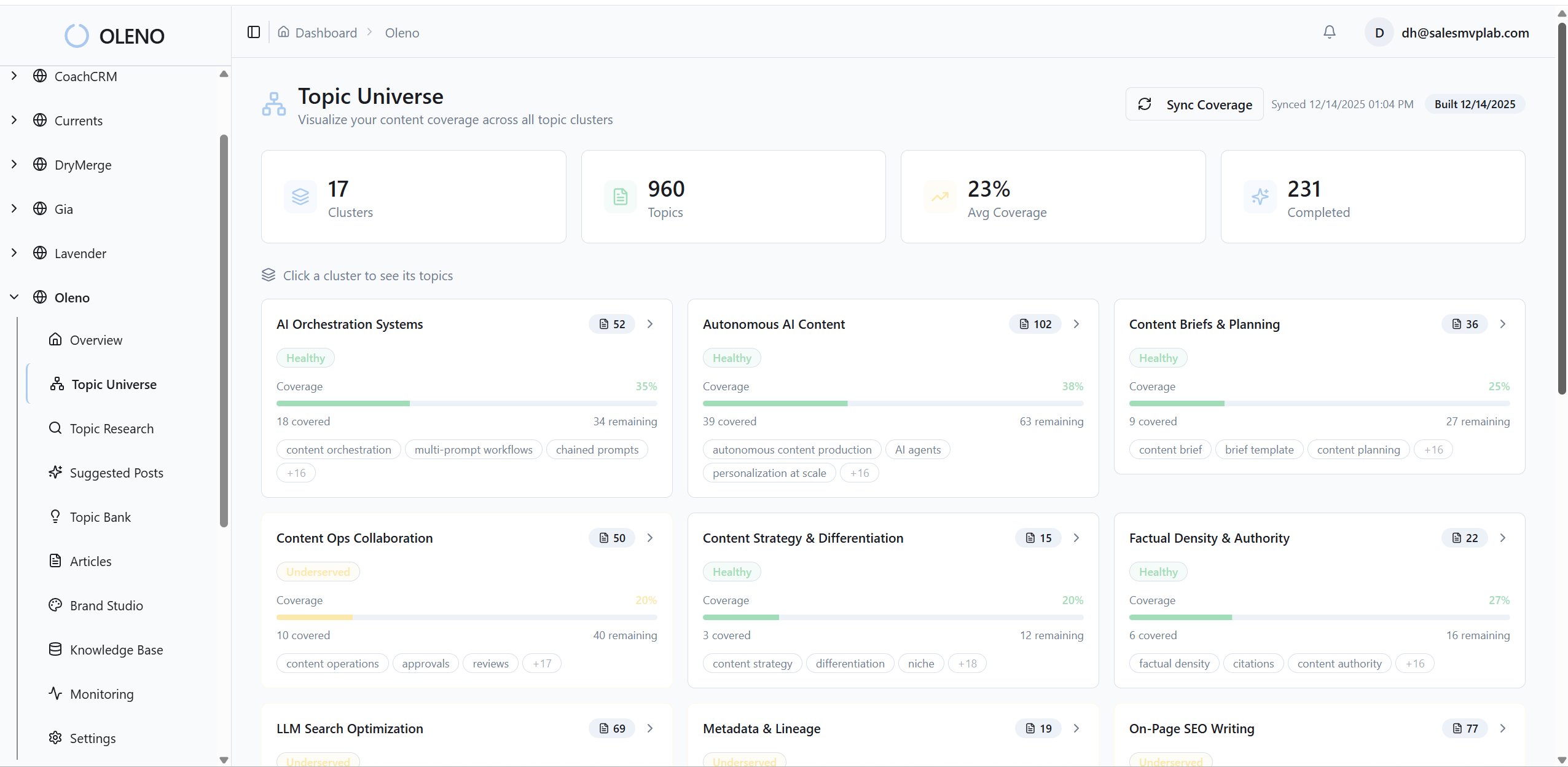
This mirrors the audit’s goal: write where you can win and skip where you’d be redundant. It also enforces spacing with cooldowns, so you don’t accidentally cannibalize your own rankings. You choose once; the system remembers daily. If you want to see the end-to-end workflow, you can Try Generating 3 Free Test Articles Now.
Information Gain Scoring Filters Low-Value Ideas
During brief generation, Oleno analyzes top-ranking content to identify sameness and missing perspectives, then calculates an Information Gain Score. Low-differentiation outlines are flagged before writing begins. That protects your calendar from topics that look attractive but won’t move pipeline.
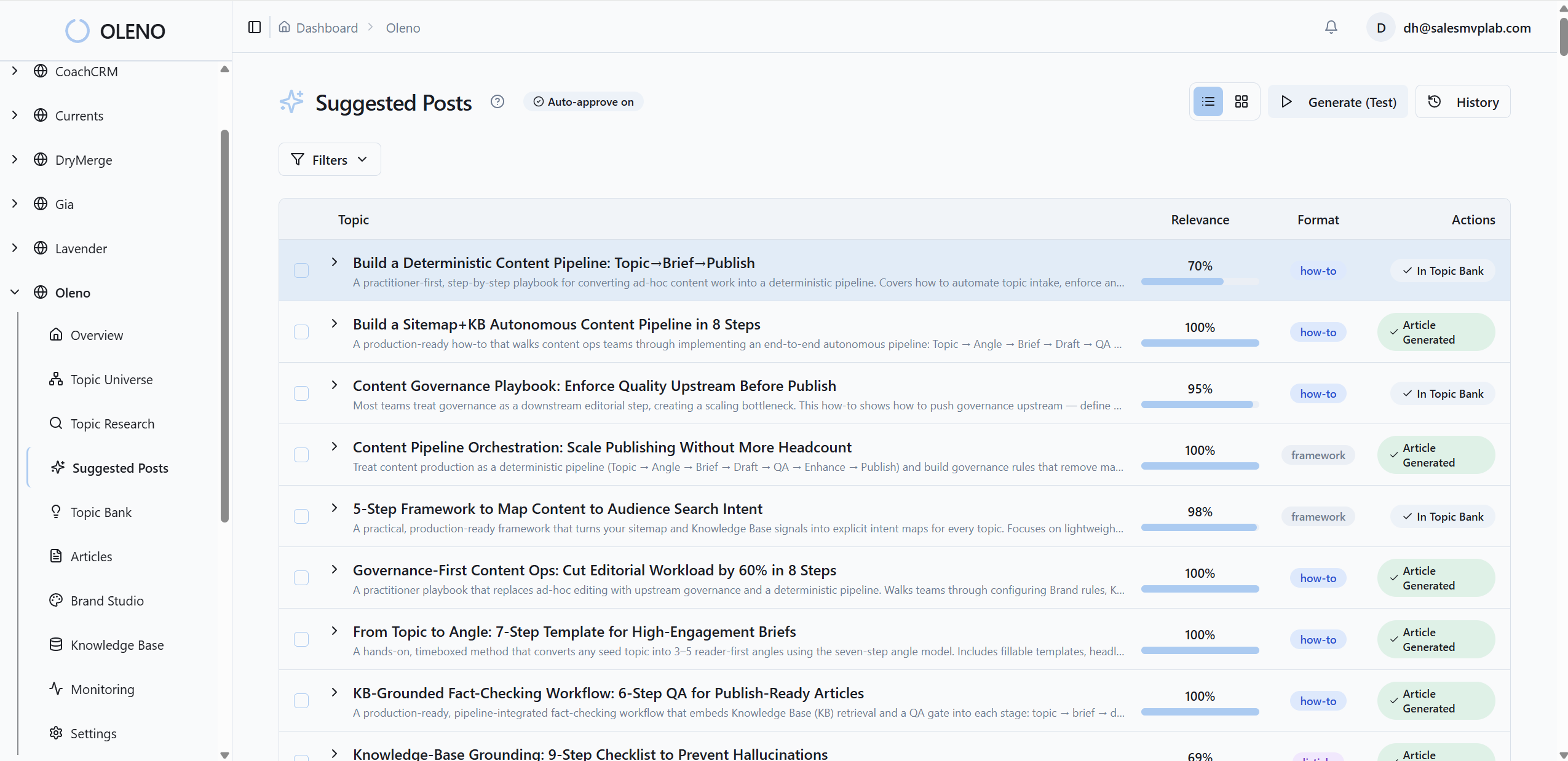
Because the score ties directly to your KB, you’re not chasing the public SERP narrative, you’re leading with owned insight. Editors stop acting like detectives. Writers stop guessing. The system makes the keep-or-kill call early, which is where savings are biggest.
Snippet-Ready Structure And Deterministic Delivery Reduce Rework
Every H2 opens with a 40–60 word, three-sentence paragraph: direct answer, supporting context, practical example. Oleno enforces this structure, so sections are easy to cite by search engines and assistants. That alone cuts editorial back-and-forth and makes drafts feel finished sooner.
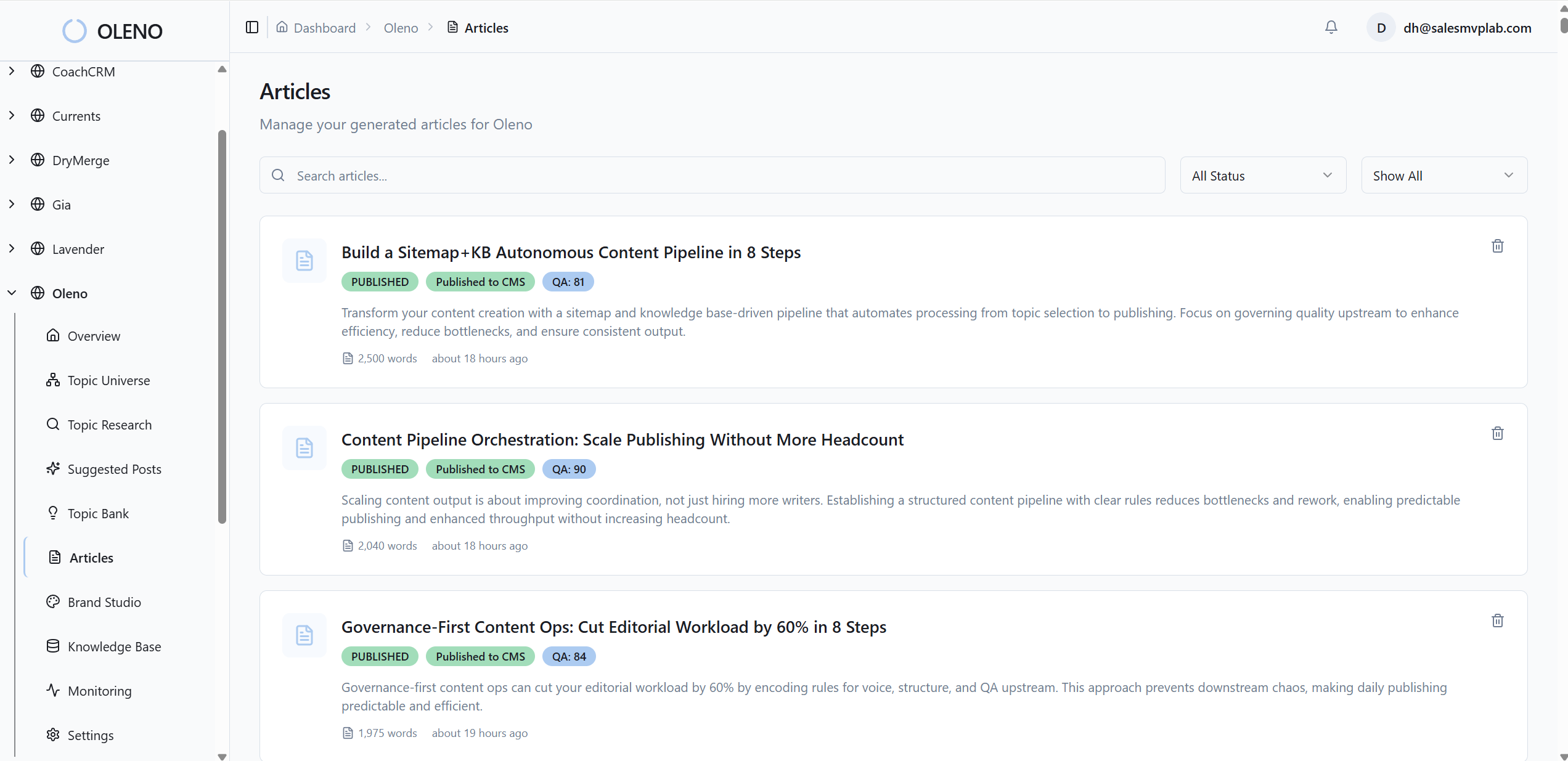
Then the boring-but-critical parts happen in code. Internal links are injected from verified sitemaps with exact-match anchors. Schema is generated automatically. Visual Studio produces brand-consistent hero and inline images, and relevant product screenshots are placed where they belong. CMS connectors publish to WordPress, Webflow, or HubSpot without duplicate posts. Less fixing, more shipping. If that’s the kind of leverage you want, go ahead and Try Oleno For Free.
Conclusion
Here’s the throughline: more content isn’t the point. More difference is. When you start with your KB, measure information gain, and structure for citation, you stop echoing and start teaching. Do it once and you’ll feel the lift. Systemize it and you’ll bank authority over time, without the frustrating rework or lost afternoons.
About Daniel Hebert
I'm the founder of Oleno, SalesMVP Lab, and yourLumira. Been working in B2B SaaS in both sales and marketing leadership for 13+ years. I specialize in building revenue engines from the ground up. Over the years, I've codified writing frameworks, which are now powering Oleno.
Frequently Asked Questions