Content Gap Audits: 5-Step Coverage & Information Gain Framework

Most teams run “content gap audits” like a keyword scavenger hunt. Lots of exports. A few red-yellow-green slides. Then a backlog of “quick wins” that look productive until rankings flatten and sales asks why three pages say the same thing. I’ve made that exact mess. Twice. It’s not your writers. It’s the missing measurement.
Back when we scaled Steamfeed, volume worked because we had breadth and depth with a clear system. At PostBeyond and LevelJump, small teams struggled not because we lacked ideas, but because we lacked a scoreboard. No coverage model. No cooldowns. No uniqueness gate. So we republished similar angles, crossed wires with sales, and created frustrating rework. That’s the trap this framework avoids.
Key Takeaways:
- Treat content gap audits as a scoring system, not a spreadsheet
- Calculate coverage per topic using breadth, depth, and recency
- Score information gain 0–100 before writing to block duplicates
- Enforce a 90‑day cooldown to avoid republishing the same idea twice
- Merge or redirect overlapping pages to reduce cannibalization
- Use a prioritization matrix that blends business value, intent, and info gain
Ready to skip the theory and see how this runs end to end? Try Generating 3 Free Test Articles Now.
Why Content Gap Audits Fail Without Measurement
Most content gap audits fail because they don’t measure duplication or uniqueness across topics over time. Teams inspect keywords, not coverage. Without rules and scoring, you’ll keep shipping familiar angles that look new but say the same thing. That’s how cannibalization starts quietly.

The real problem is duplication, not ideas
You’re not short on topics. You’re short on guardrails. When three posts explain the same feature from slightly different angles, the best page rarely wins. Google gets mixed signals. Your internal links wander. Sales shares three URLs and hopes the buyer connects the dots. Everyone loses time.
I’ve watched great content teams chase “fresh” while repackaging the same logic into thought leadership, how‑to, and comparison formats. On paper, they look different. In practice, they fight for the same terms, links, and clicks. Without a uniqueness gate and a short cooldown, you’re building overlap that steals from itself.
The fix isn’t more ideation. It’s measurement. Put a coverage score on each topic, enforce a cooldown, and require an information‑gain threshold before anything moves forward. It’s blunt, sure. But blunt rules beat post‑publish cleanup every single time.
What is coverage scoring and why does it matter?
Coverage scoring blends breadth, depth, and recency into a single per‑topic metric. Breadth counts unique subtopics you’ve touched. Depth evaluates how comprehensively each subtopic was handled. Recency ensures freshness and guards against stale clusters. One number. Clear decisions.
This matters because authority compounds when you avoid noise. Coverage scores help you decide whether to refresh a canonical asset, merge a duplicate, or write net‑new. They also prevent accidental re‑coverage of the same angle two months later. Keyword lists alone won’t show that. A coverage score will.
Competitor lists are fine for context, but they’re not an audit. Without your first‑party inventory, scoring rubric, and a uniqueness check, you’ll just publish “me too” content faster. If you want a primer on inventory best practices, the Nielsen Norman Group’s take on content audits is a good foundation. Then layer scoring on top.
The Mechanics Behind Coverage And Information Gain
A real audit system normalizes your content data, scores coverage per topic, and tests information gain before writing. It uses formulas and thresholds, not vibes. That’s how you block duplicates and prioritize work that moves the needle.

What traditional audits miss
Most audits stop at counting pages and tagging topics. No normalization across sources. No per‑topic coverage math. No freshness decay. And certainly no pre‑publish uniqueness test. Slides look clean, but your backlog still favors easy repeats because they’re familiar and quick to ship.
What you need is a canonical dataset and a scoring rubric you trust. One row per URL. One topic per row. Consistent dates and intents. Then coverage math that blends breadth, depth, and recency with weights you agree on. Decisions get easier when the scoreboard is visible and stable.
Finally, a gate. Don’t write until the planned angle clears a minimum information‑gain score. Think of it as a pass/fail that protects your future self from cleanup. For background on gap analysis mechanics, ProjectManager’s gap analysis overview is helpful context, even if we adapt it for content.
Information gain in plain English
Information gain asks a simple question: how much new insight are you adding versus what already exists on the SERP and in your library? It’s not a feeling. It’s a rubric. Score four axes: novelty, specificity, examples, and proprietary data. Total them on a 0–100 scale. Gate low scores.
Here’s the flow. Compare your outline against common denominators on top results. Then check your own coverage for overlap. If your draft leans on definitions everyone has, with no fresh examples or data, the score drops. If you add proprietary insights, deep specifics, and concrete scenarios, the score rises.
This isn’t about chasing “originality” in a vacuum. It’s about earning reference value. The USDA Digital Strategy content plays echo this principle, make each asset useful, scannable, and distinct. Information gain gives you a way to enforce it.
The Hidden Cost Of Redundant Coverage
Redundant coverage wastes budget, dilutes authority, confuses internal links, and slows down future work. The kicker? It often looks like progress on the calendar. You feel busy while undermining your best pages.
The waste compounds quietly
Let’s pretend your team ships 20 posts per month, and 30 percent are duplicative angles. That’s six posts of waste. At $800 all‑in per post, you’re burning $4,800 monthly. Now add the opportunity cost of the six high‑impact topics you didn’t cover. Over a quarter, the math gets uncomfortable.
That waste isn’t just dollars. It pollutes your architecture. More URLs to maintain. More near‑duplicates in sitemaps. More confusion for crawlers and buyers. Overlapping pages breed hesitant refreshes because no one knows which URL is the true canonical. It slows everything down.
The fix isn’t heroic editing. It’s prevention. Once coverage and info‑gain gates exist, waste gets harder to create. If you want more on the operational side of preventing overlap, Sprinto’s guide to gap analysis has a useful lens on codifying controls.
The cannibalization tax
Cannibalization is the hidden tax you pay for similar pages. It shows up as ranking volatility, weaker internal link signals, and diluted external links. Even when a duplicate “does fine,” it can suppress a stronger asset by splitting intent and authority.
The playbook is simple. Pick a canonical winner per topic. Merge overlapping pages into it when overlap is high and engagement is weaker on the older URL. Use redirects and consistent canonical tags. Then, refresh the winner with the best parts and prune the rest. Tie those decisions back to coverage scores and cooldowns so you don’t repeat the cycle.
Seeing these symptoms already? You’re not alone. But you don’t have to keep paying the tax. Shift the work upstream and most of it disappears.
Still triaging duplicates by hand each month? There’s a better way to run this consistently. Try Using an Autonomous Content Engine for Always‑On Publishing.
The Moments That Make Teams Change Course
Teams change when the pain is obvious: buyers can’t find the right page, releases create thin duplicates, or the same topic gets repackaged again. You don’t need more hustle. You need a governed audit pipeline.
When your biggest customer cannot find the right page
I’ve been there. Great content. Wrong page ranking. Sales sends three links to explain one feature because no single page wins. Then comes the rework: combining content, rewriting intros, re‑doing internal links. Teams feel the headache, blame writing, and miss the root cause.
What’s missing is a coverage model that decides which single page should win and when to refresh it. With a coverage score and a canonical winner per topic, you avoid splitting intent. Sales sends one link. Search engines see one signal. And refreshes become straightforward, not political.
There’s nuance here. Sometimes a secondary page deserves to exist for a different intent. But that’s a rule, not a feeling. Intent labels and coverage thresholds keep you honest.
How do you avoid republishing the same idea twice?
Set a clear rule: no topic gets republished within 90 days unless the coverage score drops or information gain exceeds a threshold. Pair that with strict canonical patterns and redirect merges during refreshes. That single rule reduces noise and keeps authority concentrated.
Make it visible. Put cooldowns in your backlog view. When someone proposes a “quick win,” check the info‑gain score. If it’s low, hold or re‑angle. If it’s high, publish with confidence. Simple beats heroic cleanup later. If you like more SERP‑level context work, Backlinko’s content gap guide is a solid reference to pair with your first‑party rules.
A Practitioner 5-Step Coverage And Information Gain Framework
You don’t need a giant program to do this. You need a clean dataset, a scoring rubric, a uniqueness gate, and a prioritization matrix. The rest is discipline.
Step 1: Build a canonical dataset
Consolidate URLs from a site crawl, knowledge base, analytics, and your editorial calendar into one sheet. Normalize columns for URL, topic, cluster, intent, last publish date, last significant update, conversions, and canonical. Then deduplicate by canonical so every row is a real, unique URL.
Make the hygiene rules explicit before you score anything. One topic per row. One canonical per URL. One source of truth for dates. It sounds rigid. It saves weeks. Without clean inputs, every smart decision downstream gets noisy. Interjection: this is the step most teams skip.
If you want a quick diagnostic of coverage data you’ll need later, the Nielsen Norman Group’s content audit guidance is a helpful cross‑check.
Step 2: Calculate coverage scores with a rubric
Create a per‑topic coverage score with three inputs. Breadth counts unique subtopics covered. Depth grades section completeness and media variety. Recency applies time decay. A simple formula works: Coverage = 0.4 Breadth + 0.4 Depth + 0.2 Recency. Keep weights stable for a quarter so you can compare.
Export a per‑cluster average to spot weak spots quickly. If a cluster is “well‑covered” but recency is low, refresh the canonical winners. If breadth is thin, publish net‑new. When you attach decisions to a number, prioritization stops being a debate and starts being a plan.
Optional add‑ons can wait. This core rubric will carry you far.
Step 3: Measure information gain against the market
Analyze top‑ranking pages to list common denominators and missing specifics. Then score each planned or existing asset for uniqueness across four axes: novelty, specificity, examples, and data. Use a 0–25 scale per axis and total to 100. Require, say, 65+ to proceed.
Low score? Hold, merge, or re‑angle. High score? Move it to the top of the backlog. The point isn’t perfection, it’s preventing duplicates from entering the pipeline. For an adjacent checklist mindset, SearchStax’s content gap analysis overview pairs well with your info‑gain rubric.
Step 4: Build a prioritization matrix and rank the backlog
Score each topic on business value, acquisition intent, and information gain. Business value means pipeline tie‑in or product adjacency. Acquisition intent favors BoFu over MoFu over ToFu. Sort by a weighted total like 0.5 Business, 0.3 Intent, 0.2 Info Gain.
Publish the top 20 with one‑sentence “why now” notes and owner names. If a “quick win” bubbles up but has low info gain or low intent, it waits. The matrix prevents the illusion of progress, busy calendars with low‑impact outputs.
Step 5: Set execution rules, cooldowns, and merge patterns
Codify rules so good decisions scale without you in the room. Enforce a 90‑day cooldown before re‑covering a topic. Define merge vs. refresh logic: merge when overlap exceeds 60 percent and the older URL has weaker engagement; refresh when the page is canonical and the coverage score dropped.
Require canonical tags and redirects for merges. Add lightweight triggers for violations in your workflow. You’re not building a police state. You’re giving your team a system that catches problems before they publish.
How Oleno Turns Audits Into A Continuous System
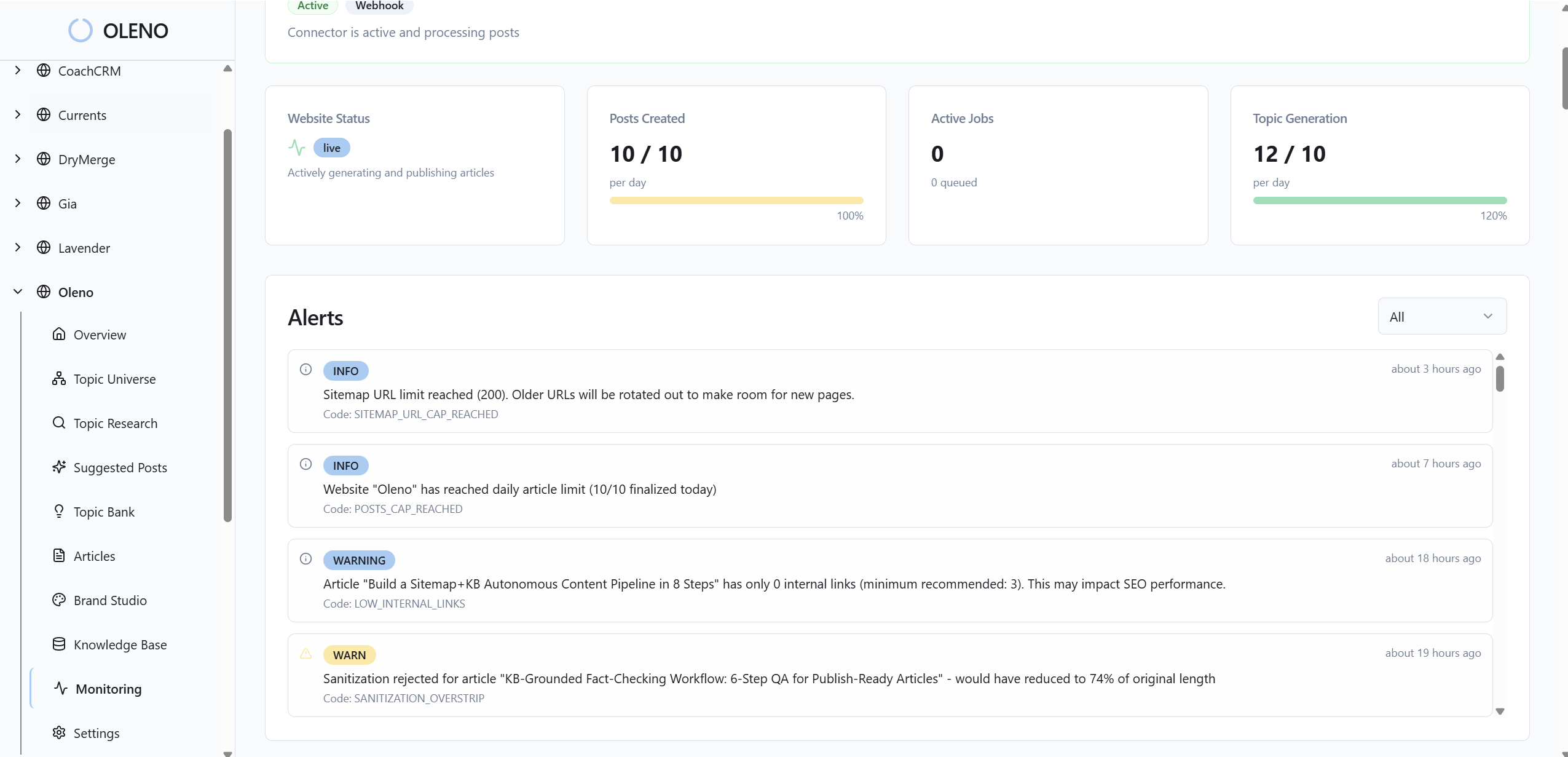
Oleno turns this framework into a daily, autonomous loop. Strategy, uniqueness checks, structure, visuals, links, and publishing run as one governed pipeline. The outcome is consistent, not just the intent.
Topic Universe maps coverage and enforces cooldowns
Oleno’s Topic Universe builds your topic landscape, tracks coverage and saturation by cluster, and applies a 90‑day cooldown before re‑covering a topic. That gives you a live map of where you’re over‑ or under‑serving and prevents accidental duplicates from entering the queue.
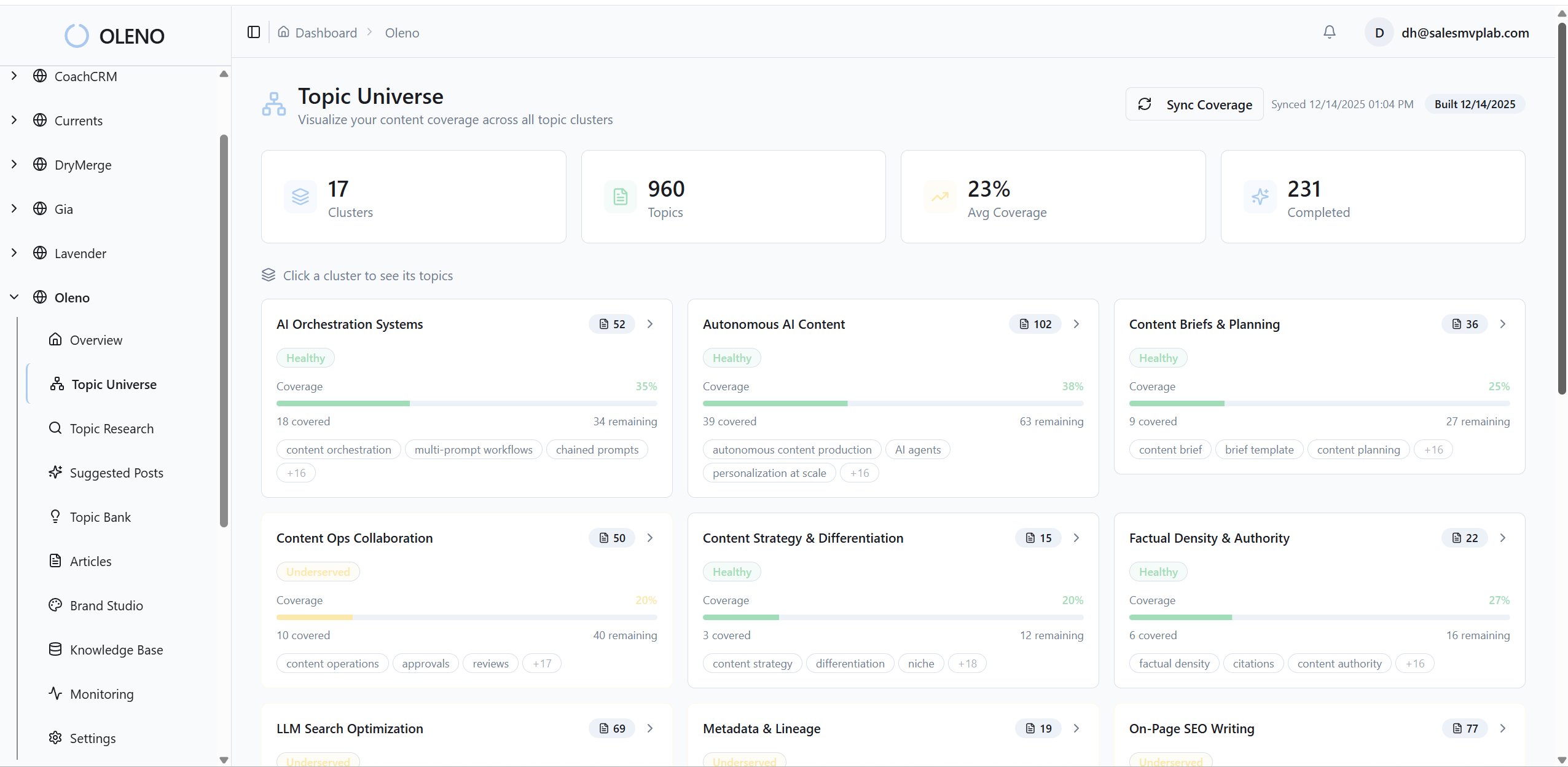
Because coverage is tracked per topic and cluster, you can decide quickly: publish net‑new, refresh the canonical winner, or merge overlapping URLs. Those decisions reflect the system we outlined, just executed automatically. And yes, suggestions respect cooldowns, so your backlog stays clean instead of noisy.
When people ask “what should we write next?”, Topic Universe answers with intent and sequence, not guesswork.
Information Gain Scoring blocks low-value outlines
Oleno performs competitive research during brief generation, identifies common coverage, and calculates an Information Gain Score (0–100) before drafting. Low‑gain outlines are flagged early. High‑gain briefs move forward. That’s the uniqueness gate preventing repeats upstream.
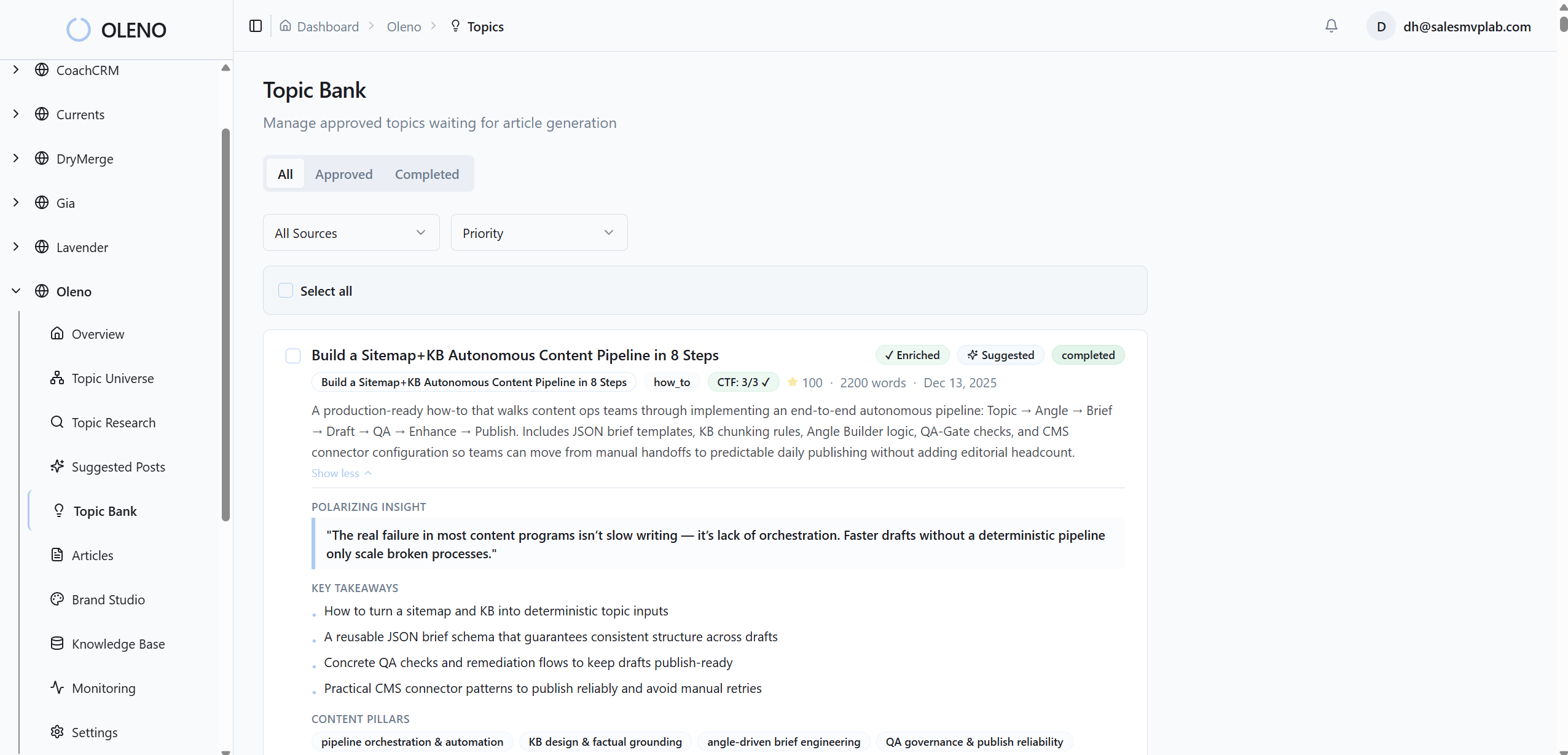
From there, QA‑Gate enforces structure and brand voice, Visual Studio generates brand‑consistent images and places product visuals where they matter, and deterministic internal linking injects verified URLs with exact‑match anchors. Schema is generated programmatically, and publishing connectors push clean articles to WordPress, Webflow, or HubSpot without handoffs.
This is how the earlier costs disappear: fewer duplicates created, fewer manual edits, and a backlog you can trust. If you’re ready to hand off the mechanics and keep the narrative, Try Oleno for Free.
Conclusion
You don’t need a bigger content team to fix content gap audits. You need a system that scores coverage, enforces uniqueness, and sequences work with intent. We’ve lived the pain, duplicate angles, cannibalization, late‑night cleanup. The shift is simple: measure first, gate repetition, and publish with discipline. Do that manually with this framework, or let a system run it daily so your team can focus on the story, not the scaffolding.
About Daniel Hebert
I'm the founder of Oleno, SalesMVP Lab, and yourLumira. Been working in B2B SaaS in both sales and marketing leadership for 13+ years. I specialize in building revenue engines from the ground up. Over the years, I've codified writing frameworks, which are now powering Oleno.
Frequently Asked Questions