Content Orchestration Playbook: Maintain Quality With 50+ Writers

Most teams add headcount when quality slips. Feels logical. But the minute your system turns into “more writers, more edits, more meetings,” you’re scaling interpretation, not outcomes. I’ve lived both versions, the high-volume network effect of Steamfeed on one hand, and the small-team chaos of founder-led content on the other. The difference wasn’t talent. It was structure.
At PostBeyond, I could ship three to four strong posts a week because my framework did the heavy lifting. As the team grew, quality dipped while cycle times went up. Same thing again at LevelJump and Proposify in different flavors. The pattern is simple: without deterministic rules upstream, quality degrades as people multiply. You can’t out-edit that.
Key Takeaways:
- Define quality with operational metrics, not vibes: pass rate, edits per draft, time-to-publish, and information gain rejections
- Push differentiation and structure upstream at the brief stage to cut rework
- Use a Topic Universe to cluster, assign ownership, and enforce cooldowns so you stop cannibalizing coverage
- Treat links, schema, and visuals as code, not checklists; remove fragile handoffs
- Standardize snippet-ready openers to keep clarity when many voices write
- Quality should be a property of the pipeline, not a person’s calendar
Why Headcount Without A System Degrades Quality Fast
Hiring more writers doesn’t fix systemic inconsistency; it multiplies it. As contributors increase, voice drift, structural variance, and link hygiene degrade unless rules run automatically. The fastest path back to quality is to define gates that always execute in the same order. Think process, then people.
The Metrics That Actually Predict Scale Quality
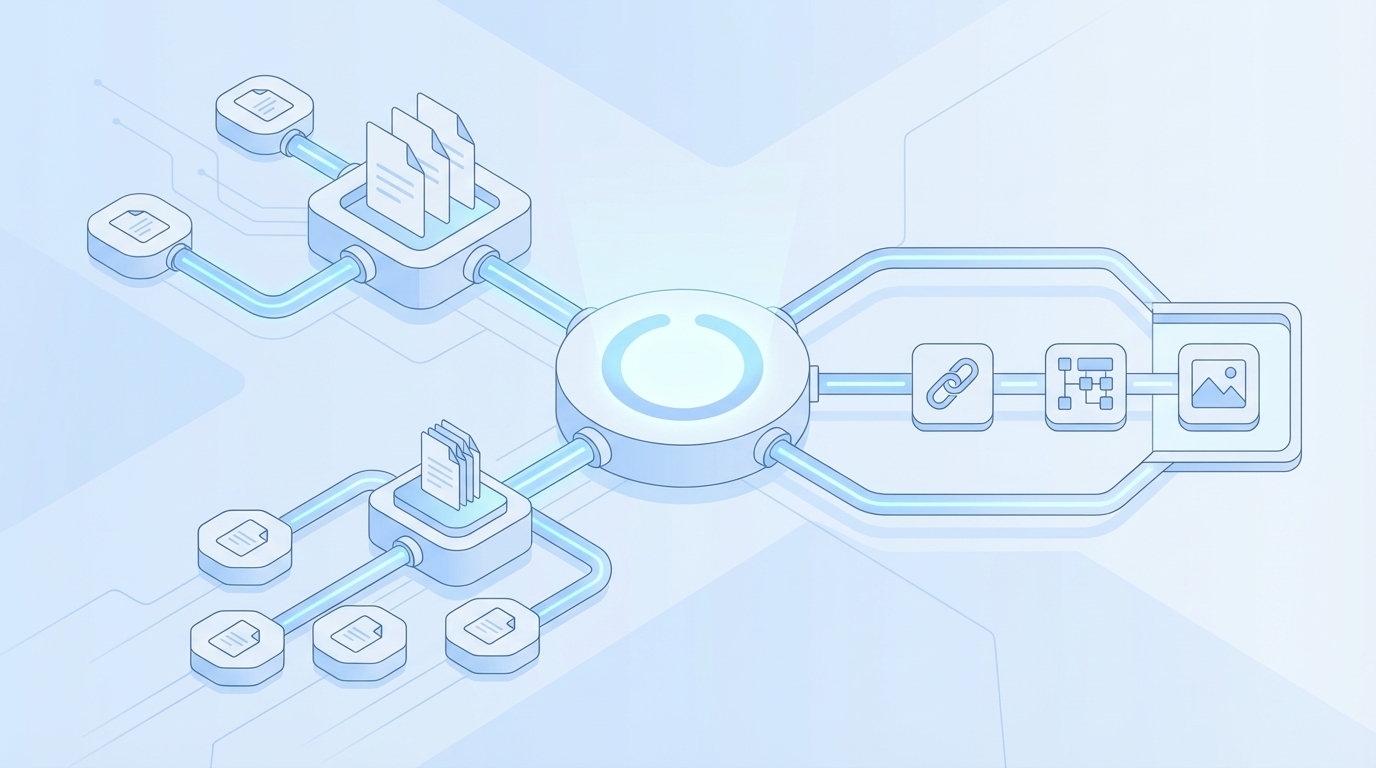
If you want to know whether you’re scaling quality or noise, track the inputs that make quality likely. We’re talking editorial pass rate, manual edits per draft, time-to-publish, and percent of briefs rejected for low information gain. If those get worse as headcount grows, you’re amplifying chaos, not output. I’ve watched teams chase publish volume while their edit queue turns into a parking lot. That’s the red flag.
Make the metrics visible and boring. Pass rate stabilizes when writers know exactly what gets flagged. Edits per draft fall when briefs remove ambiguity. Time-to-publish improves when structure, visuals, and links are handled by the system, not a checklist. These sound unglamorous. They are. They’re also how you keep quality from becoming an accident.
Why Conventional Wisdom Fails When You Hire Fast
The default playbook is predictable: hire more writers, add more editors, schedule more meetings. It feels like governance. It’s actually variability disguised as oversight. Every new person introduces a new interpretation of the rules because the rules live in people’s heads or a dusty brand doc. That’s how voice drifts. That’s how structure drifts.
Here’s the thing. You can’t edit your way out of systemic inconsistency. You need deterministic gates: rules that run in a fixed order and don’t care who wrote the draft. When the system enforces structure, voice constraints, and link hygiene, humans focus on narrative and expertise, not policing commas and headings. That’s the job you want your experts doing.
What Is A Topic Universe And Why Does It Matter?
A Topic Universe is your single source of truth for what gets written and when. It clusters themes, labels saturation, assigns ownership, and enforces cooldowns so you don’t re-cover ideas every few weeks. That alone reduces repetition and prevents cannibalization as contributor count rises. It’s the strategy layer most teams skip.
If you’ve ever watched two teams publish overlapping pieces three days apart, you’ve felt the pain. A Topic Universe stops that. Clusters drive priorities; cooldowns prevent reflexive rewrites; ownership clarifies who moves first. Even tools outside content recognize orchestration as the path to consistency. See how enterprise teams discuss it in Content Orchestration by Sprinklr. Different domain, same principle: rules reduce thrash.
If you want to see this type of pipeline in practice, with quality checks baked in, you can Generate 3 Free Test Articles and compare the before-and-after edit load.
The Root Cause Is Fragmentation Across Strategy, Structure, And Shipping
Quality slips because strategy, structure, visuals, and publishing run in separate lanes. Hand-offs introduce drift, and drift multiplies with headcount. The fix isn’t harder editing; it’s a pipeline that enforces non-negotiables automatically. Align the parts, then let the system do the boring work.
What Traditional Playbooks Miss About Consistency
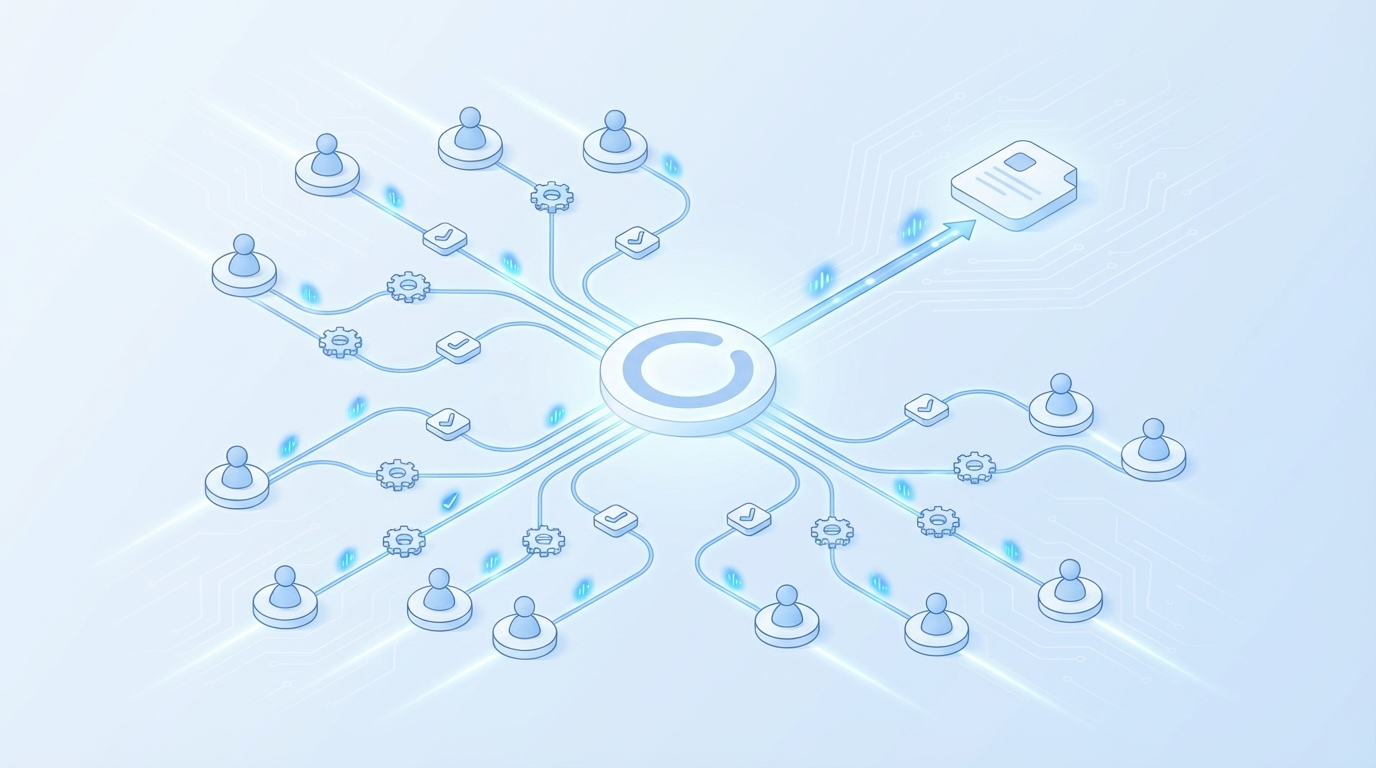
Brand guidelines and best practices are useful, but optional in the real world. Consistency needs rules that run, not rules that sit in a doc. Convert tone, banned terms, and structure into checks that fire before anything can progress. Your system should be the gate, not an editor’s calendar. When you rely on meetings to enforce quality, you’ve already lost.
It’s the same logic process designers use in other functions. Documenting a process isn’t the finish line; automating it is. The “process-first” mindset shows up in adjacent platforms too, structured, repeatable flows that reduce human variation. If you need a mental model, the notion is similar to how ServiceNow’s process designer treats steps and gates. The content world needs the same discipline.
How Upstream Topic And Brief Rules Prevent Rework
Most rework shows up because differentiation and structure weren’t decided until late. Push both to the brief. Require an information gain score. Define cluster rules and cooldowns. Include internal link candidates before a word is written. If the brief isn’t unique and linkable on paper, it won’t be in production. Fixing originality late is slow and demoralizing.
And on style? Lock the frame, allow nuance inside it. Enforce structure always, headlines, snippet-ready H2 openers, paragraph length, schema, internal links. Give writers freedom on examples, analogies, and voice within that frame. You’ll keep the personality without sacrificing the scaffolding that scales.
The Hidden Costs That Sink Teams As They Scale
Rework, broken structure, and cannibalization are quiet killers at scale. They don’t always show up as obvious failures; they bleed time and trust. Quantify them, and you’ll see the system is cheaper than headcount. Automate the predictable; reserve human time for insight.
The Rework Tax On Managers And Editors
Let’s pretend you manage 50 writers. Each draft needs 45 minutes of extra editing for voice and structure drift. That’s 37.5 hours a week, or a full person. Add a second reviewer for links and visuals, and you’ve just funded a system. The irony is brutal: manual cleanup becomes the most expensive way to buy quality.
There’s also the opportunity cost. Editors babysit repeatable issues, headings, link hygiene, alt text, instead of coaching on narrative, product depth, and examples. That’s the work machines can’t do. Borrow a page from security ops and run playbooks for the repeatable stuff, the concept of automated runbooks shows up in other teams too, like Automate Responses With Playbooks by Microsoft. The theme is consistent: standardize, then automate.
How Coverage Cannibalization Destroys Authority
Re-covering the same idea too soon splits signals and confuses readers. It also wastes a slot you could use to close a gap. Cooldowns and saturation labels prevent it. If a cluster is “well-covered,” pause or write a true update with net-new information. Your authority compounds when you close gaps, not when you echo yourself.
Without those rules, the calendar gets political fast. Teams “win” slots by shouting. Coverage turns reactive. I’ve seen this inside SaaS teams, ranking well, publishing often, but drifting far from the product narrative and starving the topics that actually move pipeline. That’s not a writing problem. It’s a system problem.
Still doing this manually? There’s a calmer way to run the machine. If you’re curious how an autonomous pipeline changes the math, Try an Autonomous Content Engine and measure your edit time before and after.
The Human Side Of Scale When Quality Slips
When quality wobbles, people feel it first. Late rollbacks, off-brand visuals, anxious launches, none of that shows up in a ranking dashboard. These are process problems masquerading as heroics. If the gates move earlier, the weekends come back.
The 3am Rollback No One Budgets For
You publish a batch, then a visual is wrong or a link fabricates a URL. Now you’re cleaning up HTML, re-exporting images, re-tagging schema at 3am. I’ve done those rollbacks. They’re not rare; they’re the natural result of drafts slipping past weak gates. Put the non-negotiables, structure, links, schema, and visuals, before “publish,” or you’ll keep paying for fire drills.
This isn’t about perfection. It’s about moving risk left. If a draft can’t pass automated checks for headings, snippet-ready openers, valid links, and alt text, it doesn’t advance. People then focus on the story. Not HTML surgery.
Who Owns Quality When Your Best Writer Leaves?
If the answer is a person, you’re exposed. If the answer is the pipeline, you’re fine. Writers add insight; the system enforces consistency. At Proposify, we had incredible writers and designers, and still had content drifting away from the product narrative because we lacked the connective tissue. That’s the lesson. Make quality a property of the pipeline, not a star’s availability.
The New Way To Run A Deterministic Content Pipeline At Scale
A scalable content pipeline centralizes topics, standardizes briefs, and enforces structure automatically. Links, schema, and visuals run as code, not checklists. Writers bring insight; the system guarantees consistency. This is how you publish daily without inviting chaos.
Centralize Your Topic Universe With Ownership And Cooldowns
Stand up a Topic Universe that clusters themes, labels saturation, and enforces a 90‑day cooldown on re‑coverage. Assign owners to clusters, define cadence, and tie every suggested topic to a documented gap. Now “what do we write next?” isn’t a meeting. It’s a rule.
When Topic Universe runs, two good things happen. First, you stop stepping on your own toes. Second, you can scale contributors without losing the plot. This kind of orchestration is becoming table stakes in digital teams; even headless platforms discuss coordination patterns, as in Content Orchestration Paves The Way For Dynamic Digital Experiences.
Standardize Briefs With Information Gain And Link Candidates
Make every brief accountable to uniqueness. Calculate an information gain score and reject low-diff outlines. Require 3–5 internal link candidates and 1–2 external authorities at the brief stage. Include target H2s, snippet-ready opener patterns, and audience intent. A strong brief erases half your downstream edits.
Two notes. Don’t confuse speed with quality; a fast, shallow brief is expensive later. And don’t outsource differentiation to the writer’s intuition. Put it in the gate.
Enforce Snippet-Ready Structure Across Many Voices
Start every H2 with a three-sentence, snippet-ready opener. Keep paragraph lengths consistent. Validate that each section stands alone. This helps humans and machines cite your work. Treat structure as a pass/fail gate. If it fails, the draft doesn’t move. That sounds strict. It’s how you keep clarity when 50 people contribute.
Automate the rest: inject internal links from a verified sitemap, generate Article/FAQ/BreadcrumbList schema in JSON‑LD, and run checks for structure, voice, accuracy, visuals, and alt text. You can even borrow process discipline from other domains, playbooks and gates aren’t new. See the pattern echoed in OASIS CACAO Security Playbooks V2.0.
How Oleno Automates Quality Control Across 50 Plus Contributors
Oleno runs a governed pipeline from topic to publish so quality doesn’t depend on meetings. Strategy, differentiation, structure, visuals, and publishing happen in a fixed order with checks at each step. That’s how teams publish frequently without inviting rework or rollbacks.
Topic Universe Prioritization With Cooldowns And Saturation Labels
Oleno maps topics into clusters, tracks coverage levels in real time, and enforces a cooldown before re‑covering an idea. Ownership is clear; suggestions come from gaps, not guesses. The benefit is simple: less duplication, less cannibalization, steadier authority. When a cluster is “well‑covered,” Oleno nudges focus to “underserved,” so you compound coverage intentionally.
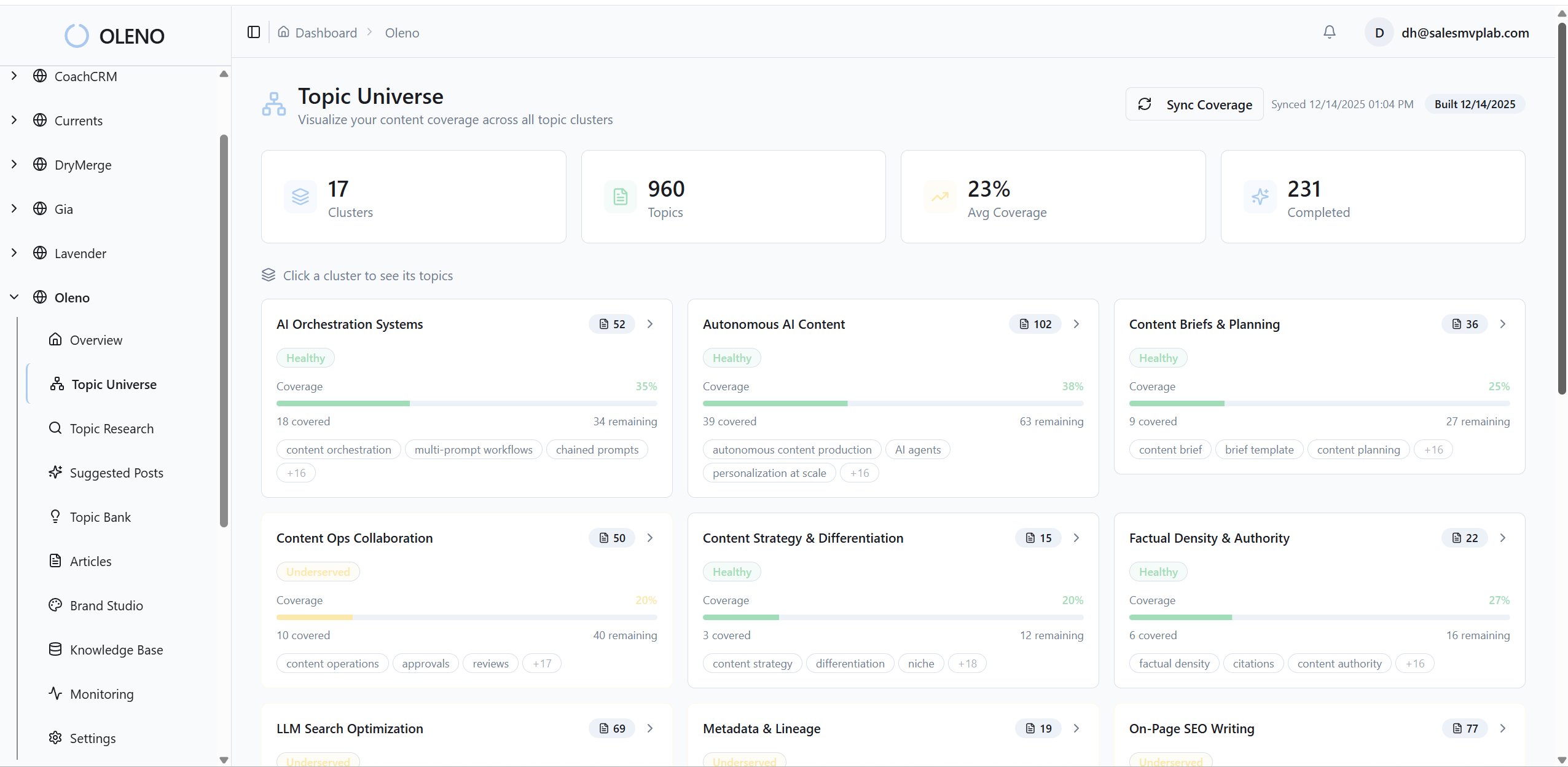
This directly counters the cannibalization cost we talked about earlier. Instead of two near-duplicates competing, the system funnels effort to net-new angles that strengthen the cluster.
Brief Generation With Information Gain Scoring And Sources
Every approved topic becomes a structured brief inside Oleno. Competitive research runs before writing, a uniqueness score flags shallow outlines, and external authority candidates are included. Writers (and AI) then work inside clear constraints. That upstream clarity shrinks the edit loop you’re currently paying for in hours every week.
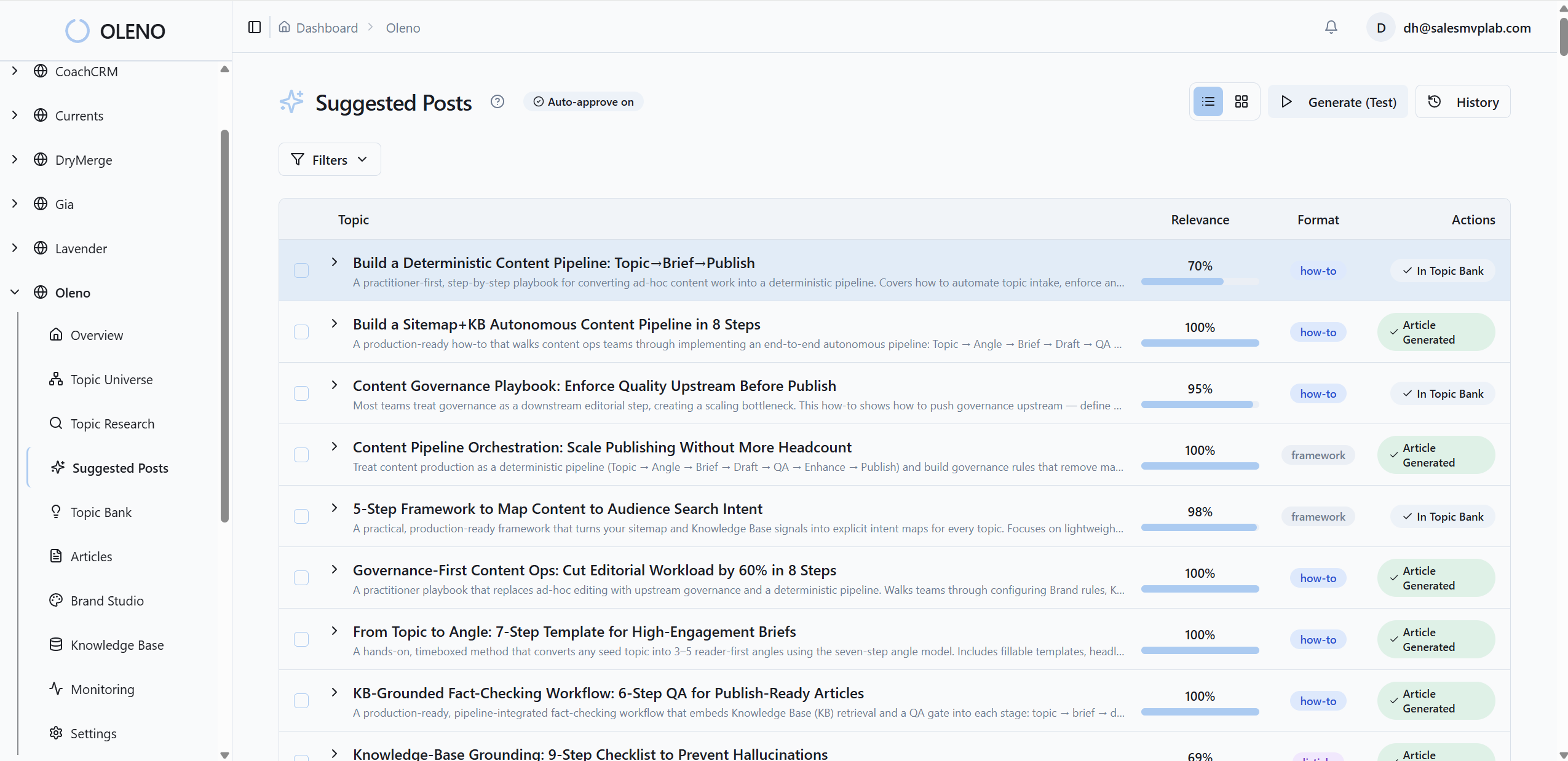
It’s not a silver bullet; it’s a constraint. And constraints, applied early, are why pass rates stabilize as headcount grows.
QA Gate, Deterministic Linking, Schema, And Visuals As Code
Oleno runs 80+ automated checks for structure, voice alignment, information gain, snippet-ready openers, and visual consistency. Internal links are injected from your verified sitemap with exact‑match anchors. JSON‑LD for Article, FAQ, and BreadcrumbList is generated and validated automatically. Visuals come from Visual Studio: brand colors, logos, style references, and product screenshots matched to relevant sections.
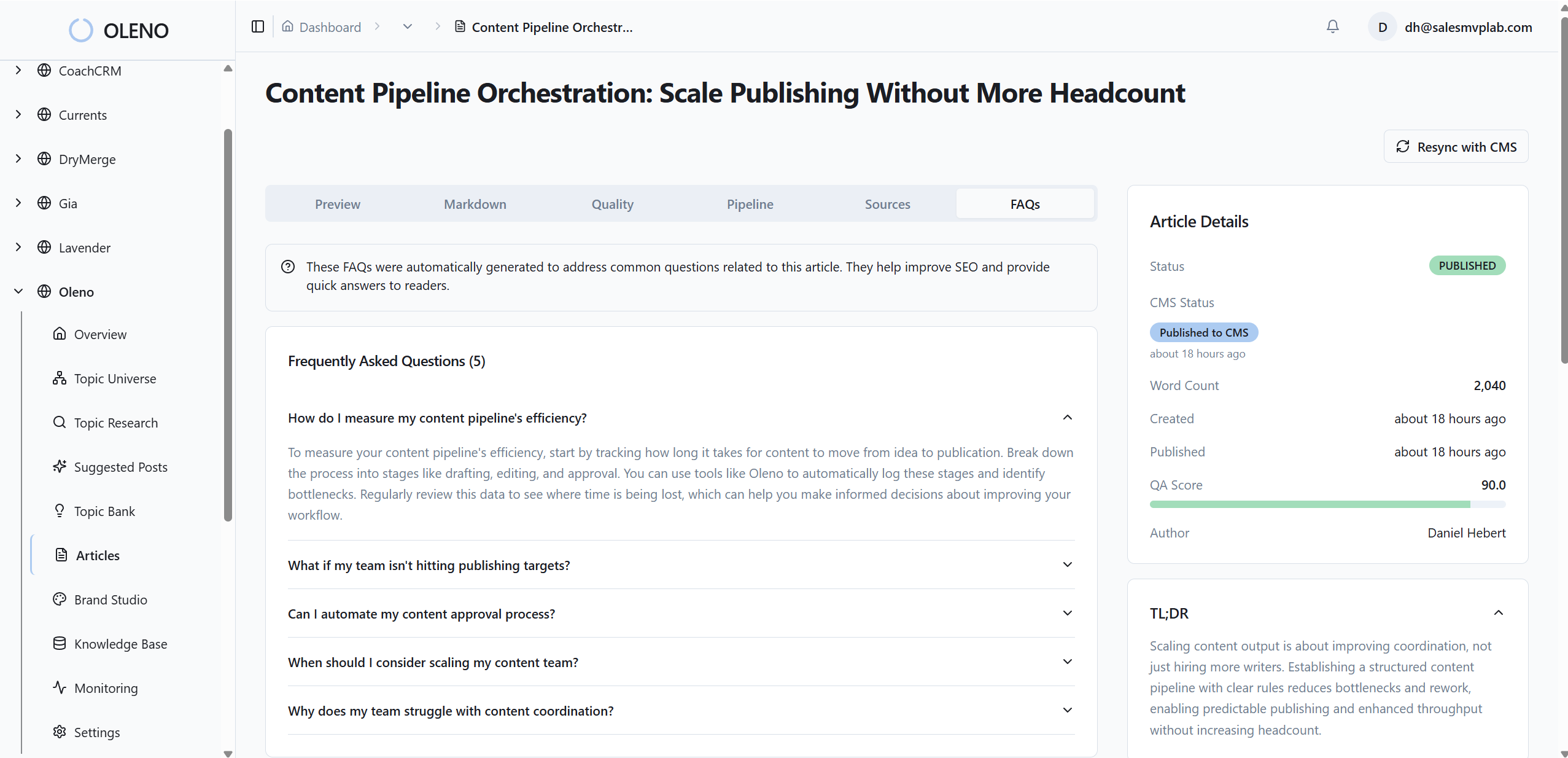
This is where the rework tax gets paid back. Instead of editors hunting broken anchors and missing alt text, the system prevents them from shipping. Fewer late-night fixes. Fewer partial publishes.
Oleno also delivers CMS‑ready HTML to WordPress, Webflow, and HubSpot with duplicate prevention and idempotent retries. Draft or live is policy‑driven. Delivery failures trigger notifications so you don’t wonder what shipped. Publishing becomes predictable, across brands, teams, and time zones.
Want to see it without a long setup? You can Try Oleno For Free and measure your edit minutes per draft before and after.
Conclusion
More writers don’t create more authority. Systems do. Centralize topics, standardize briefs, enforce structure, and turn links, visuals, and schema into code. Humans bring the story; the pipeline guarantees the rest. If you’re tired of frustrating rework and worried about rollbacks, move your gates upstream. Quality becomes the default, even when the team doubles.
About Daniel Hebert
I'm the founder of Oleno, SalesMVP Lab, and yourLumira. Been working in B2B SaaS in both sales and marketing leadership for 13+ years. I specialize in building revenue engines from the ground up. Over the years, I've codified writing frameworks, which are now powering Oleno.
Frequently Asked Questions