Content Quality Checklist 12 Essentials for Marketing Teams Scaling Output

You can publish 40 articles a month and still lose the category. If your content quality checklist 12 is just a Google Doc, you felt the failure this week: one draft hit Slack, three stakeholders rewrote the intro, and somehow the piece got worse instead of better.
Small SaaS teams love to blame output. More writers. Better prompts. Another SEO tool. Usually wrong. The real break happens when the rules behind good content live in one person's head and nowhere the workflow can actually enforce.
Key Takeaways:
- A real content quality checklist 12 isn't just 12 editing items. It needs to cover strategy, audience, product truth, structure, and distribution fit.
- Content quality usually fails from context gaps, not weak writers.
- If 3 or more stakeholders rewrite messaging late in the process, your checklist is too late in the workflow.
- Good content in the GEO era has to satisfy humans, search engines, and LLMs at the same time.
- The highest leverage move is to set rules once, then enforce them automatically across every draft.
- Mid-market SaaS teams don't need more content activity. They need governed execution.
- If your review process keeps catching the same mistakes, your system isn't learning.
If you want to see what governed execution looks like in practice, you can request a demo.
Why Most Content Quality Checklists Break at Scale
A content quality checklist is supposed to protect quality. In most SaaS teams, it turns into a cleanup ritual instead. The list appears at the end, after the damage is already baked into the brief, the outline, and the first draft.
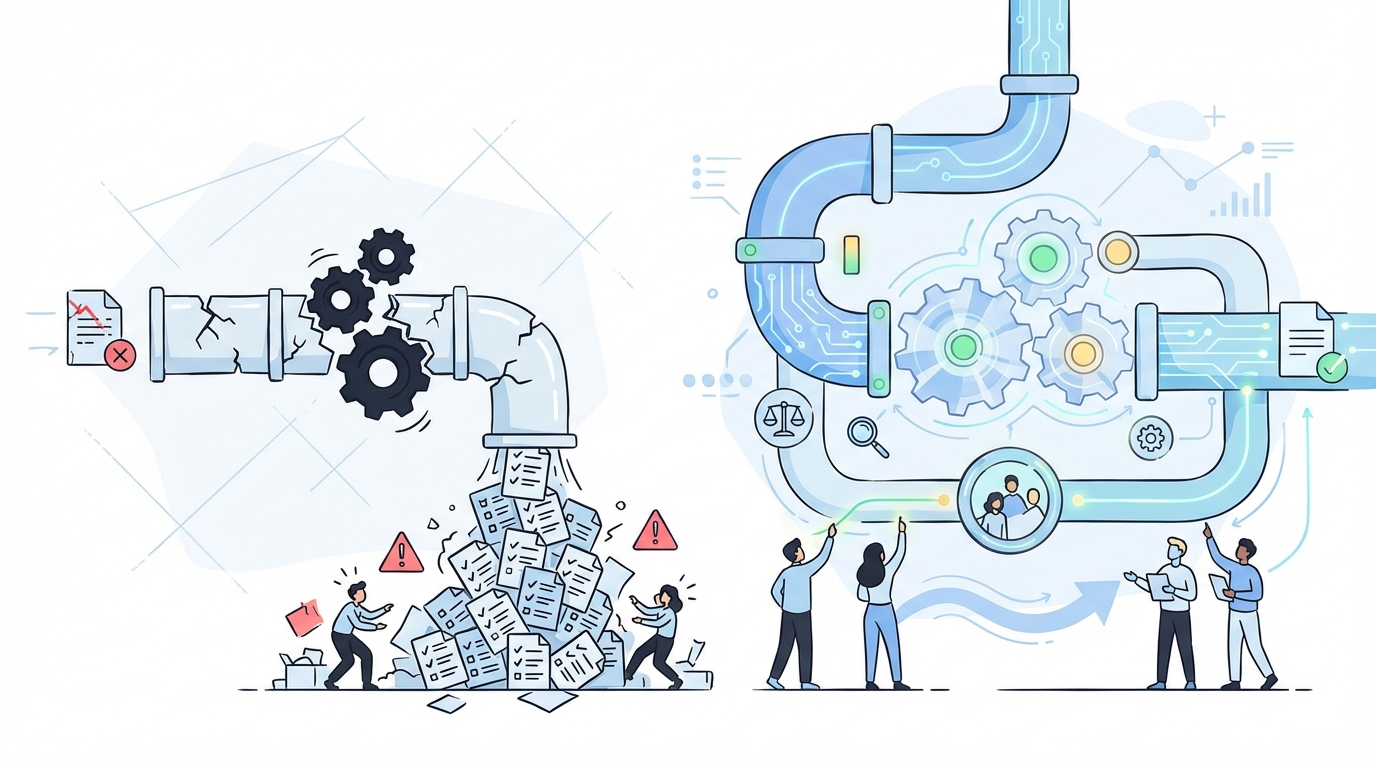
The checklist usually shows up too late
Back when I was the sole marketer on a SaaS team, I could crank out 3 to 4 high quality blog posts a week. That worked because the strategy, positioning, product context, and writing lived in one head. Mine. Once more people got involved, quality got weird fast. Not because people were bad. Because the context didn't transfer.
That's the first rule in what I'd call the Context Transfer Test. If quality depends on one person carrying the whole market story in their head, it will fail the second you add writers, PMMs, freelancers, or an agency. A checklist at the end can't fix missing context upstream. It just catches the wreckage later.
Picture a mid-market SaaS team on a Tuesday at 2:17 PM. The content lead is in Google Docs, PMM is dropping comments in the margin, demand gen is pushing in Slack for a Thursday publish date, and SEO is asking for one more subhead. By review round three, 47 comments are open and the intro still reads like it could belong to any competitor. Finance never sees the comments, obviously. They just see that one article absorbed six people's time and still needed a rewrite. That is how content starts looking expensive in a way leadership actually notices.
The root cause isn't writing quality
What if the writer isn't the real issue at all?
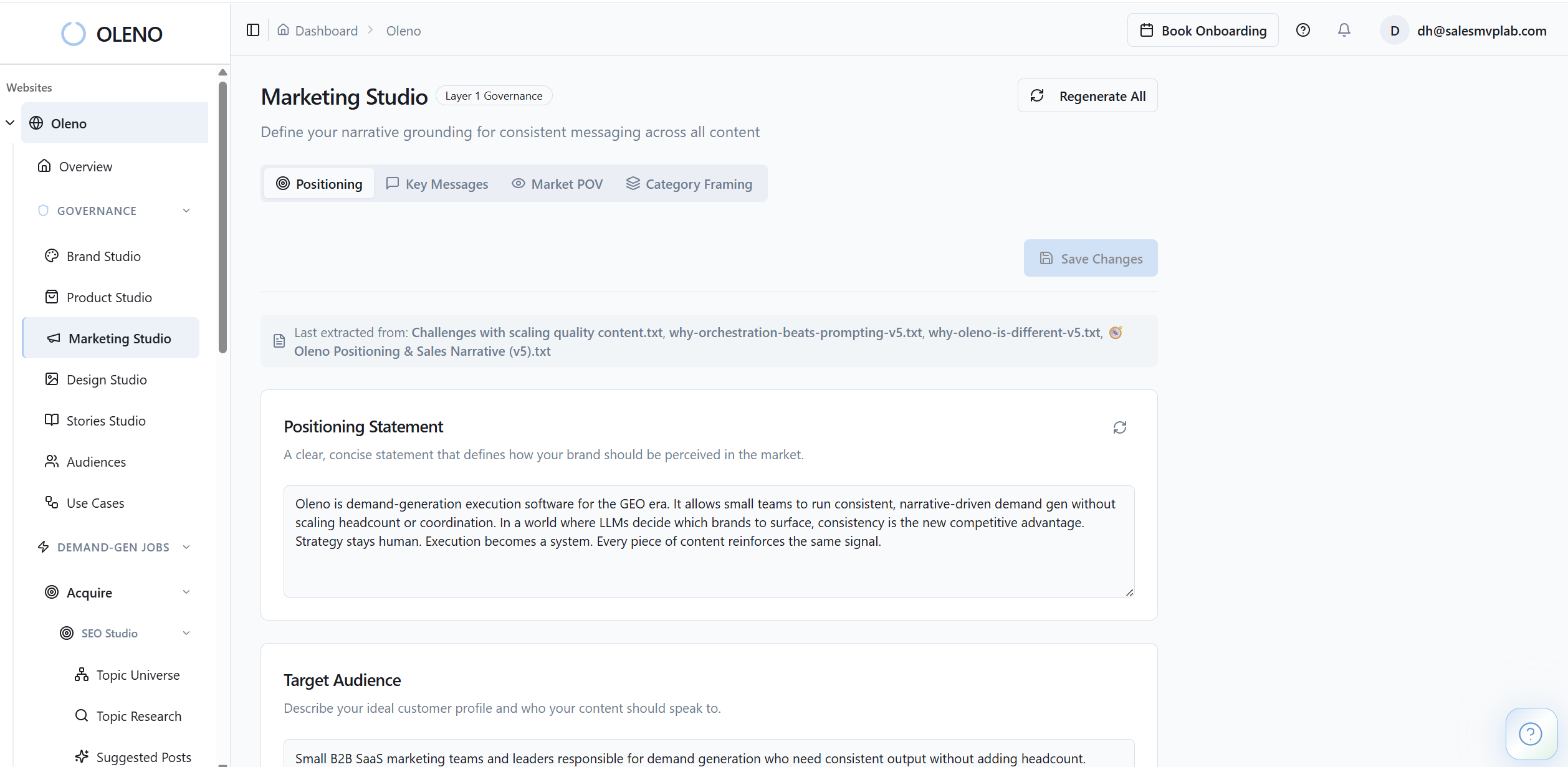
Most teams blame the writer, the AI, or the editor. Fair point. Sometimes the writing is the issue. But for scaling SaaS teams, the bigger problem is that the system has no idea what good looks like.
If your process doesn't encode your market point of view, core messaging, audience differences, product definitions, and tone rules before the draft gets made, then every draft becomes a fresh negotiation. Marketing argues with product. Product argues with demand gen. Leadership jumps in late because “this doesn't sound like us.” Then everyone decides AI content is the problem.
Not quite. What failed was governance. The mechanism matters here: missing context creates weak first drafts, weak first drafts trigger subjective reviews, subjective reviews expand stakeholder count, and bigger review groups produce narrative drift. That's why the same mistakes keep showing up. The system is not learning; it's relitigating.
The GEO era raises the bar
Three audiences now judge the same article: humans, search engines, and LLMs. That single shift makes an old-school content quality checklist 12 feel way too small if it's only checking polish at the end.
I've seen the scale effect before. Back when I ran Steamfeed, we hit 120k monthly visitors by building both breadth and depth. We saw jumps at 500 pages, then 1,000, 2,500, 5,000, then 10,000. Most pages got under 100 visits a month. Didn't matter. The catalog compounded because the quality bar was clear enough across a huge volume of content.
Here's the twist now. In GEO, consistency beats isolated brilliance. Search can reward one standout page. LLM retrieval tends to reward repeated signal across a body of work. Think of your content system like a podcast audio chain: if one mic sounds amazing and the next 20 episodes are muddy, listeners remember the mud. LLMs do something similar. They infer your brand from the average signal, not the heroic outlier.
And yes, late-stage review has a purpose. It catches obvious misses and legal or product issues. That's valid. But if your content quality checklist 12 only appears after the draft exists, you're using inspection to solve a manufacturing problem. The next question is obvious: what does a checklist look like when it actually prevents rework instead of documenting it?
The Hidden Costs of Low Content Quality
Low content quality doesn't just create a weak article. It creates drag across pipeline, trust, and team capacity. Once you see the cost structure, a content quality checklist 12 stops looking like editorial hygiene and starts looking like an operating control.
A 12-point checklist is too small if it ignores market truth
A lot of teams search for a content quality checklist 12 because 12 feels manageable. Fair enough. Nobody wants a 97-item monster taped to the wall. But if those 12 items are all editorial—grammar, readability, SEO, CTA, formatting—you've optimized the paint job and ignored the framing.
I'd break the work into the Five-Layer Quality Stack:
- Market truth
- Audience fit
- Product truth
- Structural clarity
- Distribution readiness
Before, teams often asked, “Is this polished?” After applying the stack, the better sequence is: “Is this true? Is it for the right buyer? Is the product claim accurate? Is the logic extractable? Is it reusable?” If Layer 1 fails, the rest barely matters. A grammatically clean article with fuzzy positioning is still weak.
This is where a lot of AI writing tools break. They're optimized around channel outputs—blog post, LinkedIn post, landing page. They don't understand the marketing plan underneath. That gap is bigger than people think, because market truth is what keeps 50 assets from sounding like 50 different companies.
Rework compounds faster than output
At 30% rewrite distance, you do not have an editing problem. You have a systems problem.
Most mid-market teams miss this because output still looks healthy on paper. Drafts exist. Reviews happen. Things ship. But the metric that tells the truth is edit distance: how far does each draft need to travel before it sounds like your company?
Here's the rule I use. If the average article needs more than 30% substantive rewrite after first draft, the fault is upstream. If it needs more than 50%, stop scaling volume immediately for two weeks and fix inputs first. Otherwise you're hiring people to produce rework.
You can see this in live meetings. PMM says the positioning is off. Product says the feature explanation is wrong. Demand gen says it won't convert. SEO says the structure is thin. None of them are wrong. The draft arrived without a shared source of truth.
The emotional cost is real too
Contrast two teams. In one, a head of content reviews the last 10% of polish and signs off in 12 minutes. In the other, the VP Marketing reads every paragraph because three weird drafts slipped through last month and now trust is gone. Same org chart. Totally different energy.
There's a team cost people underrate. When every draft becomes a debate, your best marketers stop trusting the system. They review harder. They hold work longer. They become bottlenecks because they're the only ones who can catch the drift.
I've watched this happen in slow motion. First comes optimism. Then a few drafts miss the message. Then a product claim comes out a little too loose. Then leadership starts reading line by line because they don't trust what shows up. Pretty soon the promise of leverage is gone, and AI-generated content starts feeling less like acceleration and more like babysitting a smart intern who improvises facts.
To be fair, extra review can protect the brand. That's the status quo's real merit. But once the same people are fixing the same categories of mistakes every week, review is no longer quality control. It's unpaid production labor. So the real question becomes: what belongs in a better content quality checklist 12 if you want to stop the mistakes before they happen?
A Better Content Quality Checklist 12 for GEO-Era Teams
A strong content quality checklist 12 should work like a preflight system, not a cleanup list. It should tell you whether the draft deserves to exist, whether it matches your go-to-market reality, and whether it can scale without leadership rewriting it by hand.
1. Start with message fit, not sentence polish
Bold claim: if the article could be published by a close competitor with only minor edits, it already failed.
The first check is brutally simple: does this piece argue your position, or could it belong to anybody in the category? Most teams go straight to style, formatting, and SEO. That's backwards. If the article doesn't reinforce your market point of view, you're publishing noise.
I use a rule here called the 60-Second Forward Test. If a VP Marketing reads the first three paragraphs and still can't tell what your company believes, the article fails. No exceptions. In category content, the job is to make the old way feel incomplete and the new way feel inevitable.
A solid content quality checklist 12 check here looks like this:
- Does the article name the real enemy clearly?
- Does it explain the old way vs. new way?
- Does it reflect your core differentiators?
- Does it sound like your company, not a neutral publisher?
If 2 or more answers are no, stop editing and rework the angle.
2. Diagnose audience fit before you approve the draft
What kind of “good” article gets read and still does nothing? One written for a fictional generic reader.
For a CMO or VP Marketing audience, the article should reflect executive stakes: ROI, coordination cost, consistency, narrative control, team scale. If the examples sound like solo creator pain or generic freelancer problems, you're off target before the second section.
Use the Three-Question Audience Screen:
- Would this matter to the persona's actual job this quarter?
- Would they use this language in a meeting?
- Would the examples fit their company size and team shape?
If the draft fails 2 of the 3, it's off. Simple. Before: “This helps writers create better content faster.” After: “This reduces late-stage rewrites across PMM, demand gen, and content so leadership stops acting as the final editor.” One sounds helpful. The other sounds purchase-relevant.
3. Check product truth before you check persuasion
At 1 questionable product claim, the draft goes backward, not forward.
This one matters more than people think. If your product explanation is fuzzy, stretched, or just slightly wrong, you don't only hurt trust with buyers. You create review debt internally. Product teams get pulled in. PMMs rewrite sections. Sales loses faith in the asset.
So the checklist needs hard boundaries:
- Are product descriptions accurate?
- Are feature limits respected?
- Are use cases grounded in reality?
- Is the content saying what the product does, not what we wish it did?
Some teams think this slows things down. It can. That's a fair criticism. But the tradeoff is worth it. I'd rather slow a draft by 10 minutes than spend 3 days cleaning up invented claims after the fact. Trust breaks faster than copy gets fixed.
4. Make structure do the quality work
A weak structure makes average writing look bad. A strong structure makes even decent writing carry weight.
This is especially true in GEO. If you want humans, search engines, and LLMs to understand the piece, the article has to answer implied questions quickly and cleanly. That's why content quality checklist 12 thinking can't stop at polish. The logic has to be extractable.
Use this Structure Load Rule:
- If a reader can't grasp the point of a section in under 70 words, the section is overloaded.
- If a heading could fit in 1,000 other articles, rewrite it.
- If the article teaches without giving decision rules, it's too soft.
A more operational version looks like this: if your team has 4 or more contributors touching content monthly, you need formal governance, not informal review habits. Before, the article says, “Review your content process.” After, it says exactly when the old process stops working. That's what makes a content quality checklist 12 usable.
5. Build one diagnostic section into every article
Backwards advice is everywhere: tell people what to do before proving you understand where they are.
One of the highest-trust moves in any article is diagnosis. Show the reader where they are before you prescribe the fix. It makes the content feel more credible because it proves you understand the situation, not just the theory.
So every content quality checklist 12 should ask whether the piece contains a diagnostic layer. Even a short one. Here are four buckets:
- Founder-led content with no repeatable system
- Growing team with context gaps and heavy rewrites
- Mature team with volume but narrative drift
- Large team with process, but weak category signal
Each bucket needs a different fix. If you're still founder-led, prioritize message capture. If you're in the 4-to-8 contributor zone, prioritize governance. If you've got process but no signal, prioritize sharper POV. That's the difference between advice and diagnosis.
And yes, there are exceptions. If you're a tiny pre-product startup, this kind of content quality checklist 12 is overkill. You still need to figure out what your product is and who it's for. On the other end, a huge enterprise may already have chunks of this solved. The painful middle is where this framework matters most.
6. Review distribution fit before you hit publish
Contrast a one-time article with a reusable narrative asset. Both can rank. Only one compounds.
The final check teams ignore all the time is this: is the asset shaped for how it will actually get used? A blog article that can't be repurposed into social, buyer education, category framing, or sales follow-up is less valuable than it looks.
Think of it like packaging software for release. The code might be solid, but if the deployment process breaks, users still experience failure. Content works the same way. The draft isn't finished when the article is done. It's finished when the narrative survives movement across channels.
So the last part of the content quality checklist 12 should ask:
- Is the core point of view clear enough to repurpose?
- Are there pull quotes, frameworks, and examples worth reusing?
- Does the article support an actual funnel stage?
- Can sales, PMM, social, or leadership borrow from it without rewriting the whole thing?
If not, you didn't publish an asset. You published an event. And events don't compound.
How Oleno Enforces Content Quality Without More Review Chaos
Once you know what belongs in a content quality checklist 12, the next problem shows up fast: who enforces all this without adding more review meetings? The answer is to move quality rules upstream so the draft starts from governed context instead of hoping reviewers catch drift later.
Governance first, output second
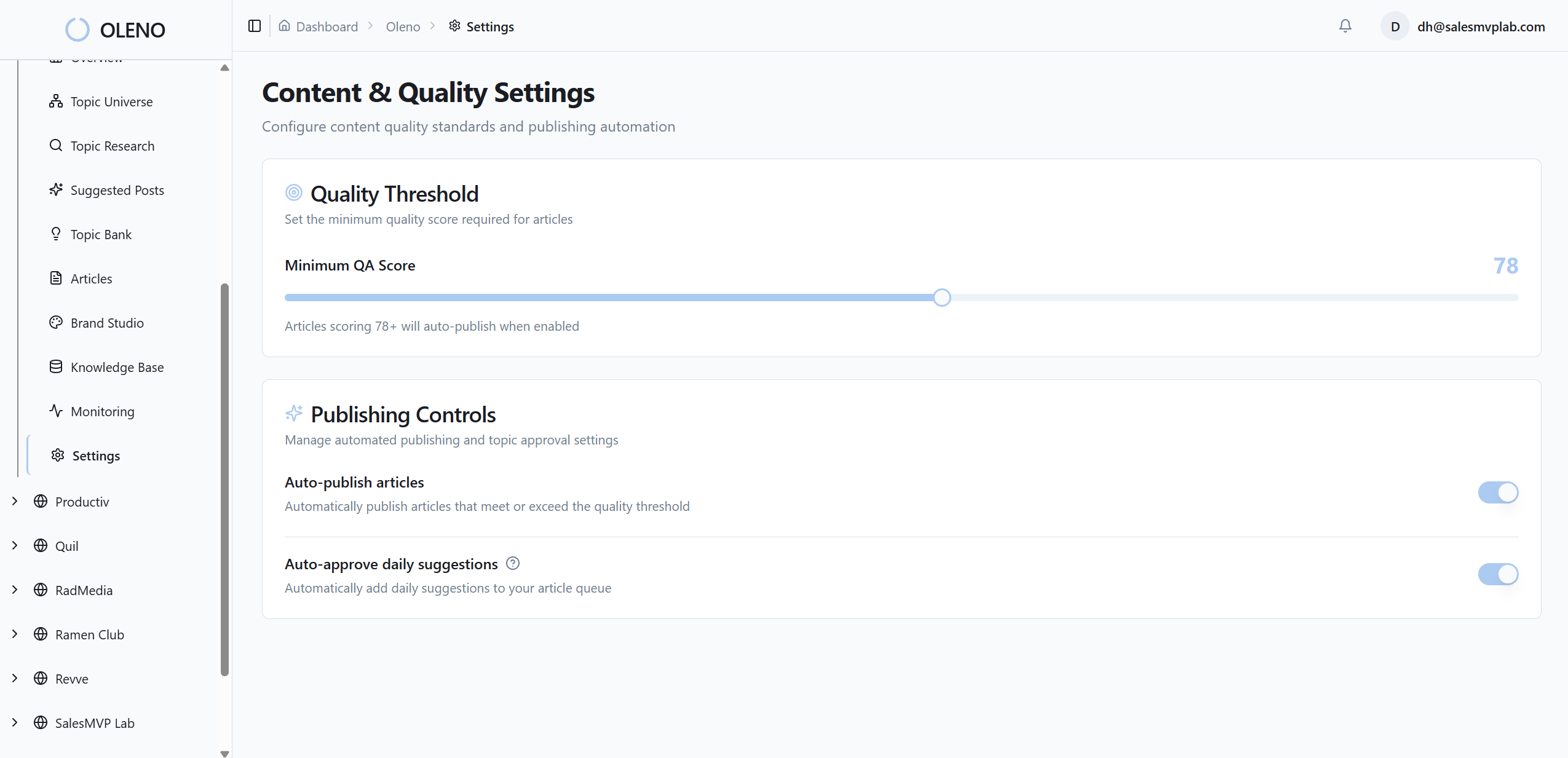
Oleno starts with Brand Studio, Marketing Studio, Product Studio, and Audience & Persona Targeting. That's important because the system isn't guessing what “good” means. Your team defines voice, positioning, product truth, and audience context once. Then those rules flow into briefs, drafts, and QA automatically.
That matters a lot for scaling SaaS teams. The issue usually isn't that writers can't write. It's that different contributors are working from different versions of reality. Oleno closes that gap by making the draft work from the same governed inputs each time.
Marketing Studio keeps the point of view intact. Product Studio keeps product claims grounded. Audience & Persona Targeting keeps the framing tied to the actual buyer. Brand Studio keeps the tone from drifting. So the content quality checklist 12 stops being a static document and starts acting like a rules engine.
The workflow runs like a system, not a prompt chain
Ask yourself one ugly question: are you running content ops, or are you just passing prompts around and calling it process?
Oleno uses Programmatic SEO Studio, Category Studio, Product Marketing Studio, Buyer Enablement Studio, Storyboard, and the Orchestrator to run job-based pipelines across the funnel. That's a very different model from prompting ad hoc and hoping the output is close enough.
If your team is trying to build category authority, this matters. Category Studio produces long-form, opinionated content shaped by your market POV. Storyboard allocates coverage across audiences, personas, products, and use cases so you don't keep publishing random pieces that look busy but don't compound. The Orchestrator keeps the pipeline moving against quotas and approved topics instead of relying on whoever had time that week.
Then Quality Gate steps in before anything reaches review. If a draft misses the bar on voice, structure, grounding, or clarity, it gets revised or blocked before the queue turns into a comment graveyard.
Executive teams get control without becoming bottlenecks
Fewer weird surprises. That's the executive win.
For a CMO or VP Marketing, the value isn't just more output. It's fewer late-stage rewrites. Fewer assets that look fine but miss the market story. Fewer moments where leadership has to become the emergency editor.
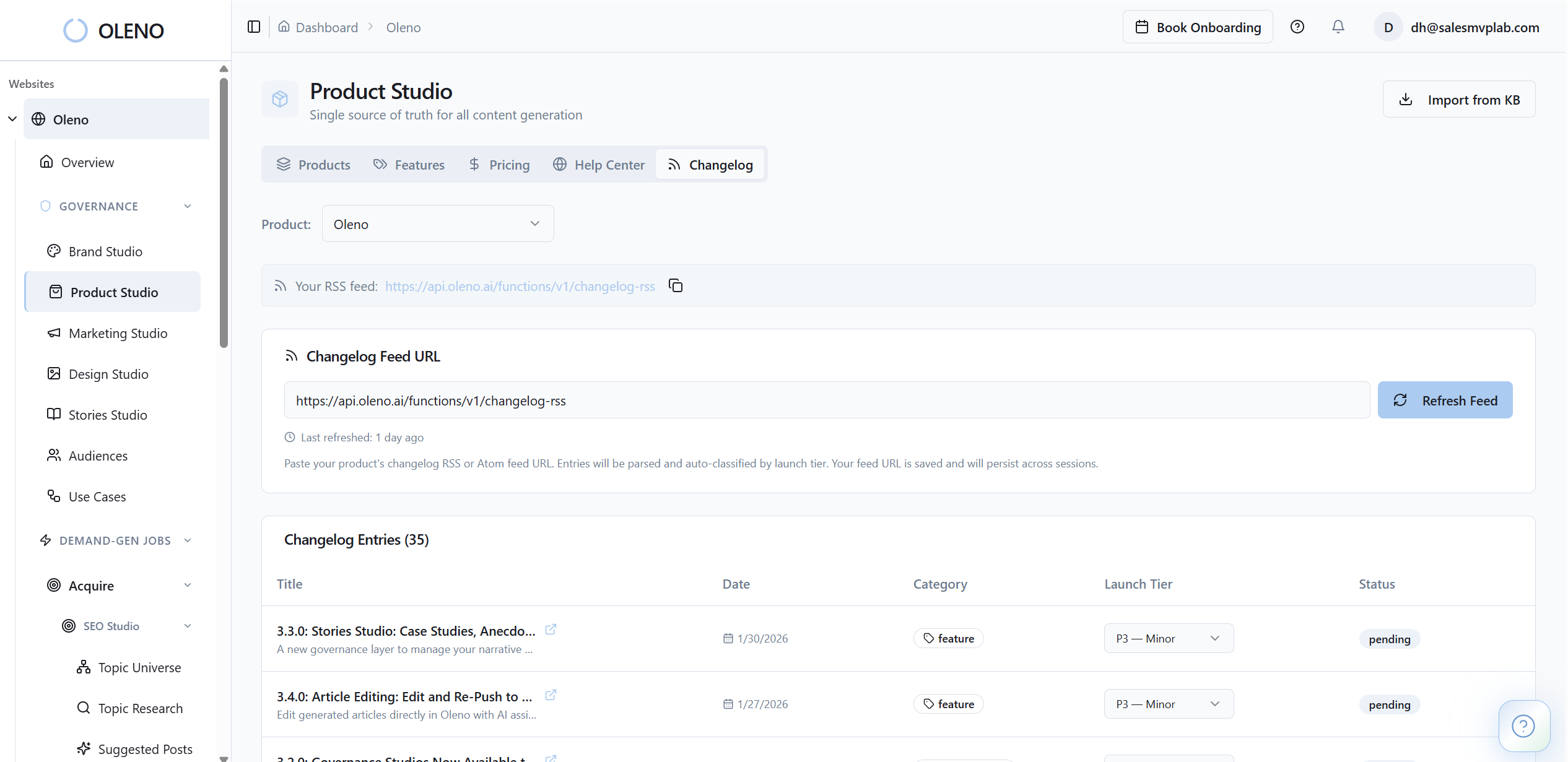
Oleno also gives leadership visibility through the Executive Dashboard, which shows output cadence, quality trends, coverage gaps, and pipeline health. So you're not left guessing whether the system is working. You can see where quality is holding and where it isn't.
One real limitation, because it's worth saying plainly: Oleno doesn't replace your whole stack. It doesn't do technical SEO, attribution, paid media, PR, or campaign strategy. That's true. But if your bottleneck is briefing, writing, editing, and publishing, that's usually the part killing consistency anyway. Ready to see how the governance layer and studios work together? Book a demo.
The Teams That Win Will Encode Quality, Not Review for It
If you're leading a content team in SaaS, this is the shift. Stop treating quality as something humans inspect at the end. Start treating it as something the system enforces from the start.
A content quality checklist 12 can still be useful. But only if it goes deeper than editing. It needs to check message fit, audience fit, product truth, structure, diagnosis, and distribution readiness. More importantly, it needs to live inside the workflow, not beside it.
That's where content starts compounding. Not when you publish more. When every piece reinforces the same signal.
About Daniel Hebert
I'm the founder of Oleno, SalesMVP Lab, and yourLumira. Been working in B2B SaaS in both sales and marketing leadership for 13+ years. I specialize in building revenue engines from the ground up. Over the years, I've codified writing frameworks, which are now powering Oleno.
Frequently Asked Questions