Content Quality SLOs: Define & Monitor Service Levels for Publishing
Quality problems aren’t mysterious. They’re invisible. If you’re publishing without service levels, you’re flying by feel and hoping your gut is calibrated. Sometimes it is. More often, it isn’t. That’s why teams stall on volume, argue about “good enough,” and burn cycles on frustrating rework that shouldn’t have happened in the first place.
Here’s the shift. Treat content quality like uptime. Define what “good” means, measure it with indicators, and set targets that guide speed vs. safety. You’ll still use judgment, but it won’t carry the whole load. And when the system drifts (it will), you’ll see it early, not at 3am.
Key Takeaways:
- Quality SLOs turn subjective edits into objective gates you can manage
- Error budgets let you trade speed for risk without gambling brand trust
- Map failure modes end to end, then translate them into SLIs you can monitor
- Quantify rework, drift, and publish delays to build urgency and buy back time
- Use simple instrumentation and playbooks, not a complex stack, to spot and fix issues
- Pair autonomous creation with SLOs to know when to pause, remediate, or accelerate
Why Quality Without SLOs Keeps Teams Stuck
Quality without SLOs stalls because decisions stay subjective and reactive. Teams argue over taste instead of using indicators and thresholds to guide release decisions. Borrow SRE principles: define quality targets and error budgets so speed is governed by policy, not vibes, especially when output volume grows.
The Editorial Gut Check Does Not Scale
Editorial instinct is useful. It just doesn’t scale a daily pipeline. When it’s three posts a month, you can wing it with smart people and a clean doc. But with 20, 30, 50 posts a month across contributors, instinct becomes a bottleneck. Edits pile up. Opinions diverge. And velocity collapses under the weight of review.
The fix is treating quality like a service. Name the few signals that predict “safe to ship,” define target windows, and decide up front how strict they are. That way, “good enough” is a threshold, not a debate. You’ll still catch edge cases in edit. You’ll just catch far fewer because the system blocks the obvious misses for you.
What Is An Error Budget For Content?
An error budget lets you move fast without pretending you’re perfect. If your SLO for QA pass rate is 95% over 30 days, your budget is the 5% you’re allowed to miss before you slow down. It’s the same principle you’ll see in Google’s SRE guidance on SLOs and echoed in IBM’s definition of service level objectives.
Here’s how it works in practice. You “spend” budget on experiments, new formats, or higher volume. If you burn it early, say QA pass rate dips to 91% mid-month, you pull back: route through human review, tighten rules, fix root causes, then accelerate again once you’re back in range. The point isn’t perfection. It’s governance. Decisions become policy-driven, not personality-driven.
Where do checklists fit? They’re necessary, not sufficient. A checklist without thresholds is just more tasks. Tie checks to SLIs and targets so you see drift, not just activity.
Early mover and ready to skip the theory? If you want to see a governed pipeline do the heavy lifting, Try Generating 3 Free Test Articles Now.
Where Content Pipelines Actually Break
Content pipelines break at the seams between steps. Discovery can choose the wrong topics, briefs can miss constraints, drafts can drift from voice or facts, QA can wobble, and publishing can duplicate or miss schema. Map the flow, name the failure modes, and make that risk visible to the team.

Map The Flow And Name The Failure Modes
You can’t fix what you don’t name. Start by drawing the full path: Discovery → Angle → Brief → Draft → QA → Visuals → Publish. At each stage, list the specific ways quality fails. Don’t be shy. It’s better to be honest once than surprised weekly.
Discovery misses competitive differentiation. Briefs omit voice constraints or clear intent. Drafts drift from the knowledge base or bury structure. QA becomes subjective and inconsistent across reviewers. Visuals look off-brand. Publish introduces duplicates, missed schema, or broken internal links. A simple wall chart or doc that lists these failure modes changes behavior fast because it gives the team a shared risk map.
From there, decide which failures get blocked automatically and which get flagged for review. Not every risk deserves a halt. Some just deserve a warning and a note.
Which Signals Tell You Quality Is Drifting?
Failure modes turn into SLIs. That’s the job. For example: QA pass rate, knowledge base grounding coverage, hallucination detection rate, revision loops per article, time to publish (p95), and idempotent publish success rate. Define the exact numerator, denominator, and time window for each. Keep it simple enough to calculate weekly without a platform overhaul.
A quick tip: keep windows short (weekly) for “early warning” signals and longer (monthly) for stability signals. If you want a primer on reliable SLI math and windows, skim Datadog’s guide to SLOs. The point isn’t to build dashboards on day one. It’s to make drift measurable so you know when to pause hands-off publishing and route through human review.
The Hidden Costs Of Flying Blind On Quality
Flying blind inflates cost and kills momentum. Rework stacks up, publish times slip, and trust erodes. The fix isn’t more meetings. It’s a small set of SLIs with thresholds and budgets, so you see drift early and act before issues compound into a backlog.
The Rework And Delay Compound
Let’s pretend you publish 20 posts weekly. If 30% fail QA late and each needs two revision loops at 45 minutes per loop, you just burned 18 hours. That pushes publish windows, compresses review capacity for new work, and creates a Friday pileup no one wants. It’s not just time. It’s lost momentum, plus a morale hit when Mondays start with cleanup.
Error budgets turn that pain into rules. When the budget burns too fast, you stop spending it on velocity and spend it on remediation. Not forever, just until the line is back in range. Most teams discover that a week of remedial focus buys back a month of predictable flow. It’s worth it.
The Downstream SEO And Brand Tax
Inconsistent structure and off-brand visuals create cleanup debt. Broken schema leaves rich results on the table. Duplicate posts confuse crawlers. Weak internal links stall topic clusters. Even if traffic holds for a while, trust wobbles. Fixing this debt later costs more, especially when you’re untangling duplicates or re-merging versions.
Think of it like service level management. The control point belongs upstream, at the gate, not downstream in cleanup. If you need a vocabulary for that conversation with IT, borrow from an ITIL-aligned overview of service level management. You don’t need their processes. Just their clarity about gates, targets, and accountability.
Still dealing with this manually across spreadsheets and Slack? When you’re ready to reduce rework and stabilize cadence, Try Using An Autonomous Content Engine For Always‑On Publishing.
When Quality Slips, People Feel It
Quality misses aren’t abstract. They show up as late‑night edits, tense Slack threads, and fragile trust. Give teams a clear policy, with SLOs and budgets, so the system slows itself before people burn out.
The 3am Publish No One Wanted
You push a piece live. Somebody flags an ungrounded claim. Slack pings start. One person hot‑edits in the CMS. Another reverts. Now you’ve got version drift and a morning headache. No one is wrong; the system is. A simple tripwire, “if grounding coverage dips below X, publish pauses,” would have saved the night and the goodwill.
This is what SLOs buy you. Not dashboards. Not more steps. Just a rule that stops risky automation before it bites you. Humans re‑enter the loop with a purpose: fix the upstream cause, restore the budget, then go back to hands-off.
A Short Story From The Trenches
When we scaled contributor content, volume worked, until quality slipped. We saw ranking wins, but some pieces drifted from the product story. Great writing, wrong direction. Leads didn’t convert. That one’s on us. Without explicit SLIs that measured business fit, not just craft, we created noise that looked good in analytics and felt bad in pipeline.
Later, as a solo marketer, I could crank out 3–4 strong posts a week by using a consistent framework. As the team grew, context spread thin and drafts took longer with lower confidence. The lesson stuck: define “good enough to ship” in measurable terms and make the system enforce it. Otherwise, you’ll argue your way through every week.
A Practical SLO Model For Content Quality
A practical model keeps the list short, the math clear, and the actions obvious. Choose 5–7 indicators, set thresholds and budgets, log minimal events, and write one-page playbooks. That’s enough to steer velocity safely without building a monitoring empire.
Choose SLIs That Reflect Real Risk
Pick indicators that predict harm if they drift. Start here: QA pass rate, knowledge base grounding coverage, hallucination detection rate, revision loops per article, p95 time to publish, idempotent publish success rate, and schema validation pass rate. Define each one precisely, numerator, denominator, and time window, so no one argues about the math.
Keep the set stable for at least a month before swapping anything out. Changing signals mid-stream makes it hard to learn. Also, don’t over-optimize. You’re not trying to model the universe. You’re trying to catch drift early and decide if you should pause, remediate, or accelerate.
If you want inspiration for pragmatic SLI design and burn math, skim Honeycomb’s SLO documentation. Their framing for windows and alerting translates well to content operations.
Set Thresholds And Error Budgets You Can Live With
Use cadence and risk tiers. Example for daily posts: QA pass rate 95% monthly (5% error budget). Knowledge base grounding coverage 90% weekly (10% budget). p95 time to publish under 24 hours weekly. Define burn rules now, not later. If any budget exhausts, you switch to human review and run remediation until indicators recover.
Keep instrumentation light. Log: QA outcomes, KB grounding scores, hallucination flags, revision loop counts, publish attempt status, and schema validation results. Store timestamps and article IDs, nothing fancy. A simple dashboard with rolling percentages and p95 times is enough to see drift quickly.
Write one-page playbooks tied to each SLI. If hallucination rate breaches, tighten grounding rules, update the KB, and enable human review for risky topics. If idempotent publish fails, trigger retries, check duplicates, and flip to draft mode. Name owners and expected time to recovery. Keep it blunt and actionable.
How Oleno Enforces Quality Gates You Can Trust
Oleno enforces quality as a gate, not a suggestion. Articles are created in your voice, grounded in your knowledge base, scored against strict criteria, and only published when thresholds are met. That aligns naturally with SLOs: you define the targets and budgets, Oleno handles the pass/block mechanics and consistent execution.
Automated QA Gate With Pass Or Block Policy
Oleno runs every article through an automated QA gate that scores structure, voice consistency, clarity, SEO placement, LLM readability, and knowledge‑base grounding. Below threshold, it revises and re‑evaluates automatically until the piece passes, or it doesn’t ship. No exceptions required, no late‑night scrambles.
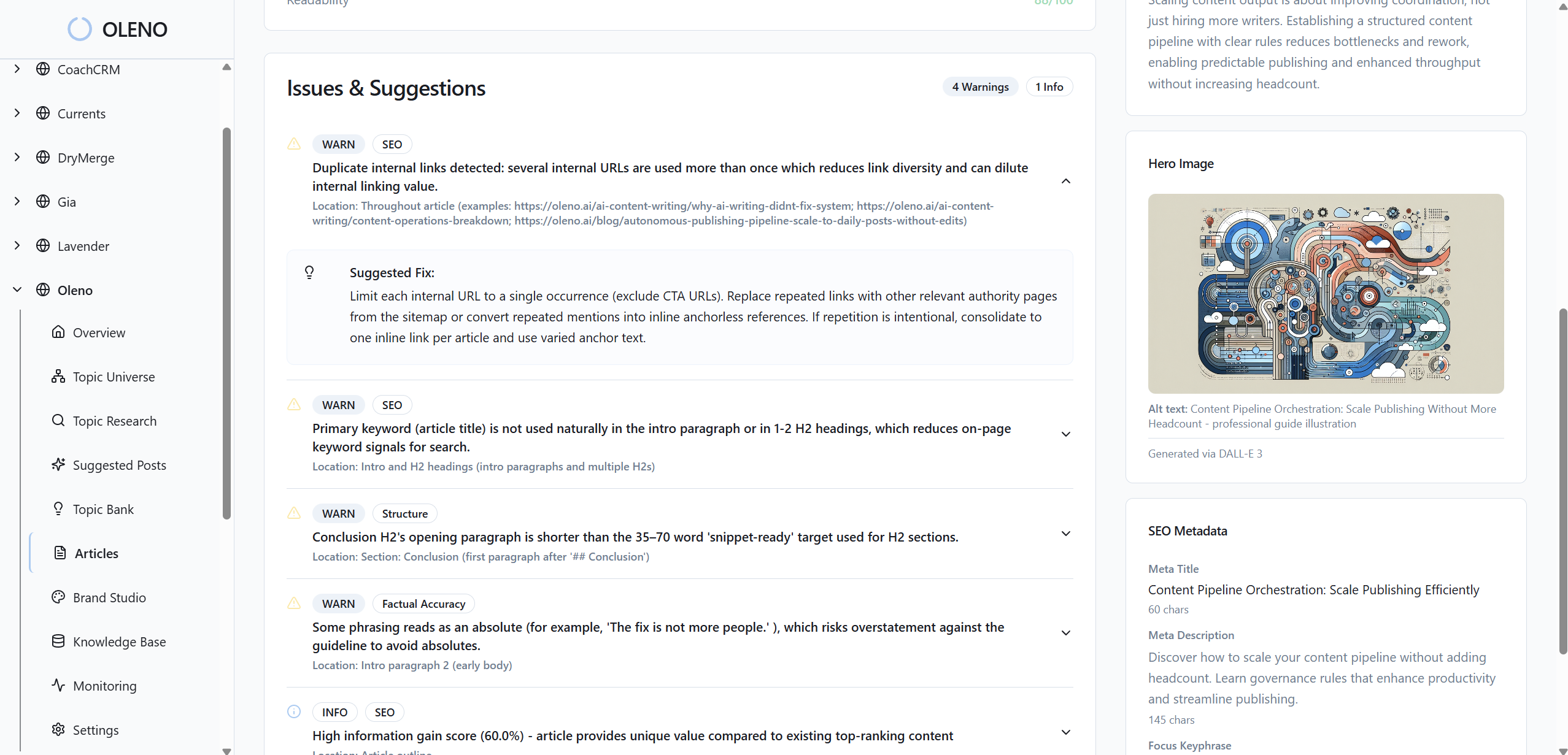
Because the gate is deterministic, your QA pass‑rate SLO becomes enforceable instead of aspirational. When pass rate dips, you’ll see it in your own simple dashboard, and you can tighten rules or route content through human review without changing the pipeline. Oleno doesn’t measure performance or track visibility. It just ensures quality is enforced before publish.
Deterministic Publishing, Idempotency, And Retries
Once content clears QA, Oleno publishes directly to your CMS, draft or live, using idempotent behavior to prevent duplicates. Automatic retries handle transient failures. That gives you clean, measurable signals for “time to publish” and “idempotent success,” which pair well with the SLO model you own.
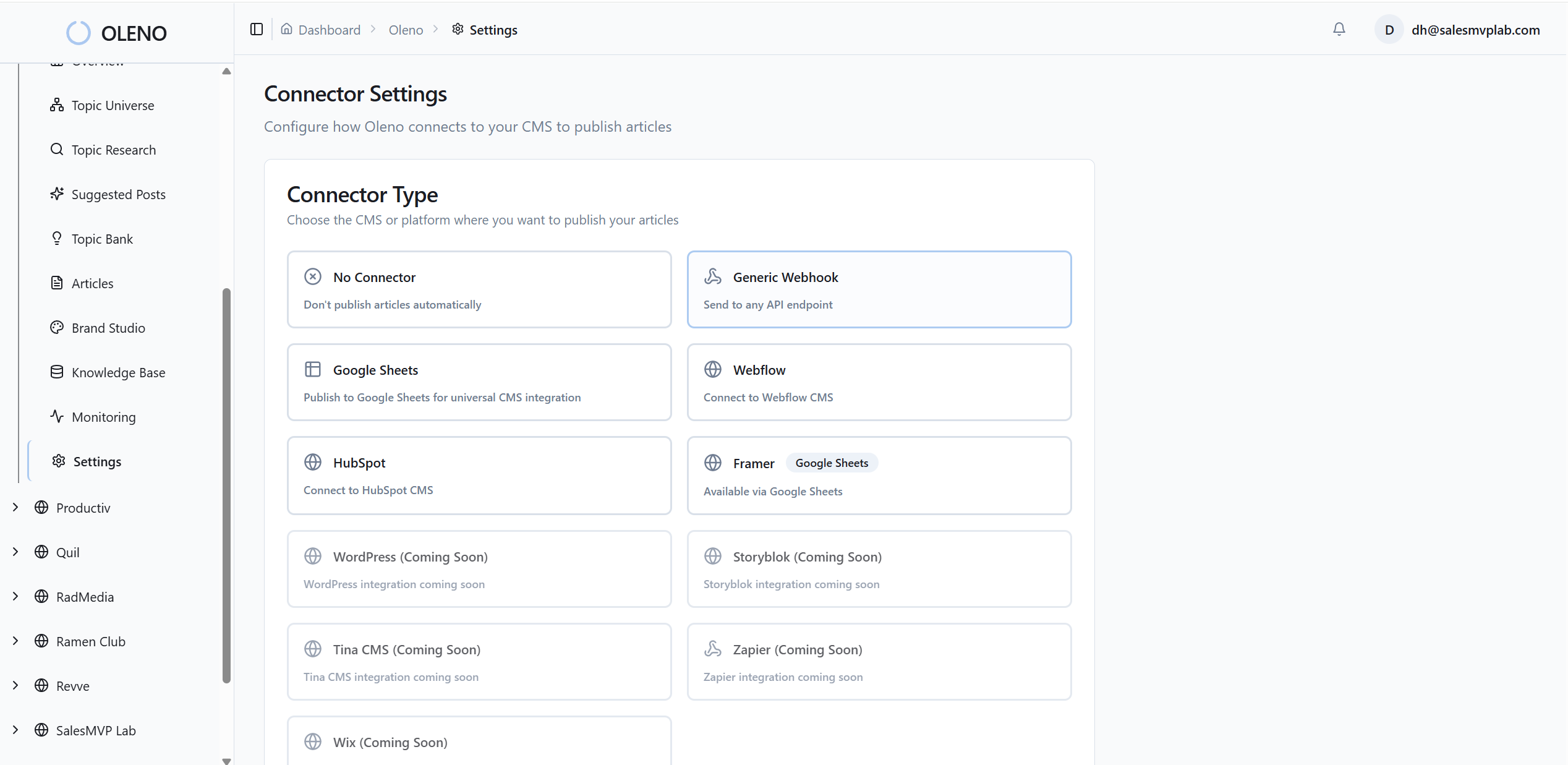
When your publishing error budget burns, you can switch Oleno to draft mode while you investigate issues. You don’t lose cadence planning or create duplicate entries during the incident. And because the steps are fixed: Discover → Angle → Brief → Draft → QA → Visuals → Publish, you get predictable operations you can trust.
If you’re ready to move from “we hope it’s fine” to “the system enforces fine,” let Oleno shoulder the gatekeeping so your team can focus on story and strategy. Try Oleno For Free.
Conclusion
You don’t need a bigger review committee. You need service levels for quality and a system that honors them. Define the few signals that matter, set thresholds and error budgets, and make the pipeline enforce pass or pause. The result isn’t slower content. It’s fewer surprises, less rework, and a cadence your team (and leadership) can actually trust.
About Daniel Hebert
I'm the founder of Oleno, SalesMVP Lab, and yourLumira. Been working in B2B SaaS in both sales and marketing leadership for 13+ years. I specialize in building revenue engines from the ground up. Over the years, I've codified writing frameworks, which are now powering Oleno.
Frequently Asked Questions