Content Refresh Playbook: Recover Lost Rankings in 30 Days

Most teams assume the fix for dropping rankings is “publish more.” I’ve made that call. It feels productive. It also hides the real problem: your best pages are drifting out of alignment with the SERP, with intent, and with how machines parse structure. You don’t need more content. You need faster refresh cycles on what already wins.
Back when I ran Steamfeed, we pumped out volume and rode the long tail. At Proposify, I saw the other side, great traffic, but content too far from the product to convert. The lesson I keep coming back to: when winners slip, stop shipping new pieces for a minute. Triage, refresh, republish. It’s production work, not a brainstorm.
Key Takeaways:
- Treat ranking decay as a production incident, not a writing problem
- Triage by measurable signals and business value before touching copy
- Lead every H2 with a 40 to 60 word snippet paragraph to win SERP features
- Consolidate cannibalizing pages and redirect into a single canonical winner
- Refresh in bundles: structure, schema, examples, and internal links together
- Use a 30-day window with clear owners, rollback plans, and draft publishing modes
Ready to skip the guesswork and see a working system? Try Generating 3 Free Test Articles Now.
Stop Publishing New Posts When Your Winners Are Slipping
Ranking decay is best fixed by refreshing pages that already rank and convert, not publishing net-new content. You’ll move revenue faster by lifting proven URLs than by chasing new keywords from scratch. Think incident response: identify slipping winners, scope the fix, and republish with precision.

The Fastest Wins Hide In Your Existing Library
If a page already ranks and influences pipeline, a small lift can show up in revenue this quarter. That’s the lever. Pull a quick list of URLs with declining impressions or CTR, confirm keyword displacement, and weigh business value. You’re reallocating effort from maybes to near-certainties.
Most teams don’t make this shift because creating something new feels easier than fixing something old. I’ve watched content calendars protect “momentum” while winners quietly decayed. It’s backwards. Winners deserve priority handling, a structured refresh plan, and a clean path to republish. Put the oxygen mask on the revenue pages first.
What changes do you make? Start with structure. Open each H2 with a direct-answer paragraph, tighten headings to match intent, and update examples that age badly. If a sibling post competes for the same term, consolidate it. And if the target intent moved, rewrite sections to match searcher language today, not last year.
What Is Content Decay And Why Does It Hit Your Best Pages?
Content decay is the slow slide you see when competitors refresh, SERP features evolve, and intent shifts. It shows up as position churn, a CTR dip, and lost snippet visibility. Your highest-value pages attract the most competition, so they decay first. They need proactive cycles, not set-and-forget.
We tend to notice decay late, after demos dip or pipeline gets jittery. That lag hurts. The fix is a standing refresh cadence for money pages. No drama, just discipline. Treat each refresh like a release: scoped changes, validation steps, and a scheduled republish. Your future self will thank you.
A quick mental model helps: pages live in states, healthy, slipping, or decaying. Healthy gets monitored. Slipping gets a light patch. Decaying gets a structured refresh. Reserve rewrites for misaligned or thin content. It’s a spectrum, not a binary.
Why Most Teams Respond With Net New Content
New content looks good on a calendar. It rarely reverses a ranking slide in time. It splits focus, dilutes crawl budget, and often cannibalizes the page you should be fixing. When budgets get tight, refreshing a small set of high-value URLs is safer than chasing unearned terms.
Publishing net-new also delays the hard question: what broke on the winner? Was it structure, intent, or internal links? You need to know. Because even if that new post ranks, you’ve left revenue on the table by ignoring the asset with momentum. I’ve done it. It bites later.
If you need a sanity check, skim the refresh approaches outlined in the Content Refresh Playbook. The tactics are familiar. The difference is urgency and sequencing.
Ranking Drops Usually Start With Signals You Can Measure In Hours
Early decay shows up in Search Console deltas: impressions slide, CTR dips by query, and keywords reshuffle. Snippet loss and technical issues amplify it. You can spot this within 24 to 72 hours with period-over-period comparisons, snippet checks, and quick status/canonical validation. You’re pattern-matching, not running a week-long audit.

Which Decay Signals Matter First
Chase the fastest signals that correlate with revenue: impressions trend, CTR by query, sudden keyword displacement, and competitor backlink swings. Pair that with a quick glance at snippet ownership and the SERP layout. If a People Also Ask unit expanded or a new listicle took the snippet, structure probably needs attention.
I like a 30-minute “is this real?” pass before doing anything heavy. Check the time window for seasonality distortion. Verify the page still resolves 200 with the right canonical. Confirm internal links haven’t been removed during a navigation update. You’re looking for simple, reversible issues first.
One more angle: compare your query mix. If branded queries hold while non-branded long tails drop, intent likely shifted or competitors added fresh, example-rich sections. That’s a content job, not a tech job.
How Do You Triage Pages In 30 Minutes?
Use a simple scoring model: traffic risk (how much could we lose), business value (pipeline or revenue influence), and update effort (hours, not days). Pull the top 50 slipping URLs, tag intent, score 1 to 5 on each dimension, sort, and lock the top 10 for this 30-day cycle.
The win here isn’t fancy math, it’s a shared view that speeds decisions. Sales, product, leadership, they see the same sheet. You cut the “what are we doing this month?” thread by half. And when someone wants to jam in a net-new idea mid-cycle, the stack-ranked list holds the line.
If you want a reference workflow for rapid response, the outline in What To Do After A Google Ranking Drop maps well to this triage rhythm.
What Traditional Audits Miss
Most audits obsess over titles and word count. They skip the mechanics that help machines select your answer. Lead each H2 with a snippet-ready paragraph, validate JSON-LD, and fix internal links so authority flows to the canonical winner. These aren’t cosmetic. They change how crawlers interpret your page.
I’m opinionated here because I’ve watched small structural changes punch above their weight. A clean, direct-answer intro can recapture a snippet you thought was gone. Consistent schema makes your page eligible for richer results. Deterministic internal links reinforce the right URL when cannibalization creeps in.
Core updates don’t help if your structure is noisy. Review the broader context of Google Core Updates to understand why clarity and intent alignment matter when the ground shifts.
Still dealing with this manually across five tools and a dozen tabs? Try Using an Autonomous Content Engine for Always-On Publishing.
The Hidden Costs You Pay When Decay Runs Unchecked
Even small CTR dips compound quickly across money pages. Cannibalization splits clicks and muddies relevance. Thin or off-intent content pulls down perceived quality. Add it up over a quarter, and you’re funding competitors’ growth with your inaction. This isn’t theoretical, it’s easy to model with conservative numbers.
What A 10 Percent CTR Drop Really Costs
Let’s pretend a money page drives 10,000 monthly impressions at 4% CTR and 2% conversion with a $200 AOV. That’s 400 visits, eight orders, and $1,600. A CTR drop to 3.6% is 40 fewer visits, roughly 0.8 fewer orders, and $160 gone this month. Spread across five pages over a quarter and you’re in five figures.
That model’s intentionally simple. Real losses snowball if position slides from 8 to 14 and you lose a snippet simultaneously. The invisible cost is pipeline jitter, sales planning becomes guesswork, and marketing spends cycles explaining variance instead of fixing root causes. I’ve sat in those meetings. It’s not fun.
Two notes to keep the math honest: adjust for branded vs non-branded mix, and watch for big seasonality swings. Then act on the conservative estimate like it’s real cash, because it is.
The Compounding Effect Of Cannibalization
Near-duplicate posts siphon clicks and confuse crawlers. You end up with two average pages instead of one strong one. The fix is straightforward: pick the canonical winner, consolidate overlapping content, redirect siblings, and reinforce the winner with internal links from relevant hubs.
This feels painful when a team “owns” each post, but it’s a net gain. Authority concentrates. Crawl signals get clearer. And future updates are simpler because you’re not maintaining two answers to the same question. I’ve watched this single decision reverse a slide more than once.
If you need tactics for consolidation and pruning, the outline in the Content Refresh Strategy Guide is a pragmatic place to start.
The Moment You Realize Your Money Post Fell Off Page One
You feel decay before you measure it. Pipeline stutters, then dashboards confirm the drop. Don’t panic rewrite. Calibrate. A structured refresh, snippet-ready sections, updated examples, clean schema, and reinforced internal links, usually moves the needle in a couple of weeks. Think bundle of fixes, not one magic tweak.
When Your Biggest Keyword Slips To Position 12
It shows up in one-on-ones before it shows up in Search Console. “Why are demos down?” Then you check: the core phrase dropped from 6 to 12 and CTR cratered. The instinct is to start over. Resist it. You need a surgical refresh, not a blank page.
Start with the SERP itself. What now holds the top spots? Are they leading with direct answers, adding current-year examples, or using tighter subheads? Match the structural patterns without copying content. Then shore up your authority with internal links from the right hubs and clean up schema so machines get the message.
I’ve watched this play out repeatedly: the right bundle of changes rescues the page without a full rewrite, and you protect the equity you already earned.
You Do Not Fix This With A Title Tag Alone
Title tweaks can help CTR, but recovery rarely comes from a single change. You need multiple fixes moving together: snippet-ready lead paragraphs, clear H2/H3 hierarchy, updated examples, precise schema, and internal links pointed at the canonical URL. Bundles beat one-offs.
There’s nuance. If intent truly shifted, you may need a deeper update, new sections, different examples, perhaps a consolidated sibling redirected in. Just document the choice so you’re not debating it mid-sprint next week. Progress stalls when refreshes become opinion wars.
For a grounded incident mindset, the rapid-response flow in What To Do After A Google Ranking Drop holds up well under pressure.
Run A 30-Day Refresh Like Production, Not Guesswork
A 30-day refresh cycle works when you lock scope, assign owners, and publish in controlled increments. Day 1 to 3: triage and select. Week 1 to 2: update and patch. Week 3: republish and monitor. Week 4: escalate or roll back. No heroics, just a release plan with gates.
Detect And Prioritize Fast
In the first 72 hours, pull a slip list from Search Console, tag intent for each URL, and score by traffic risk, business value, and update effort. If a page is decaying but still sits in positions 8 to 20, it’s high priority. Lock the top 10, assign owners, and freeze net-new content for the month.
This freeze is where teams wobble. But it’s the only way to protect focus. I’ve seen “just one new piece” sneak in and eat the hours needed to refresh a revenue driver. Your calendar exists to concentrate effort, not scatter it.
One small optimization: pre-draft snippet-ready intros for each H2 in a shared doc. It speeds editing and keeps structure consistent.
Update, Patch, Or Recreate, Which Should You Choose?
Use a simple decision tree. Patch if the page needs snippet paragraphs, headings, and schema. Update if intent shifted or examples are stale. Recreate only when the page is off-intent, too thin, or competing with a stronger sibling. Consolidate duplicates into the winner and redirect.
Document the decision in a one-page brief: what we’re changing, why it matters, and how we’ll validate success. This reduces churn during review and gives leadership a crisp status without a meeting. And if you reverse course later, you’ve got the paper trail for a clean rollback.
Interjection. Thin pages usually want consolidation, not polish.
On-Page Repair Checklist For SERP Features
Open each H2 with a 40 to 60 word snippet paragraph, revise meta to match dominant queries and outcomes, validate JSON-LD Article/FAQ, normalize H1–H3 order, refresh examples to current year, and update target terms in headings. Keep edits tight, you’re optimizing answerability, not inflating word count.
A good discipline here: run a quick pre/post diff of your structure. Did every section start with a direct answer? Are examples current and specific? Are FAQs actually questions users ask? And did you point at the canonical winner from your relevant hubs? Five minutes of discipline prevents a week of “why didn’t this move?”
If you want tactical guidance on republishing and redirects, this practical walkthrough on How To Refresh Old Content is useful for the mechanics.
How Oleno Automates A Safe 30-Day Refresh Workflow
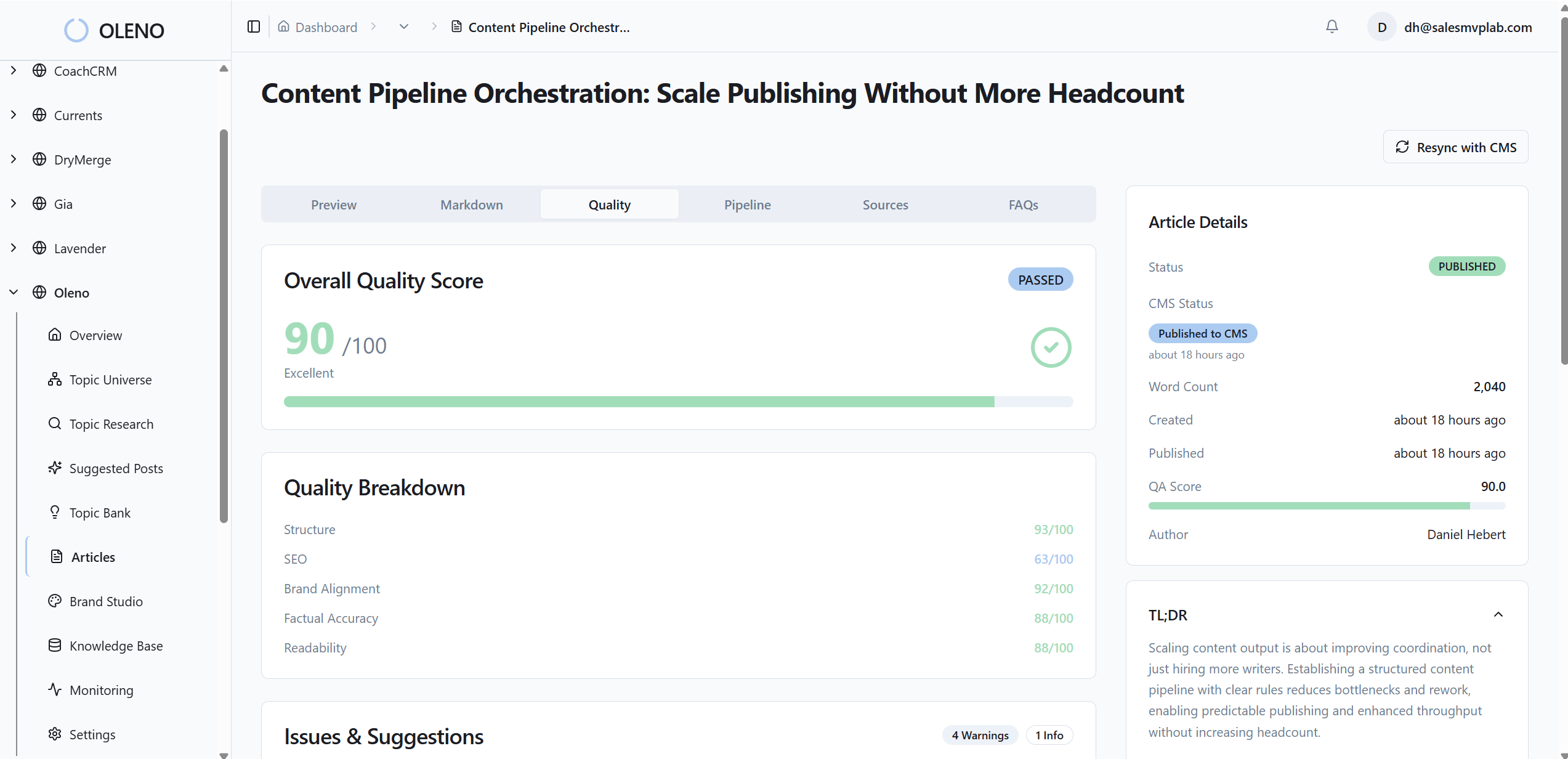
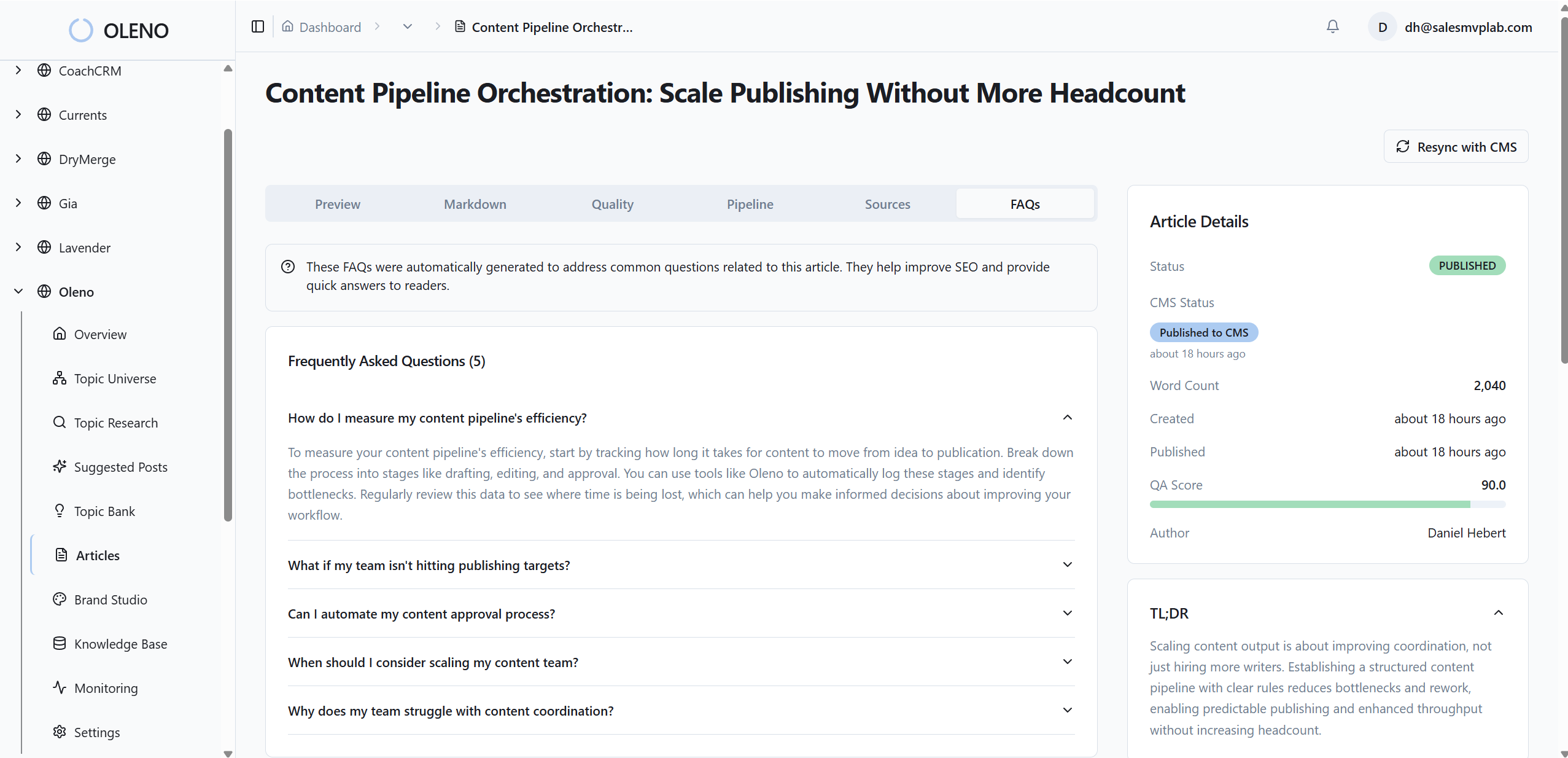
Oleno turns refreshes into a governed pipeline: snippet-ready structure, valid schema, deterministic internal links, QA-gated drafts, and safe publishing to your CMS. It doesn’t replace strategy. It enforces it, so your team spends time on narrative and examples while the system handles structure, links, and delivery.
Structured Sections, Schema, And Links Handled For You
Oleno opens every H2 with a tight, three-sentence snippet paragraph, so refreshed pages answer directly and cleanly. That supports snippet eligibility and improves scanability without bloating the page. Valid JSON-LD for Articles and FAQ is generated automatically, which reduces rich result failures when SERPs get picky about structure.
Internal links are injected programmatically from your verified sitemap with exact-match anchors. No fabricated URLs, no missed opportunities, no roulette. When you consolidate siblings and redirect to a canonical winner, Oleno reinforces that choice with deterministic internal linking so authority isn’t split by accident.
One early mention, because it matters: Oleno’s Visual Studio also ensures the solution section looks like your brand with consistent, on-topic visuals and product screenshots placed where they help understanding, without turning refreshes into a design project.
Quality Gate And Publishing That Prevent Regressions
Every draft passes more than eighty checks across structure, information gain, brand alignment, and snippet readiness. If a refreshed page misses the mark, Oleno triggers refinement loops until it clears the bar. That’s how you avoid frustrating rework after publishing and keep tone consistent when multiple people touch the same page.
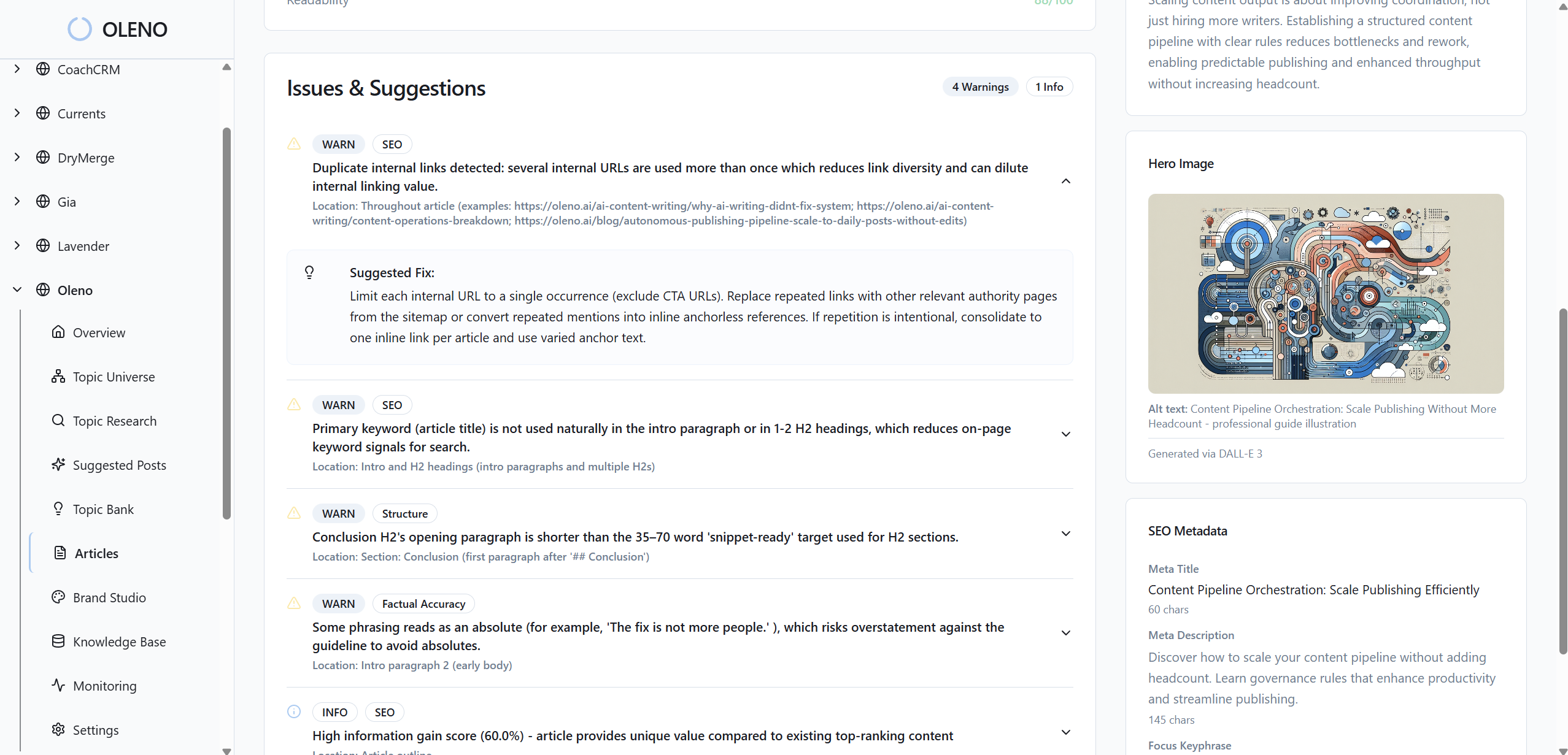
When you’re ready to ship, Oleno converts markdown to CMS-ready HTML and delivers directly to WordPress, Webflow, or HubSpot in draft or publish mode. Fields map correctly, canonicals are respected, and duplicate publishing is prevented. For high-traffic pages, you can republish in a staged rollout window and watch the deltas before scaling the change.
If you’ve been wanting guardrails baked into your process, you’ll appreciate that Oleno keeps the mechanics tight so your team can focus on content choices. Want to pressure-test it with your own pages? Try Oleno for Free.
Conclusion
Here’s the thing. You probably don’t need more posts this month. You need to stabilize the pages that already put points on the board. Treat decay as a production incident, prioritize by measurable risk, and refresh in bundles, structure, schema, examples, links, within a 30-day window. Then let a system enforce the guardrails so you don’t regress next quarter.
If you do that, rankings recover faster, pipeline stops wobbling, and your content doesn’t just look active, it compounds.
About Daniel Hebert
I'm the founder of Oleno, SalesMVP Lab, and yourLumira. Been working in B2B SaaS in both sales and marketing leadership for 13+ years. I specialize in building revenue engines from the ground up. Over the years, I've codified writing frameworks, which are now powering Oleno.
Frequently Asked Questions