Content Saturation Playbook: Cut Waste by Prioritizing Coverage Gaps

You don’t have a “more content” problem. You’ve got a “we keep covering the same ground” problem. Different headlines. Same substance. Search engines shrug, readers bounce, and the backlog grows. I’ve seen teams publish 20 pieces in a quarter and net out at zero momentum because they were stepping on their own toes.
The fix isn’t another brainstorm. It’s discipline around coverage and a system that blocks duplication before you write the first sentence. When you treat saturation as a constraint, not an accident, you stop wasting hours on near-twins and start compounding authority. That’s where things finally move.
Key Takeaways:
- Treat content saturation as a measurable condition at the intent-cluster level
- Score coverage overlap and information gain before approving new topics
- Enforce 90-day cooldowns to prevent re-covering the same idea too soon
- Merge or republish duplicates into a single canonical winner to concentrate equity
- Use snippet-ready structure and clean schema to increase citation eligibility
- Prioritize gaps, not ideas, so momentum compounds instead of stalls
Ready to skip the theory and see a system run it for you? Try Generating 3 Free Test Articles Now. Try Generating 3 Free Test Articles Now.
Why Volume Without Coverage Discipline Burns Budget
Publishing more content doesn’t create authority if multiple pieces answer the same intent. Saturation splits signals, confuses crawlers, and forces your readers to sift through near-duplicates. The fix is defining coverage at the intent-cluster level and enforcing rules before commissioning the next article.

What Is Content Saturation, Really?
Content saturation happens when multiple pages on your site answer the same search intent with similar substance. Not identical words, identical ideas. Search engines then split credit and your audience bounces because they can’t tell which page is the “one.” This is solvable if you treat coverage as a unit of planning. For most teams, that unit is the intent cluster, not the keyword.
Define the cluster. Map what you already have. Track density, overlap in the live SERP, and recency since last coverage. You’ll see patterns fast. A practical reference point: the structure and governance approach in the Official Content Strategy Playbook aligns with making coverage an explicit constraint. You don’t need fancy dashboards. You need to stop pretending duplication is subjective.
The Metric You Ignore That Quietly Stalls Growth
Most teams count posts and call it progress. They don’t score saturation. That’s the quiet killer. If you start labeling clusters by overlap, across your own URLs and the SERP, you change prioritization conversations overnight. Suddenly “we should write X” turns into “we should pause X, or republish with higher information gain.”
It’s a simple operational shift: add an overlap label, a cooldown field, and an information gain threshold in your brief. Then throttle topics that are hot and greenlight gaps. You’ll watch approvals get cleaner and production waste go down. If you want a pragmatic nudge, the mindset in 5 Top Tips For A Winning Content Playbook mirrors this: measure what causes quality, not just velocity.
Why Voice Alone Will Not Beat A Saturated Cluster
Voice is not a moat against duplication. If you say the same thing with nicer words, you’re still cannibalizing. The only escape is to add net-new information, unique claims, data, angles, or examples. That belongs upstream in your brief, not as a hope during editing.
Make uniqueness a checkbox with teeth. Require a minimum information gain before anything leaves planning. If the angle doesn’t clear the bar, pivot to a new job-to-be-done inside the cluster or consolidate into a single canonical page. It’s not glamorous, but it’s how authority compounds. “Stand out” content usually stands out because it adds something, not because it speaks louder.
Treat Saturation As A System Constraint, Not A One Off Problem
Saturation is a planning constraint you track and enforce, not a one-time cleanup. Build the rule into how topics get approved, when clusters can be re-covered, and why a piece ships or merges. When the constraint is visible, your cadence stays high without repeating yourself.

A Quick Story On Why Speed Without Structure Backfires
Back in 2012 to 2016, we scaled a site to tens of thousands of pages with dozens of contributors. Volume alone didn’t move the needle. Coverage depth and breadth, guided by structure, did. Later in SaaS roles, I watched small teams push hard, great writers, strong voice, but drafts slowed and differentiation dropped because context lived in people, not a system.
When speed outruns structure, you pay the rework tax. Editorial ping-pong. Duplicate angles. Off-brand tangents. The lesson I keep coming back to: speed helps only when there’s a governor that prevents overlap. That’s why we built systems to label clusters, enforce cooldowns, and force uniqueness checks before writing. It sounds rigid. It frees you up.
What Traditional Planning Misses
Keyword lists aren’t coverage maps. They ignore intent clusters, internal cannibalization, and the timing dimension, when a topic is safe to re-cover. Calendars filled with “ideas” feel productive, but they drift toward repetition because nothing says stop.
Replace ad hoc calendars with a simple topic universe. Cluster by job to be done, label each cluster by saturation, and approve topics on a gap-first rule set. You’ll still ship on time, you’ll just stop publishing two pieces that trip over the same intent three weeks apart. That’s the unlock.
How Do You Measure Coverage Objectively?
Use three inputs: your sitemap (what you already say), the live SERP (what the market rewards), and your knowledge base (what you must anchor). Cluster pages by intent, then compute page density, SERP overlap, and age since last coverage. Put that on a 0-100 saturation scale so editorial calls become informed, not personal.
If the score is high, don’t force it. Merge or republish with a clear information gain plan. If the score is low, go build the pillar. This is repeatable, teachable, and doesn’t require a BI team. You’re turning “I feel like we should…” into “the system says we should.”
The Hidden Costs Teams Underestimate When Topics Are Over-Covered
Overlap burns time, dilutes equity, and stalls authority compounding. The costs are sneaky because they hide inside “busy” work, briefing, editing, image sourcing, and internal link cleanup that adds zero net new value. Put numbers to it and the waste is hard to ignore.
The Hours You Never Budget For
Let’s pretend you ship 20 posts this quarter. If a quarter of those overlap, you’ll burn 40–60 extra hours on briefs, edits, and image work that don’t move authority forward. Double it if your design team has to retrofit screenshots and you’re hand-placing internal links. That’s real budget leaking into near-duplicates that compete with you.
This is where upstream gates pay for themselves. A basic information gain check and a saturation label in your brief cuts the false starts. Your writers don’t waste cycles, your editors stop refereeing similar drafts, and your designers aren’t churning art for content you’ll merge later anyway. Boring ops? Maybe. Effective? Absolutely.
The SEO Drag From Cannibalization
Duplicate intent splits signals across URLs. You dilute topical authority, lose snippets, and force crawlers to choose which page to rank. Over time, that slows compounding because you never consolidate into a clear canonical. A controlled cooldown and merge plan concentrates internal equity and stabilizes rankings.
If you need a bit of outside context on making saturated areas still win, the pattern outlined in Content Saturation No Problem is directionally aligned: focus on distinct angles and consolidation, not brute-force volume. The point isn’t more pages. It’s clearer signals.
Still fighting this with spreadsheets and editorial debates? There’s a faster way to operationalize it. Try Using An Autonomous Content Engine For Always-On Publishing. Try Using An Autonomous Content Engine For Always-On Publishing.
When Your Best Article Loses To Your Own Site
If your newest post steals traffic from last month’s and both slide, you’re paying the cannibalization tax. It looks like “we’re publishing” on paper and feels like “nothing moves” in the metrics. That’s not effort. That’s misallocation.
The 3 Month Backlog That Never Moves The Needle
You publish. Nothing moves. Sales asks for more posts, the backlog grows, and editing becomes a weekly headache. The instinct is to push harder. The fix is to publish differently. Stop re-covering safe ideas just because they’re familiar. Enforce cooldowns, score saturation, and require information gain before new work gets greenlit.
I’ve watched backlogs clear once this rule hits the planning meeting. You say no to good ideas because they’re not net-new. A month later, search stabilizes around a smaller set of canonical pages and your next re-cover window actually adds something, examples, data, product proof, rather than more words.
When Your Newest Post Steals Your Own Snippet
You ship a near twin. It outranks last month’s post for a week, then both drop. Painful. That’s classic cannibalization. Solve it by merging into one canonical winner, tightening internal links into that page, and refreshing the structure and schema to reinforce the topic’s intent.
If you need a baseline on consistent, citable structure, the YouTube Playbook isn’t about articles, but it’s a useful reminder: lead with clear answers and reinforce context visually. The same idea applies to web content, direct answers, clean sections, and supportive visuals tend to win and keep the win.
A Practical Playbook To Map Coverage And Prioritize Gaps
You can map coverage in a week and change approvals the week after. Start with an audit, add a simple scoring model for saturation and information gain, and enforce cooldowns. You’ll keep your cadence while cutting overlap.
Audit Your Topic Coverage Map
Export your sitemap. Normalize slugs, strip parameters, and map each URL to a primary intent. Cluster pages by job-to-be-done. Then tag each cluster for business relevance and current performance signals if you have them. This baseline shows where you’ve stacked multiple posts against the same searcher need.
Don’t overcomplicate it. You can start with a spreadsheet and a few rules. What matters is the clarity it gives the team: these are our pillars, these are our duplicates, and these clusters are underserved. Once you see it, planning stops being a debate and starts being a sequence.
Score Saturation And Information Gain
Put a 0-100 saturation score on every cluster. Weight three inputs: page density in the cluster, SERP overlap with your titles, and recency of last coverage. Heavier weight recent overlap. Flag any score above 70 as saturated and below 40 as a gap. Now layer information gain on each proposed brief: count unique claims, data points, and sources.
Require a minimum information gain threshold before writing. If a pitch doesn’t clear it, pivot the angle or merge into an existing canonical. This is where the editor’s job gets easier. You’re not arguing taste; you’re evaluating net-new value. Approvals become faster and quieter.
Enforce Cooldowns And Republish Rules
Add a 90-day cooldown per cluster. That single field changes behavior. During cooldown, you only republish if intent has shifted or you can materially raise information gain. For duplicates, choose: pause, merge with a 301, or canonicalize. Keep it transparent with a visible cooldown end date in your CMS.
Once you adopt this, you’ll see fewer short-term spikes and more sustained growth from concentrated pages. It’s less satisfying day one. It’s more satisfying quarter over quarter. That’s the trade most teams need but rarely operationalize.
How Oleno Operationalizes Cooldowns And Gap First Planning
Oleno bakes these constraints into the system so teams don’t have to remember every rule. Topic Universe ranks suggestions by gaps, saturation labels, and knowledge base relevance. Brief generation calculates information gain before anyone writes. QA-Gate enforces structure and clarity, and publishing injects schema and internal links deterministically.
Prioritize By Relevance, Gain, And Saturation
Oleno’s Topic Universe keeps a live map of coverage. It ranks daily topic suggestions by cluster gaps, saturation labels, and how tightly a topic ties back to your knowledge base. Editors approve what actually moves authority forward, not just what feels timely. The effect is fewer duplicates with the same publishing rhythm you’re used to.
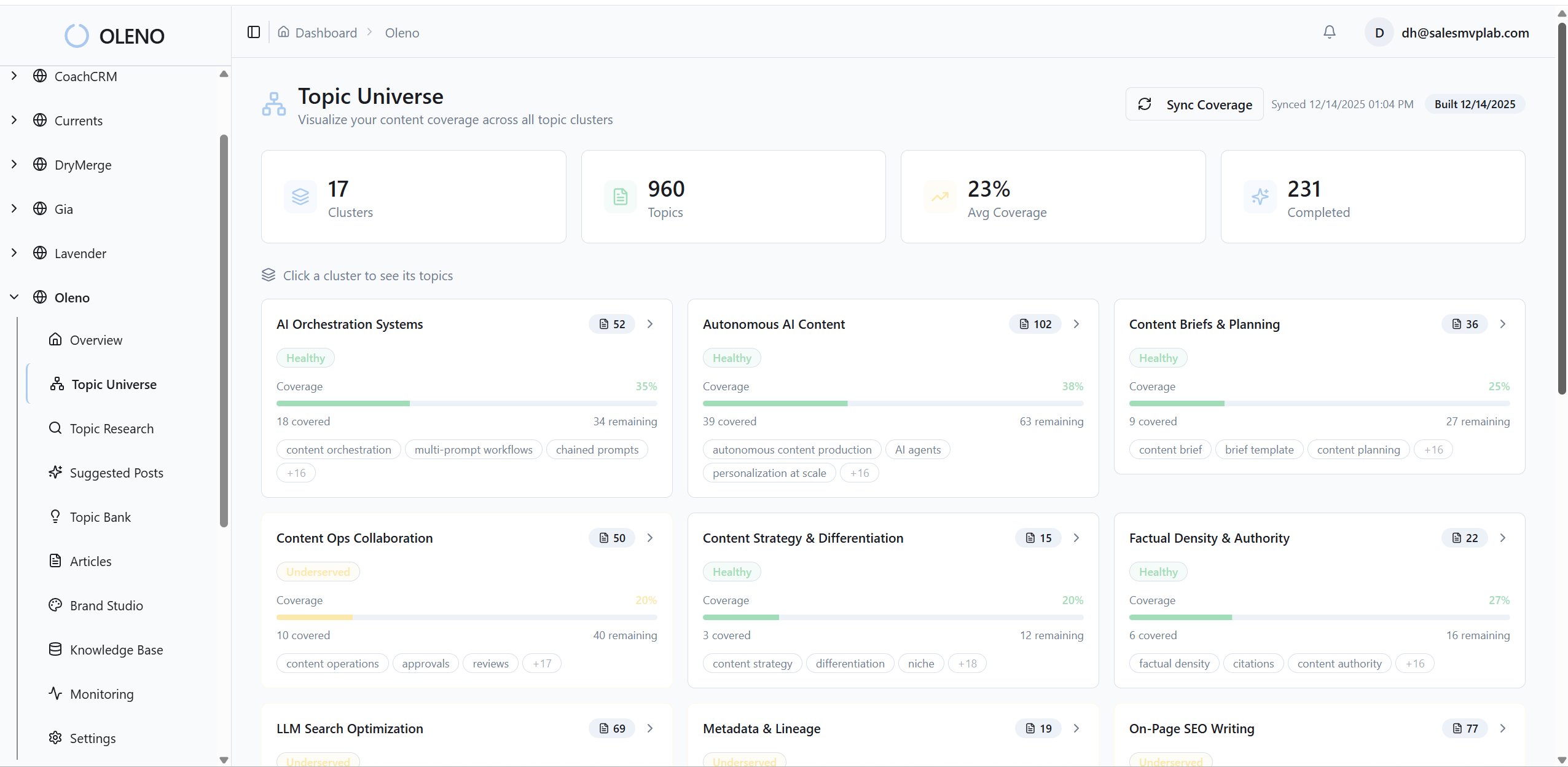
By pushing gap-first approvals, Oleno helps you cut waste without pausing your cadence. Think of it as a governor on the planning engine. You still move fast. You just stop re-covering an idea that’s already “hot” in your universe because the system says “not yet.”
Operationalize With Brief Templates And QA Gates
Every approved topic in Oleno becomes a structured brief that includes competitive research and an Information Gain Score. Low-gain outlines trigger warnings upstream so you don’t pay for drafts you’ll merge later. When the draft is ready, QA-Gate checks voice, structure, snippet-ready openings, and narrative order against 80+ criteria before anything ships.
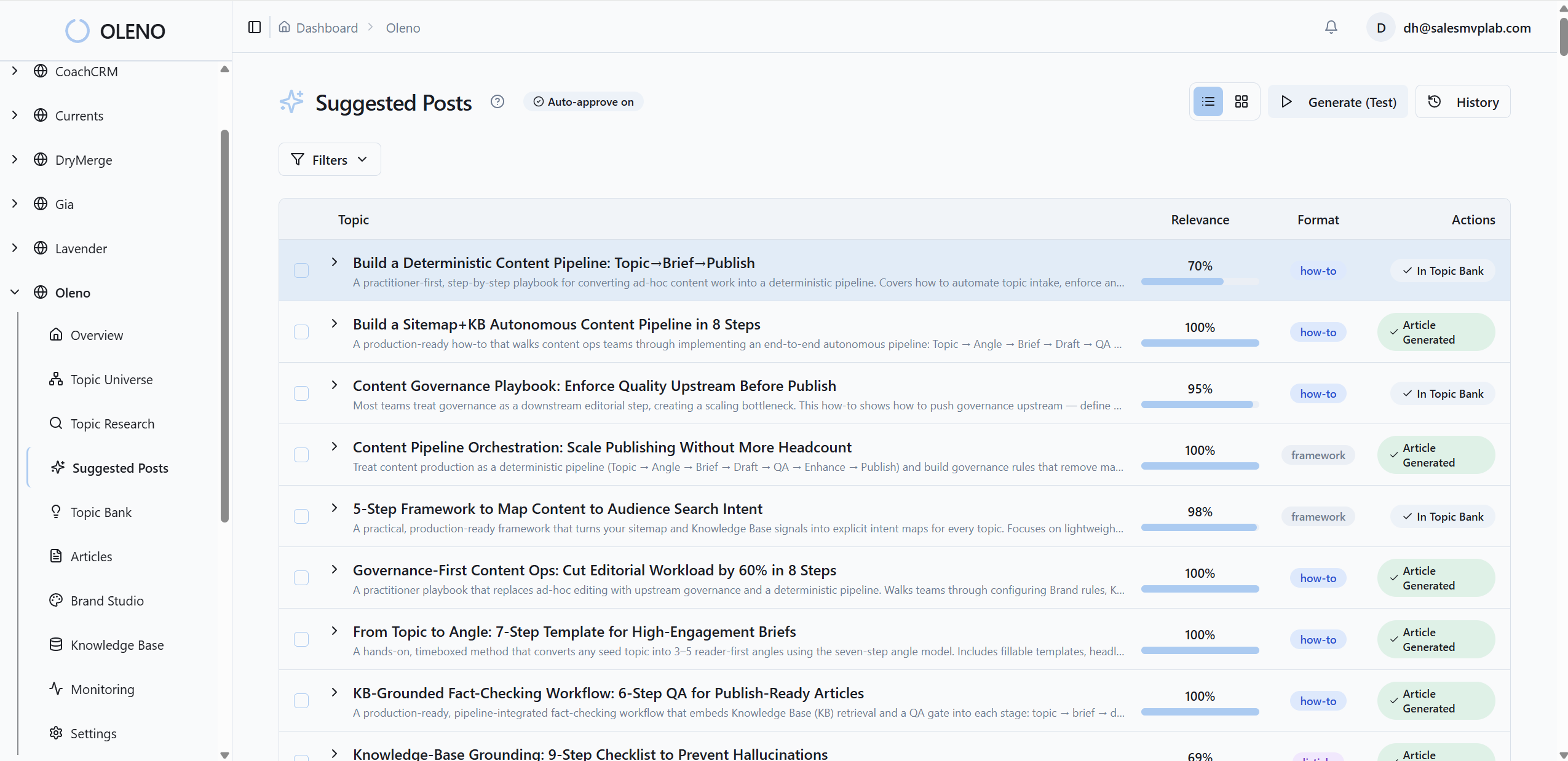
No heroics required from editors. No manual enforcement of the boring parts. Oleno handles the guardrails so your team can focus on the story, the examples, and the product truth you want to push forward. And yes, you can still tune the brand voice, once.
Deterministic Linking, Schema, And Recovery
When it’s time to publish, Oleno injects internal links from verified sitemaps only, matches anchor text to page titles, and places links at natural sentence boundaries. Schema is generated programmatically for articles and FAQs. Publishing connectors push clean, production-ready content directly to your CMS, preventing duplicates by design.
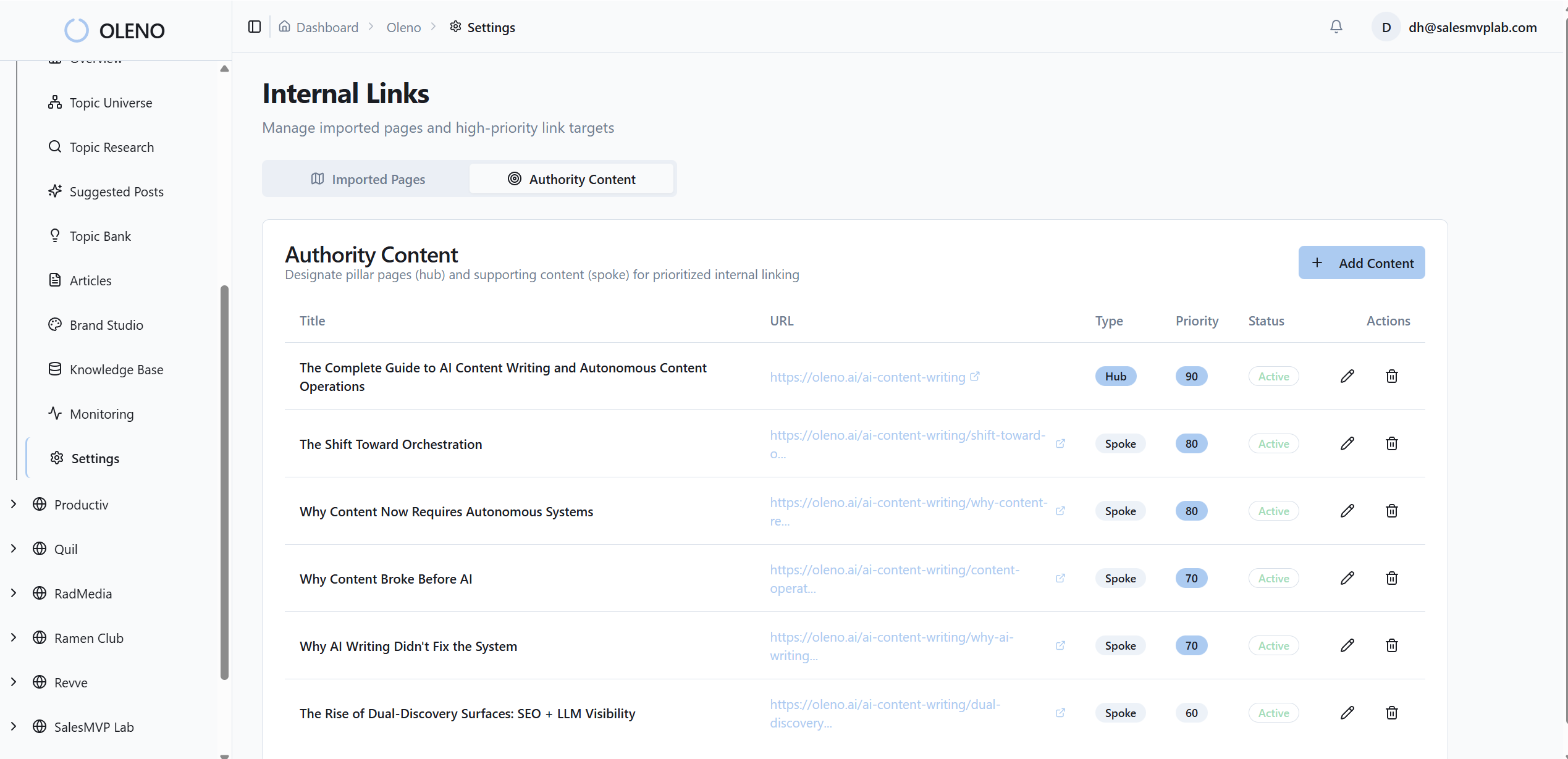
This matters when you recover from saturation. Merged pages get consistent crawl paths, the canonical wins, and your next re-cover window actually adds something. The system helps you avoid shipping another near-twin that confuses crawlers and readers. That’s the cost you remove, the hours and the erosion of signals you felt quarter after quarter.
If you’d rather see it than talk about it, spin up a small test. Try Oleno For Free. Try Oleno For Free.
Conclusion
Coverage discipline beats volume bias. When you plan by clusters, score saturation and information gain, and enforce cooldowns, you stop fighting yourself and start compounding. Whether you run it with spreadsheets or let an engine like Oleno enforce the rules, the outcome’s the same: fewer duplicates, clearer signals, and content that finally pulls its weight.
About Daniel Hebert
I'm the founder of Oleno, SalesMVP Lab, and yourLumira. Been working in B2B SaaS in both sales and marketing leadership for 13+ years. I specialize in building revenue engines from the ground up. Over the years, I've codified writing frameworks, which are now powering Oleno.
Frequently Asked Questions