Content Scaling Playbook: Framework for Agencies Handling Multiple Brands

72 hours into most content scaling projects, the same thing happens. Drafts start sounding off, product details get fuzzy, and your PMM becomes the human QA layer for a machine that was supposed to save time.
That’s why most so-called content scaling playbooks break. They optimize production speed, but they ignore the thing that actually makes marketing work: strategy encoded into execution.
Key Takeaways:
- A real content scaling playbook starts with positioning, audience, product truth, and voice. Not prompts.
- If your PMM is rewriting claims, examples, and messaging in every draft, you don’t have scale. You have hidden review debt.
- The bottleneck usually isn’t writing. It’s fragmented execution across SEO, content, PMM, and demand gen.
- In the GEO era, consistency across 100 pieces matters more than one great article.
- Small teams can scale content without adding headcount, but only if quality gates block weak output before it ships.
- Canonical product definitions and governed messaging are now table stakes for reliable AI-assisted content.
- The best content scaling playbook is really an operating model, not a writing trick.
Why Most Content Scaling Playbooks Fall Apart in Practice
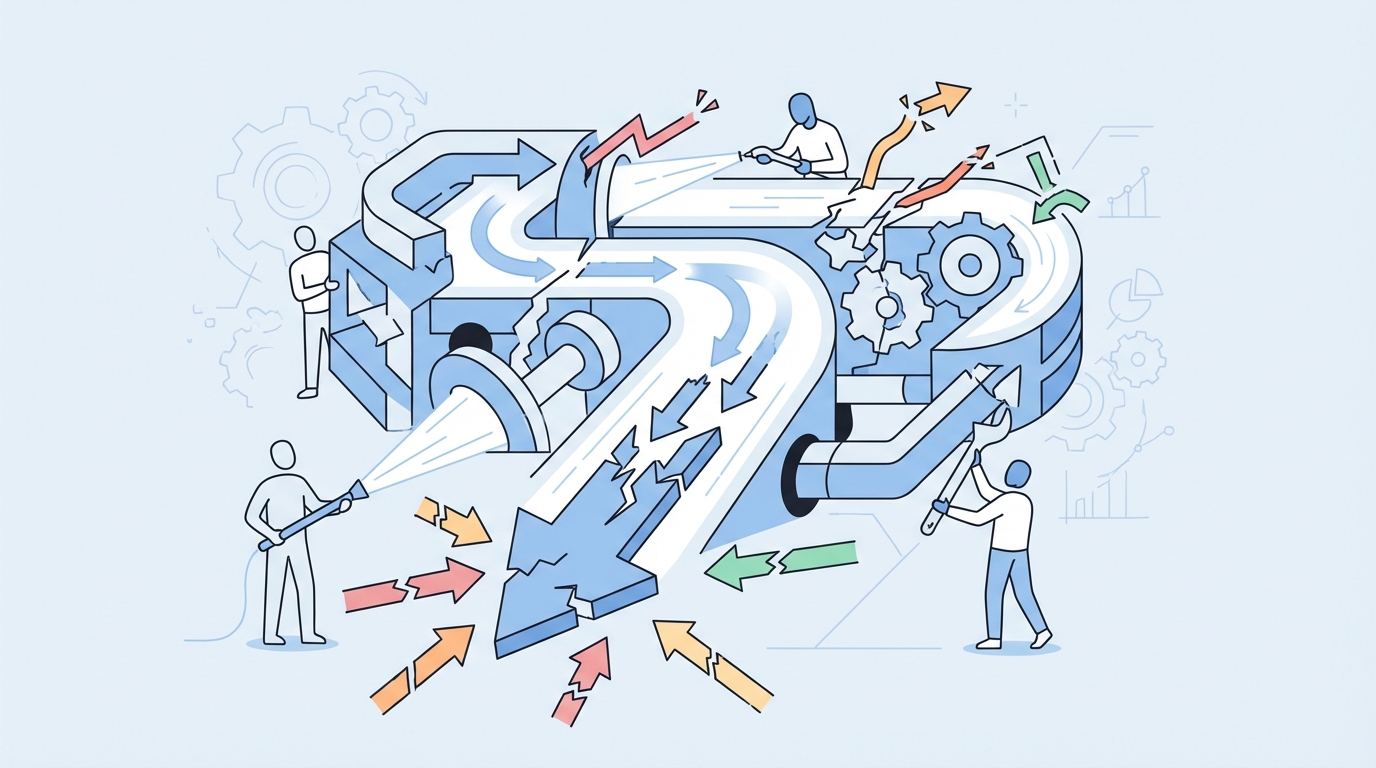
Most content scaling playbooks fail because they treat content like a volume problem. It usually isn’t. It’s an alignment problem, and the alignment gets worse as more people, tools, prompts, and reviews get added to the mix.
Back in 2012-2016, I ran a digital marketing site that got up to 120k unique visitors a month. We had 80 regular contributors and 300+ guest contributors. We started seeing SEO spikes at 500 pages, 1000 pages, 2500 pages, 5000 pages, then 10000 pages. So I’m not against scale. Quite the opposite. I’ve seen firsthand that breadth plus depth can compound in a big way.
But there’s a catch. That model worked because there was actual point of view in the system. Different contributors brought different angles. Volume wasn’t random. It had coverage, repetition, and enough quality to rank for long-tail terms that individually looked tiny but collectively mattered a lot.
Then I saw the other side of it in SaaS. I was the sole marketer at one company and could write 3-4 high-quality blog posts a week because I had the context in my head and a structured framework in how I worked. As the team grew, output didn’t get easier. It got messier. The new writer had less context. I had less time. Quality dipped. Review cycles got longer. Sound familiar?
That’s the part most people miss. More contributors don’t automatically create more throughput. Past 3 handoffs, your content scaling playbook starts behaving like a relay race where every baton pass drops context. And once context drops, everything else follows: voice, differentiation, product accuracy, narrative.
For a PMM, this gets painful fast. You’re supposed to protect product truth and messaging consistency, but instead you end up cleaning up drafts that should never have made it to review. A Tuesday afternoon turns into Slack threads, doc comments, and “can we tweak this section because it kind of overstates the feature?” That’s not scale. That’s expensive cleanup work wearing a growth costume.
If you want to see what a different model looks like, you can request a demo and watch how governed execution changes the review burden.
The Real Bottleneck in a Content Scaling Playbook Is Missing Marketing Context
The real problem isn’t that AI writes badly. The real problem is that most systems have no clue what marketing actually is.
I still remember sitting at a marketing panel in Toronto years ago. A guy kept going on about tools. Use this tool for lists. This one for outreach. This one for whatever else. Then April Dunford jumped in and basically cut through the whole thing. Tactics without strategy are garbage. That was the point. And she was right.
That’s the same issue with most content scaling playbook advice right now. It starts from channels and tactics. Keywords. prompts. workflows. publishing velocity. But good marketing doesn’t start there. It starts with position. Who you’re for. What you believe. What the enemy is. What your category frame is. What the old way gets wrong. What your product actually does. Then the tactics follow.
The Context Stack that decides whether scale works
A content scaling playbook only works when five layers are defined before the writing starts. I think of this as the Context Stack.
First, you need market context. That means your POV, category framing, key messages, differentiators, and old way versus new way contrast. If this layer is weak, the article may read fine but it won’t move your narrative.
Second, you need audience context. A PMM writing for a Head of Product Marketing at a scaling SaaS company should not sound like someone writing to a solo creator. Different stakes. Different language. Different examples.
Third, you need use-case context. If the reader cares about launch content accuracy or category definition, the examples and proof need to line up with that.
Fourth, you need product truth. This one matters more than people admit. If you don’t have canonical definitions, boundaries, approved claims, and clear “does not do” guidance, scale turns into claim drift.
Fifth, you need voice rules. Not fake style-guide stuff. Real cadence. Word choice. Opinion. The stuff that makes the content sound like your company instead of a decent freelancer with no skin in the game.
Miss even two of those five, and the whole content scaling playbook gets shaky. Miss three, and your team ends up arguing with drafts instead of shipping them.
Why PMMs become the unpaid control system
A lot of PMMs are quietly running what I’d call the Human Correction Loop. The machine spits out content. Then the PMM fixes the narrative, corrects the claims, rewrites the examples, tightens the positioning, and sends it back. After 5-10 cycles, people say AI content doesn’t work.

I don’t buy that. I think the setup was wrong.
At another SaaS company, we were doing founder-led content by recording videos and turning them into written pieces. That was faster. No question. But the structure wasn’t right for search, and topic selection was weak, so we were producing content without a strong search or demand-gen frame. Good raw material. Weak system. That distinction matters.
There’s a fair counterpoint here. Prompt-based tools are useful for ad hoc work. I use them too. If you need one draft, one rewrite, one outline, fine. But if you’re trying to run a repeatable content scaling playbook across product marketing, category content, SEO, and buyer education, ad hoc prompting breaks at around the point where consistency starts to matter.
A kitchen works the same way. One talented cook can improvise a great meal. A busy restaurant can’t run on improvisation. It needs recipes, prep stations, checks, and timing. Content is the same. Once you’re feeding a market instead of a single moment, process beats improvisation.
The next question is obvious: what does a content scaling playbook look like when it’s built like a system instead of a series of rescue missions?
What a Real Content Scaling Playbook Looks Like for Scaling SaaS Teams
A real content scaling playbook is a governed system for producing accurate, consistent, audience-specific content at a steady cadence. It doesn’t start with drafting. It starts with constraints, then moves into repeatable execution, then blocks weak output before it goes live.
Start with the 4G model: Govern, Ground, Generate, Gate
If I had to boil this down into one practical framework, I’d call it the 4G model.
Govern means define the rules first. Your position, audience, use cases, voice, and messaging. If those aren’t explicit, the system will invent defaults, and defaults are where generic content comes from.
Ground means pull from approved product truth and real examples. Not vibes. Not assumptions. Not “close enough.” If your content mentions features or use cases, it needs a source of truth behind it.
Generate means create outputs against that governed context. This is where the speed comes from, but only after the first two layers are solid.
Gate means nothing publishes unless it clears a bar for accuracy, narrative cohesion, clarity, and structure. This is the part most teams skip because it feels slower. It isn’t. It’s cheaper than rework.
What works best, in my view, is using this in order every single time. If you generate before you govern, you’ll get speed with drift. If you generate before you ground, you’ll get polished nonsense. If you skip the gate, you’ll publish debt.
Diagnose your maturity before you chase volume
Before you try to scale, ask three questions.
Do your writers or AI systems have canonical product definitions to work from?
Does the same topic come out differently depending on who touched it last?
Is your PMM still the person catching factual drift, positioning drift, and audience mismatch near the end of the process?
If you answered yes to all three, you’re in what I’d call Stage 2 Chaos. You have enough resources to produce more content, but not enough system control to keep that content aligned. That stage is brutal because on paper you look capable. In practice, you’re leaking hours everywhere.
Stage 1 is founder-head knowledge. One or two people can still brute-force quality because the context lives in their heads.
Stage 2 is team sprawl. More contributors. More handoffs. More review tax.
Stage 3 is governed scale. Context is encoded. Output is consistent. Review becomes verification instead of reconstruction.
A lot of scaling SaaS teams get stuck in Stage 2 for years.
Build content around use cases, not content types
This is a big one. Most content scaling playbooks are organized by format. Blog posts. landing pages. social posts. comparison pages. That sounds tidy, but it leads to shallow planning.
The better move is to organize by use case and audience intersection. If your PMM cares about launch content, buyer enablement, and category narrative, those should become the planning backbone. Format comes after.
Say you’re targeting scaling SaaS teams and the PMM persona. The useful questions become:
- What product narratives must stay accurate across every asset?
- Which use cases need repeated explanation?
- Where does the buyer get confused during evaluation?
- Which category points need to be reinforced over time?
That gives you a content scaling playbook with substance. You’re not filling a calendar. You’re building a coverage map.
Honestly, this is where most teams underestimate the work. They think scaling means writing faster. It usually means deciding better.
Separate cadence from campaigns
Campaign thinking is one of the hidden reasons content systems break. Teams go hard for six weeks, then reset. New priority. New launch. New message. New scramble.
The content scaling playbook I prefer separates ongoing cadence from campaign spikes. Cadence is the always-on layer that compounds your position in market. Campaigns sit on top.
If you’re publishing fewer than 8 meaningful pieces a month and every quarter feels like you’re starting over, your cadence layer is too weak. If you’re shipping 20+ pieces but your message changes every time a different stakeholder weighs in, your governance layer is too weak.
There’s a case to be made for flexibility here. Not every market message should be locked down forever. Fair. Messaging should evolve. But it should evolve intentionally, not because three reviewers had different takes on Tuesday.
That’s why a real content scaling playbook needs versioned truth. Clear inputs. Planned changes. Same core signal repeated enough times that the market and LLMs can actually understand what you stand for.
For teams trying to get from scattered output to governed scale, it helps to request a demo and see the system mapped to your own workflow.
Treat quality control as a publishing filter, not an editor’s burden
One of the biggest shifts is moving quality checks upstream. Most teams review after the damage is done. Draft gets written. Then people catch the errors. Then they fix it manually. Then they wonder why throughput stalls.
The better rule is simple: if content fails on product accuracy, narrative cohesion, clarity, or structure, it shouldn’t move forward.
I’d argue this is the heart of the modern content scaling playbook. Not the generation step. The filter.
Because once you do that, the whole system changes. Writers stop guessing. PMMs stop rewriting from scratch. Reviewers focus on the 10% that actually needs human judgment. Your average draft quality goes up because the standards are real, not implied.
And in the GEO era, that matters even more. LLM visibility doesn’t reward random volume. It rewards repeated clarity. Same definitions. Same message. Same audience fit. Over and over.
How Oleno Turns a Content Scaling Playbook Into a Repeatable System
Oleno turns a content scaling playbook into governed execution by encoding your messaging, product truth, audience context, and quality standards before drafts are produced. Then it runs content through defined job paths and blocks weak output before it reaches publish.
Canonical truth goes in before the draft exists
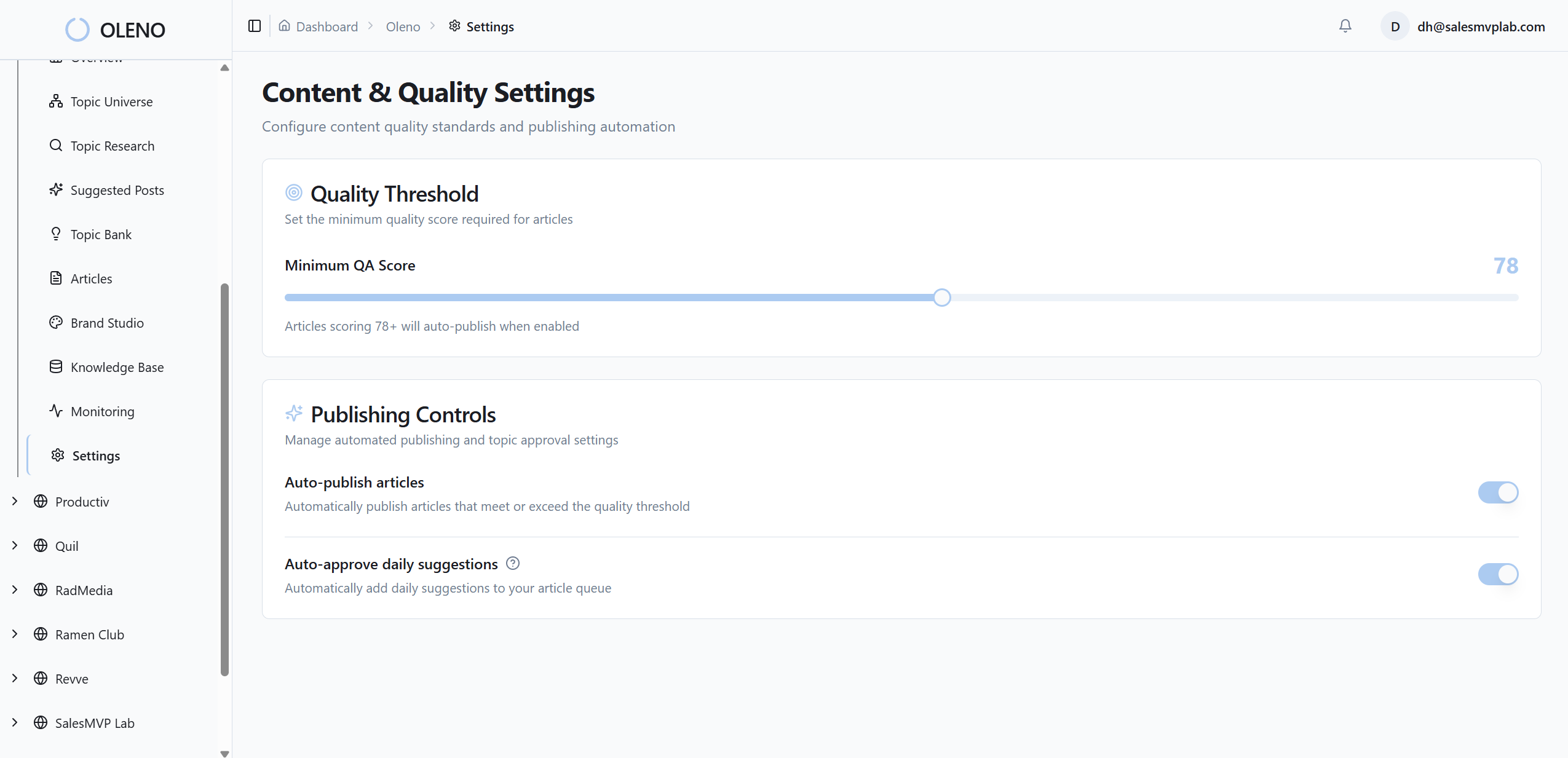
This is the part I like most because it addresses the real failure mode. Oleno doesn’t assume the model will just “figure out” your marketing. Marketing Studio stores the category framing, key messages, and narrative structures. Product Studio stores approved product descriptions, feature boundaries, supported use cases, and approved claims. Audience & Persona Targeting brings in who the content is for, what they care about, and how they talk about the problem.
That matters because most bad scaling starts with missing context, not bad prose.
For a PMM, this means less last-minute cleanup around feature language and messaging drift. Product truth is grounded before the draft. Not after. And because Oleno uses governed inputs, the content scaling playbook becomes a system with memory instead of a prompt session with guesswork.
There’s a limitation worth saying out loud. Oleno won’t replace your positioning work. If you’re still pre-product, still fuzzy on who you sell to, or still changing your core story every week, this won’t magically fix that. You need the fundamentals first. But once those are in place, this is where things get interesting.
Quality Gate changes review from rewrite to approval
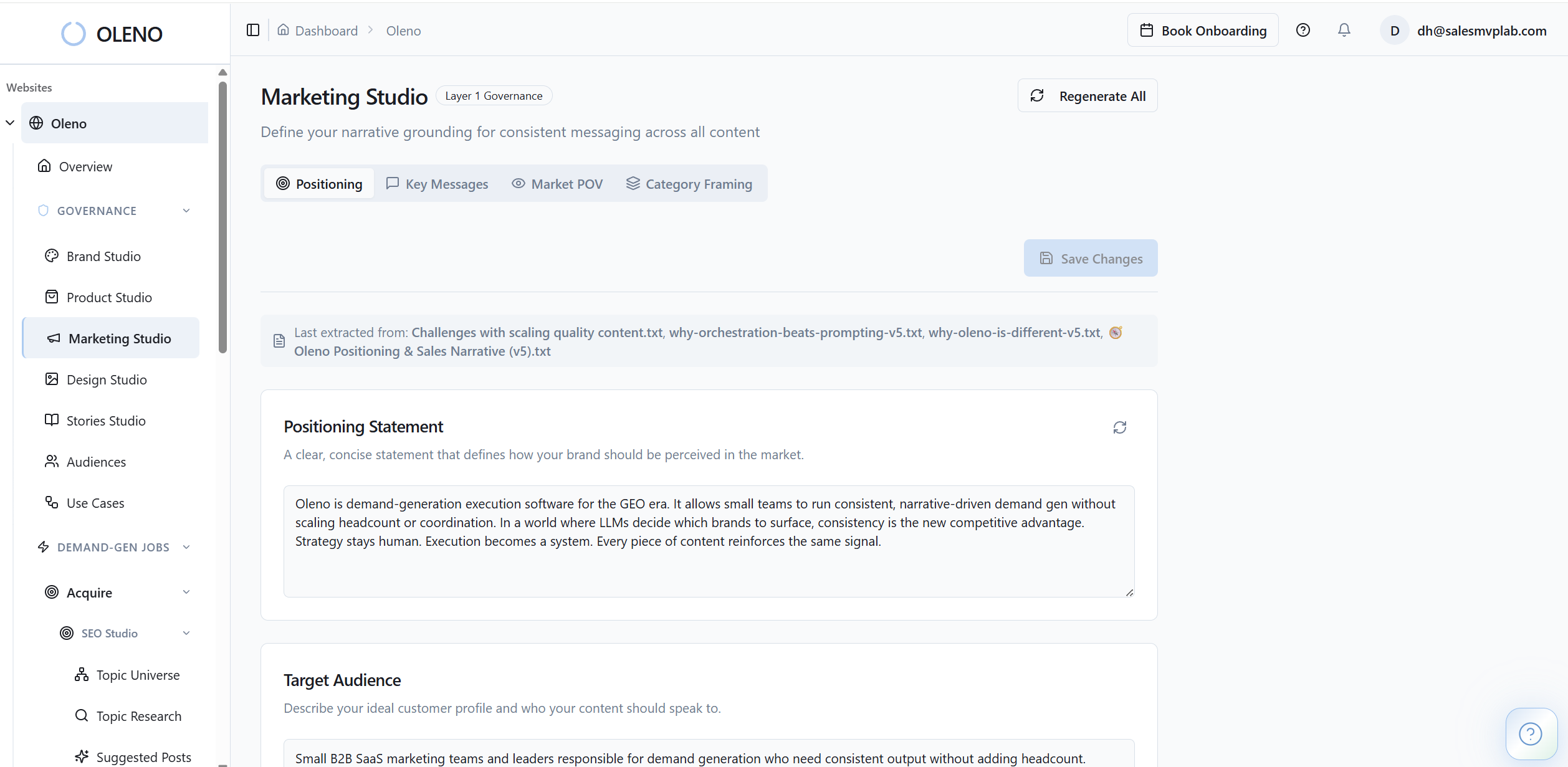
The second thing is the Quality Gate. This is a big deal. During QA, Oleno evaluates content across voice, structure, clarity, repetition, grounding, and SEO. If the score is low, it tries auto-revision. If it still misses the bar, it blocks publishing.
That’s the right model.
Because the goal isn’t to generate more drafts. The goal is to stop bad drafts from becoming your team’s next problem. Nothing publishes unless it meets the bar for brand standards, structural requirements, and content quality thresholds. For small teams and scaling SaaS teams alike, that’s where risk drops fast.
Health Monitor adds another useful layer by surfacing cadence and quality trends across the pipeline, while the Executive Dashboard gives leadership visibility into output, quality score movement, and coverage gaps. So you’re not managing content off vibes or random Slack complaints. You can actually see whether the system is holding.
Oleno also isn’t pretending to be your whole stack. It doesn’t do technical SEO audits, rank tracking, paid media, analytics attribution, or campaign planning. That’s fine. It shouldn’t. It handles the governed creation and execution layer, which is the part most teams keep duct-taping together.
Planning and orchestration make scale actually stick
The third piece is that content doesn’t just get drafted in a vacuum. Storyboard allocates content across audiences, personas, products, and use cases based on coverage gaps and governance weights. Orchestrator then schedules approved topics, runs the blueprints, and manages execution order without manual babysitting.
That solves a very real problem. Most teams don’t fail because they can’t write one article. They fail because they can’t keep the machine running every week without a lot of coordination overhead.
Programmatic SEO Studio handles acquisition content at scale, and Category Studio supports long-form thought leadership built around governed POV. For PMMs, Product Marketing Studio and Buyer Enablement Studio matter too, because they let you scale workflow guides, feature education, comparisons, objection handling, and other mid to bottom-funnel assets without divorcing them from product truth.
And if you want founder or executive perspective to actually sound lived-in, Stories Studio threads documented anecdotes and examples into content during the Angle and Draft stages. That’s important. Thought leadership without actual stories just sounds like polished oatmeal.
If you want to see how this looks in practice, book a demo and map your current review burden against a governed workflow.
The Best Content Scaling Playbook Is Really an Operating Model
A content scaling playbook is not a doc full of prompts, templates, and publishing tasks. It’s an operating model for how your team turns strategy into repeated, accurate market signals.
If you’re a scaling SaaS team with PMMs, content leads, and demand gen people all touching the process, that matters a lot. Because your problem probably isn’t effort. It’s fragmentation. Too many tools. Too many handoffs. Too much context living in people’s heads. Too much rewriting at the end.
The old way treats content, SEO, product messaging, and narrative as separate jobs. The new way treats them like one system with shared rules.
That’s the shift.
And if that shift is what you need, Oleno is worth a closer look.
About Daniel Hebert
I'm the founder of Oleno, SalesMVP Lab, and yourLumira. Been working in B2B SaaS in both sales and marketing leadership for 13+ years. I specialize in building revenue engines from the ground up. Over the years, I've codified writing frameworks, which are now powering Oleno.
Frequently Asked Questions