Content Scaling Techniques for Growing Marketing Teams

42% of content leaders say creating high-quality content consistently is a top challenge, according to Content Marketing Institute. If you’re a Head of Content at a scaling SaaS company, you probably felt that this week when one draft sounded like sales, another sounded like SEO, and neither sounded like your company.
You don’t need more content scaling techniques for B2B SaaS teams. Not really. You need fewer translation layers between strategy and execution.
Key Takeaways:
- Content scaling techniques for B2B SaaS teams fail when strategy lives in docs instead of the production system.
- If your review cycle touches the same draft 3 or more times, you have a governance problem, not a writer problem.
- The best content scaling technique is to encode voice, audience, product truth, and POV once, then enforce it every time.
- Volume without consistency creates a hidden tax: more edits, more meetings, more drift.
- For scaling SaaS teams, content quality usually breaks at the handoff points, not at the keyboard.
- GEO raises the bar. LLM visibility rewards consistent positioning across many pieces, not random bursts of output.
Why Most Content Scaling Efforts Break at the Team Layer
Content scaling techniques for B2B SaaS teams usually break when a company adds people, tools, and urgency all at once. More writers should mean more output. In practice, it often means more interpretation, more review cycles, and more drift between what leadership meant and what actually gets published.

A Head of Content at a 250-person SaaS company feels this pretty fast. Monday morning, they’re reviewing a freelancer brief in Notion, rewriting a product section from a PMM doc, fixing positioning in a Google Doc, then answering a Slack thread about whether the post is for a buyer, a user, or both. By Thursday, the draft is technically done. But it’s off. Again. That’s not a capacity problem. It’s a system problem.
There’s a case to be made for hiring more writers, and fair enough, sometimes that is the right move. But if each new writer adds another layer of context transfer, your output rises slower than your coordination cost. That’s the part most teams miss.
The bottleneck isn’t writing speed
Most scaling teams assume content output breaks because writing is slow. It usually isn’t. Drafting got faster the minute AI entered the room. The real slowdown happens after the draft exists, when everyone starts correcting missing context.
This is the Translation-Loss Model. Every handoff strips meaning. Strategy starts in a deck. Then it gets compressed into a brief. Then a writer interprets it. Then an editor reinterprets the writer. Then a stakeholder adds product nuance late. By the end, the piece is technically about the right topic, but the sharpness is gone.
I saw this years ago at PostBeyond. I could write 3 to 4 strong posts a week because I had the context in my head and a writing framework that worked. As the team grew, output should have gone up. Instead, new writers took longer and the drafts got weaker, because they didn’t have the same depth of context. That pattern repeats constantly in scaling SaaS teams.
AI made draft speed cheap, not alignment easy
This is where a lot of teams get fooled. A blank page used to be the hard part. Now the hard part is deciding whether the draft is accurate, on-message, role-aware, and worth publishing.
Prompting gives you motion. It does not give you reliability. If you’re using AI and still editing every intro, every product section, and every CTA, you haven’t removed work. You’ve moved work upstream and hidden it in review.
According to Content Marketing Institute’s B2B content benchmarks, teams still struggle most with consistency and differentiation, not just output. That tracks with what I’ve seen. Speed without a governed system just creates a bigger pile of drafts to fix.
The hidden cost is the editing tax
The editing tax is what happens when each draft arrives 70% right and still eats 45 to 90 minutes of senior review time. Not catastrophic on one article. Brutal across 20.
Use the 3x3 Rule here. If a piece goes through 3 stakeholders and 3 substantial rewrites, stop blaming execution and audit the inputs. If voice is drifting, if product claims keep getting corrected, or if the audience framing changes halfway through the piece, your content system is broken before anyone starts writing.
And yeah, this gets frustrating. You start to resent your own content calendar because every “published” asset came with two hours of cleanup and four Slack threads. That’s when you know the problem is structural, not tactical.
If the team layer is where content breaks, the next question is obvious: what exactly is missing from the system?
[Want to see what a governed content system looks like in practice? request a demo].
The Real Problem Is Missing Governance, Not Missing Content Tricks
Content scaling techniques for B2B SaaS teams work only when the system knows what “good” looks like before the draft gets written. Without that, every article becomes a negotiation between memory, taste, and whoever comments last.
Governance is just a simple word for a very practical thing: what is true, what do we believe, who are we talking to, and how should this sound every single time. If those answers live in scattered docs, they don’t really exist operationally. They exist academically.
Strategy in docs is strategy that leaks
A lot of companies think they have strong messaging because they ran a positioning workshop six months ago. There’s a deck. There are notes. There might even be a nice framework slide. But none of that means the content engine is actually using it.
That’s the Strategy-Execution Gap. Strategy lives upstream, but production lives downstream. And the water gets dirty on the way down.
I’d argue this is the central failure in modern content ops. Not bad writers. Not lazy teams. Not even weak ideas. Just strategy that never makes it into the system that produces the work. If your positioning has to be manually re-explained in every brief, it isn’t operationalized. It’s trapped.
Voice drift is usually a system failure
A lot of content leaders take this personally. They read a draft and think, “why can’t people just get the tone right?” Reasonable reaction. But tone drift usually has a root cause.
If you have 4 or more contributors and no explicit voice constraints, drift is guaranteed. That’s a useful threshold. Below four contributors, strong editors can sometimes hold the line manually. Above four, human memory loses. The system has to carry it.
The same thing happened in founder-led content motions. At LevelJump, we’d record videos with the CEO and transcribe them. That was faster. It got real thinking onto the page. But it still missed search structure, topic selection, and the kind of packaging content needs to rank. Good raw material. Incomplete system.
The old way has merits, but it stops compounding
To be fair, the patchwork approach can work for a while. A smart Head of Content. A good freelancer. A decent PMM. A few prompts. A couple review loops. You can ship like that.
But it breaks at the exact moment you need compounding. GEO adds pressure here. LLMs don’t just reward a single clever article. They reward brands that express the same core truths clearly across lots of content. Positioning clarity. Audience specificity. Product definitions. Repetition without drift. That’s what gets surfaced.
Google has said for a while that helpful, people-first content matters more than search-first manipulation, and that logic only gets stronger in AI search environments. You can see that direction in Google’s own guidance on helpful, reliable, people-first content. The system is moving toward trust signals that look a lot like governance.
So if the old way stops compounding, what does a content system look like when it actually scales?
Content Scaling Techniques That Actually Hold Up at 20 to 40 Articles a Month
Real content scaling techniques for B2B SaaS teams don’t start with “write faster.” They start with “remove interpretation.” That’s the shift. Once you get that, the rest gets a lot clearer.
I tend to think about this as building a content factory with a calibrated mold. Not a generic factory. Your factory. If the mold is wrong, you just produce bad parts faster. If the mold is right, volume becomes your advantage.
Start with a diagnostic before you add volume
Before you try to scale, figure out what kind of scaling problem you actually have. Most teams fall into one of three buckets.
- Capacity problem: you simply don’t have enough hands, but alignment is decent
- Context problem: writers lack product, audience, or category understanding
- Governance problem: the team cannot consistently enforce voice, POV, and product truth
If more than 30% of published drafts require substantive rewrites from senior marketing leaders, you’re in bucket three. If most edits are about missing product nuance or fuzzy audience framing, you’re in bucket two. If the drafts are good but the queue is too long, that’s bucket one.
Honestly, most scaling SaaS teams think they’re in bucket one. They’re usually in bucket two or three.
Encode voice, audience, and product truth once
This is the first real lever. Don’t keep re-briefing the same truths every week.
The Governance Stack is simple:
- brand voice rules
- category framing
- product truth and boundaries
- audience and persona context
- use case context
- proprietary stories and examples
When those six inputs are defined once and loaded into production every time, content gets more reliable fast. Not perfect. But way more stable. If one of those layers is missing, that gap shows up in the draft.
A lot of teams skip audience specificity here. Big mistake. A Head of Content at a scaling SaaS company and a CMO at a larger org may care about the same topic, but not in the same language. If you don’t frame content by audience and persona, you get generic middle-of-the-road pieces that nobody fully claims.
Build around the Handoff Compression Rule
Here’s the rule: if two adjacent roles are exchanging more than 10 minutes of clarifying context per asset, compress the handoff.
That means the brief has to do more of the work. Or the governance layer has to do more of the work. Or the system has to retrieve the right product and audience context automatically. But the answer is not “more Slack.”
What I’ve seen work is reducing the human chain. Strategy gets encoded upfront. The draft gets generated within those boundaries. Review happens against clear standards. Not vibes. Not memory. Standards.
The benefit is bigger than time savings. You also stop exhausting your best people on repetitive correction. Your Head of Content should be shaping editorial direction, not rewriting the same positioning paragraph for the fifth time this month.
Use the Breadth-Depth Threshold for SEO and GEO
Back in 2012 to 2016, I ran a digital marketing site that got to 120k monthly visitors. We saw traffic jumps at 500 pages, 1,000 pages, 2,500 pages, 5,000 pages, then 10,000 pages. Most pages got less than 100 visits a month. But breadth and depth together created long-tail coverage that compounded over time.
That experience gave me a pretty strong bias here. Content doesn’t compound because every single article is a hit. It compounds because the catalog becomes structurally hard to ignore.
The threshold I use is this: if you’re publishing fewer than 8 high-quality articles a month in a competitive SaaS category, compounding will be slow. If you can sustain 20 to 40 publish-ready pieces a month with quality intact, topical coverage starts changing the game. That’s one of the few content scaling techniques for B2B SaaS teams that actually produces step-function results, because it changes your coverage footprint, not just your activity level.
Treat stories as infrastructure, not decoration
This one gets overlooked a lot. Teams think anecdotes are a nice extra. They’re not. They’re what make the content believable.
An experienced SEO consultant looked at Oleno output and said it passed the slop test. That matters because every content leader knows what slop feels like instantly. Thin claims. Empty confidence. Generic examples. Once readers smell that, trust drops.
So build a Story Bank Framework. Capture founder stories, customer moments, sales call patterns, objections, and field examples in a structured way. Then reuse them intentionally. If you can’t point to at least one lived-in example per article, the piece will probably sound polished but forgettable.
[If you’re trying to get out of endless briefing and review cycles, request a demo and see how the governance layer changes the draft before anyone starts editing.]
Separate scaling from the rest of the stack
One more thing. Content production is not your whole marketing stack. And pretending one tool does everything usually ends badly.
You’ll still need technical SEO, keyword research, attribution, distribution, and probably paid amplification. That’s valid. The content system should remove the creation bottleneck, not pretend it replaces the rest of marketing. The exception is if your current issue is purely strategic and you haven’t defined your positioning yet. In that case, don’t automate much of anything yet. You need clarity before scale.
Once the method is clear, the obvious question becomes: what does a system look like when it enforces this at the production layer?
How Oleno Turns Governance Into Repeatable Output
Oleno turns content scaling techniques for B2B SaaS teams into an operating system instead of a weekly fight. The value isn’t that it spits out text. A lot of tools do that. The value is that it keeps strategy, voice, audience context, and product truth attached to execution.
Governance that survives handoffs
Oleno uses Brand Studio, Marketing Studio, and Product Studio to encode how you sound, what you believe, and what is true about the product. That matters because most teams lose those three things first.
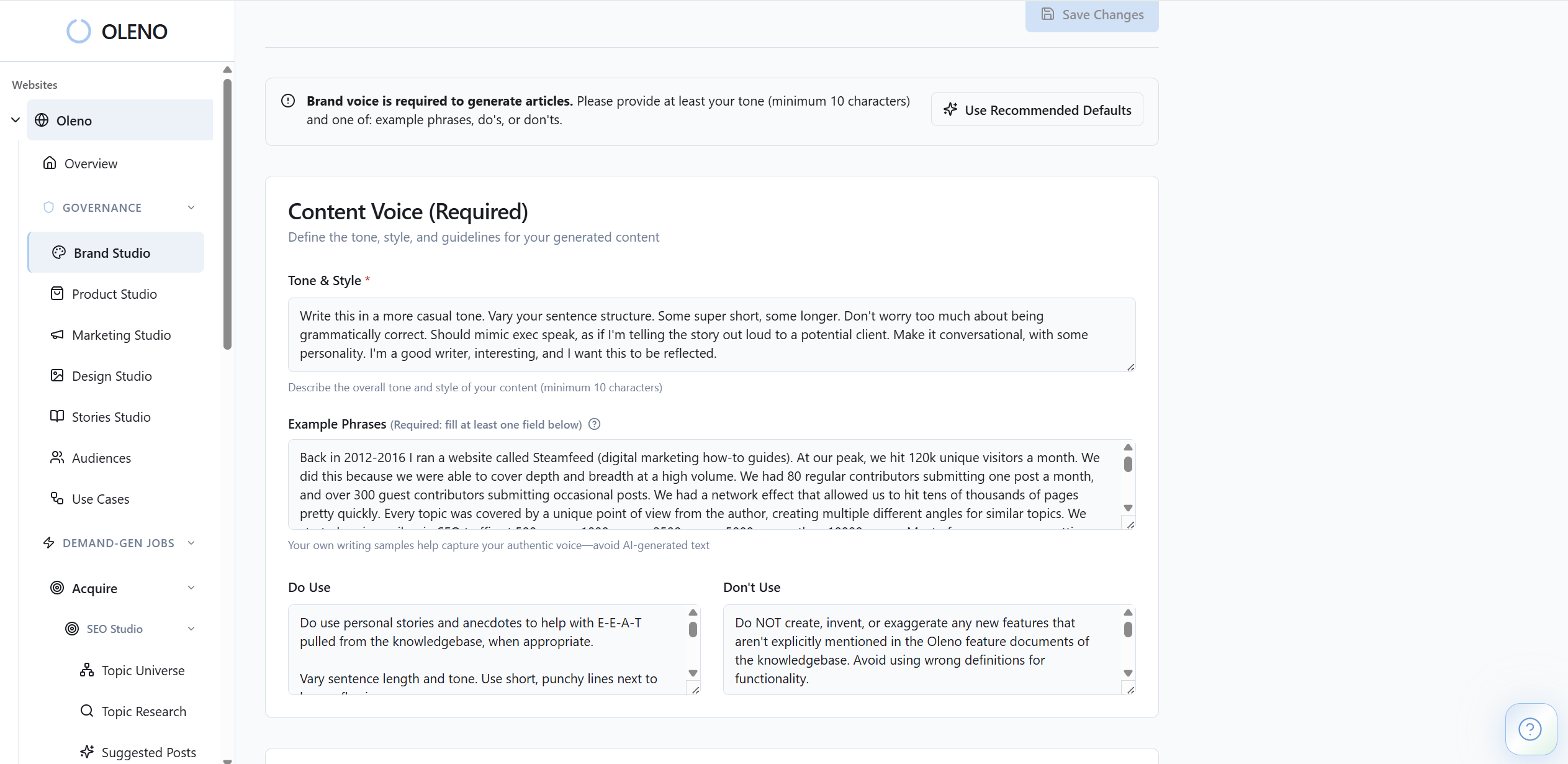
Brand Studio gives the system voice constraints and style examples, so output doesn’t drift every time a new contributor or job type gets involved. Marketing Studio injects your category framing, key messages, and POV into briefs and drafts, which keeps content from collapsing into bland education. Product Studio grounds claims in approved product truth and boundaries, which cuts one of the highest-friction review problems: fixing invented or fuzzy product language after the fact.
This is where the editing tax starts dropping. Not because nobody reviews. Because the draft shows up closer to what the team would have written themselves.
Audience context and use cases built into production
Oleno also uses Audience & Persona Targeting and Use Case Studio to shape how a topic gets framed for the actual reader. For a Head of Content, that means a piece can talk to coordination overhead, review burden, and brand consistency. For a CMO, the same topic can shift toward efficiency, coverage, and ROI.
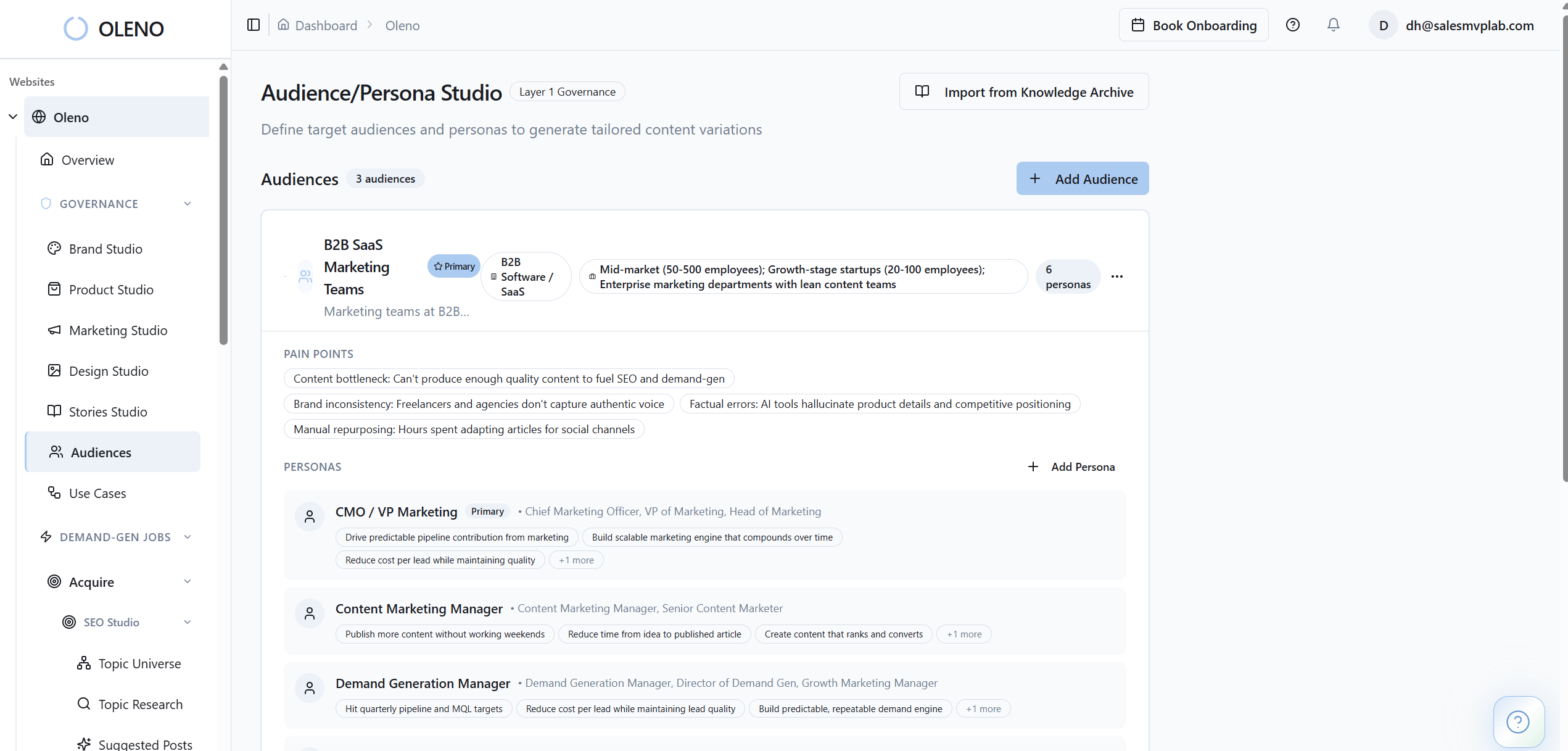
That sounds small. It’s not. Audience mismatch is one of the fastest ways to create a “pretty good” article that still misses. If the content doesn’t reflect how the buyer thinks, it usually triggers more edits or weaker performance.
And this isn’t about inventing personas out of thin air. Oleno operationalizes the segments, personas, and use cases you define. Big difference.
A content pipeline that keeps moving
For teams trying to scale beyond 4 to 8 articles a month, Programmatic SEO Studio and the Orchestrator are where the system starts to feel like added headcount. Programmatic SEO Studio discovers and organizes topics, then runs a structured pipeline that creates and scores content at scale. The Orchestrator schedules approved topics and manages execution by blueprint and quota, so the team isn’t manually pushing every asset through the same repetitive cycle.
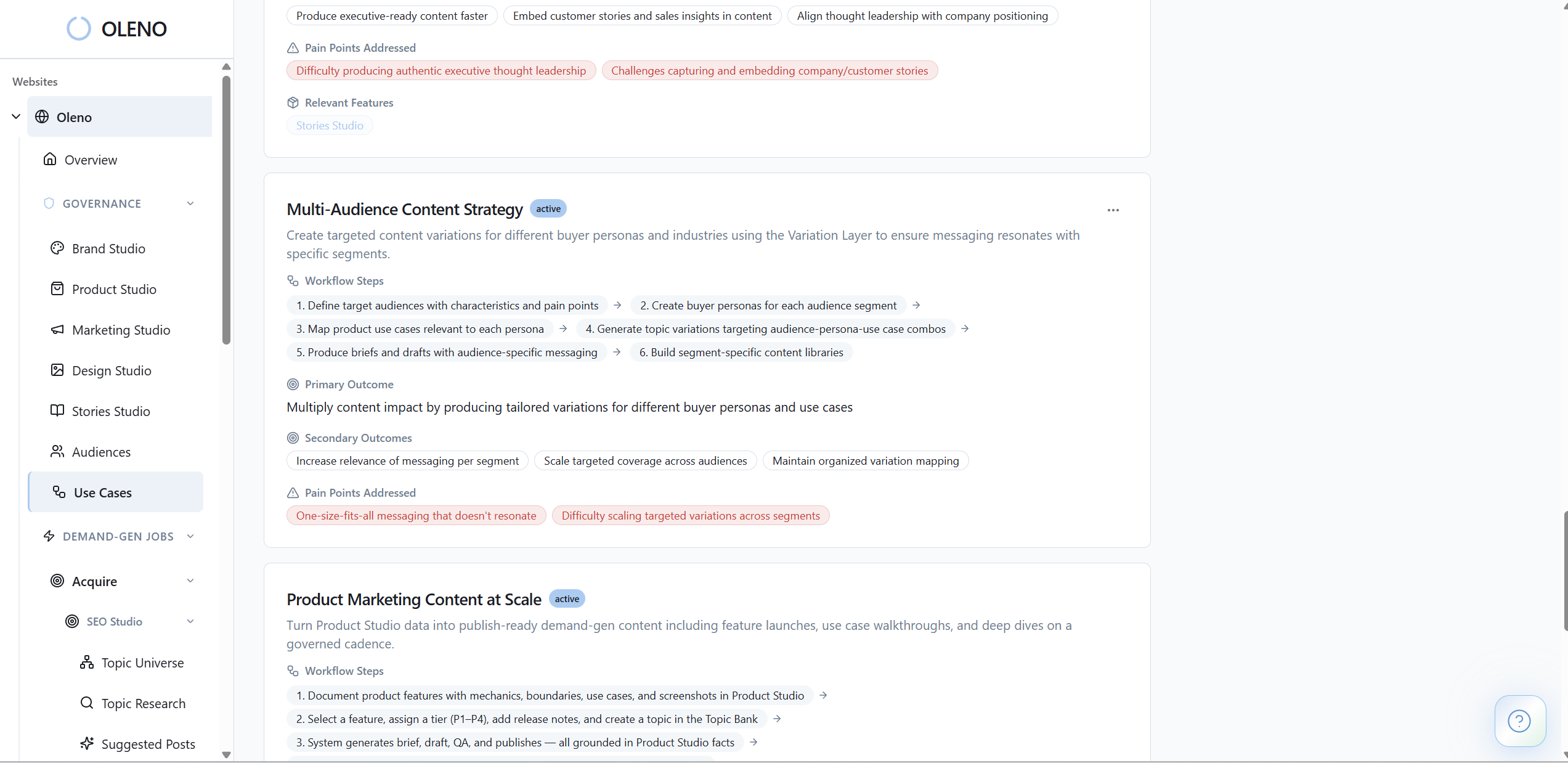
Then the Quality Gate checks the work against voice, structure, grounding, and quality thresholds before it moves forward. That’s a very different model from “generate a draft and hope the editor catches everything.”
One customer reaction captured the value pretty cleanly: this felt like adding 3 people to the team. That line sticks because it’s exactly how the benefit lands for budget-constrained content leaders. More output. Less coordination. Fewer rewrites.
If you want to see how Oleno applies governance, audience targeting, and quality controls in one system, book a demo. It’s the fastest way to see whether your bottleneck is really writing, or the system around writing.
The Teams That Scale Content Best Usually Edit the System, Not the Draft
Content scaling techniques for B2B SaaS teams only work when the system carries the context. Otherwise your senior people become human middleware, translating strategy over and over until they burn out.
That’s really the punchline. The bottleneck isn’t a lack of ideas. It isn’t even a lack of AI. It’s fragmented execution.
If you’re a scaling SaaS team with a growing contributor mix, the move isn’t to add more prompts and hope. It’s to encode what matters, reduce handoffs, and make quality repeatable. Do that well, and content starts compounding instead of resetting every week.
About Daniel Hebert
I'm the founder of Oleno, SalesMVP Lab, and yourLumira. Been working in B2B SaaS in both sales and marketing leadership for 13+ years. I specialize in building revenue engines from the ground up. Over the years, I've codified writing frameworks, which are now powering Oleno.
Frequently Asked Questions