Content Strategy System: Prevent Overpublishing & Build Authority

You don’t build authority by publishing more. You build it by publishing what your system says is necessary, in the order it says, with rules that prevent waste. I’ve seen teams crank out content for quarters and wonder why nothing compiles into real trust. The cadence is fine. The constraints are missing.
When content becomes infrastructure, everything changes. Topics get IDs. Coverage and saturation guide priorities. Every H2 opens with a direct answer. Visuals aren’t decoration; they’re deliberate. Internal links and schema aren’t guesses; they’re rules. That’s when volume actually compounds instead of dilutes. Not before.
Key Takeaways:
- Treat content like an operating system with enforceable rules, not a calendar
- Map a topic universe, label saturation, and enforce cooldowns to curb duplication
- Score information gain before drafting to stop thin, repetitive posts early
- Use deterministic internal links and programmatic schema to avoid cannibalization
- Make snippet-ready sections your default so each piece is citable on its own
- Publish less in saturated clusters and redirect effort to coverage gaps
- Shift your team’s time from cleanup to narrative and product storytelling
Ready to skip the theory and see a working system? Try the actual engine behind this approach. Try Oleno For Free.
Why Publishing More Often Dilutes Authority For Most Teams
Publishing more dilutes authority when your system can’t prevent duplicates, weak angles, or off-brand execution. Without a topic map, cooldowns, and quality gates, extra volume simply multiplies inconsistencies. For example, two “ultimate guides” targeting the same query split equity and confuse both search engines and assistants.
The real failure mode behind overpublishing
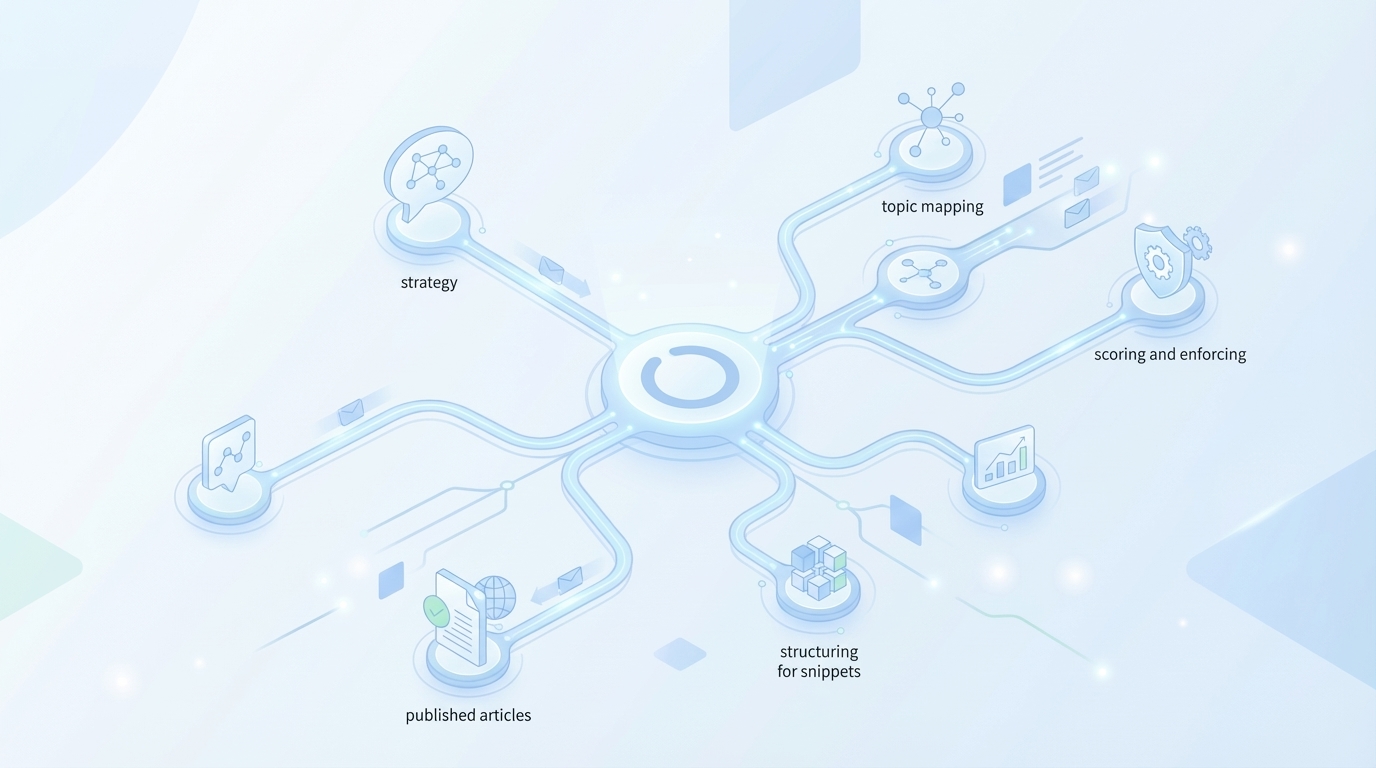
Overpublishing isn’t about writing too often. It’s about writing without coordination. When strategy, structure, visuals, and publishing live in different tools, small inconsistencies compound into big credibility problems. A topic map fixes this by deciding what should exist and what shouldn’t, then enforcing that decision at the brief, draft, and publish stages.
Most teams don’t notice the drift. The calendar fills, the review cycles stretch, and “we’ll fix it later” becomes the norm. The fix isn’t a stricter editor. It’s a system that rejects low-differentiation outlines, requires snippet-ready H2 openers, and blocks near-duplicates. This is governance, not opinion. And it’s how you stop cluster decay before it starts. For fundamentals on standards and governance, see Nielsen Norman Group’s content strategy guidance.
What is a content operating system and why does it matter?
A content operating system is a closed loop that decides what to write, enforces differentiation, structures for citation, and publishes without manual babysitting. It maps your topic universe, tracks saturation, enforces cooldowns, injects internal links deterministically, and adds schema programmatically. You run it daily. It reduces guesswork and rework.
Think of it like this: briefs include competitive research and an information gain score; outlines must pass QA gates before drafting; every H2 opens with a direct answer; visuals follow brand rules; publishing uses mapped fields. No drama, fewer surprises. And the output is citable, section by section. For process and prioritization discipline, Siteimprove’s content strategy framework captures the practical pieces teams miss.
The metrics that actually matter for authority growth
Authority grows when each article adds net-new value and reinforces a cluster. Track coverage completeness, saturation labels by topic, and information gain versus the market. Monitor deterministic link health and QA pass rates for structure and clarity. Cadence is tempting. But cadence without these signals pushes you toward repetition.
I like simple dashboards that answer three questions: where are we light, where are we saturated, and what’s the next most valuable piece? If your “success” metric is published count, you’ll drift. If it’s gap closure and rising information gain, you’ll compound. That shift alone stops a lot of future cleanup and keeps your library citation-ready. For outcome alignment examples, review Salesforce’s content strategy lens.
The Real Constraint Is Missing System Rules, Not Writer Capacity
You don’t have a writing problem. You have a rules problem. Editorial calendars schedule activity; they don’t govern outputs. Add canonical topic IDs, saturation labels, cooldowns, and quality gates, and suddenly the same team feels larger. Because they stop rewriting the same idea twice.

What traditional editorial calendars miss
Calendars help you plan. They don’t prevent waste. Without canonical topic IDs, your “new” post becomes a near-duplicate 40% of the time. Add a deterministic internal linking policy and an outline-level QA that scores information gain before drafting. Now the calendar is just a deployment surface for rules.
I’ve worked in teams where the calendar looked full and the pipeline felt busy, yet clusters still eroded. The reason was simple: no one could see saturation or duplication risk in real time. The fix is boring and effective, IDs, labels, and gates. Once installed, your velocity starts producing authority, not volume. Governance matters; Digital.gov’s guidance on standards is a useful reference point: content strategy standards and governance.
Why coverage and cooldowns beat volume caps
Volume caps treat the symptom, too many posts. Coverage and cooldowns treat the cause, publishing into saturated space. Label each topic as underserved, healthy, well-covered, or saturated. Only ship work that moves topics toward healthy. Enforce a 90‑day cooldown on the same canonical topic unless there’s a material change.
When should you intentionally publish less? When saturation is high, information gain is low, or internal links would cannibalize a stronger URL. Hold the draft. Upgrade the brief. Consolidate instead of adding another URL. Yes, it feels slow. It’s not. It’s compounding. For prioritization mindset, see Siteimprove’s framework on content prioritization.
The Hidden Costs You Pay When Content Lacks Constraints
Lack of constraints looks like speed until the bill arrives. It shows up as rework hours, cannibalized rankings, and broken link graphs. Teams feel busy. The library gets noisier. Authority stalls.
Engineering and editorial hours lost to rework
Let’s pretend you ship 40 posts this quarter and 30% are near-duplicates. If each one triggers 2 hours of rewrite and 1 hour of SEO cleanup, you’ve burned 36 hours on non-differentiation. Add link fixes, schema edits, and voice repairs, and you’ll cross 60 hours. That’s a week and a half of a senior operator.
I’ve lived that loop. It’s not a talent issue; it’s a system issue. Put rules ahead of drafts: information gain scoring in the brief, snippet-ready section requirements, link placement rules, and a minimum QA score to pass. Rework drops. Morale rises. And the pipeline stops eating itself. For a practical lens on inconsistency costs, NN/g’s take is useful: content strategy reduces inconsistency.
The cannibalization tax and random linking, combined
Duplicate angles fight over the same phrases. Internal links get sloppy, equity spreads thin, and assistants can’t find a canonical answer. Random visuals make it worse, decorative images signal “generic,” not authority. A deterministic link policy with exact-title anchors, verified URLs only, and rule-based placement concentrates trust.
Here’s the shift: treat links like infrastructure and visuals like brand assets. Use rules to place 5–8 contextual internal links, inject schema programmatically, and prioritize solution sections for on-brand screenshots. The byproduct is a stable, citable cluster, one that survives author turnover and tooling changes. For component-level rigor, see ContentDesign.London’s evidence-driven checks.
The Friction Everyone Feels But No One Quantifies
You feel the pain before you see it in metrics. Sales calls that stall. Drafts that bounce between reviewers. Clusters that sound busy but don’t rank or convert. It’s not subtle.
The 3 pm sales call where content cannot back up the pitch
You’ve got a clean pitch. Prospect asks for a deep dive on a specific angle, and the closest asset is… close, not precise. Trust dips. This is upstream work. Map each cluster with a canonical explainer, comparison, and implementation guide tied to topic IDs. Then make each section stand alone and citable.
When that system exists, sales has links that do the job. No improvising. No “we’ll follow up with something else.” It’s less about more content and more about the right content. Governance tables help here; the Georgia team’s playbook outlines how to map content to tasks and gaps: governance and content-to-task mapping.
The 3 week rewrite that never ships on time
I’ve been stuck in the rewrite loop. It’s frustrating rework. Small SaaS teams get crushed when drafts need structural fixes, voice rewrites, and link repairs. Put rules before words: score the outline for information gain, require snippet-ready openers, predefine anchor targets, and set a QA pass threshold. Shipping gets predictable.
The surprising part? Writers relax. They’re not guessing what “good” looks like each time. They’re operating within guardrails that protect the cluster. Fewer surprises at review. Fewer cold-start briefs. And three weeks becomes three days. If you’re still firefighting this, there’s a simpler path: try an autonomous engine. Try Generating 3 Free Test Articles Now.
Build A Content Operating System That Prevents Overpublishing
A content OS prevents overpublishing by enforcing constraints at every stage. Map topics, label saturation, and enforce cooldowns. Score information gain before drafting. Inject internal links deterministically and schema programmatically. It’s not glamorous. It works. And it scales.
Map a topic universe with clusters and canonical IDs
Start with your sitemap, product docs, and sales narratives. Discover topics, group them into clusters, and assign canonical IDs. That becomes your source of truth. It tells you where you’re thin, where you’re strong, and what to write next, without guesswork or competing URLs.
Make it tangible. Define cluster purposes (awareness, evaluation, adoption). Ensure each has a canonical explainer, comparison, and implementation asset. Then lock the IDs. New proposals reference the ID or don’t move forward. It’s a small hurdle that removes a lot of future pain. For IA-minded teams, NN/g’s guidance is a solid anchor: information architecture within content strategy.
Compute coverage and saturation metrics you can act on
Label topics as underserved, healthy, well-covered, or saturated. Set thresholds per cluster. If 0–1 assets equals underserved and 6+ equals saturated, you know exactly where to deploy effort. Visualize it. Your roadmap becomes obvious, move underserved to healthy and keep saturated quiet with a cooldown.
The cooldown matters. Default to 90 days per canonical topic unless there’s a material change: product release, regulation, or a truly higher-gain angle. When you revisit, update or consolidate the canonical piece instead of spawning a sibling URL. This is how clusters retain strength over time. For KPI alignment examples, scan Siteimprove’s framework and Salesforce’s outcome mapping.
Enforce prioritization, queue SLAs, and approval gates
Build a simple scoring model: coverage gap weight, business relevance weight, and information gain potential. Turn it into a queue with an SLA, approvals inside 48 hours. Nothing moves to draft until the outline passes an objective QA: angle clarity, snippet-ready H2s, link targets, and differentiation above your threshold.
This is where speed returns. The team ships fewer drafts that boomerang. Editors stop playing “find the angle.” Writers know exactly how to win the outline stage. And your calendar finally reflects reality, governed work that compounds, not a wish list of headlines. For pre-draft checks, ContentDesign.London’s brief quality guidance is practical.
How Oleno Runs This System For You, End To End
Oleno runs a closed-loop system that turns strategy into published, brand-complete articles. It maps your topic universe, enforces cooldowns, scores information gain, structures for snippets, injects internal links and schema, generates brand visuals, and publishes to your CMS, without manual handoffs. That’s the point. Deterministic where accuracy matters.
Topic Universe with cooldown and saturation enforcement
Oleno builds your Topic Universe from your knowledge base and sitemap, clusters it, and labels coverage in real time. It enforces a 90‑day cooldown per canonical topic so you don’t overpublish where you’re already saturated. The queue stays full with suggestions that target gaps and avoid duplication.
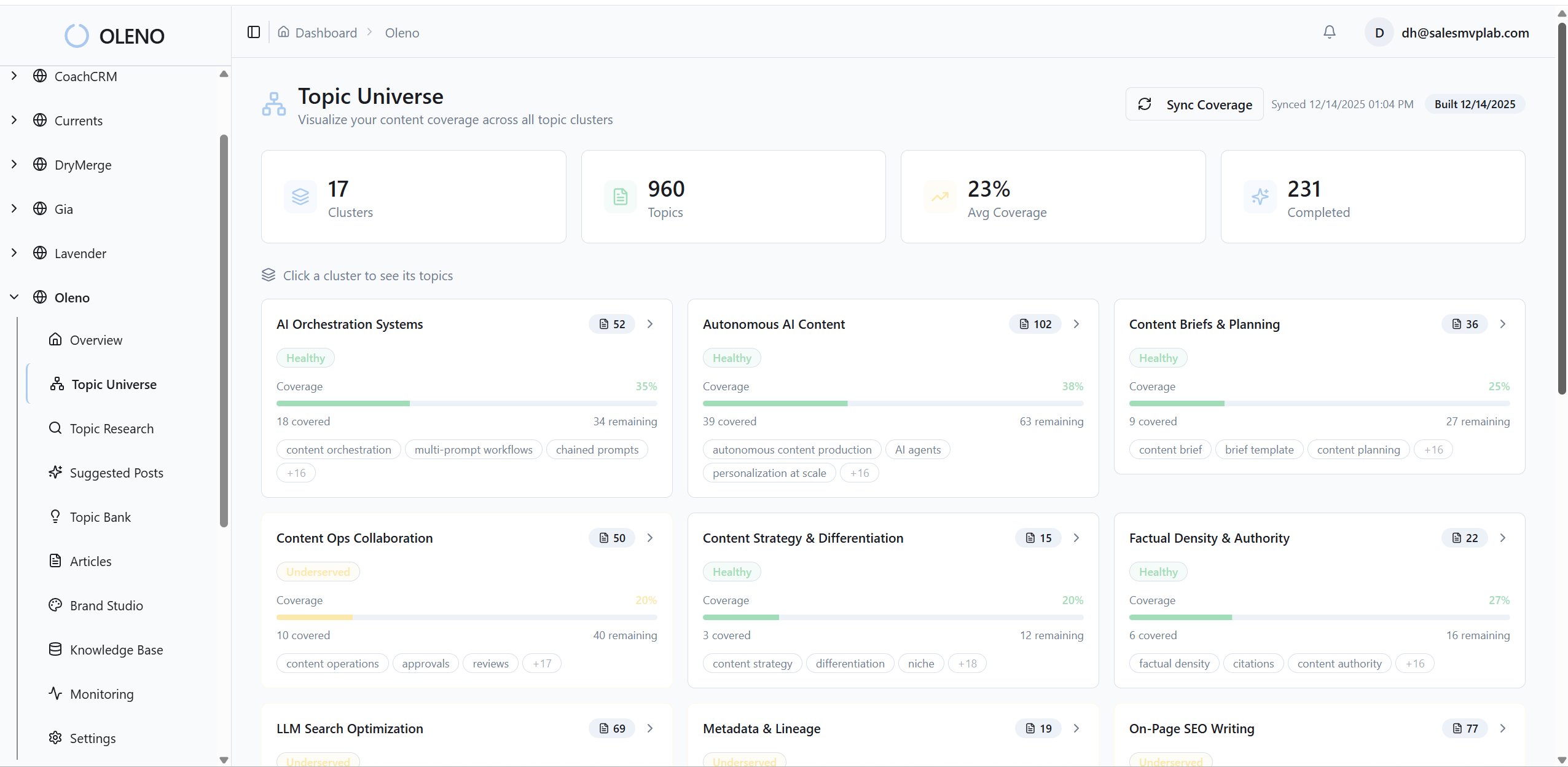
What changes on your side? Less guesswork, fewer “isn’t this similar to X?” debates, and a roadmap that moves underserved areas toward healthy. It directly addresses the duplication and rework hours you’re losing now, those 36–60 hours of cleanup start disappearing because the system won’t let low-gain work through.
Information-gain briefs and QA Gate to prevent repetition
Every approved topic in Oleno becomes a brief with competitive research and an Information Gain Score. Low-differentiation outlines are flagged before writing starts. Drafts must pass QA gates that evaluate structure, brand voice, snippet readiness, and clarity. Quality is enforced upstream, not patched later.
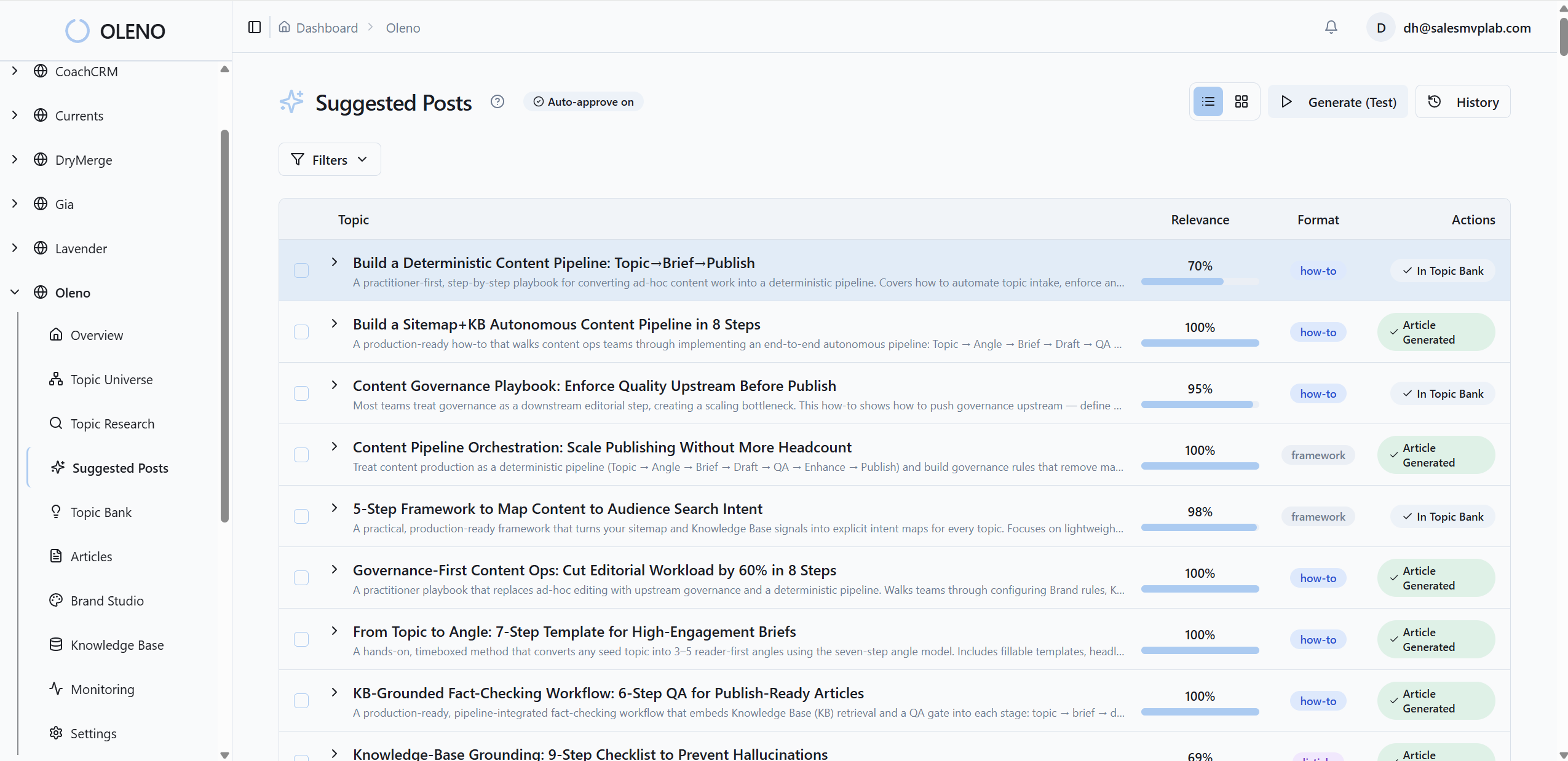
The result isn’t a promise of perfection. It’s fewer shallow drafts, fewer rewrites, and more sections that can stand alone as citations. That’s how you reduce cannibalization and keep clusters strong over time. This is where Oleno earns trust: not by writing faster, but by preventing repetition from ever getting to draft.
Deterministic internal linking, schema, and brand visuals, without manual hops
Oleno injects internal links from verified sitemaps only, with exact-title anchors placed at natural sentence boundaries. No fabricated URLs. Schema markup (Article, FAQ, BreadcrumbList) is generated and validated as JSON‑LD. Visual Studio generates brand-consistent hero and inline images, prioritizes solution sections, and produces SEO-friendly alt text and filenames automatically.
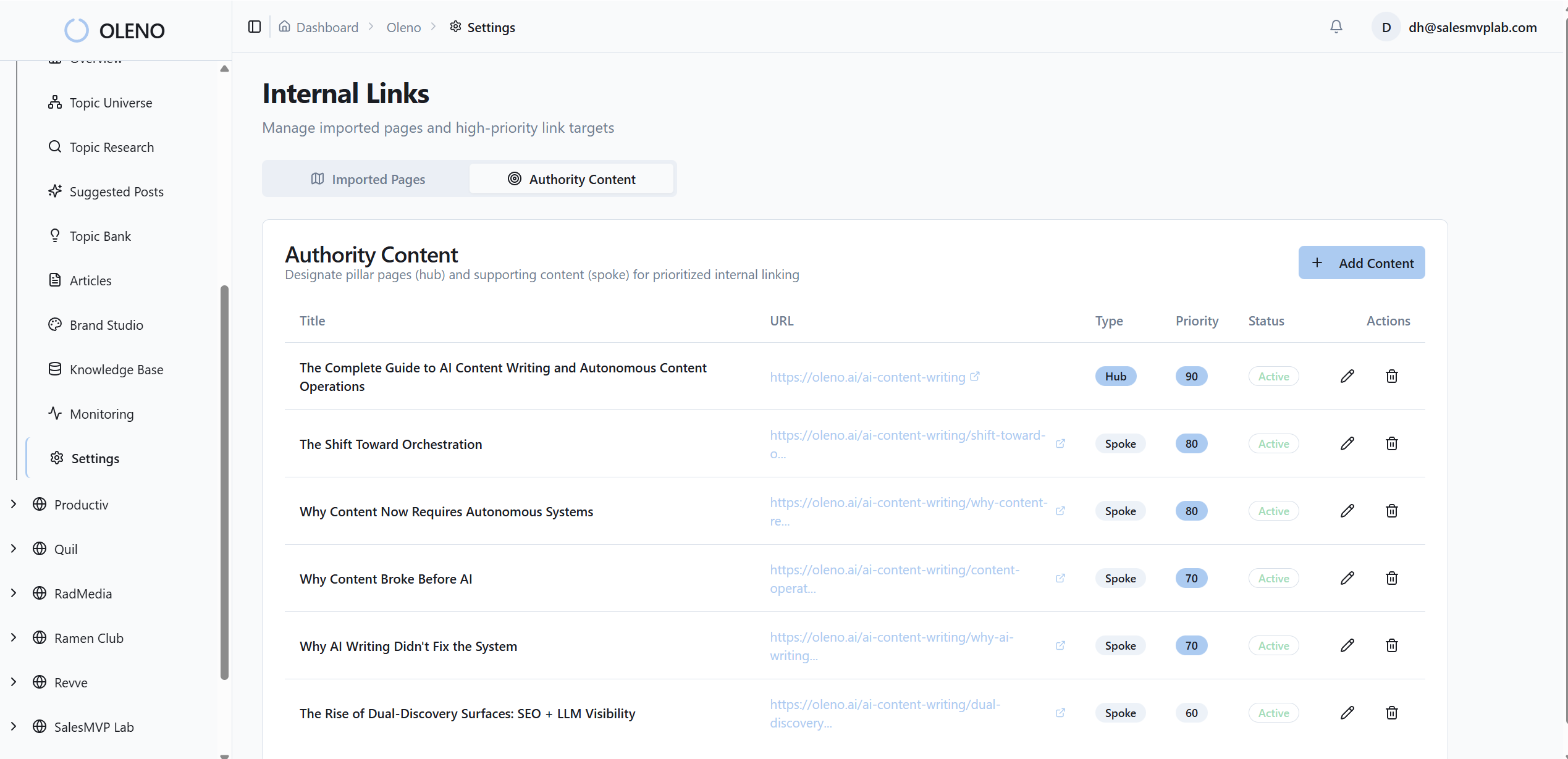
Publishing is handled through mapped CMS connectors (WordPress, Webflow, HubSpot, or Google Sheets for custom flows). Duplicate posts are prevented by design. The payoff is concrete: less cannibalization, fewer SEO fixes, and no last‑mile fragility. You focus on story and product. Oleno handles structure, links, visuals, and ship.
If you’re thinking, “We need this running next quarter,” you’re not alone. Teams use Oleno to move from calendars to systems in weeks, not months. Want to see the pipeline end-to-end? Try Using An Autonomous Content Engine For Always-On Publishing.
Conclusion
Here’s the simple version. Content is a system, not a schedule. When you map topics, label saturation, enforce cooldowns, and gate quality before a single word gets written, volume starts compounding into authority. When you don’t, it turns into noise and rework. You already have the stories. Put the rules around them.
If you want the rules embedded in your stack, Oleno runs them for you, topic universe, information gain, snippet structure, links, schema, visuals, and publishing. It’s a closed loop designed to build trust over time, one governed article at a time. When you’re ready, let the system do its job. Try Oleno For Free.
About Daniel Hebert
I'm the founder of Oleno, SalesMVP Lab, and yourLumira. Been working in B2B SaaS in both sales and marketing leadership for 13+ years. I specialize in building revenue engines from the ground up. Over the years, I've codified writing frameworks, which are now powering Oleno.
Frequently Asked Questions