Content Unit Economics: Calculate Cost-Per-Article & Optimize ROI

Most teams chase volume because they can’t measure per‑article ROI clearly. Content unit economics gives you the missing lens. When you treat content like a product with unit costs and unit outcomes, you stop guessing. You start prioritizing work that lowers cost per article while keeping conversion per article steady. That’s where programs start compounding.
I learned this the hard way. At one company I could write 3–4 strong posts a week myself, then output cratered when the team grew and context got diluted. We were producing “more,” but our cost per article ballooned and the win rate per piece fell. Once we mapped the math, it got obvious what to cut, what to fix, and what to double down on.
Key Takeaways:
- Compute all‑in cost per article, not just writer fees, so your math reflects reality
- Map each article to a funnel job and a measurable proxy for value
- Use a simple prioritization matrix: cost, impact, effort, confidence
- Pull five levers to drop unit cost without losing quality or conversions
- Run a 4‑week experiment to validate changes before you scale them
Content Unit Economics, Not Volume, Decides If Your Program Works
Content unit economics says a program works when cost per article drops or conversion per article climbs, ideally both. Volume hides bad economics because more posts can mask waste for a while. When you track unit cost and unit value per piece, your roadmap shifts fast toward assets that earn their keep.
Why Volume Can Hide Bad Economics
Headcount, contractors, review cycles, tooling, and rework all add up, and they don’t show on a vanity “posts per month” chart. If your average article takes three people, two review rounds, and a week of slack time, you’re paying more than you think. I’ve watched teams celebrate output while burning cash on edits that shouldn’t exist in the first place.
You also feel the drag in small ways. A writer waits for a product detail. An editor fixes voice drift. A PMM corrects claims. None of that moves pipeline, yet it soaks up hours. Most of the waste isn’t in writing paragraphs, it’s in coordination. That’s why unit economics is a better yardstick than volume. It forces the hard questions about where time and money actually go.
Get the unit math right, and velocity becomes a byproduct. You stop green‑lighting pieces that will never pay back. You protect the ones that do.
The GEO Reality Check On Consistency
LLMs now judge whether your content is consistent, precise, and citable across many pages. Humans and search bots tolerated a bit of drift. LLMs don’t. If each article sounds different, defines features differently, or wobbles on your POV, you pay twice: more editing now, weaker visibility later.
I’ve seen great ideas die because the narrative shifted mid‑series. Your unit economics suffer when every piece needs a “fix the story” pass. The GEO bar makes the economics even tighter: repeatable structure, consistent definitions, and clear claims lower edit time and raise extractability. That’s a real cost advantage.
Treat consistency like a cost lever. It is.
Stop Counting Posts, Start Owning Cost Per Article
Counting posts tells you activity. Cost per article tells you viability. The number you want is total cost divided by published pieces, including labor, tools, rework, and delays. Once you have it, you can actually compare formats, workflows, and vendors on equal footing.
What “All‑In” Really Means
All‑in isn’t just the writer invoice. It includes strategy, research, outlining, drafting, SME time, reviews, edits, images, CMS formatting, and distribution work. If an engineer spends 30 minutes fact‑checking a feature, that cost belongs in the article P&L. If your lead PMM does a voice pass, add it.
You’ll be surprised where the money hides. Many teams ignore idle time between steps, which quietly inflates cost because context goes stale and rework creeps in. Capture start and end timestamps, not just “active” minutes. Idle time is expensive.
Do this across a sample of 10–20 recent pieces. Average it. Now you have a baseline. You can’t lower what you don’t measure.
Map Each Piece To A Measurable Outcome
Every article should have a job: acquire, educate the category, drive evaluation, explain product, or prove value. Tie each job to a metric you can attribute with reasonable confidence: first‑touch leads, assisted pipeline, demo requests, free trials, or bottom‑funnel engagement.
You won’t get perfect attribution. You don’t need it. Directionally correct beats imaginary precision. If an evaluation page drives demos at 1.5% and costs $600, while a broad top‑funnel piece costs $900 and drives little intent, your prioritization writes itself. Keep the model simple and honest.
A quick sanity check against market data helps too. Reports like the 2024 State of Content Marketing by Semrush and the 2024 State of Marketing by HubSpot show what content types pay back fastest for peers. Use them as a backdrop, not gospel.
Where The Money And Time Go In A Single Piece
Unit economics break when costs concentrate in coordination, not creation. Most teams underestimate research, reviews, and CMS work, then overestimate the value of “more words.” The stack is simple to diagram, hard to face, and essential to fix.
The Cost Stack You’re Probably Missing
When you unpack a piece end to end, a pattern shows up: research stalls, voice fixes, product accuracy passes, image creation, formatting, then post‑publish tweaks. Each hop adds context loss. Context loss creates rework. Rework inflates cost.
I still remember a piece that took six days end to end for no good reason. The draft was fine on day one. By day six, five people had touched it, and the message had drifted. We cut the loop from six touches to three, and cost per article fell by roughly a third. Nothing else changed, especially when evaluating content unit economics.
A clear stack forces choices. If distribution takes 30 minutes but reviews take 120, you know where to focus. If CMS formatting eats an hour per post, fix templates before you hire another writer.
After you’ve mapped it, summarize the usual suspects:
- Idle time between handoffs: context cools, edits multiply
- Voice and structure drift: rewrite tax on every piece
- Product accuracy checks: SMEs pulled in late
- CMS formatting: manual layout and image work
- Distribution setup: platform tweaks, links, and UTMs
The Hidden Opportunity Costs
Every extra round of edits steals time from the next high‑leverage piece. Slow cycles delay learning too. If an evaluation article could have been live a week sooner, that’s a week of missed demos. That cost is real, even if it never hits a line item.
There’s morale tax as well. Writers get frustrated when their work pinballs through vague feedback. Editors burn out chasing voice. Stakeholders lose trust when claims wobble. That pain shows up as turnover and slower hiring ramps, which then hits output again.
Market context doesn’t stand still. If you’re late with a compare page, a competitor captures the query first. Research from McKinsey on generative AI’s economic impact shows that coordination overhead drags down potential gains, especially in knowledge work. The takeaway from their 2023 analysis is simple: remove bottlenecks or you leave value on the table (McKinsey’s generative AI economic potential).
What It Feels Like When The Economics Are Broken for Content unit economics
Broken economics feels like late nights, long threads, and content that never quite lands. You know the feeling. You publish, but you don’t trust the work to move numbers. That’s the tell.

The 11 PM Rewrite
You’re fixing an intro the night before publish because the tone doesn’t match. You know it’s wrong the second you read it. The writer didn’t have the product nuance. The editor missed a claim. The PMM spotted it too late. Now everyone’s frustrated.
I’ve been there more times than I care to admit. The next morning the team is tired, conversions don’t budge, and cost per article quietly ticks up. Everyone promises to “align earlier,” then the cycle repeats. Without a system, it always repeats.
The Backlog Spiral
Backlog grows, review slots shrink, and the only way to hit the calendar is to lower the bar. Someone says “we need more top‑funnel to keep traffic up,” and you end up feeding a machine that doesn’t pay you back. That’s not a content problem. That’s an economics problem.
The fix starts with math and ends with behavior. You can’t will your way out of a broken process. You change what gets approved, how work flows, and who touches what. Then the late nights fade.
A Simple Content Unit Economics Model You Can Run Next Week
Start with a baseline: your true cost per article and a clean map of outcomes by content job. Then prioritize like an owner. The model is light, fast, and good enough to steer real decisions within 30 days.
Build Your Cost‑Per‑Article Calculator
You need a sheet with three tabs: Costs, Outputs, and Outcomes. Keep it simple, keep it updated weekly, and force yourself to log idle times. That honesty pays for itself almost immediately.
Here’s the build in five moves:
- List roles and hourly rates: writers, editors, PMMs, SMEs, designers
- Add per‑piece time by step: research, brief, draft, SME, edit, CMS, distribution
- Include tooling costs per piece: image tools, AI tokens, CMS apps
- Capture idle time between steps: date stamps in, date stamps out This is particularly relevant for content unit economics.
- Tie each article to one job: acquire, educate, evaluate, product, proof
Once you’ve logged 10–20 pieces, calculate averages. That’s your baseline. You’ll see obvious wins staring back at you.
Prioritization: Cost, Impact, Effort, Confidence
Now build a one‑page matrix. Rows are ideas or refreshes. Columns are unit cost estimate, impact potential, effort to ship, and your confidence level. Sort by highest impact per unit cost, weighted by confidence.
Two rules keep you honest. First, kill work that looks expensive and low‑impact, even if it’s someone’s pet project. Second, batch similar jobs so the team stays in context. Context switching is a hidden tax that torpedoes unit economics.
If you want a quick external gut check on impact potential, the market studies from Semrush and HubSpot mentioned earlier offer helpful benchmarks for which formats tend to convert. Use them as a nudge, not a script.
Five Levers To Cut Unit Cost Without Losing Quality
You don’t need heroics. You need disciplined changes that compound:
- Tighter briefs: reduce rewrites by setting voice, claims, and angle up front
- Fewer handoffs: assign ownership, limit reviewers, time‑box feedback
- Reusable structures: standardize headers, definitions, and CTA rules
- Earlier product grounding: load verified features before drafting
- Template‑first publishing: stop rebuilding layouts in the CMS
Ready to apply the model and see the numbers shift in your world? Request a Demo
How Oleno Operationalizes Content Unit Economics
Oleno turns the model into daily practice by encoding voice, product truth, and audience rules, then running deterministic pipelines that ship on schedule. The effect on content unit economics shows up fast: fewer rewrites, shorter cycles, and higher consistency that GEO rewards.

Governance Makes Every Draft On‑Brief
Oleno’s Brand Studio, Product Studio, and Audience & Persona Targeting load tone, style, approved claims, and buyer context into every brief and draft. Writers and AI work from the same playbook, so voice drift and claim wobble drop.
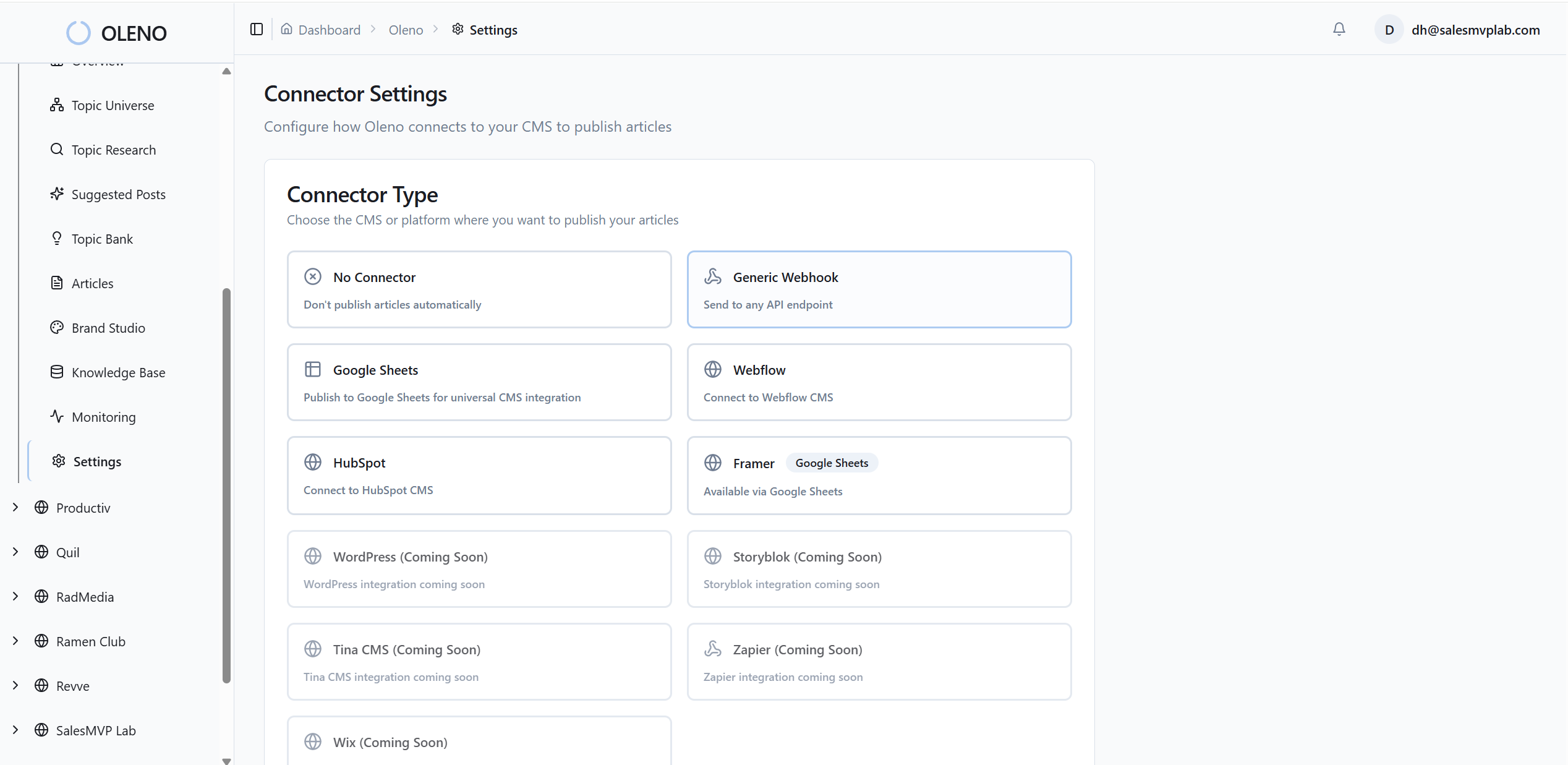
That governance layer removes a common source of rework. Product details stay accurate because they’re pulled from a single source of truth. Tone stays aligned because voice rules are enforced up front and scored in QA. Less fixing later means lower cost per article.
You also avoid “SME at the last minute” chaos. Approved product boundaries are already in the system, so you protect credibility without halting the line.
Deterministic Pipelines Lower Cycle Time
Programmatic SEO Studio, Topic Universe, and the Orchestrator replace ad‑hoc juggling. Jobs move through defined steps: brief, draft, sanitize, QA, images, finalize, publish. CMS Publishing pushes clean structure directly into WordPress, Webflow, and others, so you skip the copy‑paste tax.
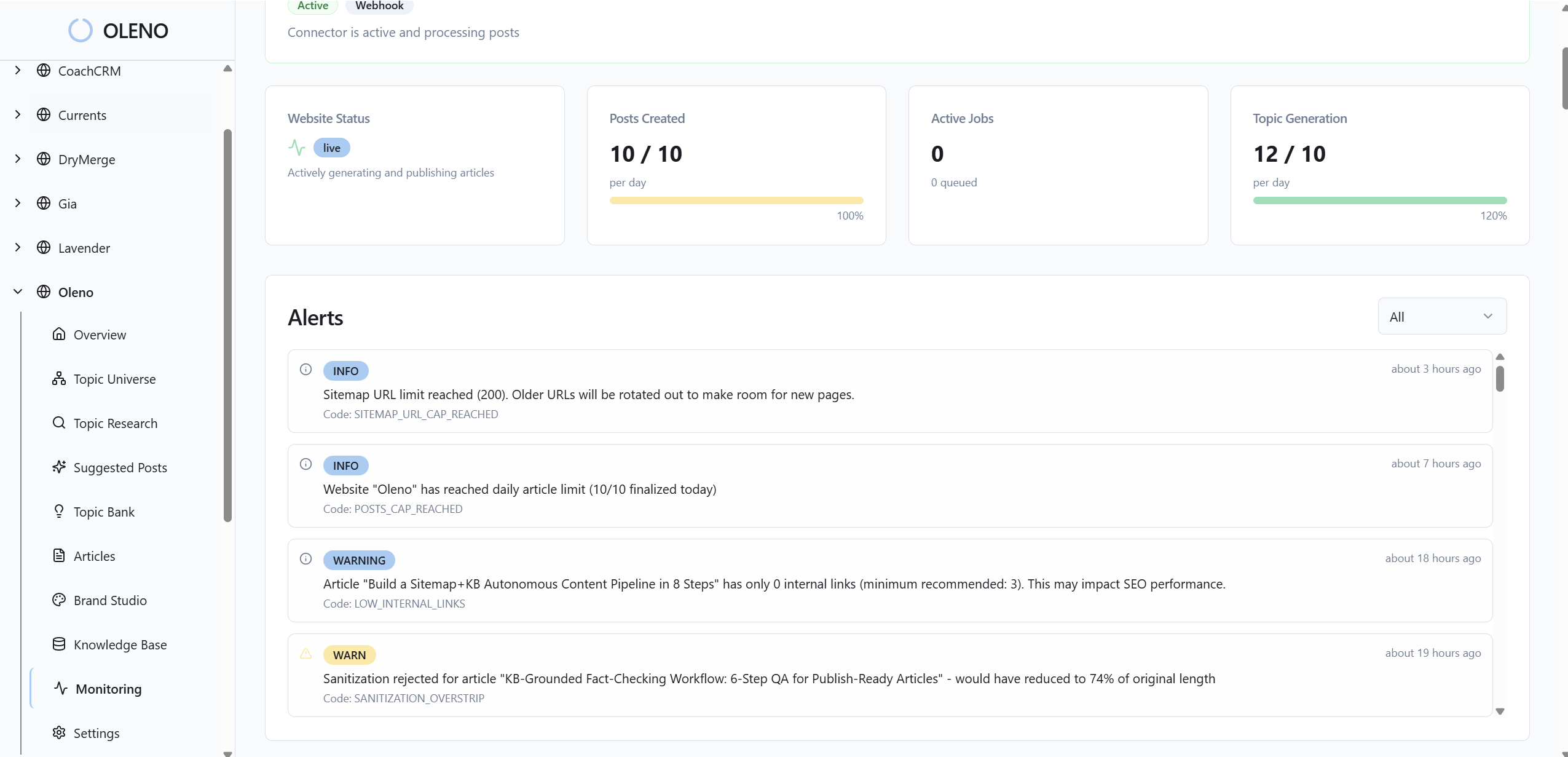
Predictability is a cost lever. When each article follows the same chain, idle time shrinks, context sticks, and your average hours per piece drop. That’s exactly where earlier we saw review cycles eat 60–120 minutes per post. Oleno collapses that gap.
If your baseline showed CMS formatting as a hidden cost, publishing connectors pay for themselves quickly. Templates stay intact, and the team gets time back.
Want to see how the pipeline drives down your per‑piece cost in practice? Request a Demo
Quality Gate And Distribution Keep ROI Compounding
The Quality Gate blocks thin or off‑voice drafts before they reach review. Structure, clarity, grounding, and SEO checks run automatically, so only pieces at or above the bar move forward. That protects conversion per article while you lower cost per article.
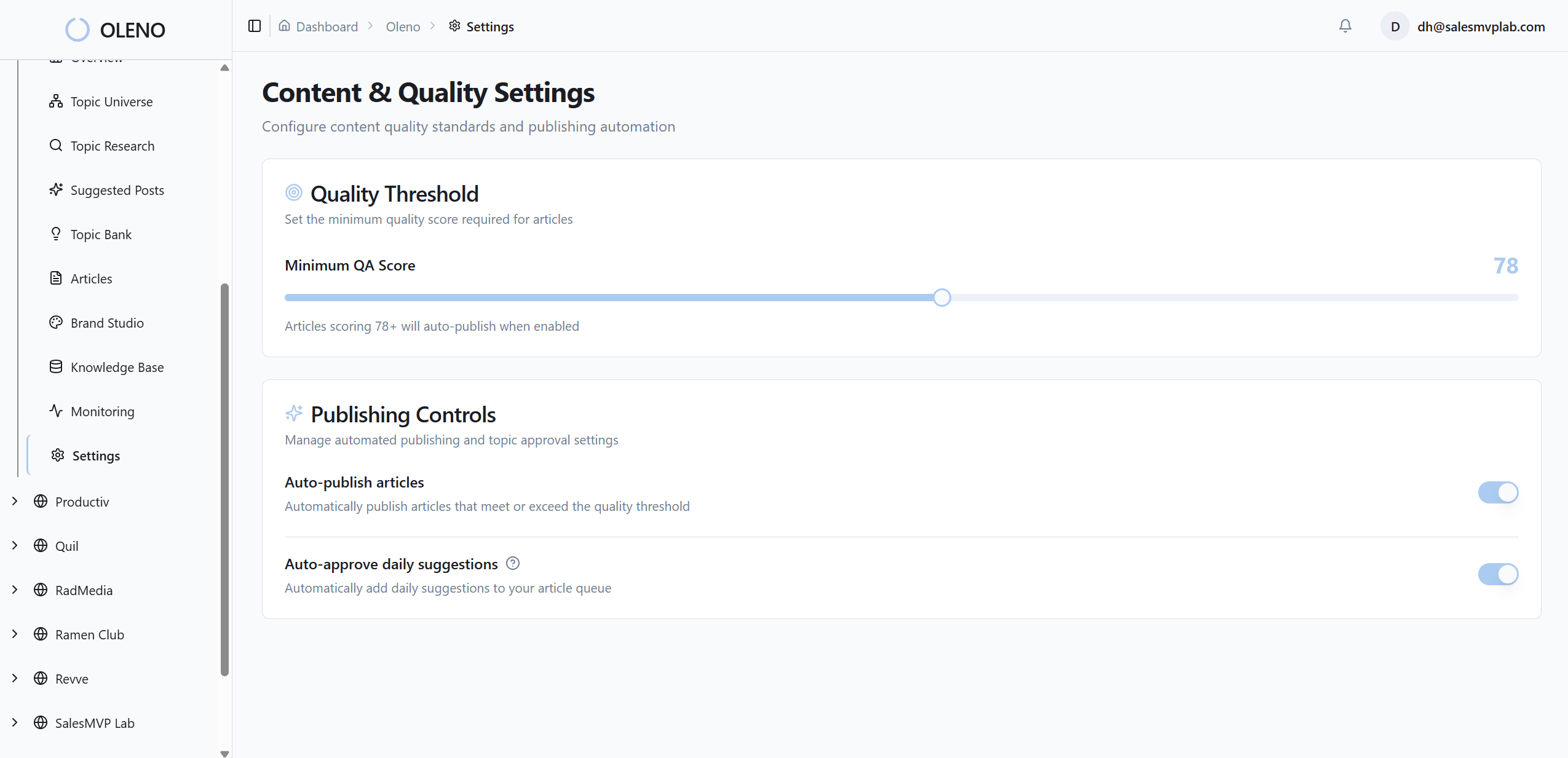
Distribution Studio then repurposes approved articles into platform‑ready posts for LinkedIn and X. The same narrative and claims travel across channels without extra lift. More touches from one asset raises the value side of your unit economics without adding new creation costs.
Oleno isn’t a prompt toy. It’s an execution system that encodes your rules, runs the work, and keeps quality steady as you scale. That’s exactly what the unit economics model requires.
Before you wrap, set a target: reduce average unit cost by 30–50 percent in 3–6 months while holding or improving conversion per article. Oleno is built to make that target real. Book a Demo
Conclusion
If you remember one thing, make it this: content unit economics beat volume. Measure all‑in cost per article, map each piece to a real job, and prioritize by cost, impact, effort, and confidence. Then tighten governance, cut handoffs, standardize structures, and publish from templates.
Do it for four weeks and check the math. Your average cost per article should drop. Your conversion per article should hold or rise. Keep what worked, kill what didn’t, and let the system keep running. That’s how small teams scale output without losing their voice or their budget.
About Daniel Hebert
I'm the founder of Oleno, SalesMVP Lab, and yourLumira. Been working in B2B SaaS in both sales and marketing leadership for 13+ years. I specialize in building revenue engines from the ground up. Over the years, I've codified writing frameworks, which are now powering Oleno.
Frequently Asked Questions