Contrarian: Stop Scheduling Thought Leadership — Let an Executive Thought Leadership Workflow Run Your Narrative

A calendar is guesswork. That’s the core problem with most executive thought leadership workflow setups. You’re locking in topics and dates before you have evidence, buyer intent signals, or product proof to back them up. So you burn exec hours on pieces that never move pipeline. Or worse, they dilute your narrative and confuse the market.
I’ve run the calendar-first play. It looks productive. Feels busy. But when you audit results, you see the same pattern. Spikes, then stalls. Posts that sound fine but never get cited. Sales calls where buyers say, “I saw it,” then ask for case proof you don’t have. The fix isn’t more ideas or more output. It’s orchestration. A system that waits for topic signals and real stories before letting anything ship. That’s what an executive thought leadership workflow should be built on.
Key Takeaways:
- Calendar-first exec publishing wastes expensive time and creates noise. Use trigger-based signals and evidence to decide when to publish.
- Tie leadership stories to a live Topic Universe so you write where demand and SEO opportunity already exist.
- Pull anecdotes from Stories Studio only when Knowledge Archive proof exists, so your exec lands as credible—not opinionated fluff.
- Use a Variation Layer to spin audience-specific versions from one source piece without manual rewriting.
- Enforce a hard QA Gate for voice, claim safety, and grounding. Nothing ships until it passes.
- Measure system reliability, not vanity. Cadence, quality, and proof density matter more than post count.
Polarizing Insight
Most executive thought leadership fails because it’s scheduled, not signaled. Authority compounds when stories line up with live topical opportunity and product proof. Orchestration that waits for demand cues and evidence prevents publishing noise and focuses every asset on pipeline impact.
Calendars Create Noise
A calendar tells you when to publish—not whether the market cares or if your product story is ready. That gap is where wasted posts come from. You fill slots, you hit dates, you miss impact. I’ve seen leadership teams grind out thought pieces that never earn a single sales-share. Not because the ideas were bad, but because the timing and proof were off.
And you feel it in sales cycles. Reps want a link they can send mid-evaluation that answers “why now” with real examples. Instead they get a high-level essay from last quarter’s calendar theme. Close rates don’t budge. Pipeline atrophies. The content wasn’t wrong; it was irrelevant in that moment.
Orchestration Waits For Proof
Orchestration flips the rule. No topic gets a green light until you have one of three triggers:
- Rising search intent in your Topic Universe
- A real customer story in your Knowledge Archive
- A product milestone that changes the buyer’s decision
That’s the bar—not the quarter’s editorial theme.
Once you adopt that bar, cadence gets healthier. You won’t publish less forever. You publish fewer weak takes now, then more high-impact pieces as your story bank grows. The noise drops fast. Authority starts stacking.
Reframe
The real problem isn’t that your exec doesn’t write enough. The real problem is there’s no single system that decides which stories earn a slot and which wait. Without that, you optimize for output speed instead of reliability, which is why your narrative drifts and trust erodes.
The Symptom You Feel Is Volume Pressure
You feel behind, so you chase volume. Fill the slots. Hit the theme. Keep the calendar green. It looks like progress. Except the backlog grows with pieces that need rewrites, legal passes, or “more data” that never arrives. You ship late or you ship soft, and both choices cost pipeline.
Volume pressure also pushes shortcuts. Generic “point of view” posts. Big claims without examples. That’s the mistake. Buyers smell it. Search engines do too. You might get impressions, but you lose the shot at being cited or shared by people who matter. You bought activity at the expense of credibility.
The Root Cause Is Fragmented Inputs
Your inputs live everywhere. Leadership’s stories in Slack. Product truth in docs. Customer proof in decks. SEO opportunities in a separate tool. With fragmentation, no one can see when three signals line up. So the only planner left is the calendar—which is the worst planner of all.
A system changes that. When narrative, knowledge, and topic signals sit in one place, you can wait for alignment without slowing down. You aren’t guessing. You’re listening. That’s the difference between posts that read fine and posts that change deals.
Rational Drowning
Calendar-first leadership programs waste hours, dilute voice, and stall deals. The costs stack quickly. A single exec post often burns 6 to 10 hours of leadership time, plus 4 to 8 hours from marketing. Miss the mark three times in a quarter and you’ve lost a workweek you’ll never get back.
The Real Cost Of Calendar-First
There’s the direct time sink, which hurts. The hidden cost is worse. Every off-angle post teaches the market the wrong thing about your category. Fixing that drift takes 3 to 5 stronger pieces later. Reps also stop sharing leadership links when those links don’t help them win, which breaks your internal distribution.
I’ve watched teams spend weeks polishing a flagship piece, then abandon it after two calls because buyers asked for specifics and the article had none. That’s not content failure. That’s system failure. You didn’t require evidence before writing. So you paid twice—once to produce and again to repair.
After you tighten the system, you see the inverse. One triggered piece anchored to real proof keeps paying off. Search engines cite it more. Reps reuse it more. Prospects paste it into internal threads. That compounding effect is what you’re missing with calendar-first, especially when evaluating executive thought leadership workflow.
- Direct time lost per weak post: 10 to 18 hours across exec and marketing
- Drift repair tax: 3 to 5 follow-on posts to correct positioning
- Sales trust hit: fewer internal shares, slower deal velocity
Evidence Beats Opinions In Search And Sales
Opinion can open a door, but evidence gets you shortlisted. The best-performing leadership pieces I’ve shipped tied a sharp take to a specific customer story or a product milestone buyers could validate. That’s when prospects pause and think, “Okay, they’ve lived this.”
Search engines reward it too. Google’s guidance on helpful content favors first-hand expertise and citations that demonstrate experience, not generic takes. If you want AI overviews to quote you, give them extractable proof and structure, not calendar filler. Start there, then scale it once you see lift. The Google Search Essentials guide outlines these principles.
Emotion: Executive Thought Leadership Workflow
You know the feeling. It’s 9 pm, your exec’s draft is “almost there,” and you’re still chasing a screenshot or a customer quote. Tomorrow’s slot is looming. You push it live anyway. The next morning, sales ignores it. You wonder why you keep doing this.
What It Feels Like To Chase Posts
It’s exhausting. You’re herding inputs instead of shaping a narrative. You’re guessing at what will land because the system isn’t feeding you real triggers. Then you get feedback like “sounds off-brand” or “needs proof,” which sends you back to the same scattered sources.
That cycle drains momentum. It also chips away at leadership’s willingness to participate. Execs don’t mind writing when their stories matter. They hate writing when it feels like homework. The way out is changing when and why you ask them to write.
Exec Time Is Too Expensive For Guesswork
An hour of exec time is scarce. Spend it where odds of impact are high. That means you don’t bring a topic to them until the signals line up. When I’ve switched to that approach, I’ve seen execs re-engage. They can feel the difference between “we need a post” and “the market is asking for this take, and we have the proof.”
You’ll also sleep better. Fewer last-minute edits. Fewer rewrites. Fewer post-mortems. You’re not forcing content into a date. You’re letting triggers pull it into existence. Simple shift. Big relief.
New Way
The new way is trigger-based orchestration. Publish only when three inputs align, then adapt once—not fifty times. Your executive thought leadership workflow becomes a system, not a sprint. You trade calendar anxiety for reliability and compounding authority.

Trigger Based Publishing Flow
Stop starting with topics. Start with triggers. The system watches three inputs at all times, then opens a slot only when at least one fires and the others can support it. You aren’t waiting months. You’re just refusing to guess. That alone removes most wasted posts.
Here’s a simple flow you can implement:
- Monitor your Topic Universe weekly for rising opportunities that match your narrative (queries, SERP changes, competitor gaps).
- Log product milestones and customer wins in a central Knowledge Archive with pull quotes and artifacts (screens, metrics, approvals).
- When a topic rises, check for matching proof. No proof, no post. With proof, move to brief with a single core claim and 2–3 evidence points.
- Draft with voice rules locked, then enforce a QA Gate for voice, claim safety, and structure (block if any artifact is missing).
- Publish, then create audience variants from the same source piece, not fresh rewrites—role, industry, and funnel-stage tweaks only.
Run this for a quarter. You’ll see fewer misses and more reuse. Month one feels slower. By month three, it’s faster because the system does the choosing and the quality bar is non-negotiable.
Quality Gates Over Opinions
Strong opinions help, but they don’t replace governance. Make voice, term usage, and claim boundaries explicit so you don’t debate them on every draft. Require proof artifacts in the brief. Block publishing if evidence isn’t attached. That single rule prevents so many mistakes.
And when the piece passes, you can scale it safely. Create tailored variants by role or industry without diluting the core claim. You’ll stop rewriting from scratch. You’ll also keep exec takes tight across segments, which is where most programs fail and drift.
Solution
Oleno makes the trigger-based approach practical for small teams. It encodes voice, narrative, and product truth once, then runs a deterministic pipeline so executive content only ships when it’s on-message, grounded, and aligned to buyer intent. What used to take weeks of back-and-forth becomes a governed workflow you can trust.

How Oleno Enables The New Way
Brand Studio locks tone, terminology, CTA style, and structure so every draft sounds like your exec wrote it. Marketing Studio encodes your category POV and message pillars, which keeps takes sharp instead of generic. Product Studio grounds claims in approved descriptions and boundaries so you don’t risk invented features or fuzzy promises. Stories Studio pulls lived anecdotes and customer examples into drafts so leadership pieces feel real, not theoretical.
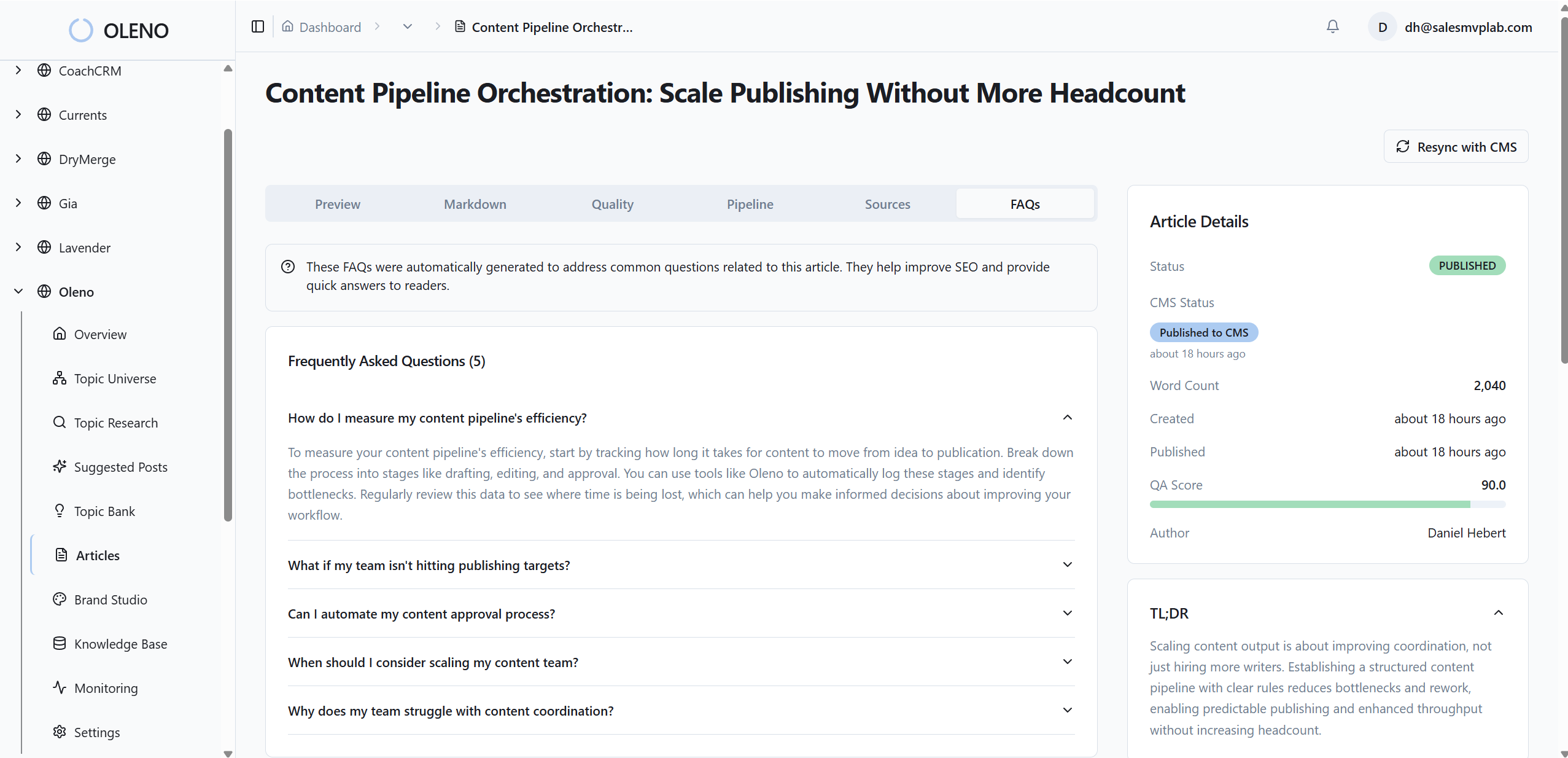
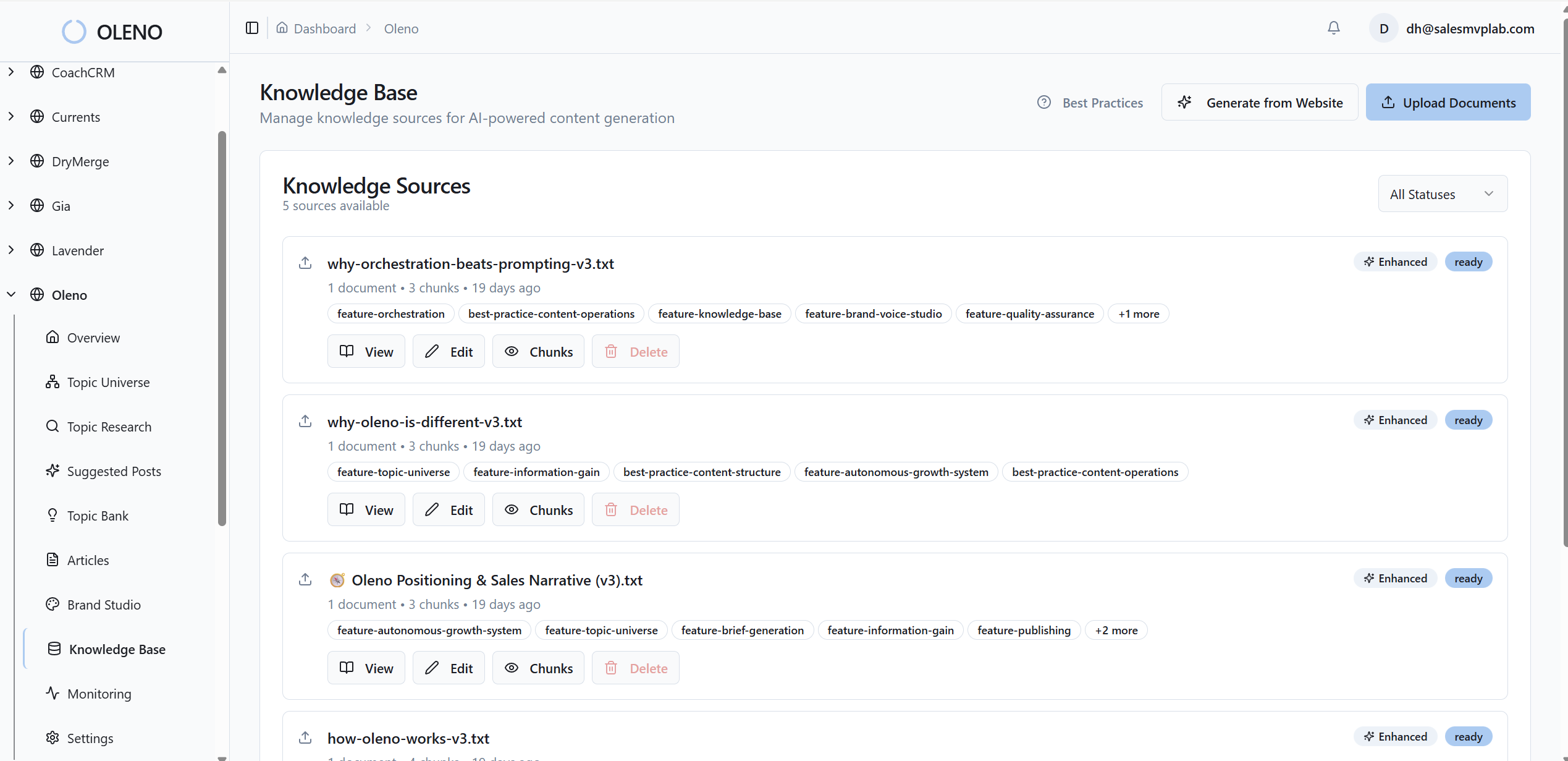
The Knowledge Archive feeds retrieval during briefs and drafts, then the QA Gate blocks anything that misses voice, structure, grounding, or clarity. That ties directly back to the earlier costs. Those 10 to 18 hours per weak post shrink because rework drops and approval time compresses. And when a piece passes, the Variation Layer adapts it by audience or persona so one triggered asset reaches multiple segments without manual rewrites.
Fewer rewrites, faster approvals, and safer claims. That’s what Oleno delivers. Request a Demo
Features That Lock In Governance
With Oleno, you can require evidence before publishing, not after. Brand Studio and Product Studio remove voice and claim debates from live drafts, which speeds decisions. Marketing Studio keeps every leadership piece inside your strategic narrative, so you build authority instead of scattering it. The QA Gate enforces standards every time, which means your quality floor rises as output grows.
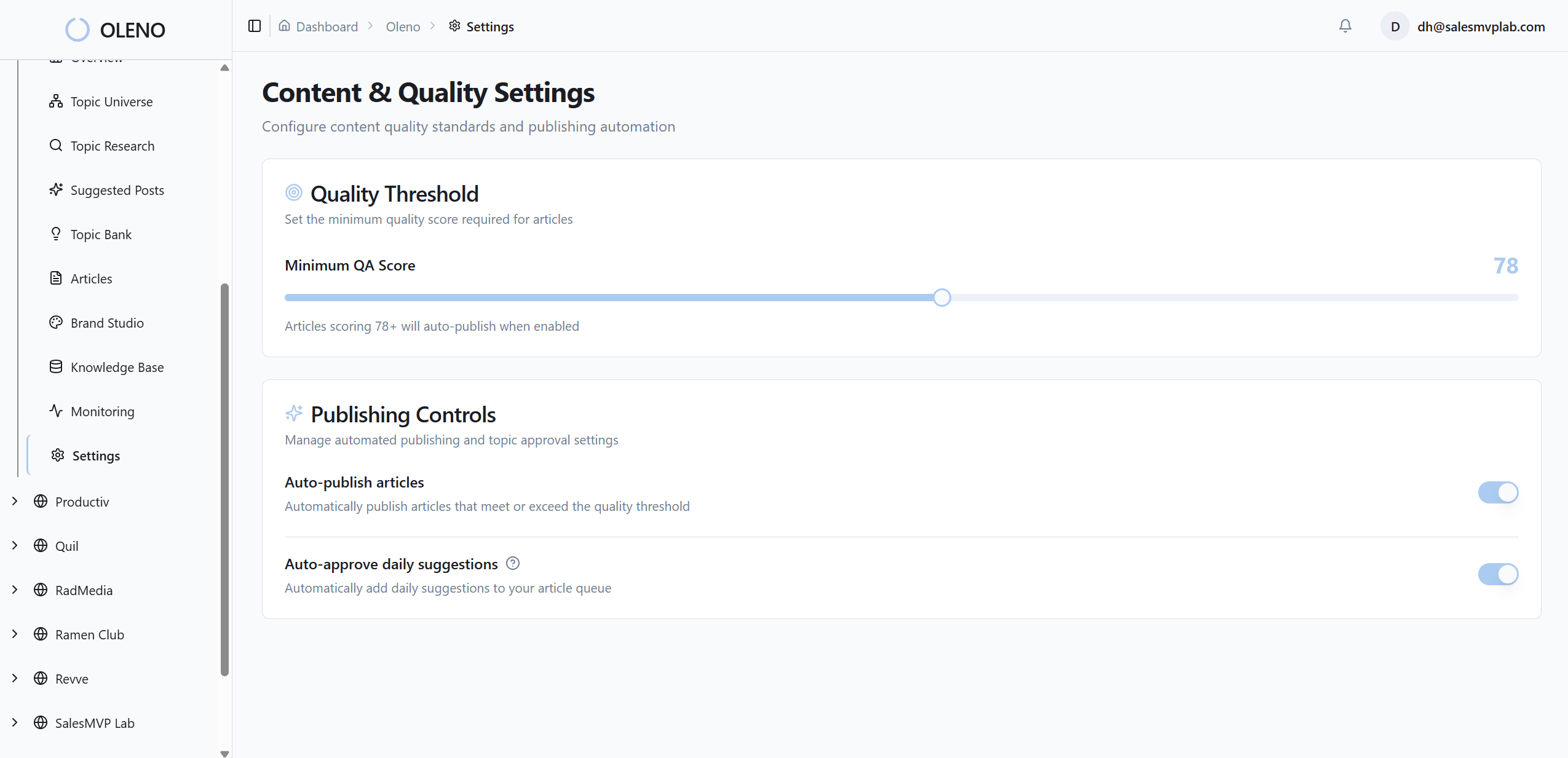
When a topic rises in your SEO Studio’s Topic Universe, you match it to archived proof, draft with governance, then push straight to your CMS as a draft or live post. That’s the execution layer most teams miss. It’s also why teams using governance-first approaches see their thought leadership get cited more and ignored less. For context on why this matters, the annual Edelman and LinkedIn study shows decision-makers reward thought leadership that teaches with proof, not platitudes. Read the latest findings here: Edelman-LinkedIn B2B Thought Leadership report.
Key capabilities that matter most:
- Brand Studio for voice, term rules, structure, and CTA consistency
- Marketing Studio for message pillars and category framing
- Product Studio for allowed claims and feature boundaries
- Stories Studio plus Knowledge Archive for real anecdotes and proof
- QA Gate that blocks anything off-voice, ungrounded, or structurally weak
Before you worry about scale, make the system reliable. Oleno is built for that order of operations.
Conclusion
A calendar is a blunt tool. It can’t tell you when the market is ready for your take, or when your product story has the proof to carry it. A trigger-based executive thought leadership workflow can. Wait for topic signals, anchor every piece in real evidence, enforce voice and claim rules, then adapt for segments once—not fifty times.
Do that for a quarter and the pattern changes. Fewer misses. More citations. Sales links your content because it actually helps them win. And your exec time goes into the stories that matter, not the ones that fill a slot.
For extra context on building content that earns citations and visibility, study Google’s guidelines on helpful, experience-backed content. They reward the same thing your buyers do, which is why the shift from calendar-first to orchestration pays off twice. The guidance is here: Google’s helpful content principles.
About Daniel Hebert
I'm the founder of Oleno, SalesMVP Lab, and yourLumira. Been working in B2B SaaS in both sales and marketing leadership for 13+ years. I specialize in building revenue engines from the ground up. Over the years, I've codified writing frameworks, which are now powering Oleno.
Frequently Asked Questions