Stop Shipping Content. Execution Is a Category.

Most teams are stuck because execution is a category, but they keep treating content like output and treating execution like a bunch of tasks. That mindset funnels you into fragmented, prompt-based demand-gen execution, where every asset is a one-off event, and nothing really compounds.
Demand-generation execution software is a marketing operations platform that delivers consistent, narrative-driven demand creation by governing voice and product truth, orchestrating content across the funnel, and automating cadence, publishing, and reinforcement so work compounds instead of resetting each quarter, with predictable quality and minimal coordination cost. Unlike AI writing assistants or content tools, it’s not trying to make drafting faster. It’s trying to make the whole demand-gen system reliable.
And yeah, I’m being a bit contrarian on purpose. Because I keep seeing smart marketing teams work their faces off… and then wonder why they’re still restarting the machine every quarter.
Key Takeaways:
- Stop counting assets. Start tracking system health: QA pass rate, cadence SLOs, and “why did this fail” sampling.
- Treat content like jobs across the funnel (acquire, educate, convert, retain, reinforce), not “blog posts” and “social posts.”
- Prompting increases volatility unless you have rules, grounding, and a deterministic pipeline.
- A 30-day triage can fix most of the rework by tightening voice rules, grounding product truth, and raising QA thresholds until the baseline publish rate is stable.
- Compounding comes from reuse and reinforcement, not net-new content marathons.
Content Isn’t The Product. Compounding Execution Is.
Compounding demand gen doesn’t come from “more content,” it comes from a system that can run every week without breaking. The shift is simple to say and annoying to do: you stop managing assets and you start managing the execution layer that produces assets, checks them, publishes them, and reinforces them. Demand-generation execution software helps drive that shift from output to system.
Fragmented, prompt-based demand-gen execution is the default right now. You’ve got a doc for messaging, a doc for voice, a prompt library, a freelancer, an SEO tool, a project board, a half-working approval process, and a CMS that still needs someone to copy-paste things in at the end. It feels productive. It’s also why your demand gen resets every quarter.
The market doesn’t experience your content calendar. Buyers experience the system. Cadence. Coherence. Repetition without sounding repetitive. And if that system is wobbly, the market feels it.
Execution Is A Category, Not A Tactic
Execution is a category when it becomes the organizing principle for how you run demand gen. Not “we should publish more.” Not “we should use AI.” Not “let’s hire an agency.” The organizing principle becomes: can we run a narrative-driven machine, across the funnel, with predictable quality, week after week, without adding more coordination work than output?
That’s why “execution is a category” matters. Once you accept it, you start noticing what’s missing in your stack.
You start asking different questions:
- Where is voice actually enforced, and is it enforced before draft #1 or only in a painful edit loop?
- Where are product truths stored, and who’s responsible for stopping bad claims before they ship?
- Who decides what content should exist next week across acquire, educate, convert, and retain, without it turning into another meeting?
If you can’t point to a system that answers those questions, you don’t have a demand-gen engine. You have activity.
Output Velocity Without Orchestration Increases Volatility
Prompting looks like progress because it produces output. I’ve done the same thing. You prompt. You get a draft. You tweak it. You ship it. You feel like a machine.
Then you try to do it for real demand gen. Across SEO, category education, competitive pages, product education, customer proof, social distribution. Across multiple people. Across weeks where priorities shift. That’s when the bill shows up.
The volatility comes from a few places that pile up:
- Two prompts written a week apart aren’t the same, even if they “look” the same.
- The draft quality swings, so review time swings, so cadence swings.
- The narrative drifts because each asset gets created as an isolated event.
- The team starts compensating with more reviews, more edits, more meetings.
You don’t feel it on asset #3. You feel it on asset #30. That’s when “faster drafting” turns into “frustrating rework.”
The System Is The Product Your Market Experiences
Your buyers don’t care how hard you worked to ship the post. They care what it taught them, whether it sounded like you, and whether it connects to the next thing they read.
I saw this the hard way at Proposify. We ranked for a ton of stuff. Great writers, strong design, real effort. But the content was detached from the solution, so even when we “won” SEO, it didn’t pull the reader anywhere. It didn’t reinforce a narrative. It didn’t move demand.
And that’s the subtle part: the buyer’s experience isn’t one page. It’s the sequence. If your execution is fragmented, the buyer experiences noise. If your execution compounds, they experience a point of view that keeps showing up in different forms, in different places, without contradicting itself.
That’s what shrinks the learning curve. For them, and for you.
The Real Problem Isn’t Ideas, It’s Fragmented Execution Is A Category Problem
Most teams don’t fail at demand gen because they lack ideas. They fail because the work is split across too many tools, people, and processes that don’t talk to each other, so humans become the glue and humans don’t scale.
That’s why fragmented, prompt-based demand-gen execution persists. It’s familiar. It’s easy to start. It also pushes the hardest parts onto your team: judgment, consistency, and coordination.
You can’t “tool” your way out of that with another point solution. You need a new category frame: demand gen is a system execution problem, and execution is a category.
Familiar Tools Push Judgment And Coordination Onto People
Look at the normal flow for a “simple” piece of content.
Someone suggests a topic. Someone writes a brief. Someone prompts a draft. Someone edits tone. Someone checks facts. Someone checks product claims. Someone updates screenshots. Someone formats. Someone publishes. Someone repurposes it into social. Someone checks that it didn’t contradict last week’s message.
Now multiply that by 20 assets a month. Then add a product launch. Then add sales screaming for a deck. Then add the CEO asking for a POV post.
The mistake is thinking you have a writing problem. You don’t. You have a coordination problem.
Prompt-based workflows are sneaky here because they don’t remove judgment. They relocate it. The judgment just becomes a meeting. Or a Slack thread. Or a “can you take a look at this real quick” that turns into 45 minutes.
Agencies Scale Headcount, Not Systems
Agencies and freelancers can absolutely add capacity. I’m not anti-agency. I’m anti pretending that more hands automatically creates a compounding system.
The more you outsource, the more you inherit:
- voice mismatch
- knowledge gaps
- longer feedback loops
- dependency risk when a key writer rolls off
- the same “wait, why are we writing this” conversations every month
You’ll still need a system that makes output consistent. Without it, you’re just buying more drafts. And drafts aren’t demand gen.
The Quarter Is The Enemy Of Compounding
The quarter is when most demand gen quietly dies.
You do planning. You spin up new themes. You reset the board. You retire half the work you made last quarter because “we’re moving in a new direction” or “the priorities changed.” And maybe they did change. That part is real.
But if your execution layer has no memory, no reinforcement loop, no mechanism to reuse what you already proved… you’re basically building sand castles. Every 90 days.
Compounding needs reinforcement. It needs the same truth showing up again and again, in different packaging, for different stages, for different segments, without drifting.
That doesn’t happen by accident.
The Bill Comes Due When Execution Is Fragmented
Fragmented, prompt-based demand-gen execution has a hidden tax, and it shows up as time, money, and narrative drift. You can ignore it for a while. Most teams do. Then you wake up one day and your “content engine” is a backlog of drafts, half-reviewed pieces, and a calendar that’s always slipping.
Let’s make it concrete.
Coordination Cost Scales Faster Than Output
Coordination cost grows non-linearly. That’s the part people miss, especially when evaluating execution is a category.
Let’s pretend you publish 8 pieces a month right now. You’ve got a writer (or you), a reviewer, and maybe someone from product marketing who checks claims. Annoying, but workable.
Now you want 25 pieces a month. You don’t just add 3x output. You add:
- more reviews
- more edge cases
- more “this doesn’t sound like us” edits
- more internal approvals because more stuff is going out
- more QA work because prompt variance creates more variance in drafts
So you end up with the dumbest outcome: you made drafting faster, and you made publishing slower.
People say “we need more headcount.” Sometimes you do. Often you just need less variance upstream.
Manual, Headcount-Heavy Models Are 10x More Expensive
The traditional model is expensive in a way that doesn’t show up on the surface.
You think you’re paying for writing. You’re actually paying for:
- management time
- alignment time
- rework time
- knowledge transfer time
- all the little “quick checks” that pile up
If you’ve ever been on a lean team, you know this pain. When I started at PostBeyond, I was the sole marketer. I could crank out 3 to 4 high quality posts per week because I had context and I had a framework. As the team grew, we hired a writer and output slowed down, because they didn’t have the context, and I didn’t have the time to transfer it. I was in meetings, managing, dealing with everything else.
That’s the real cost. The system depends on a few brains. And brains are busy.
The counterintuitive thing is that one strategic marketer plus AI can cover a lot, at a fraction of the cost, if the system is governed and repeatable. Without that, AI just increases the draft pile.
Narrative Drift Silently Erodes Positioning
Narrative drift doesn’t feel like a fire. It feels like a slow leak.
Week 1 you publish something that frames the problem one way. Week 2 you publish something that uses different language. Week 3 a freelancer writes a piece that’s technically correct but has a different vibe. Week 4 you publish a competitive page that subtly contradicts the POV you’ve been pushing.
Now your market doesn’t know what to believe. Sales calls get longer. Demos require more explaining. And you start hearing “so what do you guys actually do” from people who should already get it.
Even worse, drift makes your library less coherent for discovery. SEO likes consistency. LLMs like consistency too. When your terminology, claims, and framing wobble, you miss out on the compounding effect of being the “default” explanation for a topic.
Review Hell Is What Fragmented Execution Feels Like for Execution is a category
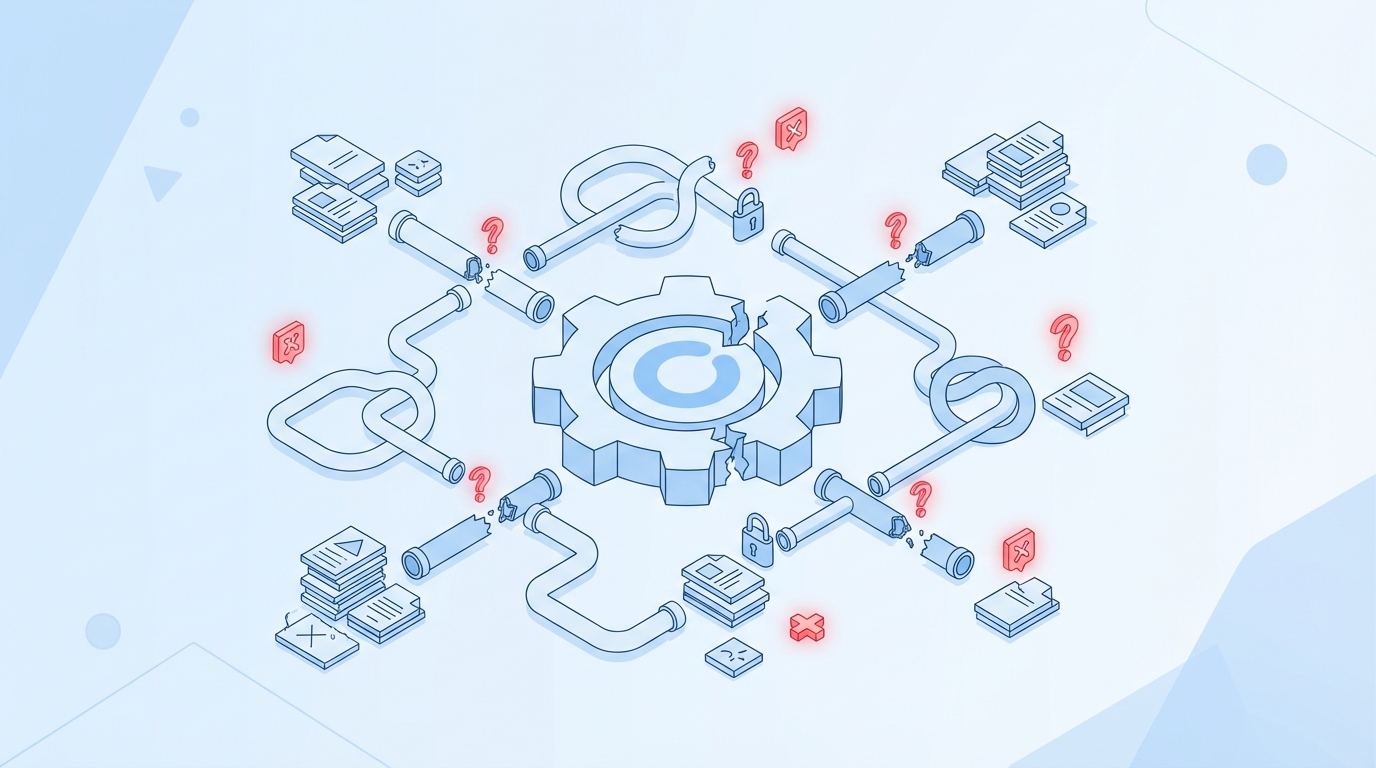
When you’re living inside fragmented, prompt-based demand-gen execution, the work stops feeling like marketing and starts feeling like policing. It’s all clean-up, not compounding. You’re chasing variance, not shaping belief. That’s the tell: more drafts, more drift, more meetings, less momentum. And once that cadence slips, it’s hard to claw it back without changing the system.
You’re Shipping Drafts, Not Decisions
You check boxes. “Draft done.” “Reviewed.” “Scheduled.” “Posted.”
But the thing you actually need, which is a decision about what the market should believe, isn’t getting stronger. It’s getting fuzzier, because every asset is a little different, and you’re always making micro-compromises to get it out the door.
That’s when you start to feel cynical about content. Not because content doesn’t work. Because your system doesn’t let content compound.
Your Calendar Hides A Coordination Tax
Your week fills up with “quick reviews” that aren’t quick. You spend an hour rewriting intros because the tone drifted. You spend another hour removing claims because nobody grounded it. You go to a meeting to align on messaging that was already in a doc, but the doc didn’t enforce anything.
I’ve watched teams build a full-time job out of approval and coordination. That’s the hidden tax.
And yeah, I’ve been that person too.
My founder story started with this exact grind: prompting, copy-pasting, formatting, posting, every day, 3 to 4 hours. It felt like progress. It was also a waste of time. That’s not a “work ethic” issue. That’s a broken execution model.
How Leaders Treat Execution As A Category And Make It Compound
You don’t need a bigger content calendar. You need an execution playbook, backed by demand-generation execution software principles, that makes compounding the default. Clear rules, fewer handoffs, tight cadence. If I was walking into your team on Monday with 30 days to stop the bleeding, here’s exactly how I’d get you out of volatility and into repeatability.
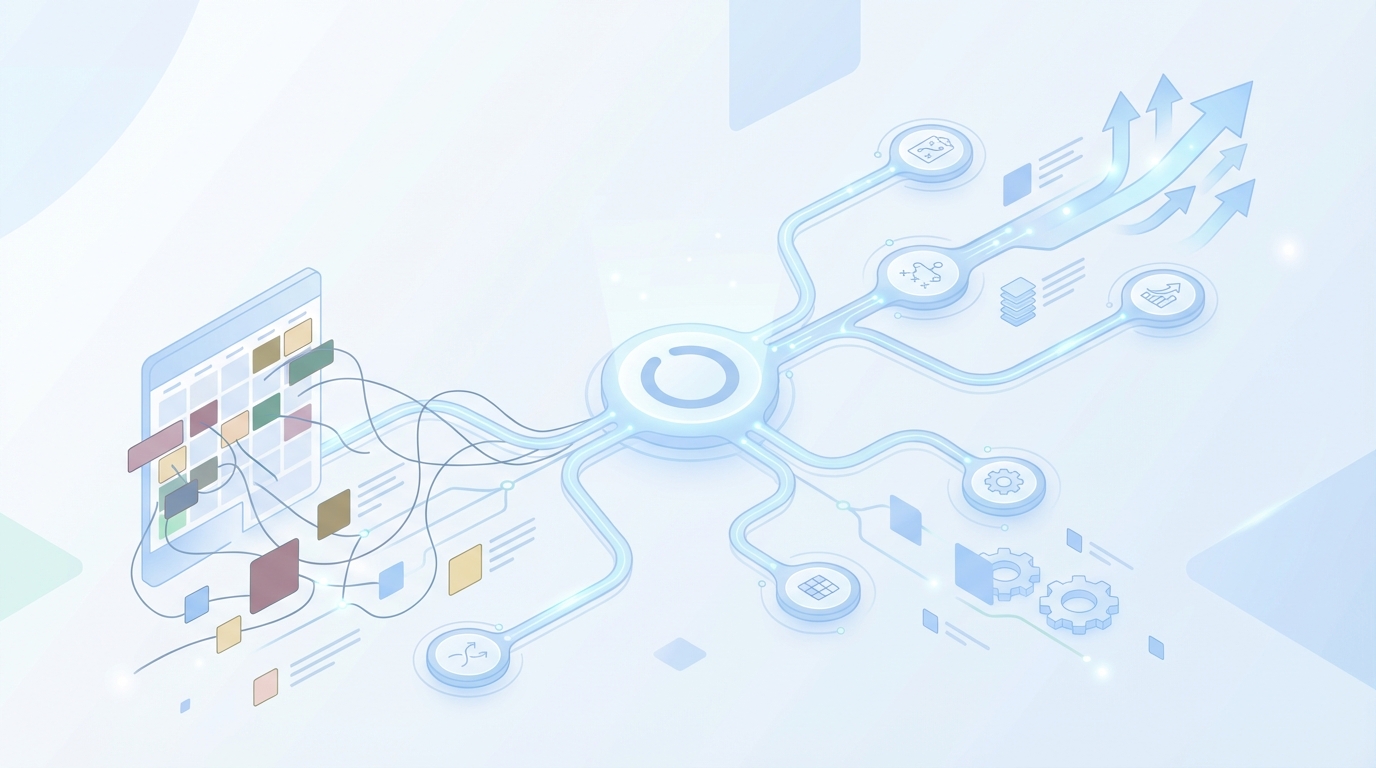
First, the three pillars. Keep this simple.
- Governance-First Consistency: Codify voice, POV, and product truth upfront so every asset aligns without manual policing.
- End-to-End Orchestration: Plan and produce across Acquire, Educate, Convert, Retain, and Reinforce so content compounds as a system.
- Operational Cadence & Reinforcement: Automate steady publishing, repurposing, and refresh cycles to prevent quarterly resets and preserve momentum.
That’s the category behavior. You can implement a rough version of this with docs and discipline. It won’t be perfect, but you’ll feel the difference fast.
Define Narrative Once, Enforce Everywhere
Start with one source of truth. Not “a bunch of docs.” One place where you lock:
- what you believe about the problem
- what language you use
- what claims you can and can’t make
- what tone you want, and what tone you never want
- what your CTA style looks like (yes, this matters more than people admit)
The key is enforcement. If you only define narrative but you don’t enforce it, you’ve built a reference guide. Helpful, but it won’t stop drift.
So create a simple enforcement checklist you run on every asset before it ships: This is particularly relevant for execution is a category.
- Does it use our core terms, or did it invent synonyms?
- Does it state a product truth that’s actually true, or did it get fuzzy?
- Does it reinforce the same POV, or did it accidentally argue the opposite?
- Does it fit the audience, or is it generic “marketing blog” voice?
Most teams skip this because it feels like overhead. But you’re already paying the overhead. You’re just paying it as rework.
If you do this right, approval gets faster. And you’ll publish more, without trying to publish more.
Run A Weekly Operating Cadence That Compounds
Cadence beats sprints. Sprints feel good. Cadence compounds.
Here’s a simple rhythm that works, even on a small team:
- Monday: plan coverage by funnel stage (not by “topics we like”)
- Tuesday: create governed briefs (or at least structured outlines)
- Wednesday: review for narrative and accuracy (not line edits)
- Thursday: publish and distribute
- Friday: reinforce, repurpose, refresh, and update
The big move is Friday. Most teams skip reinforcement. They always chase net-new. That’s why they keep resetting.
Reuse before net-new is how you get compounding without burning out.
And you should measure system health, not just output. Track:
- QA pass rate (first pass vs. rewrites)
- cadence SLOs (did we ship what we said we’d ship)
- sampling failures (what types of issues keep showing up)
Those metrics tell you if the machine is getting healthier. Output metrics don’t.
If you want to see what this looks like when it’s encoded into an execution layer, request a demo. Not because you can’t do it without software, you can. Software just makes it harder to wiggle out of the discipline.
Orchestrate Coverage Across The Full Funnel, Not Posts
Most content plans are a list of posts. They aren’t a system.
Demand gen coverage means you’re deliberately producing for:
- Acquire: search-intent and discovery
- Educate: category framing and POV
- Convert: competitive, evaluation, product education
- Retain: adoption, proof, expansion
- Reinforce: repurpose and refresh the winners
If you’re a small team, you don’t need perfection. You need ratios.
A simple starting point:
- 40% acquire
- 30% educate
- 20% convert
- 10% retain and reinforce (then grow this over time)
And you need acceptance criteria per job. Not “is it good.” More like:
- Does this acquire piece clearly answer the query without going off-mission?
- Does this educate piece clearly attack the old way and teach the new way?
- Does this convert piece stay fair and grounded, without sketchy claims?
When you do this, your library starts to feel connected. Buyers move through it naturally. You stop writing random stuff and hoping it adds up.
One more thing. This is where a lot of teams get it wrong.
If you don’t have a real system owner for execution, the work will drift back to fragmentation. Every time.
What It Looks Like In Practice With Oleno When Execution Is A Category
Oleno is built for this exact shift: from fragmented, prompt-based demand-gen execution to a governed system that runs on a cadence. It starts with the unsexy part, the part everyone avoids, which is defining the rules upfront so you stop paying for rework later.
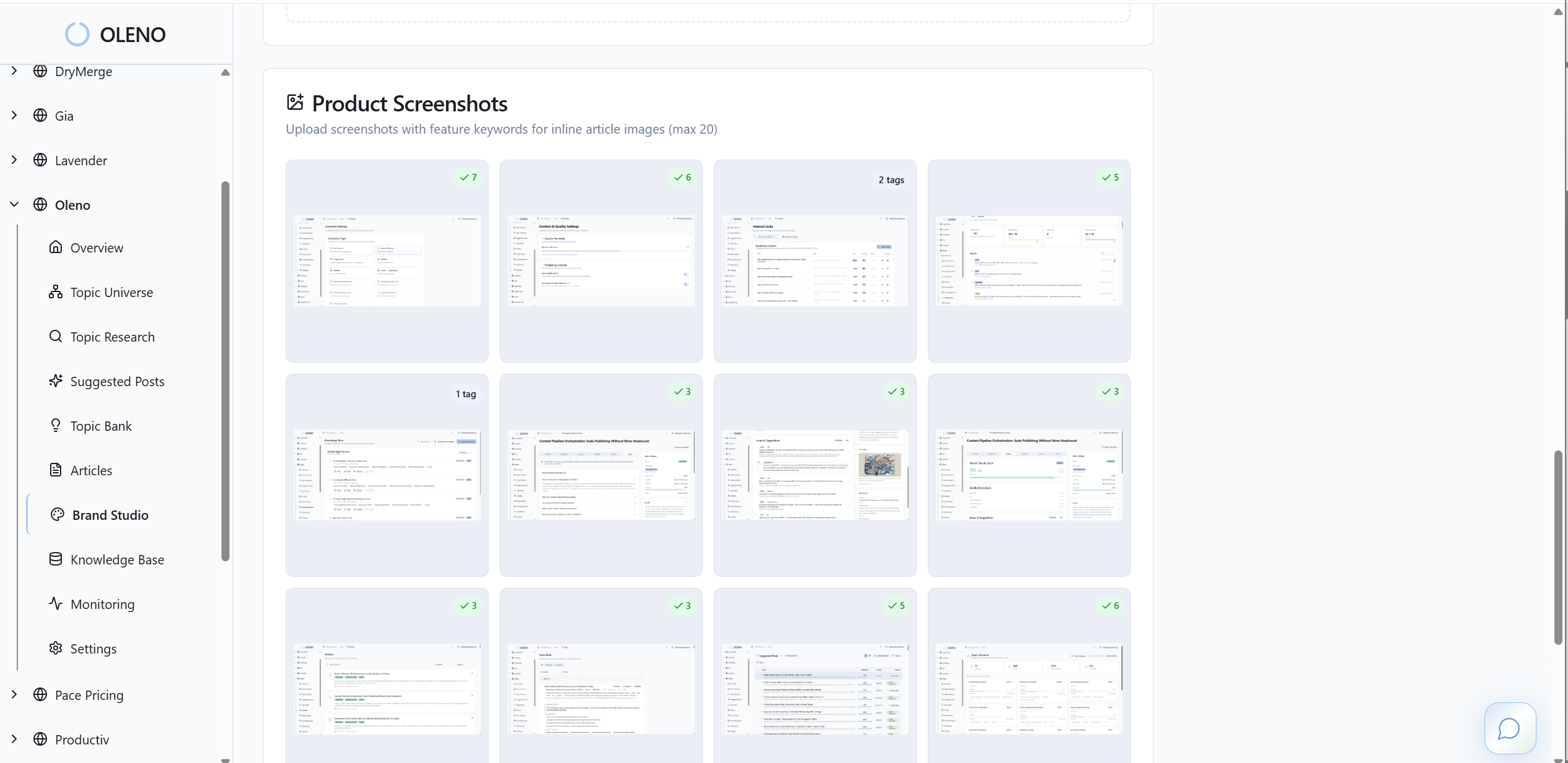
The way it plays out is pretty straightforward. You codify your voice in brand studio, your POV in marketing studio, and your allowed product truth in product studio, then you run content jobs through a deterministic pipeline (Discover to Publish) with quality control (qa gate before publishing) blocking anything that doesn’t meet the standards. That’s how you reduce drift without adding a human “tone police” role.
You also get the operational pieces that keep the week-to-week system stable: variation layer & topic universe so you can cover segments without rewriting from scratch, cms publishing to avoid the copy-paste tax, and distribution so every approved article turns into social posts without inventing new messaging. That’s where the cadence starts feeling real.
Governance That Prevents Drift, Even At Scale
The whole point of Oleno’s governance layer is to stop the “same topic, different vibe” problem before it hits your reviewers. Brand studio keeps structure and voice consistent, marketing studio keeps the narrative consistent, and product studio keeps claims consistent.
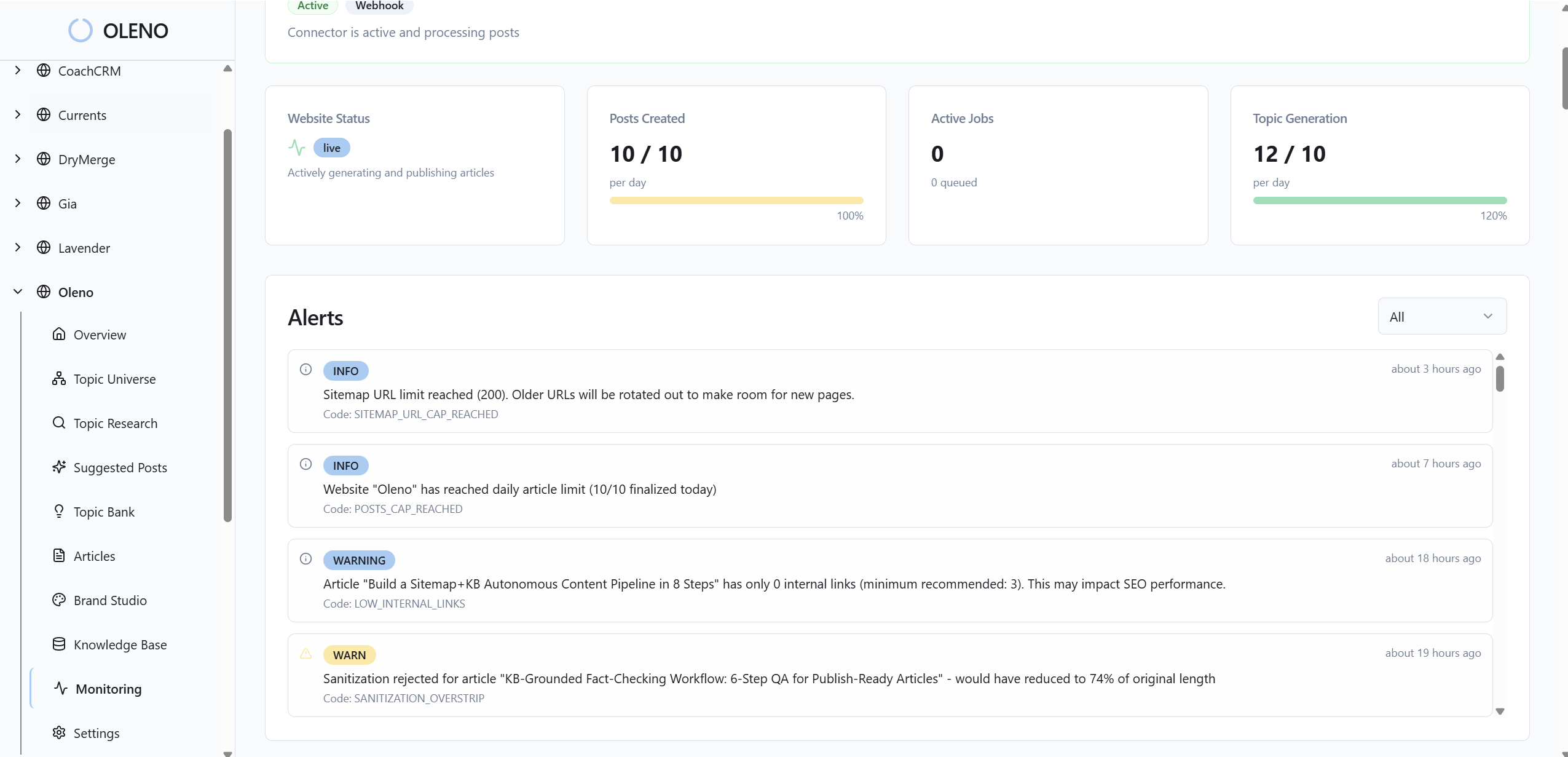
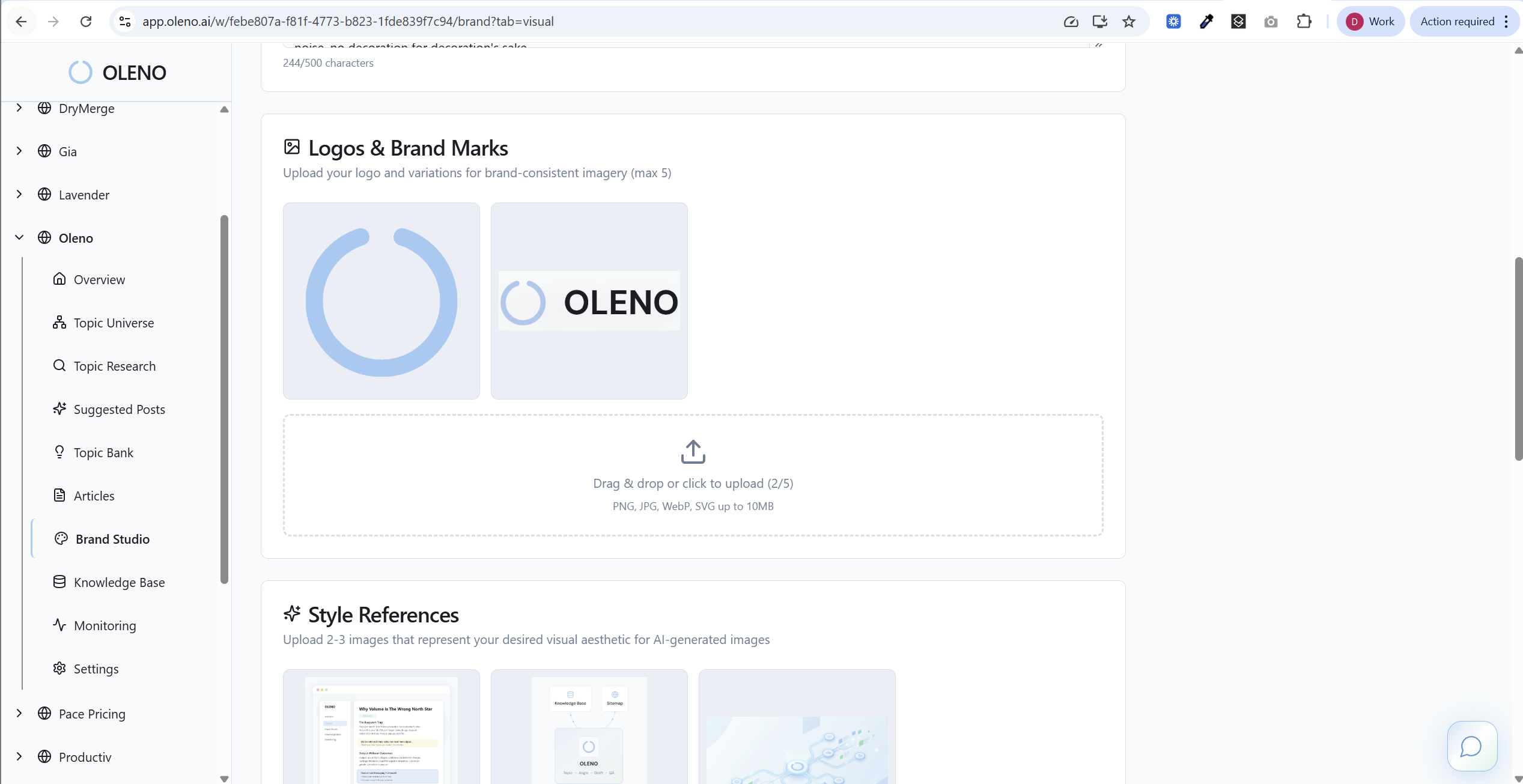
That matters because narrative drift is rarely one big mistake. It’s a hundred small ones. Most teams don’t notice until sales says “leads are confused.”
Jobs And Cadence That Don’t Reset Every Quarter
Oleno is oriented around jobs across the funnel, not “content types,” which is a subtle but important distinction. It means you can plan Acquire, Educate, Convert, Retain, Reinforce as a system, and you can keep shipping even when priorities shift, because the pipeline doesn’t depend on one person remembering all the rules.
If you want to see it applied to your current workflow, request a demo. Bring your messy process. That’s the fun part to untangle.
The 30-Day Triage To Stop Resetting And Start Compounding
If you do nothing else, do this: spend the next 30 days turning your execution into something you can trust. No heroics, no “content sprints.” Lock narrative, reduce variance, raise the QA bar, and build reinforcement into the week. This is how demand-generation execution software thinking shows up without buying anything new yet.
Week 1: Lock your narrative and product truths in one place. Cut the optional stuff. Make it enforceable. Week 2: Define your funnel jobs and pick ratios. Stop letting “random topics” dominate the plan. Week 3: Install a QA bar and measure pass rate. Don’t debate opinions in review, debate standards. Week 4: Build reinforcement into the week. Repurpose and refresh before you chase net-new.
That’s what it means when execution is a category. You’re not trying to be heroic. You’re trying to be consistent.
If you want to skip the duct tape phase and see what a governed execution layer looks like with real pipelines and gates, book a demo.
About Daniel Hebert
I'm the founder of Oleno, SalesMVP Lab, and yourLumira. Been working in B2B SaaS in both sales and marketing leadership for 13+ years. I specialize in building revenue engines from the ground up. Over the years, I've codified writing frameworks, which are now powering Oleno.
Frequently Asked Questions