Create Snippet-Ready Article Briefs with Competitive Research
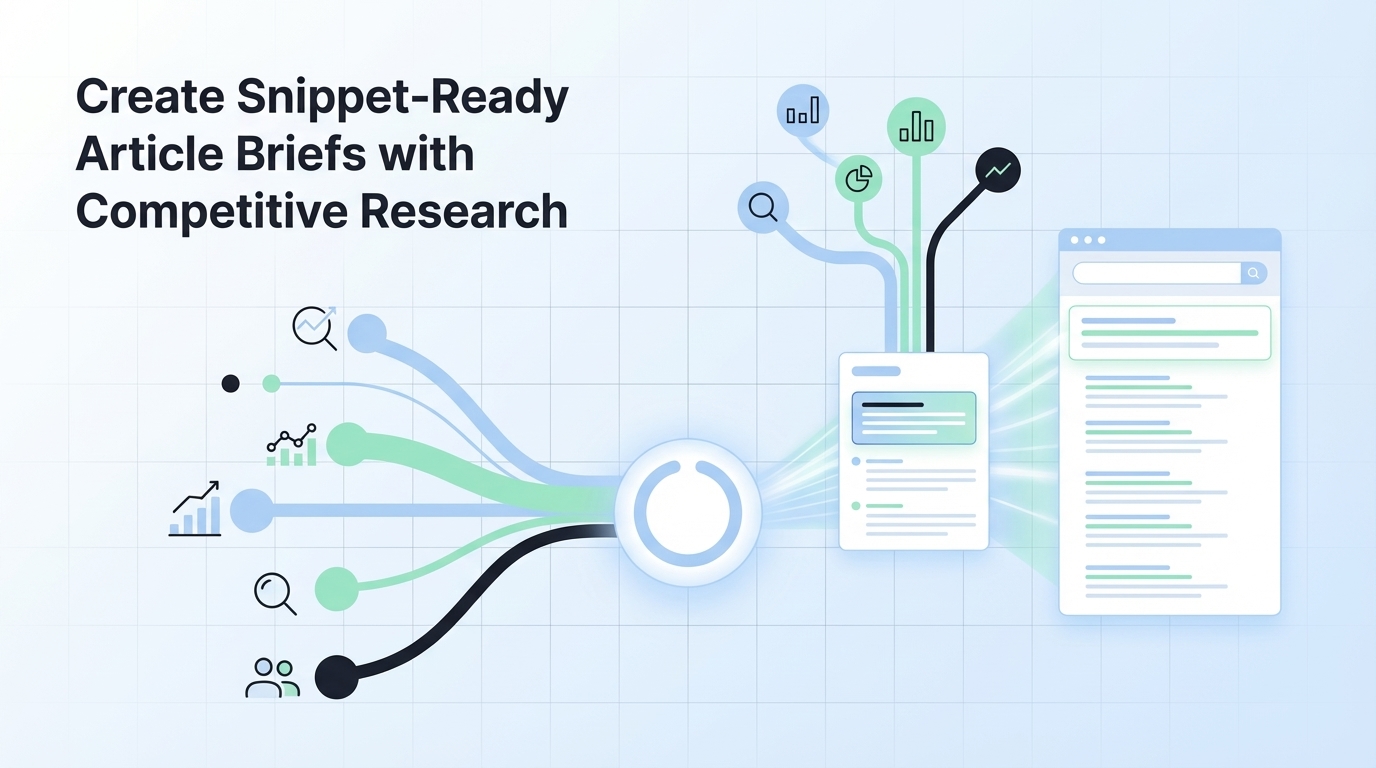
You don’t miss snippets because your writers aren’t good. You miss them because the brief didn’t force the structure machines can quote or the novelty humans actually want. That’s fixable. We’ll make briefs do the heavy lifting: direct-answer openers, evidence types, and a simple way to score whether you’re saying something new.
Back when I was the sole marketer at a SaaS startup, I could crank out 3–4 solid posts a week. Then the team grew. Quality dipped, rewrites piled up, and nobody had the context to write from authority. We were moving fast, sure. But our briefs didn’t enforce clarity or originality. If I could go back, I’d change the brief, not the team.
Key Takeaways:
- Bake a 40–60 word, three-sentence opener under every H2 to enable snippet capture
- Score information gain at the brief stage and set a pass threshold before drafting
- Prescribe evidence types and authoritative sources in the brief, not after
- Separate layout from novelty: structure helps extraction, new information earns quotes
- Enforce QA checks for opener length, clarity, and section-level differentiation
- Use deterministic systems (visuals, internal links, schema) to prevent launch-night fixes
Why Your Briefs Are Invisible To Snippets And AI Citations
Your briefs miss snippets because they don’t force direct answers at the section level. Machines prefer 40–60 word openers that answer, clarify, and provide a quick example. When writers improvise, structure drifts and assistants skip you. Bake the pattern into the brief so every section stands alone cleanly.

Why most brief templates fail snippet capture
Most brief templates stop at keywords, a theme, and a loose outline. That’s a format, not a blueprint machines can quote. You need short, consistent openers that match how search engines extract answers and how assistants cite. The brief should define the question each section answers, explicitly, then require the three-sentence opener.
When teams rely on “we’ll tighten it in editing,” they create fragile workflows. An editor can catch a weak opener once. They won’t catch it 30 times a quarter. The fix isn’t heroic editing; it’s forcing structure upstream. Clear, enforced rules win consistency. Consistency gets cited.
If you want to pressure-test your structure, compare it with how pragmatic research guides define questions and outcomes in planning, like the approach in the SBA’s market research overview. Planning clarity compounds.
What is a snippet-ready opener and why it matters?
A snippet-ready opener is a three-sentence paragraph under each H2. Sentence one directly answers the implied question. Sentence two adds one critical why or how. Sentence three grounds it with an example. It’s short. It’s predictable. It’s extractable.
This pattern reduces ambiguity for both readers and machines. It also forces you to decide the section’s point before the draft wanders. Think of it as “answer first, prove second, anchor third.” For example, on an H2 about competitive analysis, you’d define the goal, state the criteria you’ll use, then cite a quick case or scenario. Not complicated. Just strict.
Who benefits when you score information gain?
Everyone. Content leads stop playing referee over fuzzy “this feels derivative” feedback. Editors get a quantitative reason to reject or refine a weak outline. Writers know what “original enough” means before they type a word. And leadership sees fewer drafts that sound like everyone else.
Information gain scoring is simple in practice: list the common claims you found in competitor coverage, list what’s missing, then score whether your outline adds net-new definitions, data, frameworks, or examples. Set a pass threshold. If the score is low, adjust before writing. You’ll ship fewer low-differentiation pieces and create more citable sections.
Want to see the pattern applied in real drafts without rebuilding your process from scratch? Try a live run and compare output side by side. Try Generating 3 Free Test Articles Now.
The Problem You Really Have Is Differentiation, Not Draft Speed
Draft speed rarely fixes invisibility. Originality fixes invisibility, and originality is a planning choice. Your brief should map what’s already said and prescribe what you’ll add. Layout helps machines; information gain earns quotes. You need both.

What traditional competitive research misses
Most research sweeps copy formats and headings. They don’t quantify what’s saturated versus what’s missing. A better sweep inventories claims by angle and evidence type, definitions, data points, examples, frameworks, and highlights shallow explanations. Now you’re building a novelty map, not a lookalike outline.
We’re not trying to “beat” a competitor’s H2 order. We’re trying to add something that wasn’t there. That might be a sharper definition, a decision rule, or a worked example. When research ends with “we’ll cover the same points, cleaner,” it telegraphs a low-gain article. That’s why assistants skip it. For a useful overview of structuring competitive understanding into decisions, see this pragmatic take on competitive intelligence.
The difference between originality and layout
Layout affects extractability. Originality affects quotability. You can format perfectly and still repeat stale claims. You can be wildly original and still get ignored because your answers aren’t cleanly extractable. The brief must enforce both: the three-sentence opener and the requirement for net-new substance per section.
I frame it like this with teams: structure is the highway, novelty is the vehicle. Without the highway, you’re slow. Without the vehicle, you’re parked. The trick is choosing the few places you’ll add new insight, and making those commitments in the brief, so the draft doesn’t chase novelty at the last minute.
The Hidden Costs Of Low-Information Briefs
Low-information briefs create avoidable rework, diluted cluster authority, and missed citations. You don’t always feel it immediately. You see it in the backlog, the weekend edits, and the sections that never get referenced. The bill shows up later.
Engineering hours lost to rewrites
Let’s pretend your team ships four articles a week and two miss the differentiation bar. Each rewrite burns 3–5 hours across writer and editor. That’s 24–40 hours a month spent fixing what a tighter brief could have prevented. It’s not just time; it’s momentum. Momentum matters.
Rewrites also create risk. Last-minute edits often change context without rechecking the whole piece. That’s how weak openers slip into final drafts. A brief with a pass/fail threshold for information gain, plus required opener text, reduces that risk meaningfully. It’s not perfect. It’s practical.
A helpful lens here: academic work on information value and selection bias shows how often repeated claims crowd out new insight. It’s worth skimming this peer-reviewed perspective on information value and bias to see how “common but shallow” happens systematically.
Opportunity cost when drafts sound like everyone else
Low-gain pieces can still publish. They rarely win snippets. They rarely earn links. They fragment crawl equity and dilute cluster authority. Over a quarter, 20–30% of your calendar can produce negligible lift. That hurts pipeline and brand credibility, even if traffic looks fine.
The hidden part: your team loses confidence. Writers feel like they’re producing filler. Editors feel like they’re playing defense. Leadership wonders if content “works.” A stricter brief flips that story. You’ll ship fewer pieces, net, but more with citable sections. That compounds.
The Frustration You Feel When Rewrites Pile Up
You launch to crickets. Or you’re rewriting at 3 am because a section is thin. It’s not your team. It’s the process. Strong briefs prevent chaos. They also keep weekends intact.
When the brief ships and nobody quotes you
You ship. Traffic’s fine. Snippets? Nothing. Assistant mentions? Also nothing. It stings. Usually, the cause is simple: H2s lacked direct answers or the draft repeated common claims. That’s not a writer problem. That’s a brief problem.
The fix is upstream. Prescribe the 40–60 word openers, set the bar for novelty per section, and require links to two or three credible sources in the brief. Do that, and you’ll start seeing parts of your article show up in places you care about. Not always. Often enough to matter.
What happens during the 3 am pre-launch scramble?
We’ve all done it. Someone spots a shallow section late. Now you’re pulling links, rewriting openers, and hoping formatting holds. This is fragile work. It also breaks trust with your team, because “launch” quietly means “maybe we’ll fix it live.”
Make launch nights boring. Put the opener template and references block directly in the brief. Enforce a minimum information gain score in QA. Pre-commit to the sources you’ll use to substantiate each section so no one is panic-Googling. You won’t eliminate surprises. You will reduce the expensive ones.
If you’re nodding along because you’ve lived this and want relief without hiring more people, consider an autonomous pipeline that handles structure and QA before anyone hits publish. Try Using an Autonomous Content Engine for Always-On Publishing.
A Practical Workflow To Produce Snippet-Ready, Original Briefs
You don’t need a big team to do this. You need a repeatable workflow. Define the outcomes, inventory what exists, score novelty, and force openers. That’s enough to improve citations and cut rewrites.
Define intent, audience, and target outcomes
Start with two outcomes: business conversion and snippet eligibility. Write the primary question your article must answer and who cares. Add two secondary questions you could win. Then state a measurable brief goal, like “one featured snippet opportunity and one assistant-ready definition per article.”
This framing clarifies scope and trims fluff. It also helps you say no. If a proposed section doesn’t serve a buyer decision or a snippet opportunity, cut it. When in doubt, I ask, “Would I cite this sentence?” If the answer’s no, it probably doesn’t belong in the opener.
Run a competitive sweep to extract claims and gaps
Scan the top 5–8 results. Inventory shared claims, evidence types, and shallow explanations. Note missing angles, better definitions, or worked examples you can add. Decide the gaps you’ll fill, intentionally, so the draft isn’t guessing at novelty later.
This turns research into a map, not a mirror. You’re not copying formats; you’re deciding where you’ll add something useful. If you want a straightforward primer on planning the sweep and turning it into decisions, this practical guide is solid: a step-by-step competitor analysis overview.
Build a snippet-ready outline with H2 opening templates
Outline H1 to H3s, then attach a 40–60 word opener to each H2 using the three-sentence pattern: answer, context, example. Record the exact question the opener answers. Add a references placeholder and the internal pages you’re likely to link. Now the writer knows what to deliver and why it’s citable.
Fold information gain checks into this step. For each section, ask: do we redefine, add data, offer a decision rule, or include an uncommon example? If none, you’re repeating the web. Adjust the section or cut it. You’ll save hours later.
How Oleno Turns Your Brief Into A Snippet-Ready, Measurably Original Article
Oleno systematizes everything above so you don’t manage it by hand. Briefs include competitive sweeps and an Information Gain Score. Drafts open every H2 with the three-sentence pattern. Visuals, internal links, and schema get handled deterministically. You focus on the story; the pipeline enforces structure.
Information gain scoring and competitive research built in
Oleno generates a structured brief that catalogs common coverage, highlights shallow areas, and proposes angles to add new information. Each brief receives an Information Gain Score (0–100). If the score is low, Oleno flags differentiation gaps so you can adjust before anyone writes. That’s where most rewrites die, in planning, not editing.
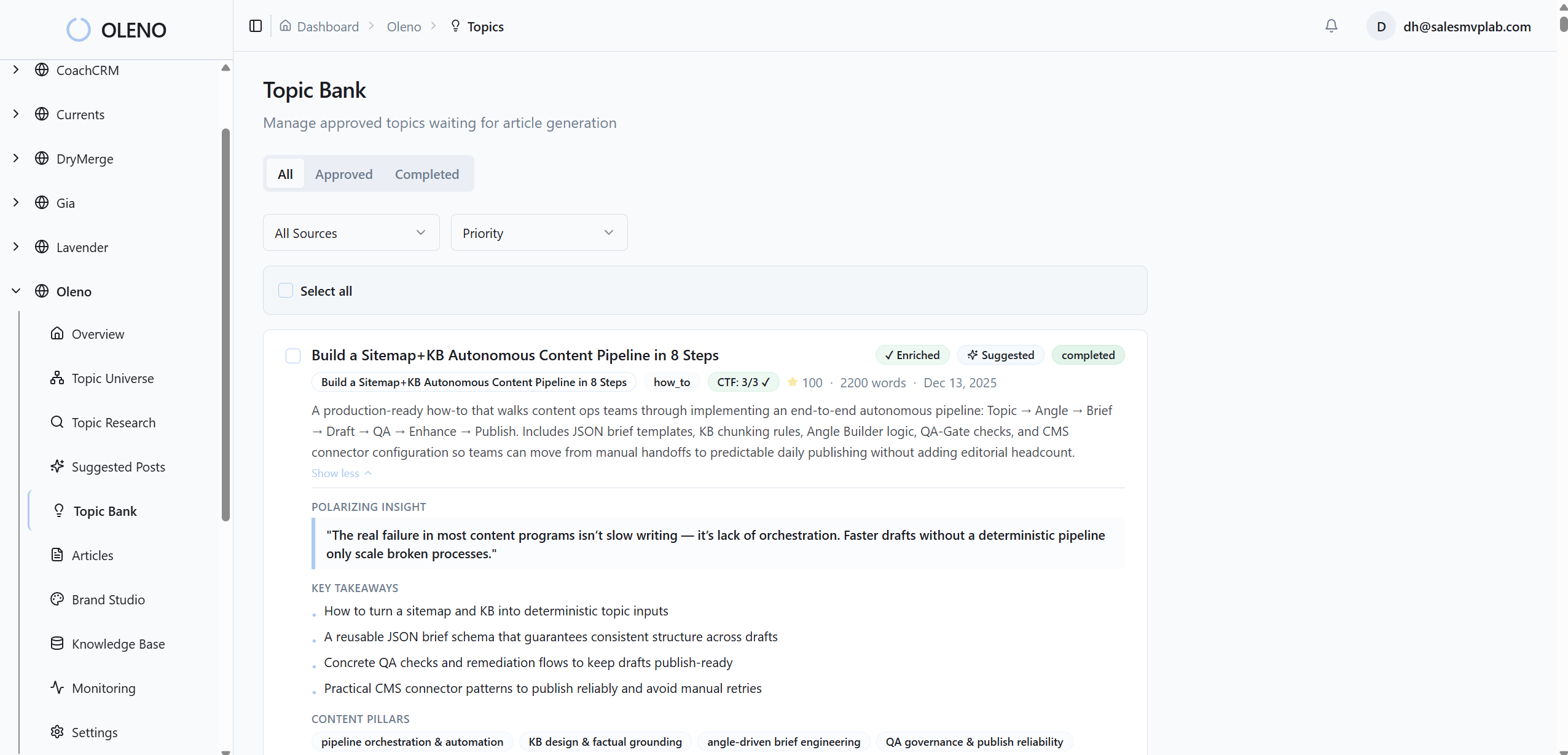
Because competitive research exists to improve originality (not to copy layouts), Oleno’s approach keeps you grounded without producing lookalike outlines. It stays within your brand rules, too. Voice, phrasing, and banned terms are enforced in the draft phase, not left to chance.
Snippet-ready H2 openers and QA enforcement
Every H2 in an Oleno draft opens with a 40–60 word, three-sentence paragraph: direct answer, context, example. Oleno validates opener length and clarity during QA, alongside section structure, tone, and information gain. Sections stand alone cleanly, which increases eligibility for search snippets and assistant citations.
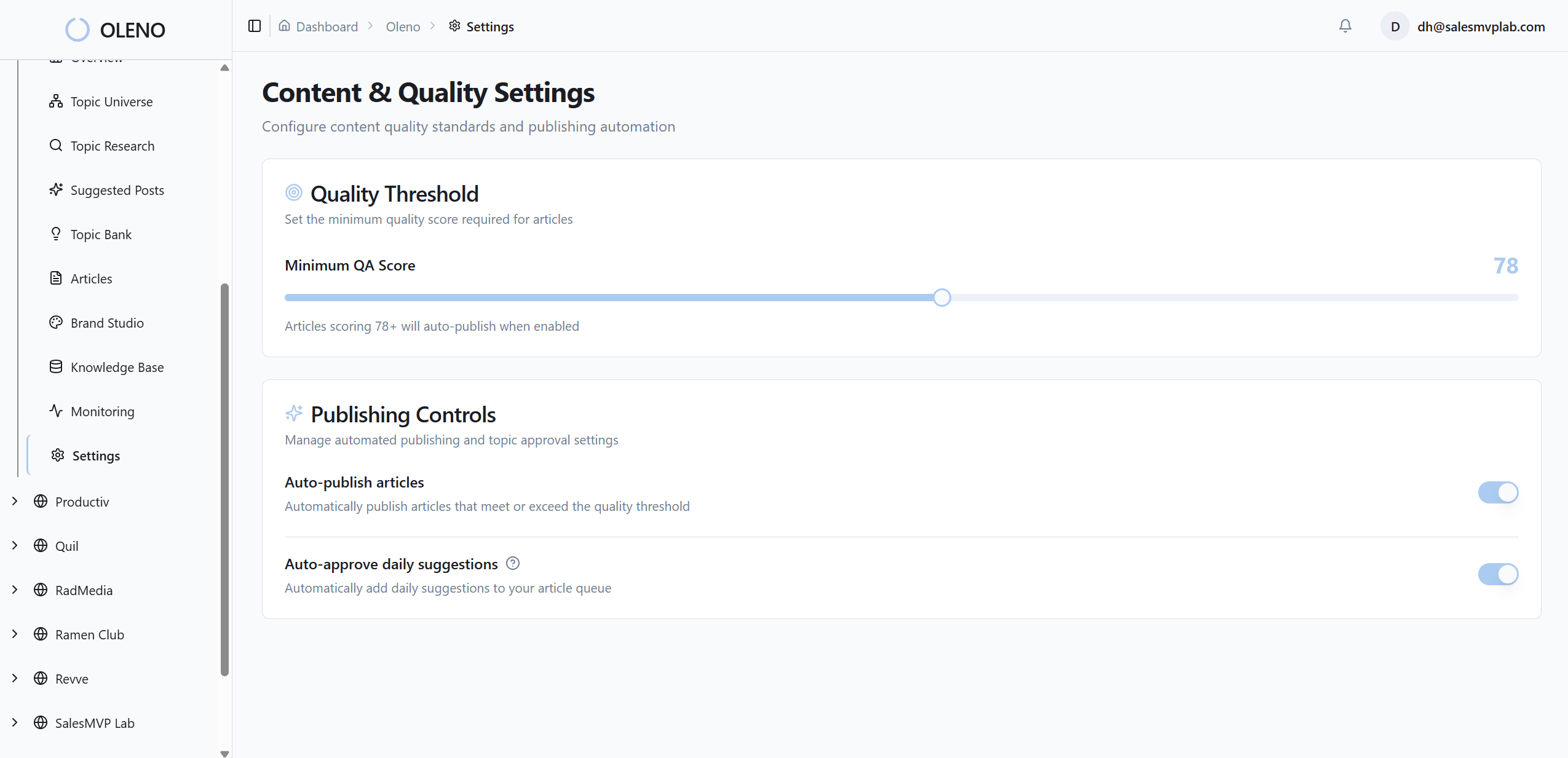
This directly addresses the pains we covered, missed snippets and last-minute fixes. The QA gate removes AI-sounding language and normalizes tone, so you’re not polishing phrasing at 3 am. Again, not perfect. Consistently better.
Visual planning, internal links, and schema handled deterministically
Oleno’s Visual Studio generates brand-consistent hero and inline images, then places them in relevant sections using your brand assets and tagged product screenshots. Internal links are injected from your verified sitemap only, with exact-match anchors. Schema (Article, FAQ, BreadcrumbList) is generated as valid JSON-LD automatically.
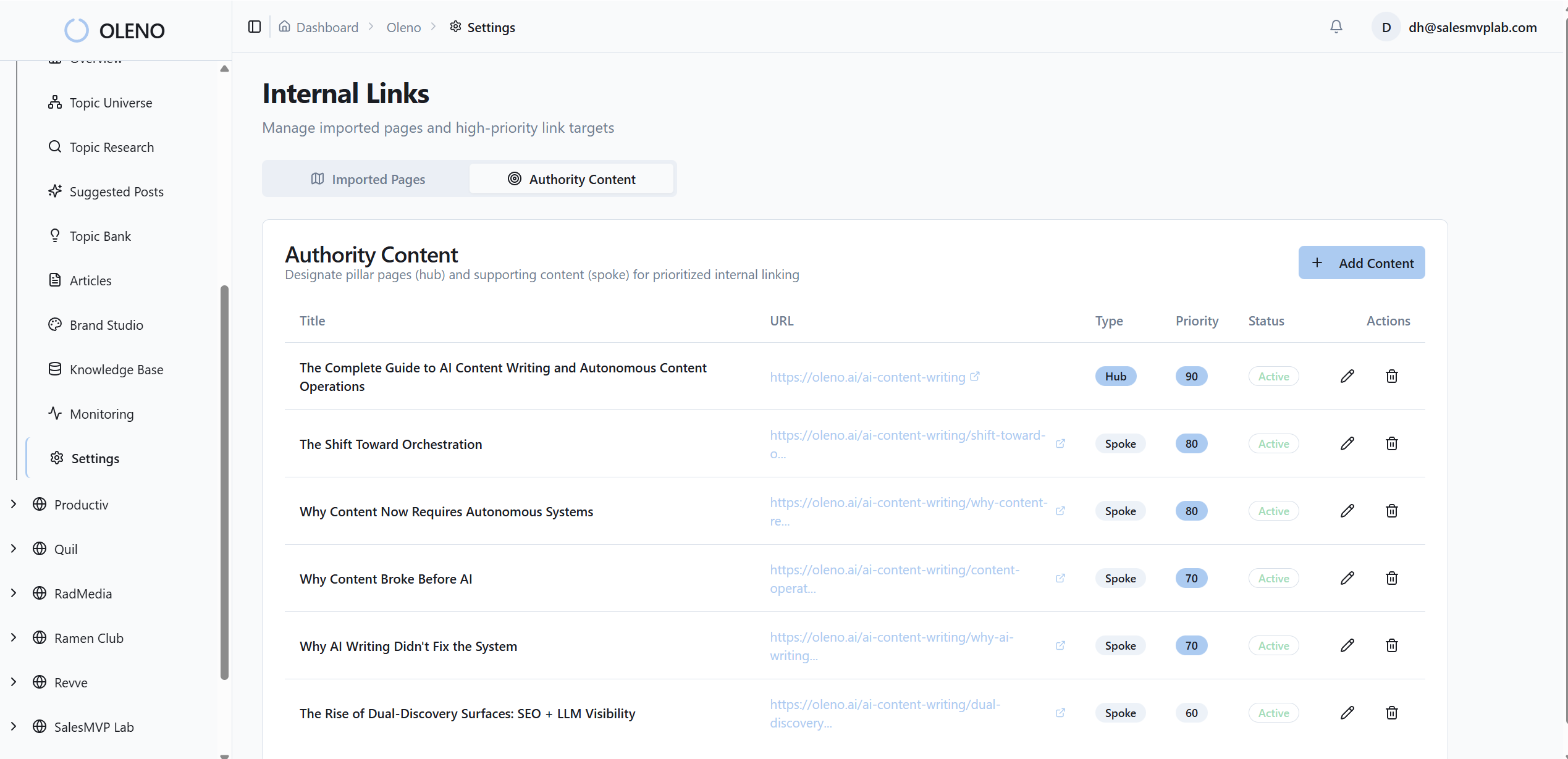
No fabricated URLs. No broken publishing. No manual screenshot placement. And when you’re ready to ship, connectors deliver to WordPress, Webflow, or HubSpot with mapped fields. The operational outcome: fewer rewrites, fewer launch-night scrambles, and more citable sections in every article.
If you’re ready to offload the structure and keep the narrative, you can start quickly. Try Oleno for Free.
Conclusion
Here’s the simple version. Snippet visibility and assistant citations start at the brief, not the draft. When you enforce direct-answer openers and measure information gain before writing, you cut rewrites and increase the odds your sections get quoted. Put structure in the system and let your team focus on the story.
About Daniel Hebert
I'm the founder of Oleno, SalesMVP Lab, and yourLumira. Been working in B2B SaaS in both sales and marketing leadership for 13+ years. I specialize in building revenue engines from the ground up. Over the years, I've codified writing frameworks, which are now powering Oleno.
Frequently Asked Questions