Creating Modular Content Streams With Storyboard Workflows
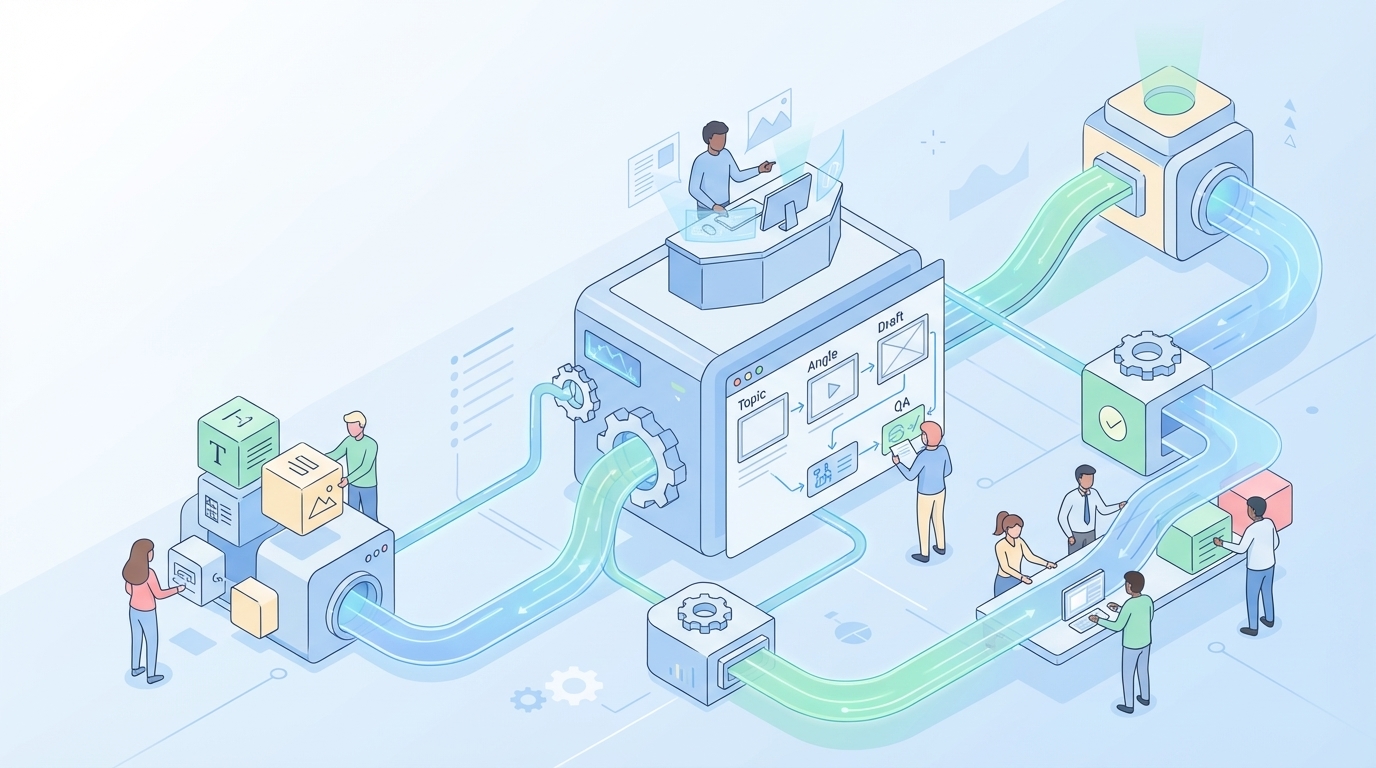
Creating modular content streams sounds simple when you're in a planning meeting. One big theme. A few assets. Some repurposing. Then real life hits. Your launch brief turns into one blog post, maybe one LinkedIn post, and then the quarter moves on. For growth-stage SaaS teams, that's usually the issue. Not effort. Not ideas. It's that the system for creating modular content streams never really exists.
That becomes expensive fast. You end up re-briefing the same angle for SEO, product marketing, social, and campaign content. You re-explain the audience. You restate the product context. You redo approvals because the framing drifted between assets. And if you're the Head of Marketing wearing five hats, this is where the headache starts. You don't need more random output. You need a way to turn one strategic narrative into steady execution without restarting every few weeks.
Oleno fits into that gap. More specifically, storyboard gives you a planning layer that turns quarterly priorities into structured content lanes, then connects those lanes to ongoing execution. So instead of treating every asset like a custom project, you set the logic once and let the system carry it forward.
Key Takeaways:
- Creating modular content streams works best when one strategic theme is planned across audiences, personas, use cases, and funnel stages before drafting starts.
- Small SaaS teams often lose hours every week to re-briefing and re-approving content that should have been connected from the start.
- Storyboard in Oleno allocates content by weighted focus areas, which keeps production from clustering around whoever shouted loudest that week.
- Teams using Oleno for SEO content scaling can move from 4 to 8 articles per month to 20 to 40 plus, without adding headcount.
- Modular planning won't fix weak positioning on its own, but it can make strong strategy far more repeatable.
Why Creating Modular Content Streams Breaks Down In Small Teams
Creating modular content streams usually fails because one campaign brief dies as a single asset. The plan sounds broader than the execution. You say you want a theme that runs across acquisition, evaluation, and product-led content, but the team only has enough time to get the blog post out. Then the rest gets pushed to “later,” which usually means never.
One Campaign Brief Often Dies As A Single Asset
One campaign brief often dies as a single asset because there isn't a real planning system behind it. There's a kickoff doc, maybe a notion page, maybe a few Slack messages, but nothing that translates strategy into a repeatable stream. So the brief gets consumed by the first deliverable and that's it.
I've seen this pattern a lot. Back when I was running content at smaller SaaS companies, one person usually held the context in their head. That works right up until it doesn't scale. The moment someone else has to create the follow-up asset, they need the whole thing re-explained. Same theme. Same product. Same audience. New meeting.
The hidden tax is ugly:
- one brief becomes four mini-briefs
- one approval becomes three extra review loops
- one idea gets rewritten for blog, product, sales, and social
- one strategic theme loses its shape by the second asset
And that tax rarely shows up in a dashboard. It shows up as lost time and frustrating rework.
Rebuilding Content From Scratch Creates Quarterly Reset Cycles
Rebuilding content from scratch each quarter creates reset cycles because nothing compounds. The team ships content, but the underlying structure never survives into the next planning cycle. So when Q2 starts, you're not building on Q1. You're basically starting over with a different deck and slightly different wording.
This is common with under-resourced teams. At PostBeyond, I could write 3 to 4 strong posts a week when I had the context and the framework in my head. As the team grew, quality got harder to maintain because the context transfer wasn't happening cleanly. The writer took longer. The output got weaker. And I had less time to jump in because I was in meetings and managing other work. Sound familiar?
That reset cycle has a cost. Let's pretend your team creates 8 meaningful content assets a month, and each one needs 60 to 90 minutes of re-contextualizing before anyone can draft. You're burning a full workday or more every month just rebuilding the starting point. Not writing. Not publishing. Rebuilding.
Manual Repurposing Breaks Narrative Consistency Across The Funnel
Manual repurposing breaks narrative consistency because every channel rewrite introduces drift. The acquisition article says one thing. The evaluation page frames the problem differently. The social posts simplify it so much that the core argument disappears. By the time your market sees all of it, your company sounds like three different companies.
That matters more now. GEO doesn't just reward isolated page wins. It rewards repeated, consistent market signals across a lot of content. If your content says one thing on your blog, another thing in your comparison pages, and something else on social, you're making it harder for LLMs and buyers to understand what you stand for.
Some teams think the problem is drafting speed. I don't buy that. Speed matters, sure. But the real problem is preserving the same narrative through volume. Without that, faster drafting just creates more noise.
Creating Modular Content Streams Starts With Planning Logic
Creating modular content streams starts with planning logic, not with a blank doc and a fast writer. The team needs a structure that decides what should exist, how themes expand across formats, and how each piece stays connected to the same story. That's the part most content workflows skip.
Modular Planning Beats One-Off Content Production
Modular planning beats one-off content production because it treats content like a system of connected assets, not isolated tasks. One theme can and should feed multiple outputs. An acquisition article. A use-case page. A comparison angle. A social sequence. Maybe a product-led piece if the topic supports it. You're not inventing four ideas. You're extending one idea through different buyer moments.
Back in the Steamfeed days, we saw this from another angle. We hit 120k monthly visitors because we had both depth and breadth at volume. Hundreds of contributors gave us multiple angles on related topics, and that breadth compounded over time. Most pages got very little traffic on their own. But together, they built authority. That's why modular planning matters. One isolated asset rarely changes much. A connected body of work can.
A useful modular plan usually includes:
- a core theme or narrative
- the audiences that need different framing
- the personas involved in the buying process
- the use cases tied to actual workflows
- the formats needed across funnel stages
That sounds obvious. It's not how most teams plan.
Content Systems Compound When Structure Is Set Before Execution
Content systems compound when structure is set before execution because the team stops reinventing the same logic every week. You define the lanes first, then let production run inside those lanes. That reduces decision fatigue and cuts a lot of preventable rework.
Prompting alone doesn't solve this. Prompting gives you text. It doesn't give you a repeatable content machine. In my experience, that's where a lot of teams get fooled. They see faster draft generation and think the system is improving. But humans still carry the hard parts: what to create, what angle to take, how to keep it aligned, how to review it, how to publish it, how to reuse it.
That's debt. Not leverage.
If you want to see how governed execution works in practice, request a demo.
Governance Matters More Than Drafting Speed In The GEO Era
Governance matters more than drafting speed in the GEO era because LLM visibility depends on repeated clarity. You need product truth, audience specificity, positioning, and a consistent point of view expressed across a lot of pages. One strong post won't carry the whole thing, especially when evaluating creating modular content streams.
A lot of content tools stop at output. They can generate, rewrite, or check SEO structure. Useful, yes. But they don't usually decide what content should exist, how it connects across the funnel, or how to keep the story from drifting. That's why the bottleneck isn't really content. It's fragmented execution without a system.
Not everyone agrees with that. Some teams still think the answer is just more volume. I think volume without planning is how you create a bigger mess.
Creating Modular Content Streams In Oleno Runs Through Storyboard
Creating modular content streams in Oleno runs through Storyboard because Storyboard is the planning layer that allocates content across audiences, personas, products, and use cases based on governance weights and coverage gaps. It materializes existing topic_bank entries into a prioritized, balanced content calendar with a visual planning interface. That means strategy doesn’t stay trapped in a quarterly deck.
Storyboard Turns Planning Into Structured Content Streams
Storyboard turns planning into structured content streams by taking existing topic candidates and mapping them against the dimensions that matter. Audience. Persona. Product. Use case. Coverage gaps. Instead of saying “we should talk more about this,” you get a planning model that can translate priorities into a balanced calendar.
That matters for growth-stage teams because everything tends to reset fast. A new launch comes up. Sales wants something. Leadership has a fresh message. Suddenly the old plan is gone. Storyboard gives that planning a home so it can be reflected in a content calendar rather than handled as one-off requests.
In practical terms, that means a broad GTM theme doesn’t just sit there as an idea. It gets mapped against coverage and scheduled into a more structured stream. That’s a big difference.
Weighted Planning Prevents Content From Clustering Around The Loudest Request
Weighted planning prevents content from clustering around the loudest request because Storyboard reads governance weights and scores topic candidates against coverage gaps. If one segment, one use case, or one internal stakeholder dominates every conversation, the calendar can still reflect a more balanced mix across what you’ve already defined as important.
This is a bigger deal than it sounds. Most teams don’t have a content quality issue first. They have an allocation issue. The calendar gets hijacked by what feels urgent, and then six weeks later they realize they ignored product education, buyer enablement, or a key audience segment. Storyboard reduces that drift by tracking dimension coverage and balancing the calendar accordingly.
So instead of:
- three posts for the same campaign angle
- zero evaluation content
- scattered social follow-up
- no meaningful segment balance
you get a more intentional mix that reflects the plan you actually meant to run.
Storyboard Creates A Balanced Calendar The Team Can Actually Use
Storyboard doesn’t create new topics on its own, and its allocation stays advisory until calendar entries are approved. What it does do is materialize the topic universe you already have into a prioritized calendar your team can work from, complete with drag-and-drop rescheduling, stream views, status filtering, and dimension-based coverage tracking.
From there, Oleno can take approved topics into execution through the Orchestrator, which selects from approved Topic Universe items, creates jobs by blueprint, and manages pacing against your quotas. Depending on the content type, those jobs can run through Programmatic SEO Studio, Product Marketing Studio, Buyer Enablement Studio, and CMS Publishing. So you’re not managing a pile of prompts. You’re running a defined production model inside Oleno.
There’s a reason this exists. The founder story behind Oleno started with manually prompting GPTs, copy-pasting output, and adding content into a CMS by hand. That was taking 3 to 4 hours a day. Useful output, awful system. Hard-coding the engine fixed the operational mess, not just the writing step. I think that’s the real lesson here.
Want to see how planning turns into execution inside a real system? Request a demo to see storyboard in action.
One Narrative Can Expand Into A Full Publishing Stream
One narrative can expand into a full publishing stream when the team plans around a theme instead of a single deliverable. That changes the output shape completely. Instead of publishing one launch post and hoping the team finds time to reuse it, you set up a stream that supports multiple buyer moments from the start.
One Product Narrative Can Feed Acquisition, Evaluation, And Product-Led Content
One product narrative can feed acquisition, evaluation, and product-led content when the planning system knows who the content is for and what job each piece needs to do. That's where storyboard and audience & persona targeting work well together. The same underlying initiative can be framed differently for a Head of Marketing researching a problem, a buyer comparing options, and a stakeholder trying to understand product fit.
Let's pretend you're a Head of Marketing at a 60-person SaaS company launching a new workflow around customer onboarding content. In a manual setup, you might get:
- one feature launch article
- one sales deck update
- maybe a couple of social posts if someone has time
That's usually where it stops. In a more structured setup, the same theme can support an acquisition article, a use-case walkthrough, a buyer-facing comparison angle, FAQ content, and approved article repurposing for social distribution. Same narrative spine. Different jobs.
A Single Quarterly Theme Becomes A Multi-Format Publishing Stream
A single quarterly theme becomes a multi-format publishing stream when planning is tied to the full funnel. Oleno is built around that idea. Not every studio does the same job, but they can all work from shared planning and governance inputs. So a theme can move through acquisition content in programmatic seo studio, evaluation content in buyer enablement studio, and product-fit education in product marketing studio without losing the thread, especially when evaluating creating modular content streams.
This is where a lot of teams get stuck with founder-led content too. At LevelJump, recording videos and transcribing them gave us faster raw material, but it didn't solve the structural problem. The content had ideas. It didn't always have search structure or topic logic. Good thought leadership, weak compounding. A modular planning system closes that gap better because the story isn't just captured. It's routed.
Approved articles can also be repurposed for social distribution, which matters if your team is trying to squeeze more out of every piece. One article turning into 5 to 10 plus social posts is a much better use of a small team's time than starting fresh on every channel.
The Team Ships More Without Adding Meetings Or Headcount
The team ships more without adding meetings or headcount because the planning burden gets centralized and execution becomes more reliable. That's the payoff. Not that nobody has to think anymore. They do. But the thinking moves upstream, where it belongs.
According to Oleno use cases, teams using the platform for SEO content scaling can increase output from 4 to 8 articles per month to 20 to 40 plus without adding headcount. That doesn't mean every team will hit the same number. Context matters. Inputs matter. Review standards matter. But the range tells you what's possible when planning, content creation, QA, and publishing stop being disconnected chores.
If you want to move from quarterly resets to a steadier engine, request a demo for your workflow.
Storyboard Improves Planning, But It Doesn't Replace Judgment for Creating modular content streams
Storyboard improves planning, but it doesn't replace judgment. That's important to say plainly. If your positioning is muddy, if your product truth is incomplete, or if your audience definition is weak, a better planning layer won't magically fix that. It will operationalize what you give it. Good or bad.
Modular Streams Do Not Replace Strategic Judgment
Modular streams do not replace strategic judgment because someone still needs to define the message, the market point of view, and the priority. Oleno keeps marketers in control of those decisions. The system executes within the boundaries you set. That's a strength, not a gap.
If you're hoping software will invent your strategy for you, this isn't that. It can encode your voice, product truth, audience context, and planning logic. It can't decide what you should believe about your market if you haven't figured that out yet.
Better Planning Cannot Fix Weak Positioning
Better planning cannot fix weak positioning because repetition only amplifies what's already there. If your message is fuzzy, modular output just spreads fuzzy messaging farther. That's why the upstream work in marketing studio, product studio, and audience & persona targeting matters so much.
Honestly, this is where some teams go wrong. They want the machine before they want the clarity. But clarity is the prerequisite. Prospects need a frame of reference. LLMs do too. Without that, you may publish more and still miss the point.
The System Improves Execution Reliability, Not Market Demand By Itself
The system improves execution reliability, not market demand by itself. It can reduce rework, preserve narrative consistency, maintain coverage balance, and keep the content engine moving. It can't create buyer pain where none exists, and it can't rescue an offer the market doesn't care about.
That's not a knock on the product. It's just honest scope. Oleno is demand-generation execution software. The word execution matters.
See How Storyboard Turns Planning Into Ongoing Output
Seeing storyboard in a real workflow is the fastest way to understand modular execution because the value isn't one isolated feature. It's how planning connects to the rest of the system. The quarterly theme becomes a lane. The lane becomes scheduled work. The work gets generated, checked, published, and reused. That's the shift.
Teams That Systemize Planning Stop Restarting Content Every Quarter
Teams that systemize planning stop restarting content every quarter because their planning logic survives beyond the kickoff meeting. Instead of burning energy rebuilding briefs, reframing the same idea, and chasing approvals for near-duplicate assets, they create a structure that keeps running.
That can mean fewer bottlenecks. Fewer context gaps. Less worried-about-this-being-off-message editing. And for a small marketing team, that matters a lot more than another drafting tool.
The Fastest Way To See Modular Execution Is Inside A Real Workflow
The fastest way to see modular execution is inside a real workflow because the difference shows up in the handoff from plan to publish. You can watch how storyboard, topic planning, governed job execution, quality gate checks, and cms publishing fit together. That's where the system clicks.
If that's the problem you're trying to solve, book a demo and walk through the workflow.
About Daniel Hebert
I'm the founder of Oleno, SalesMVP Lab, and yourLumira. Been working in B2B SaaS in both sales and marketing leadership for 13+ years. I specialize in building revenue engines from the ground up. Over the years, I've codified writing frameworks, which are now powering Oleno.
Frequently Asked Questions