Executive Dashboard KPI Tiles for Faster Decisions

Most Heads of Marketing don't need more charts. They need custom KPI tiles in one place that answer the same executive questions every single week. If you're running demand gen on a lean SaaS team, the real headache usually isn't finding a number in isolation. It's pulling the right numbers together fast enough to make a call before the meeting turns into live report assembly.
I've seen this a lot. You walk into a leadership review with data from three tools, two spreadsheets, and a browser full of tabs. Then one number changes. Someone wants context. Now you're rebuilding the story in real time instead of talking about what to fix. That's usually when trust starts slipping.
The better setup is simpler than most teams make it. Put the few metrics leadership actually uses on one recurring decision surface. Keep that view visible. Make it part of how the team runs. That's where Oleno's executive dashboard starts to matter.
Key Takeaways:
- Custom KPI tiles work best when they show the few metrics leadership reviews every week, not every metric available.
- For lean SaaS teams, one shared dashboard can cut hours of recurring report prep and reduce frustrating rework before exec meetings.
- Oleno's executive dashboard gives marketing leaders visibility into output cadence, quality score trends, coverage gaps, and quota utilization.
- Better visibility can speed decisions, but it won't fix unclear goals, weak positioning, or bad source data on its own.
- When reporting lives inside the operating system, teams spend less time assembling updates and more time deciding what to do next.
Why Custom KPI Tiles In Executive Reporting Matter
Custom KPI tiles in executive reporting matter because decision speed drops when leaders have to piece together context from too many places. The issue usually isn't a lack of data. It's that the right data isn't packaged for the moments when decisions need to happen. That creates delay, inconsistency, and wasted motion.
Executive Visibility Breaks When Metrics Live In Too Many Places
Growth-stage SaaS teams usually don't have a reporting problem because they lack tools. They have one because the tools don't come together in a way that matches how leadership actually reviews the business. Content performance sits in one place. Publishing status sits somewhere else. Coverage context lives in another tab. So a simple question turns into a scavenger hunt.
And if you're the Head of Marketing, you're usually the one eating that cost. You own strategy, execution, reporting, and half the follow-up that comes out of those meetings. So every weekly review comes with a hidden tax. Pull the numbers. Clean up the story. Reconcile what changed. Make sure nobody spots a mismatch from last week's deck.
I've lived versions of this. Back at PostBeyond, I was the sole marketer for a while. I could write 3 to 4 solid posts a week because I had the context in my head. As responsibilities piled up, writing got harder, delegation got messier, and the overhead started beating the output. Reporting works the same way. Once the context gets scattered, the work around the work starts winning.
Delayed Reporting Creates Slower Decisions And Weaker Accountability
Delayed reporting slows decisions because stale context creates hesitation. If the numbers are two days old, partially copied over, or framed differently each week, leadership stops reacting with confidence. People ask more questions. They hold decisions longer. Accountability gets softer because nobody is fully sure they're looking at the same picture.
Let's use a simple example. Say you're spending 2 hours every Friday pulling updates together for Monday's exec review. Add another hour fixing slides after someone asks for a new cut of the data. Over a month, that's 12 hours gone. Not on improving coverage. Not on adjusting campaigns. Just on packaging the same story again.
That waste compounds. According to McKinsey, leaders already spend a meaningful share of their week in decision-related activity, and poor information flow slows the quality of those decisions even more (McKinsey on decision making). And if reporting changes from meeting to meeting, you lose trust too. Quietly. Which is worse.
If you're exploring a better way to make custom KPI tiles part of executive reporting, discover how Oleno's executive dashboard fits into the broader operating model.
Why Custom KPI Tiles In A Dashboard Improve Decision Quality
Custom KPI tiles in a dashboard improve decision quality because they narrow attention to the numbers that actually drive action. Good dashboards don't try to impress people with volume. They reduce noise. That means less report assembly, clearer priorities, and faster conversations about what changed and what to do next.
Decision Quality Improves When Teams See The Right Metrics By Default
Better decisions usually start before the meeting. When the right metrics are visible by default, leaders don't need to ask for three extra tabs, a spreadsheet export, and a quick summary from the team. They can see the operating picture faster and spend the conversation on action.
Most dashboards fail because they show too much. Everything available gets thrown in, and then leadership still asks for a spreadsheet. That's not really a dashboard problem. It's a prioritization problem.
What works better is a dashboard built around recurring executive questions. Are we shipping on cadence? Is quality holding? Are there coverage gaps? Are we using the quota we planned for? You don't need fifty metrics for that. You need the right six to ten, visible by default.
This is where a lot of teams go wrong. They confuse access to data with operational clarity. Totally different things. A team can have perfect access and still be slow because nobody agreed on what matters most.
There’s a good parallel in business intelligence research too. Gartner has been saying for years that dashboard usefulness depends more on relevance and decision context than visual complexity (Gartner dashboard design guidance). That's why custom KPI tiles are useful. They shape attention before the meeting starts.
A Governed Dashboard Turns Reporting Into Part Of The System
Consistency matters more than flash here. When reporting becomes part of the operating system, the team doesn't have to recreate the same view every week. The metrics stay stable. The review cadence gets easier to run. And leadership can compare changes over time without wondering whether the reporting logic changed again.
Oleno is built around that idea more broadly. Strategy stays with the marketing team. You set the voice, product truth, audience framing, and the metrics you care about. Then the system executes inside those boundaries. That same philosophy applies to the executive dashboard too. Reporting becomes part of the operating model, not a scramble before leadership asks for updates.
If you want to see the broader structure behind that, request a demo with the Oleno team. It makes more sense when you see how planning, execution, quality control, publishing, and visibility sit in one place.
How The Executive Dashboard Works
The executive dashboard gives leaders a single view into content operations. Instead of piecing updates together across docs and tabs, teams can see output cadence, quality score trends, coverage gaps, and quota utilization in one place. In Oleno, that view sits alongside the broader content system while remaining a read-only reporting surface for executive visibility.
The Executive Dashboard Puts Content Operations In One View
What matters here is simple: one place to review the signals leadership keeps coming back to. Not a flashy reporting layer. A practical one, especially when evaluating custom kpi tiles in.
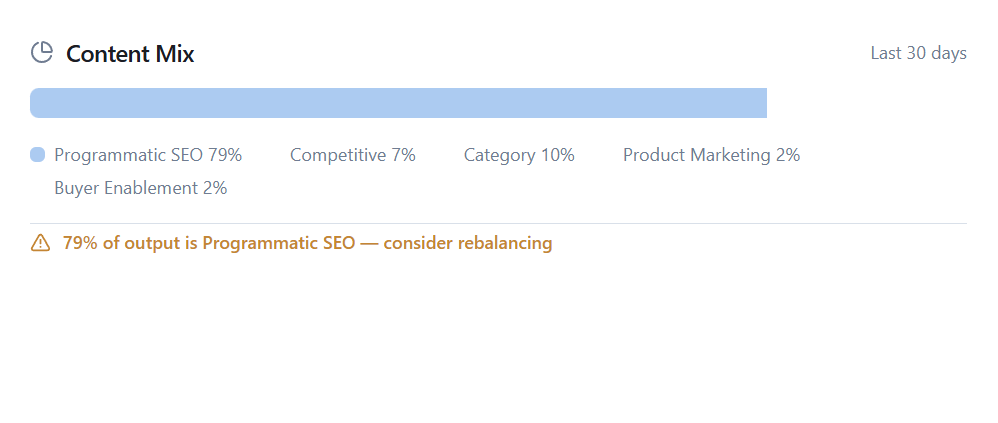
Within Oleno, the executive dashboard aggregates data from content operations into a single dashboard view. It shows trends over time with configurable date ranges, so leadership can monitor how content operations are performing without digging through multiple systems.
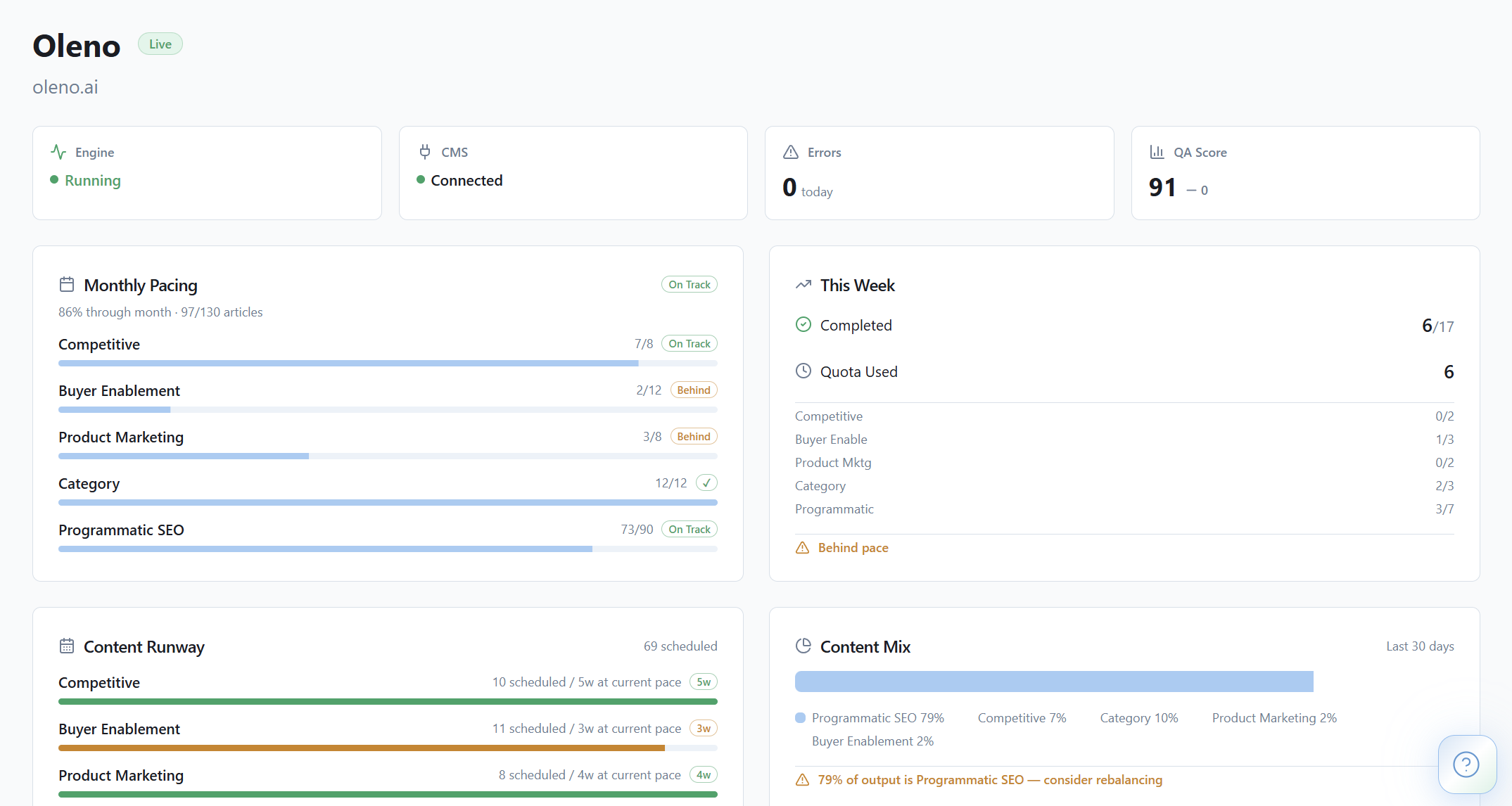
When the same operational metrics are visible in one place, meetings spend less time reconstructing status and more time discussing what to do next.
Teams Can Monitor Progress Through A Consistent Reporting View
A consistent reporting view changes the meeting dynamic. Instead of rebuilding context every week, leadership starts from the same operating picture and looks at what moved.
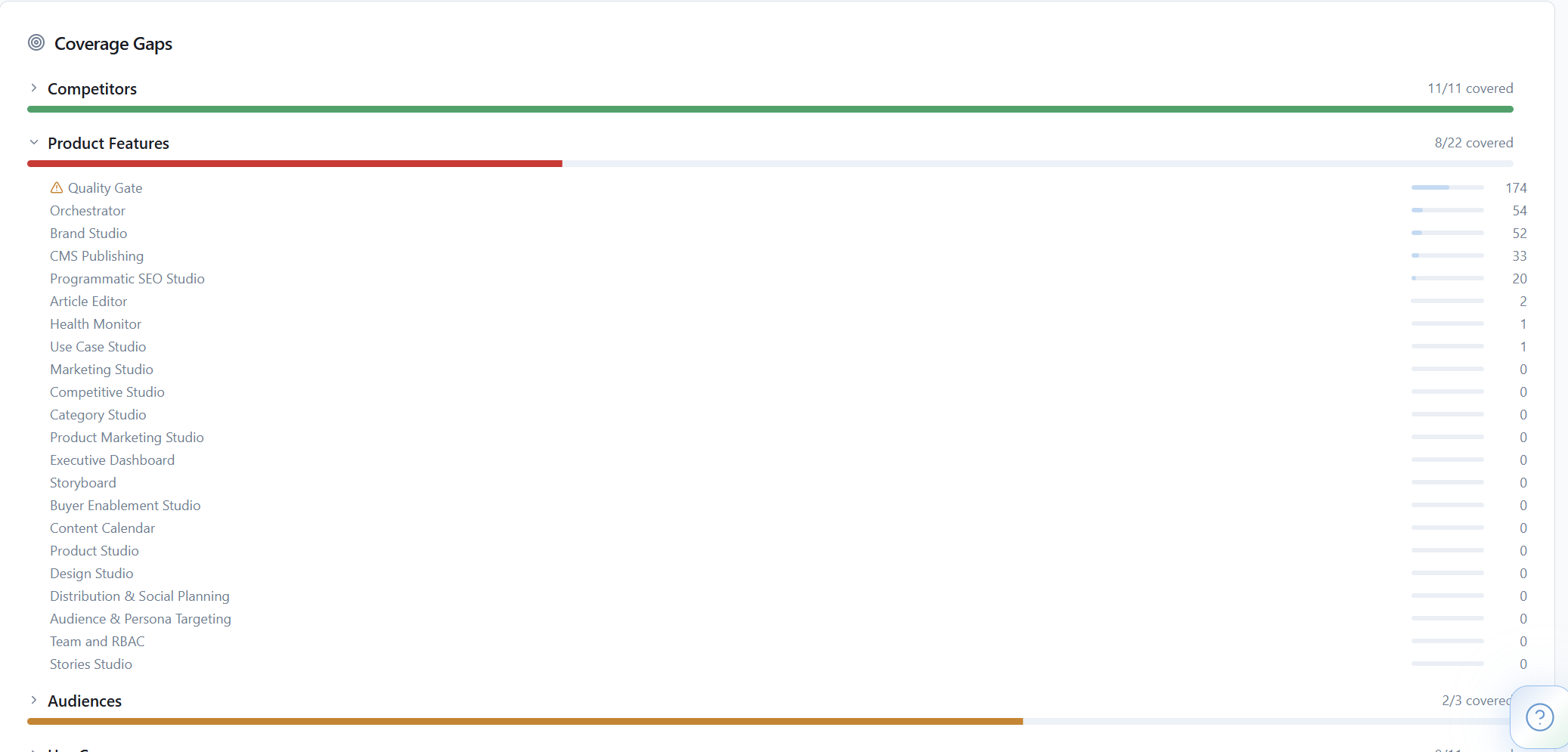
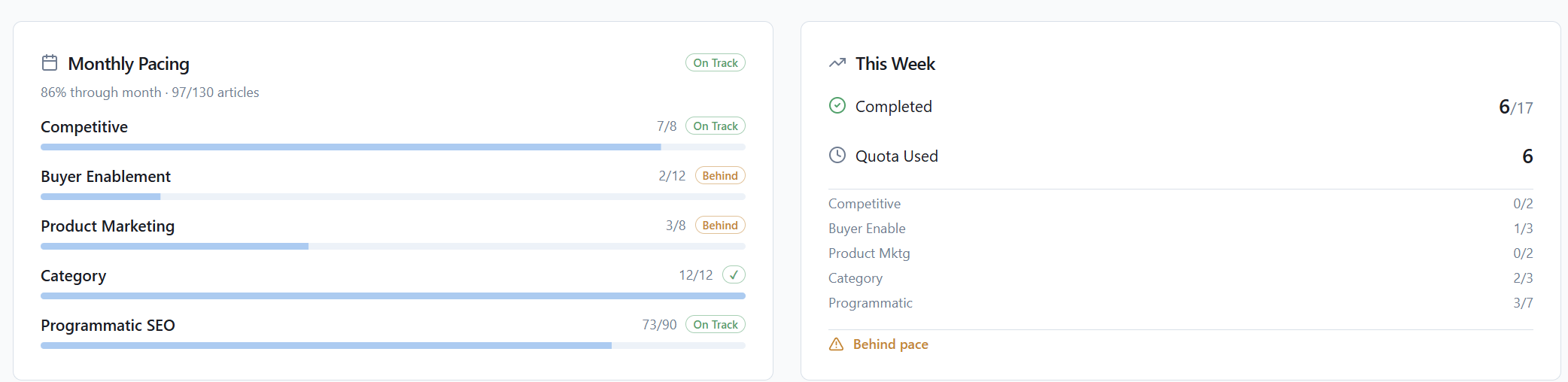
That can include publishing cadence, quality trends, coverage gaps across dimensions, and quota utilization. The exact mix matters less than the habit it creates: one consistent view for repeated decisions.
Prompt-based workflows usually push this burden back onto people. Someone has to gather numbers, interpret them, update slides, and explain inconsistencies. That's one reason ad hoc systems create debt over time. IBM makes a similar point in its analytics coverage: dashboards are most useful when they support ongoing monitoring and repeated decision cycles, not one-off reporting exercises (IBM on business dashboards).
If the goal is to get clearer visibility into content operations, start using Oleno's executive dashboard.
Shared Visibility Supports Better Marketing Oversight
Shared visibility helps leadership stay aligned without pulling the team into constant status explanation. Everyone looks at the same reporting surface. Everyone starts from the same context.
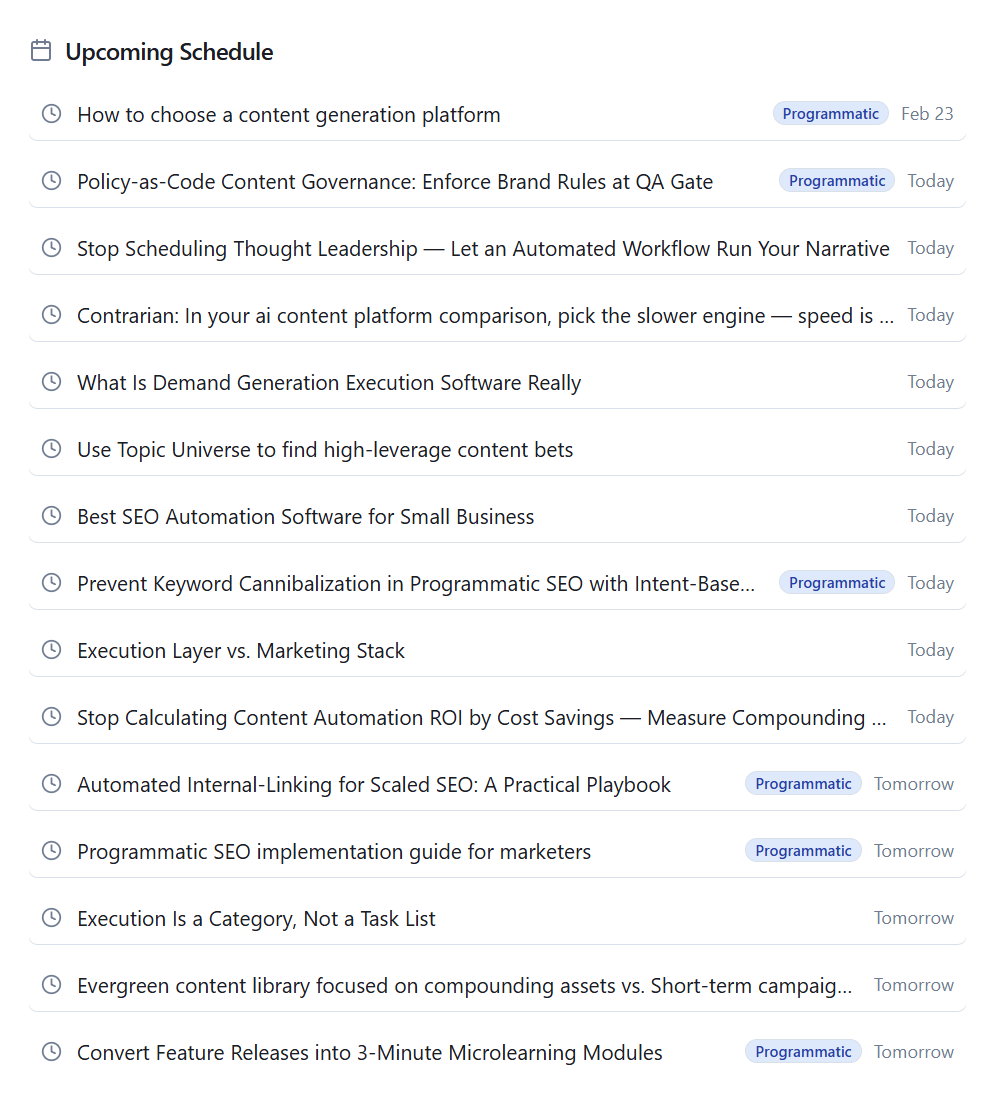
A lot of rework isn't caused by bad execution. It's caused by fragmented reporting, where output, quality, coverage, and quota status all live in different places.
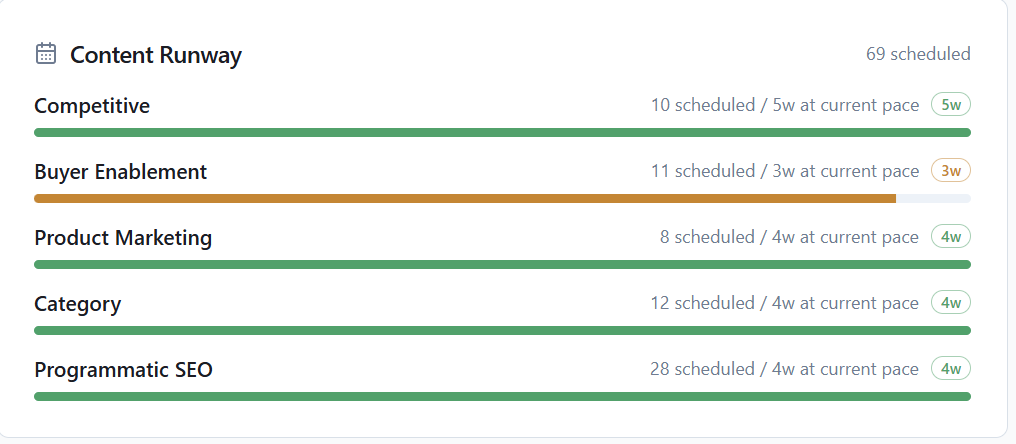
That's a bigger deal than most people admit. One person is looking at output. Another is looking at quality. Another is looking at coverage. Another is asking whether quotas are on track. Now you spend half the meeting aligning before you can act.
With Oleno, the executive dashboard gives CMOs and VPs a centralized, read-only view into content operations. And because it reflects data aggregated from the system itself, leadership gets a clearer picture of how execution is performing over time.
A Weekly Leadership Review Can Shift From Status Gathering To Action
A weekly leadership review shifts from status gathering to action when the dashboard already reflects the metrics leadership expects. The meeting starts with shared context instead of report assembly. That saves time, but more importantly, it changes the kind of conversation the team can have. Less explaining. More deciding.
One Weekly Leadership Review Can Shift From Status Gathering To Action
When the recurring questions already have a home, the meeting gets sharper. You stop spending the first fifteen minutes assembling the story and start spending that time making calls.
Let's use a realistic growth-stage SaaS scenario. You're a Head of Marketing with a small team. You need to walk into the Monday exec meeting and answer some very normal questions. Are we shipping enough? Is the quality holding up? Are we covering the right parts of the funnel? Are there gaps by audience or use case?
Before a dashboard like this, you probably pull data from a content tracker, a reporting sheet, maybe a CMS, maybe another dashboard, and then turn all of that into a summary someone else can consume in 5 minutes. That's a lot of prep for a conversation that should have started with the answer already visible.
After the shift, the structure changes. The dashboard is already organized around the KPI tiles leadership reviews regularly. So instead of spending the first part of the meeting gathering status in the room, you get to the real issue faster. Where are we underweight? What's falling behind? What needs to change this week?
A Lean Team Can Spot Content Issues Before They Compound
Lean teams feel reporting drag the most because they don't have spare capacity. Every hour spent packaging updates is an hour not spent on messaging, campaigns, or fixing a weak part of the funnel.
Back when I was building content systems by hand, I lost 3 to 4 hours a day just prompting, copy-pasting, and manually loading content into a CMS before I built a more automated engine. That was the whole reason Oleno started. The work itself wasn't always the problem. The operational drag around it was. Reporting overhead creates the same kind of drag. Different surface area. Same tax.
And for growth-stage teams trying to increase output without adding headcount, visibility matters a lot. If output cadence slips or coverage gaps start showing up, you want to see that early. Not after the quarter is gone, especially when evaluating custom kpi tiles in.
If that sounds familiar, see how Oleno's executive dashboard supports faster weekly reviews.
Better Dashboard Visibility Does Not Replace Strategy for Custom kpi tiles in
Better dashboard visibility does not replace strategy because reporting only reflects the model you've already defined. A cleaner view can speed action and improve consistency, but it can't choose what matters for your business. If goals are fuzzy or inputs are unreliable, the dashboard will surface that problem, not solve it.
KPI Tiles Improve Visibility, But They Do Not Replace Strategy
Clear reporting helps teams move faster, but it doesn't make strategic decisions for them. That's the boundary, and it's an important one.
This feature is useful when you already know what you're trying to monitor. KPI tiles can keep leadership focused on the right signals, but they don't decide your positioning, your goals, or your success criteria for you.
That distinction matters. A lot. I've seen teams assume that better reporting will somehow create clarity upstream. Usually it doesn't. If the company hasn't agreed on what good looks like, the dashboard just reflects that confusion faster.
Oleno is built so marketers stay in control of the important decisions. The system runs inside those boundaries. So custom KPI tiles support that operating model. They don't replace it.
Better Reporting Does Not Fix Unclear Goals Or Bad Inputs
The reporting layer is only as useful as the inputs behind it. If source data is messy or definitions change every week, the dashboard will make that more visible, not magically clean it up.
Dashboard customization also won't repair weak source data on its own. If your upstream data is incomplete, if your team is using inconsistent definitions, or if you're tracking the wrong outcomes, the tiles won't magically correct that. They'll just present the inputs you're feeding the system.
Fair point if you're thinking that's obvious. In practice, teams forget this all the time. They clean up the reporting layer and expect the business to feel tighter overnight. Sometimes it does. Sometimes it just reveals the mess more clearly.
And honestly, that's still useful. Visibility is often the first step to fixing the underlying issue. But it is still a first step.
See How Clearer Executive Visibility Changes The Operating Rhythm
Clearer executive visibility matters because the whole system runs better when leaders can see the right signals without extra assembly work. The dashboard becomes the place where execution, quality, and coverage stay visible together. That makes follow-through easier and reporting less painful. For a lean team, that can be the difference between reacting weekly and just catching up.
Clearer Executive Visibility Makes The Whole System Easier To Run
A reporting layer only sticks when people actually use it. That usually happens when the view is tied to the way the team already works, not bolted on afterward.
Custom KPI tiles are most valuable inside a broader operating system. On their own, they're useful. Inside a system that already tracks cadence, quality score trends, coverage gaps, and quota utilization, they become a practical way to keep leadership focused on what matters.
That's the bigger point. Oleno isn't trying to give you another isolated reporting widget. The executive dashboard is part of a larger operating system built for teams that don't have time for constant coordination. So the reporting layer supports planning, execution, quality control, and publishing instead of sitting off to the side.
The Next Step Is Building A Reporting Layer Leaders Will Actually Use
If leaders can get answers fast, they use the dashboard. If they can't, they go right back to slides, side asks, and one-off status requests.
So the next step isn't adding more metrics. It's deciding which few deserve permanent visibility, then tying them to a system that can keep execution and reporting connected. Oleno does that through its executive dashboard, with marketers still setting the rules.
If you're trying to run demand gen with a small team and you're tired of rebuilding the same reporting story every week, ready to make executive reporting easier to run? Book an Oleno demo today.
About Daniel Hebert
I'm the founder of Oleno, SalesMVP Lab, and yourLumira. Been working in B2B SaaS in both sales and marketing leadership for 13+ years. I specialize in building revenue engines from the ground up. Over the years, I've codified writing frameworks, which are now powering Oleno.
Frequently Asked Questions