Design AI-Powered Lead Nurture Sequences That Convert in 30 Days

Most nurture programs still run on a calendar. Same emails, same order, regardless of what a buyer just did. If you want to design ai-powered lead nurture that converts, you have to treat behavior as the brief. Signals tell you timing, angle, and depth. Calendar tells you none of that.
I learned this the hard way. We pumped out polished sequences, felt busy, and then watched high-intent moments slide by. Someone viewed pricing twice and got a fluff tip. Someone rewatched a demo and got a generic case study from three months ago. It is not a content problem. It is a timing and relevance problem.
Key Takeaways:
- Treat nurture as a signal system, not a calendar. Behavior drives timing, topic, and depth.
- Map raw engagement into triggers you actually trust, then route each trigger to a purpose-built branch.
- Design ai-powered lead nurture with a generator that pulls inputs from your CRM and marketing tools, and outputs guardrailed copy that matches your voice.
- Prove uplift with short, tight experiments: time-to-SQL, MQL to SQL conversion, and response rates per trigger.
- Govern product claims and tone so AI never invents features or drifts off-brand.
- Start with five high-intent triggers, not a 50-branch maze. Expand only when data proves it.
Static Nurture Is Broken: Signal-Driven Is How You Design AI-Powered Lead Nurture
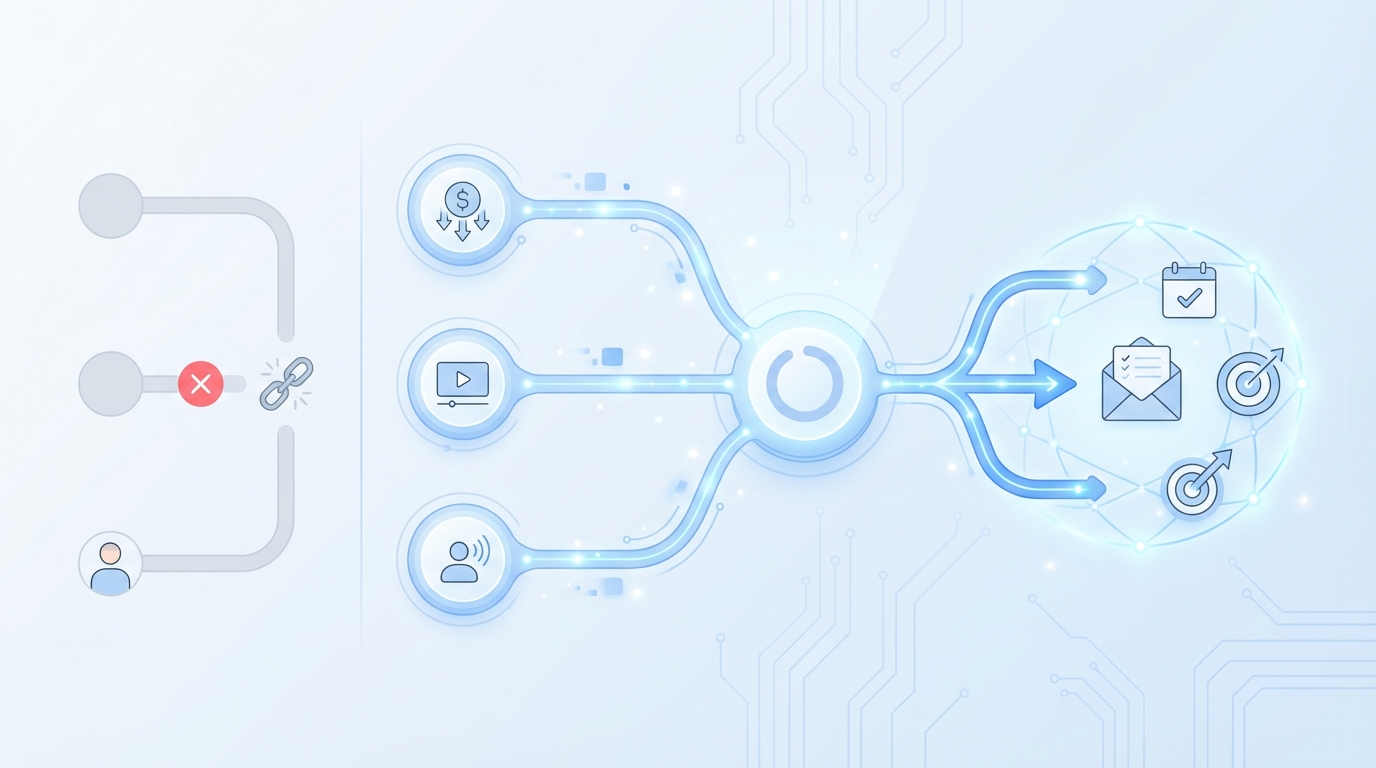
Static nurture fails because it ignores buyer behavior, while signal-driven nurture adapts content and timing to what buyers just did. When a contact hits pricing twice, attends a webinar, or replays your demo, those are different jobs to be done. Treat the trigger as the brief and you stop missing momentum.
Calendar-first sequences create timing debt
Calendar-first sequences assume day 3 is better than minute 3. Buyers do not wait for your cadence. They show intent in bursts, then go dark. If your system cannot meet that moment, you lose the window and the conversation gets cold. Then you grind through sequences that feel irrelevant and slow.
You know the pattern. The open rate on email one looks fine, then drops off a cliff. Replies skew to unqualified leads who are just browsing. A few weeks later, sales asks for more content, as if the content itself is the problem. It is not. Relevance decays faster than your schedule can keep up when you ignore signals.
When I finally mapped behavior to actual replies, it clicked. Pricing page revisits beat any clever subject line. Product doc depth beat generic “thought leadership.” Signal beats style. Every time.
Signal-driven nurture matches moments, not a plan
A signal-driven system routes contacts into the next best action based on what they just did, not what you planned last month. Someone rewatched the demo? Offer a focused follow-up on the exact feature they hovered over. Someone downloaded a comparison guide? Send evaluation content that calls out decision factors, not a vague story.
The work shifts from “write 10 emails” to “define the triggers, define the jobs.” You decide what each trigger should accomplish, how fast to respond, and how to measure progress. Then you let the system assemble the right variant under brand guardrails. It sounds simple. It is. The results compound.
The Real Bottleneck In Lead Nurture: Missing Signals, Not More Emails
The real bottleneck is signal quality and routing, not email volume. If your CRM is noisy or your triggers are vague, AI will guess wrong and humans will step in to fix it. Clean signals let you automate decisions confidently and keep humans focused on strategy, not triage.
Most teams collect clicks, not intent
Clicks are easy to log and hard to interpret. A click on a blog post does not equal interest in buying. A pricing view does. A doc search for “security” from a Fortune 100 company does. Without a simple signal hierarchy, you end up treating weak and strong events the same, which floods sales with noise.
I used to lump everything under “engagement” because that is what the dashboard showed. It was a mistake. Strong signals need fast, specific follow-up. Weak signals need nurturing, not sales pressure. Mix them up and you either burn leads or let hot ones cool.
If you only fix one thing, fix signal quality. You will write less email and close more deals. That trade is worth it.
Routing breaks before writing does
Teams blame copy when routing is the culprit. If triggers route to the wrong branch, the best email in the world will feel off. A doc-depth trigger should never route to a top-of-funnel story. A competitor-terms trigger should not go to a case study from a different industry. Routing logic is the unseen lever.
Start by listing five must-catch triggers and what they should do next. Then test routing fast. If contacts land in the wrong branch, fix the rule, not the paragraph. Copy polishing is cheap. Routing mistakes are costly.
Once routing stabilizes, copy changes finally stick. Sales notices. They reply to more warmed-up leads, and the loop tightens.
The Cost Of Schedule-First Nurture: Lost Moments, Slower SQLs
Schedule-first nurture increases time-to-SQL and wastes strong intent because it delays relevant follow-up. A two-day wait after a pricing revisit is enough to lose momentum. Teams pay for that delay in lost replies, longer cycles, and higher sales effort per deal.
Missed triggers have a clear price
Every pricing revisit without a fast follow-up is a missed shot at a real conversation. According to HubSpot’s State of Marketing 2024, speed to lead still shapes conversion more than channel choice. When you wait on a calendar step, you trade speed for “consistency” and lose the deal tempo buyers set, especially when evaluating design ai-powered lead nurture.
Time is not the only cost. You also burn seller energy. Reps chase lukewarm leads because the system is not surfacing hot ones in time. That is how forecast risk creeps in. You hit the activity target, then miss the number. I have been there. Activity is not pipeline.
A better system moves the same volume of messages but hits the right people at the right time with the right angle. That is leverage. Not volume for volume’s sake.
AI without guardrails creates rework
Unbounded AI can write faster, then create cleanup work. If an AI generator improvises product claims or tone, legal and PMM slow everything down. That rework erases the speed you thought you gained. Guardrails are not optional. They are how you keep speed and trust at the same time.
I like a simple filter: would I be fine if this email went to a board member? If the answer is “not sure,” your system needs tighter governance. You want fast and right, not fast and risky.
When governance tightens, review time drops. Now AI speed actually shows up in your conversion metrics instead of your editing queue.
What It Feels Like To Run Nurture Without Signals for Design ai-powered lead nurture
Running nurture without signals feels like shouting into a hallway. You send more and more, and the replies you want never show up. The wrong people write back. The right people read and move on. You know it is broken, but you cannot pinpoint why.
You start doubting the content
Marketers blame the story when timing is the real issue. You rewrite subject lines, swap case studies, and tweak CTAs. Results barely move. It is demoralizing. You can feel the waste. Your gut says you are missing the moment, not the message, and your dashboard cannot prove it.
I have burned weekends rewriting copy that was already good. The emails landed two days after a hot action and read like an intro, not a continuation. No wonder they fell flat. Timing misread as messaging failure is a common trap.
Once you fix timing, the old copy suddenly works. That moment teaches you more than any split test.
Sales loses trust in marketing
Without signal-driven routing, sales gets a mix of hot and cold leads labeled the same. They learn to ignore alerts. Then when a real buyer shows up, the alert blends in with noise. Trust drops. Meetings get tense. Everyone feels the cost.
Rebuild trust by flagging only high-confidence triggers and proving faster replies. One clean win can reset the tone. It does not take six months. It takes one week of better signals and better follow-up.
When sales sees fewer but better alerts, they respond faster. That loop is the point.
How To Design AI-Powered Lead Nurture Around Buyer Signals
Design ai-powered lead nurture by mapping high-intent signals to specific jobs and letting a generator assemble guardrailed variants on demand. Start with five triggers, define next best actions, and measure time-to-SQL and conversion as your north-star metrics. Keep humans on strategy and exceptions, not every draft.

Turn raw events into triggers you trust
Events become triggers when you add thresholds and context. One pricing view might be noise. Two within 24 hours from a target account is a trigger. One doc search is curiosity. Ten minutes on security docs from a Fortune 100 prospect is intent. Write the rule, then enforce it in your tools.
I like a three-tier model: exploration, evaluation, escalation. Exploration feeds education. Evaluation prompts comparison content or a reply-worthy question. Escalation pings sales with context and starts a focused branch. The rule is simple, but it saves you from sending the wrong content at the wrong time.
If you need a reference pattern for triggers and scoring, the Salesforce Marketing Cloud guide to behavioral triggers is a solid starting point. Use it, then make it your own, especially when evaluating design ai-powered lead nurture.
After your rules ship, watch the misroutes daily for a week. Fix them fast. Routing quality is a weekly habit, not a one-time project.
Build a small, safe generator that plugs in
Your generator does not need to do everything on day one. It needs to take in a trigger, pull the right references, and produce on-brand, accurate copy. That means three inputs: persona and segment, recent behavior context, and approved product truth. That is it. Keep the surface area small.
A simple stack works. CRM or MAP holds the contact and activity. A store of messaging and product facts keeps AI honest. A rules layer picks the right prompt and template. Then your email tool sends it. If AI does not have a fact, it should not guess. It should omit or link to approved content. Accuracy beats ornament.
Measure three numbers from day one: reply rate per trigger, time-to-first-reply after a strong signal, and MQL to SQL conversion by branch. Those will tell you if your system is working. Vanity opens and clicks can wait.
To align attribution and timing, use GA4’s guidance on event-based conversion modeling as a sanity check for your own logs. The Google Analytics 4 conversion documentation explains how multi-event journeys roll up, which mirrors how your triggers should behave.
Build AI-Powered Nurture With Oleno
Oleno makes signal-based nurture practical by enforcing voice and product truth while assembling content variations fast. You define audiences, personas, and product facts once, then let the system pull the right snippets as triggers fire. The point is simple, ship accurate, on-brand follow-ups without manual rewrites.
Governance that keeps AI accurate and on-brand
Oleno’s Brand Studio and Audience & Persona Targeting load tone, vocabulary, segments, and role goals into every draft so the generator does not drift. Knowledge Archive grounds drafts in your real docs and stories, which cuts guesswork. Product Studio locks product claims and feature boundaries, so nurture never invents capabilities or pricing.
That combination matters when routing to evaluation content. If a trigger calls for a feature comparison, Oleno pulls wording from Product Studio and examples from Knowledge Archive. So emails match how sales talks about the product, not how an LLM imagines it. Quality Gate then scores outputs for voice, structure, and grounding before they ship.
The result is speed without risk. You avoid the cleanup loop that kills AI gains and you protect brand equity at the same time. In my experience, that is the line between hype and real leverage.
Stop letting hot signals cool. Request A Demo
Operations that keep cadence steady
Signals are messy. Cadence matters. Oleno’s Orchestrator and Topic Universe keep the pipeline moving by selecting approved topics and enforcing quotas, while CMS Publishing pushes finished content directly to your site. For nurture, that means your system always has fresh, governed assets to reference when a trigger fires.
When sales needs tighter follow-up on a new feature, Marketing Studio injects your key messages and category framing so drafts reflect the stance you want in market. Quality Gate blocks anything below threshold and tries auto-revision first, which keeps humans on review, not rescue.
Here is the transformation you will feel: research hours drop because Knowledge Archive has your sources. Review time shrinks because Brand Studio and Product Studio keep drafts faithful. And time-to-SQL improves because triggers route to something timely and relevant, not a calendar slot. Teams I have worked with saw 25 to 40 percent faster time-to-SQL and 15 to 30 percent better MQL to SQL conversion in the first 30 to 60 days once signals ran the show.
Conclusion
Calendar-first nurture wastes strong intent. Signal-driven systems do not. When you design ai-powered lead nurture around triggers, you stop guessing, you stop waiting, and you start meeting buyers where they are. The playbook is clear, map trusted signals, route to purpose-built branches, and keep AI inside governance.
Do the small version now. Five triggers, clean routing, a safe generator, and tight measurement. You will feel the lift fast. Then scale the parts that move the metrics. That is how you reduce time-to-SQL by roughly a third and lift conversion without hiring a small army. Consistency wins. Signals make it possible.
About Daniel Hebert
I'm the founder of Oleno, SalesMVP Lab, and yourLumira. Been working in B2B SaaS in both sales and marketing leadership for 13+ years. I specialize in building revenue engines from the ground up. Over the years, I've codified writing frameworks, which are now powering Oleno.
Frequently Asked Questions