Deterministic Content Pipeline: Publish Daily Without Handoffs

Most teams blame slow writers for missed deadlines. I've been that writer and the manager waiting on them. At Steamfeed, we published daily because the pipeline was simple and consistent. At PostBeyond, we slowed down when handoffs ballooned. The writing wasn’t the bottleneck. The choreography was.
Here’s the pattern I see everywhere. Great draft. Then it bounces: design, screenshots, SEO pass, CMS tweaks, “can someone add schema?”, “who’s fixing alt text?”, “why did this publish twice?” That mess isn’t content. It’s chaos disguised as collaboration. The fix isn’t more people or faster typing. It’s deterministic rules that remove optionality.
Key Takeaways:
- Treat content as a deterministic pipeline, not a series of handoffs
- Push decisions upstream and encode them as rules the system enforces
- Use gates to stop bad outputs early rather than editing downstream
- Map topics with clusters, saturation, and cooldowns to avoid cannibalization
- Generate visuals, links, and schema programmatically to prevent cleanup work
- Publish idempotently to eliminate duplicate posts and fire drills
Ready to see what a deterministic pipeline feels like? Try Generating 3 Free Test Articles Now.
The Real Waste Is Handoffs, Not Writing Speed
Daily publishing dies in the gaps between people, not at the keyboard. Deterministic content ops means the same inputs create the same outputs every time, without last, minute decisions. Picture schema generated programmatically and internal links injected from a verified sitemap. No debates. No “quick fixes” in the CMS.

What Does Deterministic Mean In Content Ops?
Deterministic means you can predict the outcome from the inputs and rules, consistently. Links come only from verified URLs, schema is generated from code, and visuals follow placement rules. You can run it daily without gambling the brand. The writing stays creative; the operations stay predictable. That split unlocks velocity.
When teams say “we’ll fix it in the CMS,” they invite variance. Variance creates rework. And rework kills cadence. If your pipeline can’t reproduce the same decisions confidently, link sources, alt text structure, JSON-LD patterns, you end up with “surprises.” Surprises become delays. A deterministic pipeline makes correctness boring by design.
As a parallel, the software world treats determinism as table stakes for reliable delivery. The logic applies here too. If you want reliable content delivery, start with governed rules and predictable outcomes. Minimum viable variability. Maximum repeatability. It’s not glamorous, but you feel it as less friction across the week.
By the way, the concept isn’t new. See how reliability teams define determinism in delivery in MinimumCD’s definition of determinism. Different domain, same physics. We’re just applying it to content.
The Hidden Complexity In Ad-Hoc Handoffs
Handoffs look harmless. They’re not. Draft to design means waiting on screenshots. Screenshots means aligning product context. Someone “fixes” structure in the CMS. Another person adds schema last minute. Each hop adds delay and silent variance. You’re managing a parade, not an operation.
The trick is to move decisions upstream and capture them as rules. Don’t “remember to add alt text.” Generate it. Don’t “choose internal links.” Inject them from a verified sitemap with exact, match anchors. The mental checklist you keep in your head? Convert it into code. Then it runs the same way every time.
I learned this the hard way. At LevelJump, we shipped good ideas via transcripts, but lacked structure for search. The fixes came late and often. It felt like pushing a boulder uphill. When you codify the choices, the hill flattens. You still push. You just don’t slide back down with every handoff.
Why Daily Publishing Fails Without Gates
Daily cadence amplifies tiny errors. One fabricated URL. One missing alt text. One schema miss. You burn hours on cleanup and start resenting the schedule. Gates exist to block that. Make QA a pass/fail boundary with automated refinements. If the draft doesn’t meet the threshold, it doesn’t move. Simple.
Treat variability intentionally. You can constrain generation choices and require structure long before anyone hits “publish.” The point isn’t perfection. It’s eliminating avoidable rework. The payoff is compounding: fewer edits today, fewer messes tomorrow, more confidence to schedule daily next week.
You don’t need complex tuning to get there. You need guardrails and a consistent scoring standard. Drafts get evaluated the same way every time. Low scorers get targeted refinement loops. No heroics. No last, minute Slack scramble. Boring process. Predictable output. That’s the goal. For practical levers on controlling variability, see Vertex AI generation parameters.
Treat Content Like A Pipeline You Can Operate Daily
You operate pipelines with contracts and gates, not vibes. Build a topic layer you can audit. Force differentiation before writing. Enforce snippet, ready structure and brand, consistent visuals. Then make publishing idempotent to avoid duplicates. Do this, and daily becomes sustainable rather than stressful.

Map Your Topic Universe Like A Contract
Start with inputs you can verify: sitemap pages, your knowledge base, and focus areas. Group topics into clusters and assign saturation states. Add a cooldown policy per topic so you don’t re-cover ideas too fast. The output is a daily, approved queue. Clear acceptance criteria in, unambiguous priorities out.
Think of it like an API contract for topics. You define what a valid topic looks like (cluster, status, KB alignment), and the system only accepts compliant payloads. When scope creep tries to sneak in, “quick idea for next week”, the contract keeps you honest. You publish with intent, not impulse.
There’s nuance here. Not every cluster needs the same cadence. Some pillars build authority faster with broad coverage; others need depth. The point is to decide intentionally. A visible map reveals where you’re thin versus over-published. From there, the calendar almost writes itself.
For teams balancing automation with discretion, the spectrum between free, form agents and rule, driven workflows is useful framing. The article on deepset’s spectrum of agents and deterministic workflows lays out when you lock decisions versus explore.
How Do Clusters And Cooldowns Prevent Cannibalization?
Clusters force portfolio thinking. Each topic belongs to a pillar with a current status: underserved, healthy, well, covered, or saturated. Enforce a 90, day cooldown before repeating a topic. It sounds strict. It’s not. It’s a speed bump that prevents endless rewrites of the same idea.
Cannibalization creeps in quietly. You write three takes on the same theme in a month because different people had similar ideas. Traffic looks fine, but authority dilutes. Meanwhile, neglected clusters stagnate. Cooldowns are the governance you tolerate because they save weeks of rework later.
This also helps teams resist “quick wins.” If a topic is saturated, the queue rejects it, even if it’s tempting. You move to gaps instead. Over a quarter, that discipline compounds into authority. Not a spike, but a slope. It’s better.
Define Acceptance Criteria For Every Stage
Write pass/fail rules before building. Briefs must hit an Information Gain threshold and include three to five vetted external sources. Drafts must open each H2 with snippet, ready paragraphs. Visuals must follow brand palette and placement rules. Publishing must be idempotent. If a rule is ambiguous, it invites handoffs.
You’re not making rules for rules’ sake. You’re preventing downstream debates. “Does this look on-brand?” isn’t a question when the palette and alt, text patterns are enforced. “Is this differentiated?” isn’t a debate when the brief failed the Info Gain score. The system answers before a human needs to.
A nice side effect: onboarding speeds up. New teammates ship confidently because the pipeline encodes the guardrails. Less shadow QA. Fewer “ask Sarah” moments. The machine handles structure; the team focuses on story.
The Hidden Costs Draining Your Team Every Week
The costs of nondeterminism don’t show up on a single report. They accumulate as background tax: duplicate publishes, tone fixes, link cleanups, and image mismatches. Add them up and you’ll find days per month gone. Not dramatic. Just draining.
Engineering Hours Lost To Retries And Duplicates
Let’s pretend your CMS publishes a duplicate post twice a month. Each incident takes 90 minutes to diagnose, revert, and republish. With four brands, that’s roughly 12 hours a month. It doesn’t blow anything up. It just quietly steals time from real work.
Idempotent publish logic, mapped fields, and duplicate prevention remove that tax. You don’t notice the absence of chaos. You notice more time for projects that actually move the needle. The win is boring. That’s exactly why it’s valuable.
Rework From Inconsistent Voice And Structure
A single off, brand section triggers a ripple: tone edits, heading rewrites, list fixes. That’s two to three hours per article when voice drifts. On a small team, it adds up to a week each quarter. You can’t see it in a dashboard. You feel it in delayed launches.
Enforce voice constraints and an H2, first structure in the draft phase. The model should generate section, ready prose that already sounds like you. Remove the cause, not the symptom. When the baseline is right, you stop editing and start approving.
What Is The Risk Of Fabricated Internal Links?
One fabricated URL looks sloppy. At scale, it becomes a credibility leak. Readers bounce. Crawlers lose trust. And you waste time hunting ghosts in the CMS. It’s annoying. It’s avoidable.
Replace LLM, guessing with deterministic link injection from a verified sitemap. Use exact, match anchors and place links at natural sentence boundaries. No made, up pages. No cleanup after publish. You trade cleverness for correctness. The site gets stronger.
Still burning hours on cleanup when you should be publishing? Try Using An Autonomous Content Engine For Always, On Publishing.
When One Broken Publish Turns Into A Fire Drill
Fire drills don’t start big. They start small, a duplicate URL, a wrong image, a missing alt tag, and spiral under pressure. When you’re publishing daily, small errors multiply. They also erode trust inside the org. People hesitate. And the cadence stalls.
The Duplicate Publish You Notice After Customers Share It
You ship a post at 4 pm. Slack pings at 6. Same article, two URLs, both indexed. Now you’re merging, redirecting, and trying not to lose equity. Stressful, preventable, and distracting. It wasn’t a strategy problem. It was plumbing.
Idempotent publish calls and duplicate checks end this drama. Set the rule: same content fingerprint, one publish result. If a delivery fails, retry safely. If it succeeds, never again. The win isn’t a feature. It’s one less Tuesday on fire.
The Wrong Screenshot In Your Solution Section
A mismatched product image undermines credibility right where you’re asking for action. It hints at sloppiness. Prospects notice. So do sales.
Use semantic matching to place screenshots only where the section meaning fits. Prioritize solution sections. Generate alt text programmatically. This isn’t about pretty. It’s about trust in the exact moment that matters.
Why You Hesitate To Schedule Daily Posts
You’re not anti, velocity. You’re anti, cleanup. The fear is reasonable. Without gates, a daily schedule multiplies rework. You don’t need more courage. You need better safeguards.
Tie alerts to real failure modes only. Debounce noise. Keep logs for retries and version history so you can diagnose without guesswork. The moment you trust the plumbing, you push daily. Not because you should. Because it’s safe.
A Deterministic Pipeline You Can Run With A Small Team
You don’t need a big team to publish daily. You need a small team running a predictable system. Four stages. Clear acceptance criteria. No handoffs where code can decide.
Step 1: Topic Universe And Brief Templates
Implement a topic inventory from your sitemap and knowledge base. Assign cluster IDs, saturation states, and cooldowns. Generate briefs with a required Information Gain threshold and three to five external sources. Include acceptance criteria for snippet, ready H2s, voice constraints, and solution images. Low, score briefs never become drafts.
This is the leverage point. When briefs carry differentiation and structure requirements, drafts start right. The downstream pipeline stops catching preventable problems. You invest time where ideas are novel, not where familiarity feels easy. Upstream quality creates downstream speed.
Step 2: Draft Generation With KB Retrieval And Voice Constraints
Generate section, first drafts against the approved brief. Enforce brand lexicon, banned terms, and tone rules. Ground claims in your knowledge base rather than letting the model invent. Keep links, schema, and visuals out at this stage. You want clean text that passes structure checks and reads like you.
This separation of concerns matters. You’re not trying to do everything at once. First, get the narrative right. Then, attach the assets deterministically. It’s calmer. It’s faster. It also reduces “one fix breaks three things” moments later.
Step 3: QA Gates With Automated Refinement Loops
Score drafts against 80+ criteria: structure, voice, snippet readiness, image rules, link readiness, schema eligibility. Use a pass threshold so nothing advances half, baked. Trigger targeted refinement loops for low, scoring areas. If it still fails, it gets rejected. No drama. Just standards.
The key is consistency. Every draft receives the same scrutiny. Humans stop policing commas and start owning the story the system can’t judge. Your editorial time shifts from fix, it work to meaning, where the human edge lives. For a useful mental model, borrow governed evaluation patterns from Determined AI’s documentation on training loops.
Step 4: Deterministic Assets And Idempotent Publishing
After text passes, inject internal links from a verified sitemap with exact, match anchors. Generate JSON, LD for Article, FAQ, and BreadcrumbList and validate it. Place visuals per rules, not vibes. Convert to CMS, ready HTML, map fields, and publish with duplicate prevention and safe retries. If delivery fails, notify and retry.
You get a reliable finish line. No fabricated URLs. No schema surprises. No “who added that stock photo?” mysteries. It doesn’t feel faster at first. It feels calmer. Then you realize: calmer is faster when you run every day.
How Oleno Ships Daily, Brand-Complete Articles Without Handoffs
Oleno is an autonomous content and brand execution engine that turns strategy into published, on, brand articles, text and visuals included. It replaces scattered tools and manual cleanups with a continuous, deterministic pipeline. The outcome isn’t just more content. It’s fewer messes and more trust to publish daily.
Topic Universe And Information Gain That Prevent Repetition
Oleno maps your topic landscape, labels cluster saturation, and enforces cooldowns so you don’t cannibalize coverage. Briefs carry Information Gain scores and include external source candidates. Low, differentiation briefs fail early. You invest only in novel angles that move authority forward rather than reruns that dilute it.
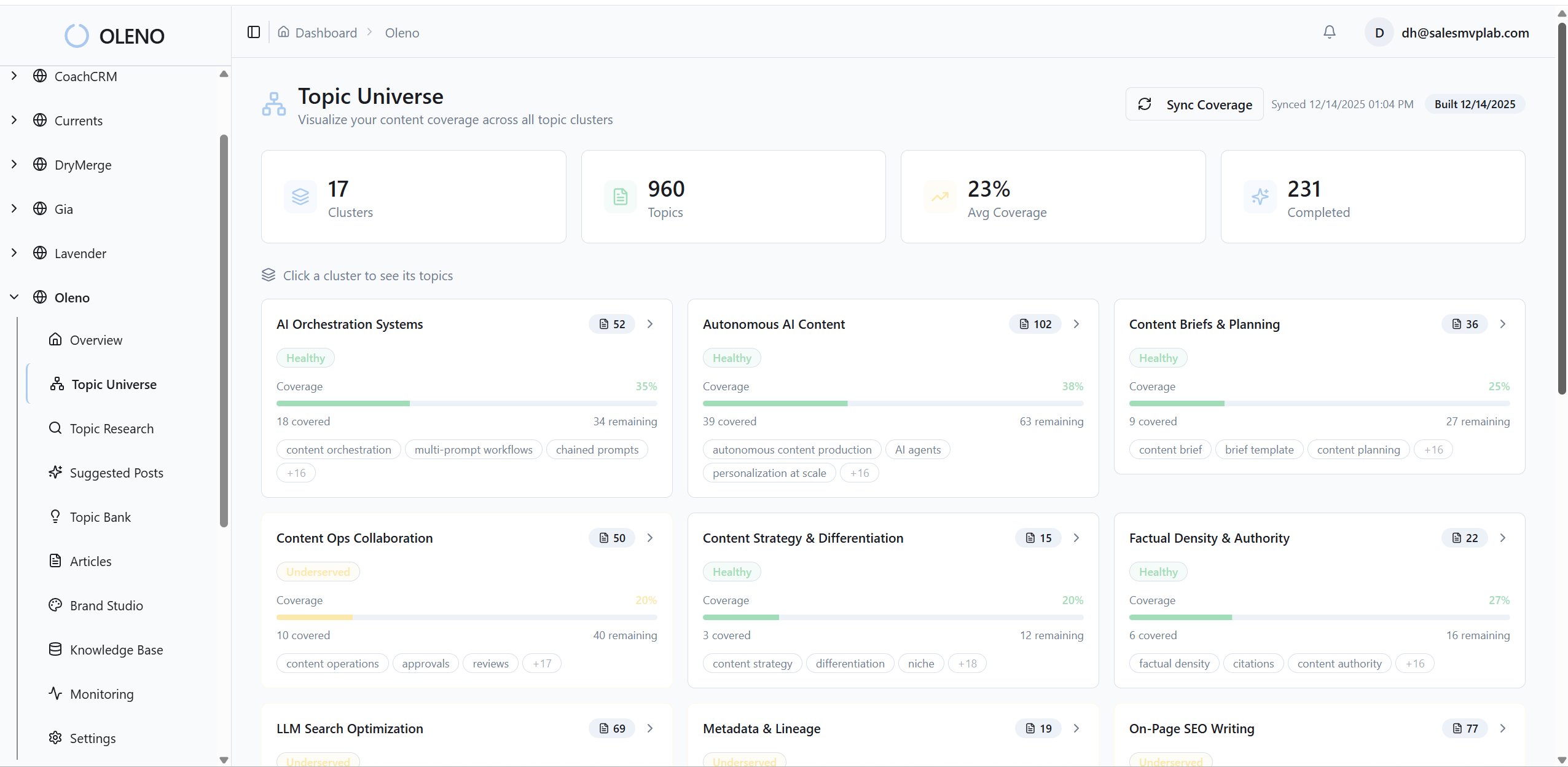
This directly addresses the weekly tax we talked about, rework from repetitive topics and aimless updates. By encoding novelty into the brief, Oleno reduces downstream edits and keeps your calendar focused on what matters. You get slope, not spikes.
Deterministic Links And Schema That Remove Cleanup Work
Oleno injects five to eight internal links from your verified sitemap with exact, match anchors only. JSON, LD for Article, FAQ, and BreadcrumbList is generated programmatically and validated. No fabricated URLs. No hand, built schema in the CMS that breaks later. The structure is consistent and citable.
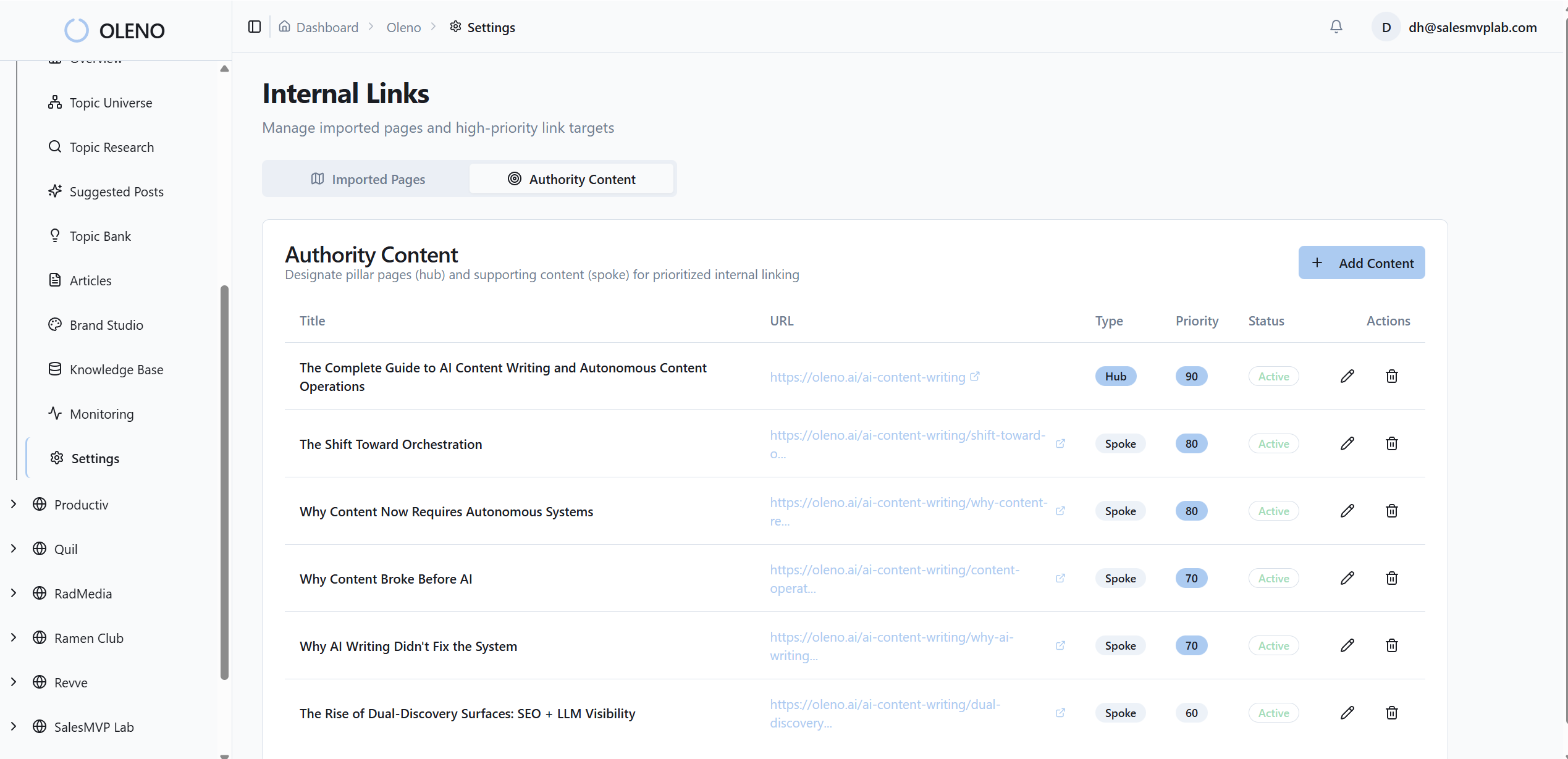
Crawlers and assistants understand the article cleanly. Your team avoids the cleanup hours that used to follow “publish.” This is how you make daily publishing feel safe rather than reckless. The brand looks tighter because the rules are doing their job.
Visual Studio That Places The Right Image In The Right Section
Oleno’s Visual Studio builds hero and inline visuals using your brand assets and matches product screenshots to relevant sections using semantic similarity. Solution sections get priority. Alt text and SEO, friendly filenames are generated automatically. You stop debating images in Slack and start shipping with confidence.
This isn’t about making everything pretty. It’s about credibility in the exact places where readers decide to act. The right image, in the right section, every time, without a human playing traffic cop across tools.
CMS Connectors With Idempotent Delivery, Retries, And Audit Logs
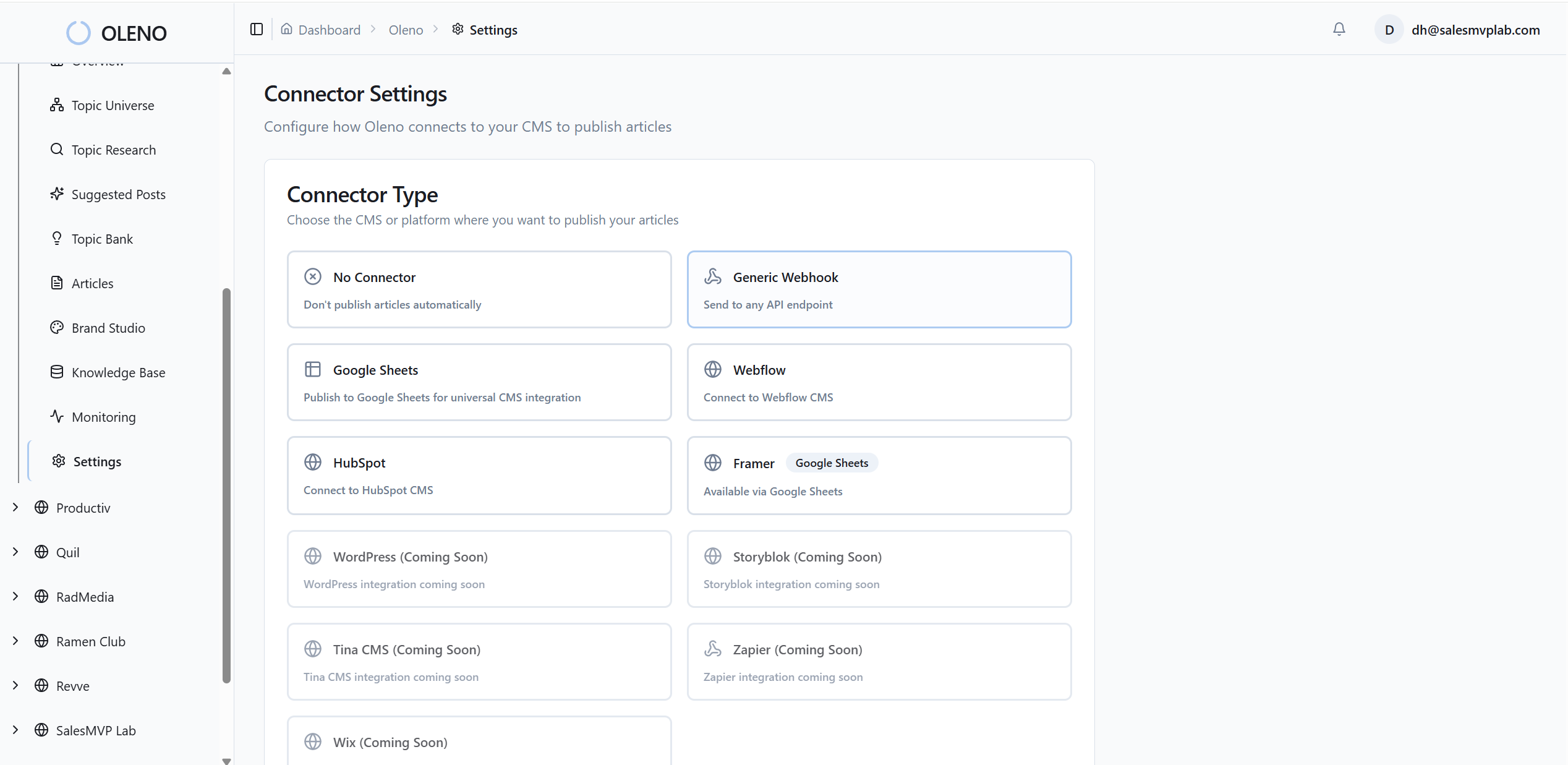
Oleno converts drafts to CMS, ready HTML, maps fields, and publishes to WordPress, Webflow, HubSpot, or Google Sheets with duplicate prevention. Failures trigger debounced notifications and safe retries. Version history and publish attempts are logged internally, so the system can retry work and keep outputs consistent.
This is where those fire drills vanish. No duplicate posts. No mystery failures. Just a steady pipeline you can trust. If you’re ready to cut the chaos and keep your team focused on story, not plumbing, Try Oleno For Free.
Conclusion
Most teams don’t have a writing problem. They have a handoff problem. When you encode decisions as rules, topics, briefs, structure, visuals, links, schema, publishing, daily becomes realistic. Not because you push harder, but because you remove the reasons to slow down. You can write creatively and ship predictably. That’s the system.
About Daniel Hebert
I'm the founder of Oleno, SalesMVP Lab, and yourLumira. Been working in B2B SaaS in both sales and marketing leadership for 13+ years. I specialize in building revenue engines from the ground up. Over the years, I've codified writing frameworks, which are now powering Oleno.
Frequently Asked Questions