Deterministic Content Pipelines: Publish Daily Without Bottlenecks
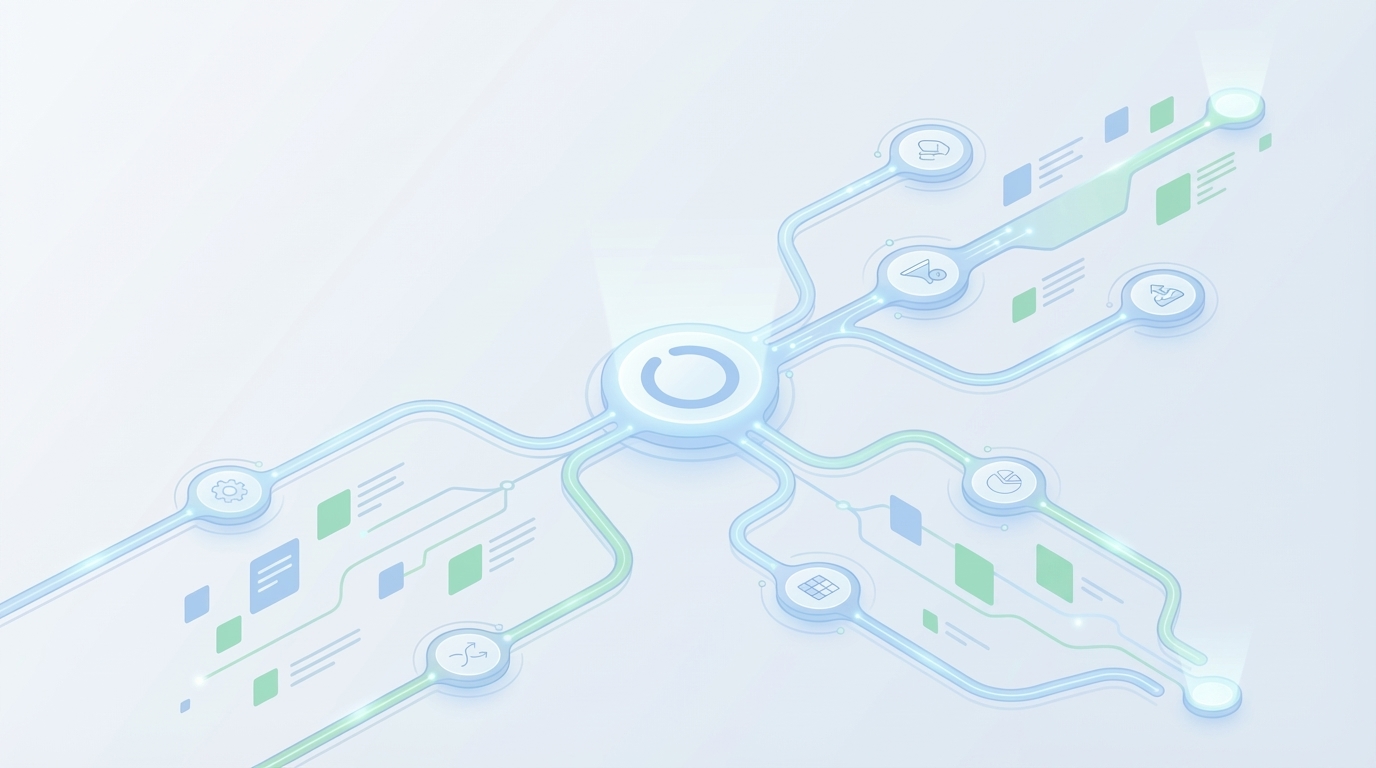
Daily publishing sounds like a discipline problem. It isn’t. It’s a systems problem. You don’t miss because people aren’t trying hard enough; you miss because the pipeline is fragile. One late approval, one forgotten schema, one mis-mapped CMS field, and the whole thing slides a day. Then momentum dies.
Here’s the twist. You don’t need more meetings or bigger calendars. You need determinism where it matters. Treat content like software delivery: fixed inputs, automated gates, predictable outputs. When the rules run the same way every time, you stop firefighting and start compounding.
Key Takeaways:
- Daily publishing requires deterministic gates, not more calendars or approvals
- Move judgment upstream: enforce information gain, structure, and brand rules before drafting
- Codify correctness: links, schema, alt text, and CMS mapping must be code, not memory
- Quantify the hidden cost of rework and rollbacks to build urgency for change
- Balance: be deterministic where accuracy matters, flexible where narrative does
- Logs and notifications reduce anxiety by making outcomes auditable and repeatable
Ready to skip theory and see a governed pipeline in action? Try Oleno For Free.
Why Daily Publishing Breaks Without Determinism
Daily publishing breaks when each stage depends on human timing and preference instead of rules. Calendars keep you honest, but they don’t remove variance or rework. A fixed pipeline with enforced gates takes approvals out of traffic, so publish throughput becomes predictable, even during launch weeks.

The Bottleneck No Calendar Can Fix
More topics and tighter calendars won’t fix transition risk. The friction lives between stages, brief to draft, draft to visuals, visuals to schema, schema to CMS. Every “quick tweak” resets momentum, and every handoff introduces interpretation. You don’t need more speed; you need fewer chances to wobble.
When we’ve tried to “calendar our way out,” the same anti-pattern shows up: a clean plan ruined by ad hoc edits and last‑minute fixes. Replace preference debates with policy. Replace “looks good” with pass/fail gates. Throughput improves not because people type faster, but because the system stops inventing detours.
What Is A Deterministic Content Pipeline?
A deterministic pipeline is a fixed sequence with known inputs, quality gates, and automated outputs. Topic → brief → draft → QA → enrichments → visuals → publish. Each step has pass/fail logic, retries, and clear side effects. It’s not about perfection; it’s about repeatability and auditability.
In software, this idea shows up as deterministic delivery, same inputs, same results, every time. The content equivalent is codified rules for links, schema, voice, and publishing behaviors. If you want a primer, see how Minimum CD defines deterministic delivery. The point isn’t theory. It’s reliability under pressure.
The System-Level Shift That Removes Bottlenecks
The shift is simple: stop optimizing the draft and start governing the pipeline. Most delays happen in transitions, approvals, enrichment, and publishing handoffs. Determinism turns subjective edits into codified rules. You protect creativity in the narrative while removing ambiguity everywhere else.

What Traditional Approaches Miss
Most teams pour energy into the words. Fair. But drafts aren’t the bottleneck. The failure modes happen after the writing: link fabrication, missing alt text, schema drift, screenshot chaos, and flaky CMS mapping. These aren’t creative problems. They’re process defects that keep repeating until you make them code.
So move quality upstream. Enforce information gain before drafting. Enforce structure (snippet-ready openings) as a constraint, not an edit suggestion. Enforce brand tone through a governed style system. Then let people argue about ideas, not commas. You’ll still review, just a lot fewer times and for better reasons.
Where Should You Be Deterministic Vs Flexible?
Be deterministic where correctness or safety matters: internal link selection, JSON-LD schema, alt text generation, CMS field mapping, and duplicate prevention. Those are machines’ jobs. Be flexible in narrative, examples, and POV. That’s where the voice lives.
There’s a spectrum from hand-coded rules to agentic workflows. The art is choosing the right balance so outcomes are predictable without making the work sterile. If you want a helpful frame, this spectrum of AI agents vs deterministic workflows lays it out well. Bottom line: if a rule can eliminate a recurring error, make it code.
The Hidden Costs Of Manual Handoffs You Keep Paying
Manual handoffs drain hours you’ll never see in a report. The costs are buried in rework, context resets, and post-publish hotfixes. Quantify it once and you’ll never unsee it. When gates remove those repeat offenders, you recover time immediately and you stop paying it every month.
Time Sinks That Never Show Up On The P&L
Let’s pretend you ship 20 posts a month. Two hours to create briefs, three to draft, one to add images, one to link and schema, one to publish. That’s 140 hours. If rework hits even 20% of pieces, add 28 hours. That’s almost a full extra week of someone’s time, gone to cleanup.
And it’s not just hours. It’s attention shifts. Writers waiting for designers. Designers waiting for editors. Editors waiting for “final-final” approvals. Each pause creates a queue that cascades. Daily publishing dies on those micro-stalls. Deterministic gates don’t make people faster; they make the stalls disappear.
Interjection. None of this is glamorous.
The Compounding Cost Of Rework And Rollback
Rework is expensive. Rollbacks are worse. You publish, then discover the wrong canonical, a bad internal link, or missing FAQ schema. Now you’re hotfixing in the CMS, updating screenshots, and pinging someone to re-index. That’s not just time; it’s trust erosion with your team and your audience.
These failure modes are preventable with code-level injection, validation checks, idempotent publishing, and duplicate protection. Even structured outputs, a pattern popularized in LLM workflows, demonstrate how deterministic boundaries remove parsing bugs and flakiness. If you’re curious, this explainer on structured outputs for deterministic pipelines is a good reference, conceptually.
Still handling this manually? You don’t have to. Try Generating 3 Free Test Articles Now.
The Human Side: Frustration, Rework, And Trust Debt
When the pipeline flakes, people stop trusting it. They invent side doors, skip steps, and push “just this once.” That trust debt shows up as anxiety, weekend work, and a backlog of “almost done” drafts. Rules reduce the drama. Gates replace debates.
When Your Team Stops Trusting The Pipeline
I’ve been that marketer triaging edits while sales pings for leads. At one startup, I could write quickly by myself. As the team grew, our writer didn’t have all the product context I carried. Drafts lagged. I had less time to close the gap. We tried transcribing founder videos to accelerate, which helped output but missed structural depth and search intent. We shipped, but cleanup and rework followed us around.
Trust eroded because the system relied on memory and favors. Every exception creates three more. Once we moved to rules, clear thresholds, pass/fail gates, the energy shifted. People started focusing on inputs and differentiation, not whether alt text was present or if a link matched the sitemap page title.
The 3 AM Publish That Didn’t Stick
You finally ship. Then the connector times out. Or one field maps wrong and the post is half-published, images missing, schema dropped. You backfill by hand, fix canonicals, and promise a “clean process next time.” Next morning, you find a duplicate entry. Everyone’s now gun-shy about pushing live.
This is what happens without retries, idempotency, and explicit failure notifications. It isn’t a talent problem. It’s a missing safety net. When the pipeline tells you exactly what failed and why, people stop guessing and start trusting.
Build A Deterministic Topic To Publish Pipeline
A deterministic pipeline starts with strategy and ends with automatic publishing. Map your topic universe, codify cooldowns and differentiation, enforce QA thresholds, and turn enrichments and publishing into code. Keep the creativity in the story; bind everything else to rules.
Map Your Topic Universe With Cluster Boundaries
Start with your knowledge base and sitemap. Cluster topics into pillars, then track coverage by cluster. Label each state: underserved, healthy, well‑covered, saturated. Use that to drive a daily topic queue that prioritizes gaps and enforces variety. You’re building authority systematically, not “finding ideas.”
This is where most teams get leverage fast. A simple cluster view prevents over-publishing the same theme while ignoring adjacent intent. Enforce a cooldown window before re-covering a topic. And drive angles from your actual expertise, so briefs don’t drift into generic takes that add nothing new.
Implement QA Gates With Pass Or Fail Actions
Your QA gate should read like a contract: structure, voice, KB grounding, snippet-ready openings, visuals and alt text, internal links, JSON‑LD schema. Score it across 80+ criteria. If a section fails, trigger targeted refinements and re-test. If the article misses threshold, it doesn’t move forward. No exceptions.
Codify what “good” means so no one has to remember. The point isn’t to police creativity; it’s to remove recurring defects. When everyone knows the gate is fair and consistent, anxiety drops and output rises. The upside shows up in fewer regressions and fewer late-stage rewrites.
How Oleno Ships Publish Ready Articles Without Manual Cleanup
Oleno enables this New Way by turning each fragile step into a governed one. It enforces differentiation before writing, structures sections for citation, injects links and schema deterministically, and publishes to your CMS with retries and duplicate protection. The result is consistent, auditable output, without manual cleanup.
Deterministic Enrichment, Internal Links, And JSON‑LD At Publish Time
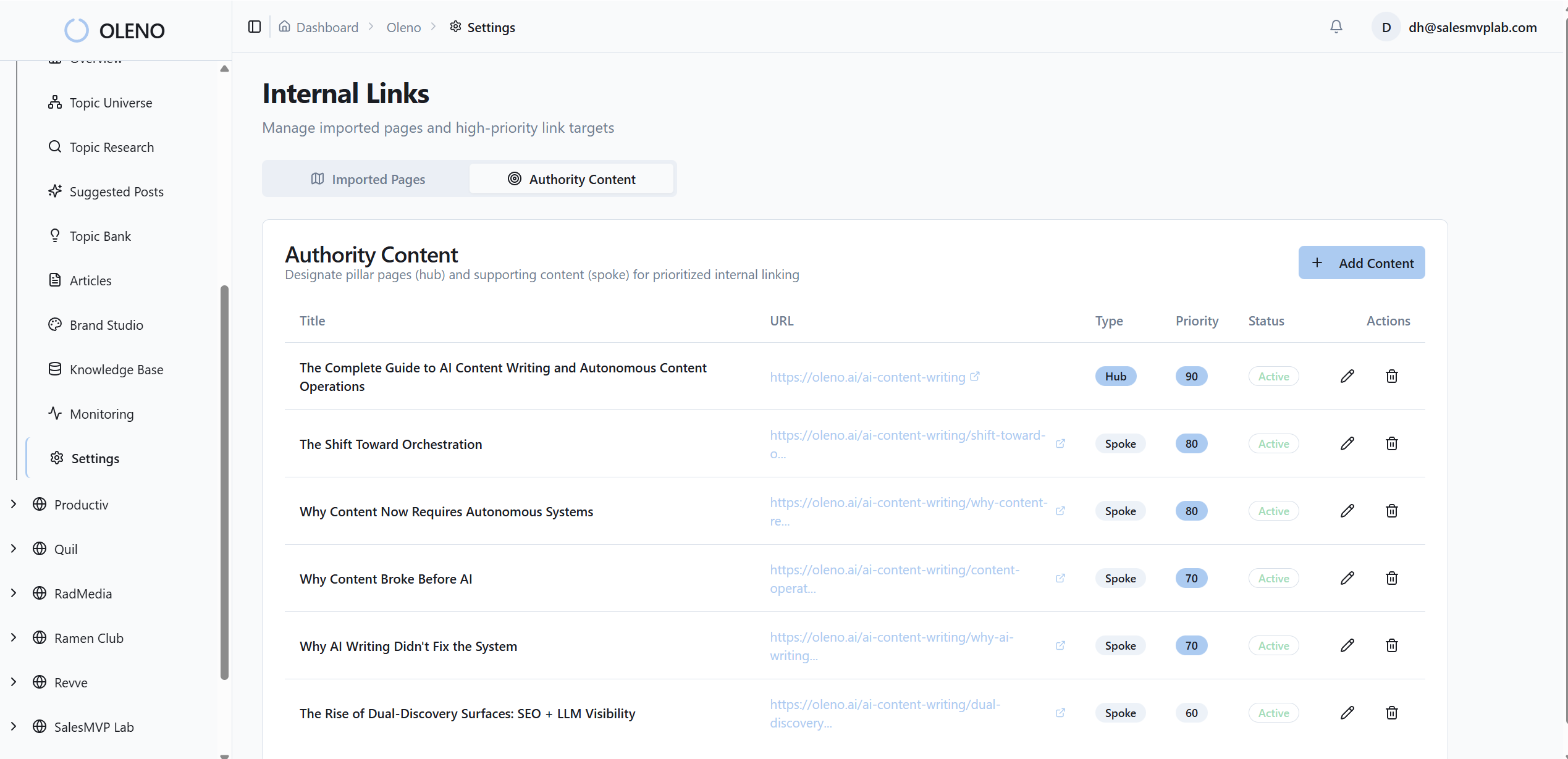
Oleno injects 5–8 internal links from your verified sitemap with exact-match anchors. There’s no fabricated URL risk because link candidates come only from what your site already publishes. JSON‑LD for Article, FAQ, and BreadcrumbList is generated, validated, and attached as metadata, again, via code, not a prompt.
Visuals aren’t an afterthought. Oleno’s Visual Studio uses your Brand Asset Library, colors, logos, reference styles, and tagged product screenshots, to generate a hero and 2–3 inline images per article. It prioritizes solution sections, matches screenshots to the right paragraphs using semantic similarity, and generates accessible alt text and SEO‑friendly filenames. It keeps visuals on-brand by default. It doesn’t replace designers; it removes the scramble.
CMS Connectors With Field Mapping, Retries, And Duplicate Prevention
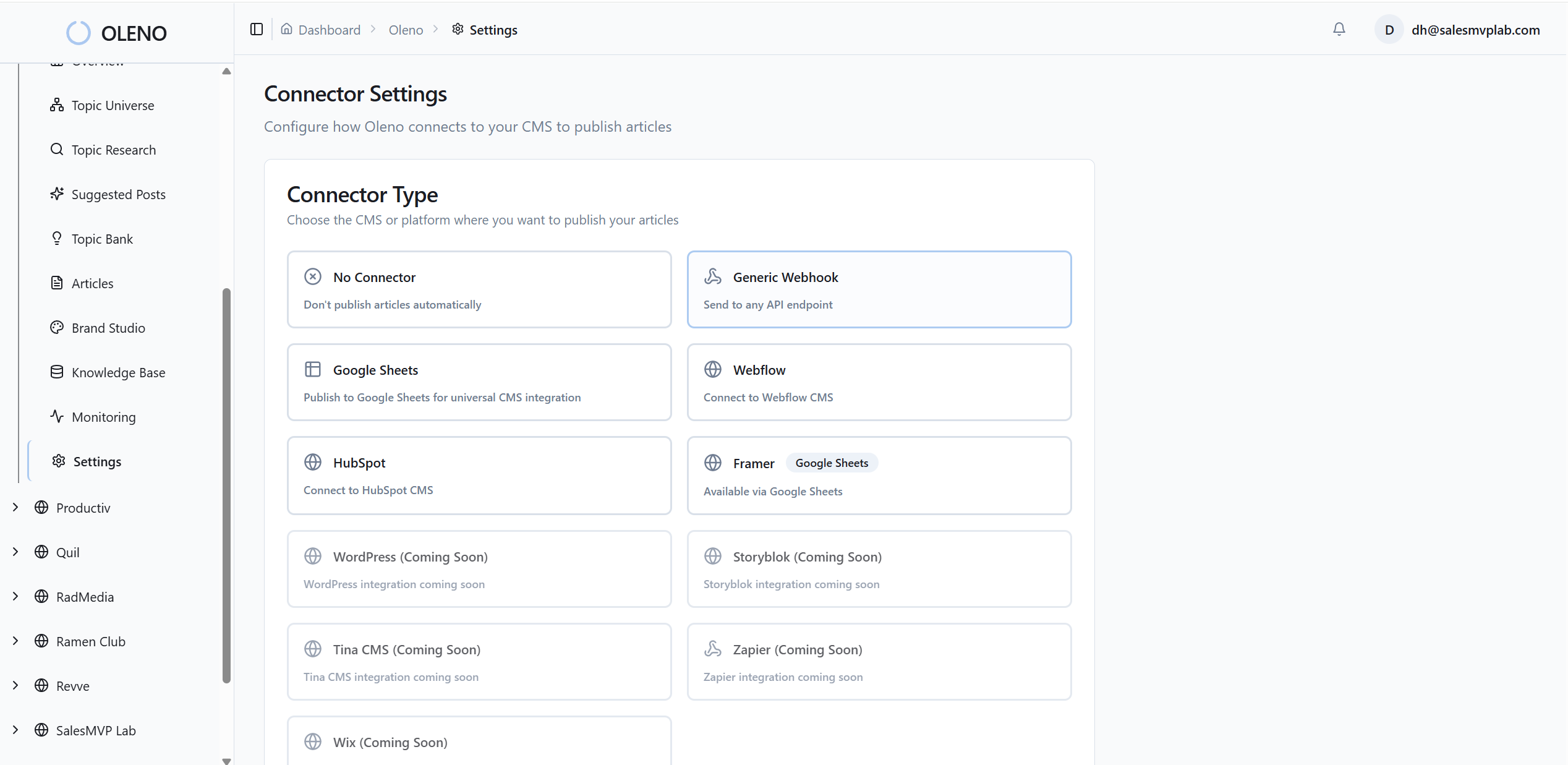
Publishing is where many teams lose days. Oleno converts markdown to CMS‑ready HTML, maps fields automatically, embeds visuals and metadata, and publishes as draft or live to WordPress, Webflow, HubSpot, or even Google Sheets for custom workflows. Duplicate prevention is built in, so you don’t get double posts after a timeout.
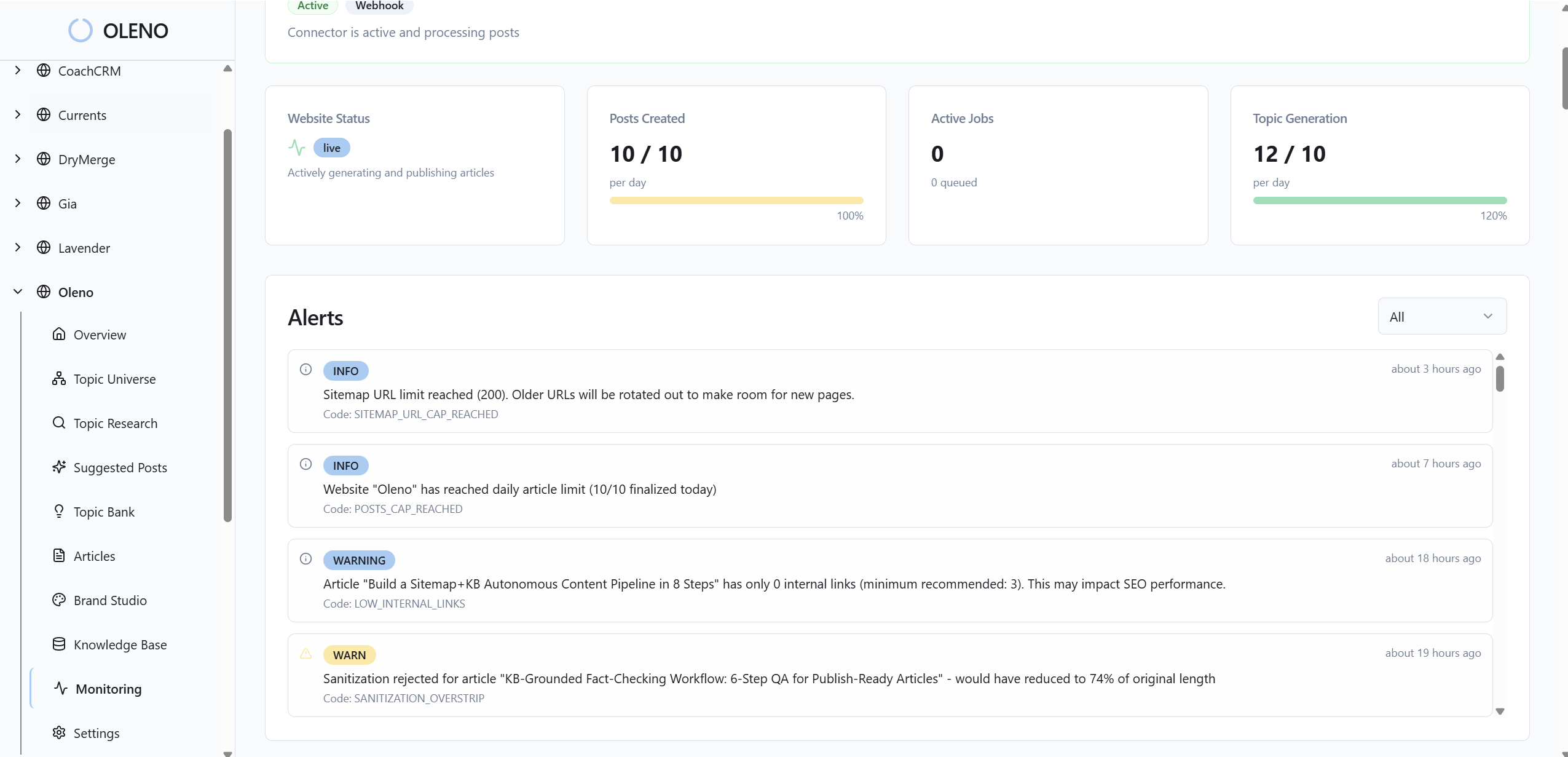
If delivery fails, retries handle transient errors and notifications tell you why, draft ready, publish success, generation failure, or low topic inventory. Oleno also keeps an internal audit trail of pipeline inputs/outputs, KB retrievals, QA scoring, publish attempts, retries, and version history. Not dashboards. Not analytics. Just the operational record you need to ship daily without guessing. For reliability nerds, this is similar in spirit to how Temporal guides durable pipelines.
If you’re ready to turn “we should publish daily” into “we do,” let the system handle the brittle parts. Try Using An Autonomous Content Engine For Always‑On Publishing.
Conclusion
Here’s the thing. You don’t scale daily publishing by pushing harder. You scale it by removing variance where it doesn’t belong. Deterministic rules for links, schema, visuals, and publishing turn cleanup into code and approvals into gates. Keep the narrative human. Make the pipeline predictable. That’s how teams publish every day without burning out, or backtracking on Tuesday what they shipped on Monday.
About Daniel Hebert
I'm the founder of Oleno, SalesMVP Lab, and yourLumira. Been working in B2B SaaS in both sales and marketing leadership for 13+ years. I specialize in building revenue engines from the ground up. Over the years, I've codified writing frameworks, which are now powering Oleno.
Frequently Asked Questions