Deterministic Publishing Checklist: Stop Broken, Inaccurate Articles

Most teams don’t have a writing problem. They have a shipping problem. I learned that the hard way. At PostBeyond, I could write 3–4 strong posts a week when I owned the context. As the team grew, quality didn’t break in drafts, it broke when articles moved from Google Docs to the CMS. Links got changed. Images wandered. Schema got “we’ll add it later” treatment. Later never came.
At LevelJump, we shipped founder-led content by recording and transcribing. Smart content, fast. But the last mile was brittle. We lost time to handoffs, fixes, and re-fixes. At Proposify, we ranked like crazy but publishing cadence wobbled during campaigns. The lesson stuck: you don’t need more editing. You need a deterministic pipeline that treats correctness as code.
Key Takeaways:
- Publishing fails at the last mile when links, schema, visuals, and CMS mappings are manual
- Deterministic rules, not memory, prevent regressions and reduce rework
- Verified-sitemap linking and programmatic schema kill fabricated URLs and copy-paste errors
- QA gates (80+ checks) and retries cut engineering time lost to failed publishes
- Visual standards (assets, ratios, alt text) protect brand trust at scale
- The “new way” is a governed, end-to-end system, not more reviewers
Why Broken Publishing Is Not A Writing Problem
Publishing breaks because correctness isn’t enforced in code; it’s left to memory and handoffs. The draft is rarely the failure point, it’s the injection of links, visuals, schema, and field mappings under deadline pressure. Deterministic rules stop late-stage drift and make “what ships” repeatable.

The Hidden Failure Happens After The Draft
Drafting feels like the hard part, but the surprise overhead arrives at publish time. Links get added by memory. Images are dropped in wherever there’s space. Schema gets skipped because “we’ll do it right after we push.” Those shortcuts create long-tail chaos: duplicates, broken anchors, missing metadata, and inconsistent templates that quietly erode trust.
When you lock non-negotiables into code, the chaos fades. Verified internal links only. Anchor text matches titles. JSON-LD attached as metadata every time. Mapped fields that won’t publish the wrong block into the wrong template. The result isn’t fancy, it’s predictable. And predictable is what protects your schedule.
Here’s the thing. More editing doesn’t fix structural randomness. Systems do.
Why Manual Cleanups Create Randomness
Manual fixes feel noble. A quick anchor change here, a “better” image there. But now your article’s logic is untraceable. Next quarter, nobody knows why it ranks or why it broke. The “just this once” edits compound into a pile of exceptions that only live in Slack threads and someone’s memory.
If it must be right, links, schema, alt text, placement, encode it. Rules don’t forget. Humans do. And when rules gate publishing, you avoid the six-month archaeology project every time something wobbles.
What Is Deterministic Publishing And Why Does It Matter?
Deterministic publishing means same inputs, same rules, same outputs. Clean Knowledge Base, validated sitemap, verified links, programmatic schema, mapped fields, idempotent retries. Nothing exotic. Just repeatability. The upside: fewer firefights, fewer regressions, fewer 9pm rollbacks. You don’t eliminate issues entirely. You bound them, and that’s enough to reclaim your week.
Want a quick look at the approach in a working system? If you’re ready to test the flow without rewiring your stack, you can Try Generating 3 Free Test Articles Now.
The Real Root Cause Of Publish-Time Errors
Publish-time errors come from fragmented context and inconsistent inputs. Strategy, drafts, visuals, and links live in different tools with different owners. The fix isn’t more reviews; it’s one governed flow where the KB, sitemap, structure, visuals, links, schema, and publishing rules work as a single system.

Handoffs Fragment Facts And Structure
When strategy lives in a doc, writing in a prompt, visuals in a drive, and links in someone’s head, you’re relying on memory to preserve truth. That’s fragile. Each handoff is a chance to lose intent, miss a constraint, or forget a detail that matters later, like the one FAQ that should be structured for snippets but ended up as a throwaway paragraph.
Put the system in charge. If sections must open with direct answers, enforce it. If internal links must come from verified pages, block anything else. The more your pipeline carries the rules, the less you chase avoidable fixes downstream, the kind that blow up during a launch window.
KB And Sitemap Drift Produce Fabricated URLs
Nothing breaks trust faster than a fabricated or stale link. If your sitemap is messy or your Knowledge Base is stale, the system will guess. Guessing is how 404s slip into finished posts. Clean the inputs first: import and validate your sitemap, normalize page titles, deprecate obsolete URLs, and link from that source of truth only.
This is where deterministic rules shine: block unverified URLs, match anchor text to page titles exactly, place links at natural boundaries. Editorial checklists help, but code secures the floor. For a simple primer on process hygiene, the editorial checklist overview is a useful baseline.
How Do You Fix Root Causes Without Adding Headcount?
You don’t need more eyes; you need sharper rails. Prevent generic drafts with information gain thresholds. Enforce snippet-ready section openers for structure. Generate schema programmatically. Run an automated QA gate against 80+ criteria. Then publish through mapped connectors that prevent duplicates and support clean retries. It’s not heavier process, it’s lighter, because the checks are consistent and automatic.
The Hidden Costs Teams Pay For Fragile Publishing
Fragile publishing burns engineering time, dents SEO clarity, and introduces opportunity cost that rarely shows up on a dashboard. You feel it in slipped dates, broken links, and nervousness about “just push it.” The costs add up, quietly at first, loudly later.
Engineering Hours Lost To Retries And Rollbacks
Let’s pretend you publish 20 pieces a month. Three fail due to broken links, schema errors, or CMS mapping quirks. Each failure takes 2 hours to diagnose, rerun, and message. That’s 6 hours gone, plus context-switching and delayed work the team actually planned. Not crushing on paper, but over a quarter, you’ve burned multiple days.
Deterministic connectors with dedupe and idempotent retries don’t remove all failures. They make them cheap to recover from. That difference is the gap between a 3pm fix and a 9pm rollback.
The SEO And Brand Hit From Broken Links And Missing Schema
When anchors point to the wrong page or schema is missing, you reduce clarity for both humans and machines. Search engines and AI assistants have less to cite. Users click a hero link and hit a dead end. One visible miss is enough to erode confidence. A simple “publish-ready” checklist helps, but programmatic schema and verified links help more. See the basics in this publish-ready checklist primer.
What Is The Opportunity Cost Of A Failed Publish?
A post meant for Tuesday ships Friday. It misses the campaign window, the partner roundup, the sales sequence. No one line item looks huge. But compounding opportunity cost drags growth. Deterministic rules keep schedules predictable, which keeps revenue moments intact. Not guaranteed upside, consistent availability.
If you’re still firefighting basic publish steps, it might be time to let guards do the guarding. You can Try Using An Autonomous Content Engine For Always-On Publishing and see where the friction drops first.
When It Breaks, It Breaks Trust
Publishing failures aren’t just technical. They’re emotional. Missed launches, late nights, off-brand visuals, it all signals wobble. Confidence fades, and teams hesitate to ship. A predictable system won’t make the work easy, but it makes it sane.
The 3pm Launch That Turns Into A 9pm Rollback
You’ve seen it. The post is live, Slack lights up, a key link 404s. Editors scramble to patch, engineers trace mappings, and someone says “just roll it back.” It’s not the end of the world, but it costs you the most precious resource: trust. When links are verified, schema validated, and duplicates prevented, those nights go from common to rare.
When Your Logo Shows Up On The Wrong Image
Visual misses aren’t cosmetic. They say the lights are on but nobody’s home. Use a brand asset library, enforce aspect ratios, generate alt text, and prioritize solution-section visuals. Those rules make your content look like your content. Consistently. That consistency is what readers notice even if they don’t mention it.
Why Your Best Article Never Ships
Great drafts stall when the last mile feels risky. I’ve watched strong pieces wait in “final review” because publishing felt like a minefield. The team wasn’t slow. The system was brittle. When the pipeline is deterministic, drafts don’t linger in limbo. They move, and people stop dreading the push.
For a process-side reference, release checklists from software teams map well to content ops. The release checklist approach is a good mental model for avoiding regressions.
A New Way To Ship With Confidence
Shipping with confidence means putting rules in code and treating content as a system. Start with clean inputs, enforce structure and differentiation, inject links deterministically, attach schema, standardize visuals, pass a QA gate, and publish through connectors with safeguards. It’s disciplined, not heavy.
Step 1: Validate Knowledge Base And Sitemap Inputs
Start with inputs because everything downstream inherits their quality. Import and validate your sitemap. Remove draft or private paths. Normalize titles so your anchor text can match exactly. Process your Knowledge Base so claims are grounded and recent. If a page isn’t on the verified sitemap, it doesn’t exist for internal linking. If a fact isn’t in the KB, it doesn’t get asserted.
You’ll be tempted to “just add the link.” Don’t. Fix the source. Strong inputs reduce exceptions, and fewer exceptions reduce regressions later.
Step 2: Enforce Brief And Draft Guardrails With Information Gain
Guard against generic content before a single sentence is drafted. Use competitive analysis to compute an information gain score. If an outline adds nothing new, revise the angle. Enforce snippet-ready H2 openers so every section starts with a direct answer. Keep brand voice constraints in place so tone doesn’t drift between authors or runs.
The result isn’t only better content. It’s smoother QA because structure is consistent and fewer issues escape into later stages.
Step 3: Apply Deterministic Internal Linking Rules
Inject links after the draft and visuals are complete. Scan the verified sitemap only. Select 5–8 relevant internal pages. Place links at natural sentence boundaries. Match anchor text exactly to page titles. Block any URL not on the sitemap. This step should be code-based, not LLM-based. That’s how you eliminate fabricated or stale URLs permanently.
Editorial preference is welcome. Fabricated anchors aren’t.
Step 4: Generate And Validate JSON-LD Schema
Programmatically create Article, FAQ, and BreadcrumbList schema. Validate the JSON-LD and attach it as metadata so it ships with the article via your connector. No manual copy-paste. No template drift. Clean, consistent schema doesn’t guarantee rich results, but missing or invalid schema reliably reduces eligibility.
If you want a standards mindset to anchor this, the book publishing standards checklist shows how checklists codify quality at each step.
Step 5: Enforce Visual Placement And Alt-Text Policies
Use a brand asset library. Generate a hero and 2–3 inline visuals per article. Match product screenshots to relevant sections using semantic similarity. Prioritize visuals in solution sections where they actually support narrative and conversion. Generate SEO-friendly filenames and descriptive alt text. Enforce aspect ratios and resolution rules so images render cleanly across devices.
Images shouldn’t be decoration. They should do a job. Write rules accordingly.
Step 6: Run QA Gate Thresholds And Auto-Refine
Evaluate drafts, visuals, links, and schema against an 80+ criteria gate. Check structure, brand alignment, snippet readiness, information gain, alt text, filenames, and more. Set a minimum passing score, say 85, that triggers automatic refinement loops when missed. Don’t publish until the gate passes. That single guard reduces the noisy, post-publish debugging you’re tired of doing.
Step 7: Harden Publishing With Connectors, Retries, And Rollbacks
Publish via mapped fields to WordPress, Webflow, or HubSpot. Support draft or live modes. Prevent duplicate publishing by design. Convert markdown to CMS-ready HTML and embed visuals and metadata correctly. If delivery fails, notify and retry in a controlled way. Keep logs of attempts and versions so rollback is a decision, not a scramble.
How Oleno Enforces Deterministic Publishing End To End
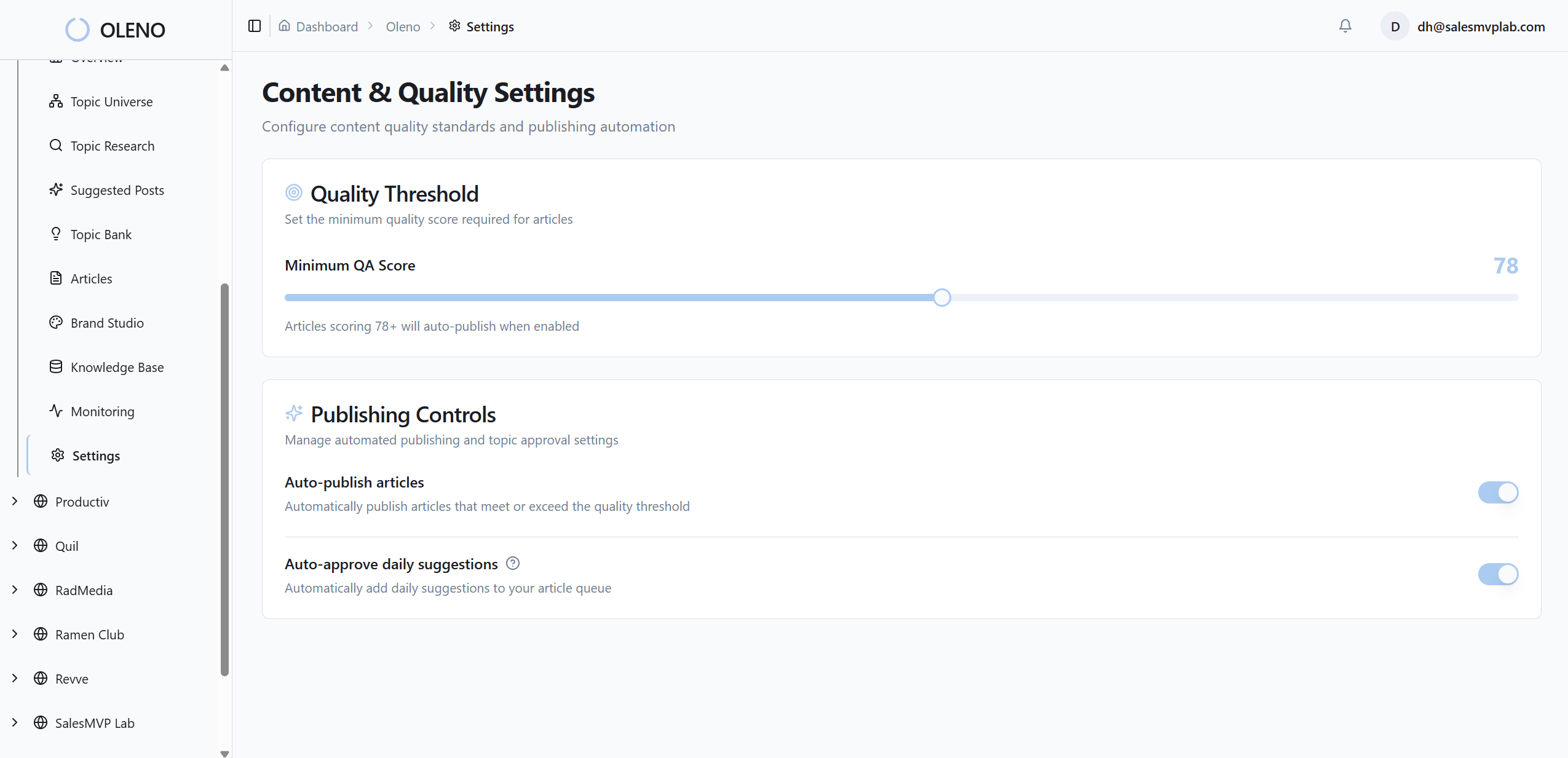
Deterministic publishing is tedious to maintain manually. Oleno treats it as a governed system: verified-URL linking, programmatic schema, brand-consistent visuals, QA gates, and mapped connectors with dedupe and retries. You get fewer regressions and more predictable shipping without new headcount.
Verified-URL Internal Linking That Never Fabricates Anchors
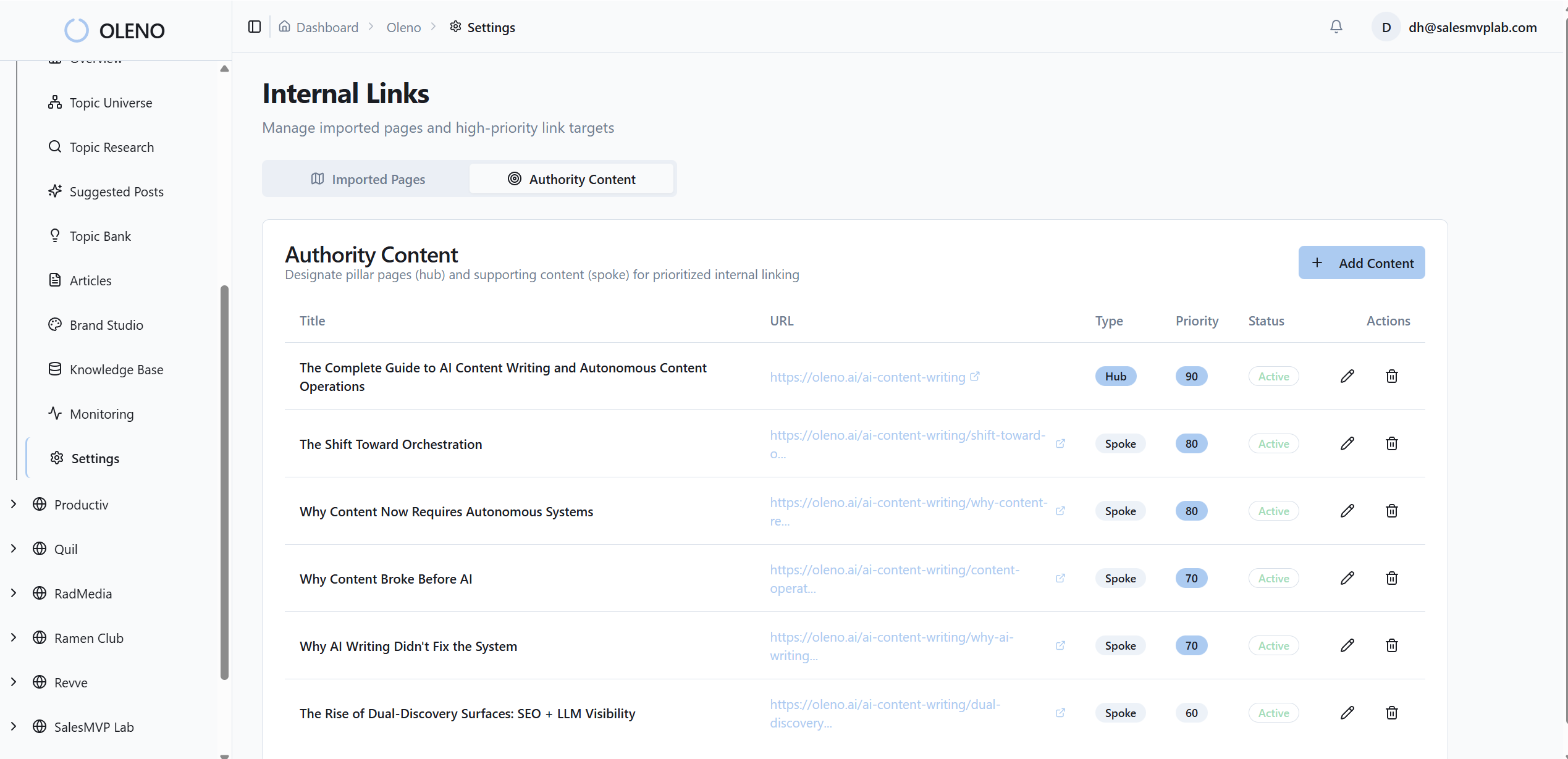
Oleno injects 5–8 internal links only from your verified sitemap. It places links at natural sentence boundaries and matches anchor text exactly to page titles. No LLM guessing, no fabricated URLs. This removes the most common breakage, stale links and mis-anchored text, and builds consistent internal architecture across your library without hand edits.
Schema Auto-Generation With CMS Attachment
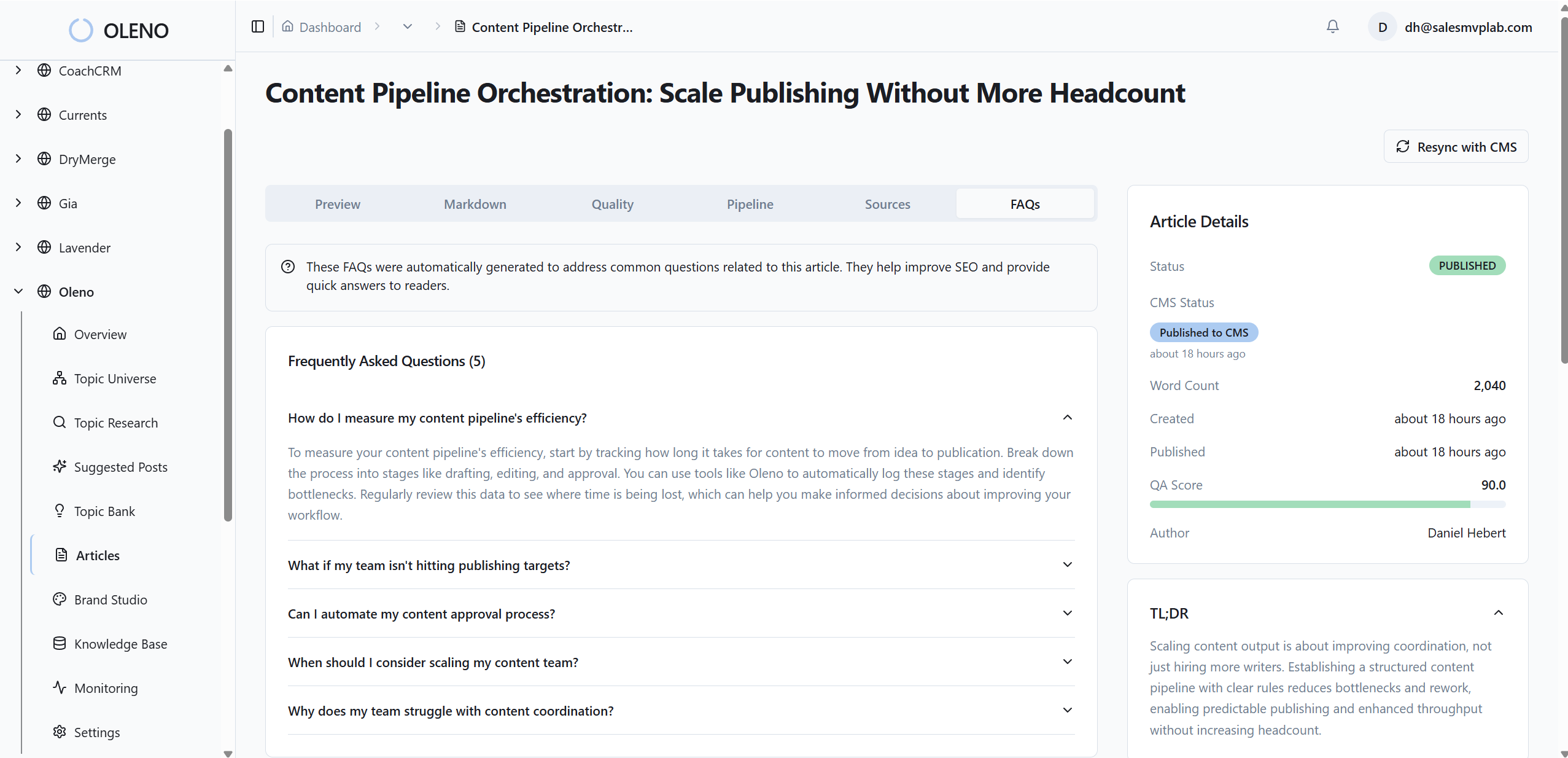
Oleno generates valid JSON-LD for Article, FAQ, and BreadcrumbList, validates it, and attaches it as metadata through the connector so schema ships with the post. That eliminates copy-paste errors, missed updates, and template drift. Cleaner markup reduces ambiguity and improves eligibility for richer presentation without promising specific outcomes.
Visual Studio For Brand-Consistent Assets And Placement
Oleno’s Visual Studio references your brand assets, generates a hero and 2–3 inline visuals, and matches product screenshots to the right sections using semantic similarity. It prioritizes solution sections for product visuals and auto-generates filenames and alt text. You get consistent, on-brand visuals without scavenger hunts in shared drives or last-minute swaps that break layouts.
Publishing Connectors With Dedupe And Controlled Retries
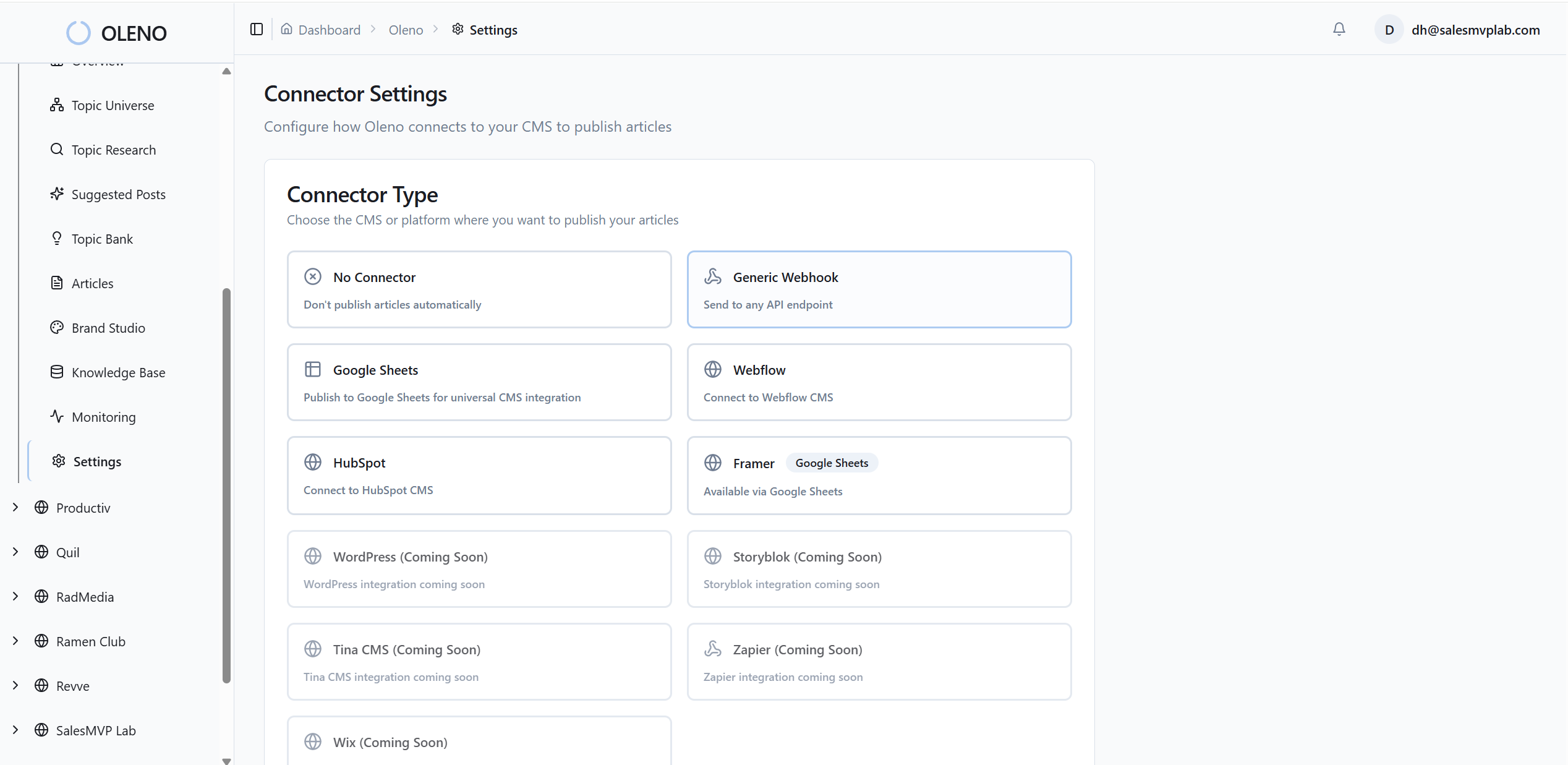
Oleno maps fields to your CMS, converts markdown to HTML, embeds visuals and metadata correctly, and prevents duplicate publishing. If a delivery fails, the system retries and notifies you, without creating multiple posts. By combining connectors, idempotent retries, and version awareness, Oleno reduces the 3pm-to-9pm rollback risk you’ve likely felt too many times.
If you’re ready to experience this with real content, not a diagram, you can Try Oleno For Free. A couple runs will show where your current process bends, and where a system can carry the weight.
Conclusion
You don’t need another edit pass. You need fewer places for things to go wrong. Clean inputs, encoded rules, automated QA, and guarded publishing turn “hope it ships” into “it ships.” Whether you implement the framework yourself or let Oleno run it, the goal is the same: fewer regressions, steadier cadence, and content that looks and reads like your brand. Every time.
About Daniel Hebert
I'm the founder of Oleno, SalesMVP Lab, and yourLumira. Been working in B2B SaaS in both sales and marketing leadership for 13+ years. I specialize in building revenue engines from the ground up. Over the years, I've codified writing frameworks, which are now powering Oleno.
Frequently Asked Questions