Editorial Decision Tree: 12 Rules to Keep Voice & Accuracy at Scale

Most content teams lose trust through paper cuts. One fuzzy claim. Two CTAs fighting for attention. A paragraph that sounds like three different authors. Each mistake on its own looks harmless, but you feel the drag. Review turns into debate. Publishing slows. The queue grows while everyone argues style.
I’ve been on both sides. At Steamfeed, we scaled to 120k monthly visitors because we enforced structure, even with 80 regular writers and 300 guests. At PostBeyond, I could ship 3-4 strong posts a week as a solo marketer because my framework did the heavy lifting. When teams grow, context fragments and quality slips. You don’t need more meetings. You need boring, binary rules that catch repeatable issues fast.
Key Takeaways:
- Replace style debates with a decision tree of binary checks
- Put decisions at the edge of publishing to protect cadence
- Quantify rework costs so the team feels the urgency
- Encode voice, claims, and structure so tone drift goes down
- Review high-risk items first, route fails to the right lane
- Use 12 rules to score and publish in under 3 minutes
- Let Oleno enforce your rules in the CMS without new headcount
Stop Debating Style, Start Enforcing Decisions
You keep losing time on subjective edits because the system invites opinions instead of decisions. A small team can’t afford judgment variance at volume, especially when contributors change. The fix is a deterministic set of binary checks that reviewers can run in minutes. Treat it like an editorial circuit breaker, not a suggestion list.

Tiny errors add up. One unsourced claim isn’t just risky, it forces meetings. A missing alt tag seems minor, but it breaks accessibility and weakens SEO. A CTA dropped in the intro can hurt conversion across dozens of pages. Reviewers burn cycles on tone and phrasing while the structural risks slide by. What works is simple: rules with pass or fail answers, ordered by risk, documented with examples for edge cases. Even academic editors lean on structured criteria at the decision point, which is why I like how Springer’s editorial guidelines anchor judgment to clear standards.
When your rule set is binary, review time collapses. You move down the list, green or red, with a publish threshold that doesn’t change. You stop rewriting paragraphs to “sound better” and instead fix what failed. That behavior shift is the win. You go from open-ended edits to an operational check that preserves cadence without lowering the bar.
The Hidden Variable Breaking Your Editorial Process
Subjective variance, not skill, is what breaks most editorial teams at scale. Two editors reading the same checklist interpret it differently under deadline pressure. Without pass or fail logic, the same piece can ping-pong across Slack for days. Decision trees force consistency because they mirror how operators think under load.

Checklists help, but they still lean on judgment. Decision trees reduce judgment to controlled paths. Think of it like a simple model that routes content based on yes or no answers, the same way [IBM’s decision tree documentation] explains branching logic for classification. You can do the same with editorial: if claim is proprietary, check against governed product truth. If claim is external, require a source near the sentence. If both fail, route to fix lane.
Binary checks compress review time because you remove negotiation. Editors move in a single sequence, highest risk first, with a publish threshold that doesn’t shift based on who’s on review duty. No wordsmithing unless a rule is red. This is how you get to sub three-minute reviews for most assets. Over time, contributors start self-correcting to the rules and your error rate drops.
Decision points belong at the edge of publishing. Drafting should be creative. Pre-publish checks should be binary. Draft freely, then score quickly. Pass publishes. Fail routes automatically, minor fix or full review. You protect cadence and avoid limbo. That’s the difference between a content team that ships and one that churns.
Ready to replace opinion roulette with predictable publishing? See how a governed QA gate works in practice. Request a Demo.
The Cost Of Subjective Reviews Adds Up Fast
Subjective review isn’t just annoying, it’s expensive. At 50 posts a month, 20 minutes of back-and-forth per post turns into 16 to 18 hours of rework. That’s two or three full writing days gone. And if your reviewers are your best writers, the opportunity cost is even higher. Reviews should protect risk, not consume output.
Let’s pretend your average editor costs $60 per hour fully loaded. Those 16 hours are $960 a month just in review overhead. Add the delays. A blocked draft stops social reuse, email slots, and a landing page refresh you were counting on. When you switch to a decision tree with a publish threshold, the rework drops to only what fails. You still keep quality high, but you stop paying the coordination tax. The science world found a similar rhythm with Registered Reports, where criteria are defined up front to reduce subjective drift later. Different field, same lesson.
Loose structure and sloppy heading patterns cost you traffic and conversions quietly. Inconsistent H2 and H3 design signals to search engines that the content doesn’t answer intent cleanly. CTAs that show up before the payoff depress clicks. Multiply a small drop in CTR across a 500-page library, then look at your pipeline. That trickle becomes real money. Fix the rules and you usually see gains without publishing anything new.
At 50 posts a month, the queue breaks. Reviewers get inconsistent as fatigue sets in. Error rates rise. Contributors lose confidence and start over-checking everything. A deterministic decision tree stabilizes quality under load so cadence doesn’t collapse when volume scales or new authors join. I’ve seen it firsthand. The rule set becomes the guardrail that keeps velocity without inviting risk.
Stop spending two days a month on preventable rework. Publish on time with a consistent bar. Request a Demo.
The Frustration Of Fixing The Same Issues Over And Over
Tone drift is the quiet killer. You can hear it immediately. Sentence rhythm is off, the banned words sneak in, CTAs read like they were borrowed from three different landing pages. Fixing it once doesn’t prevent the next author from making the same mistake. You need the rule encoded, not a memory of a comment.
Claims are the other trap. One vague statement can cause headaches with sales and legal for weeks. It’s not fear, it’s accuracy. Define what’s true about your product, which claims are allowed, and where references live. Then check it every time near the claim. When this is a binary rule, you don’t argue tone while a risky sentence slips through. You catch what matters first, then polish.
Imagine reviewing every asset in under three minutes with a scorecard that mirrors how editors think. Highest risk at the top. Red or green for each rule. Clear pass threshold. Pass goes live. Fail routes to the right lane. The best part is how the team learns by osmosis. After a week, the drafts start passing on first try because the rules are transparent.
A 12 Rule Editorial Decision Tree You Can Run In 3 Minutes
You can review faster without dropping quality if the rules are clear, ordered by risk, and binary. These 12 cover 95% of the repeatable issues I see. Use them as is, or tweak to fit your constraints. The order matters, because it reduces the chance you spend time polishing a draft that should fail on a high-risk check.
Rule 1: Claims Are Precise And Sourced
Claims that aren’t obvious should be tied to your knowledge base or a reliable external citation near the sentence. If a claim implies a measurable outcome, give a range or the exact context. “Increase conversions” without a baseline is red because it’s vague and invites doubt.
I prefer to keep thought leadership flexible, but not ungrounded. If you’re arguing a contrarian point, say it plainly and link supporting context that shows why you believe it. Editors should scan claims first. If five are fine and one is vague, route to fix. Don’t keep reading until that’s green.
Rule 2: Evidence Is Visible And Clickable
Evidence should live where the reader needs it. Link the source near the claim, not at the bottom dump. Product facts should point to an internal doc. Third-party data should point to the original report, not a blog referencing it.
Screenshots are content too. If a screenshot proves a point, it needs alt text and a source in the caption. I’ve seen teams bury sources in footers. That’s a fast way to get called out by savvy buyers. Keep it close to the sentence, then move on.
Rule 3: POV Is Explicit In The Opener
Your opener should make a clear promise and state your stance in one or two lines. If the first paragraph reads like a definition, it’s red. You’re not Wikipedia. A point of view invites the reader to care and creates a frame for the rest.
In comparison guides, you can balance neutrality, but set the criteria up front. Tell the reader how you’ll evaluate options, then apply it fairly. Save the POV punch for the wrap up if you need to, but don’t hide the frame.
Rule 4: Tone Matches Brand Voice Rules
Voice consistency isn’t just style, it’s trust. Sentence rhythm, vocabulary, and banned phrases should match your voice rules. If you hear off-brand words or see forbidden patterns, mark red. Quotes can keep the original voice, but the narrative should stay on brand.
I like to keep a short list of “always avoid” words and a separate “preferred terms” list handy for reviewers. That one change cuts most tone drift by half, because people know exactly what to look for.
Rule 5: CTA Is Placed And Phrased To Fit Intent
CTAs should appear after value delivery with a natural lead-in. One primary CTA per section that merits it is plenty. Multiple competing CTAs push readers away. CTAs in the first paragraph are usually red unless it’s a product page designed for that.
Micro-CTAs can work on product marketing pages as long as they don’t fight the primary action. Keep the phrasing tight, avoid hype, and make sure the CTA text matches your brand’s style. Consistency here shows up in your click rates.
Rule 6: Structure Follows The Locked H2 And H3 Pattern
Headings should follow the brief’s structure and the narrative flow you set. Statement H2s, mixed H3s that answer specific questions. Generic headings like “Overview” or “Conclusion” without context are red because they don’t help the reader or search engines.
When you’re running a CTF-style flow, heading discipline is the difference between skimmable and fuzzy. I’ve seen teams fix 20% of their ranking issues by standardizing H2s and H3s across similar articles. It isn’t glamorous. It works.
Rule 7: SEO Hygiene Is Intact At The Section Level
Check H1 uniqueness, H2 answers to intent, paragraph length, and scannability patterns. Keyword stuffing is red. Missing meta hurts you quietly. Repeating H2s across your site confuses search engines and people.
Story sections can run longer paragraphs when it serves the point, but keep that as an exception. If your discipline is loose here, you’re paying a ranking tax that compounds over time. Ten minutes of hygiene saves months of slow performance.
Rule 8: Repetition And Filler Are Eliminated
Each section should add a new point or a next step. If two sections say the same thing with different words, cut one. Platitudes like “be customer-centric” without a concrete action are red. Interjection, one crisp story beats three fluffy paragraphs.
Strategic repetition is fine in summaries and CTAs. The key is intentionality. If repetition doesn’t serve comprehension or conversion, it’s waste. Editors should feel comfortable cutting lines that don’t move the narrative forward.
Rule 9: Proprietary Claims Match Governed Product Truth
Product statements must match governed facts, feature names, and allowed boundaries. Implying unsupported capabilities is red. Pricing and roadmap references need governed tags and context. Reviewers shouldn’t have to guess.
When claims change, update them in one place and push the rule everywhere. Teams save hours by centralizing product truth. You also avoid the “sales caught us” moment that erodes trust between teams.
Rule 10: Visuals Reinforce The Point And Include Alt Text
Images and diagrams should be on brand with clear labels. Alt text isn’t optional. Charts need a source and date in the caption. Off-brand visuals are red because they signal sloppiness instantly.
Visuals exist to carry meaning, not to decorate. If the image doesn’t reinforce the point, remove it. The page will load faster and your message will be clearer. Keep the bar tight here and your content looks like it comes from one brain.
Rule 11: Localization Flags Are Set When Needed
Market-specific claims, screenshots, or idioms should be flagged for localization review. Assuming one region by default is red. Global pages can keep a neutral variant while market pages handle nuance.
Localization is a quality problem disguised as a workflow problem. The rule is simple. If content carries local risk or context, flag it. A five-second check avoids rework and awkward moments with international teams.
Rule 12: Legal Red Flags Are Screened
Regulated topics, export controls, medical or financial claims require correct disclaimers and links to official guidance. If anything regulated appears without a check, it’s red. When in doubt, link out to the source like the ECFR export control reference.
Legal review shouldn’t bottleneck everything. It should intercept risk. Encoding a few bright-line rules catches 90% of issues before they reach counsel. Your lawyers will thank you. Your ship cadence will stay intact.
How Oleno Enforces Your Decision Tree In The CMS
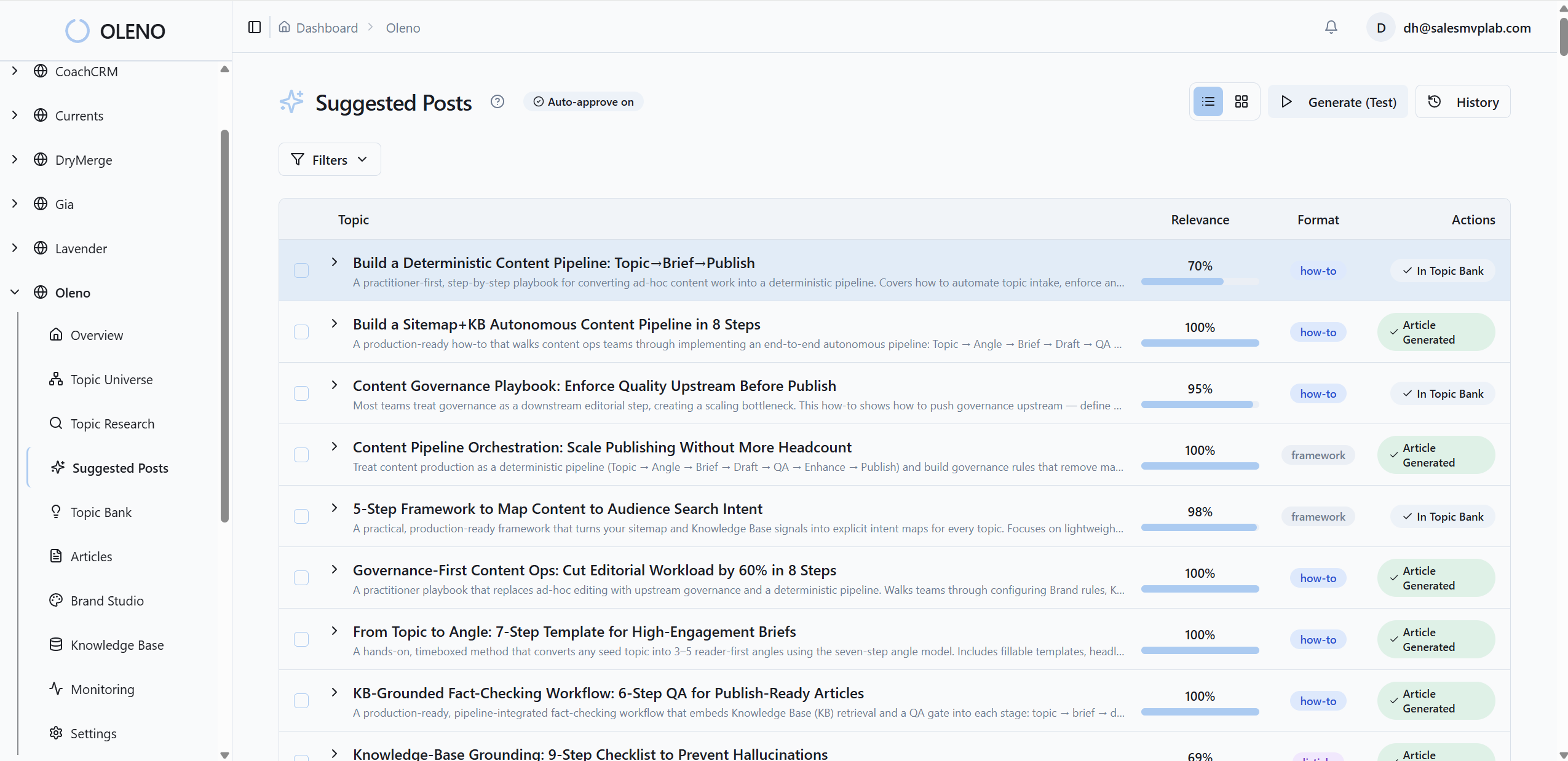
You can set these rules once and enforce them everywhere without hiring more editors. Oleno runs a pre-publish QA gate that checks voice, structure, repetition, grounding, and accuracy. You define brand voice, product truth, and structure rules in governance. The gate blocks publishing until content passes the binary checks. This catches factual drift early and cuts frustrating rework. It also removes personality from the review, which is good for trust.
Claims control is baked into the process. Approved product descriptions, use cases, and boundaries are encoded, so contributors don’t invent capabilities by accident. When product facts change, you update them in one place. Oleno applies the new rules across everything it produces. Editors stop guessing. Writers stop asking the same questions. Accuracy moves from subjective to enforceable.
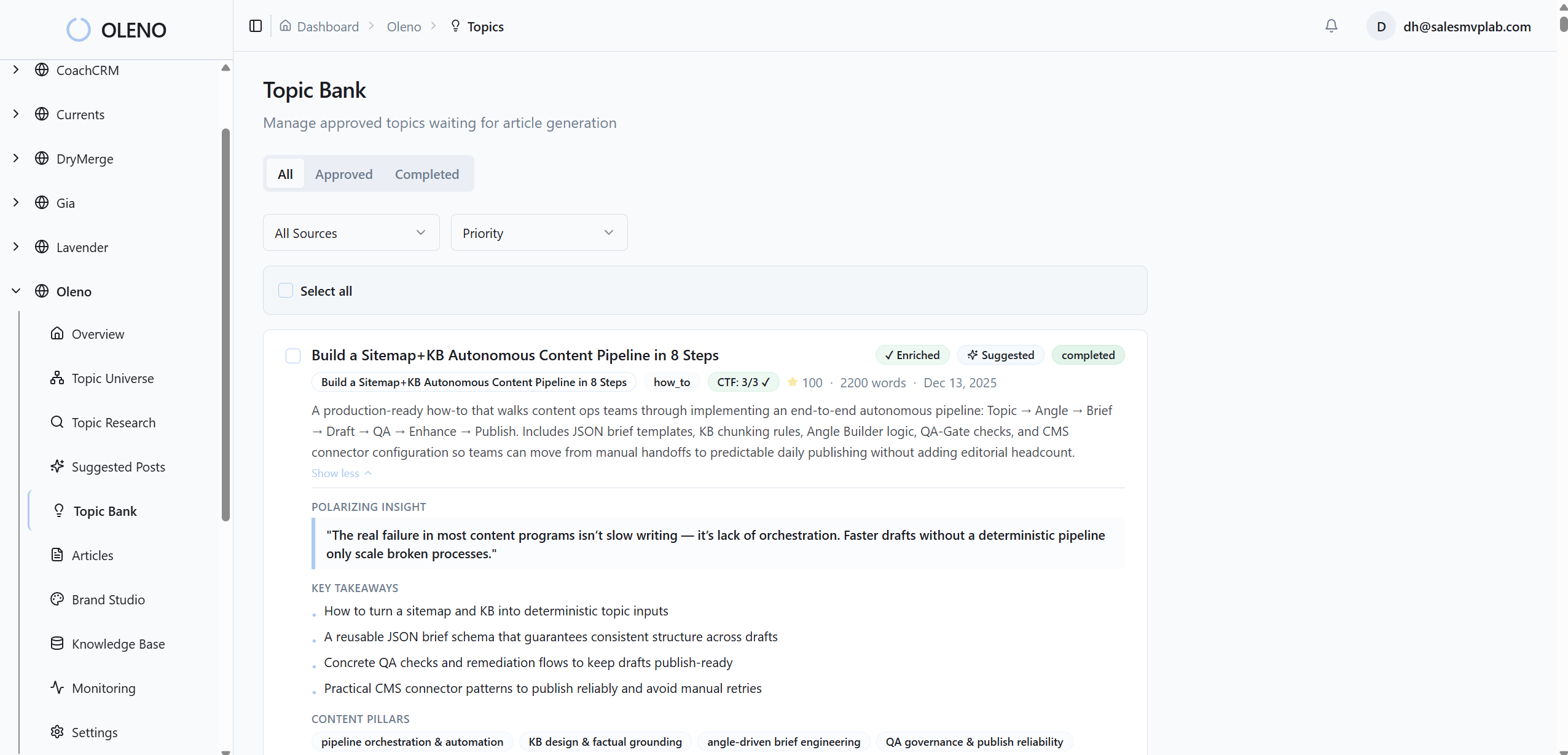
Publishing is direct and controlled. Oleno connects to WordPress, Webflow, HubSpot, and more, publishing as draft or live. Pair the QA score with lanes. Pass can auto-publish. One or two reds route to a minor fix queue. Multiple reds go to full editor review. Idempotent publishing prevents duplicates and versioning lets you roll back calmly when you need it. You’re running an operation, not a chain of ad-hoc tasks.
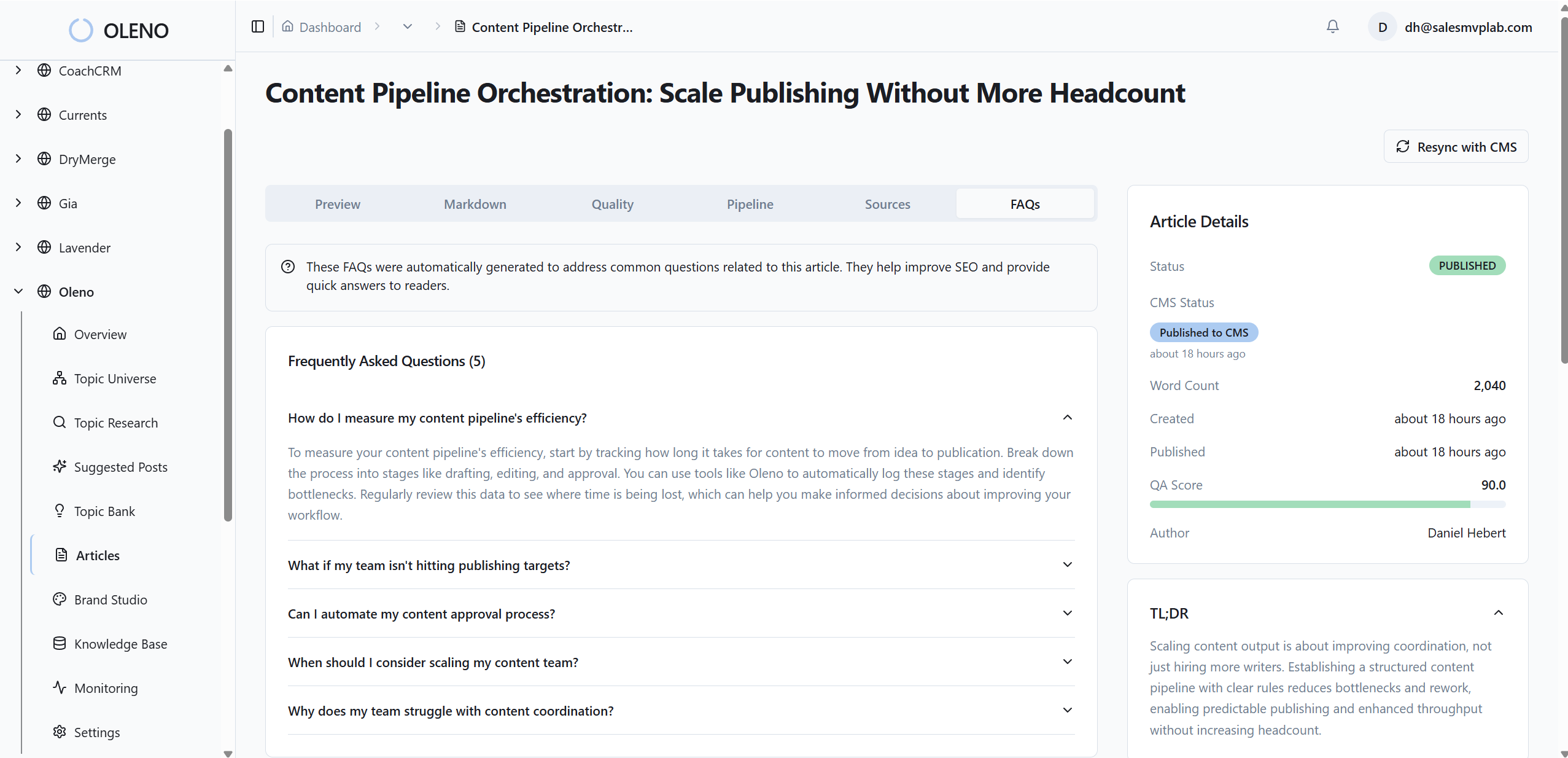
Quality doesn’t stop at the gate. Oleno tracks output volume and cadence, and it surfaces quality patterns and common failure modes over time. Sampling catches edge cases QA can miss. You don’t need flashy dashboards to get value. You need a steady signal that tells you the engine is healthy. That’s the point of an execution system. It keeps shipping, stays consistent, and compounds.
Ready to let the system carry the checks while your team focuses on the work only humans should do? Oleno runs the QA gate, enforces your rules, and publishes cleanly. Request a Demo.
Conclusion
Most teams don’t fail because they lack ideas. They fail because execution drifts. Binary rules remove drift from the day to day. Review becomes predictable. Cadence stabilizes as volume grows. The narrative holds across authors and months.
Write freely. Decide systematically. Push decisions to the edge of publishing. If you do that with a simple 12-rule tree and a gate that never gets tired, you’ll stop debating style and start compounding results. That’s the boring path to trust at scale.
About Daniel Hebert
I'm the founder of Oleno, SalesMVP Lab, and yourLumira. Been working in B2B SaaS in both sales and marketing leadership for 13+ years. I specialize in building revenue engines from the ground up. Over the years, I've codified writing frameworks, which are now powering Oleno.
Frequently Asked Questions