Effective Content Distribution Strategies for Maximum Reach

48% of marketers say content creation, distribution, and strategy are more fragmented now than they were two years ago, according to HubSpot’s latest trends data. If your team is trying to improve effective content distribution with a stack of SEO tools, AI writers, PMM docs, Slack threads, and last-minute reviews, you probably felt that fragmentation this week.
The mistake is thinking distribution is the tail end of content. It isn’t. Effective content distribution starts much earlier, at the point where positioning, audience, use case, and product truth get locked in. If those inputs are weak, the post can still ship. It just won’t travel well.
Key Takeaways:
- Effective content distribution is not a posting problem. It’s an upstream strategy and system problem.
- If your content needs heavy rewrites before every channel adaptation, your inputs are broken before distribution starts.
- Teams usually blame output volume, but the real cost comes from coordination tax, narrative drift, and weak signal consistency.
- The GEO era changes the bar: content has to work for buyers, search engines, and LLMs at the same time.
- The best distribution systems use one source of truth for positioning, product definitions, audience context, and brand voice.
- If your PMM team is still stitching together docs, prompts, and reviews manually, you don’t have a distribution engine yet.
- If you want to see what a governed execution model looks like in practice, you can request a demo.
Why Most Content Distribution Breaks Before Promotion Starts
Effective content distribution breaks before promotion starts because most teams treat distribution like a channel task instead of a systems task. The content gets written first, then people try to figure out LinkedIn snippets, email blurbs, sales enablement reuse, internal sharing, and maybe some search visibility after the fact. By then, the hard part is already over. Or at least people think it is.

A mid-market SaaS PMM finishes a launch article at 4:30 on a Thursday in Google Docs. Product wants feature accuracy. Demand gen wants campaign fit. SEO wants structure. Sales wants a talk track. Social wants three hooks by tomorrow morning. Nobody is wrong, exactly. But nobody is working from the same operating system either, so the article turns into a pile of edits, side comments, and channel-specific rewrites.
That’s the hidden problem. Distribution fails because the content was never built to distribute cleanly in the first place. It was built as a one-off asset, then forced into five other jobs.
The channel-first model creates rework tax
Most teams organize content around channels. One person owns blog. Another owns social. Another owns email. PMM owns launch content. Sales asks for enablement materials when they need them. It feels normal because that’s how most organizations are set up.
But channel-first execution has a nasty side effect. It localizes decision-making. The blog post gets optimized for the blog. The LinkedIn post gets rewritten for engagement. The email version gets softened. The sales version gets stripped down. A month later, you have five versions of the same idea, all saying roughly the same thing in slightly different language. That drift is small at first. Then it compounds.
I’ve seen this up close. At one SaaS company, we had strong writers and solid traffic, but a lot of the content sat too far away from the product and too far away from the actual demand-gen story. It ranked. It looked good. But it didn’t move people anywhere useful. Good content with weak distribution logic is just expensive publishing.
SEO tools and AI writers optimize pieces, not systems
SEO platforms are useful. AI writing tools are useful too. But most of them are anchored in channels and tactics, not in marketing as a system. That distinction matters more than people think.
Back when I was at LevelJump, I remember hearing April Dunford on a panel after another marketer spent way too long rattling off tools and tactics. Her point was blunt, and she was right: tactics without strategy are useless. That stuck with me because it matched what I kept seeing in SaaS. When positioning is clear, the tactics get clearer. When positioning is fuzzy, every channel becomes harder.
That’s what most content teams are really dealing with. Not a writing problem. Not even a distribution problem, at least not in the narrow sense. A marketing system problem.
GEO makes inconsistency more expensive
The GEO era raises the cost of sloppy distribution because now your content has to send a clean signal across buyers, search engines, and LLMs. Those audiences don’t evaluate you the same way, but they all punish inconsistency.
According to Google’s own guidance on creating helpful, reliable, people-first content, clarity, accuracy, and demonstrated expertise are part of what makes content worth surfacing and citing (Google Search Central). That sounds obvious. Still, most teams ship content through fragmented workflows that make those traits harder to maintain at scale.
And that’s the tension. You’re not just trying to publish more. You’re trying to make the same market signal show up across every asset, every channel, and every reuse path. When that doesn’t happen, distribution doesn’t amplify your story. It dilutes it. The next question is why that dilution happens so predictably.
The Real Problem With Effective Content Distribution
The real problem with effective content distribution isn’t that teams forget to promote enough. It’s that they never encoded the fundamentals needed for content to stay coherent while it moves across channels. That changes the fix entirely.
Most teams think distribution underperforms because they need better posting habits, better repurposing, or more channel coverage. Fair point. Those things do matter. If you never ship, nothing happens. But that’s not the root cause in established SaaS teams with PMMs, demand gen managers, SEO leads, and content folks already in place.
The root cause is fragmented execution. Content, narrative, product truth, audience targeting, and distribution are all handled in different places by different people with different context. So the output can’t stay stable.
The SIGNAL framework for content distribution
The framework I’d use here is SIGNAL. If five things aren’t stable, distribution won’t compound.
- Stance: your category point of view and enemy framing
- ICP context: who the content is for and what they care about
- Grounded product truth: what the product does, does not do, and when it matters
- Narrative consistency: the same argument showing up across assets
- Adaptation rules: how one core asset changes by channel without losing the plot
- Lifecycle orchestration: how content gets reused over time, not just on launch week
If you’re missing 2 or more of these 6, effective content distribution will feel random. You’ll still post. You might even get reach. But you won’t build repeated market understanding.
That’s why prompt-based workflows hit a wall. Prompting creates outputs. It doesn’t preserve SIGNAL. Humans end up carrying the whole system in their heads.
Distribution is an input quality problem
A lot of PMMs know this instinctively. You can feel it when you open a draft and instantly know it’s going to be painful to repurpose. The words may be fine. The structure may be fine. But the content has no spine.
If the piece doesn’t clearly state the old way vs the new way, if it doesn’t define the audience pain, if it floats around the product without grounding, then every downstream adaptation becomes custom work. Social has to invent hooks. Sales has to rewrite it. Demand gen has to reinterpret it for campaigns. Leadership reads it and says it “doesn’t sound like us.”
Honestly, that’s the biggest tell. If every distribution touchpoint needs a smart human to rescue the message, your system is broken upstream.
Why more contributors often make distribution worse
This is counterintuitive for a lot of teams. More contributors should mean more coverage. Sometimes it does. But once you cross a certain complexity threshold, more contributors without shared governance create more drift than output.
Back in the Steamfeed days, we got to 120k monthly visitors because we had both breadth and depth, plus enough volume to cover long-tail demand from multiple angles. But that model worked because the output still had a clear framework behind it. Later, in smaller SaaS teams, I saw the opposite. Add one writer without enough context, and output slows down while quality drops. Add more stakeholders, and distribution gets even messier because everyone is correcting from a different mental model.
So yes, the status quo has merits. Specialized people can absolutely improve quality. But only if they’re working from the same playbook. Without that, specialization just creates handoff overhead with a nicer org chart.
The old mental model says distribution starts after publish. The better one says distribution starts at the moment you define the message. Once you see that, the path forward gets a lot more practical.
How High-Performing Teams Build Effective Content Distribution Systems
High-performing teams build effective content distribution systems by designing one core signal that can survive adaptation. They don’t write a blog post and then “make content from it.” They build a governed asset that already knows who it’s for, what argument it’s making, what product truth it can lean on, and how it should travel.
That sounds abstract, but it isn’t. There’s a pretty clear operating model behind it.
Diagnose your current distribution maturity first
You should diagnose your distribution model before changing tools because the right fix depends on where your team actually breaks. Most teams fall into one of three buckets.
Bucket 1 is manual reuse. You publish something, then scramble to make social posts, email copy, maybe a sales doc. Bucket 2 is templated repurposing. You have some process, but every asset still needs manual interpretation. Bucket 3 is governed distribution. Core content is built from shared definitions, so reuse is faster and cleaner.
A quick test works well here. Ask these five questions:
- Can two different team members describe your core message in nearly the same words?
- Can your PMM, content lead, and social owner all point to one approved product definition source?
- Does one article usually produce at least 5 usable downstream assets without major rewrites?
- Do executives edit for nuance, or do they rewrite for meaning?
- Can a new contributor create on-brand content in under 2 weeks?
If you answer “no” to 3 or more, you don’t have effective content distribution. You have content recycling. Big difference.
Build from message architecture, not channel requests
Content that distributes well starts with message architecture. That means defining the claim, the enemy, the audience pain, the use case, and the product truth before anyone starts polishing copy.
Think of it like laying conduit before you pour concrete. Once the slab is down, changing the wiring is painful. Same thing here. If the article is built without a clear argument structure, every downstream channel edit becomes demolition work.
The minimum viable structure I’d recommend is the 5x5 Distribution Spine:
- 1 core problem
- 1 contrarian angle
- 1 primary audience
- 1 clear use case
- 1 product truth boundary
Then map 5 reuse paths:
- article
- social
- sales enablement
- buyer evaluation content
If one draft can’t hold those 5 paths without changing its meaning, it isn’t ready. Don’t distribute it yet.
Write for adaptation, not just publication
This is where most teams miss. They optimize for the publishable artifact instead of the adaptable artifact.
A publish-first draft often has nice prose but weak extraction points. A distribute-first draft has claim-based headings, direct answers, reusable definitions, crisp framing, and sections that can stand alone. That makes it easier to pull snippets into email, social, FAQ libraries, sales collateral, and LLM-citable formats.
Research from Nielsen Norman Group has shown for years that people scan digital content heavily and rely on structure, front-loaded clarity, and chunking to make sense of it (Nielsen Norman Group). LLMs behave differently than people, obviously. But the weird part is that structured, answer-first writing tends to work better for both.
We were surprised by how often this holds. The pieces that distribute best aren’t always the prettiest. They’re the ones with the strongest bones.
Create adaptation rules before you scale volume
Once the core asset is solid, you need rules for adaptation. Otherwise every channel owner improvises. That’s where drift sneaks in.
A simple rule set works:
- Keep the core claim unchanged across channels.
- Shorten the framing, not the meaning.
- Change examples by audience, not by opinion.
- Never introduce product claims that weren’t approved in the source asset.
- If the adaptation requires more than 30% rewriting, rebuild the source asset instead.
That 30% rule matters. If social, email, or sales has to rewrite a third of the piece to make it usable, the original content wasn’t structured for effective content distribution. It was structured for one destination only.
Some teams prefer looser creative freedom, and that’s valid in brand campaigns or founder-led content. I’m not against that. But for repeatable SaaS demand gen, especially when PMM accuracy matters, looser rules usually mean higher review cost later. That tradeoff is real.
Measure distribution by signal retention
Most teams measure distribution by reach, clicks, and maybe pipeline influence. You should still track those. But there’s another metric that matters earlier: signal retention.
Signal retention asks one question. As your content moves from article to social to email to sales to buyer evaluation, how much of the original message survives?
You can score this with a simple 4-point check:
- problem statement preserved
- audience preserved
- differentiator preserved
- product truth preserved
If an adapted asset holds 3 out of 4, it’s probably healthy. If it falls below 2, the message is drifting. That drift becomes expensive because every channel starts teaching a slightly different market story.
At that point you’re not doing effective content distribution. You’re paying multiple teams to slowly blur your positioning.
That’s why the better teams don’t ask, “How do we post this everywhere?” They ask, “How do we make one strong signal travel?” And if you want that to happen consistently without carrying the whole system in people’s heads, you need infrastructure.
If you want to see how that kind of governed execution works in practice, you can request a demo.
What Effective Content Distribution Looks Like With Oleno
Oleno makes effective content distribution more reliable by turning the upstream strategy into governed execution rules, then carrying those rules through planning, drafting, QA, and reuse. That matters because distribution usually breaks when every asset depends on people remembering the same context from scratch.
Governance first, then execution
Oleno starts with governance, not output. Brand Studio defines tone, structure rules, and voice constraints. Marketing Studio encodes your key messages, category framing, and narrative logic. Product Studio centralizes approved product descriptions, boundaries, and supported use cases so feature claims stay accurate.
That combo matters more than another drafting tool. It means your PMM team isn’t re-explaining positioning every time a new asset gets created. It also means the system can hold onto the same core signal across different job types, which is the real backbone of effective content distribution.
And for teams dealing with rework tax, that’s the payoff. Less arguing with drafts. Fewer meaning-level rewrites. More consistent downstream reuse.
Plan, create, and adapt from one operating model
Storyboard helps allocate content across audiences, personas, products, and use cases based on coverage gaps and priorities. Audience & Persona Targeting and Use Case Studio make sure the same topic gets framed differently for the right reader, instead of turning into generic education. Category Studio and Buyer Enablement Studio let teams create both market-shaping thought leadership and decision-support content from the same governed base.
Then the Orchestrator runs the production flow against approved topics and quotas, while the Quality Gate checks voice, structure, clarity, grounding, and SEO before anything moves forward. That’s a very different model from prompting your way through a backlog.
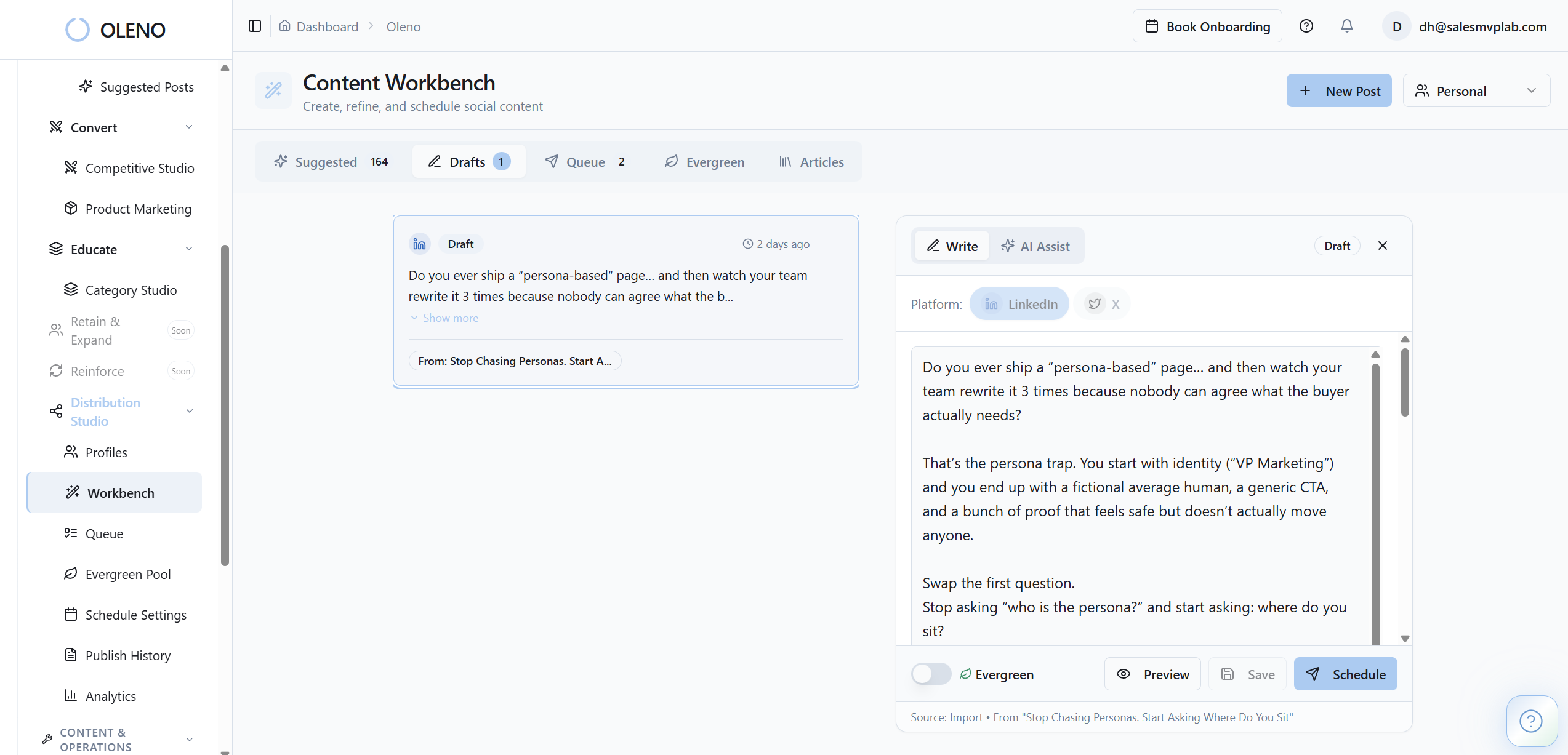
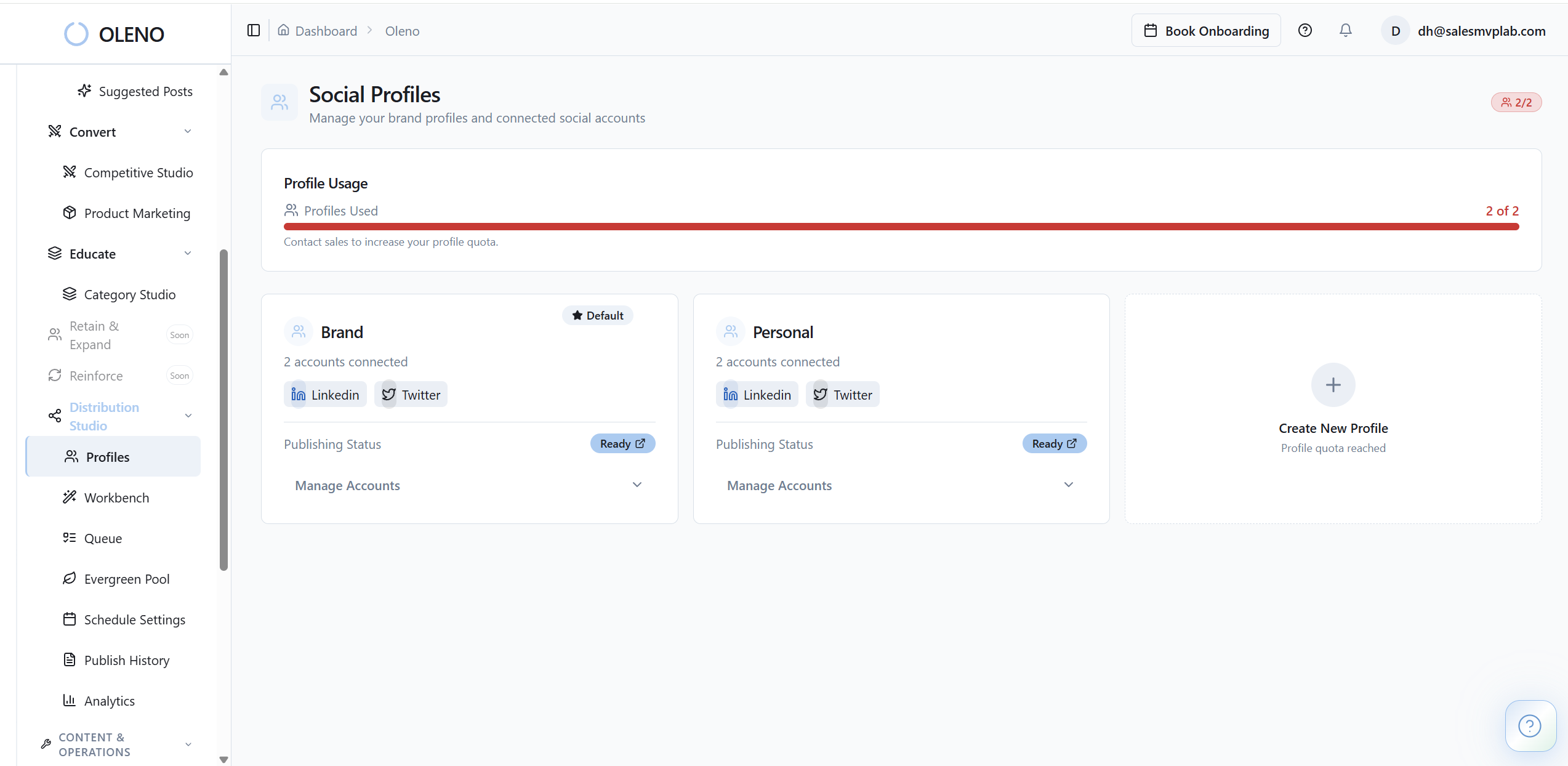
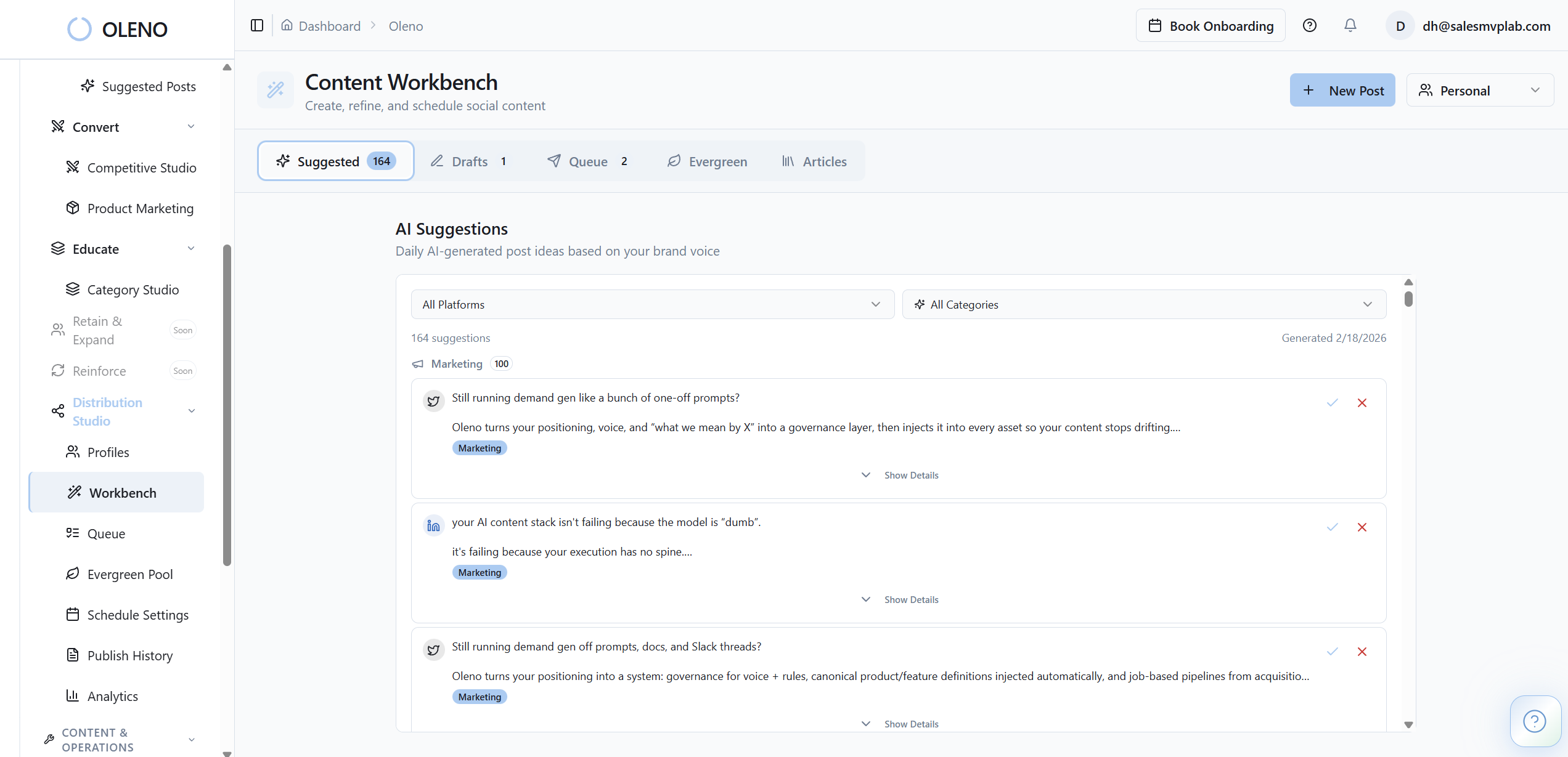
Oleno also supports Distribution & Social Planning for turning published articles into platform-specific social variants, with review and scheduling built into the workflow. So instead of treating distribution like a separate scramble after publish, the system extends the same core message into the next channel layer. That’s how you preserve signal without multiplying coordination overhead.
If your team is trying to run category content, product marketing, SEO, and buyer education at the same time, this is the kind of structure that keeps it from collapsing under its own weight. You can book a demo and see how the full workflow fits together.
A Better Way to Think About Content Distribution
Effective content distribution is the result of good marketing systems, not better hustle after publish. If your positioning is clear, your audience is defined, your product truth is grounded, and your adaptation rules are tight, distribution gets easier fast.
That’s the shift. Stop treating distribution like promotion glued onto the end of content. Build the message so it can travel, then let the system carry it.
About Daniel Hebert
I'm the founder of Oleno, SalesMVP Lab, and yourLumira. Been working in B2B SaaS in both sales and marketing leadership for 13+ years. I specialize in building revenue engines from the ground up. Over the years, I've codified writing frameworks, which are now powering Oleno.
Frequently Asked Questions