Embedding-Based Narrative Drift Monitor for Marketing Content
Most teams don’t lose the narrative in one bad post. It leaks out slowly. A phrasing here, a “close enough” claim there. Two months later, sales is pitching a different story than the homepage. I’ve lived that. It’s fixable, but not with more meetings or heavier editing.
Here’s the uncomfortable bit. Manual QA can catch typos and tone. It won’t reliably spot subtle claim drift across a 500‑asset library. You need a baseline, a way to compare meaning at the sentence level, and rules that block publish when claims cross the line. That’s where embeddings, used well, not as hype, change the game.
Key Takeaways:
- Define a canonical narrative contract and snapshot it with versions before you detect drift
- Compare meaning, not just keywords, use sentence embeddings to flag subtle claim shifts
- Separate claim drift (risk) from tone drift (cleanup) and gate on claims
- Set a false positive budget and SLOs so the system stays usable at scale
- Close the loop by wiring governance rules into your QA gate and publishing flow
Why Manual Reviews Miss Narrative Drift At Scale
Narrative drift is semantic or claim-level deviation from your approved story over time. It shows up as subtle meaning shifts, not just tone or style changes. A single post won’t reveal it; compounding across dozens will. The fix starts with a written narrative contract and versioned baselines.
What Qualifies As Narrative Drift?
Narrative drift means your content starts asserting something directionally different than your market POV or product truth. Not snark vs friendly. Meaning. Think “we enforce governance” turning into “we provide analytics,” or “use-case explainers” expanding into “competitive intelligence software.” Close cousins, different implications.
Here’s how to make it concrete. Write a one‑page narrative contract. Clarify your category frame, describe approved value pillars, and list allowed claims with a few canonical sentences each. Snapshot it with a version tag and date. Everything new compares back to that stable reference. It’s boring in the best way.
The Compounding Effect Across Content Libraries
Drift creeps at the edges. A headline loosens a claim; a feature gets framed a degree off angle; a “helpful” example in a webinar recap stretches the promise. Search picks up the wording. Sales borrows the phrasing. Your story fragments. No one decided it. It just happened.
Stopping the creep means seeing it early. Embed at the sentence and section level so similarity is measured against canonical chunks, not a whole document. Track drift rate by topic and source. When a cluster of assets near “launch messaging” drifts in the same way, you have a pattern, not a one‑off.
Why Editorial QA Cannot Keep Up
Editors excel at clarity, structure, and voice. They’re not a distributed detection system. As cadence rises, human review becomes laggy and noisy. You drown in “looks fine” approvals while contradictions slip through. It’s not laziness. It’s bandwidth and the limits of memory.
Move QA upstream with an algorithmic layer that scores semantic distance and claim compliance. Let the system flag high‑risk assets for human review, and pass the clean ones. Let editors make decisions, not go hunting. If you want a model reference on drift detection with embeddings, see this overview on detecting concept drift via document embeddings.
Ready to operationalize this with governance and a real QA gate? Try Oleno For Free.
The Real Source Of Drift In High Velocity Pipelines
Drift doesn’t start in the editor. It starts with fragmentation, positioning in a deck, claims in a doc, prompts in a tool, and publishing in a CMS. Embeddings help by comparing meaning across these sources, not just keywords. When paired with clear rules, they reveal the actual pattern.
How Embeddings Expose Subtle Semantic Shifts
Sentence embeddings let you compare meaning directly, not string overlap. You vectorize canonical sentences from your narrative contract and compare them to sentences in a new draft. The cosine distance tells you how far the meaning wandered. Group by topic so “friendly variance” doesn’t mask real contradiction.
What matters is context. Keep a reference corpus organized by claim, topic, and version date. When your “governance first” baseline changes, mark the old as V1 and the new as V2, then compare new content to the active version. Drift often looks small sentence by sentence. Aggregated across a section, you’ll see the story bend.
Claim Drift Vs Tone Drift, Why Both Matter
Tone drift irritates brand folks. Claim drift creates risk. Separate them. Run a lightweight classifier that recognizes allowed claims and flags banned or off‑policy phrases. Gate on claims. Tone can be a weekly cleanup; claims should block publish until resolved. This keeps your reviewers focused where it matters most.
We’ve used voice linters to nudge style and phrasing, but they’re not your superpower. Your superpower is not contradicting what you actually sell. Treat that like a release blocker. If you want broader context, this Frontiers review on AI model drift and monitoring concepts offers useful mental models you can adapt.
Where Traditional SEO And Grammar Checks Fall Short
Grammar tools enforce surface quality. SEO tools enforce coverage. Neither answers “does this claim align with our canonical narrative?” You can hit every keyword and still mislead evaluation. You can write cleanly and still promise the wrong thing. Both are helpful. Neither is a guardrail.
Add a semantic baseline and claim rules. Think of it this way: you’re not trying to prevent creativity. You’re preventing contradiction. A fresh angle that’s semantically close to your baseline? Great. A confident statement that crosses a boundary? That’s a stop sign.
The Operational Cost Of Letting Drift Slide
Drift taxes your team in hidden ways: rework, confusion, and lost pipeline. You might not notice it in a single week. Over a quarter, it adds up. Quantify it. Give yourself a false positive budget so the detection system doesn’t become the new bottleneck.
Let’s Pretend Numbers: Rework, Brand Confusion, Pipeline Loss
Let’s pretend you ship 100 assets this month. Five percent claim drift means five rewrites. Ten hours each if we’re honest. Fifty hours of rework. If two of those assets show up in evaluation and bend expectations, you lose one opportunity this quarter. Let’s call it 8k in pipeline. Not catastrophic. Repeat for three quarters.
Now stack channels. Website, docs, blog, webinar recaps, enablement decks. Small misalignments propagate. A single off‑angle post becomes the most indexed version of your story, because it’s fresher or more linked. You feel it in sales calls. You feel it in customer emails. That’s where the cost lives.
How Drift Pollutes LLM Retrieval And Sales Calls
If your library contradicts itself, retrieval models surface conflicting chunks. Sales sees three answers to the same “what do you actually do?” question. That creates friction. Anchor consistent claims with canonical TL;DR snippets and teach your retrieval layer to prefer them. Then check new content against those embeddings pre‑publish.
I’ve seen this play out. We’d fix a page, but the cached off‑angle version kept getting quoted in sales notes. Without a stable, embed‑anchored claim set, you’re playing whack‑a‑mole. There’s research on how inconsistent messaging erodes brand trust; here’s one marketing study on brand meaning consistency and performance. It’s not about perfection. It’s about predictability.
What Is Your False Positive Budget?
If every other asset gets flagged, reviewers stop listening. You need a number. For example: no more than 2% of published assets can be flagged incorrectly in a week. That forces you to tune thresholds, sampling, and reviewer load. It also creates a healthy conversation about risk tolerance.
Write it down. Revisit quarterly. Your budget will change with volume and narrative complexity. When you launch a new pillar, loosen thresholds for a week and add sampling. When things stabilize, tighten. Treat it like any SLO: a lever you adjust, not a law you suffer.
Curious how to integrate this without adding meetings? Try Using An Autonomous Content Engine For Always‑On Publishing.
What It Feels Like When The Narrative Slips
The pain is visceral, not theoretical. You’re on the hook. A rep needs a fix before a demo. The homepage and the blog disagree. Everyone has an opinion; no one has a baseline. A good monitor would’ve caught it days earlier with a clean, actionable flag.
The 3AM Message From Sales
You know the one. “This post says we do X. The deck says we do Y. Which is it? I’m in a demo at 9.” You patch the copy. You update the deck. You tell yourself it won’t happen again. It will, unless the system changes.
When we ran lean, I learned to record the CEO, transcribe, and publish quickly. It was fast. It also missed structure and left room for drift. Speed without a baseline creates rework. A monitor with claim checks would’ve stopped those drafts at the gate, not my inbox.
Who Owns The Fix?
You do, but not alone. Marketing sets the rules. Product supplies truth and boundaries. Ops runs the pipeline. Legal handles red lines. Write the RACI. Wire it into triage so alerts go to the right owner with links to the exact sentences. Not a vague “something’s off.”
Ownership isn’t bureaucracy. It’s how you buy back time. When the system routes “claim mismatch: governance vs analytics” to the product marketer who owns that pillar, the fix happens fast. When it lands in a shared inbox, the problem ages in place.
Build The Monitoring Pipeline That Catches Drift Early
A usable drift monitor starts with a canonical corpus, then chooses embedding and storage options you can afford, and finally defines similarity and claim rules tied to thresholds. The point isn’t perfect detection; it’s reliable, explainable signals that feed your QA gate.
Define The Canonical Narrative Corpus
Start with approved sources: positioning doc, product truth, brand voice, and a few “model” pages. Chunk them into stable statements with IDs and tags. Store embeddings for each chunk, and snapshot the corpus per version. This becomes your comparison baseline and your rollback plan when messaging evolves.
Treat the corpus as governance, not content. You’re encoding decisions once so the system can enforce them daily. Include “allowed claims,” “disallowed phrases,” and a handful of canonical TL;DRs per pillar. Name everything clearly. When you update “governance first,” you’ll know exactly what changed, and so will your monitor.
Design Similarity And Claim Matching Metrics
Use cosine similarity for sentence comparisons to your canonical chunks. Add section‑level topic alignment so you don’t over‑penalize creative phrasing within the right lane. Train a simple classifier that recognizes allowed claims. Pattern‑match banned phrases. Combine these into a weighted drift score per asset.
Save raw distances and labels for audits. Reviewers need to see “this line drifted from claim G‑2 by 0.23” and click through to the canonical statement. You’ll tune weights over time. If retraining or recomputation costs worry you, this note on embedding drift, recompute cadence, and budgeting offers practical knobs to turn.
How Oleno Enforces Narrative Rules And Closes The Loop
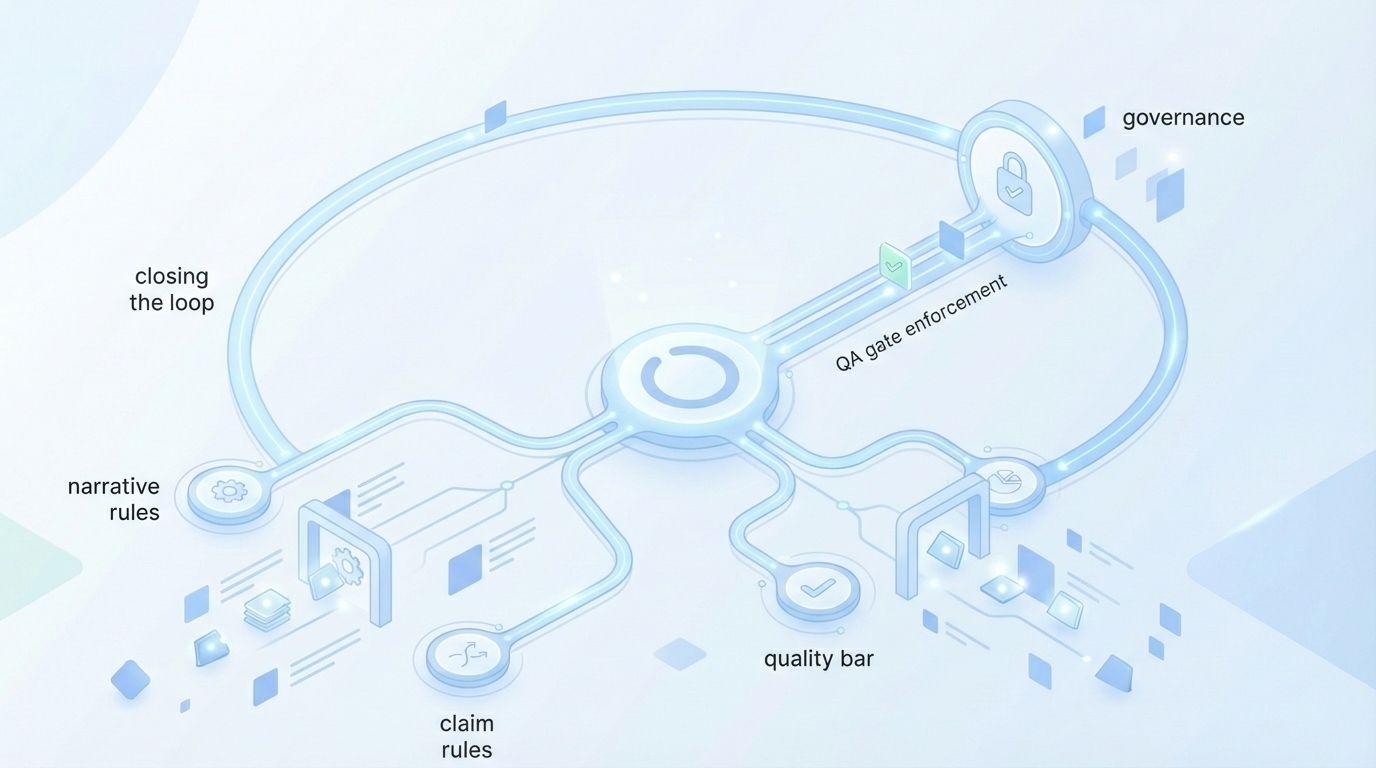
A drift monitor is only valuable if it changes outcomes. Oleno turns your narrative, claim rules, and quality bar into an operational system. Governance defines the guardrails. The QA gate enforces them. Measurement shows where to adjust. Execution keeps moving.
Governance As Code, Encode Claims And Banned Patterns
Oleno starts with governance. You define market POV, approved claims, voice rules, and product truth once. Those rules apply everywhere. We’ve seen teams convert their nagging edit list into explicit “allowed/banned” patterns that the system checks automatically. It’s not about being strict. It’s about being clear.
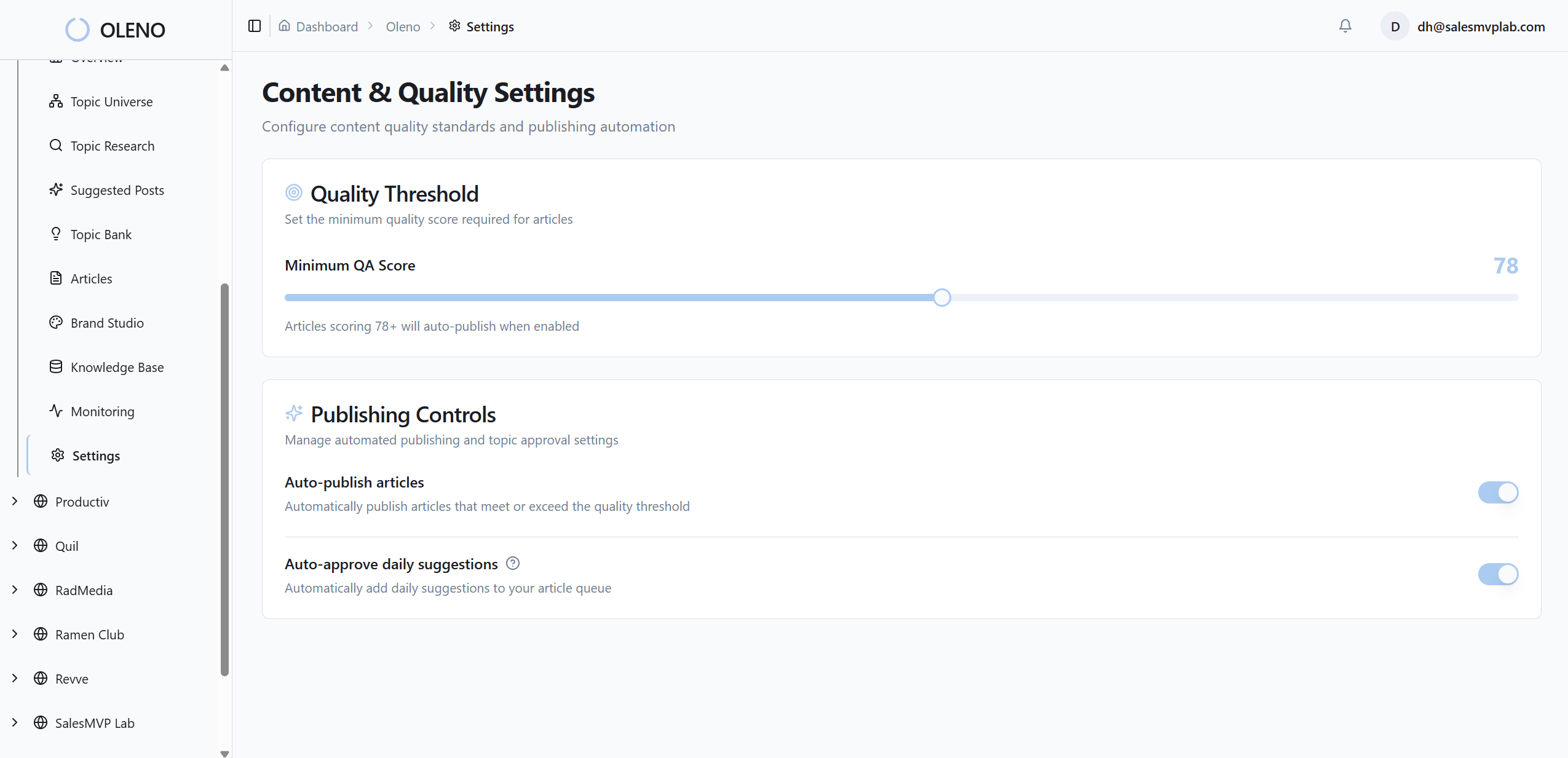
Because Oleno separates governance from execution, the same claim rules your drift monitor uses are also the ones your content jobs follow. That keeps drafting and detection in sync. No finger‑pointing between tools. No “the model didn’t know.” Oleno doesn’t invent claims; it enforces yours.
QA Gate Integration Points, Block Or Flag Before Publish
Here’s where drift signals pay off. Route high‑risk assets into Oleno’s QA gate. If claim checks fail, publishing is blocked. If tone drifts, the asset is flagged for revision. You stay fast without flying blind. Editors spend their time on narrative choices, not comma patrol.
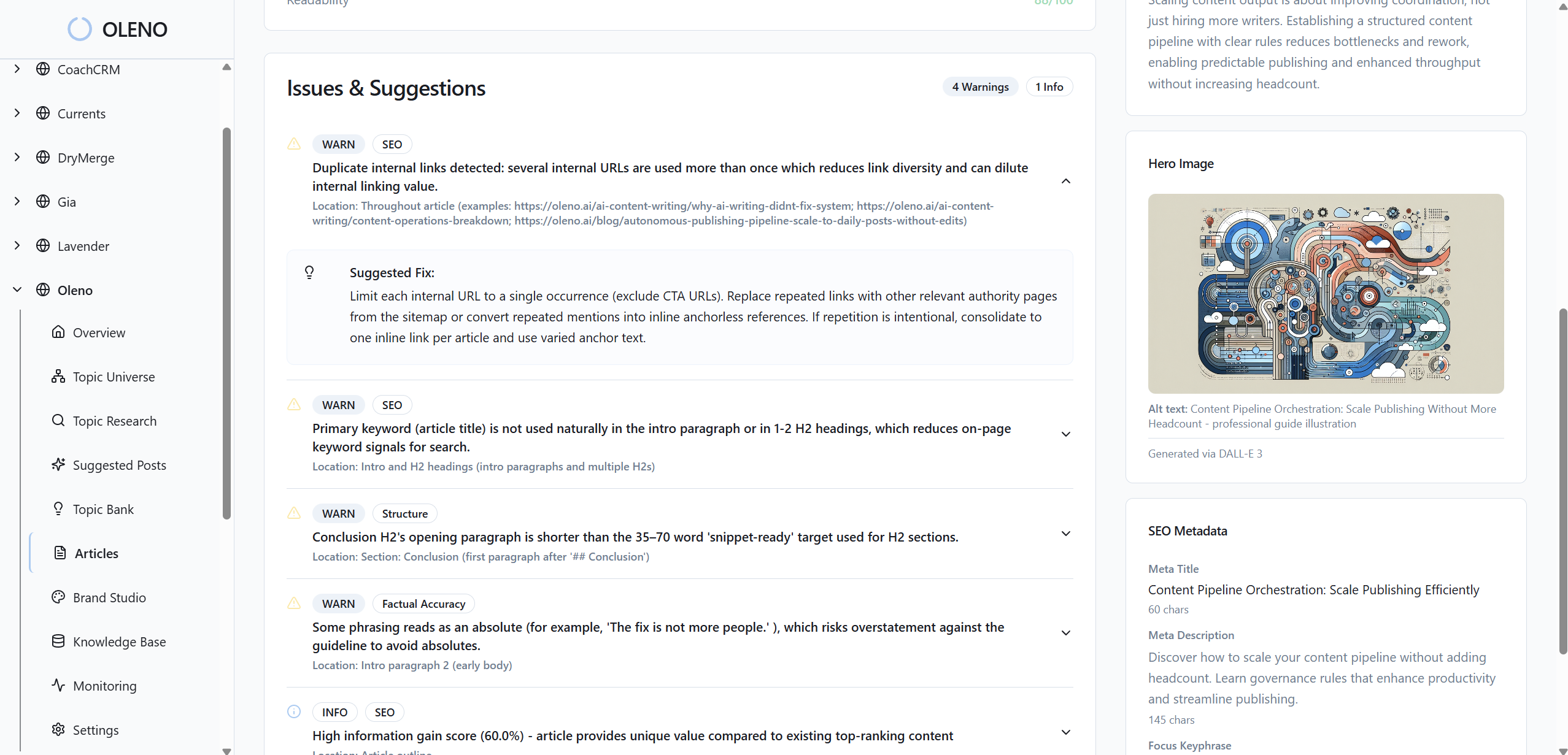
Oleno’s execution engine runs a consistent flow, discover, angle, brief, draft, QA, enhance, visuals, publish, so guardrails are applied at the same points every time. Tie alerts to the exact sentences, and attach suggested rewrites that map to canonical chunks. When the rule is clear, authors fix it quickly.
Oleno is built for small teams, so it also includes the operational pieces you’ll need as volume grows: automated quality enforcement across jobs, optional sampling to catch issues QA can miss, and direct CMS publishing so approved content doesn’t sit in limbo. If you want to streamline this start to finish, Try Generating 3 Free Test Articles Now.
Conclusion
You don’t fix narrative drift with more opinions. You fix it with a baseline, semantic checks, and rules that block contradictions before they ship. Most teams try to edit their way out. That works, until volume rises.
Do the simple, durable things. Write the narrative contract. Build the corpus. Compare meaning, not strings. Separate claims from tone. Then wire it into your QA gate so the system enforces what you care about, and your people get to focus on the story, not chasing inconsistencies.
About Daniel Hebert
I'm the founder of Oleno, SalesMVP Lab, and yourLumira. Been working in B2B SaaS in both sales and marketing leadership for 13+ years. I specialize in building revenue engines from the ground up. Over the years, I've codified writing frameworks, which are now powering Oleno.
Frequently Asked Questions