Enforce Content Differentiation with Information-Gain Briefs to Avoid Waste

Publishing more isn’t the problem. Publishing more of the same is. You know this when you look at a monthly content report that shows volume up, but nothing meaningful moves. Pipeline’s flat. Sales ignores the docs. Search lifts a little, then stalls. It’s not a writing problem. It’s a differentiation problem.
Here’s the shift: stop judging drafts on “does it read well?” and start scoring briefs on “does this add anything new?” You can’t out-edit sameness. You have to block it upstream. That means a brief-level uniqueness score, proof of new evidence, and a hard pass/fail before anyone writes a word.
Key Takeaways:
- Measure uniqueness at the brief stage, not during editing
- Use a reproducible information-gain score (0–100) to gate topics
- Store competitive inputs with the brief to kill rework and arguments
- Standardize pass/fail thresholds and topic cooldowns to avoid over-coverage
- Structure sections for snippet-ready clarity to improve citation odds
- Use deterministic enhancements (links, schema, visuals) to reduce plumbing work
Why Publishing More Of The Same Compounds Noise, Not Authority
Publishing more of the same dilutes authority because search and LLMs reward net-new signals, not repetition. Unique angles, first-party data, and uncommon structure get cited; reworded summaries don’t. If you want odds-on visibility, score for what’s new, not how clean the prose is, then decide if the topic deserves a page.

The Metrics That Actually Predict Unique Value
Uniqueness isn’t a vibe. It’s a measurable gap between what exists and what you’ll add. Start by capturing the top results, extracting headings, entities, recurring claims, and stats. That becomes your baseline. Then compare your brief’s proposed evidence and structure to the baseline and score the delta. No hand-waving. Just inputs and a number.
In practice, it looks like this: you scrape ten SERP leaders, map the overlap, and highlight what’s missing. Maybe everyone lists the same “ten best practices.” None provide the math or a first-party example. You propose both. That’s measurable difference. With a consistent process, two different editors will land within a few points of each other.
This isn’t about judging writing style. It’s a go/no-go mechanism. If the number’s low, you re-angle or kill it. There’s freedom in focus. You ship fewer pieces that do more work.
By the way, the platforms telegraph this preference. Read Google’s helpful content guidance. They don’t ask for more pages; they ask for original, reliable signals.
What Is Information Gain And Why Should You Care?
Information gain is a brief-level uniqueness score, 0 to 100, computed before writing. It rewards net-new facts, contrarian structure, proprietary examples, and original analysis. It penalizes overlap, generic summaries, and uncredited stats. Simple idea: difference earns points, sameness loses them. That’s your early warning system against waste.
Why care? Because editing won’t fix sameness. Once words exist, sunk cost bias kicks in and you’ll try to “make it work.” An information-gain score forces the hard decision when it’s cheap: before writing. If the score is low, you don’t write that page. You find a sharper angle or you move on.
Treat the score as a gate, not gospel. You’re not promising performance. You’re enforcing inputs that correlate with distinct value. Over time, your team learns the patterns that lift the number—and your bar rises naturally.
Why Conventional Brief Practices Fail Here
Traditional briefs chase keywords and dump H2s. They outsource differentiation to the writer and hope novelty appears in the draft. That’s backward. When the uniqueness work isn’t done up front, you get lookalike outlines, vague examples, and “we can add a stat later” edits that never land.
Flip it. Put competitive context and uniqueness scoring at the start. Force the brief to name gaps it will fill, sources it will cite, and evidence it will generate. If it can’t, don’t write. That one guardrail eliminates most downstream rework and “is this worth it?” debates. Less roulette. More intent.
You’ll also notice morale improves. People don’t want to polish derivative drafts. They want to publish pieces with a point of view. Give them a process that produces that.
The Upstream Bottleneck Is Differentiation, Not Draft Speed
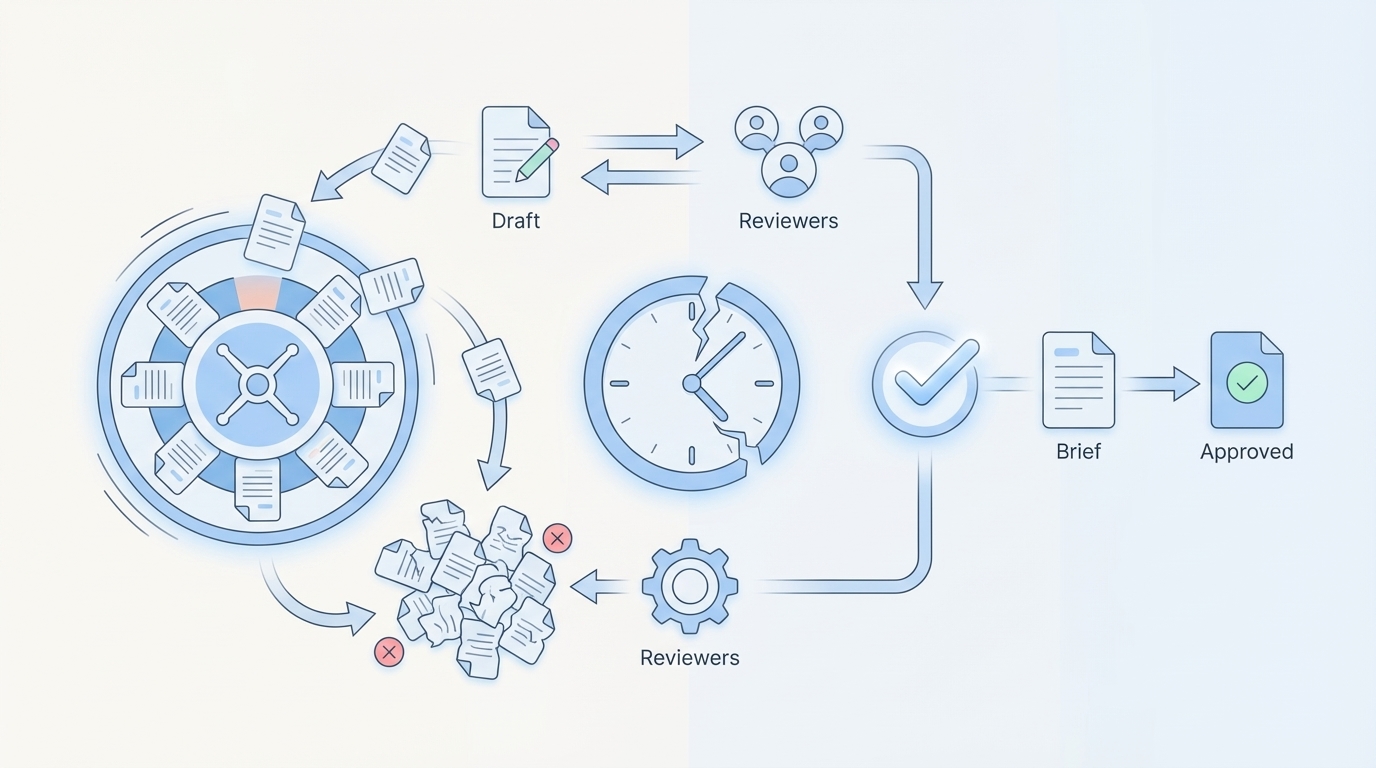
The real bottleneck isn’t writing speed; it’s proving you have something new to say before you write. Editing faster can’t recover a derivative angle. Build a brief-level scoring gate with reproducible inputs, and you’ll prevent sameness from entering the pipeline at all. Draft speed matters, just not first.
What Traditional Approaches Miss
Most teams try to differentiate during editing. Too late. Once the draft exists, you’re attached to it. The outline becomes a cage. You end up swapping synonyms and adding a quote while the core idea stays identical to everyone else’s. That’s how you ship 2,000 words of déjà vu.
Instead, embed competitive evidence and forced-uniqueness prompts in the brief. Make the outline “show its homework.” If it can’t prove novelty in two minutes—one net-new subtopic, one first-party data point, one proprietary example—do not push it downstream. You’ll save the week you would’ve burned trying to salvage sameness.
Quick note: we’ve seen teams try to “eyeball” this. It drifts. Use a simple, visible score. Even when we run this in Oleno, we keep the inputs auditable so decisions don’t become opinions.
How Do You Compute This Score Reproducibly?
Standardize inputs and weights. For each competitor, extract headings, entities, stats, and claims. Normalize them. Compare against your brief’s proposed evidence. Award points for new subtopics, fresh data, proprietary examples, and clarity patterns that are scarce. Deduct points for overlap and uncredited, common stats. Log the inputs and the computed score with the brief.
Think of it like a lightweight research rubric. You’re not modeling the world. You’re making an explicit, repeatable choice. Consistency matters more than perfection. If two editors get the same number with the same inputs, your governance is working. For method inspiration, the ACM artifact review and badging guidelines show how repeatable evaluation can look in practice.
Finally, store the snapshot with the brief. Next month, no one should have to redo the same SERP scrape to answer “why did we approve this?” The evidence is there.
The Hidden Costs Of Me Too Drafts You Never Ship
Derivative drafts drain time and credibility because they take hours to write, more to edit, and still don’t move the funnel. Direct costs add up quickly, and the opportunity cost is worse. Your calendar looks busy, but search and sales don’t care. You shipped words, not novelty.
Let’s Quantify The Waste In Real Terms
Let’s pretend a senior writer costs 100 dollars per hour. A low-gain draft burns 8 hours to write, 4 hours to edit, 2 hours to rework. That’s 1,400 dollars per piece, plus the context switches you never get back. Ship three per week, and you’re at 16,800 dollars per month on content that can’t win. The math stings.
And that’s without counting the “we need a new angle” meeting that eats a team’s afternoon. Or the approvals ping-pong. Or the late-stage “who has a dataset?” scramble that still lands on a generic survey stat. Real waste hides in the shadows you don’t measure.
Meanwhile, the competition publishes one truly useful piece and takes the links you wanted. They earned them. They added something.
The Cascading Impact On Pipeline And Brand Trust
Noise hurts more than nothing. Search engines see duplication. LLMs quote someone else. Sales won’t send a link that reads like every other blog. Over time, you train your stakeholders to expect content that doesn’t help them close. That’s a trust problem, not just a traffic one.
A brief-level uniqueness gate cuts this at the source. Approve fewer pieces with a sharper point of view. Structure sections for snippet-ready clarity so machines can cite you cleanly. If you want a reference on why structure matters here, read Google’s featured snippets documentation. Direct answers win more often.
One more ripple: your team’s energy. Shipping “meh” is demotivating. Shipping something that gets quoted feels different.
The Pain Of Rework And Approval Roulette
Rework piles up when novelty isn’t proven early. Deadlines slip, reviewers disagree, and the approval queue turns into roulette. Most of that chaos disappears when you score the brief, not the draft, and make the pass/fail rules visible to everyone. It’s less personal. More process.
When The Calendar Betrays You
You planned the quarter. Deadlines hit. Drafts read like everyone else. Now you’re juggling rewrites, stakeholder edits, and an approval queue that moves slowly. I’ve been there—at PostBeyond, I could crank out 3–4 strong posts a week because I had a structure. As the team grew, context diffused. Output slowed. Quality slipped. Not because anyone was bad—because the system didn’t enforce uniqueness up front.
At LevelJump, we recorded the CEO, transcribed, and published. Fast, yes. But we missed the structure and search intent needed to rank. We were saying smart things, just not in the way machines could reference. The fix wasn’t more writing time. It was changing what passed the gate.
A brief-level score reframes the conversation. We’re not debating taste. We’re enforcing inputs.
Who Owns The Gate And What Changes Day To Day?
Give ownership to content ops, not individual writers. The gate is a rule, not a vibe. Writers propose angles. Ops scores the brief. Editors review gaps. If it passes, it moves. If not, it returns with a re-angle checklist. Everyone knows why the decision was made, and no one is surprised at the end.
Day to day, the only variable is the evidence. Your weights, thresholds, and cooldowns stay steady. If you need an override, require a written reason tied to a specific program or launch. It happens, rarely. And because overrides are logged, they don’t become the default.
System beats heroics. Every time.
A Brief-First System To Enforce Information Gain
A brief-first system enforces originality by moving research, scoring, and structure decisions upstream. You map competitive coverage, define a visible score, and force novelty into the template. Then you set pass/fail thresholds and cooldowns so you don’t over-cover the same idea next week. It’s operational, not mystical.
Step 1: Map Competitive Context Fast
Automate a SERP snapshot for target queries. Extract headings, entities, stats, and claims from the top set. Cluster common coverage and highlight missing subtopics. In two pages, you should see: here’s what everyone says; here’s what nobody says. Save the snapshot with the brief so reviewers can audit inputs without redoing work.
This step shouldn’t be a research paper. Think speed and sufficiency. You’re clearing the bar for “do we deserve a page?” not writing a thesis. If you can’t surface two legitimate gaps quickly, that’s a signal—not a challenge to try harder.
Pro tip: keep your extraction schema consistent. The more uniform your inputs, the more reliable your scoring.
Step 2: Define And Calculate An Information-Gain Score
Design a 0–100 formula with visible weights. Award points for new subtopics, proprietary data, first-party examples, and unique structure (e.g., lead with a calculation, not a list). Deduct for overlap and uncredited, common stats. Require the brief to list the evidence it will produce, not just “we’ll find something later.”
Make the score auditable. Store the competitor set, extraction, proposed evidence, and the computed score beside the brief. This is how you avoid the weekly “why did we approve this?” meeting. Two months from now, you can still explain the decision with the same inputs.
You’ll tune the weights as you learn. Keep changes intentional and documented. Small tweaks. Big clarity.
Step 3: Build A Brief Template That Forces Novelty
Embed competitive findings into the template. Include fields for: gaps to fill, sources to use, proprietary artifacts to generate, and snippet-ready section intents (a direct answer, supporting context, and an example). Add forced prompts like, “show one new dataset or kill the topic.” Make uniqueness a checkbox with teeth.
Structure supports discovery. Snippet-ready sections increase the odds of clean citation by humans and machines. They also keep your writer focused. A direct answer up top, the detail that proves it, and an example that grounds it. Simple, repeatable, effective.
Want to see this wired end to end instead of building it from scratch? Try Generating 3 Free Test Articles Now. Use it as a litmus test for your current process.
How Oleno Enforces Differentiation From Brief To Publish
Oleno enforces differentiation by scoring briefs for information gain before writing, validating structure for snippet readiness, and using deterministic systems for visuals, internal links, and schema. It’s not a monitoring tool. It’s an autonomous pipeline that moves from topic to published article without manual glue, while keeping originality checks up front.
Step 5: Generate Scored Briefs With Oleno
Oleno creates structured briefs with built-in competitive research, gap extraction, and a 0–100 Information Gain Score. Low scores trigger warnings before any drafting begins. You approve briefs that prove novelty and list sources you’ll use. No guesswork. No “we’ll figure it out in editing.”
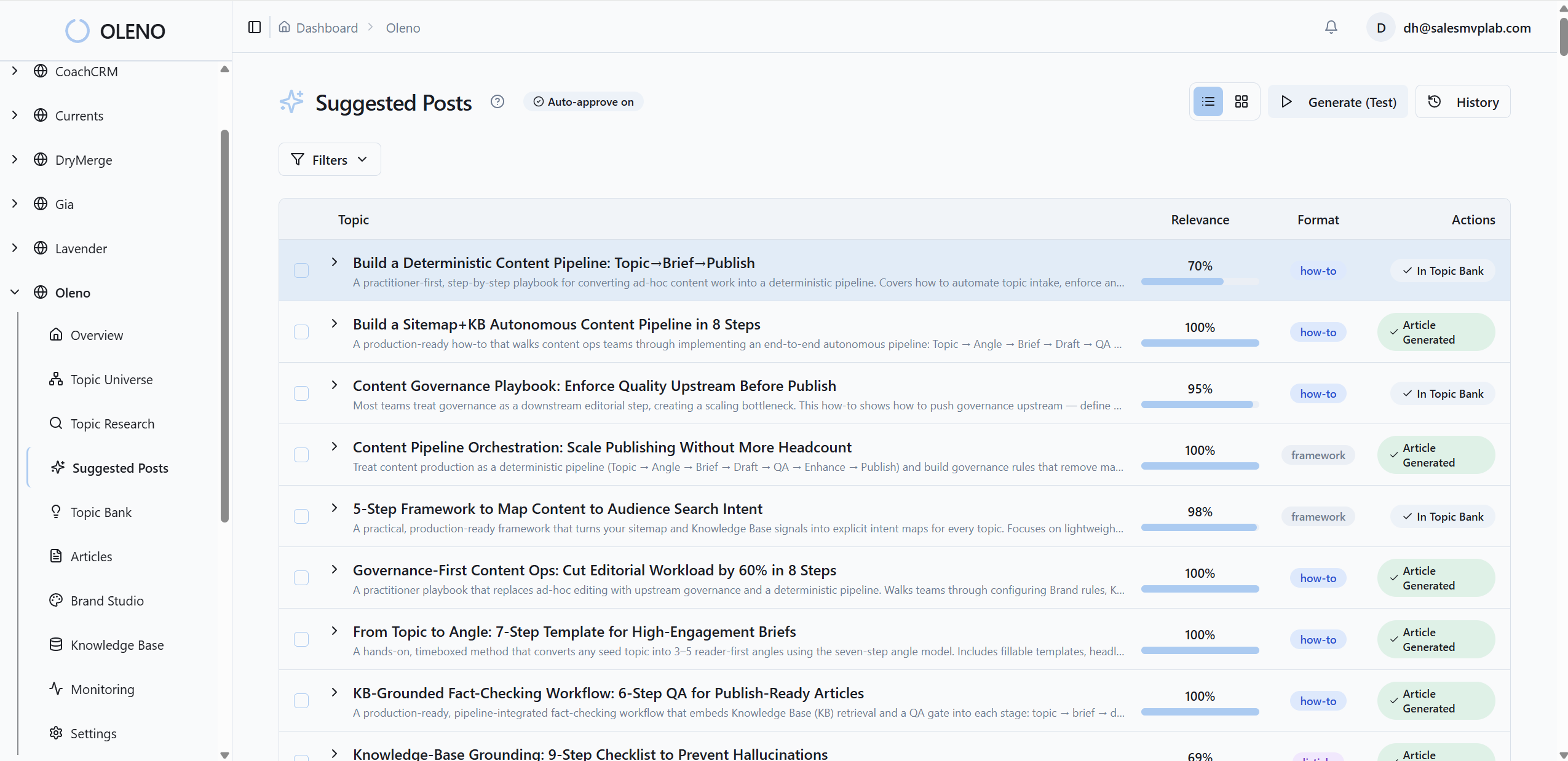
Because the inputs are saved with the brief, anyone can audit why something passed. That’s the governance you’ve been trying to do in spreadsheets. Briefs also include 40–60 word snippet-ready intents for each H2, so structure is defined early, not patched later.
It’s upstream by design. Which is where differentiation belongs.
Step 6: Apply QA Gates And Cooldowns In The Pipeline
After drafting, Oleno runs a QA-Gate that checks 80+ criteria—structure, voice alignment, KB accuracy, snippet readiness, and more—with a minimum passing score enforced. Drafts that fail are refined and re-tested automatically until they meet thresholds. Combine that with Topic Universe’s 90-day cooldown to avoid over-covering the same ideas.
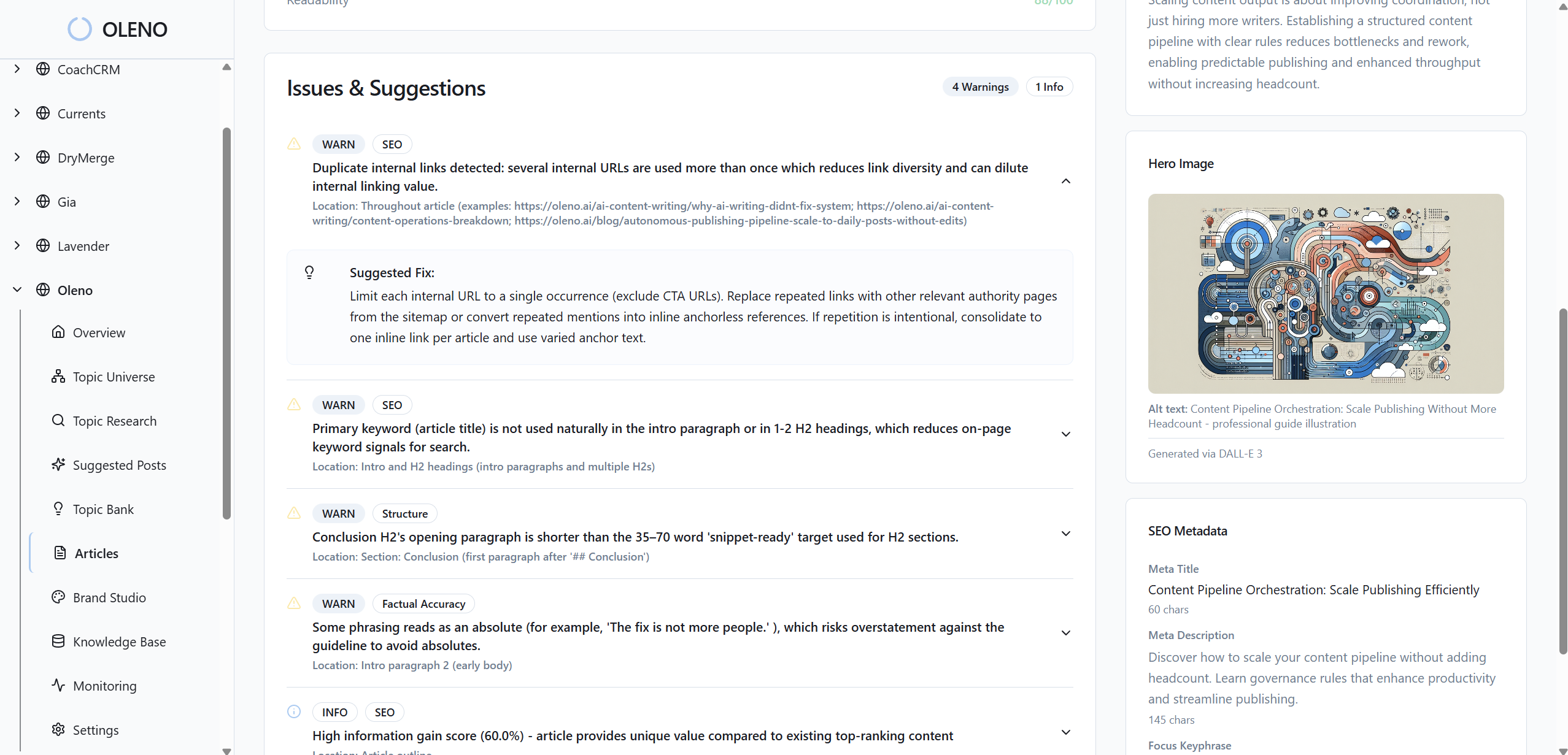
This isn’t performance tracking. It’s quality enforcement. The outcome is predictable: fewer surprises at publish time, fewer “we missed a section” edits, and more pieces that earn citations because the opening paragraphs answer questions directly.
Want always-on output without babysitting handoffs? Try Using An Autonomous Content Engine For Always-On Publishing.
How Oleno’s Deterministic Enhancements Reduce Rework
Oleno handles the plumbing deterministically. Internal links are injected from your verified sitemap with exact-match anchors. Schema markup (Article, FAQ, BreadcrumbList) is generated programmatically. Visual Studio produces brand-consistent hero and inline images, matches product screenshots to relevant sections, and generates alt text and filenames.
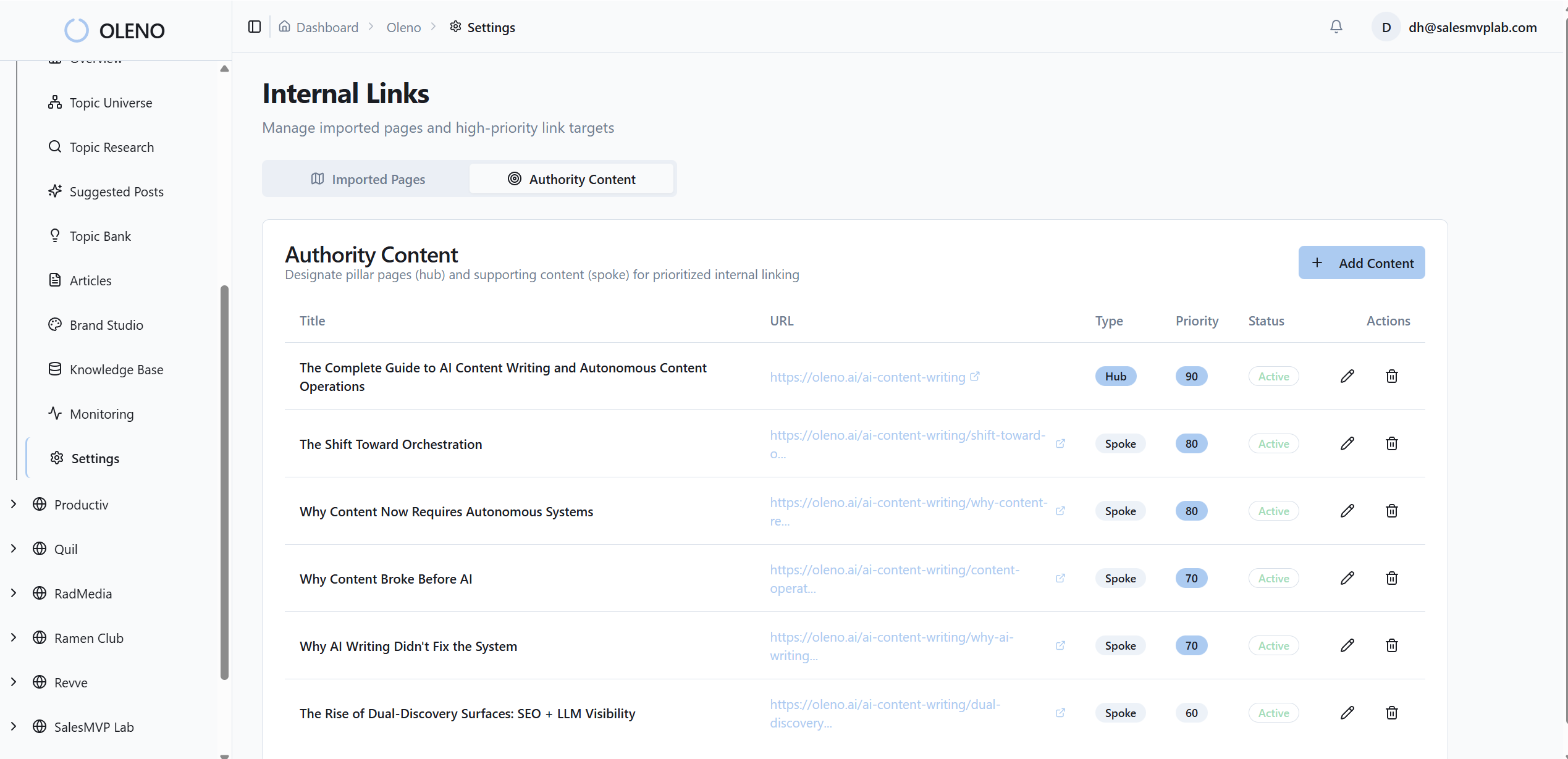
The result isn’t perfection. It’s fewer variables. Editors focus on substance, not commas or where a screenshot should live. Publishing connectors push to WordPress, Webflow, or HubSpot with mapped fields and duplicate prevention. And yes, the system keeps internal logs for retries—so the pipeline is explainable without turning into a dashboard.
If the financial math earlier made you wince, this is where you earn back that time and spend it on better angles.
Conclusion
Here’s the throughline. You don’t beat sameness by writing faster. You beat it by refusing to write until the brief proves novelty—and then letting a system carry that intent to the finish line. Score information gain up front. Store the evidence. Keep structure snippet-ready. Let code handle the boring parts.
When we’ve run this play, volume doesn’t drop; waste does. Authority compounds because every new page actually adds something. If you want help turning that into muscle memory, Oleno’s pipeline was built for it. It keeps the gate upstream and the execution steady. And it leaves your team to do the one thing machines can’t fake: add real, new insight. Try Oleno For Free.
About Daniel Hebert
I'm the founder of Oleno, SalesMVP Lab, and yourLumira. Been working in B2B SaaS in both sales and marketing leadership for 13+ years. I specialize in building revenue engines from the ground up. Over the years, I've codified writing frameworks, which are now powering Oleno.
Frequently Asked Questions