Enforce Differentiation: Information-Gain Briefs to Prevent Repeat Content

Most teams think the fix for repetitive content is better prompts or faster writers. I’ve done both. Back when we ran Steamfeed, volume plus unique angles fueled real growth. Later, on small SaaS teams, we could write fast, but sameness crept in the moment briefs mirrored what was already ranking. The pattern was clear: uniqueness breaks before anyone writes a word.
If you do not enforce differentiation at the brief stage, you pay for it later with frustrating rework, cannibalization, and content that never earns citations. That is why we use information gain as a measurable gate, not a suggestion. It turns originality from a hope into a decision.
Key Takeaways:
- Treat information gain as a measurable score embedded in your brief, not a vague instruction
- Push uniqueness checks upstream to stop low-value drafts before they start
- Map existing coverage and cluster saturation to set realistic thresholds
- Quantify the cost of low-gain pages so fixes get prioritized
- Turn policy into code: thresholds, cooldowns, and override rules that are visible
- Use visuals, structure, and net-new facts to drive information gain, not synonyms
- Enforce gates at brief, QA, and publish time to protect writers and your brand
Faster Drafts, More Repetition: Why Uniqueness Breaks Before Writing
Information gain is the delta between what already exists and what your page adds, made measurable. You compare your outline to top SERP pages and your own corpus, then score novelty in facts, structure, and visuals. A low score signals redundancy. For example, two lookalike H2 sets often predict cannibalization later.

What is information gain and why does it matter?
You can’t fix sameness with copy edits. You fix it by changing the inputs. Define an information gain score that blends net-new, verifiable facts, novel structure, and teaching visuals. Weight it to match intent. Product-led topics might favor screenshots that show proof, while research-led topics might reward original data.
Information gain is not a universal truth. It is a scoring choice that should map to your strategy. If you need more product proof this quarter, boost the visual weight. If you are building a data moat, weigh original stats higher. The point is to own the weights and make them visible.
The hidden cost of sameness
Redundant pages burn editing time, dilute internal links, and confuse crawlers. Let’s pretend you ship 20 posts a month and 40 percent are low-gain. If each needs 1.5 hours of post-publish fixups, that is 12 hours a week gone. The cannibalization tax quietly depresses both the new and existing page.
Writers also pay the morale tax. “Be more original” after they wrote to the brief is demoralizing. That is on the process. Enforcing originality before writing shifts feedback from taste debates to “we did not clear the threshold, here is what to add.” The work gets clearer and less political.
For context on why faster drafting alone creates repetition, see ai writing limits.
A quick narrative shift: you, us, the system
You do not need more prompts. You need gates. Put checks at the right stations so originality is predictable.
I have scaled content with and without gates. With gates wins. Fewer arguments, fewer hotfixes, fewer “quiet” SEO regressions. Your pipeline calms down, your results get steadier.
The system is the fix. Write a rule once. Reuse it daily. If you are constantly coaching writers to be unique, you are paying the price of missing gates. Curious what this looks like in practice? You can Request a demo now.
Treat Differentiation As An Engineering Checkpoint
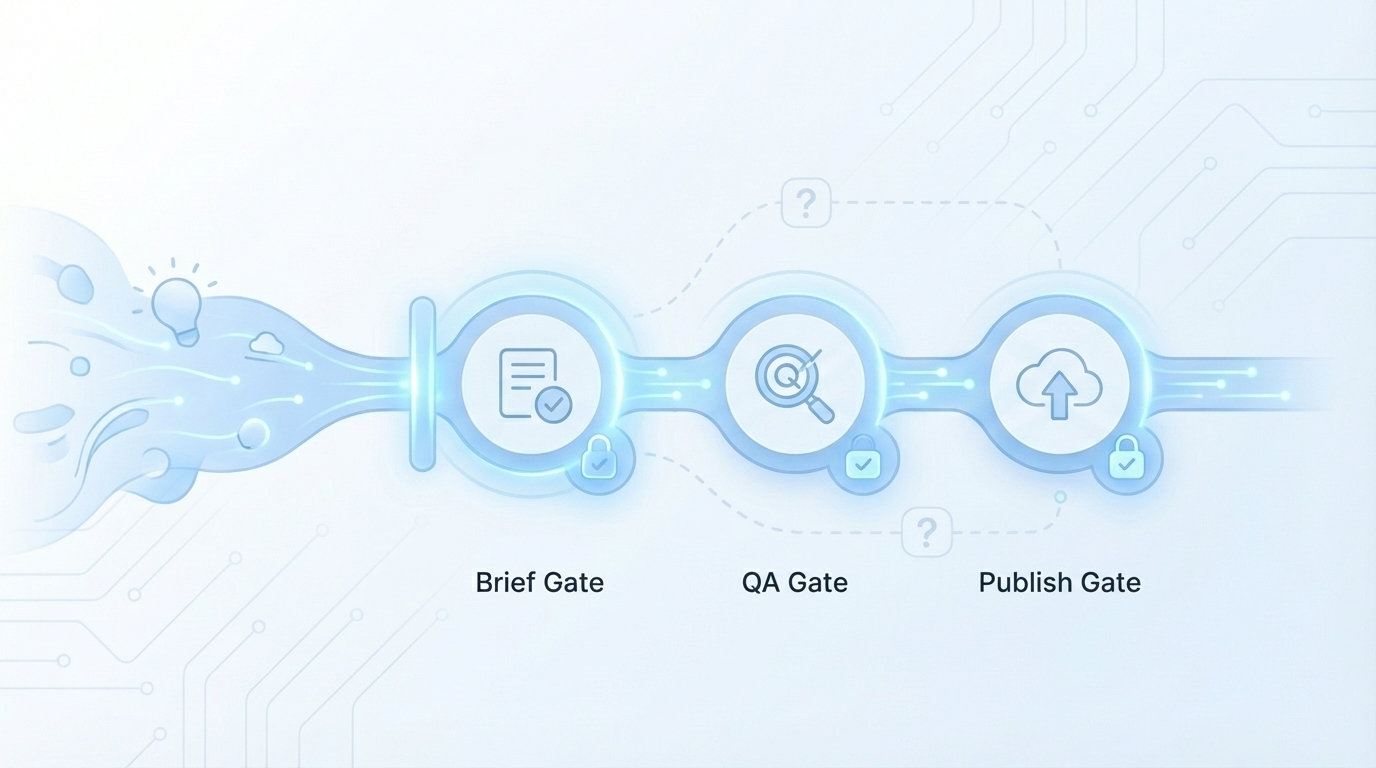
Differentiation should work like a build check in your pipeline. You map what you already have, snapshot the SERP, and measure your outline against both. Then you set pass or fail before drafting. A brief that cannot clear the bar does not ship to writers.
Map existing coverage from your sitemap and KB
Start with your house. Export your sitemap and tag each page by topic, intent, and cluster. Pull titles and H2s into a simple index. Compute nearest neighbors so you can spot cannibalization risks before you create another near-duplicate.
Index your knowledge base and product docs too. Extract unique, quotable facts you already own. If your KB is thin, your information gain ceiling is low. Often the best fix for “low differentiation” is adding proprietary data to your KB, not rewriting the same points again.
Label clusters as underserved, healthy, well-covered, or saturated. Then set higher information gain thresholds in saturated clusters. A 90-day cooldown on recent topics also prevents over-coverage and keeps the pipeline diverse.
How do you snapshot competitors without vendor tools?
Scrape the top five to ten pages for titles, H2s, and FAQ blocks. Break them into sections. Embed at the chunk level so you can compare your outline bullets to specific competitor sections, not whole pages. That is where the differences show up.
Vectorize your outline bullets and compute cosine similarity to those chunks. If a bullet is above 0.85 similarity to multiple competitors, flag it. Replace with evidence-backed additions, original data, or product proof. Track entities too, not just keywords, so you can introduce new concepts or bring first-hand experience where others are abstract.
For a broader view on information gain’s role in differentiation, see Animalz on information gain and this overview from Exploding Topics.
Build a topic baseline you can measure against
Create a JSON baseline per topic with four lists: common coverage, missing perspectives, shallow sections, and a “what good looks like” checklist. Require briefs to fill a minimum number of missing items before they pass.
Track a running count of net-new, cite-able facts per outline. A fact is verifiable, not a paraphrase. If you cannot cite it or show it, do not count it. Add visual expectations too. Plan one to two proprietary visuals that teach, not decorate, such as a product workflow or a data graphic.
If you want more context on why fragmented operations miss these checks, read the content operations breakdown.
The Cost Of Low‑Gain Pages Adds Up Fast
Low-gain pages soak time, suppress traffic, and chip away at brand trust. The numbers might look small on a single post. They add up quickly across a quarter. You feel it when your best pages wobble and your team spends Mondays rewriting last week’s work.

What’s the real cost of repetition?
Let’s pretend eight of your twenty monthly posts are low-gain and each causes a 15 percent drop on a related page. If that related page brings 1,500 visits per month, you lose 225 visits per low-gain post. Multiply by eight and you have suppressed 1,800 visits, plus the rewrite time.
The editorial cost compounds too. At 1.5 hours of rework each, that is 12 hours per month. That is one high-gain asset not created. Opportunity cost is a real cost, even if it does not show on a dashboard.
The hidden blockers nobody budgets for
Review churn grows when there is no gate. Drafts bounce between stakeholders. Opinions multiply, clarity fades, facts do not. A pre-draft gate steadies the process and keeps feedback grounded in evidence, not taste.
Publishing volatility creeps in. Thin pages need hotfixes. Hotfixes create distrust in the pipeline. When gates sit upstream, shipping becomes predictable, which usually matters more than a single win.
Link graph decay is slow but real. Low-gain pages siphon internal links from your best assets. Authority disperses. Rankings wobble. This is how “we are publishing more” turns into “we are ranking worse.”
Convert the pain into policy
Hard-code the math into your brief template. Require a minimum number of net-new facts, unique subtopics relative to the baseline, and at least one proprietary visual. Make it a scored checklist. Name the reviewer who approves exceptions.
Move editorial energy from rewriting to sourcing. Add a “missing evidence” column and assign owners to chase data, screenshots, or customer input. Incentives matter. Recognize high-gain outlines that pass QA without rework. It changes behavior faster than warnings.
If rework is swallowing your week, consider automating quality gates. Here is how an automated QA gate cuts manual reviews, and how to turn rules into code with governance as code.
Make Originality A Gate, Not A Guideline
Guidelines create polite suggestions. Gates create consistent outcomes. Put hard stops at brief, QA, and publish time. Keep them small and sharp. When the checks are visible and fair, teams support them.
When should you enforce gates?
Gate number one is the brief. If the information gain score is below your threshold, it goes back. No exceptions without a named approver and rationale.
Gate number two is QA. Recompute information gain after drafting. If the score drifts below threshold, route it back with a minimal-change fix list. Add a stat here, insert a screenshot there. Keep it surgical.
Gate number three is publish time. This should be a formality when upstream gates work. Still, enforce a hard stop for missing schema, visuals, or external citations promised in the brief. To understand why coordination beats guidelines, start with the content orchestration shift.
The human side of hard stops
Explain the why. Gates protect writers from random rewrites and protect the brand from thin pages. Framing matters. People back systems they understand.
Make exceptions visible. Keep a shared log of overrides. If leaders want to ship a low-gain page for a campaign, record it. Patterns become obvious quickly.
Keep the gate tight. A handful of high-signal checks beats a bloated list nobody reads. Start with information gain, snippet readiness, visuals present, and KB-grounded claims.
Policy to code translation
Store thresholds and cooldowns in a simple JSON config. Keep it in version control. Treat changes like code changes with lightweight review.
Lint your briefs. Validate fields like net-new facts, missing perspectives included, and visual plan. Fail builds if empty. No drama, just a red build.
Capture snippets for each H2 early. A 40 to 60 word direct answer cuts fluff and improves eligibility for quotes across search and AI. For a system-level view, see why autonomous content operations matter more than ad hoc writing.
Build And Enforce Information‑Gain Briefs
A useful score is simple to compute, aligned to intent, and hard to game. Blend facts, structure, and visuals. Normalize inputs so teams know exactly how to pass. Then work a quick example so everyone sees the math.
How do you compute a practical score?
Use a weighted formula: IG = 0.5×F + 0.3×S + 0.2×V, where F is net-new facts, S is unique structure coverage versus baseline, and V is proprietary visuals that teach. Adjust weights by intent. A product-led term might shift to 0.4, 0.3, 0.3 to reward proof.
Normalize F by dividing unique facts by a target, say eight. Normalize S by counting unique subtopics from the “missing” list you defined. Normalize V by planned visuals that convey new information, not stock art. Keep it simple enough to automate and defend in review.
One caution. Classic information gain in ML favors attributes with many values. Do not recreate that bias. Penalize superficial “newness” such as synonyms. Reward cite-able, checkable additions. For more on bias tradeoffs, review MITRE’s comparison of information gain vs. gain ratio.
Structure and visuals matter too
Structure is not decoration. Compare your H2 and H3 set to the SERP baseline. Award points for novel sections tied to user jobs, not just another “benefits” block. Map each H2 to an unmet need you found in your snapshot.
Visuals carry information, or they do not count. Plan one product screenshot per solution section and at least one data visual that explains a method or result. Score visuals only if they teach something text alone would not. And require a 40 to 60 word snippet under each H2. That forces clarity and improves eligibility for quotes, which ties to dual-discovery surfaces.
Worked example (let’s pretend…)
Topic: “API rate limiting best practices.” Baseline shows eight common subtopics. Your brief adds three missing angles, such as adaptive budgets, async backoff telemetry, and client advisory headers. S covers three of five missing items, so 0.6.
Facts: you include ten net-new, verifiable facts, like header examples, error code ranges, and queuing models. With a target of eight, F caps at 1.0.
Visuals: you plan two visuals, a flow diagram and a code-path screenshot. V is 2 of 2, so 1.0. IG equals 0.5×1.0 + 0.3×0.6 + 0.2×1.0, which is 0.88, or 88 out of 100. That passes with room to spare.
Instead of spreadsheet scoring and manual nudges, see how a system handles this end to end, then keeps running daily. If that sounds useful, you can try using an autonomous content engine for always-on publishing.
For additional perspectives on information gain and SERP differentiation, see InLinks’ framing and MarketMuse’s structure-focused approach.
How Oleno Enforces Information Gain Across Your Pipeline
Oleno treats differentiation as a first-class gate across strategy, writing, visuals, and publishing. The system scores briefs, flags low-gain outlines early, rechecks after drafting, then ships only when quality thresholds are met. The result is fewer rewrites and steadier authority growth.
Where Oleno scores, gates, and rewards
During brief generation, Oleno performs competitive research, analyzes common coverage and gaps, and calculates a 0 to 100 Information Gain Score. Low scores trigger differentiation warnings before writing, which is the cheapest, cleanest place to fix problems. This aligns with how we’ve seen teams avoid the rewrite treadmill.
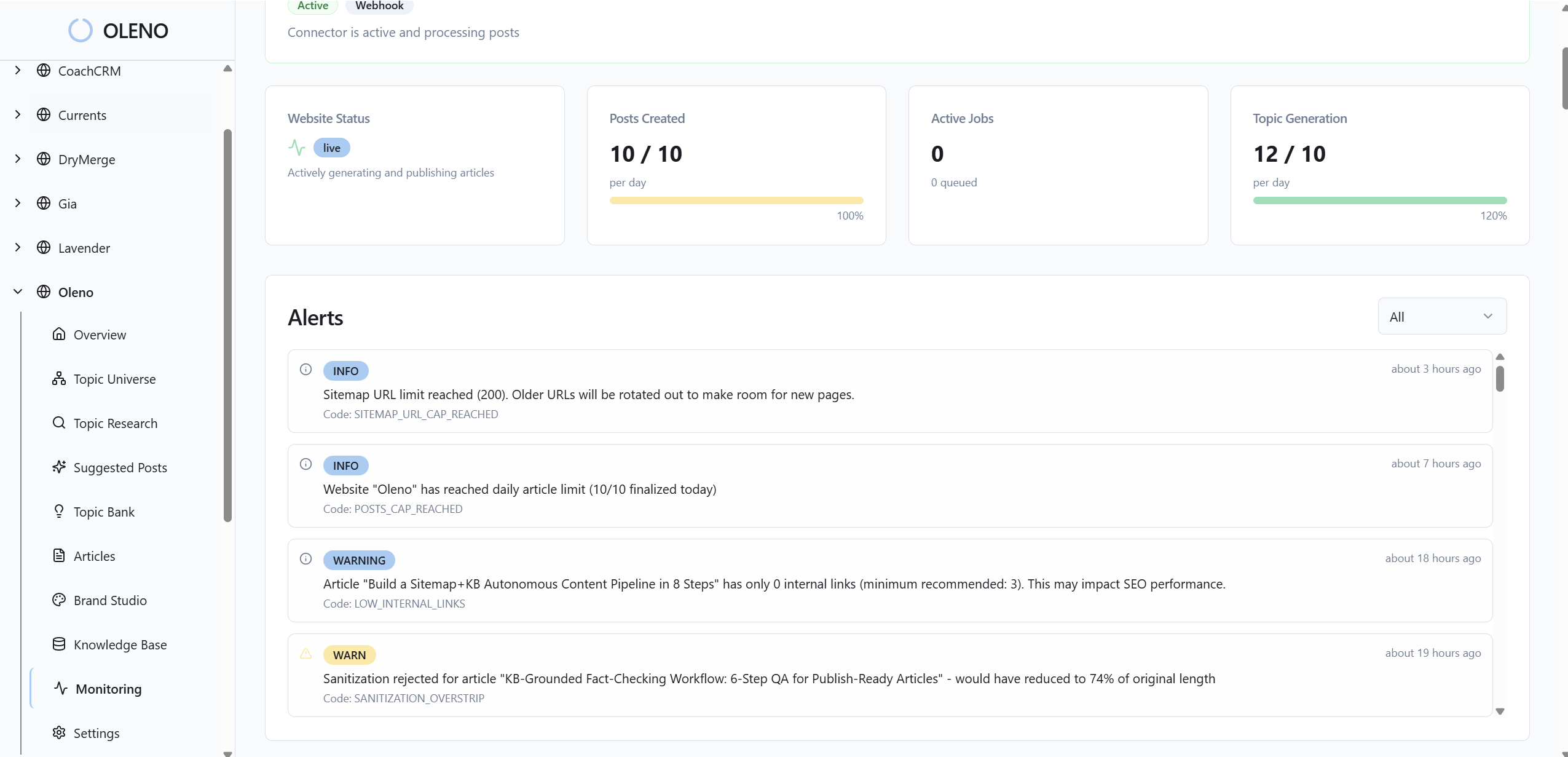
In QA, Oleno rechecks information gain alongside more than 80 criteria, including structure, snippet readiness, and visual presence. Low-scoring areas trigger refinement loops with targeted fixes, not blank-page rewrites. Publishing is deterministic. Internal links pull from verified sitemaps, schema is generated programmatically, and visuals are validated to pass thresholds.
Lightweight automation recipes you can mirror
You can mirror Oleno’s brief fields without adopting the full platform. Track baseline gaps, a net-new facts count, planned proprietary visuals, snippet-ready H2 intros, and a computed information gain score. Fail the brief if fields are empty or the score is below threshold. Keep overrides visible with owner and rationale.
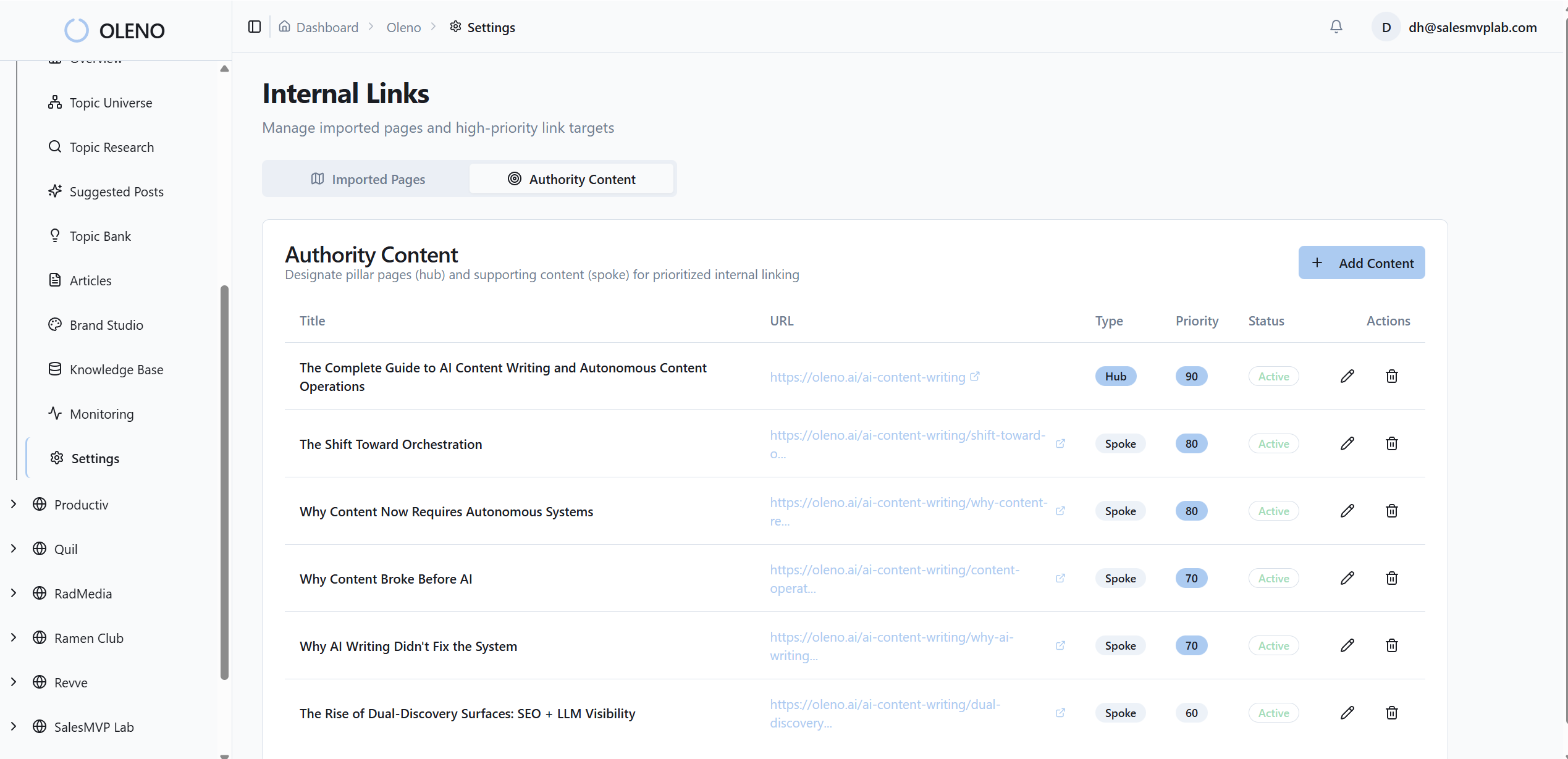
Oleno stores thresholds, cooldowns, and cluster saturation rules in configuration, which you can emulate. Tie stricter information gain requirements to saturated clusters to avoid repeating yourself. For a deeper look at why system-enforced gates matter, read the autonomous systems rationale. If you want to explore the full loop, start with autonomous content operations.
Ready to cut rewrite time and make originality predictable? If so, you can Request a demo.
Who benefits most and when to use this?
Teams publishing frequently that see diminishing returns benefit first. If new posts do not move the needle, your issue is likely differentiation, not volume. Orgs with strong product knowledge but scattered docs get an immediate lift once their KB raises the ceiling for unique angles.
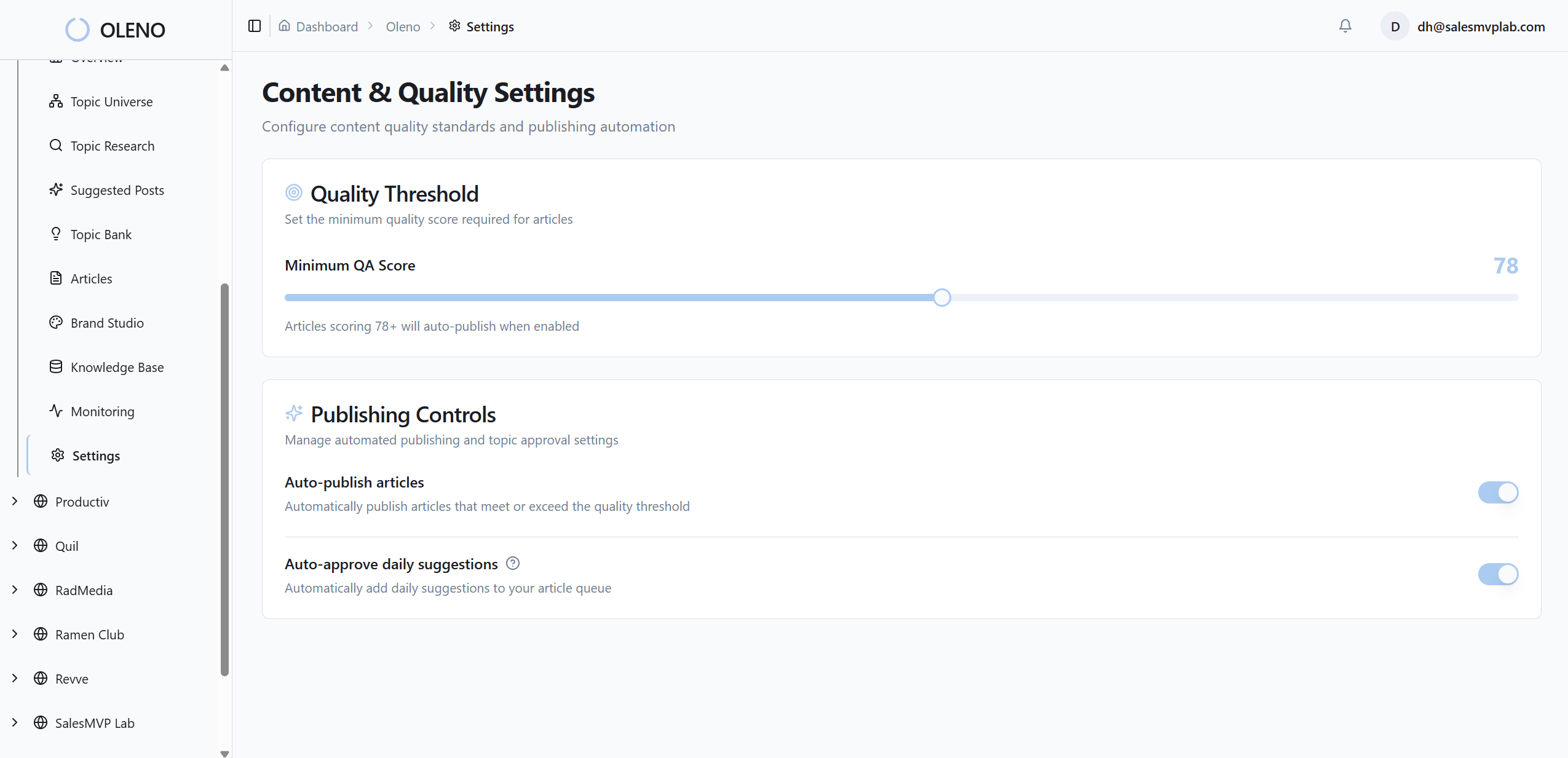
New clusters need some slack. Oleno supports relaxing thresholds at launch, then tightening as coverage builds. The system keeps you honest later, when the risk of repeating yourself goes up. For practical gating mechanics, also see InLinks on information gain.
Set Thresholds, Cooldowns, And Override Rules That Stick
Set clear pass or fail bands, enforce cooldowns, and make overrides visible. Put the rules in code, not slides. Then review them like any other part of your stack. You get consistency without turning writing into bureaucracy.
Define pass/fail bands and cooldown rules
Start with pragmatic bands. Publish-ready at 75 and above, needs additions between 60 and 74, blocked below 60. Tune by cluster saturation. Mature clusters need higher scores to proceed. Revisit monthly as you learn where false positives and negatives show up.
Enforce a 90-day cooldown for topics you just covered unless the information gain score clears 85 or a product release yields truly new facts. Cooldowns reduce cannibalization and nudge teams toward underserved clusters. This plays well with a Topic Universe view that tracks coverage and saturation.
When should you override the gate?
Urgent product releases with materially new capabilities warrant an exception, but insist on proprietary visuals and first-hand details to earn the pass. Incident response and breaking changes should go out quickly, then expand later and consolidate to avoid long-term overlap.
Strategic anchor pages sometimes justify consolidation. Plan redirects and internal link updates so you do not permanently duplicate coverage. Keep the override log open to everyone so policy drift is obvious.
Policy as code patterns
Keep thresholds in a configuration file consumed by your brief generator and QA scripts. Expose them in the UI so teams see the rules. Add unit tests for edge cases, such as near-threshold briefs, synonym-heavy paraphrases, and visuals that do not teach. Tests keep your gate honest as you iterate.
Log every gate outcome with topic, score, decision, and owner. This reveals training needs faster than anecdotes, like a recurring weakness in visuals or shallow sections. If you want a practical blueprint, translate your rules into policy as code. For broader context, revisit the content operations breakdown.
Conclusion
If you enforce differentiation before anyone writes, you stop paying the rework tax later. You ship fewer, stronger pages. Your best assets keep their rankings. Writers know what “good” means in objective terms. Editors spend time sourcing evidence, not rewriting the same section for the third time.
We learned this the hard way. Scaling without gates looks productive on a calendar and costly in the results. The fix is a system that measures information gain at the brief, validates it again at QA, then ships only when the article is complete, teachable, and on-brand. That is how authority compounds.
If you want a head start, treat information gain as a first-class field in every brief. Make the score visible. Tie thresholds to cluster saturation. Keep overrides rare and recorded. And if you want to see a fully automated pipeline handle the heavy lifting while you focus on strategy, you can try using an autonomous content engine for always-on publishing.
About Daniel Hebert
I'm the founder of Oleno, SalesMVP Lab, and yourLumira. Been working in B2B SaaS in both sales and marketing leadership for 13+ years. I specialize in building revenue engines from the ground up. Over the years, I've codified writing frameworks, which are now powering Oleno.
Frequently Asked Questions