Enough With Quarterly Content Publish More Plan Less Govern Everything

Quarterly content is usually a sign that execution is broken, not that strategy is strong, and honestly, enough with quarterly content because it trains your team to reset momentum every 90 days instead of compounding it. Demand-generation execution software is a software category that runs demand generation end to end with consistent quality and cadence by codifying governance (brand, product truth, POV), orchestrating content creation and review, and automating publishing and reinforcement so programs compound instead of resetting every quarter. Unlike planning software or another writing tool, this category is about running the system of demand gen week after week without dumping quality control and coordination back on humans.
AI made this more obvious. Drafting got faster. The messy part stayed messy. If you’re still stitching together tools, prompts, freelancers, approvals, and a CMS login, you’re not running a demand-gen system. You’re running activity. And activity loves quarterlies because quarterlies create the illusion of control.
Key Takeaways:
- Replace quarterly “big-bang” calendars with rolling 4-week sprints, and treat cadence as the product, not the plan.
- Govern once (voice, POV, product truth), then reuse those rules across every asset so you don’t pay the same review tax forever.
- Use persona variants on purpose, but keep client and segment voice isolated, or your content starts sounding like mush.
- QA sampling beats hero editing, especially when you’re shipping dozens of assets a month.
- Compounding comes from reinforcement loops, not from “new campaigns” every quarter.
Quarterly Content Feels Strategic, But It Deletes Momentum
Quarterly planning kills compounding because it forces hard resets in narrative, priorities, and production right when your content is finally starting to stick. You spend weeks in docs and decks, then you sprint, then you run out of runway, then everyone wants a new theme. It looks responsible. It’s actually expensive and it quietly erases gains.
The enemy here is fragmented, prompt-based demand-gen execution. That’s the default setup for most teams and agencies. A few tools here. A prompt library there. A freelancer or two. An SEO platform shouting at you from the corner. Everyone means well, and you still end up with drift, rework, and a weird quiet period where nothing ships because you’re “planning the quarter.” This enemy eats your margin, dulls your POV, and slows sales.
Quarterly Cadences Create Content Amnesia And Delete Momentum
Quarterly cadences create what I call content amnesia. You forget what worked. You forget what you believed. You forget the exact phrasing that made sales say, “that’s the one.” Then you swap in a new pillar, new messaging, new briefs, new stakeholders, and you basically restart the machine.
This is the part people miss: compounding doesn’t happen because you published one strong piece. It happens because you published 30 pieces that reinforce each other. Internal links start making sense. Topic clusters start having gravity. Your POV shows up in multiple places, with repetition that doesn’t feel repetitive because it’s applied across different angles and stages.
Quarterlies break that. They turn content into a series of disconnected launches. Launch energy is fun. Launch energy also burns you out.
Prompting More Isn’t The Answer, Orchestration Is
Prompting feels productive because you can create output on demand. But output isn’t demand generation. Demand gen is a system that has to hold together across time, across authors, across funnel stages, across channels, across stakeholder opinions.
Prompting pushes judgment back onto people. People write prompts, review drafts, fix voice, catch inaccuracies, decide what to publish, decide where to post it, and then they do the whole thing again next week. As output increases, the coordination cost increases too. That’s not a moral failure. It’s just math.
Orchestration is the opposite move. You decide the rules once, then you run on rails. Not “set it and forget it.” More like “stop re-deciding the same things every Tuesday.” Not prompts, but orchestration.
Volume Without Governance Erodes Positioning Over Time
Volume without governance creates drift debt. It starts small. A slightly different tone. A different way of describing the category. A bolder claim that isn’t approved. A CTA that feels off. A metaphor that doesn’t match how you talk.
Then it piles up.
A few months later, your library is big, but it’s not coherent. Your positioning gets fuzzy. The market doesn’t get a clean frame for what you are. And the worst part is you can’t point to one mistake. It’s death by a thousand paper cuts.
So you add more review. More edits. More meetings. And now your “scale” plan is actually a headcount plan.
The Hidden Problem Behind Quarterly Content Is Categorization, Not Effort
Most teams are stuck because they’re buying tools by category, not by outcome, and quarterly content becomes the coping mechanism that makes fragmented execution feel manageable. You don’t need more ideas. You need a system that can keep shipping with the same narrative spine, the same voice, and the same quality bar.
This is where demand-generation execution software matters as a category lens. It’s not a fancy label. It’s a way of saying: stop patching the workflow. Run the workflow. Not more plans, but a governed operating system for demand gen.
The Real Bottleneck Is System Execution, Not Ideas
I’ve rarely met a team that didn’t have good ideas. They’ve got a Notion full of them. A backlog of “we should write about…” a mile long. They’ve got smart founders, smart PMs, smart AE feedback, smart customer calls.
They still can’t ship consistently.
What breaks is the system. You need a consistent point of view. You need content that’s grounded in product truth. You need multiple asset types across the funnel. You need publishing and distribution to happen without a weekly fire drill. You need reinforcement so winners don’t die after one spike.
If any one of those is manual and ad hoc, the whole thing turns into a fragile chain. And chains snap under pressure.
Replace Campaign Thinking With A Governed Flywheel
Campaigns have a built-in reset button. You start. You run. You end. Then you “move on” to the next thing. Demand gen doesn’t work like that if you want compounding.
A governed flywheel is different. You pick enduring pillars. You ship in small batches every week. You repeat your POV on purpose, across different formats and stages, so the market actually learns it. And you don’t treat reinforcement as an afterthought.
The weekly rhythm matters more than the quarterly plan. That’s counterintuitive for a lot of teams, especially when leadership loves big launches. But you can still do launches. You just can’t let launches be the only time the machine runs. Not campaigns, but cadence.
Name The Enemy: Fragmented, Prompt-Based Demand-Gen Execution
Fragmented, prompt-based demand-gen execution persists because it’s familiar. Everyone can buy a tool. Everyone can hire a freelancer. Everyone can throw prompts into ChatGPT. It feels like progress.
But no one owns the end to end system.
So quality control ends up living in people’s heads. Voice lives in a Google Doc that no one reads. POV lives in a deck that was good two quarters ago. Product truth lives in a PMM’s anxiety. Publishing lives with “who has access to the CMS again?”
You can keep doing it. Most teams do. Just don’t be surprised when quarterlies become the default, because quarterlies are the only way to contain the chaos.
Quarterly Content Creates A Coordination Tax That Scales With Every Asset
The cost of the old way shows up in time, money, and missed compounding, and it usually gets blamed on “we need more people” when the real issue is that the system is doing too much manual work. A quarterly reset every 3 months means you’re constantly rebuilding briefs, re-arguing messaging, and re-onboarding contributors. Add volume, and the review and meeting load grows right alongside it.
Let’s pretend you’re a lean SaaS team trying to ship 30 assets a month across blog, landing pages, competitive pages, and social. If every asset needs 2 rounds of review, a Slack thread, and a meeting to resolve “tone,” you’re not scaling content. You’re scaling coordination, especially when evaluating enough with quarterly content.
As Output Grows, Review Cycles Explode And “More” Becomes A Trap
At low volume, manual review feels fine. You can catch things. You can rewrite. You can “just fix it in editing.” Then you try to double output.
Now every review cycle is a bottleneck. Not because your team is lazy. Because every draft is a snowflake. Every draft needs judgment. And judgment doesn’t batch well.
This is where people start getting frustrated. Writers feel whiplash. Editors become the bad guy. Stakeholders start nitpicking because they don’t trust the system. The meeting tax creeps up, and suddenly publishing slows down right when you’re trying to speed up.
Governance compresses review by shifting decisions left. Decide once. Enforce always. That’s the whole point.
Manual Headcount Is Often 10x The Cost Of A Governed System
Manual scale is expensive because it’s headcount heavy. Freelancers. Agencies. Editors. Project managers. And the hidden cost is that every new person increases coordination.
A governed system flips the cost curve. One strategic owner who knows the product and the market, plus AI under strict rules, can often produce a huge amount of content for a fraction of the cost. Not because the writing is magic. Because you’re not paying for rework and meetings on every single asset.
I’ve lived the headcount trap. When I started at PostBeyond, I could crank out 3-4 high quality blog posts per week because I had all the context and I had a structured framework. When we added a writer, output didn’t speed up. It slowed down. They didn’t have the context, they took longer, and the drafts needed more fixing. And I had less time to write because I was in exec meetings managing the team.
That pattern repeats everywhere. If the system doesn’t transfer context, you pay for it forever.
Breadth Plus Depth Creates Step-Function Discovery After 500 Assets
Compounding is real. It just takes more volume than most teams can stomach.
Back in 2012-2016 I ran Steamfeed. At our peak, we hit 120k unique visitors a month. We had 80 regular contributors submitting one post a month, and over 300 guest contributors submitting occasional posts. We saw spikes at 500 pages, 1000 pages, 2500 pages, 5000 pages, then 10000 pages.
Most pages were getting under 100 views a month. That’s the part people love to mock. But volume plus quality meant we ranked for a ton of high intent long tail keywords. The long tail stacked up. And it turned into real traffic.
Quarterly content strategies rarely get you to 500 assets with coherence. They get you to 30 assets and a rebrand deck.
The Quarterly Treadmill Feels Busy, And That’s The Problem for Enough with quarterly content
Quarterly content feels like you’re doing a lot, but it’s brittle, and you can feel it when you’re the one on the hook. You plan for weeks, a launch slips, sales needs a deck, the CEO wants a new message, then the quarter ends and everyone agrees to “reset and rethink,” even though you barely shipped.
You Plan For Twelve Weeks, Then Ship For Two
You spend a month on strategy. Another month on briefs, approvals, and stakeholder alignment. Then you get a two week window where you actually publish, and it’s frantic.
Quality drops. People cut corners. You ship things you’re not proud of. Then the quarter ends and you’re back in planning mode again, trying to explain why the last plan didn’t produce compounding.
It’s a headache. And the most annoying part is you can’t point to one villain. It’s just the system you’re stuck in.
Your Voice Changes Week To Week, And Trust Slips
Voice drift is sneaky. You don’t notice it in a single piece. You notice it when your library starts feeling inconsistent, and your buyers can’t tell what you stand for.
Sales feels it too. They’ll say things like, “we don’t have a great piece for this objection,” even though you have 200 pieces. Or “our content is all over the place,” even though everyone is working hard.
That’s what drift does. It erodes trust a little at a time. Then you lose deals and you don’t even know why.
Enough With Quarterly Content, Here’s The Governance-First Playbook That Actually Compounds
You can publish more and plan less by switching from quarterly deliverables to a rolling system built on rules, jobs, and reinforcement loops. This isn’t “post more.” It’s “stop rebuilding the machine every quarter.” Not another calendar, but a compounding engine.
This playbook is for lean B2B SaaS marketing teams and agencies who can’t just hire their way out, and who are tired of gambling on quarterly launches. You want steady output, consistent POV, and a quality floor that doesn’t collapse when priorities shift.
Govern Once: Define Truth, Opinion, And Constraints In One Place
Governance is the stuff you keep re-explaining. That’s why it matters. If it lives in people’s heads, it doesn’t scale.
So you write it down. And you keep it current. And you treat it like a product.
At minimum, you want three buckets:
- Brand voice rules, tone, terms you use/avoid, structure conventions, CTA patterns, and how direct you are.
- Market POV, what you believe, what you’ll say that’s different, the enemy you’re calling out, and the buyer frame you want to reinforce.
- Product truth, allowed claims, boundaries, supported vs. unsupported use cases, and what legal/product marketing will actually stand behind.
If you skip this, you’ll pay for it in review cycles. Every time, especially when evaluating enough with quarterly content.
Orchestrate End To End: Jobs, Cadence, Publishing, And Distribution On Rails
Orchestrating end to end means you stop treating every asset like a custom project. You define jobs. You define the cadence. You define what “done” means. And you make distribution part of the job, not a separate “we’ll get to it” step.
A simple version looks like this:
- Rolling 4-week sprint planning, not a 12-week calendar
- Weekly release targets (small batches, high frequency)
- A job library mapped to the funnel (Acquire, Educate, Convert, Retain)
- Clear review rules, with SLAs, so things don’t sit in limbo
- Publishing steps that don’t depend on one person’s memory
- Distribution lanes (site, social, email, communities) with a default cadence
One sentence interruption, because it matters. Most teams don’t actually have a distribution plan, they have a “post it on LinkedIn when we remember” plan.
Agencies feel this even harder because retainer cycles naturally push you into quarterly deliverables. It’s how clients expect to buy. But quarterlies scale coordination, not impact. If you shift to rolling governed production, clients get steady value and your margins usually improve because you’re not rebuilding context every quarter.
Compound Deliberately: Reuse Winners Instead Of Resetting Every 90 Days
Compounding needs reinforcement. That means you don’t treat publishing as the end. You treat it as the start.
A reinforcement loop can be pretty simple:
- Track what topics and angles are performing (not just traffic, also sales usefulness and conversion intent)
- Refresh winners quarterly without changing the POV
- Repurpose long-form into short-form regularly, with consistency
- Interlink aggressively inside clusters so the library becomes a system
- Maintain a living topic map so you don’t duplicate yourself or drift off-message
When I was at LevelJump, we did a ton of founder-led content. We’d record videos with the CEO, transcribe them, and turn them into posts. It was fast. It also missed SEO structure and topic discovery, so it didn’t capture search intent the way it could’ve. The lesson for me was clear: raw insight is gold, but without a repeatable structure and a way to pick the right topics, it won’t compound.
That’s why the system matters more than any one piece.
Old Way Vs Demand-Generation Execution Software (The One Table You Should Show Your Client)
Demand-generation execution software is different from stitched-together tooling because it treats demand gen like an operating system, not a pile of tasks. This table is the cleanest way I’ve found to explain it without getting lost in tool names. Share it with a skeptical exec and watch the lightbulb go on.

| Dimension | Old Way | Category Way |
|---|---|---|
| Planning cadence | Quarterly resets, big launches, long pre-work | Weekly governed releases that compound steadily |
| Governance | Ad-hoc guidelines, humans enforce inconsistently | Codified rules for voice, POV, and product truth enforced everywhere |
| Cost to scale | Headcount-heavy, coordination cost rises with volume | One strategic owner plus AI, cost and quality stay more stable as volume rises |
| Consistency and voice | Week-to-week drift, rework, message erosion | Narrative discipline preserved across assets and channels |
| Review load | Heavy per-asset reviews, lots of meetings | Smaller reviews, QA sampling, fewer subjective loops |
In Practice, How Oleno Makes The Playbook Real Without The Quarterly Reset
Oleno shows what demand-generation execution software looks like when it’s actually implemented, meaning you codify your voice and POV once, then you run repeatable content jobs through a governed pipeline with quality checks before anything publishes. It’s built for lean teams and agencies that are tired of babysitting prompts, chasing approvals, and realizing every quarter that nothing compounded.

I’ll keep this tight, because the point isn’t “look at features.” The point is that the playbook above is hard to maintain manually once you’re producing at real volume.
Governance Studios Turn Voice, POV, And Product Truth Into Rules You Can Reuse
Oleno starts with governance, so you can stop re-litigating tone and claims in every draft. brand studio captures how you sound, including terms to use or avoid, structure rules, and CTA patterns. marketing studio encodes your POV and category framing so your content stays opinionated and consistent instead of drifting into generic advice. product studio grounds what you can and can’t claim, which reduces the back-and-forth that usually shows up late in the process.
This is the part I like, personally. When governance is explicit, you get fewer subjective edits. Fewer “I don’t like the vibe” comments. More shipping.
The Execution Engine Keeps Weekly Cadence From Falling Apart
Once governance is set, Oleno runs job-based production through a deterministic flow (Discover to Publish) with quality control (qa gate before publishing) so drafts don’t go live until they meet the rules for voice, structure, and grounding. variation layer & topic universe keeps you from running out of angles while still tailoring content to specific audiences and personas, which is where a lot of agencies either over-generalize or accidentally make every client sound the same.
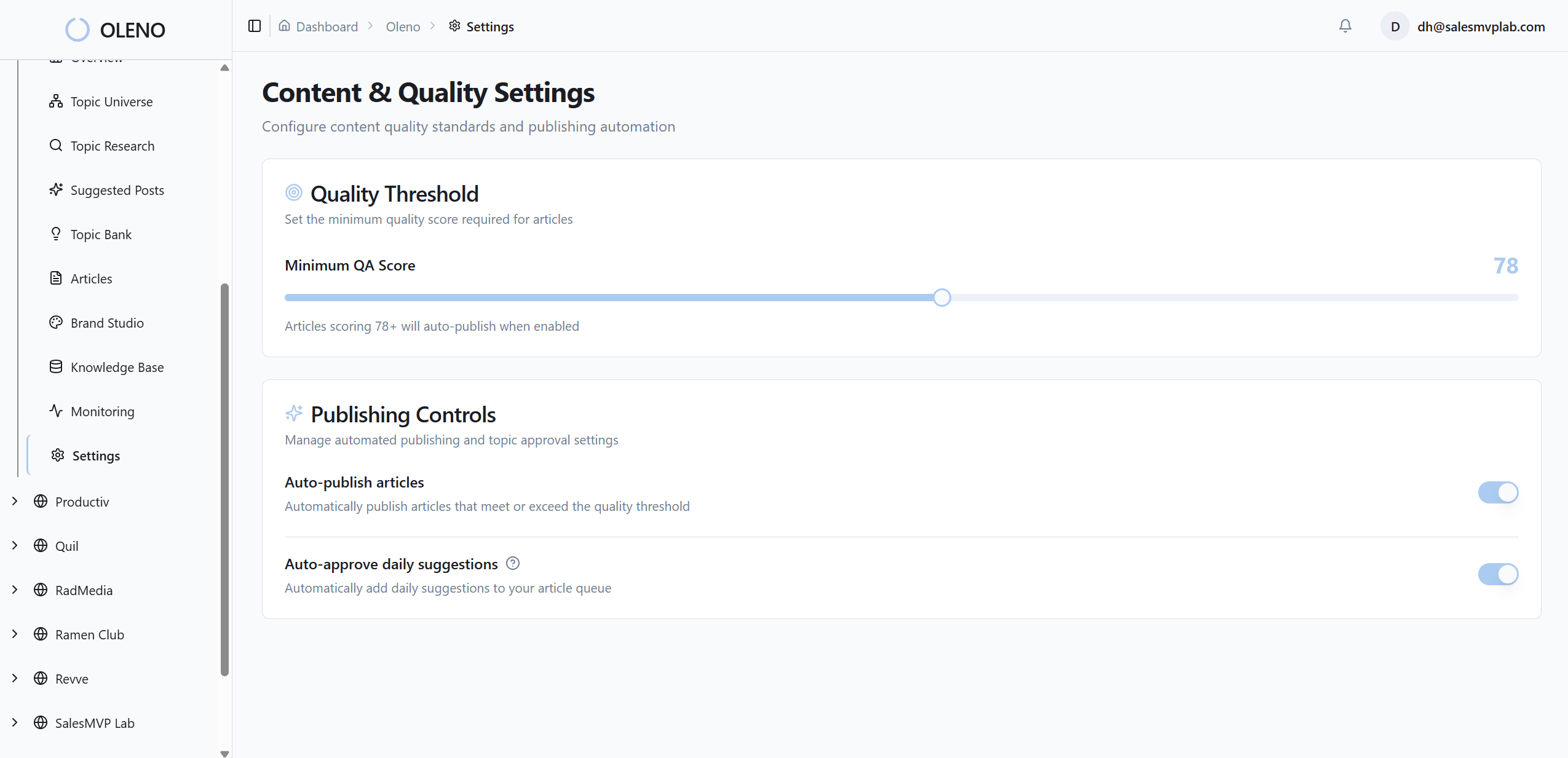
Then you close the loop. cms publishing pushes to your CMS, distribution turns approved long-form into channel-ready posts, and measurement & system health gives you a way to QA the system over time with sampling, instead of doing heavy review on every asset forever.
If you want to see what this looks like with your own voice and client constraints, request a demo.
Enough With Quarterly Content, Replace Deliverables With A Rolling System
Enough with quarterly content is really a call to stop confusing planning with progress. Planning is fine. But quarterly planning as the backbone of your demand gen creates resets, drift, and a coordination tax that gets worse as you scale.
If you run an agency, this is the migration plan I’d pitch to clients: keep the strategy, keep the POV, keep the positioning. Replace quarterly deliverables with rolling 4-week governed production. Codify client voice once. Build variants without cross-client contamination. Use QA sampling to protect quality without drowning in edits. Then measure what’s breaking in the system and fix the system, not the writer.
When you’re ready to map that migration for one account and price the margin improvement realistically, book a demo.
About Daniel Hebert
I'm the founder of Oleno, SalesMVP Lab, and yourLumira. Been working in B2B SaaS in both sales and marketing leadership for 13+ years. I specialize in building revenue engines from the ground up. Over the years, I've codified writing frameworks, which are now powering Oleno.
Frequently Asked Questions