Essential Tips for Effective Content Pipeline Management

9 out of 10 founders I talk to have the same content problem this week: they know exactly what they want to say, but they still can't get it published consistently. And the weird part is it usually isn't a strategy problem. It's an execution problem wearing a strategy costume.
You can have the messaging doc. The positioning doc. The product notes. The founder POV. Doesn't matter. If that context keeps leaking between the CEO, the marketer, the freelancer, and the AI prompt, you end up paying an editing tax every single time.
Key Takeaways:
- Effective content execution starts with encoding strategy once, not re-explaining it every week
- If your review loop takes more than 72 hours, you don't have a writing problem, you have a system problem
- Founders should stop measuring content by drafts produced and start measuring it by publish-ready output
- Teams under 3 marketers usually don't need more tools first, they need fewer handoffs
- The old patchwork of prompts, freelancers, and manual review breaks faster in GEO than it did in classic SEO
- Strong content systems separate planning, governance, and execution so context doesn't get lost
- Consistency across 20 articles beats one brilliant article followed by silence
If you've been searching for essential tips for effective content execution, start here: stop treating every article like a fresh briefing exercise. That's the hidden cost most small SaaS teams miss.
If you want to see what that looks like in practice, you can request a demo.
Why Most Content Execution Problems Are Really Context Problems
Content execution breaks when the person writing doesn't have the same context as the person setting strategy. That's the real issue. Not effort. Not even talent, most of the time.

Back in 2012-2016, I ran a digital marketing site that hit 120k monthly visitors. We had 80 regular contributors and 300-plus guest contributors. We saw SEO spikes at 500 pages, then 1,000, then 2,500, then 5,000, then 10,000. Volume mattered. But volume only worked because there was still enough depth and point of view across the content. That mix is what people miss.
The founder knows too much, and that's the bottleneck
A founder-led SaaS team usually starts with decent content because the founder writes it, reviews it, or heavily shapes it. So the first few pieces sound sharp. They have conviction. They know the customer. They know the product.
Then growth happens. Or at least the company tries to grow. A freelancer comes in. Maybe a junior marketer. Maybe ChatGPT. And now every piece needs translation. Product nuance gets flattened. Customer language gets softened. Differentiation disappears. The founder reads the draft and thinks, this doesn't sound like us.
I've seen this movie a lot. At one SaaS company, I could push out 3 to 4 strong blog posts a week because I had the context in my head and a structured writing approach. As the team grew, output actually slowed down. The writer had less product context than I did, so the drafts took longer and landed weaker. At the same time, I had less time to write because I was in exec meetings and running more of the business. Adding a person didn't remove the bottleneck. It moved it.
The visible problem is slow output. The hidden problem is translation loss
Most founders think their content issue is one of these:
- not enough time
- not enough writers
- weak AI prompts
- poor agency execution
Those are symptoms. The deeper problem is translation loss across handoffs.
Picture a Tuesday at 4:30 PM. The founder drops a voice note with three product nuances, two competitor angles, and one customer objection that really matters. The marketer turns that into a rough brief. The writer turns that into a draft. The founder reviews it on Friday night and finds seven misses in the first four paragraphs. Sound familiar? That's not because the team is lazy. It's because each handoff strips away context like a bad game of telephone.
And in a 1 to 3 person marketing team, every extra handoff hurts more. You don't have enough spare bandwidth to absorb sloppy process.
Why this gets worse in GEO, not better
SEO used to forgive a lot. You could rank with decent structure, enough topical coverage, and a bit of persistence. GEO is less forgiving because consistency matters more when AI systems synthesize your brand across multiple pieces.
A single strong article won't carry weak fundamentals. If 15 articles describe your category 15 different ways, the market gets confused and LLMs do too. That's why essential tips for effective content now have less to do with writing hacks and more to do with system design.
There's a case to be made for staying scrappy with prompts if you're very early. Fair enough. If you're pre-product and still figuring out what you sell, you shouldn't be locking a big system in place yet. But once you're post-PMF and content is supposed to support pipeline, improvisation becomes expensive.
The question isn't whether you can generate drafts. You can. The question is whether your strategy survives contact with execution.
The Editing Tax Is What Actually Kills Momentum
The Editing Tax is the time you spend fixing content that looked fast at the start. And for most growth-stage SaaS teams, that's where the whole model falls apart.
AI tools made drafting easier. They didn't make demand gen run properly. That's the trap.
Fast drafts can still be slower than writing from scratch
A lot of founders tell me some version of this: "We can get a draft in 20 minutes now." Cool. How long does it take to trust it?
That's the test I'd use before approving any content workflow. Track three numbers for 2 weeks:
- time to first draft
- time in review and rewrite
- time to publish
If review plus rewrite is more than 2x draft time, your system isn't saving time. It's creating the illusion of speed.
This matters because most teams only brag about draft speed. They never measure decision latency. A draft in 20 minutes that takes 3 days of edits is slower than a 2-hour draft that gets published the same afternoon.
One company I watched had a founder using transcripts from internal videos to turn ideas into articles faster. Smart move, on paper. The articles had decent ideas. They had real opinions. But they missed the structure needed to capture search intent, and they still needed cleanup to make the arguments tighter. So the team ended up with half the upside of founder content and all the cleanup of manual editing.
Review loops expand quietly, then all at once
This part sneaks up on you.
At first, one or two edits feels normal. Then every piece needs founder review. Then PMM wants to check product wording. Then someone wants SEO input. Then social wants a variant. Before long, a single article has 4 owners and no clear driver.
If your content review cycle is longer than 72 hours, cut reviewers before you add more process. That's the line. Past 72 hours, the cost of coordination usually outweighs the quality lift for a small team.
I know, that sounds aggressive. And sure, regulated industries or sensitive launch content may need extra eyes. That's a fair exception. But most SaaS blog content doesn't need a 5-person committee. It needs one accountable owner and governed inputs.
Great traffic can still produce weak demand gen
I learned this the hard way watching a SaaS team publish strong SEO content with talented writers and solid design. Rankings were good. Traffic was good. The content looked legit. Problem was, it sat too far away from the product and the demand-gen narrative. So it attracted readers but didn't really pull them toward a trial, a better category understanding, or a buying moment.
That's a painful lesson because on paper it looks like success. The dashboard says traffic is up. Meanwhile, the pipeline story is thin.
A simple diagnostic helps here. Look at your last 10 articles and score each one on three things:
- can a buyer tell what category you belong to by the end?
- can they connect the problem to your product's point of view?
- can the founder read it without rewriting the core argument?
If 4 or more of those 10 fail two of the three checks, your content engine is drifting.
Not broken forever. But drifting.
Small teams don't need more content ideas. They need lower coordination cost
This is the surprising connection most people miss. What feels like a creativity issue is usually an operations issue. The team isn't out of ideas. The team is drowning in translation, edits, rebriefs, and resets.
Prompting looks productive because text appears quickly. Agencies look productive because meetings happen and drafts get delivered. Freelancers look productive because work moves off your plate. But if the founder still has to re-explain positioning every week, nothing actually got delegated.
If you're curious how to reduce that review load without giving up control, request a demo.
What Effective Content Execution Actually Looks Like
Effective content execution means your strategy keeps showing up in the final output without you repeating yourself every time. That's the bar. Not just more content. Not just faster drafts. Consistent, usable, on-strategy content that survives scale.
This is where most essential tips for effective execution get too generic. They'll tell you to align stakeholders or document your process. Fine. But what should you actually do?
Start by encoding the non-negotiables
Before you scale output, lock down what should never drift. For most B2B SaaS teams, that's:
- brand voice
- category framing
- product truth
- buyer pain points
- use cases
- approved differentiators
If these six things are not documented in usable form, don't try to scale past 4 to 8 articles a month. That's the threshold where context gaps start compounding faster than humans can patch them.
Founders usually resist this because it sounds like overhead. I get it. No one wakes up excited to document messaging. But compare that to explaining the same product nuance in 17 Slack messages, 4 Looms, and 3 rounds of edits every month. One-time encoding beats weekly translation.
Think of it like laying track before you try to run more trains. You can absolutely push one train through mud by brute force. Maybe two. After that, schedule becomes fantasy.
Diagnose where your current workflow breaks first
Don't fix everything at once. Find the first recurring break.
Ask these questions:
- Does topic selection stall because no one knows what to publish next?
- Do briefs fail because they miss persona and use case detail?
- Do drafts sound generic even when the writer is decent?
- Do reviews drag because product details are unreliable?
- Does publishing slip because no one owns the queue?
Your answer tells you where to intervene.
If the team can't pick topics consistently, you need planning discipline first. If drafts miss the audience, your audience and persona inputs are weak. If the founder keeps correcting claims, product truth isn't codified enough. If review is the bottleneck, governance isn't strong enough upstream.
This is where a lot of teams go wrong. They buy a draft tool to fix a planning problem. Or they hire a writer to fix a product-grounding problem. Wrong fix, wrong layer.
Build around audience and use case, not generic personas
One of the fastest ways to make content sharper is to stop writing to "marketers" and start writing to a specific person in a specific buying situation.
For example, a founder at a growth-stage SaaS company doesn't read content like an enterprise CMO does. The founder wants leverage fast. They want to delegate without losing the company's actual voice. They want ROI without babysitting the content process. That's a different job, different fear, different language.
So when you're creating briefs, include at minimum:
- who this piece is for
- what trigger event makes them care now
- what use case they want to solve
- what objection they already have
- what product truth must be preserved
If your brief doesn't answer those five things, expect generic output.
Honestly, this one changes everything. Same topic, different audience, completely different article.
Separate planning, governance, and execution
This is the structure I prefer because it matches how content actually breaks in real life.
Planning decides what content should exist. Governance defines how it should sound and what must stay true. Execution produces the asset.
When one person tries to carry all three in their head, quality depends on whether they had a good day. When the layers are separated properly, quality gets more predictable.
Not everyone agrees with formalizing this. Some teams prefer to keep it loose because they worry process will slow them down. That's valid in tiny bursts. But once you're trying to ship content across SEO, product marketing, buyer enablement, and thought leadership, looseness turns into drift.
And drift is expensive because you don't always notice it right away.
Measure publish-ready output, not content activity
This one is simple. Most teams track the wrong scoreboard.
Stop looking at:
- drafts created
- prompts run
- writer utilization
- articles started
Track:
- publish-ready articles per month
- median review cycles per piece
- hours spent editing per article
- coverage by audience and use case
- percentage of content still aligned 90 days later
If publish-ready output isn't rising, your content operation isn't improving. Activity is not progress. It just feels like progress because everyone's busy.
That's why essential tips for effective content execution need to get more operational. Good content teams don't just write better. They reduce the number of times strategy has to be translated by hand.
How Oleno Turns Strategy Into Repeatable Execution
Oleno turns content execution into a governed system instead of a prompt-by-prompt chore. That's the main thing. It doesn't replace your overall marketing stack, and it doesn't do your technical SEO, analytics, or campaign planning. It handles the content production and governance layer so the strategy you've already defined actually survives to publish.
Governance first, then output
Oleno starts by storing the stuff most teams keep re-explaining: voice, positioning, product truth, audiences, personas, and use cases. Brand Studio defines how you sound. Marketing Studio defines the narrative and category framing. Product Studio keeps claims grounded so feature explanations don't drift. Audience & Persona Targeting and Use Case Studio shape who the content is for and what real workflow it should speak to.
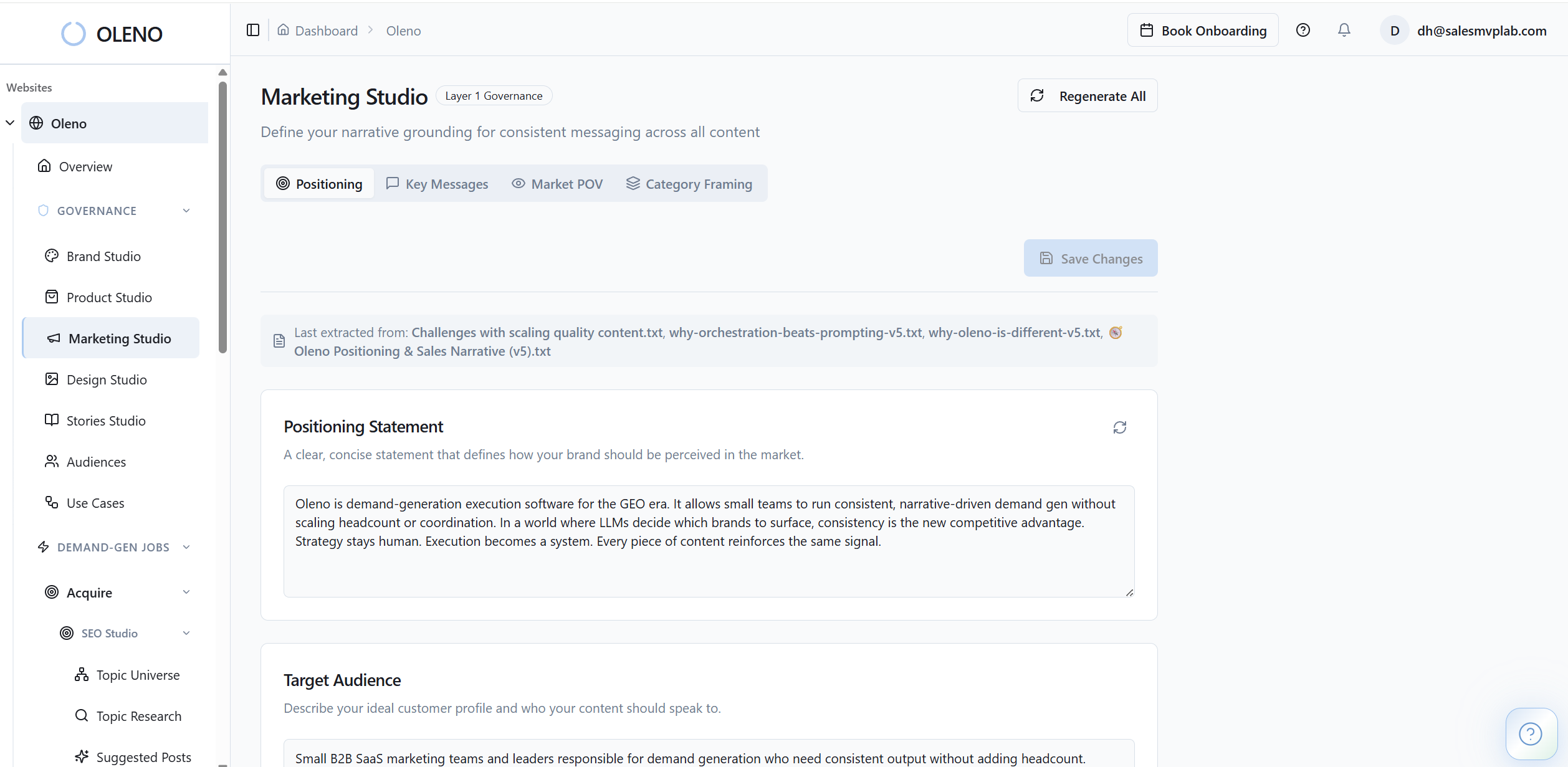
That matters because strategy persistence is the goal. You define it once, then the system keeps applying it. Instead of briefing a writer from scratch every week, you're working from governed inputs that stay consistent across articles, social posts, and content types.
The pipeline is built for steady output, not one-off heroics
For growth-stage SaaS teams, the real win is getting out of reactive mode. Programmatic SEO Studio can discover and organize topics through the Topic Universe, then run a locked process that moves from brief to draft to QA to publish on a steady cadence. Product Marketing Studio handles product-led content like feature deep dives and workflow guides. Buyer Enablement Studio covers decision-stage assets like FAQs and objection handling. Category Studio supports long-form POV content when you need to shape the market, not just answer a keyword.
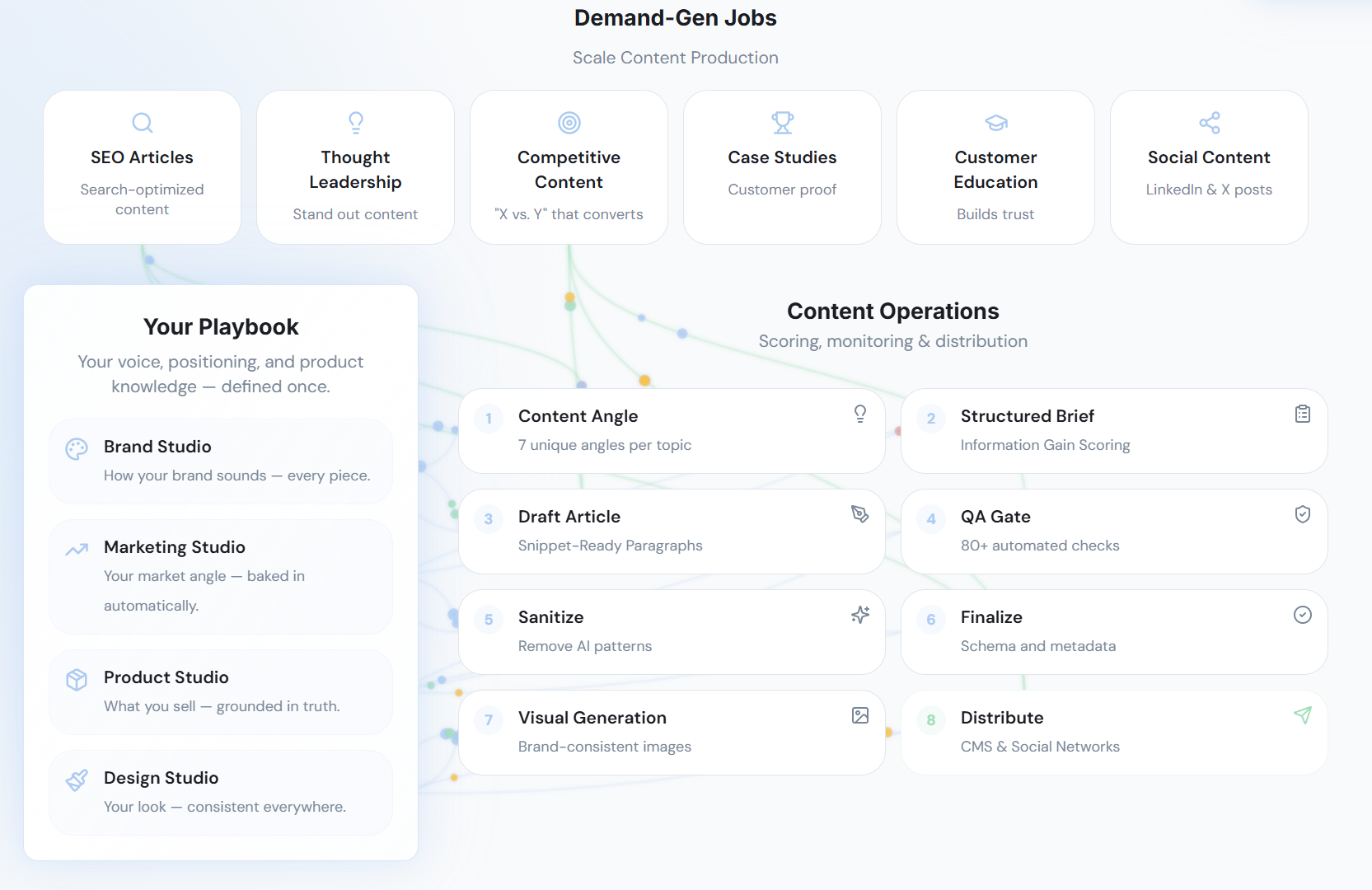
Then the Orchestrator keeps the whole thing moving based on approved topics and quotas, while the Quality Gate checks voice, structure, grounding, and quality before anything gets through. If your current problem is spending 3 days reviewing content that was supposed to save you time, that's the transformation callback. The system reduces rework by moving the standards upstream.
This is best for teams with strategy already in place
Oleno is not for everyone. If you're pre-revenue and still figuring out your positioning, you probably don't need this yet. If you're a solo creator writing personal content, same story. And if you're a huge enterprise with a 10-plus person in-house content team and mature workflows, your problem is different.
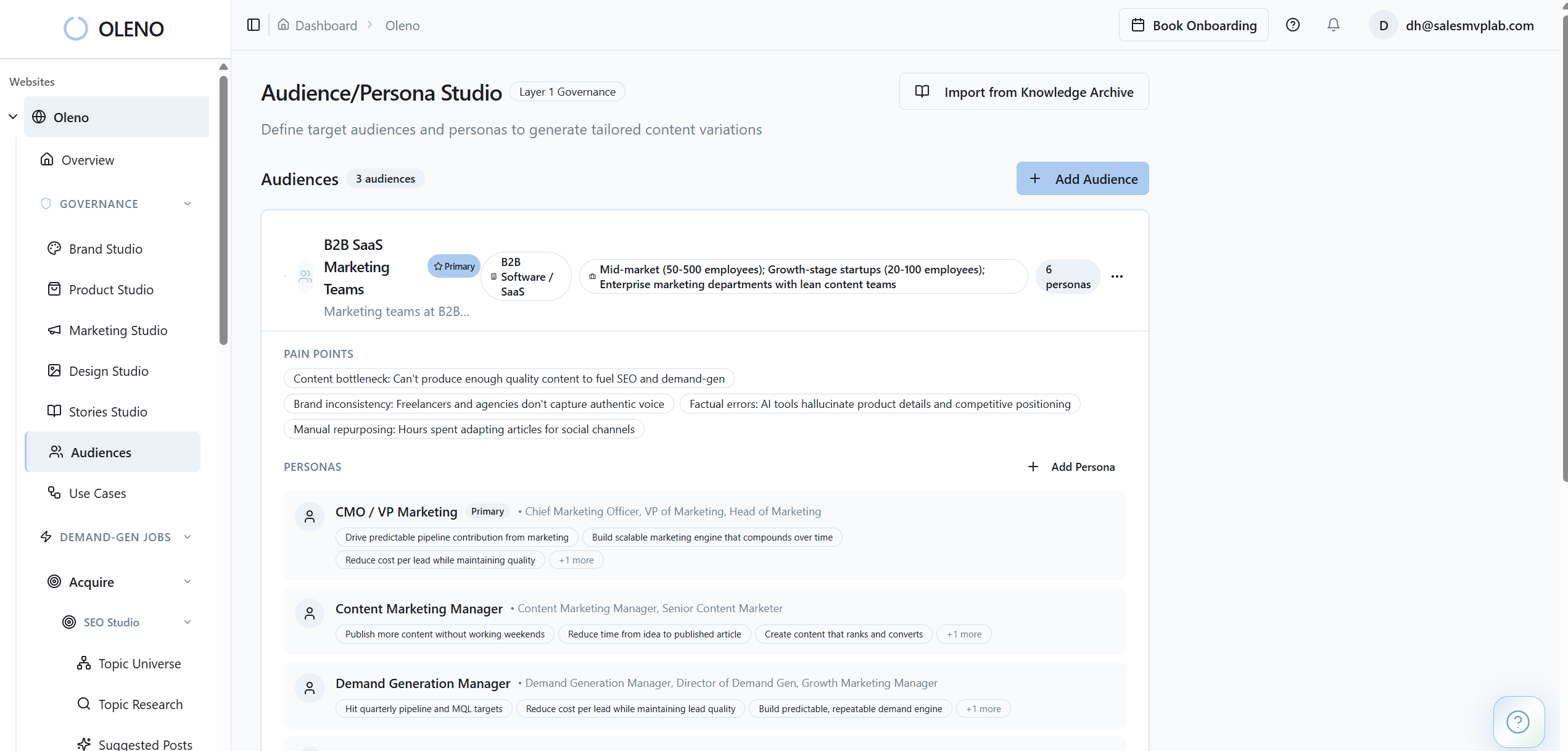
But if you're a founder or lean marketing leader at a post-PMF SaaS company, and the pain is that content keeps slipping because the strategy never survives execution, this is exactly the use case. If you want to see how Oleno encodes your strategy once and keeps enforcing it across the pipeline, you can book a demo.
Why Consistency Beats Bursts Every Time
Effective content execution is not about having one great content sprint every quarter. It's about building a system that keeps shipping without needing the founder to rescue every draft.
You don't need more content chaos. You need fewer handoffs, tighter governance, and a way to make your strategy stick. That's what turns content from a side project into a demand-gen asset.
About Daniel Hebert
I'm the founder of Oleno, SalesMVP Lab, and yourLumira. Been working in B2B SaaS in both sales and marketing leadership for 13+ years. I specialize in building revenue engines from the ground up. Over the years, I've codified writing frameworks, which are now powering Oleno.
Frequently Asked Questions