Establishing Brand Voice Governance: Preventing Inconsistency Across Teams

76% of B2B buyers now use AI search during research, according to Gartner, and that changes what brand voice governance actually means. If your team shipped content this week that sounded like three different companies, you don't have a writing problem. You have a governance problem.
Establishing brand voice governance is not about making content sound prettier. It's about making your market position repeatable across dozens of contributors, channels, and AI-assisted workflows, before drift starts costing you trust, pipeline, and visibility.
Key Takeaways:
- Brand voice governance is a system, not a style guide sitting in Google Docs.
- If more than 20% of drafts need major voice rewrites, your voice is not governed. It's interpreted.
- The real failure point is usually context loss between strategy, product truth, and execution.
- In the GEO era, consistent language across scale matters more than raw content volume.
- Head of Content teams should treat voice like an operating rule, with inputs, checks, and failure thresholds.
- AI content quality usually breaks because the marketing plan never made it into the draft in the first place.
- A governed process beats prompt tinkering every time.
If this is already hitting a nerve, that's probably because you've lived it. The Head of Content writes one way. PMM writes another. Freelancers sound polished but generic. AI sounds fast but off. Then your team spends half the week fixing drift instead of creating leverage. If you want to see what a governed system looks like in practice, you can request a demo.
Why Most Brand Voice Efforts Break Once More People Touch the Content
Brand voice governance breaks when teams confuse documentation with control. A voice guide can describe how you want to sound, but it can't enforce anything once five people, two agencies, and three AI tools start producing content from partial context.

The symptom looks like inconsistent tone. The root cause is almost always fragmented execution. Strategy lives in one doc. Product truth lives in somebody's head. Audience nuance sits in call notes. Then the draft shows up and everyone wonders why it feels wrong.
The style guide trap
A lot of teams think they have establishing brand voice governance handled because they wrote a 12-page brand doc. Fair point. That's better than nothing. But a static doc only works when one person is writing everything, or when review cycles are slow enough that a senior person can rewrite every piece.
That breaks fast. Especially in scaling SaaS teams.
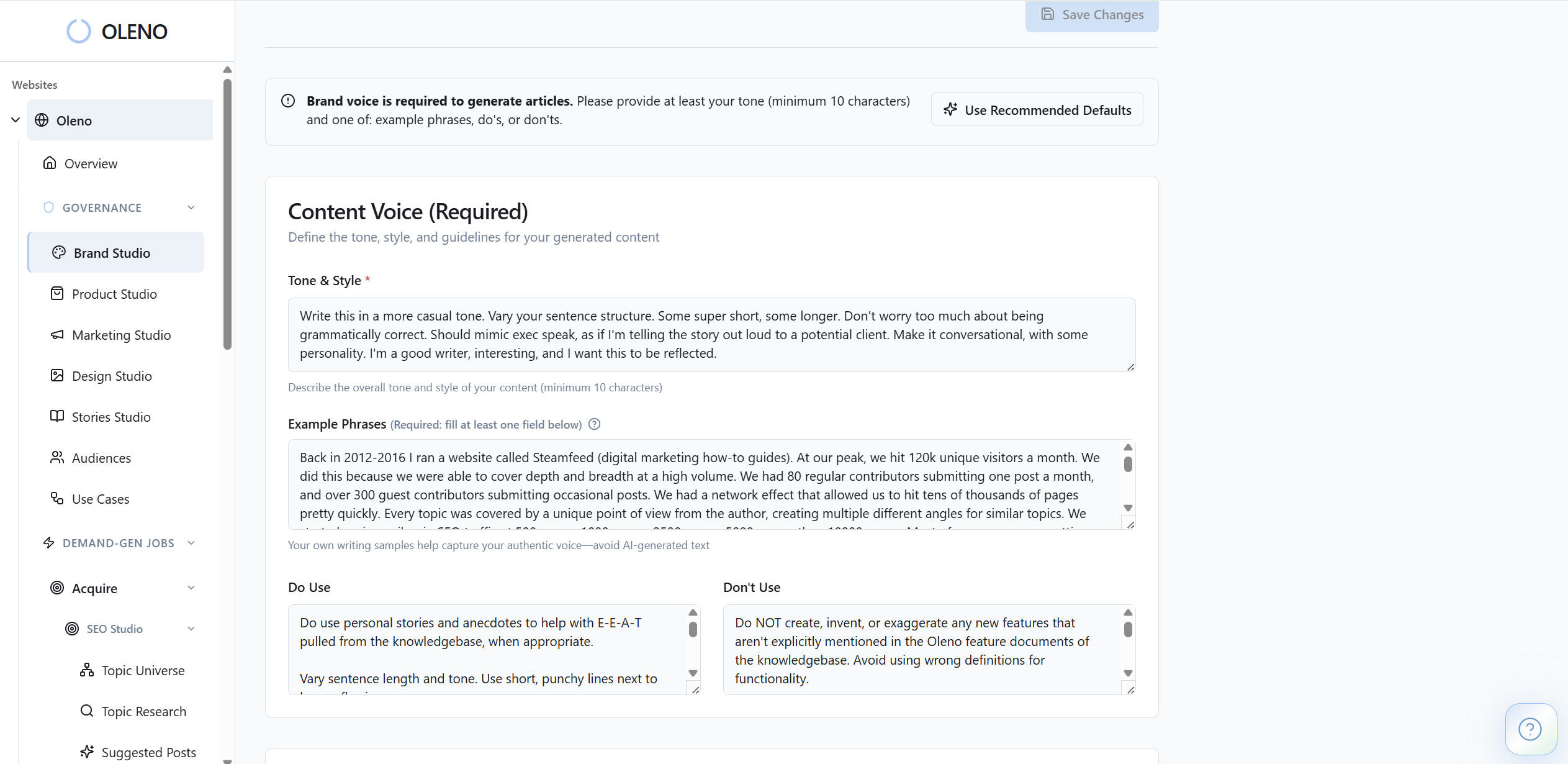
Back in 2012-2016, I ran a digital marketing site that hit 120k unique visitors a month. We had 80 regular contributors and 300+ occasional guest contributors. The reason it worked wasn't that every writer magically shared the same instincts. It worked because there was enough structure that depth and breadth could coexist without total chaos. We saw traffic jumps at 500 pages, 1000, 2500, 5000, then 10000. That kind of growth only happens when quality and consistency hold long enough to compound.
The analogy I use is this: a style guide is like a sheet of music. Governance is the conductor, the rehearsal, and the rule that the orchestra can't improvise the melody halfway through the performance. Without that system, everybody is technically playing. Just not the same song.
Where the rework tax actually comes from
When I started at PostBeyond, I was the sole marketer. I could write 3-4 good blog posts a week because I had all the context in my head. As the team grew, output should have gone up. Instead, it got messy. The content writer didn't have the context or expertise I had, so their drafts took longer and came out weaker. Meanwhile I had less time, because I was in exec meetings, managing people, doing everything else.
Sound familiar?
This is the Context Transfer Failure model. If the person drafting doesn't have the market POV, product definitions, audience nuance, and approved language at the moment of creation, you don't get scale. You get rework. And once rework exceeds 30% of total production time, governance has already failed. You're just paying the tax quietly.
A day in the life looks like this: your content lead briefs a freelancer in Notion on Tuesday, PMM drops a few comments in Slack on Wednesday, sales adds a pain point in a Gong snippet on Thursday, and the draft comes back Friday sounding kind of close but not close enough. Then three people spend 90 minutes fixing a piece that was supposed to save time. That's not a content engine. That's a coordination loop.
You feel it too. Not just in throughput. In morale. Because nobody wants to babysit drafts all week.
GEO punishes drift harder than old-school SEO did
Traditional SEO let teams get away with a lot. You could rank with decent structure, enough links, and volume. GEO is less forgiving because LLMs synthesize across patterns. If your language, point of view, and claims keep shifting, you look less authoritative.
This is where most teams get the market wrong. They think AI visibility is about producing more AI content. I'd argue it's the opposite. LLM visibility is a consistency test.
A 2024 Bain survey found that 80% of consumers now rely on at least 40% of AI-generated search results for complex purchase decisions. Then Google keeps pushing AI Overviews further into the experience. So what happens when your category framing changes every few articles? Or your product gets described three different ways? The machine can't form a stable understanding of who you are.
That's why establishing brand voice governance is no longer a nice-to-have editorial exercise. It's a discoverability issue.
What Establishing Brand Voice Governance Actually Requires
Establishing brand voice governance means turning voice from taste into rules. Not rigid, robotic rules. But clear enough rules that different people and systems can produce content that still sounds like one company.
The easiest way to think about it is the 4-Layer Voice Stack: market POV, audience language, product truth, and stylistic rules. Most teams only define the fourth layer. That's why the whole thing collapses.
Start with market POV, not adjectives
Most voice docs start with words like bold, witty, clear, or expert. That's fine. But adjectives don't tell a writer what to argue. They don't tell AI what matters. And they definitely don't tell a Head of Content how to review for strategic alignment.
So first question: what do you believe that your market gets wrong?
That becomes the foundation. In your case, the contrarian take is strong: the bottleneck isn't content or prompts. It's fragmented execution without a system. That's not a style note. That's a worldview.
If you can't write one sentence that clearly states your market POV, you're not ready for full brand voice governance yet. Harsh maybe, but true. The threshold I use is the 15-second test. If a new writer can't explain your old way versus new way in 15 seconds, they'll create drift no matter how polished the prose is.
Consider the LevelJump lesson. We had solid founder-led content and strong ideas, but not enough SEO structure or topic discipline. The insight wasn't that the content was bad. It was that thought leadership without a clear operating frame misses discoverable demand. That's a market POV problem before it's a writing problem.
Then lock audience language to decision context
Voice without audience context gets generic fast. The same topic should sound different for a Head of Content than it does for a CMO. Not because the brand changed, but because the buying lens changed.
This is where the Audience Fit Matrix helps. I use three checks:
- What pressure is this person under this quarter?
- What language do they actually use in meetings?
- What proof do they need before they trust the point?
For a Head of Content at a scaling SaaS company, the pressure isn't abstract brand storytelling. It's editorial consistency, review load, handoff friction, and calendar reliability. So if your article on establishing brand voice governance reads like a generic branding post, it's already off.
The conditional rule is simple: if the reader owns workflow and quality, lead with rework tax and review burden. If the reader owns budget, lead with throughput and strategic control. Same brand. Different entry point.
Some teams resist this because they worry it fragments the voice. I get the instinct. But that's confusing consistency with sameness. Real governance holds the core argument steady while adapting the framing to who you're talking to.
Product truth has to sit inside the voice system
This is the hidden one. And honestly, it's the one most teams ignore.
A lot of voice problems are actually product accuracy problems wearing a tone costume. The article feels off because the writer doesn't understand what the product does, what it doesn't do, where it fits, or how to describe it without bluffing. So they fill the gap with generic marketing phrasing. That's where bad AI content comes from too.
If you're establishing brand voice governance properly, product truth has to be part of the governed layer. No invented capabilities. No drifting definitions. No swapping your category language every other week.
A simple rule works here: every product claim should map to an approved definition or it gets cut. If that sounds strict, good. A strict system is often what frees the team up to move faster.
For example, Oleno is not a full marketing stack. It doesn't do technical SEO, attribution, paid media, PR, or CRM workflows. That boundary matters. Because when your language is precise, trust goes up. And when trust goes up, the voice sounds sharper.
Style rules should be operational, not fluffy
This is the last layer, and it's where most teams start. Which is backwards.
Once market POV, audience language, and product truth are defined, stylistic rules get easier. Now you can say: short punchy sentences, direct language, low jargon, no puffed-up claims, no sterile corporate intros. You can define phrase preferences, words to avoid, sentence rhythm, even how aggressive or restrained your CTAs should sound.
But style rules need thresholds.
I like the 20-40-80 rule:
- If 20% of drafts need voice edits, watch it.
- If 40% need voice edits, the system is weak.
- If 80% need voice edits, you're relying on hero reviewers, not governance.
Another practical benchmark: if a senior editor spends more than 12 minutes fixing voice on a standard 1500-word article, your governance inputs are incomplete.
This caught us off guard the first time we really looked at it. Most teams assume the bad draft came from a weak writer. Often it came from a weak system.
Diagnose your maturity before you overhaul anything
Before you rebuild the whole process, figure out what stage you're actually in. The Brand Voice Governance Spectrum has four stages:
Stage 1: Founder Voice Only
One or two people can create strong content because the company story lives in their heads. Everyone else struggles to match it. This stage is common under 20 employees.
You can survive here for a while. There is a case to be made for it. Founder-led clarity is often stronger than committee content. But once volume goes up, this model becomes fragile. The exception is a tiny team with very low publishing volume. Everybody else eventually hits the wall.
Ask yourself:
- Does quality drop the second someone else writes?
- Do drafts require founder rewrites to sound credible?
- Is "voice" still mostly instinct?
If yes, you're in Stage 1.
Stage 2: Documented but Interpreted
You have a voice guide, templates, maybe a Notion page full of examples. Writers try to follow it. Results vary.
This is where many 100-500 person SaaS teams get stuck. It feels mature because documentation exists. But interpretation still drives output. That means drift is built in.
The red flags are obvious once you look:
- PMM says a piece is on-brand, sales says it isn't
- Writers mimic tone but miss positioning
- AI drafts sound close enough to start with but rarely publish clean
This is the most deceptive stage because it looks organized from a distance.
Stage 3: Governed Inputs
Now the system gets stronger. Voice, audience context, product definitions, and market POV are all encoded before drafting. Review becomes lighter because the draft started from better constraints.
If your major voice edits fall below 20% and approval cycles stop turning into rewrites, you're probably here.
The tradeoff is setup. This stage takes work. You have to define things clearly enough that others can execute without guessing. Some teams don't want to do that work. Fair enough. But then they also don't get predictable scale.
Stage 4: Enforced Governance
This is where standards stop being suggestions. The system checks voice, structure, product grounding, narrative cohesion, and blocks weak output before it hits the queue.
This is the stage most teams actually want, even if they don't use that language yet. Because what they really want is fewer reviews, less drift, and more trust that what ships will sound right.
How High-Output Teams Make Brand Voice Governance Stick
Brand voice governance sticks when it becomes part of the workflow, not an editorial side quest. The team needs a repeatable method that survives headcount growth, channel expansion, and AI involvement.
The framework I like here is Encode, Inject, Verify, Block. Four moves. In that order.
Encode the non-negotiables once
Encoding means deciding what is fixed and what can flex. If everything is flexible, voice drifts. If nothing is flexible, content sounds dead.
The split should look like this:
- Fixed: category framing, key messages, product definitions, prohibited claims, audience profiles, tone boundaries
- Flexible: examples, sentence rhythm, hooks, analogies, story selection, format choices inside the rules
Think of it like a sports playbook. The formation is fixed. The exact play has room to adapt to the defense. Good governance works the same way.
One more thing. You need named language assets. Not vague instructions. Actual reusable building blocks. I call this the Signal Library. Approved phrases for your category, your enemy framing, your old way versus new way, and your product definitions. If a phrase matters to how the market understands you, store it.
Without a Signal Library, every writer keeps reinventing the company.
Inject context before the first sentence
This is where most workflows fail. Teams brief too late and too shallow. They hand writers a topic and a rough angle, but not the full context stack.
Your drafting process should start with at least five inputs:
- Audience and persona
- Use case or buying context
- Market POV
- Product truth and boundaries
- Voice rules and examples
If one of those is missing, quality becomes luck.
Prompt-first teams usually miss this. They ask the tool to write before they tell it what marketing actually is. That was the big lesson from listening to April Dunford years ago. Tactics without strategy are useless. Same thing here. Prompting without governance just produces text faster.
Halfway through the week, when your team is arguing with the draft, that's not editing. That's late-stage briefing.
If you want to pressure test this with your own team, request a demo and compare your current workflow against a governed one. The gap usually shows up fast.
Verify with objective checks, not taste wars
The reason voice reviews drag on is that teams review subjectively. One editor says it sounds off. Another says it sounds fine. The writer is stuck guessing which opinion matters most.
You need objective checks. Not because humans shouldn't use judgment. They should. But judgment works better when the criteria are clear.
Use the VERA scorecard:
- Voice: Does it sound like us?
- Evidence: Are claims grounded and specific?
- Relevance: Is it framed for the target audience?
- Accuracy: Does product truth hold all the way through?
Each category should have pass thresholds. For example:
- Voice edits under 10 line changes per 1000 words
- Zero unsupported product claims
- At least one audience-specific example
- One clear expression of old way versus new way
If a draft misses two or more categories, it goes back. No debate. That's how you reduce review fatigue.
And yes, some teams prefer looser creative freedom. That's valid in media brands or personality-driven publishing. But for scaling SaaS teams trying to compound market signals, loose governance usually turns into expensive inconsistency.
Block weak output before it reaches the queue
This is the part teams skip because it feels harsh. But it's the lever.
If everything gets published eventually, governance has no teeth. There has to be a bar.
A good rule is this: if the draft contains factual drift, narrative drift, or brand drift, it doesn't move forward. No exceptions because you're behind on calendar. That sounds severe until you've lived the alternative, where bad content ships just to hit volume and then creates more cleanup later.
The plumbing metaphor fits here. You don't want dirty water reaching the tap and then asking the customer to strain it out themselves. You want filtration upstream. Same with content. Quality has to be caught before publication, not after the Head of Content loses an afternoon rewriting.
In my experience, this is where teams finally feel relief. Because once the weak output stops reaching them, strategy time opens back up.
How Oleno Turns Brand Voice Governance Into an Operating System
Brand voice governance gets real when the rules, context, and checks are built into the production flow. That's the practical shift. Not more prompting. More orchestration.
Why Oleno reduces drift before review starts
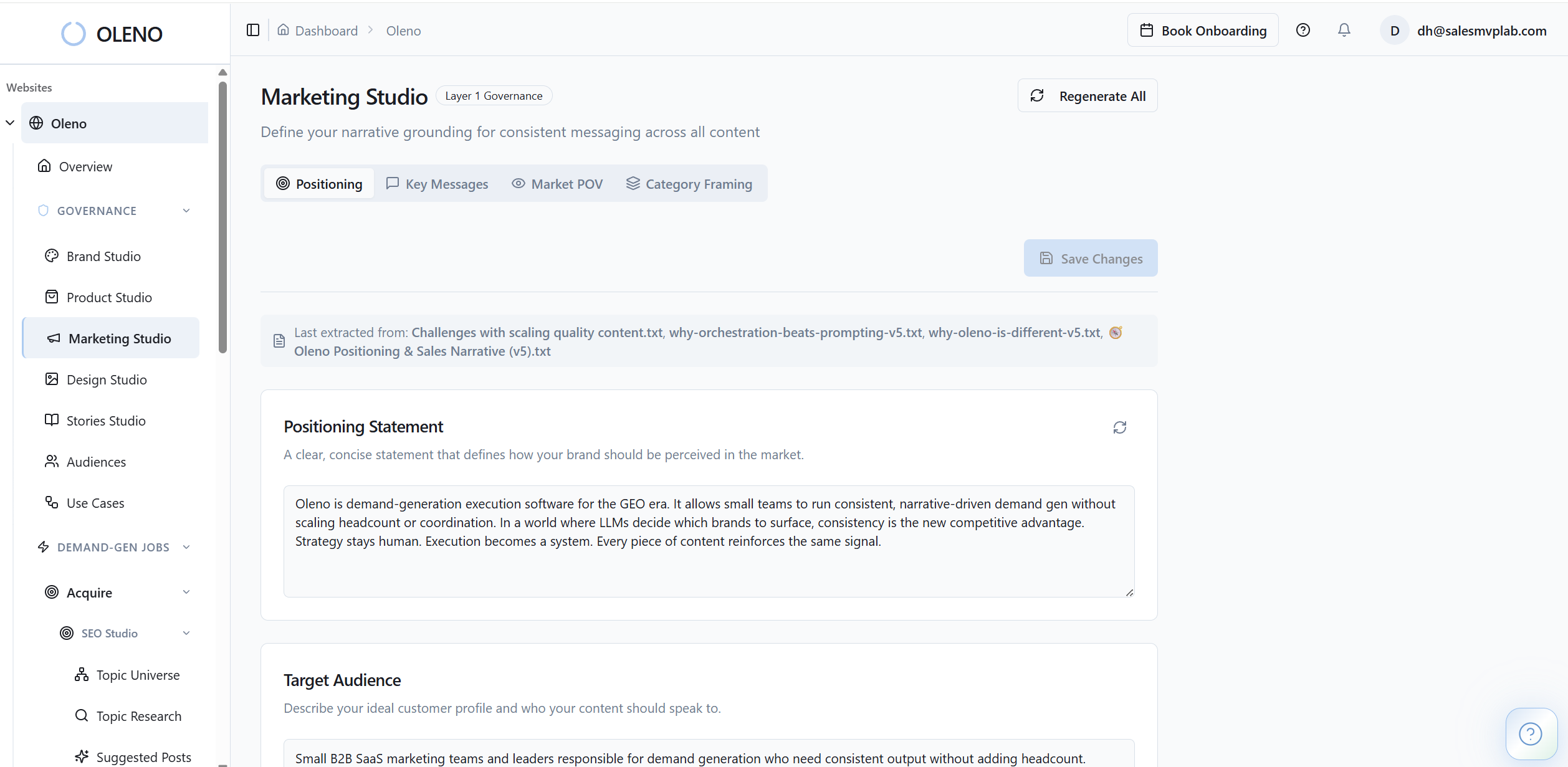
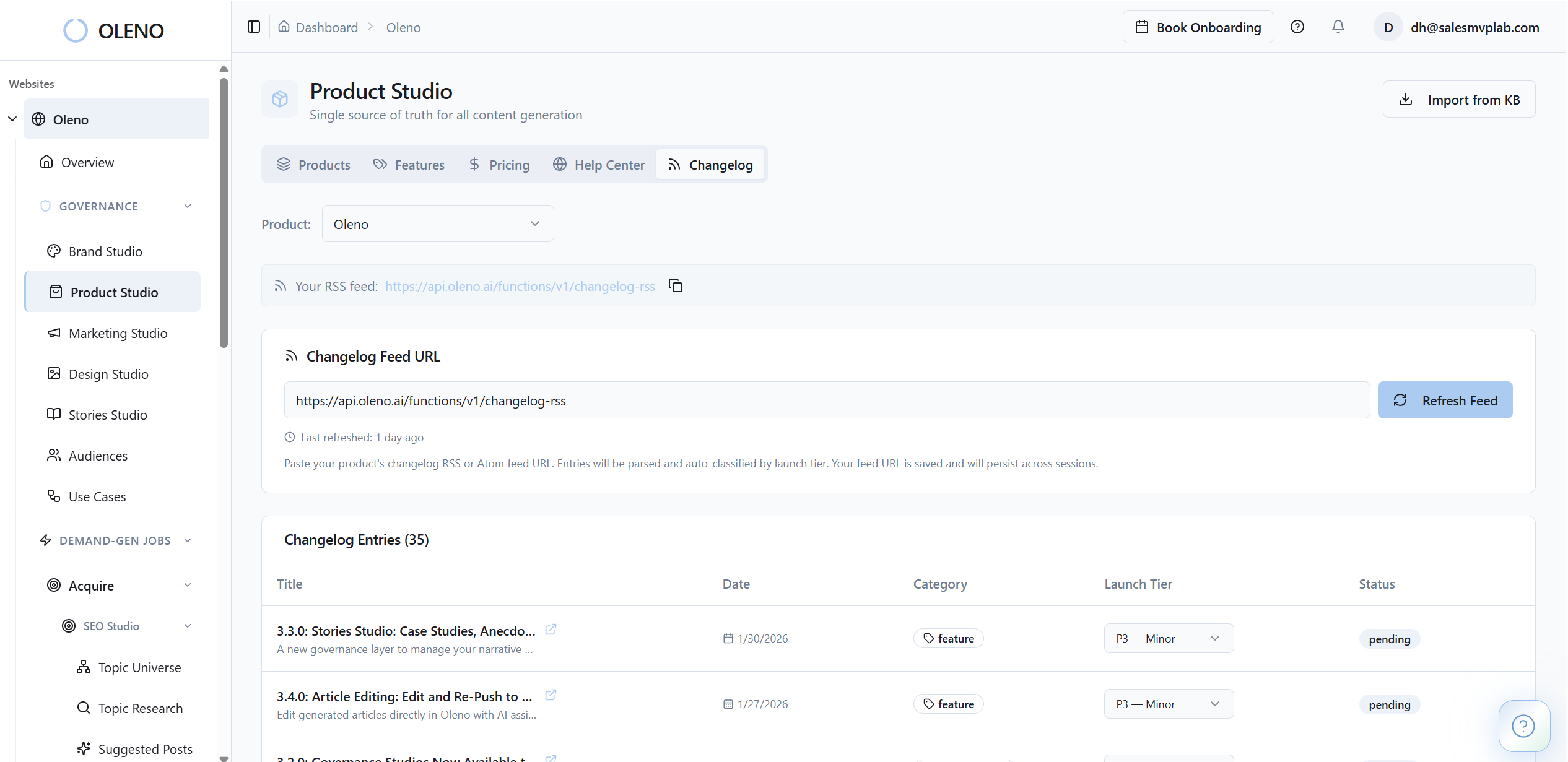
Oleno doesn't treat establishing brand voice governance as a style document bolted on at the end. It starts with governed inputs. Brand Studio stores tone, style, vocabulary, and constraints. Marketing Studio stores your category framing, key messages, and narrative rules. Product Studio stores approved product descriptions, feature boundaries, and supported claims.
That matters because most bad drafts are born upstream.
With Oleno, the draft process pulls from those governed layers before content is created. So instead of a writer or AI guessing how your company sounds, what you believe, and what the product actually does, the system starts from that truth. That's a very different model than prompt-and-pray workflows. And it's why the voice holds together better across volume.
For teams dealing with heavy review load, that shift is the win. Less interpretation. Less drift. Less rewriting. If you want to see how that looks in a live workflow, book a demo.
The quality bar is enforced, not just requested
This is the part I think matters most. Oleno uses Quality Gate to evaluate content against standards like voice, structure, clarity, repetition, grounding, and SEO before it moves forward. If the score is weak, it attempts auto-revision. If it's still weak, it blocks publication.
That is a fundamentally better way to run content ops.
Oleno also uses Audience & Persona Targeting to shape how topics get framed for the actual reader, not some generic B2B blob. Storyboard helps allocate coverage across audiences, personas, products, and use cases so your narrative doesn't drift just because the calendar got busy. And the Orchestrator runs the execution cycle against quotas and approved topics, which means the system can maintain cadence without constant human chasing.
A fair point here: Oleno isn't your whole marketing stack. It doesn't replace technical SEO, analytics, paid media, CRM workflows, or campaign strategy. You still need those. What it does is remove the content execution bottleneck, especially the briefing, drafting, QA, and consistency problem that keeps eating your team's time.
For a Head of Content at a scaling SaaS company, that's usually the break point. The team doesn't need more ideas. It needs a system that can hold the line.
The Teams That Win Will Sound More Consistent, Not More Busy
Establishing brand voice governance is really about deciding whether your company voice is a craft project or a system. One scales through heroics. The other scales through rules, context, and enforcement.
In the GEO era, consistency is not cosmetic. It's how your market, your buyers, and increasingly LLMs learn what you stand for. If your team is still fixing voice after the draft, you're solving the problem too late.
About Daniel Hebert
I'm the founder of Oleno, SalesMVP Lab, and yourLumira. Been working in B2B SaaS in both sales and marketing leadership for 13+ years. I specialize in building revenue engines from the ground up. Over the years, I've codified writing frameworks, which are now powering Oleno.
Frequently Asked Questions