Why Marketing Stacks Fail Without Demand Generation Execution Software

Most “marketing stacks” don't fail because you picked the wrong tools, they fail because you never built an execution layer that keeps demand gen consistent end to end, week after week, without you acting as the glue. Demand-generation execution software is a marketing operations system that ensures consistent, governed demand creation by codifying positioning, product truths, voice, and audiences into reusable rules, then orchestrating research, briefs, content generation, review, distribution, and measurement so teams ship at scale without drift and compounding signal grows across channels and LLMs. That’s the real “Execution Layer vs. Marketing Stack” gap most teams are living in.
Unlike a marketing stack (a collection of tools you still have to coordinate), demand-generation execution software is the layer that runs the work as a system, so the output stays consistent even when headcount, channels, and priorities change.
I’ve seen this movie a bunch of times. You start with a few tools, a few people, and a simple plan. It works. Then you grow. You add writers, an SEO tool, an AI writing assistant, a project tracker, a CMS workflow, a design queue, a social scheduler. And suddenly the “stack” is just… more places for truth to get lost.
Key Takeaways:
- A marketing stack is a toolset, not a system. Without an execution layer, you get Fragmented Demand Generation: drift, rewrites, resets, and weak compounding.
- GEO makes inconsistency expensive because LLMs reward repeated, clear signals across a wide catalog, not one-off “pretty good” posts.
- Prompting speeds up drafting, but it also pushes the hard part onto humans: QA, voice, accuracy, distribution, and topic selection.
- The execution layer starts with governance your software can enforce, then runs an end-to-end workflow that doesn’t rely on heroic coordination.
- When you fix the execution layer, output compounds. When you don’t, you stay busy and still feel behind.
Why Marketing Stacks Create Fragmentation Instead Of Execution
Marketing stacks don’t execute. People do. And when the stack gets bigger, Fragmented Demand Generation becomes the default, because narrative, product truth, and voice live in different places and get re-decided over and over again.
The timing matters. We’re in the GEO era now. You’re writing for humans, search engines, and LLMs at the same time, and those LLMs only trust you when your signals are consistent across a lot of surface area. Not one hero post. A whole catalog.
More Tools Created More Seams, Not More Outcomes
The mistake is thinking “more tools” equals “more throughput.” Most of the time it just creates more seams.
Every seam is a handoff where somebody has to interpret intent. SEO hands a keyword to content. Content hands a draft to PMM. PMM hands edits back. Design asks what the CTA should be. Demand gen asks for a version for a specific persona. Then somebody says, “Wait, do we even want to position it that way anymore?”
None of those people are doing anything wrong. The system is wrong. The stack assumes humans will stitch it together.
And you feel it in the little dumb moments. The “frustrating rework” moments. The ones that don’t show up in your dashboards but eat your week.
Prompting Accelerates Writing While Widening Execution Gaps
Prompting feels like progress because you get words fast. But demand gen isn’t words. Demand gen is a system that holds together over time.
Prompting pushes judgment onto humans. Somebody has to decide what topics matter. Somebody has to enforce voice. Somebody has to catch the invented feature claim before it goes live. Somebody has to format it in the CMS. Somebody has to turn it into social posts and schedule them. Somebody has to keep the narrative consistent across all of it.
So the writing step got faster, but the “make it real” steps got heavier.
I learned this the annoying way when I was building a B2C app last summer. I was prompting and copy-pasting outputs into my CMS, doing manual cleanup, re-prompting to fix tone, then rewriting sections to make the product claims accurate. It was taking me 3-4 hours a day. Not because I’m slow. Because the workflow was broken.
GEO Punishes Inconsistency At Scale
GEO changes the penalty for inconsistency.
In the old world, you could ship a pile of disconnected content and still pick up some SEO wins. You’d get some rankings. You’d get some traffic. You could justify the program.
Now you’re also trying to get surfaced by LLMs. And LLMs don’t rank one page in isolation. They synthesize. They pick the brand that keeps saying the same true, precise things across dozens or hundreds of pages.
Fragmented Demand Generation kills that.
You wind up with little contradictions everywhere. Slightly different definitions. Slightly different “who it’s for.” Slightly different product framing. So the LLM doesn’t feel confident citing you, because your catalog doesn’t feel like one company speaking with one brain.
That’s the hidden cost. Invisibility.
Execution Layer Vs. Marketing Stack Is The Missing Layer Most Teams Skip
A marketing stack is a set of tools. An execution layer is the system that runs demand generation end to end, with rules that don’t change every time a different person touches the work.
That’s the reframe.
Most CMOs I talk to don’t have an “effort” problem. They have a consistency problem. They have plenty of smart people. They have plenty of tools. They still can’t get a steady, compounding output without drift, rewrites, and quarterly resets.
Stacks Assume Humans Will Stitch The System Together
Most stacks are built like this: “We’ve got a tool for writing, a tool for SEO, a tool for project management, a tool for analytics, and a tool for social. So we’re set.”
But who’s enforcing the narrative across all of it? Who’s enforcing what claims are allowed? Who’s keeping the voice from drifting when you onboard a new writer or agency? Who’s making sure the content mix covers acquisition, evaluation, and product-led education, instead of just whatever feels urgent this week?
The answer is always the same.
You are.
You become the middleware. And it’s a headache. It doesn’t feel like marketing leadership. It feels like triage.
An Execution Layer Codifies Narrative, Product Truth, And Audiences
The execution layer starts by doing something most teams avoid because it feels like “process.”
You write down what you believe. What’s true. Who you sell to. How you talk. What you won’t say. What you always say.
Not as a vibe doc. As enforceable rules.
When those rules are structured, every brief inherits them. Every draft inherits them. Every distribution step inherits them. So you’re not re-briefing the same fundamentals 50 times a month, and you’re not praying a freelancer “gets it.”
And look, some teams hate this because they think it’ll make content boring. Fair point. Bad governance does that. But clear POV doesn’t make you boring. It makes you legible.
The Real Shift Is From Campaign Bursts To A Compounding Flywheel
Campaign bursts are seductive. You rally the team. You ship a bunch of stuff. Then you collapse. Then you do it again next quarter.
The execution layer is boring in a good way. It’s weekly cadence, steady coverage, and reinforcement loops.
When I ran Steamfeed back in 2012-2016, we didn’t win because every post was a masterpiece. We won because we had breadth and depth, and we kept publishing with consistent structure and quality. We saw traffic spikes at 500 pages, 1000 pages, 2500 pages, 5000 pages, then 10000 pages. Most pages were under 100 views a month. Didn’t matter. Volume plus consistency made the catalog compound.
That compounding effect is what most marketing teams are missing today, even with way more tools.
Fragmented Demand Generation Has A Measurable Cost (And It Sneaks Up On You)
Fragmentation is expensive in a way that doesn’t show up as a line item. The cost hides inside rework, review cycles, and the constant reset of “what are we trying to say again?”
You feel busy. You have output. But you don’t have momentum.
Rework Tax And Handoffs Scale Faster Than Content Output
Let’s pretend you’re a 15 person marketing team at a 200 person SaaS. Totally normal mid-market setup.
You want to go from 6 posts a month to 24. Sounds like a resourcing problem, right?
Maybe. But watch what happens when the system is fragmented.
- Each post needs an SEO brief, a content brief, a product review, and an edit for voice.
- Each handoff introduces context gaps, so reviews become rewrites.
- Each rewrite triggers another review, because now the product angle changed.
- Then demand gen wants a version for a specific persona, so you’re reworking again.
You can easily end up spending 3-5 hours of coordination and rework per article, even if the draft itself was “fast.” Multiply that by 24 posts, and you’re burning a full-time person’s month on nothing but keeping the stack stitched together.
That’s the wrong work. It’s also the work that expands as you scale.
Inconsistent Signals Reduce Both SEO Authority And LLM Citations
SEO authority is partly topical coverage, but it’s also coherence. If your content reads like five different companies wrote it, you don’t build a clean center of gravity.
LLMs are harsher.
They’re looking for repeated definitions. Repeated framing. Repeated product truths. Repeated POV.
So when your catalog says:
- “We’re a content platform” on one page
- “We’re a demand gen platform” on another
- “We’re an AI writer” somewhere else
- And your category definition changes every other week
You’re sending weak signals.
And weak signals don’t get cited.
Orchestrated Catalogs Compound; Ad Hoc Catalogs Plateau
Steamfeed is a good example of the upside when you get the system right. We had a ton of contributors. Every topic got a unique POV. But the structure and cadence were consistent enough that the catalog built authority over time.
I’ve also lived the opposite.
At Proposify, we had a killer content team. Great writers. Great design. We ranked for a lot of topics. The problem was the content drifted too far from the solution, like writing about managing SDR teams when your product isn’t for that. Traffic came in, but it didn’t connect to pipeline cleanly.
That’s fragmentation too. Not tool fragmentation. Narrative fragmentation. Same outcome. A plateau.
What Fragmentation Feels Like When You’re The One Holding It Together
Fragmented Demand Generation feels like being surrounded by activity, but never being able to relax, because you know the system will break if you stop pushing.
And yeah, that’s dramatic. It’s still true.
Your Calendar Turns Into Coordination, Not Leadership
You wake up and the day is already lost.
A writer needs context. PMM wants to “just sanity check” a claim. Demand gen needs a version for a different persona. Sales wants a one-pager. Somebody wants to change the positioning on the homepage. The agency wants feedback. The SEO lead wants to update the content brief template. You’re approving social posts that should’ve been auto-generated from approved content.
So you become the process.
Not the leader.
And if you’re a CMO or VP Marketing, that’s a problem. You’re supposed to be setting direction, not rewriting docs and chasing approvals.
Every Sprint Feels Like Starting Over
The reset cycle is brutal.
New quarter. New priorities. New campaign. New messaging tweaks. New contributor. New set of prompts. New “voice guide” doc that nobody reads. Same arguments. Same rework. Same drift.
You can feel it in the team too. People stop taking big swings because they’re worried about getting it “wrong” and creating more review. So the content gets safer. More generic. Less point of view.
And generic content is exactly what GEO ignores.
How Category Leaders Build An Execution Layer That Actually Compounds
You build an execution layer by treating demand gen like a system, not a set of tasks. That means you lock in the fundamentals, then you run workflows that keep those fundamentals consistent across everything you ship.
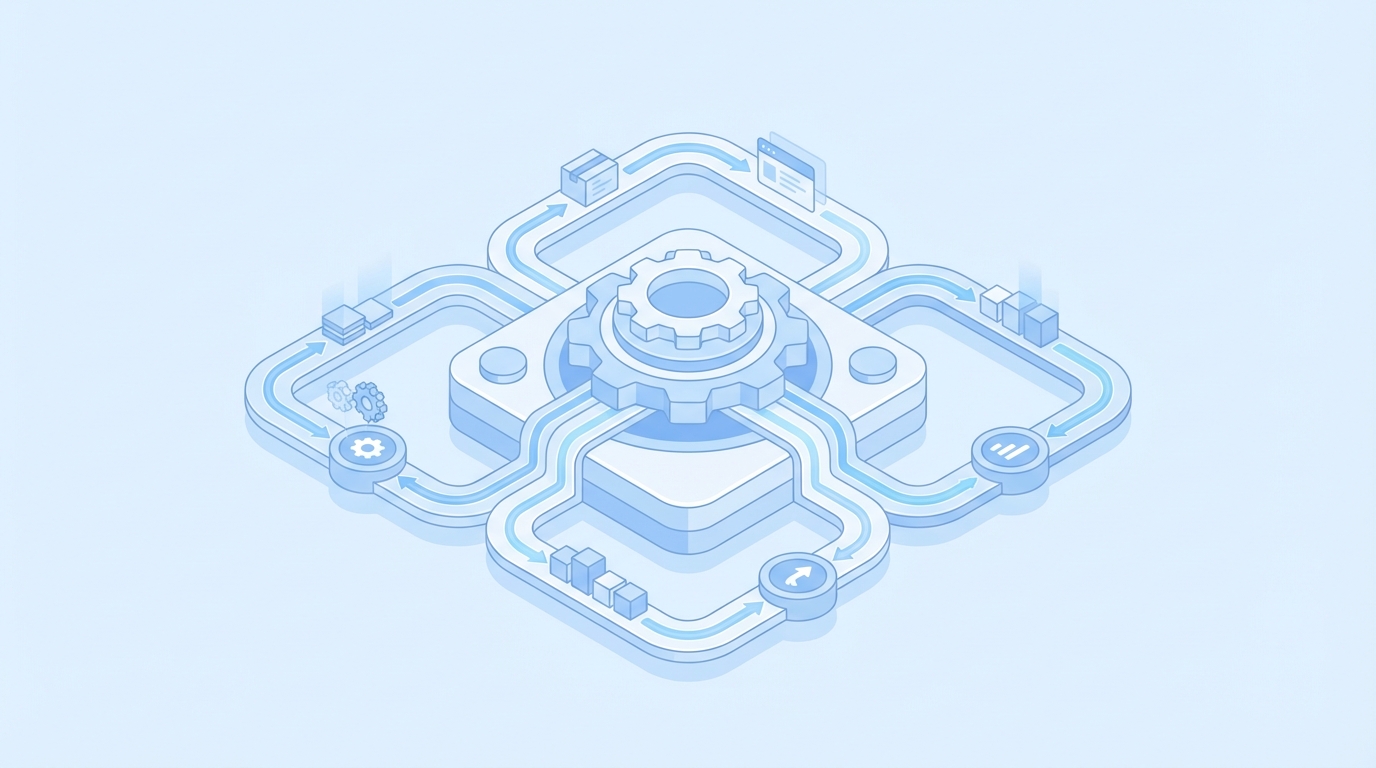
No, you don’t need new software to start. You can do a scrappy version with docs and discipline. It’s just harder than it sounds, because humans are inconsistent, and everyone’s busy.
Start With Governance Your Software Can Enforce
Governance is just the rules of the game.
If you want to stop drift, you need to define, in plain words:
- What category are we in, really?
- What do we believe that most competitors won’t say?
- What product claims are allowed, and what’s out of bounds?
- Who are the audiences and personas we sell to, and what language do they actually use?
- What does “sounds like us” mean, beyond “make it punchier”?
You also need version control. Because if your positioning changes, you want it to change once and propagate, not change in 30 random docs and 80 random posts.
Most teams skip this because it feels like work. Then they pay for it later in rewrites and confusion.
Orchestrate The Whole Workflow, Not Just Drafting
Demand gen isn’t “write a blog post.”
It’s plan, select topics, brief, draft, verify, review, publish, distribute, and then reinforce what worked. Over and over.
If you want the execution layer to hold, map the whole chain and decide what’s deterministic versus what needs human judgment.
- Deterministic: structure rules, required sections, claim boundaries, audience targeting inputs, distribution format.
- Human judgment: POV, what you’re willing to argue, what tradeoffs you’ll admit, what the market is missing.
When you keep pretending everything is “creative,” you wind up with chaos. When you over-systematize, you get bland content. The sweet spot is system for execution, humans for strategy.
Build For Dual Discovery: Humans And LLMs
Dual discovery means you’re building a catalog that works in two places.
Humans want clarity, relevance, and a point of view that feels like it came from someone who’s been in the trenches.
LLMs want extractable structure and consistent definitions. They want repeated signals across lots of pages. They want you to say the same true thing the same way, in multiple contexts.
So you use patterns on purpose:
- Clean definitions (one sentence, precise)
- Triads (three pillars, three principles)
- Comparison tables
- Consistent terminology across posts
- Content that actually connects problem framing to your solution space, instead of floating in generic education land
And you keep cadence. Because authority is partly repetition.
- Governance-first consistency: Codify positioning, product truths, voice, and audiences as enforceable rules that travel with every asset and task.
- End-to-end orchestration: Plan-to-publish workflows run as one system, briefs, drafts, reviews, distribution, and measurement align without manual stitching.
- GEO-ready compounding signal: Express a clear, repeated POV across a wide catalog so search engines and LLMs confidently surface and cite your brand.
If you want to see what this looks like as software, and not a pile of docs and Slack threads, you can request a demo. Soft pitch, but real. Sometimes it’s easier to look at a working system than imagine one.
What Demand-Generation Execution Software Replaces In The Old Marketing Stack
Demand-generation execution software replaces the glue work. Not the tools themselves. The glue work.
And if you want the cleanest way to see it, a table helps.
| Dimension | Old Way | Category Way |
|---|---|---|
| Source of truth | Lives in docs, heads, and ad hoc prompts | Codified rules that apply to every asset |
| Consistency at scale | Degrades as contributors and volume increase | Holds steady because rules travel with the work |
| Execution coordination | Manual handoffs, reviews, and resets | End-to-end workflow with checkpoints |
| GEO readiness | Inconsistent signals reduce citation and authority | Repeated, clear signals increase trust |
| Cost curve | Coordination cost outpaces creation | Marginal cost drops as the system repeats |
| Signal compounding | Volume without cohesion plateaus | Catalog breadth and depth reinforce each piece |
That’s the Execution Layer vs. Marketing Stack argument in one screen.
How Oleno Turns The Execution Layer Into A Daily System
Oleno is built to be the execution layer for demand gen, which basically means you set the rules once, then run content jobs that keep those rules intact across briefs, drafts, QA, publishing, and distribution.
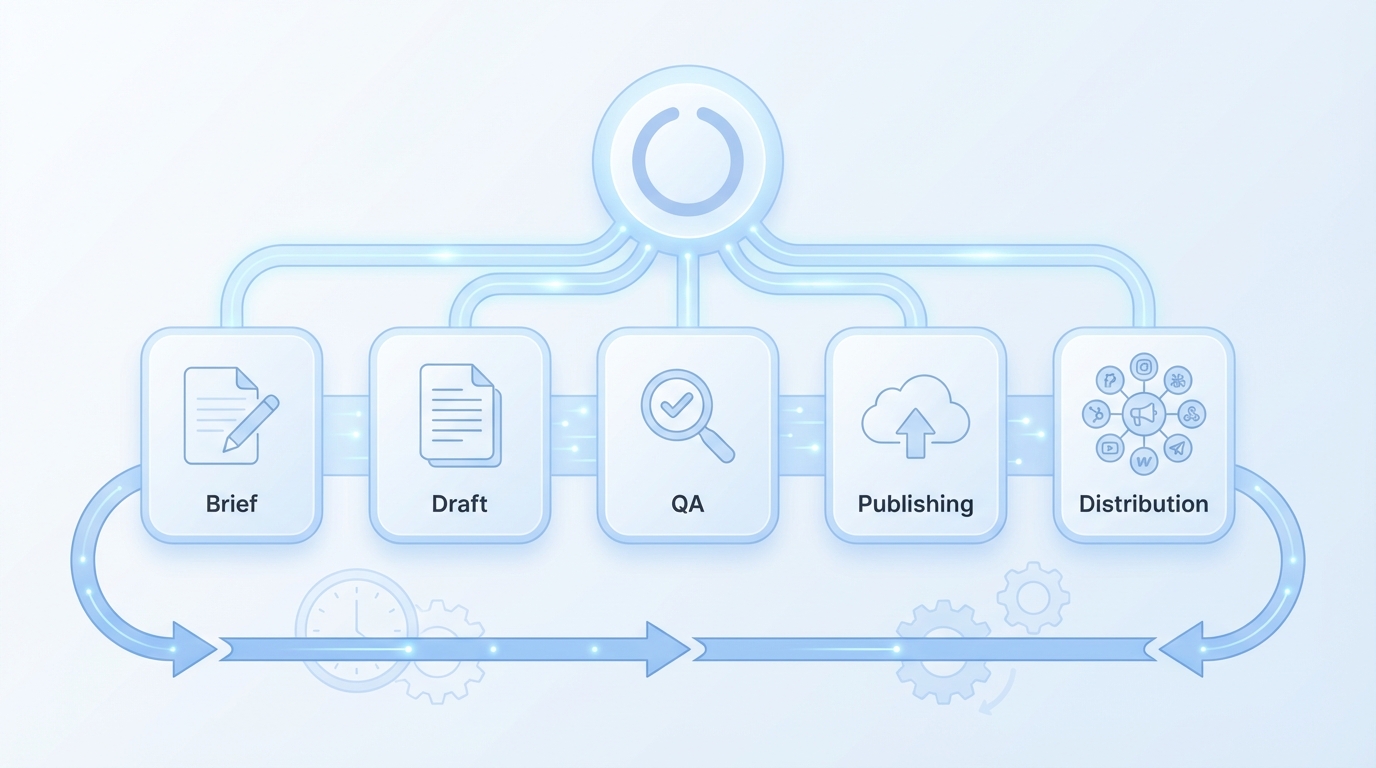
I’m going to keep this part short on purpose. If the earlier sections didn’t convince you the problem is real, listing product stuff won’t help.
Brand And Product Rules Get Captured Once, Then Used Everywhere
Oleno uses brand studio, marketing studio, and product studio to capture how you sound, what you believe, and what’s allowed to be claimed about the product, then applies those constraints inside the pipelines so you’re not relying on memory and manual review to prevent drift.
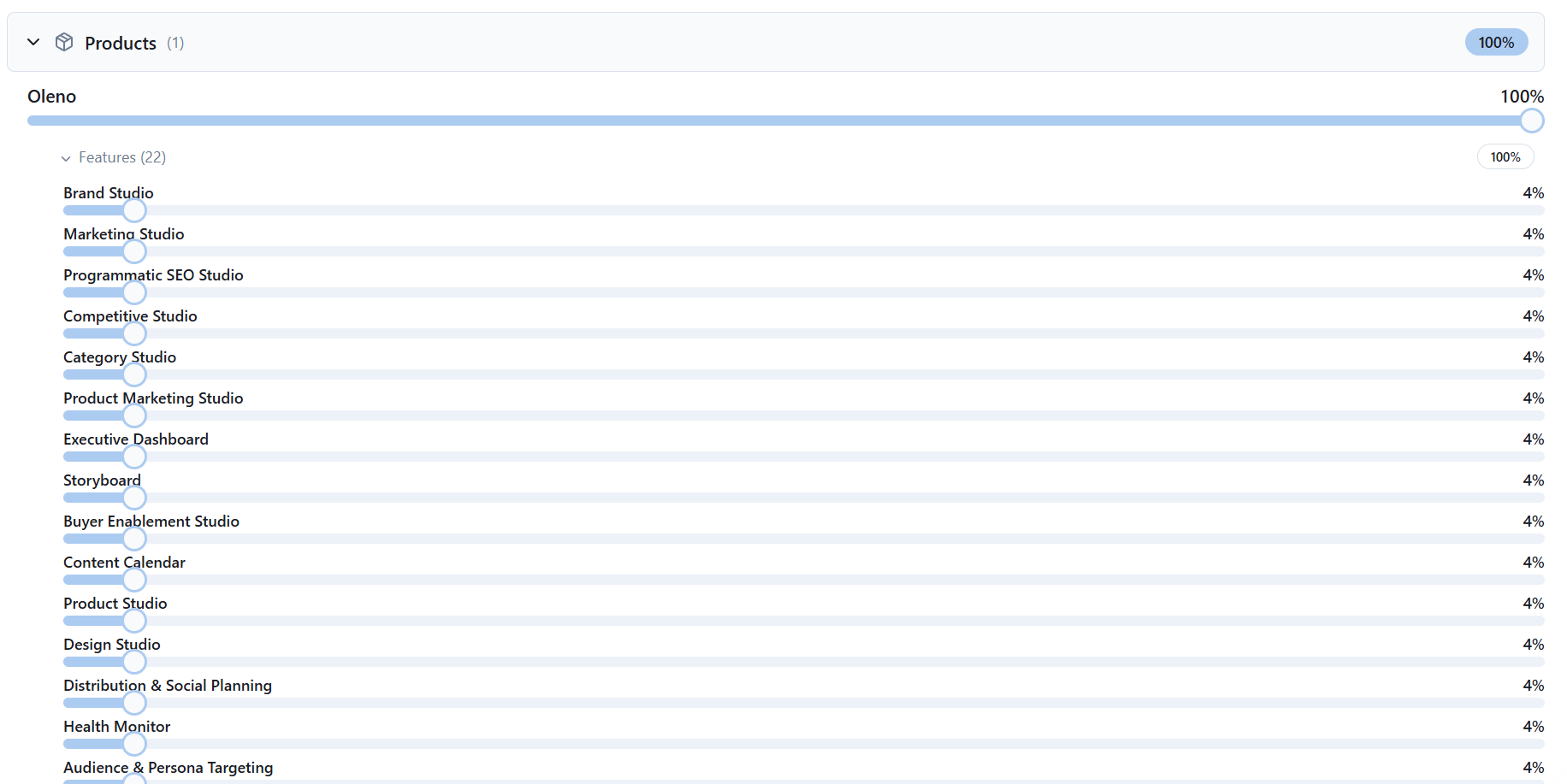
The big risk with AI-assisted content is fabricated claims. Product studio exists to reduce that risk by centralizing approved descriptions, boundaries, and supported use cases, and then having quality gate cross-check drafts against that truth so you catch issues before publishing, not after a customer calls you out.
If you’ve ever had to do the “please remove that line, we don’t actually do that” edit loop 20 times a month, you know why that matters.
The Cadence Runs Through Job Studios, Not Ad Hoc Projects
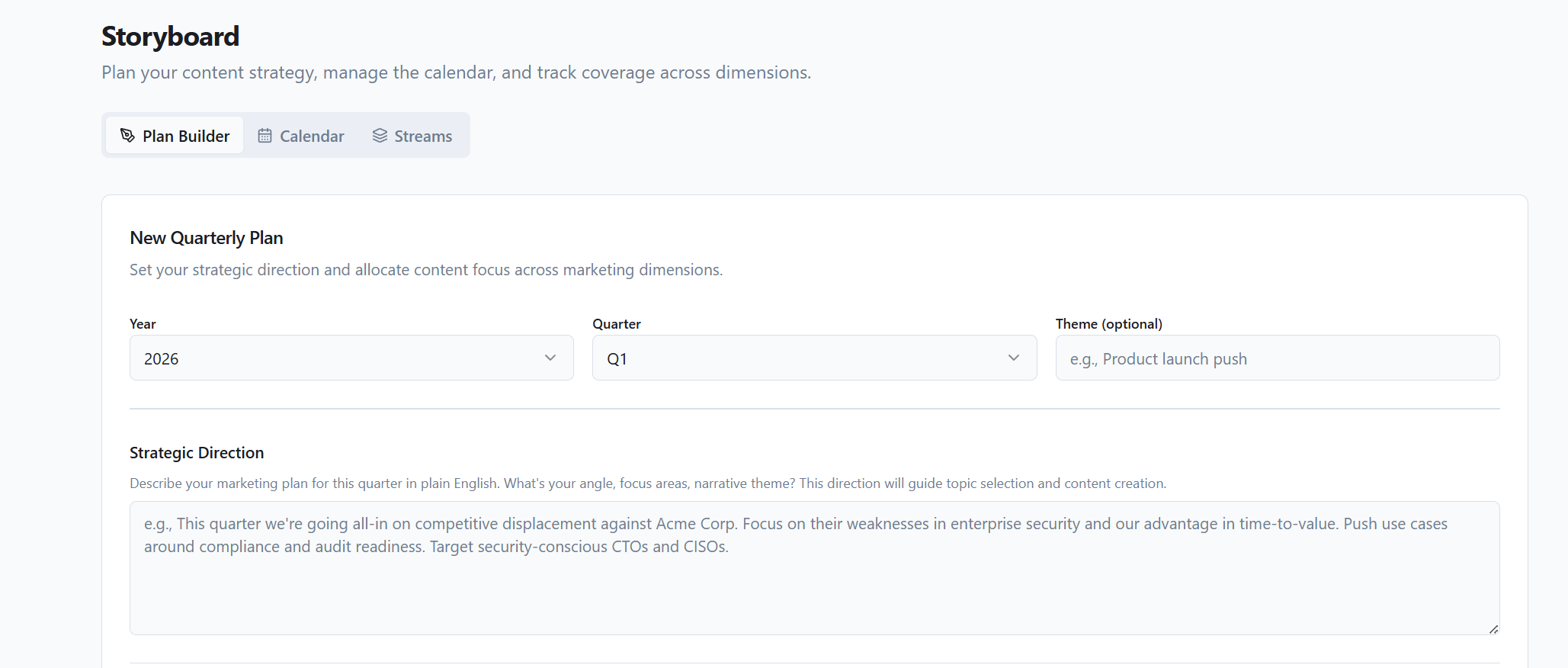
Oleno’s programmatic seo studio, category studio, competitive studio, product marketing studio, and buyer enablement studio are job types, not one-off templates, and the orchestrator schedules and runs those jobs to weekly and monthly targets so you’re not manually stitching together a calendar and hoping it survives a busy week.
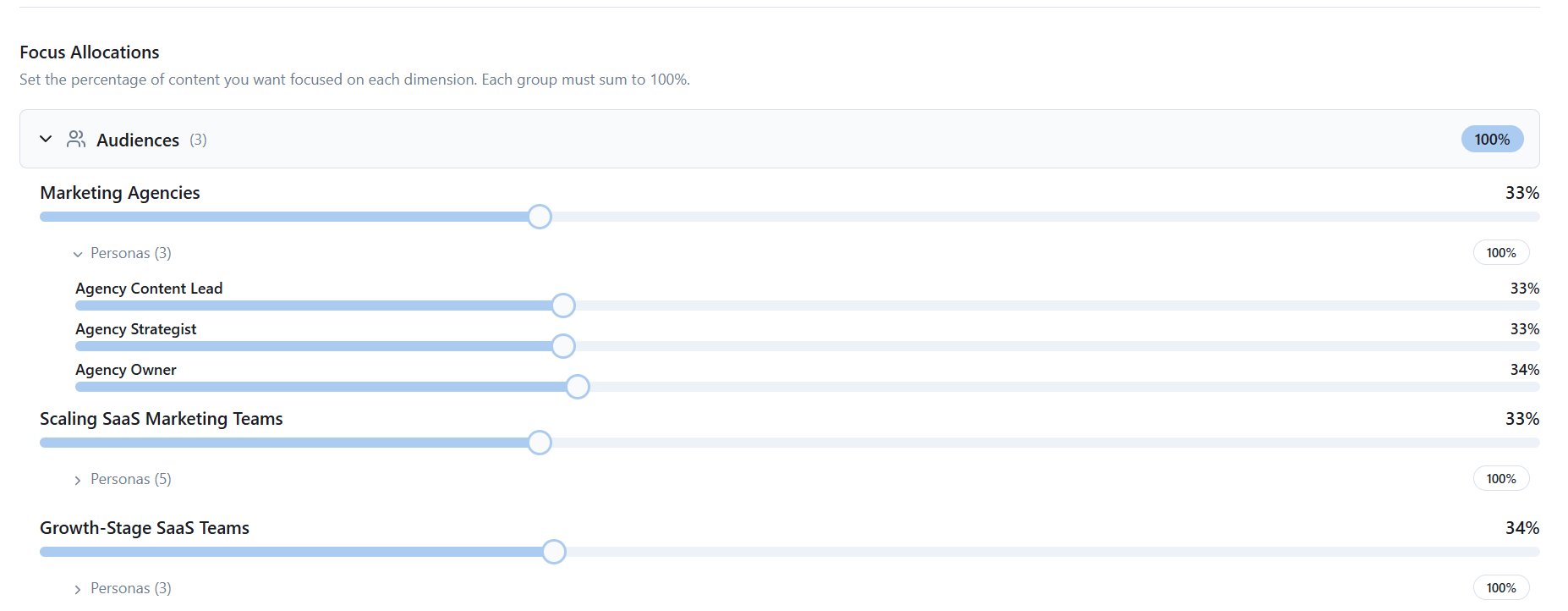
Then the last mile doesn’t turn into copy-paste hell, because cms publishing pushes the approved article into your CMS, and distribution & social planning generates and schedules platform-specific posts from the article so the work doesn’t stop at “the blog is live.”
If you want to see the workflow end to end, with your own inputs, you can request a demo. The fastest way to evaluate an execution layer is to watch it run on a real pipeline.
From Stack Ownership To Compounding Execution
Execution Layer vs. Marketing Stack is really a choice between two operating modes: you either own a pile of tools and keep acting as the glue, or you build a system where the work runs consistently and your narrative compounds instead of drifting.
Fragmented Demand Generation is the enemy because it looks normal. It even looks “productive.” Lots of activity. Lots of output. Still a ton of waste, risk, and resets.
If you’re trying to build a demand gen engine that doesn’t fall apart every time priorities shift, you’ll want an execution layer. If you want to talk through what that could look like for your team, book a demo.
About Daniel Hebert
I'm the founder of Oleno, SalesMVP Lab, and yourLumira. Been working in B2B SaaS in both sales and marketing leadership for 13+ years. I specialize in building revenue engines from the ground up. Over the years, I've codified writing frameworks, which are now powering Oleno.
Frequently Asked Questions