Executive LinkedIn Thought Leadership: 30-Day Publish & Amplify System

Most small B2B teams treat executive LinkedIn thought leadership like PR, not pipeline. You get sporadic posts, a few likes from friends, and no real learning loop. The simple fix is a system. One executive POV, converted into a 30‑day plan with proof, templates, and amplification. Predictable outcomes beat lucky spikes every time.
I’ve watched too many teams waste executive time chasing “hot takes” that do nothing for revenue. You do not need more clever posts. You need a repeatable operating system for executive linkedin thought leadership that publishes on schedule, proves claims with receipts, and ties activity to real pipeline signals. Keep it simple. Measure what matters. Ship weekly.
Key Takeaways:
- Turn one executive POV into 12 to 16 posts in 30 days, all grounded in proof
- Use four post types and simple templates that spark qualified comments and DMs
- Run a lean amplification SOP that doubles reach without begging for likes
- Track comment quality, DMs, and meeting clicks, not vanity impressions
- Lock a 30‑minute weekly review so approvals never block publishing
- Tie monthly activity to sourced opportunities, then double down on winners
Why Executive LinkedIn Thought Leadership Fails Without a System
Executive LinkedIn fails without a system because ad hoc posting never compounds, never teaches you what works, and never ties back to pipeline. Teams need one POV, tight guardrails, and a 30‑day plan built around evidence. Treat the work like a product launch with sprints, quality checks, and feedback loops.
The costly mistake of ad hoc posting
Random posts feel productive in the moment, but they create drift, rework, and missed learning. Without a single POV tied to two or three revenue narratives, the market gets mixed signals and your team burns time rewriting. I’ve made that mistake. You ship noise, then wonder why nothing moves.
When you run a 30‑day plan, patterns show up. Comments from ICPs increase, profile clicks turn into DMs, and you start predicting which hooks land. Calendar discipline sounds boring, but it prevents the weekly scramble that kills quality. A simple rule helps: one POV, two narratives, four weekly themes.
What most teams get wrong about authority
Authority is not a job title. Authority is proof, repetition, and usefulness. Claims need receipts from customer patterns, product telemetry, or third‑party data. If a claim cannot be backed, cut it. Your audience spots fluff instantly, and algorithms downrank low‑signal posts.
Trust is earned by being specific and helpful. Cite credible sources when it matters, like the Edelman Trust Barometer, then add your lived experience. Repeating the same useful idea in different formats builds recognition. Fresh angle, same spine. That is how authority compounds.
Why “viral” is the wrong goal for B2B
Virality pulls you toward entertainment and away from buyers. You do not need a million views from people who will never buy. Optimize for qualified conversation, not raw impressions. Calibrate on ICP comments, DMs started, and meetings sourced.
Formats that invite debate and questions perform better for B2B. Ask pointed questions, teach something specific, and respond fast. Most “viral” posts miss the point. Pipeline comes from depth, not spectacle.
Rethink Executive LinkedIn Thought Leadership as an Operating System
An operating system for executive LinkedIn turns one POV into repeatable inputs, processes, and outputs. Inputs are POV, proof, and ICP problems. Processes are drafting, editing, scheduling, and amplification. Outputs are posts, threads, comments, and partner shares. When the OS runs, quality stops depending on mood or calendar chaos.
The OS model: inputs, processes, outputs
Great systems start with clear inputs. Lock the executive POV, pull three recurring customer problems, then attach receipts. Next, design processes that make drafting and approvals fast. Finally, define outputs you can sustain every week.
When you treat exec social like an OS, you stop reinventing the wheel. Governance captures voice and claim boundaries. Processes keep cadence. Outputs feed measurement. If you want the bigger picture on why systems beat ad hoc, read the LinkedIn B2B Institute work on effectiveness.
Who owns what, and when handoffs happen
Ownership kills delays. Marketing owns the OS, the executive owns the POV, sales supplies prompts from the field, and ops measures results. Book a 30‑minute review every week for approvals. One doc for voice and claims keeps everything tight. No drift, fewer rewrites, faster shipping.
Clear handoffs reduce risk. Marketing drafts, exec approves, enablement runs amplification, ops reports impact. You can run this with a tiny team if roles are crisp. Fuzzy ownership is the hidden cost that drains energy.
How do you keep consistency without sounding robotic?
Codify voice with do and don’t examples, then vary structure, length, and angle. Rotate short riffs, question‑led posts, and evidence‑first threads. Reuse the same message with new proof and different hooks so it feels fresh but familiar.
Consistency is the idea, not the packaging. Variety comes from proof and angle, not random topics. That balance keeps signal high and avoids the stale vibe that turns off your audience.
The Measurable Cost of Ad Hoc Posting and Untested POVs
Ad hoc posting wastes time through re‑briefs, slow approvals, and rewrites. Untested POVs confuse the market and tank engagement. Quantify the damage by tracking time per asset, approval cycles, error rates, and post outcomes. Most teams find 30 to 50 percent of effort is pure waste without a simple OS.
The hidden cost: coordination overhead and rework
Every unplanned post triggers a mini project. Slack pings, Google Docs, calendar Tetris. Then someone asks for a new angle, someone else flags risk, and you start over. That overhead steals hours from strategy and testing. It also burns executive goodwill.
Measure the scramble for one month. You will spot patterns fast. Too many decision‑makers, no source of truth for claims, and zero batching. Fix those, and you claw back hours every week, especially when evaluating executive linkedin thought leadership.
The metrics that actually predict pipeline
Views are a vanity trap. Track signals that map to conversations and meetings. Focus on:
- Comment quality from ICPs, not just volume
- Profile visits to product pages
- DMs started by qualified buyers
- Meeting links clicked from posts or pinned comments
- Partner and employee amplification rate
Tie everything to UTM workflows and sourced opportunities. Once you see which narratives produce real conversations, you can double down and stop guessing.
Proof beats hot takes: evidence‑first construction
Start with a claim, attach proof, then invite the audience to react. Use customer patterns, product metrics, or credible third‑party benchmarks. Structure threads so the hook pulls people in, the middle proves the point, and the close invites debate. Posts that teach and challenge get saved, shared, and discussed.
Thought Leader Ads can help you scale winners once you find them. Read the official overview for context on targeting and formats, then test small budgets against posts that already earned engagement from ICPs. Here is the product page for reference: LinkedIn Thought Leader Ads.
What It Feels Like Running Exec Social Without a Playbook for Executive linkedin thought leadership
Running executive social without a playbook feels like a weekly fire drill. You react, you rewrite, you miss moments competitors grab. Momentum dies, trust erodes, and nobody believes the channel can drive pipeline. A simple playbook fixes it by removing guesswork and enforcing rhythm.

The grind: reacting, rewriting, and missing moments
You wake up to a gap on the calendar, ping the exec, and hope inspiration strikes. It rarely does. Then a competitor lands a take you should have owned. Team gets tired. Quality drops. Confidence tanks. Sound familiar?
Once a playbook exists, the energy flips. You start with pre‑approved hooks, fresh proof, and a set cadence. Publishing becomes a habit, not a gamble. Review cycle tightens to minutes, not days.
How do you keep the executive engaged?
Respect time, bring options, and show impact. Three sharpened hooks, two data points, one clear ask. Share a weekly note with DMs from target accounts, meeting requests, and which narratives performed. Executives lean in when the work is fast to approve and obviously tied to revenue.
A small win early helps. Land one thread that sparks real ICP comments, then surface the outcomes in plain English. Momentum builds quickly when the feedback loop is visible.
The 30-Day Publish and Amplify System for Executive LinkedIn Thought Leadership
A 30‑day system turns one POV into weekly themes, daily hooks, and measured outcomes. Build four weekly themes from real customer struggles, then attach proof. Use short‑form templates for daily posts and evidence‑first threads for deeper teaching. Run amplification the same day to double reach.
Ideation that never runs dry
Start with one executive POV tied to two or three revenue narratives. Map four weekly themes pulled from sales calls, support tickets, and product telemetry. For each theme, list three proofs and three angles so drafting is fast. Pre‑write hooks in batches, then pick the best on publishing day.
Consistency beats brilliance here. Small teams win when they remove blank‑page panic. A living theme doc, updated weekly, keeps inputs fresh and grounded in truth.
To keep the pipeline full, follow these steps:
- Pick four weekly themes tied to ICP problems.
- List three proofs and three angles under each theme, especially when evaluating executive linkedin thought leadership.
- Draft 8 to 12 hooks per theme in one sitting.
- Select and polish the strongest hook the night before publish.
- Log outcomes, then promote winners in next week’s plan.
Short-form templates that spark qualified conversation
Short posts carry the week. Rotate three proven patterns so rhythm stays fresh and your message stays tight. Focus on one idea, show one proof, ask one precise question that invites practitioner responses.
Templates worth using:
- Question‑led tension: challenge a common belief, add one data point, then ask a pointed question
- Myth vs reality: state the myth, prove the reality with a number, invite counterexamples
- Before and after mini‑case: describe the old state, share the shift, quantify the gain
Keep posts to four to seven lines with white space for skimming. Strong line breaks matter more than fancy language.
Amplification playbook for employees and partners
Same day as publish, send a short enablement note with suggested angles, approved quotes, and two comment prompts. Ask employees to comment in the first hour, not just like. Coordinate one weekly partner or investor share with clear talking points and a “why it matters” angle.
Create a lightweight leaderboard in your weekly recap to highlight helpful comments and partner boosts. Recognition beats nagging. For creator guidance on tone and cadence, the LinkedIn Creator Resources page has useful baselines.
Ready to turn one POV into 12 posts next month and stop the weekly scramble? Request a Demo.
How Oleno Operationalizes Your Executive LinkedIn Thought Leadership System
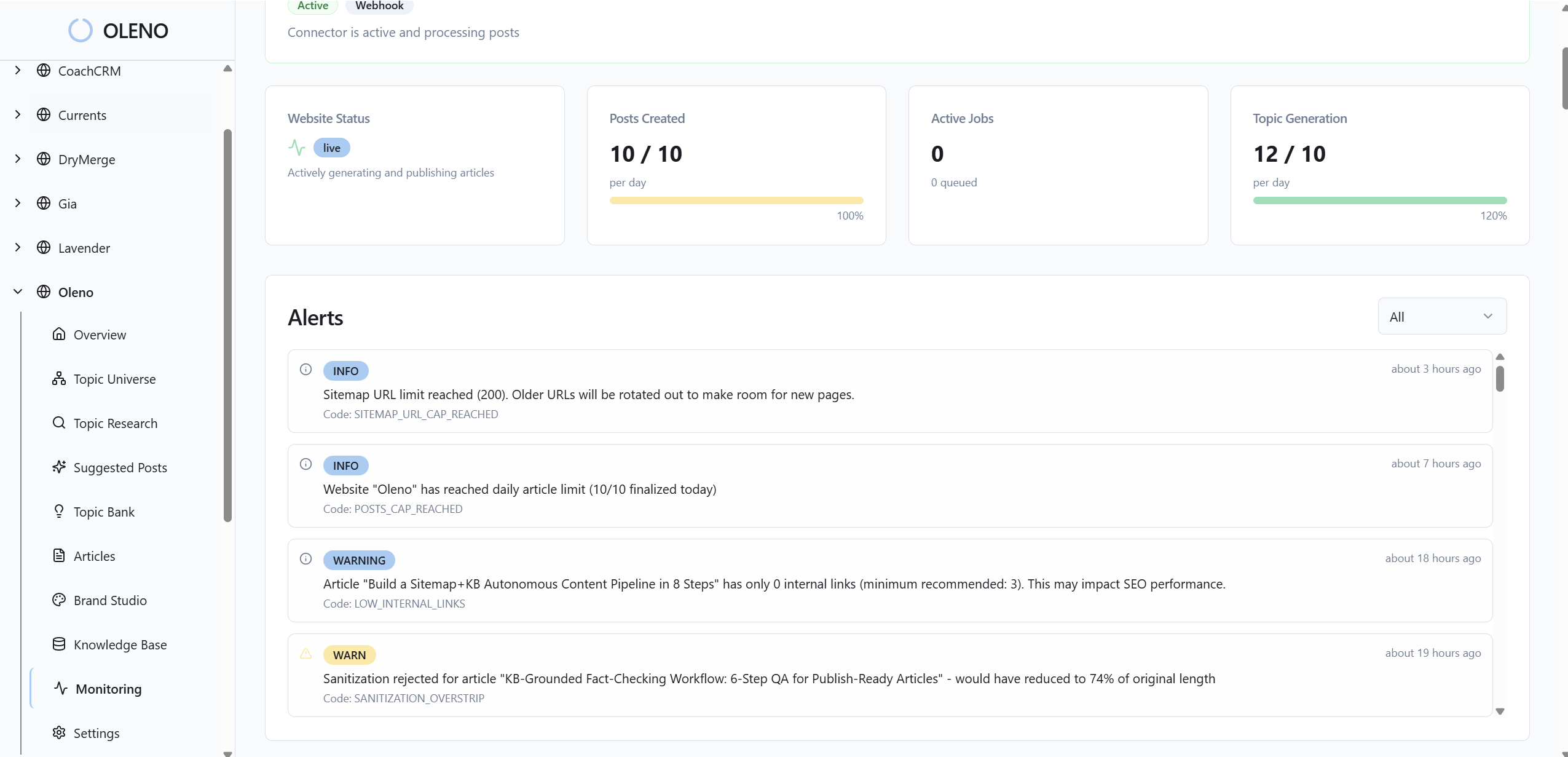
Oleno turns your OS into execution by generating a 30‑day calendar from your POV and voice rules, baking QA into every draft, and orchestrating amplification with measurable KPIs. What took hours of coordination turns into a single review session, a faster publish cycle, and dashboards that tie effort to meetings.

Oleno ingests your executive POV, voice rules, and ICP problems, then outputs a calendar with hooks, proofs, and post templates. Governance keeps claims inside approved boundaries so posts stay accurate. That alone removes half the rework most teams accept as normal.
Drafts, QA, and evidence baked in
Oleno’s brief‑to‑draft pipeline embeds citations, voice checks, and claim boundaries in every post and thread. Risky phrases get flagged, source slots are pre‑positioned, and drafts are scored against your governance before they hit review. What used to be a 30‑minute rewrite becomes a three‑minute polish.
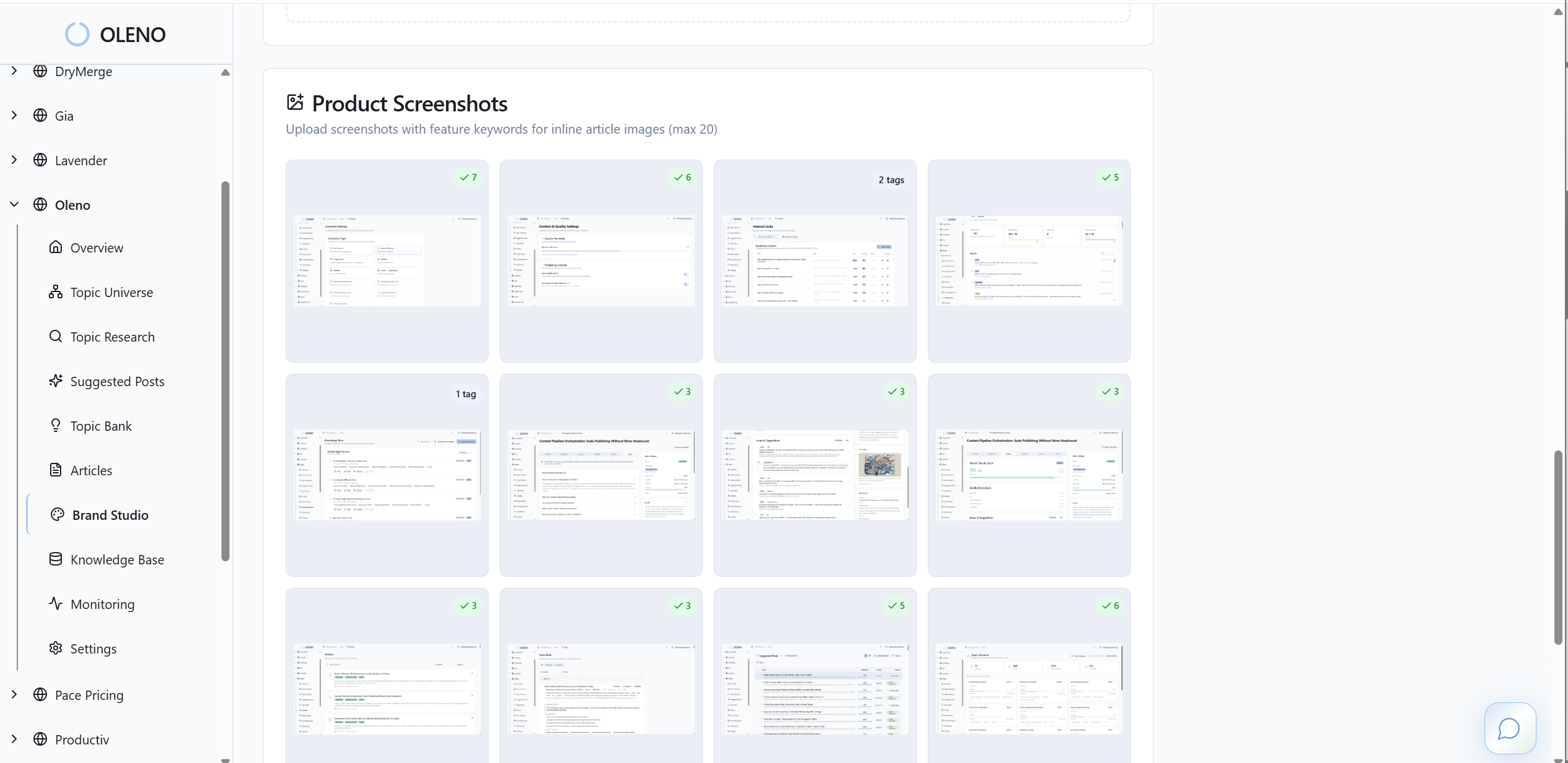
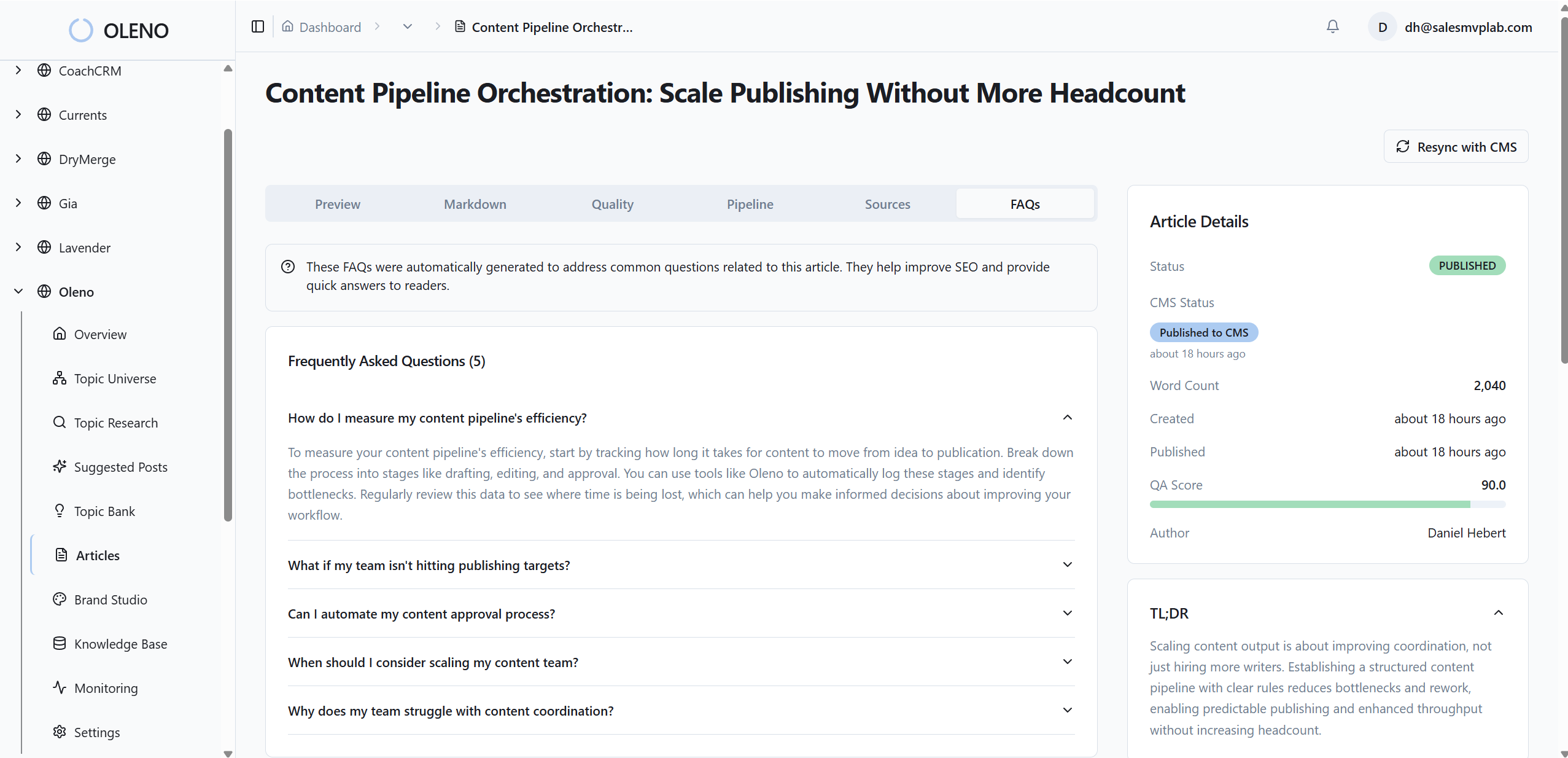
That cuts coordination overhead, reduces error rates, and shortens approval cycles. Earlier we said 30 to 50 percent of effort is waste without an OS. Oleno turns that waste into saved hours you can reinvest in testing new angles or lining up partner amplification.
Oleno also prepares same‑day enablement notes with suggested comments and timing prompts, then tracks comment quality, DMs started, meeting clicks, and sourced opportunities with UTMs and profile‑link tracking. When a narrative moves pipeline, you will see it by week two and can double down in week three. If you want to sponsor a proven winner, pair it with LinkedIn Thought Leader Ads for controlled scaling.
Want to see your calendar, drafts, and enablement notes in one place without hiring more people? Book a Demo.
Stop burning executive time on posts that do not compound. If you are ready to ship a measurable 30‑day plan that ties to conversations and meetings, let’s make it real. Request a Demo.
Conclusion
Executive social works when you run it like a system, not a stunt. Publish 12 or more executive posts in 30 days, double average reach with coordinated amplification, and create 2 to 5 qualified inbound conversations per month within 60 to 90 days. Evidence, repetition, and tight feedback loops beat luck, every time.
About Daniel Hebert
I'm the founder of Oleno, SalesMVP Lab, and yourLumira. Been working in B2B SaaS in both sales and marketing leadership for 13+ years. I specialize in building revenue engines from the ground up. Over the years, I've codified writing frameworks, which are now powering Oleno.
Frequently Asked Questions