Exemplar Library for Brand Voice: 30 Templates to Train AI & Writers

Most teams try to fix voice drift by adding more rules to the style guide. That’s the wrong lever. The fastest way to align humans and LLMs is building an exemplar library for brand voice and using those paragraphs as the source of truth. Real examples teach. Rules don’t.
I’ve watched this play out again and again. You write a “complete” style guide, people nod, then first drafts still miss your tone by a mile. Meanwhile, a two-paragraph example nails it in seconds. If you want drafts that sound like you, the path is simple: assemble an exemplar library for brand, annotate it, then wire it into your writing and generation flow.
Key Takeaways:
- Pick 30 strong examples that capture your real voice across scenarios, then annotate what makes them “you”
- Turn those examples into few-shot templates, snippets, and prompts that steer both writers and LLMs
- Add lightweight QA checks so voice fidelity is tested before edits start
- Train new writers on the exemplars first, not the rules, to cut feedback loops
- Track voice-correction edits and time-to-publish to prove improvement
- Aim for a 60% drop in voice fixes and a 30% faster publish speed within two cycles
Why an Exemplar Library for Brand Beats Any Style Guide
Exemplar libraries beat rule-only guides because examples create fast pattern recognition while rules create cognitive load. When writers and LLMs see real paragraphs with annotations, they internalize tone, rhythm, and word choice faster. Most style guides grow into checklists that people ignore, while exemplars get copied and reused.
Examples are sticky. People can mimic a paragraph right away, and modern LLMs respond to few-shot signals better than abstract do’s and don’ts. If you’re relying on rules alone, you’re asking for drift, rework, and slow onboarding.
Why rules-only guides fail at scale
Rules make sense in a workshop. In day-to-day work, they add decisions. Each sentence becomes a mini audit. Writers overthink. Editors nitpick. And the voice still slips under deadline pressure. I’ve seen teams spend hours arguing commas while the tone stays off. That’s the hidden problem.
Exemplars shortcut the judgment. You paste a paragraph, copy its cadence, swap in new facts, keep the feel. LLMs also follow this pattern. They learn from examples. The research on in-context learning backs it up, and it’s not new. See Language Models are Few-Shot Learners if you want the science.
Exemplars teach faster than definitions
Try teaching “confident but approachable” using rules. You’ll write three pages and still get drafts that sound robotic or pushy. Then share a single paragraph that nails it, and the next draft lands much closer. You can literally hear the shift.
That speed matters when you’ve got a small team and a real calendar. Style definitions are reference material. Exemplars are training wheels. You need both, but the examples do the heavy lifting.
The Root Cause of Voice Drift: Rules Without Examples
Voice drifts because teams treat tone like a set of abstract laws, not like music with tempo, phrasing, and feel. The real problem isn’t that your writers don’t care. It’s that they don’t have a concrete pattern to follow under pressure. Examples fix that. Rules rarely do.
Most teams think “more guidance” means more pages. But more pages hide the signal. The signal is how a paragraph reads out loud, where it breathes, what it avoids, and which verbs carry the weight.
You’re solving the wrong problem
If you’re adding line items to a style doc every time someone makes a mistake, you’re patching symptoms. The symptom is “this sounds off.” The cause is “we never showed what ‘on’ sounds like in context.” Once you accept that, the path is clear. Collect and label the best examples of “on.”
You can still keep core rules. Just demote them to background support. Put the examples front and center. New writer joins. They get the 30 examples first. Then they skim the rules.
Make examples the single source of truth
An exemplar library becomes the shared reality. Writers use it to start. Editors cite it in feedback. LLMs receive it as few-shot context. Leadership hears it and says, yes, that’s us. When everyone points to the same paragraphs, alignment stops being a debate.
Want a sanity check on tone labels and voice traits? The Nielsen Norman Group guidance on voice and tone is still solid. But don’t stop at labels. Pair each trait with a paragraph that proves it.
The Hidden Cost of Voice Drift Without an Exemplar Library
Voice drift burns hours in edits, increases content lead time, and dilutes trust with your market. When every draft needs correction, you pay twice: once in writer time, again in editor time. The longer those loops run, the more momentum you lose. That cost compounds across the calendar.
It’s not just time. It’s missed windows. Launch posts that get pushed. SEO pieces that sit in review. A buyer who reads three different tones across your site and decides you’re inconsistent. The revenue cost is quiet, but it’s real.
Time and money you lose in review cycles
Add up the edits. Ten rounds across three people is normal when voice isn’t clear. Each round might be 15 to 30 minutes. Multiply by the number of assets in flight. You end up burning days per month on corrections that a good exemplar library would prevent.
McKinsey estimates gen‑AI can boost marketing productivity, but only when teams redesign the workflow, not just the draft step. Their 2023 research highlights the gap between speed and reliable output. Worth a skim: McKinsey’s generative AI productivity analysis.
Quality debt that compounds quietly
When voice corrections happen late, people accept “good enough.” That’s how tone fractures across your site. A knowledge base article uses stiff, formal language. A blog post swings casual. A product page hedges. Each piece looks harmless, but together they confuse buyers, especially when evaluating exemplar library for brand.
Quality debt is sneaky. You don’t notice it until you try to scale. Then everything drags. You’re fixing problems you created months ago.
What It Feels Like When Brand Voice Keeps Slipping for Exemplar library for brand
It’s frustrating. You brief a writer, they try their best, and you still end up rewriting at 11 pm before a launch. You can feel the waste. You also start to doubt whether anyone “gets it.” That’s demoralizing for both sides.
New hires feel it too. They want to deliver. Without strong examples, they guess. Guessing is slow. Confidence drops. So does speed.
The 11 pm rewrite nobody wants
Everyone has that memory. The draft looked fine at a glance, then leadership said it “felt off.” Not wrong factually, just off. Now you’re smoothing tone, swapping verbs, cutting hedges, and praying you don’t introduce an error. That’s not sustainable.
Give that person a set of exemplars and they won’t need you at 11 pm. They’ll hear the rhythm themselves and match it earlier.
New writers stuck in the dark
Nothing stalls a new writer like vague voice notes. “Be more confident.” “Less formal.” What does that even mean? With an example, you can point and say, match this sentence length, this vocabulary, this energy. They’ll get it in one pass.
The same applies to LLM prompts. Generic instructions invite generic output. Examples constrain the model to your shape.
How to Build an Exemplar Library for Brand Voice That Scales
Build your library by selecting high-quality paragraphs that already performed well, annotating what makes them “you,” then turning them into few-shot templates and CMS snippets. Start with 30, cover your common scenarios, and keep it living. The goal is fast reuse with clear boundaries.

You don’t need perfection to start. You need coverage. Once the base is set, you can refine labels and add variants by audience and use case.
Pick the right 30 exemplars
Aim for range and repeatability. Pull from assets your market liked: case studies, product pages, top blog intros, crisp email openers. Choose paragraphs that reflect real constraints, not the clever one‑off you can’t reproduce. Then annotate.
Your annotations should explain why each paragraph works. Call out sentence rhythm, point of view, level of certainty, and words you always avoid. Keep notes tight. People should read the paragraph first, then the label.
After you annotate, sanity check the labels by reading them out loud. If an explanation feels fuzzy, sharpen it. If you can’t explain a choice, drop that example and pick a clearer one.
Turn examples into few-shot templates and checks
Examples are raw power. Templates turn that power into day-to-day leverage. Break your best paragraphs into reusable shells with blanks for product, audience, and claim. Store them where people write. Give them short names so folks can reference them in briefs.
Then add a light QA checklist that tests voice fidelity before human review. Ask whether sentence length and energy match a named exemplar. Ask whether hedging crept in. Ask whether banned terms appeared. Short, sharp, consistent.
To make this practical, teach your team a simple build order:
- Start from a relevant exemplar, not a blank page This is particularly relevant for exemplar library for brand.
- Fill the blanks with your facts and claims
- Run the voice checks yourself before sending for review
- Request feedback tied to a specific exemplar name
- Save one improved paragraph back into the library
Want a public reference for tone labels and writing patterns your team already knows? The Microsoft Writing Style Guide is a clear baseline. Then localize it with your own examples.
How Oleno Operationalizes Your Exemplar Library for Brand Governance
Oleno turns your exemplar library into working governance by encoding voice rules and examples, injecting them during briefs and drafts, and enforcing quality before anything publishes. Brand Studio and Product Studio keep tone and claims on track. QA blocks misaligned drafts automatically.

You define voice once, record the right examples, and the system carries them through discovery, briefs, drafts, QA, visuals, and CMS publishing. That’s how small teams get reliability without adding headcount.
Encode voice once with Brand Studio
Brand Studio captures tone rules, preferred terms, banned phrases, CTA format, structure constraints, and exemplar paragraphs. During Brief and Draft, Oleno applies those constraints and few-shot examples so output already sounds like you. No more prompting roulette or voice drift between writers.
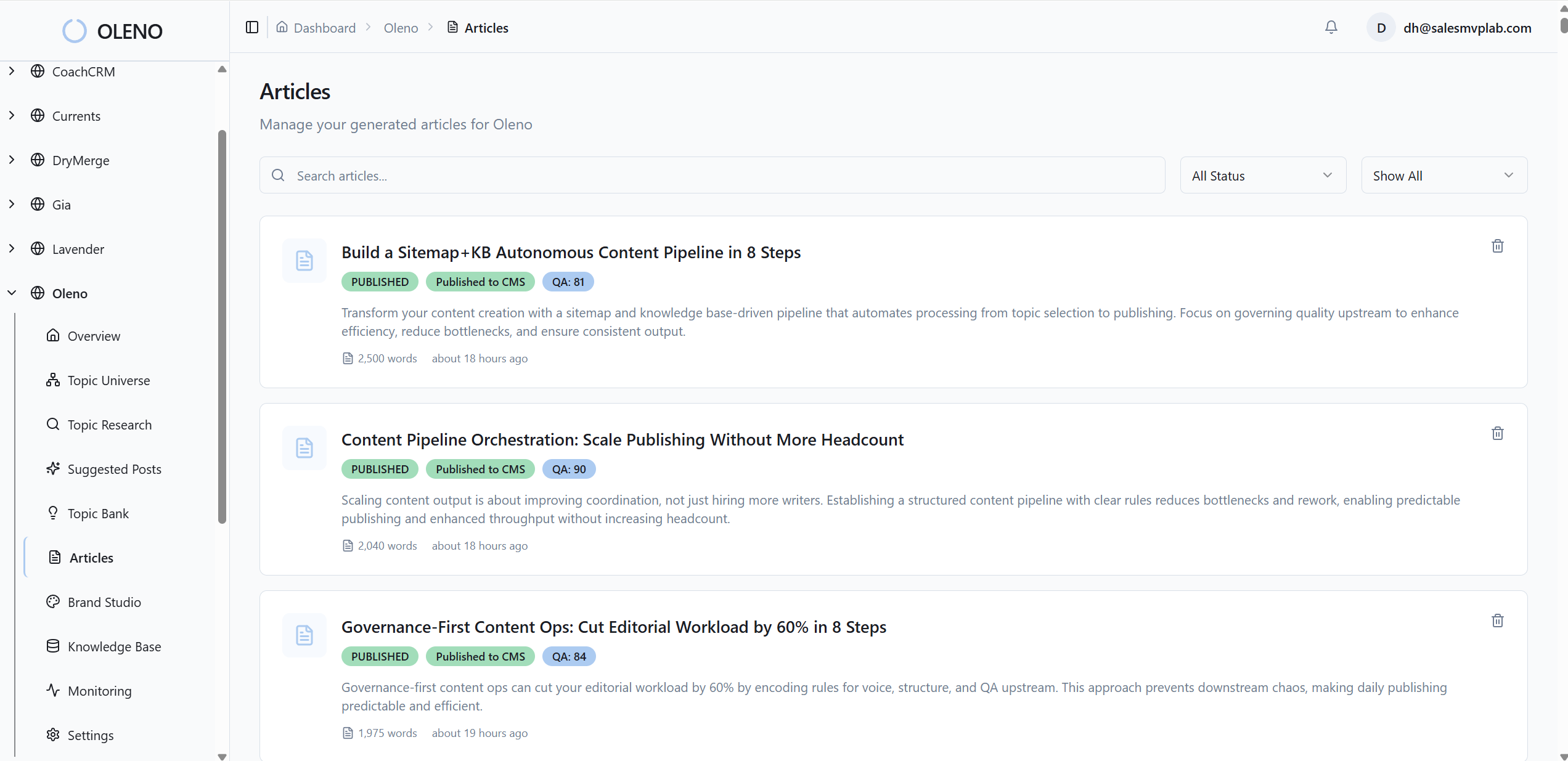
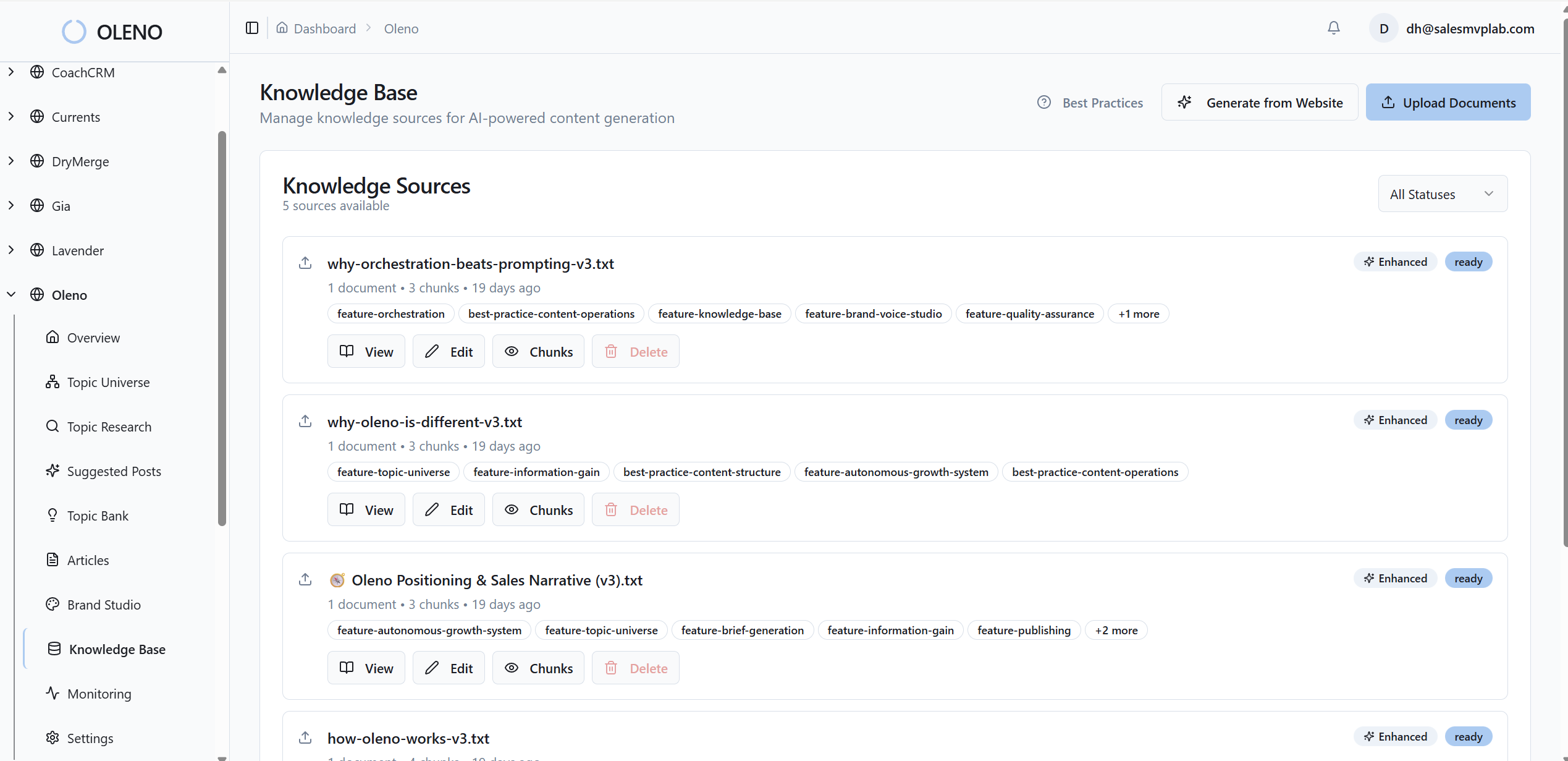
Product Studio guards the facts. Allowed claims, feature boundaries, pricing notes, and supported use cases are treated as an allowlist. That cuts the classic gen‑AI failure mode, where models invent features. Writers stop playing product cop and focus on clarity.
The result is simple. First drafts arrive closer to final. Editors give tighter feedback. You publish faster. The big win is compounding consistency across assets, not one lucky post.
QA Gate and Distribution keep outputs clean
Quality Control runs a non‑negotiable check before publishing. It validates voice alignment, narrative structure, clarity, repetition, grounding against your Knowledge Archive, and search readability. If something fails, Oleno revises and re-tests until it passes or flags what needs a human decision.
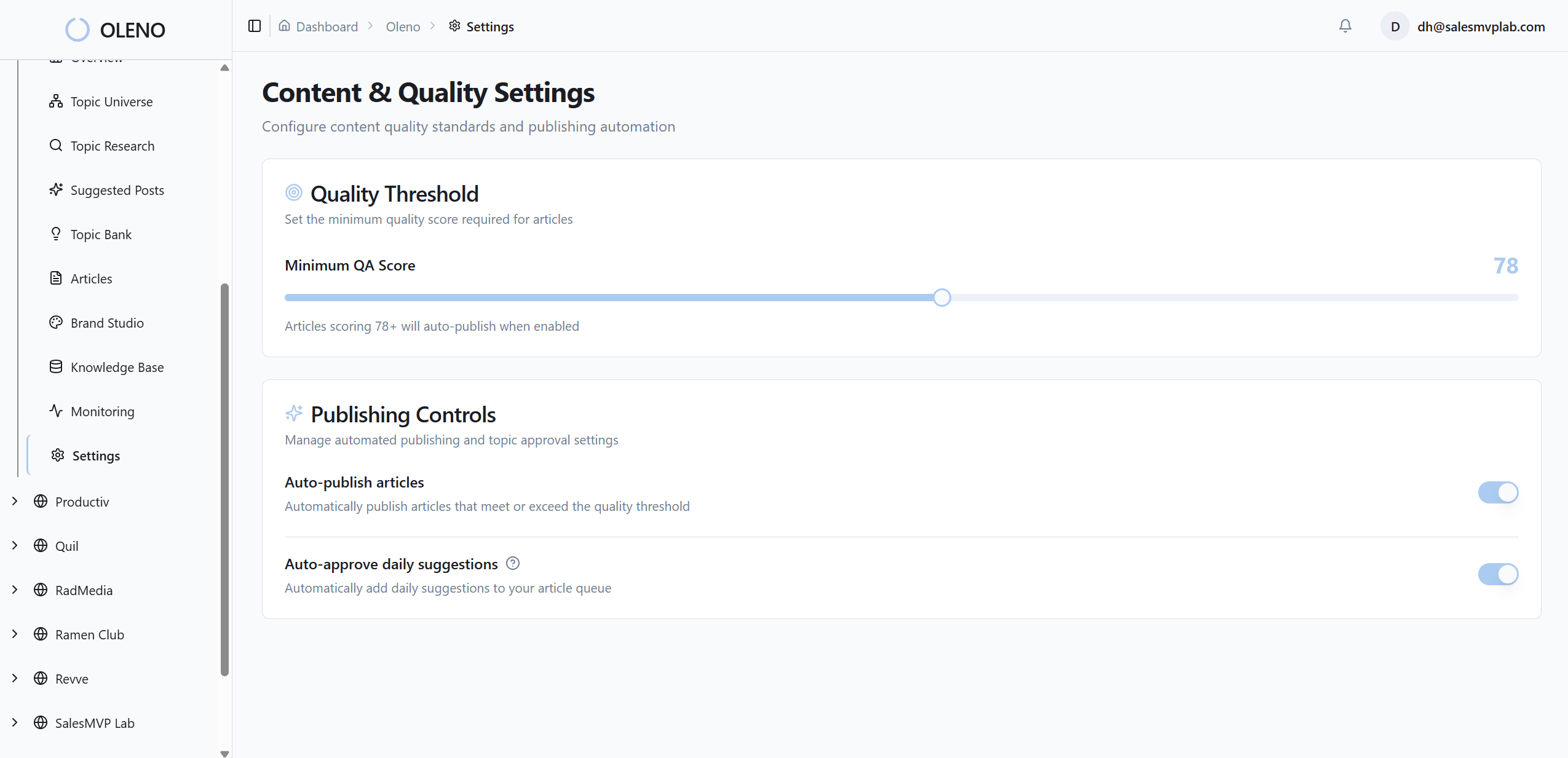
Distribution repackages approved articles into platform-formatted social posts without inventing new positioning. Your voice stays intact across channels. CMS Publishing pushes drafts or live posts straight to your site, so you stop copy-pasting and missing fields.
Most teams bleed hours on manual checks and coordination. With the QA gate and direct publishing, you cut those loops while keeping standards high. That’s the reliability you wanted from AI in the first place.
30% faster time-to-publish in two cycles. That’s what Oleno delivers when your exemplar library is encoded and enforced. Book a Demo
Conclusion
Lengthy style guides and checkbox rules won’t fix voice drift. Exemplars will. Build a strong base of 30 examples, annotate them, template them, and add simple checks. You’ll reduce voice-correction edits by about 60% and cut time-to-publish by about 30% within two content cycles, especially when the system carries the load.
If you want this to run without babysitting, encode the voice once, ground your facts, and let the QA gate protect you. That’s how small teams keep shipping, even when priorities shift. Stop losing hours to preventable edits. Start scaling a voice your buyers trust.
Stop voice drift. Start shipping consistent drafts with enforceable governance. Request a Demo
About Daniel Hebert
I'm the founder of Oleno, SalesMVP Lab, and yourLumira. Been working in B2B SaaS in both sales and marketing leadership for 13+ years. I specialize in building revenue engines from the ground up. Over the years, I've codified writing frameworks, which are now powering Oleno.
Frequently Asked Questions