Why Fragmented Content Makes You Invisible in GEO

Fragmented content makes you invisible in GEO long before you notice traffic dropping. If five people, three tools, and two AI workflows are all saying slightly different things about your company this month, LLMs don't see expertise. They see noise.
Demand-gen content execution platform is a governed demand-generation system that turns strategy into consistent, publishable content across channels by operationalizing brand rules, product truth, audience context, and execution workflows inside one continuous engine. Unlike an AI writer or SEO tool, a demand-gen content execution platform is the operating layer that keeps your message intact from strategy doc to published asset. This category emerged because GEO made fragmented execution impossible to hide. The old patchwork model was already straining. AI just exposed it faster.
Key Takeaways:
- Fragmented content makes you visible in search sometimes, but forgettable in AI answers
- The real enemy is The Strategy-Execution Trade-off, where teams choose between speed and strategic control
- GEO rewards consistency across dozens or hundreds of assets, not a few isolated content wins
- More writers, more prompts, or more tools usually increase context loss unless the system carries strategy forward
- Category leaders encode message, audience, and product truth once, then execute against those rules repeatedly
Fragmentation Is What GEO Actually Punishes
GEO visibility comes from repeated clarity, not occasional brilliance. That's the part a lot of teams miss. They think the problem is publishing speed, keyword gaps, or not having the latest prompt stack. But fragmented content makes you hard to recognize across surfaces, and when that happens, you stop looking like an authority.
GEO Rewards Consistency, Not Isolated Content Wins
A single strong article can still rank in Google. That's been true for a while. But AI answer engines synthesize patterns across many assets, which means your market position needs to show up the same way over and over or you risk getting ignored. According to Google's guidance on helpful content and people-first quality signals, consistency, originality, and clear expertise matter more than thin output churn (Google Search Central).
Back in 2012-2016, I ran a site that hit 120k unique visitors a month. We saw jumps at 500 pages, 1000, 2500, 5000, then 10000. Most pages got less than 100 views a month. But because we had breadth and depth, and because each article had a real point of view, the whole system compounded. That's the part people forget. Volume alone wasn't doing it. Volume plus consistency was.
GEO pushes that even further. A model like ChatGPT or Perplexity isn't asking, "Did you publish one pretty good page?" It's asking, "Across everything this brand has said, do they sound like they know what they mean?" That's a harsher standard. Fairly so.
The Bottleneck Is Not Writing Speed but Broken Execution
Most teams can generate drafts now. That's not the hard part anymore. The hard part is preserving the original strategy once the work leaves the strategy doc and starts passing through writers, PMMs, SEO people, freelancers, reviewers, and publishing workflows.
That's The Strategy-Execution Trade-off. You protect quality with manual review, which slows everything down. Or you chase speed with AI output, which drifts from your position. Either way, someone senior ends up paying for the gap.
This is where a lot of CMOs get stuck. On paper, the team has resources. In reality, nobody owns the full chain. One person owns positioning. Another owns briefs. Another writes. Another edits. Another publishes. Then demand gen wants campaign variants, product marketing wants accuracy, and social wants new angles. By the end, you don't have a system. You have handoffs.
If this sounds uncomfortably familiar, that's because it's normal. Too normal.
That friction is exactly why prompt-heavy workflows break at scale. As Anthropic's own prompt engineering docs make clear, prompting can improve single outputs, but it still depends on strong instructions, iteration, and human judgment at every step (Anthropic Documentation). Useful, yes. Durable as an operating model for demand gen, not really.
Fragmented Content Makes You Visible in Search and Absent in Answers
You can rank and still be strategically invisible. I've seen this firsthand.
At one company, we had strong writers, strong design, and strong rankings. We were publishing useful stuff and getting traffic. But the content sat too far away from the product narrative, so there was no natural bridge to pipeline. We ranked for a lot of terms and still didn't shape how buyers understood the problem. That gap is brutal in GEO because answer engines don't just reward relevance. They reward coherent relevance.
Think about how a model assembles an answer. It's closer to courtroom testimony than blog discovery. It looks for repeated facts, repeated language, repeated framing. If your site says one thing, your comparison pages say another, your founder content says a third, and your product pages are playing catch-up, the model has no strong witness to trust.
That's why fragmented content makes you invisible in GEO. Not because you're publishing nothing. Because you're publishing contradictions.
If you want to see what this shift looks like from a market perspective, request a demo after you finish reading. The pattern becomes obvious once you map your content the way an LLM would.
The Market Has Been Solving the Wrong Content Problem
The default question has been, "How do we make more content?" That's the wrong question now. The better one is, "How do we make sure strategy survives execution?"

More Content Does Not Fix a Broken Operating Model
More output can actually make the underlying problem worse. That's the part people resist, because it feels backwards. But if every new article introduces more drift, more output just means more surface area for confusion.
When I was the only marketer at PostBeyond, I could push out 3-4 high quality posts a week because the full context lived in my head and I was using a structured writing framework. Then the team grew. Our writer didn't have all the product and market context I had, so quality dropped and time went up. At the same time, I had less room to write because I was in meetings, managing people, doing exec stuff. We didn't have agency budget either. So the system got slower right when we needed it to speed up.
That story matters because it kills the lazy assumption that headcount automatically fixes output. It often doesn't. If context transfer is weak, every new person becomes another point where the message can bend.
I call this the 3-Layer Drift Model. First, strategy gets simplified into a brief. Second, the brief gets interpreted by the creator. Third, the draft gets softened in review by committee. By the time it ships, the sharp idea that made the strategy useful is gone. If you have more than 3 review layers and no single source of message truth, drift isn't a risk. It's the default.
Prompting Scales Output While Degrading Trust
Prompting is useful. I use it. Most smart teams do. But prompting is task leverage, not system leverage.
That's an important distinction. A prompt can help you draft an article faster. It can't reliably hold your positioning, product boundaries, audience nuance, and narrative consistency across 100 pieces unless humans keep re-injecting that context every time. And once humans are doing that, the promised speed starts evaporating.
A lot of founders learned this the hard way. One team recorded CEO videos, transcribed them, and turned that into content. It was faster. It also missed the structure needed for SEO and didn't solve topic selection. So they got thought leadership without search intent, output without discoverability. Good ingredients. Weak system.
You see the same issue in AI-heavy content teams. The first week feels fast. By month two, somebody senior is reviewing everything because the voice is off, the positioning is too generic, or the product explanation wandered. That's not a writing problem. That's a trust problem.
If a draft saves 40 minutes and creates 55 minutes of editing, you've not automated anything. You've shifted the headache upstream.
A New Category Is Emerging Because Execution Broke First
This is why a new category is starting to make sense. Not because the world needs another writing tool. It doesn't. It needs an operating layer for content execution.
That means the category isn't "AI writing." It isn't "SEO software." It isn't "agency replacement" either. It's the system that preserves the relationship between strategy and output.
Who is this for? Mostly scaling SaaS marketing teams, especially the 100-500 employee range where you already have talented people but the work no longer stays aligned by default. You have writers, PMMs, demand gen folks, maybe an SEO lead. Capacity isn't really the issue. Coordination cost is. Context gaps are. The team isn't weak. The system is.
There's a case to be made that small early-stage teams can brute-force this longer because one person still touches everything. That's true. But once multiple functions contribute to demand gen, memory stops being enough. You need the system to carry the message, or the message gets lost.
The Cost of the Trade-off Is Already Compounding
The price of fragmented execution doesn't show up in one place, which is why teams tolerate it for too long. It shows up in edits, delays, softer messaging, confused readers, missed conversion paths, and weak citation likelihood in AI answers.
Every Extra Handoff Creates a New Point of Narrative Failure
Each handoff introduces interpretation. Interpretation introduces drift. That's the mechanism.
Let's pretend you publish 20 articles a month and each piece touches a strategist, a writer, an editor, a PMM, and someone handling CMS and distribution. That's 100 workflow transitions before social variants, updates, or sales reuse. If just 15% of those transitions create a small loss of context, you've got 15 moments where the original point can weaken. Not explode. Just weaken enough to matter.
That's how narrative drift really works. Not through one giant mistake. Through lots of tiny ones.
Research from McKinsey on decision making and organizational complexity has pointed to coordination overhead as a meaningful drag on execution quality for years (McKinsey). Content teams feel this every week. The more specialists you add without a shared operating layer, the more the work starts depending on meetings and cleanup.
Senior Leaders Become Editors When the System Cannot Carry Strategy
You can usually spot system failure by looking at who's editing. If your CMO or VP Marketing is still rewriting intros, repositioning CTAs, fixing product language, and toning down generic claims, the system is asking senior leadership to carry context manually.
That's expensive. And honestly, it's a waste.
The reason this hurts so much is because the team often looks healthy from the outside. There are writers. There are campaigns. Articles are going live. But the senior person knows the ugly truth. The output is technically fine and strategically off. So they step in again. Then again. Then again.
I've seen this with teams that had rankings but weak demand-gen alignment. I've seen it with teams that added writers and got slower. And I've seen it with founder-led content where the insight was strong but the packaging missed the channel. Different surface problems. Same root issue.
One practical threshold I like is this: if a senior marketing leader is spending more than 20% of their content time rewriting, not approving, you don't have a talent issue first. You have a system issue first.
In GEO, Inconsistency Is a Discoverability Tax
Search can forgive inconsistency for longer than GEO can. That's the overlooked shift.
In search, a single page can win on intent match, links, structure, and timing. In GEO, models pull from a wider evidence set. They need confidence. Confidence comes from repeated signals. Same category framing. Same product definition. Same audience specificity. Same market point of view.
If those signals are fragmented, you pay a discoverability tax. Your content still exists. It just doesn't add up to a brand the model can confidently cite.
| Dimension | The Strategy-Execution Trade-off | Demand-Gen Content Execution Platform |
|---|---|---|
| Quality control | Maintained through manual review bottlenecks | Governed through embedded rules and system constraints |
| Speed | Increases only when strategic fidelity drops | Scales without divorcing output from positioning |
| Brand consistency | Drifts across writers, channels, and time | Stays aligned through centralized governance |
| Senior leader time | Consumed by briefing, editing, and correcting | Preserved for strategy because context is operationalized |
| GEO visibility | Weak, because signals are fragmented and inconsistent | Stronger, because authority compounds across surfaces |
| Budget efficiency | Lost to rewrites, handoffs, and coordination overhead | Invested in repeatable execution and reusable systems |
That table is the real choice. Not human vs AI. Not in-house vs agency. System vs fragmentation.
What This Feels Like Inside the Team
The human cost is pretty specific. You review a draft that's decent on the surface, but the core point is off. The team did the work. The writer isn't bad. The article just doesn't quite sound like your company, doesn't quite frame the problem right, and doesn't quite connect to why the buyer should care. So you rewrite it. Again.
You Are Not Reviewing for Polish Anymore but for Lost Intent
That shift matters. Editing for polish is normal. Editing for lost intent is a warning sign.
You can feel the difference fast. One is tightening language. The other is reconstructing the argument because the original strategy didn't survive the trip from your head to the page. For CMOs, that's where the frustration really kicks in. You're not fixing commas. You're re-inserting meaning.
The Editing Loop Signals System Failure, Not Team Failure
This part is worth saying clearly because people internalize the wrong lesson. The editing loop usually doesn't mean your team is weak. It means your system can't carry context without a person manually transporting it.
That's not blame. That's diagnosis.
Some teams prefer to call this a quality problem. I think that's too narrow. Quality is the symptom. The deeper issue is fidelity. Did the work stay true to the strategy as it moved? If not, you'll keep paying in rework no matter how talented the people are.
Busy Teams Can Still Be Strategically Invisible
Busy is not the same as cumulative. Plenty of teams are shipping a lot and still not building authority.
And that's the painful part. Because from the dashboard view, it can look like momentum. More articles. More assets. More campaigns. But if none of it reinforces the same market position, you're producing activity that doesn't compound. You're moving. You're not really gaining ground.
What Strong Category Leaders Do Instead
The teams that adapt to GEO stop treating content like a string of separate tasks. They start treating it like an execution system. Strategy gets encoded once. The system carries it forward. Humans still guide it, of course. But they stop acting as the duct tape between disconnected steps.
- Governed Strategy: The market message, brand voice, product truth, and audience context must be encoded centrally so execution does not depend on memory or repeated handoffs.
- Orchestrated Execution: Planning, creation, review, and publishing must run as one connected system rather than a chain of disconnected tools and contributors.
- Compounding Consistency: GEO visibility comes from repeated, coherent signals across many assets, not occasional high-performing posts or bursts of volume.
Short version: the rules need to travel with the work.
Strategy Must Live Inside Execution, Not Beside It
Most teams keep strategy in docs and execution in workflows. That's the first structural mistake.
Your message framework, category framing, product definitions, audience nuances, and approved points of view can't just live in a Notion page nobody opens after kickoff. They need to be present where briefs are made, drafts are written, reviews happen, and content gets published. If strategy sits beside execution, not inside it, people will default to what they remember. Memory is uneven. Systems are better.
A simple rule helps here. I call it the 80% Carry Rule. If a contributor needs to ask the same strategic question more than once every five pieces, the system isn't carrying enough context. That's when drift starts multiplying.
One more thing. This doesn't mean locking everything down so tightly that nobody can think. There's a fair concern there. The goal isn't rigidity. It's preserving the non-negotiables so people can be creative inside the right frame.
Governance Is What Makes Scale Trustworthy
A lot of people hear "governance" and think bureaucracy. I get it. Bad governance feels like process theater. But useful governance is just encoded clarity.
You decide how you sound. What you believe. What is true about the product. Which audiences matter. Which claims are off limits. Then every asset gets built inside those boundaries. That's what makes scale trustworthy.
Without that, speed becomes suspicious. Every fast draft creates worry. Is this accurate? Does it sound like us? Is the CTA off? Did we just soften our point of view into generic mush? That low-grade worry is what creates the editing tax.
If you want to pressure test whether your current setup can carry those boundaries, request a demo. Even if you don't buy anything, the exercise of mapping where your message breaks is useful.
Consistency Across Surfaces Beats Volume Across Channels
This is probably the most counterintuitive part of GEO. More channels don't automatically create more authority. More aligned signals do.
So yes, publish across your site, product content, category pages, comparisons, and social. But make sure those surfaces reinforce one another. The same framing. The same differentiated language. The same clear product truth. Repetition matters here. In a good way.
I've seen content catalogs work when they hit critical mass. But the step-function gains came when the catalog had internal coherence, not just lots of pages. That's why consistency across scale beats raw volume for LLM visibility. Models trust patterns. They don't trust random bursts.
A strong self-check for teams is this: if you sampled 20 assets from across the funnel, would they sound like one company with one argument? If the answer is no, don't solve that with more production. Solve it with a better system.
How Oleno Makes This Real
This is the point where the category stops being theory and starts looking operational. Oleno is built as a demand-gen content execution platform, which means it starts with the rules of the system before it tries to speed up output.
How Oleno Encodes the Strategy Once
Oleno puts the message layer where execution can actually use it. brand studio defines voice, structure, preferred language, and what to avoid. marketing studio holds category framing, key messages, and the market argument. product studio keeps approved product descriptions, boundaries, and supporting truth in one place. audience & persona targeting and use case studio make sure the same topic can be framed differently for different buyers without turning generic.
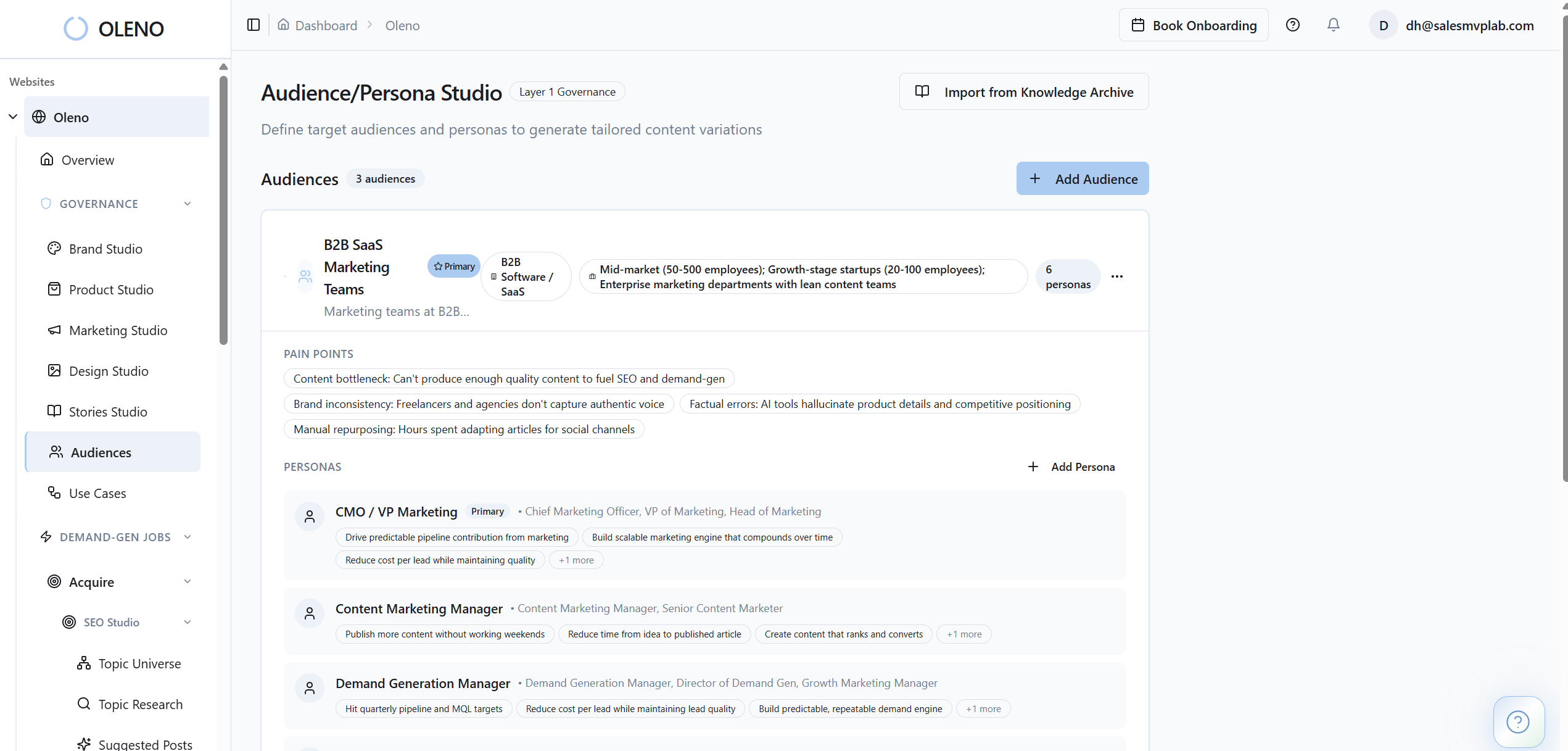
That matters because the old brief-review-rewrite treadmill usually exists for one reason: the context wasn't available when the draft was created. Oleno changes that by loading the context into the work itself, instead of expecting humans to restate it over and over.
How Oleno Replaces the Rewrite Loop with a System
Once the inputs are defined, the system can run work through a connected pipeline instead of disconnected tasks. storyboard and the orchestrator connect planning to execution cadence. programmatic seo studio, category studio, competitive studio, buyer enablement studio, and writing studio handle different job types without losing the same core position. quality gate checks content before it moves forward. cms publishing closes the loop so content can move from approved to live without the usual copy-paste mess.
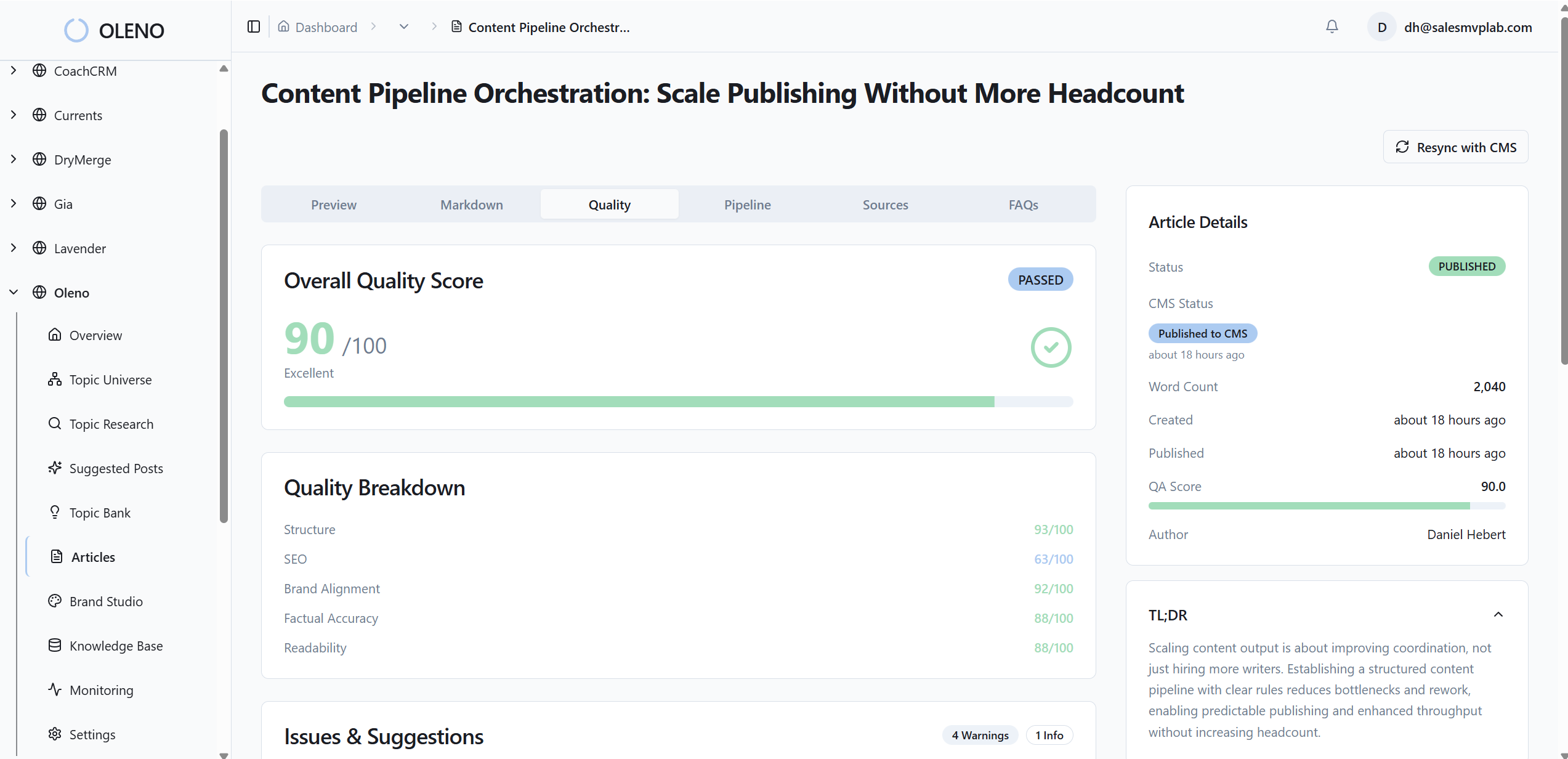
That's the important distinction. Oleno is not just drafting faster. It's reducing the number of places where the strategy can get lost.
And because product studio cross-checks product truth while stories studio and ip studio ground content in real company thinking, the output has a better shot at sounding like a practitioner wrote it instead of a generic model. An experienced SEO consultant described the output as passing the slop test. I like that phrase because every content leader knows what slop looks like.
How Strategy Becomes Publishable at Scale
The payoff is pretty practical. Senior marketers spend less time re-briefing and rewriting. Multi-audience execution gets tighter because the audience context is already there. The team can push content across acquisition, evaluation, and product-led surfaces without every asset becoming a fresh coordination project. executive dashboard and content refresh & drift monitoring add visibility so leaders can spot gaps and stale content before they become bigger problems.
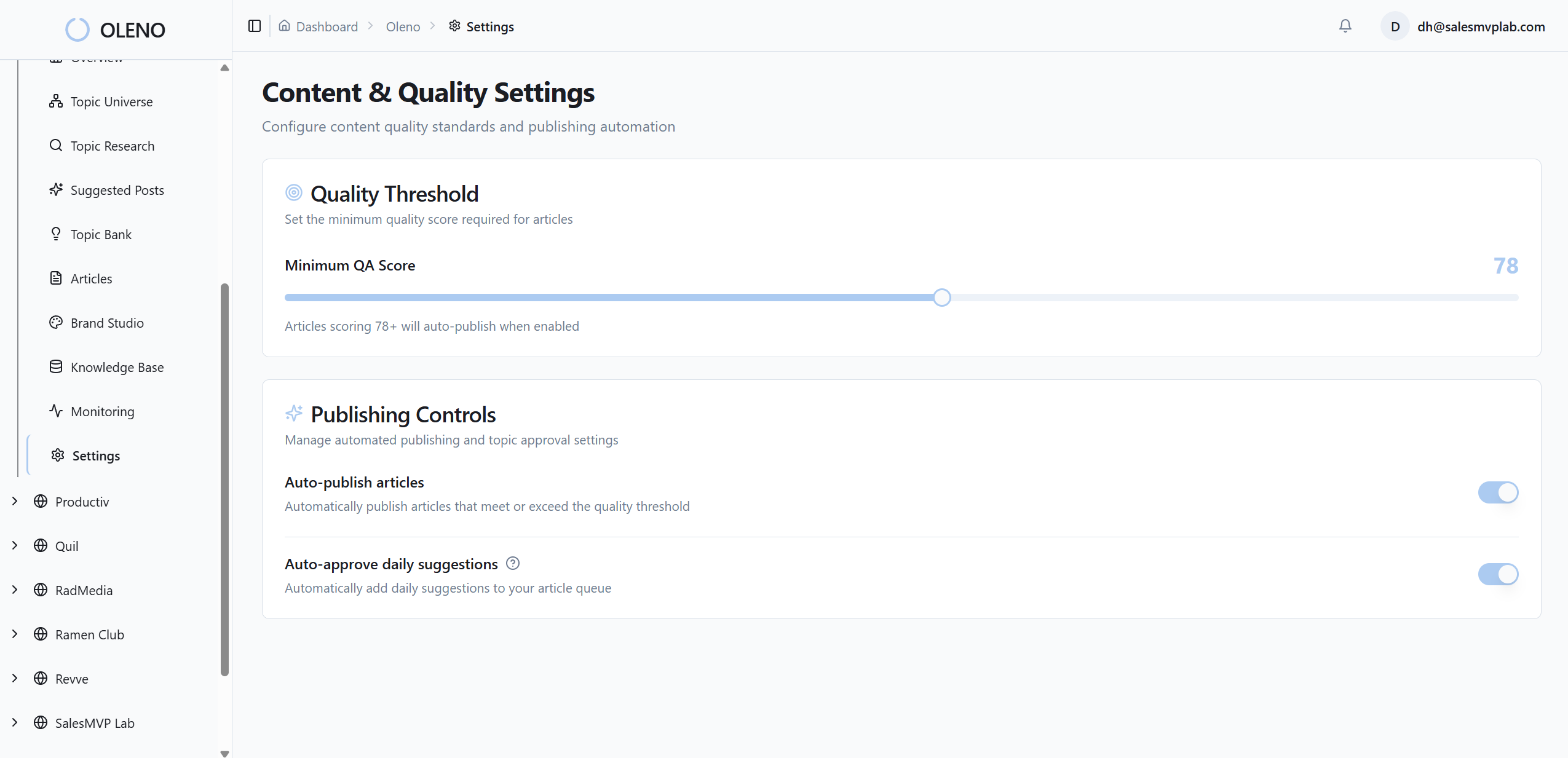
This won't remove judgment. It shouldn't. But it can remove a lot of the repetitive context-carrying work that currently sits on the shoulders of the most expensive people in the room.
If that's the bottleneck you're trying to fix, book a demo. The useful part isn't hearing a product pitch. It's seeing what your current process looks like when you map it as a system instead of a set of tasks.
Visibility in GEO Starts with Execution, Not More Activity
Fragmented content makes you invisible in GEO because fragmented execution makes your expertise hard to trust at scale. That's really the whole argument. The market has been buying tools for tasks when the deeper need is a system that preserves strategy through execution. Once you see that, a lot of frustrating rework starts to make sense.
The teams that win here probably won't be the ones with the most content. They'll be the ones whose content sounds like one company, one point of view, and one clear understanding of who they serve.
About Daniel Hebert
I'm the founder of Oleno, SalesMVP Lab, and yourLumira. Been working in B2B SaaS in both sales and marketing leadership for 13+ years. I specialize in building revenue engines from the ground up. Over the years, I've codified writing frameworks, which are now powering Oleno.
Frequently Asked Questions