Fragmented Demand Generation Is Killing AI Search Visibility

95% of the time, your AI search visibility problem isn't a content volume problem. It's a system problem. Fragmented demand generation is what happens when content, SEO, product truth, audience context, and narrative all live in different places, and LLMs are really good at spotting that fracture.
Demand-generation content execution software is a governed marketing system that turns strategy, positioning, product truth, audience context, and brand voice into consistent multi-format demand-generation output by operationalizing execution across planning, creation, review, publishing, and reinforcement. Unlike AI writers or SEO tools, demand-generation content execution software is built to preserve strategic consistency as output scales, not just generate more assets.
The timing matters. SEO used to let you get away with tactical wins. GEO doesn't work like that. Large language models don't just look at one page and call it a day. They synthesize patterns across your site, your positioning, your product definitions, your use cases, and the consistency of your signal over time. That's why fragmented demand generation is such a costly mistake now. It breaks the very thing AI systems use to decide who sounds credible.
Key Takeaways:
- Fragmented demand generation is often the hidden reason brands fail to show up in AI-generated answers
- Publishing more content won't fix weak narrative consistency across assets
- The real bottleneck isn't writing speed, it's execution integrity
- Review cycles grow when context lives in people, docs, prompts, and side conversations
- Demand-generation content execution software exists to connect strategy, planning, creation, and publishing into one system
- Category leaders centralize truth first, then scale output
- Consistency across scale beats raw volume for LLM visibility
If you're trying to fix this kind of drift without a system, you can request a demo and see what a more connected operating model looks like.
Why AI Search Visibility Breaks When Demand Generation Fragments
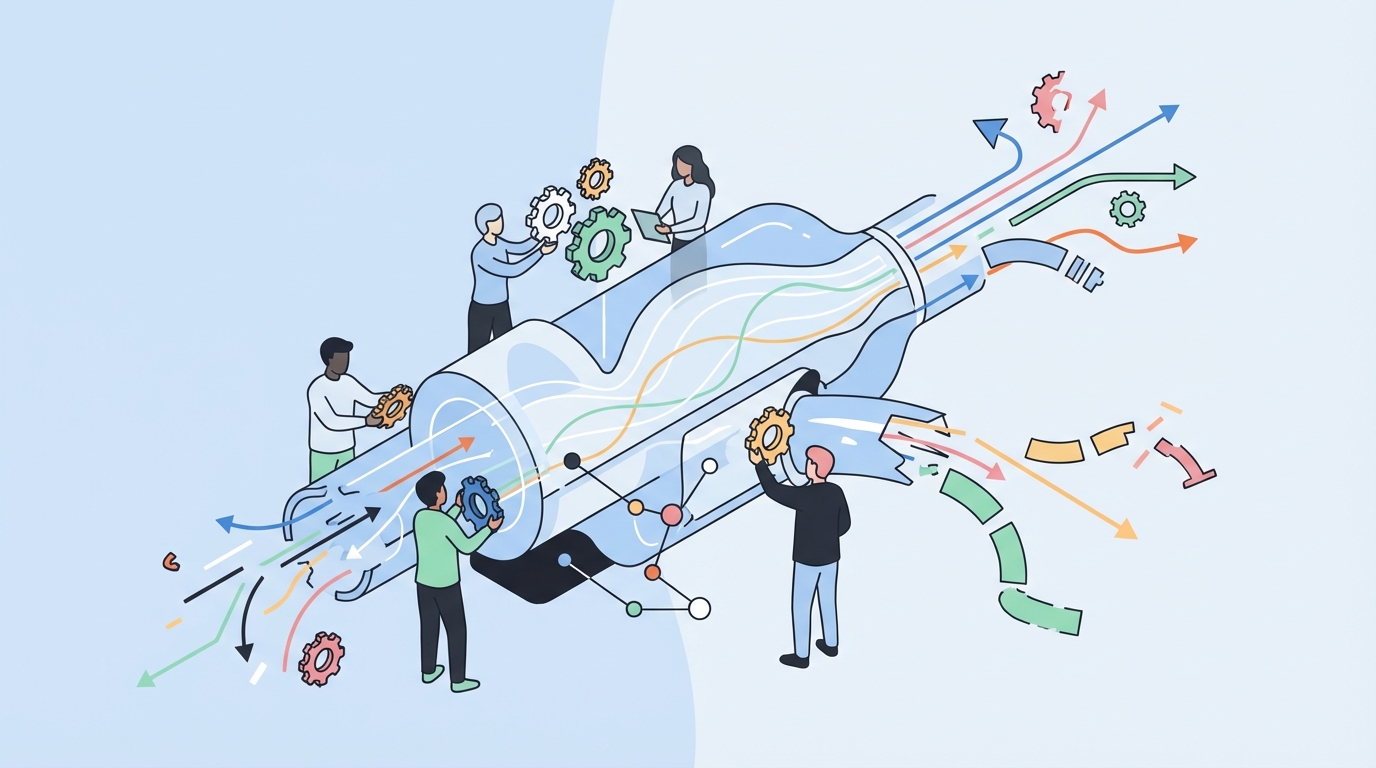
AI search visibility breaks when your brand sends mixed signals across dozens or hundreds of assets. You may still rank for some keywords, publish every week, and ship campaign content on schedule. But if your market point of view, product definitions, audience framing, and brand voice keep shifting, LLMs have less reason to surface you as the trusted answer.
Publishing More Content No Longer Means You'll Get Cited
A lot of teams are still using an SEO-era playbook for a GEO-era problem. More posts. More prompts. More freelancers. More tools. On paper, that looks like momentum. In practice, it often creates a wider mess.
I’ve seen this firsthand. Back in 2012-2016, I ran a digital marketing site that eventually hit 120k unique visitors a month. We had 80 regular contributors, 300+ guest contributors, and traffic spikes at 500, 1000, 2500, 5000, then 10000 pages. But volume only worked because it sat on top of breadth, depth, and distinct points of view. Volume by itself would've just produced a larger pile of forgettable pages.
That's the first rule I'd give you. The 500-Page Signal Rule. If your first 500 pages don't reinforce the same market logic, adding 500 more usually multiplies confusion, not authority. AI systems don't reward noise. They reward repeated clarity.
A fair counterpoint here: volume still matters. Of course it does. More surface area gives you more chances to be discovered. But volume without consistency is like hiring 20 reps and giving each of them a different pitch. You'll get activity. You probably won't get trust.
Fragmented Demand Generation Is The Hidden Tax On GEO
Fragmented demand generation feels normal because modern marketing stacks taught us to work that way. One tool for SEO. One for briefs. One for AI drafting. One freelancer for product pages. One PMM cleaning up claims. One founder rewriting intros at 11 PM. One doc somewhere with the real positioning. Maybe.
That's why the problem gets missed. The visible complaint is usually, "we need better content" or "our AI output sounds generic" or "we need to publish more." The real issue is that the system producing the content is broken. The bottleneck isn't content or prompts. It's fragmented execution without a system.
Picture a Head of Marketing at a 40-person SaaS company on a Tuesday afternoon. They have a launch page in one doc, three SEO topics in a spreadsheet, product notes in Slack, founder points of view in their head, and a freelancer waiting on a brief. By 5 PM, they haven't really created anything. They've just moved context around. That's not a creative problem. That's a structure problem.
And it gets more expensive than people think. Let's pretend every article needs 3 extra review rounds because strategy, audience, and product truth weren't locked before drafting. If each round costs 25 minutes across marketing, PMM, and leadership, that's 75 minutes of overhead per piece. Across 16 pieces a month, you're burning 20 hours on avoidable rework. That's half a work week. Gone.
LLMs Reward Coherence Across Assets, Not One-Off Wins
LLMs don't experience your brand one page at a time the way a human reader might. They infer who you are by seeing how your pages line up. That means definitions matter. Repetition matters. Consistent audience framing matters. The way you talk about the old way and the new way matters.
According to Google's guidance on creating helpful, reliable, people-first content, consistency of expertise and clarity of purpose are part of what makes content trustworthy for search systems to interpret and surface (Google Search Central). And if you look at how retrieval and ranking work in modern search and question answering systems, repeated clear signals tend to outperform isolated strong documents that sit inside a weak corpus (Google Research on retrieval-augmented systems).
That's why one strong article won't save a confused brand. It helps, sure. But AI visibility is closer to credit history than a one-time test score. The system is looking for a pattern it can trust.
The Market Keeps Fixing Output Instead Of Fixing Execution
The market has spent years trying to solve demand generation by optimizing outputs. Better prompts. Better briefs. Better writers. Better keyword research. Better content calendars. Some of that helps. But none of it fixes the deeper problem if execution still breaks between strategy and publishing.
The Real Bottleneck Isn't Draft Speed
Most teams can get words on a page now. That's not the hard part anymore. A decent writer can do it. A decent AI tool can do it. The draft isn't the bottleneck.
Execution integrity is.
By that I mean one simple test: does the article that gets published still reflect the original strategy, audience, product truth, and point of view that should have shaped it? If the answer is "kind of" or "after a lot of editing," you don't have a writing problem. You have integrity loss in the system.
When I was the sole marketer at PostBeyond, I could crank out 3-4 solid blog posts a week because I had the context in my head and a structured framework in my hands. Then the team grew. Our writer didn't have all the same context, and I had less time because I was buried in meetings and management. Output should've gone up. Instead, quality dropped and speed got worse. That's the Context Transfer Threshold. Once the knowledge required to write well lives mostly in one person's head, adding contributors tends to increase rework before it increases throughput.
Some people will say, "that's just a hiring issue." Fair. Sometimes it is. But early growth-stage teams usually don't have the luxury of hiring three perfect hybrids who are great at SEO, category narrative, PMM, and founder voice. That's why the operating model matters so much.
Tool Sprawl Breaks The Story Even When Each Tool Looks Useful
A lot of marketing software makes one promise really well. Keyword coverage. Draft generation. workflow. Analytics. Distribution. Nothing wrong with that. The problem starts when your actual narrative gets split across all of them and no one layer is responsible for keeping the whole thing intact.
So you end up with a weird stack. Your SEO tool knows what might rank. Your AI tool knows how to produce text. Your PMM knows what the product actually does. Your founder knows how the market should be framed. Your freelancer knows how to hit a deadline. Your CRM knows who converted. And none of those pieces naturally reinforce each other.
That is why fragmented demand generation is so dangerous. It creates local optimization and global confusion.
I remember hearing April Dunford on a panel years ago after another marketer spent way too long rattling off channel tactics and tool tricks. Her reaction said it all before she even spoke. Then she jumped in with a line that stuck: tactics without strategy are shit. Crude, yes. But dead on. If the center of your marketing isn't clear, every surrounding tool will just help you spread the confusion faster.
GEO Punishes The Gap Between Strategy And Production
GEO has a way of exposing this gap brutally. In the old days, you could sometimes win with a few well-optimized pages and enough backlinks. Now the system is reading for coherence. It wants to know if your product definition matches your category framing. If your audience language stays stable. If your use cases make sense. If the signal compounds.
That's why demand-generation content execution software is a distinct category, not just a nicer content workflow. It's an operational layer for teams that already know fragmented coordination is killing them. More specifically, it's for growth-stage and scaling SaaS teams where the Head of Marketing is tired of being the human glue holding every content decision together.
And no, this doesn't mean every team needs some huge formal system on day one. Very early stage companies can brute-force a lot with founder energy. I've done it. But if you're trying to publish weekly across SEO, product marketing, competitive content, and thought leadership, and you're still rebuilding context every time, you're already paying the tax.
The Cost Of Fragmentation Starts Small Then Gets Ugly
Fragmented demand generation rarely fails in one dramatic moment. It fails through accumulation. A few more rewrites here. A launch page that sounds off there. A comparison page that misses the real buying trigger. A blog that ranks but doesn't move anyone toward your product. Over a quarter, that turns into a real cost.
More Contributors Usually Means More Rework First
People assume more hands will solve the problem. Sometimes they do. Often they don't. Not at first.
When more people join without a shared system, you don't just add capacity. You add interpretation. Everyone fills gaps their own way. One person leans educational. Another leans SEO-heavy. Another writes like PMM. Another writes like a freelancer trying to stay safe. The content starts sounding like four companies in a trench coat.
I've watched this happen enough times that I use a simple rule now: if every new contributor increases review time by more than 15 minutes per asset, your system is under-documented. That's the Rework Threshold. Cross it, and headcount stops being leverage.
Consider the before-and-after. Before: one marketer writes slower than they'd like, but the signal is coherent. After: three people contribute, output rises a little, review time doubles, voice drifts, and every piece needs strategic correction. More motion. Less momentum.
Rankings Alone Don't Mean Demand Generation Is Working
This part stings because it catches good teams too. You can rank well and still miss demand generation almost entirely.
At one company, we had a really strong content team. Great writers. Strong personality. Good design. We ranked for a lot of terms. But too much of the content sat miles away from the product and miles away from the actual market narrative. So the traffic came in, but the strategic handoff never happened. Plenty of visibility. Weak pipeline connection.
That's why I push the Narrative Fit Ratio. For every 10 articles you publish, at least 6 should connect the reader's problem to your market point of view and at least 3 should connect that point of view to product reality. If you can't pass that test, you may be building an audience without building demand.
A reasonable objection is that not every article should sell. True. I agree with that. Some content should purely educate. Some should widen the top of funnel. But if the entire library avoids your product truth and your category position, you're training the market to learn from you without ever seeing why you matter.
You can request a demo if you want to see how teams turn that disconnected content motion into a tighter operating system.
Reviews Expand When Context Lives In People's Heads
Review cycles are where fragmented systems expose themselves. The draft comes in. Then somebody says the positioning is off. Somebody else says the audience framing isn't right. PMM flags a claim. The founder rewrites the intro. SEO wants a different angle. Nobody is wrong. That's the frustrating part.
The system is wrong.
Last summer, when I was building and marketing a B2C app, I created a bunch of GPTs and kept prompting, copying, pasting, and manually loading content into my CMS. It was eating 3-4 hours a day. The writing wasn't always the biggest headache. The real problem was that I was acting as planner, brief writer, editor, QA, and publisher all at once. That worked for a minute. It didn't scale even a little.
That's the Coordination Cost Curve. At low volume, humans can absorb chaos. At medium volume, chaos starts stealing nights and weekends. At high volume, the whole system slows down because people are doing translation work instead of marketing work.
What This Feels Like For A Head Of Marketing
Fragmented demand generation feels like competence with no compounding. You and your team are busy. Smart. Working hard. But every quarter still feels like you're rebuilding the machine from scraps.
Every Campaign Feels Like Starting Over
You already know this feeling if you're a Head of Marketing at a small SaaS company. New feature launch. New comparison page. New campaign. New content push. And somehow, every time, you're rewriting the same positioning in a new brief because it never made it into the system in the first place.
One week you're fixing messaging. The next week you're fixing factual drift. The week after that you're trying to explain to leadership why output exists but momentum doesn't. It's tiring because none of it looks broken from far away. But up close, every asset feels like a reset.
Reviews Become The Operating Model
When no real system exists, review becomes the system. That's what happens. The team starts relying on editors, founders, PMMs, or you to catch everything late.
Late review has a hidden cost. It makes smart people feel like bottlenecks. And it trains the org to believe quality comes from heroics instead of design. You end up worried about every publish because you know the process itself isn't trustworthy. Sound familiar?
Good Marketers Burn Out From Coordination, Not Just Workload
Most under-resourced marketers can handle a lot of work. That's not usually the issue. The issue is the kind of work.
Creating something useful is energizing. Chasing context, rewriting for alignment, moving details across docs, and re-explaining the same market story every week is draining. It's admin disguised as strategy. And because the machine never compounds, you start questioning whether the channel is broken when it's really the operating model that's broken.
What Category Leaders Do Instead
Category leaders replace fragmented demand generation with a governed execution model. They don't rely on memory, heroic reviews, or a pile of disconnected tools to preserve their market signal. They define truth once, connect planning to production, and repeat the same strategic signal across the funnel without letting it drift.
- Governed Strategy: The system must encode positioning, product truth, audience context, and brand voice before any content is produced.
- Orchestrated Execution: Planning, creation, review, publishing, and distribution must run as one connected demand-generation workflow rather than isolated tasks.
- Compounding Signal: Content should reinforce the same market POV across formats and funnel stages so SEO and LLM visibility strengthen over time instead of resetting.
| Dimension | Fragmented Demand Generation | Demand-Generation Content Execution Software |
|---|---|---|
| Strategic source of truth | Positioning, voice, and product facts live in docs, prompts, and people | Strategic truth is centralized and applied across output |
| Content production | Assets are created as one-off tasks with manual coordination | Execution follows a repeatable system tied to strategy and audience |
| Quality control | Humans catch drift late through reviews and rewrites | Guardrails reduce drift before review starts |
| AI search visibility | Brand signals stay inconsistent, so LLMs have little confidence | Repeated coherent signals make the brand easier to surface and cite |
| Team efficiency | Coordination cost rises with every contributor and tool | Scale comes from operational consistency, not more oversight |
| Demand-gen impact | Content performance is uneven and hard to connect to pipeline | Content supports one unified market story across the funnel |
Governance Has To Come Before Scale
This is the part most teams try to skip. They want the output first. Understandable. Everyone has pressure. Everyone wants content now. But scale without predefined truth creates drift faster than you think.
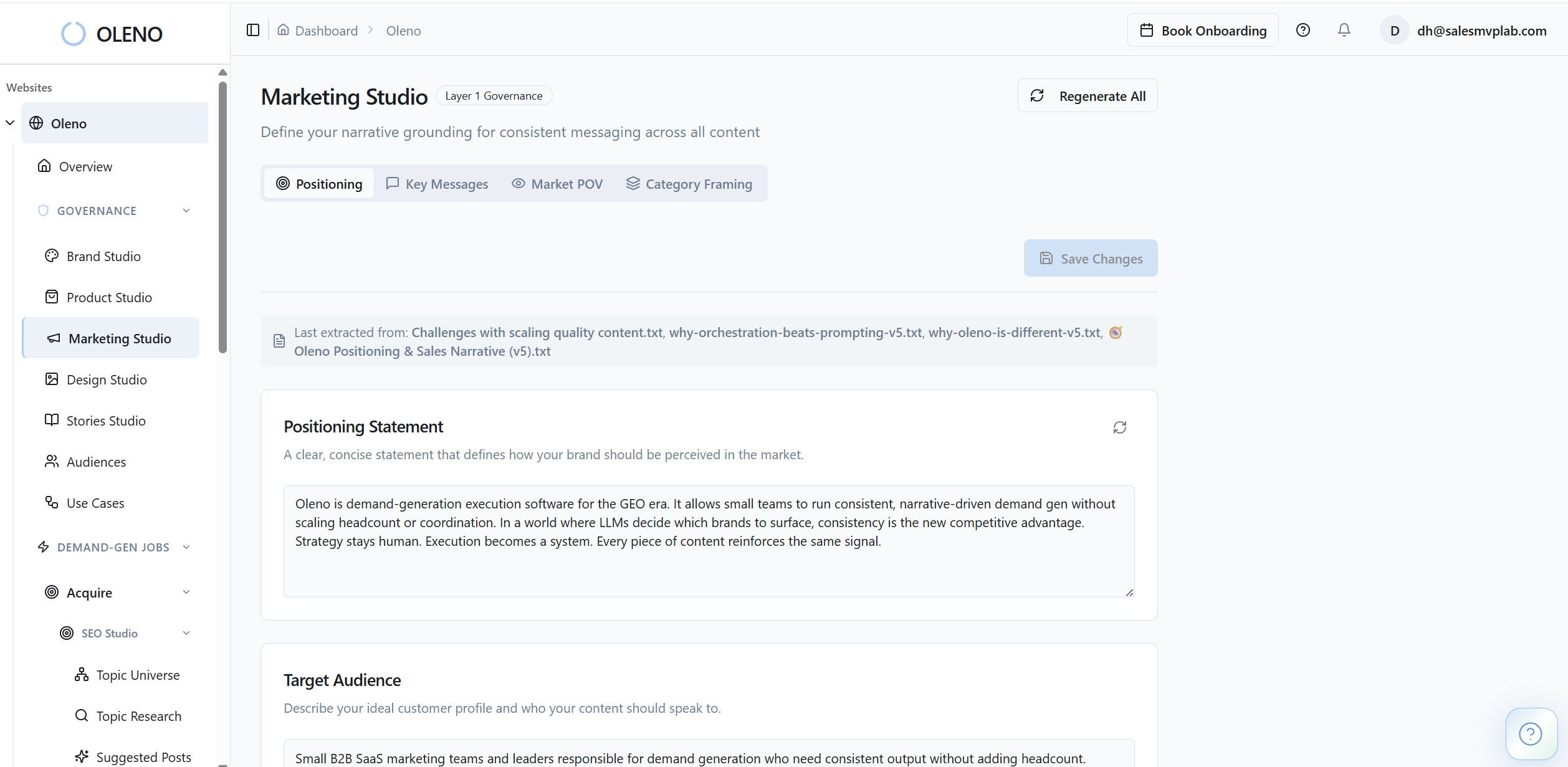
Start with one source of narrative truth. That means your category framing, product definitions, audience segments, use cases, and brand voice need to exist somewhere structured enough that production can actually use them. Not as scattered docs. Not as "ask Sarah, she knows." Structured.
If you're a tiny team, this doesn't have to be heavy. But it does have to be explicit. My rule is simple: if a new freelancer, writer, or PMM can't explain your category, your audience, and your product boundaries after 30 minutes with your source materials, your truth layer is too vague. Fix that before chasing more output.
And yes, this has a tradeoff. It takes setup time. No point pretending otherwise. But the competing choice is paying the setup tax every single week through reviews and rewrites. I'd rather pay once.
Planning And Production Need To Stay Connected
A lot of teams do strategic planning in one place and content production in another. Quarterly themes over here. Keyword ideas over there. Product launch priorities in Slack. Audience notes in the founder's brain. Production starts, and all that context gets thinned out like a bad photocopy.
What works better is connecting plan to production directly. If this quarter matters to a Head of Marketing audience in growth-stage SaaS, and the active use case is launch and demand-gen execution, that should shape topic selection, angle, proof, CTA, and framing from the start. Not after the first draft fails review.
A quick diagnostic helps here:
- Can your team explain why each article exists before it's drafted?
- Can they tie it to a specific audience, use case, and business goal?
- Can they show how this piece reinforces earlier pieces instead of duplicating them?
- Can they name what should stay consistent across every asset this quarter?
If you answered no to two or more, planning and production are too far apart.
I've seen the upside of tight planning firsthand. At one company, once we finally narrowed the positioning and understood the real entry point buyers cared about, everything got easier. Outreach tightened up. Messaging got more direct. The story repeated in a way prospects could actually understand. Focus tends to do that.
Repetition Is How Authority Gets Built
A lot of marketers are still allergic to repetition because they're worried it will feel stale. Humans sometimes feel that way internally because we hear our own message too often. Buyers don't. LLMs definitely don't.
Authority comes from consistent repetition with context, not random originality. You want your market to keep encountering the same clear beliefs, definitions, use cases, and distinctions in slightly different forms across assets. That's how a brand becomes legible.
At LevelJump, we used CEO videos and transcripts to produce thought leadership faster, which helped with publishing cadence. But without stronger topic discovery and SEO structure, the content didn't capture the right search intent. That lesson stuck with me. Founder perspective matters. Structure matters too. You need both.
That's why I think the best operating model is not "publish more" and not "say one thing once." It's repeated, audience-aware expression of the same strategic signal across the full funnel. If you're trying to build that kind of repeatable system, request a demo and look at how the pieces can stay connected instead of resetting every week.
How Oleno Puts This Category Into Practice
Demand-generation content execution software gets real when strategy, product truth, planning, and publishing actually run together. Oleno is built for that job. Not as another prompt layer, but as the operational system that many growth-stage teams are still trying to patch together with docs, tools, and meetings.
Oleno Connects The Truth Layer To The Work Layer
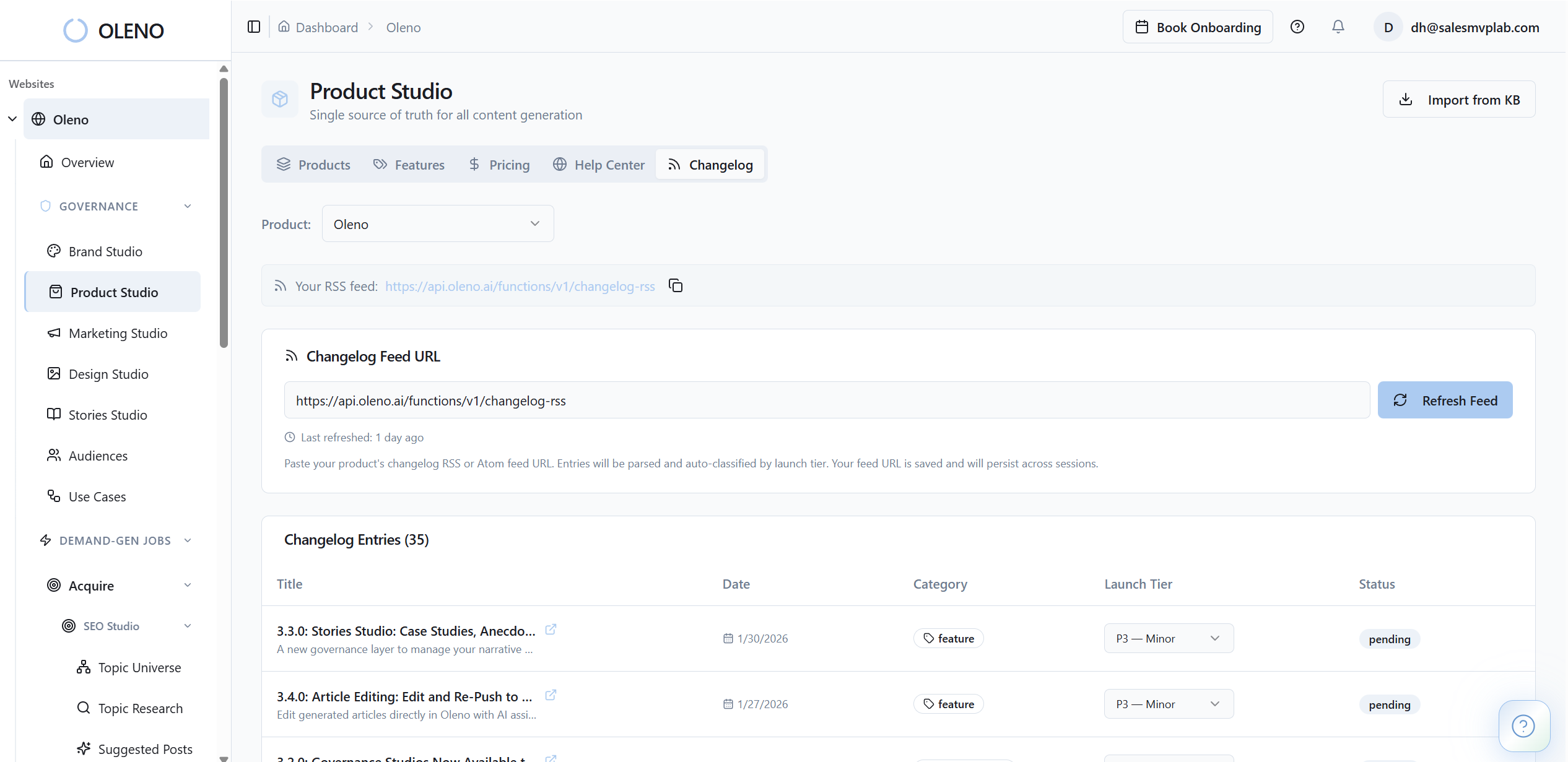
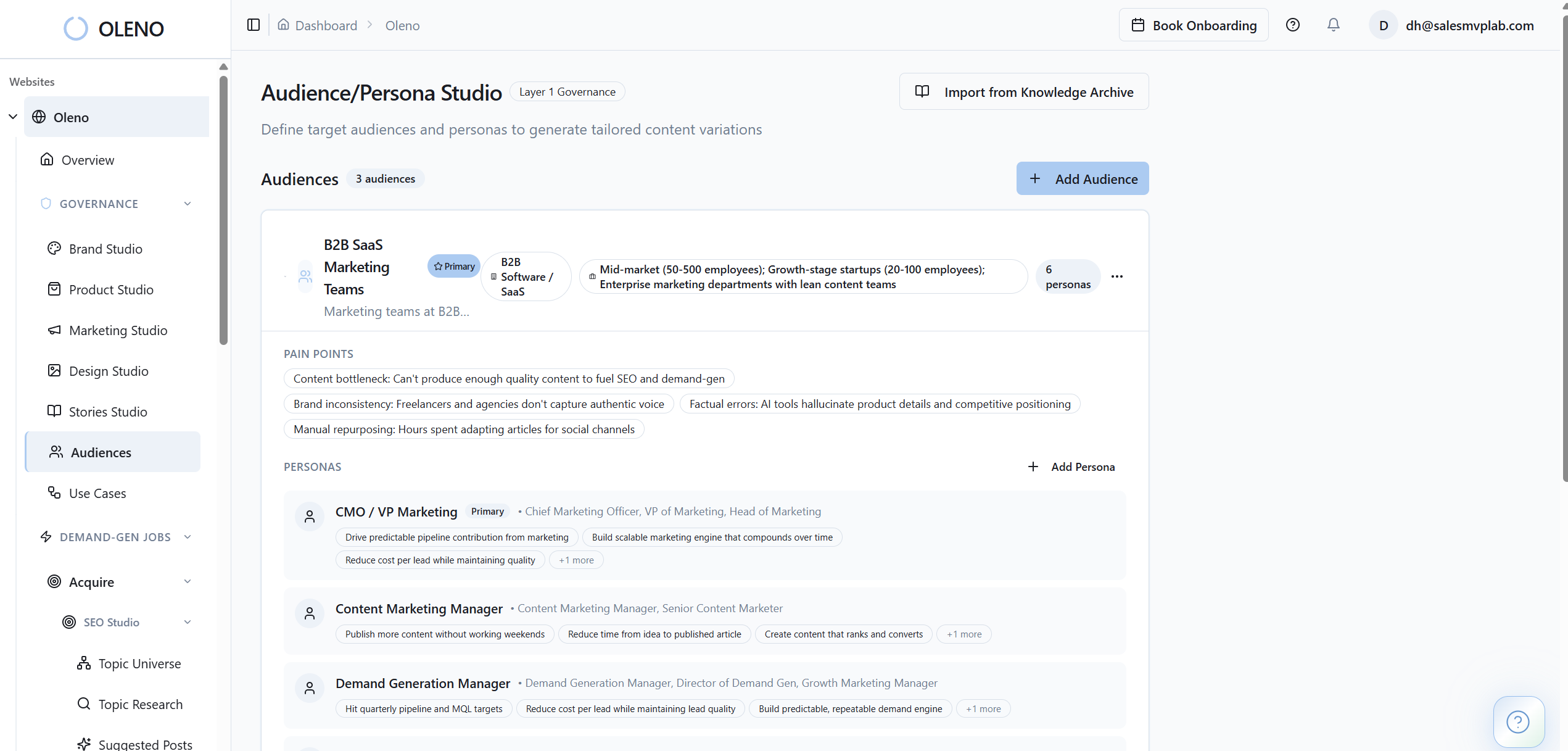
Oleno starts where most teams usually start too late: the source material. Marketing Studio holds category framing, messages, and narrative structure. Product Studio holds approved product descriptions, boundaries, pricing context, and supporting product truth. Audience & Persona Targeting and Use Case Studio hold who you're speaking to and what they actually need.
That matters because it cuts down the reset problem. Instead of re-briefing the same strategy into every article, the system can carry that context forward. In practice, that means fewer rewrites caused by missing audience framing, less factual drift in product-led content, and a better shot at keeping the same market signal across SEO, product marketing, competitive pages, and thought leadership.
Oleno Turns Planning And Publishing Into One System
This is where a lot of content stacks fall apart. Planning is one motion. Production is another. Publishing is somebody's checklist. Oleno ties those together with Storyboard, Orchestrator, Quality Gate, and CMS Publishing.
Storyboard helps allocate content across audiences, personas, products, and use cases instead of choosing topics in a vacuum. Orchestrator runs approved topics through the pipeline while enforcing quotas and pacing. Quality Gate checks whether the output meets standards before it moves forward. CMS Publishing closes the loop by pushing finished content directly into your CMS without the usual copy-paste mess.
The practical payoff is pretty simple. Teams can move from 4 to 8 articles a month to 20 to 40+ without adding headcount, according to the documented use case for SEO content scaling. That's not the whole story, though. The bigger win is that the output is more likely to stay aligned while volume goes up.
The Goal Isn't Faster Drafts. It's A Stronger Signal
Oleno also reflects the category through the job-specific parts of the platform. Programmatic SEO Studio handles acquisition content. Category Studio supports long-form category narrative. Competitive Studio builds evaluation content. Product Marketing Studio supports launch and mid-funnel product education. Stories Studio brings founder and customer perspective into thought leadership.
That matters because demand generation isn't one content type. It's a system across the funnel. If your top-of-funnel content says one thing, your comparison pages say another, and your product-led content says nothing useful at all, the signal breaks. Oleno is designed to reduce that kind of drift by connecting governance, job types, and execution in one place.
If your team is tired of stitching that whole system together manually, the next step is pretty straightforward: book a demo.
The Teams That Win Will Look More Coherent, Not Just More Active
AI search visibility is becoming a coherence test. Not just a publishing test. Not just a keyword test. The brands that get surfaced will usually be the ones that keep repeating a clear market position, clear product truth, and clear audience fit across everything they publish.
That's why fragmented demand generation is such a costly blind spot. It doesn't just slow content down. It weakens the signal your whole market presence is sending. Fixing that starts by treating demand generation like an execution system, not a pile of tasks. And for teams that need that system operationalized, Oleno is built to do exactly that.
About Daniel Hebert
I'm the founder of Oleno, SalesMVP Lab, and yourLumira. Been working in B2B SaaS in both sales and marketing leadership for 13+ years. I specialize in building revenue engines from the ground up. Over the years, I've codified writing frameworks, which are now powering Oleno.
Frequently Asked Questions