Freelancer Governance Playbook: Scale Quality Content Without Hiring

Back when I ran Steamfeed, we grew to 120k monthly visitors on the back of breadth plus depth. Not brute force. Governance. We had 80 monthly contributors and 300 occasional ones, and it didn’t devolve into chaos because we wrote the rules first, voice, structure, claims, angle variety, then scaled output. The guardrails let volume compound.
Fast forward to early-stage SaaS roles, the opposite happened. At PostBeyond and later at LevelJump, we tried to outsource writing without a shared rulebook. I could write fast because I knew the narrative in my bones. Freelancers didn’t. Edits ballooned, timelines slipped, and voice drifted. It wasn’t a talent gap. It was a systems gap.
Key Takeaways:
- Don’t scale freelancers without rules; you’ll scale edits, drift, and risk instead
- Put governance in front of output: voice, claims, structure, acceptance criteria
- Use a single source of truth, a locked brief template, and a QA gate
- Tie incentives to quality SLOs, not just drafts delivered
- Automate checks before content touches your CMS; sample the rest
- Update rules on cadence, not whims; stability beats speed over time
Why Plug-And-Play Freelancers Break Your Content Engine
Plug-and-play freelancers break when governance is missing because capacity scales faster than consistency. Editing time spikes, claims drift, and publishing slows as review debt stacks. At Steamfeed, hundreds of contributors didn’t break the system because voice, structure, and topic angles were defined before we scaled.

The volume myth that hides fragmentation
More writers feels like progress. It’s not, if the rules live in people’s heads. You’ll see output rise for a quarter, then coherence falls off a cliff. Narrative splits. Claims conflict. Editors become referees trying to stitch together a brand that now has five accents and no center.
The uncomfortable truth: fragmentation scales faster than quality. When positioning lives in a deck, briefs vary by manager, and claim boundaries are “understood,” every new writer multiplies risk. You don’t get more demand; you get more variance. We saw this at Proposify, the content team crushed SEO volume, but a chunk of it sat far from the product story. It ranked. It didn’t convert.
Why plug-and-play ruins brand voice
Freelancers are pros. They’re not mind readers. Without tone anchors, banned terms, and examples of “this is how we open” and “this is how we close,” they’ll approximate your voice. Close is still off. And small deviations compound into drift over a few cycles. Nod if you’ve been there.
Editors then spend hours fixing vibe and phrasing instead of strengthening argument and evidence. This is solvable. When voice rules, phrase patterns, and structural constraints are codified and visible before writing starts, voice becomes trainable. The result isn’t rigid copy; it’s consistent personality buyers recognize.
What breaks first when freelancers scale?
Coordination breaks first, because nobody knows who owns the rules. Then accuracy, because product truth isn’t encoded. Then narrative alignment, because topics get approved without clear demand-gen jobs. You start seeing near-duplicate angles, risky claims, and inconsistent CTAs. Publishing slows as reviews pile up.
Here’s the kicker. The system looks healthy, lots of drafts in progress, while the signal degrades. If you’re building a freelance bench, borrow patterns from structured programs that emphasize standards and operations, not just capacity. The operations piece is what keeps the engine from stalling (Building A Scalable Freelance Program).
Ready to see what governance-first execution looks like in practice? Request A Demo.
The Real Bottleneck Is Rules And Incentives, Not Headcount
The bottleneck isn’t writers. It’s missing rules and misaligned incentives. Freelancer governance, writer-facing rules, templates, and acceptance criteria, turns “good draft, wrong voice” into “publishable on first pass.” Think tone anchors, banned terms, claim boundaries, and checklists. Stable rules, fewer edits. It’s that simple.

What is freelancer governance and why does it matter?
Freelancer governance is the contract between your brand and your contributors. It explains how to write, what to avoid, and what “done” looks like. Not guidelines buried in a wiki. Real constraints in a brief, with examples, templates, and acceptance criteria a writer can use before they write, not after.
When that exists up front, two things happen. Revisions drop because expectations are clear. And your editors stop playing catch-up on voice and structure, so they can focus on narrative strength and accuracy. In my experience, this alone removes most of the frustrating rework that burns weeks. You’ll still edit. You’ll just edit the right things.
The four artifacts every writer needs to see
Give writers four artifacts, no exceptions. First, a brief template with tone anchors and section structure. Second, an approved-claims list tied to product truth, what you can say, what you can’t. Third, a deliverable checklist with acceptance criteria. Fourth, a reference pack of approved examples that match your desired voice.
Those four create a shared floor. Keep them in a single source of truth. Update sparingly. Announce changes with a changelog writers must review. This sounds bureaucratic. It’s not. It’s guardrails that make speed possible. If you’ve built governance anywhere else (security, data), you’ll recognize the pattern (Building Your Data Governance Playbook).
The Hidden Cost Of Ungoverned Freelance Work
Ungoverned freelance work inflates rework, coordination, and opportunity cost. Each extra edit, Slack ping, and SME clarification adds friction. At scale, that becomes missed cadences and off-narrative content. You don’t just pay in hours. You pay in delayed learning and momentum loss. It adds up fast.
Rework math that kills your week
Let’s pretend you ship 20 freelance posts a month. Each draft needs two rounds of edits at 45 minutes per round. That’s 30 editing hours, before context pings and SME checks. At $80 per in-house hour, you’re at $2,400 monthly just to fix avoidable issues. That’s not controversial. It’s arithmetic.
A one-time rules setup and a QA gate can cut revisions meaningfully. You won’t eliminate them. But you’ll turn “rewrite the intro, change the angle, fix the claims” into “tighten two paragraphs and add an example.” The difference over a quarter? Weeks returned to your roadmap. And less worried-about-the-launch nights.
How do payment models change behavior?
If you pay per draft regardless of quality, you incentivize speed and surface polish. Tie a portion of pay to SLOs, pass rate on QA checks, adherence to claim rules, revision counts, and behavior shifts. Writers optimize to pass criteria on the first try because it’s fair, transparent, and predictable.
We’ve used this. It’s not punitive; it’s alignment. Define the SLOs in the contract, share the acceptance criteria in the brief, and make the pass/fail bar visible. This is standard in mature freelance programs and creates healthier relationships on both sides (Modern Growth Playbook: Founders, Freelancers).
Still paying the coordination tax every week? There’s another way. Try Oleno For Free.
The Human Side Of Quality Drift
Quality drift isn’t just a metric problem; it’s a confidence problem. When a smart draft doesn’t sound like you, trust erodes. When a launch requires a 3am scramble to fix risky claims, nobody sleeps. This is what happens when the system runs on memory and meetings. It doesn’t have to.
When your best draft fails the brand sniff test
You open a draft and think, “This is good, but it’s not us.” That feeling matters. Buyers notice micro-mismatches, phrasing, cadence, point of view. Voice misfires make everything feel a bit off, even when the argument is strong. You can’t fix this in post forever. It’s exhausting.
Most of the time, the writer guessed. They didn’t have tone anchors, banned terms, or pattern examples. So they wrote what seemed right. Editors then burn cycles sanding edges and swapping phrasing, only to repeat the ritual next week. Frustrating rework isn’t inevitable. It’s a missing-guardrails problem hiding in plain sight.
The 3am edit sprint no one saw coming
We’ve all been there. Launch tomorrow. Draft’s close. But the claims feel risky, and compliance is busy. You’re rewriting sections, rephrasing benefits, and scrubbing absolutes. The stress isn’t the launch. It’s that claim control and acceptance criteria weren’t codified upstream. You’re paying for a decision you didn’t make earlier.
When claim boundaries are explicit and tied to product truth, “is this safe to say?” becomes a checklist, not a debate. Your reviewers shift from fire drills to sampling. And your late nights become rare. Not eliminated, let’s be honest, but rare enough that your team stops bracing for them.
A Governance-First Playbook To Scale Freelancers Without Hiring
Scale freelancers by designing rules before adding writers. Build one canonical brief, codify product truth, and automate checks so work arrives publishable. Onboard with tests and thresholds, contract with SLOs, and wire a QA gate in front of your CMS. This is how small teams ship at a steady cadence.
Design the writer-facing rulebook and brief template
Create one brief template that locks how pieces are structured and how they sound. Include tone anchors (“short punchy opener, opinionated POV”), formatting constraints (H2/H3 patterns, paragraph length), CTA patterns, and internal linking guidance. Add an approved claims list and a banned-terms list tied to product truth. Then make a deliverable checklist writers must tick before submission.
Store all of it in a single source of truth and link it in every assignment. Update rules on a predictable cadence, monthly is fine, unless there’s a safety issue. Announce changes with a changelog and require acknowledgement. The point is stability. Writers can’t hit a moving target. Neither can editors.
Onboard and qualify with timed tests and thresholds
Run a 60–90 minute writing test using a locked outline and SEO structure. Give a small SME-quote integration step so you can see how they handle sourcing and tone. Define pass thresholds: structure adherence, claim accuracy, and voice alignment. Only onboard writers who clear the bar. Harsh? Not really. It’s faster than onboarding, then backtracking for weeks.
During onboarding, pair new writers with your best examples. Ask for a 250-word rewrite of a section in your voice. Review together. This creates muscle memory early and prevents the “three drafts to find the voice” problem that burns trust and time. You’ll feel the difference by the second assignment.
Automate QA gates, sampling, and CMS handoffs
Put an acceptance criteria gate in front of your CMS. Check voice and tone compliance, narrative structure, factual grounding against your claim list, and SEO scaffolding. If something fails, route it back with automated notes tied to the criteria. Then sample a percentage of passed drafts each week to catch edge cases automation misses.
When it’s time to publish, push with commit-like behavior: metadata complete, schema correct, and idempotent publishing to avoid duplicates. If visuals are enabled, use brand-safe filenames and alt text patterns. Handoffs stop being fragile when these details are encoded. This is the boring plumbing that keeps cadence steady and reduces headaches (CDO Data Governance Playbook).
Want to see how the publishing pipeline ties brief → QA → CMS without duct tape? Request A Demo.
How Oleno Operationalizes Freelancer Governance End To End
Oleno turns governance into operating rules the system enforces. You define voice, product truth, and claim boundaries once. The engine runs demand-gen jobs on a steady cadence with QA gates, optional visuals, and direct CMS publishing. Small teams get leverage without pretending to add headcount. Reliable beats heroic.
Encode voice, claims, and tone as reusable rules
Oleno lets you define brand voice, preferred terms, words to avoid, CTA styles, and structural rules so they apply everywhere. You also set approved product descriptions and claim boundaries, plus the use cases you support and don’t. Writers produce within these constraints, which reduces subjective edits and protects accuracy.
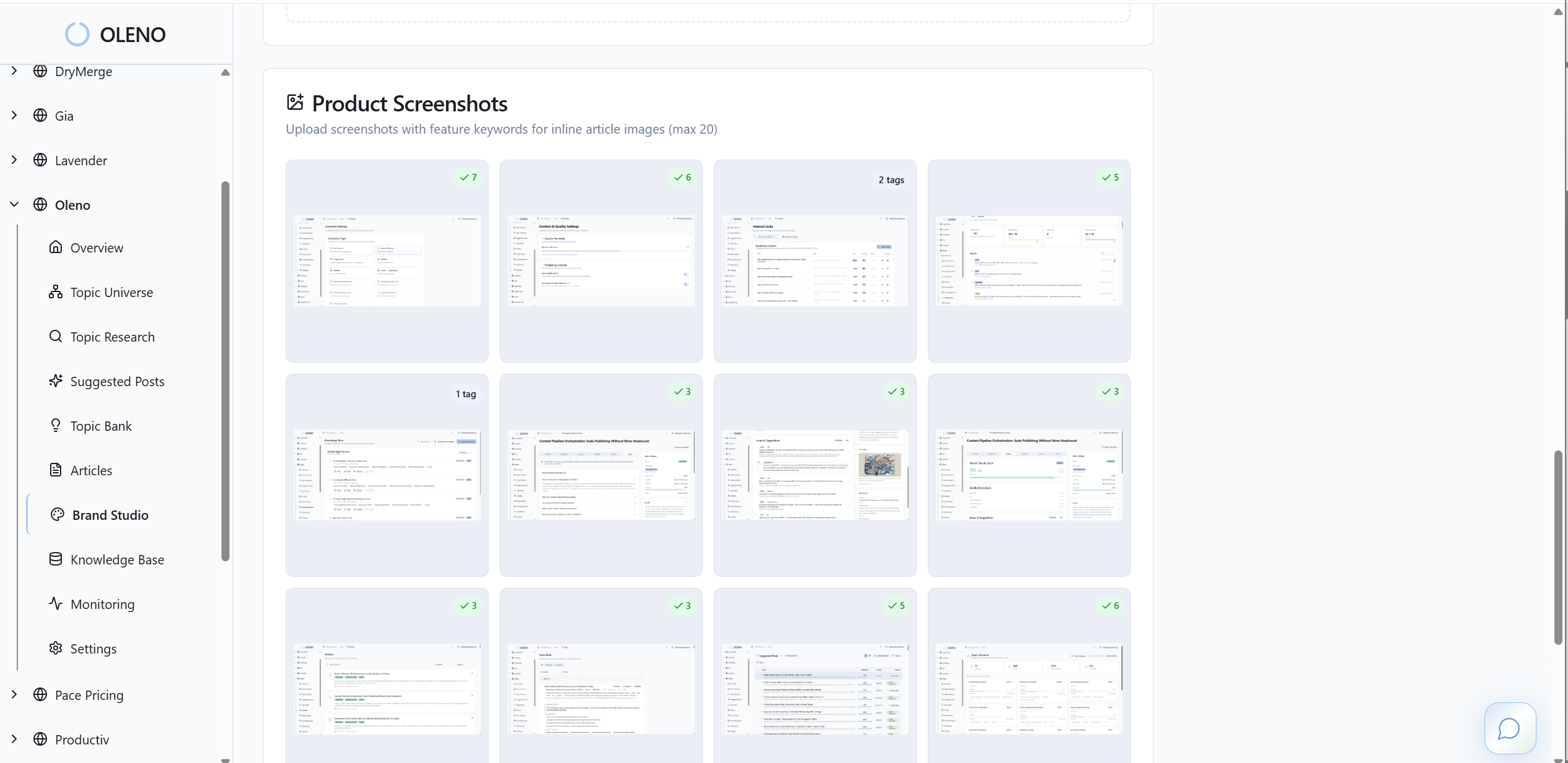
Because rules change slowly and propagate consistently, you prevent drift as output grows. This isn’t about killing creativity; it’s about creating a stable floor so variety doesn’t turn into variance. In our experience, this alone saves hours per piece and keeps “sounds like us” from being a weekly debate.
CMS publishing manages metadata, schema, and idempotent release
Once a draft passes, Oleno publishes directly to your CMS, WordPress, Webflow, HubSpot, Storyblok, and others. It handles structured metadata, prevents duplicates with idempotent publishing, and keeps drafts vs live states clean. If brand-consistent visuals are enabled, it generates safe filenames and alt text following your rules.
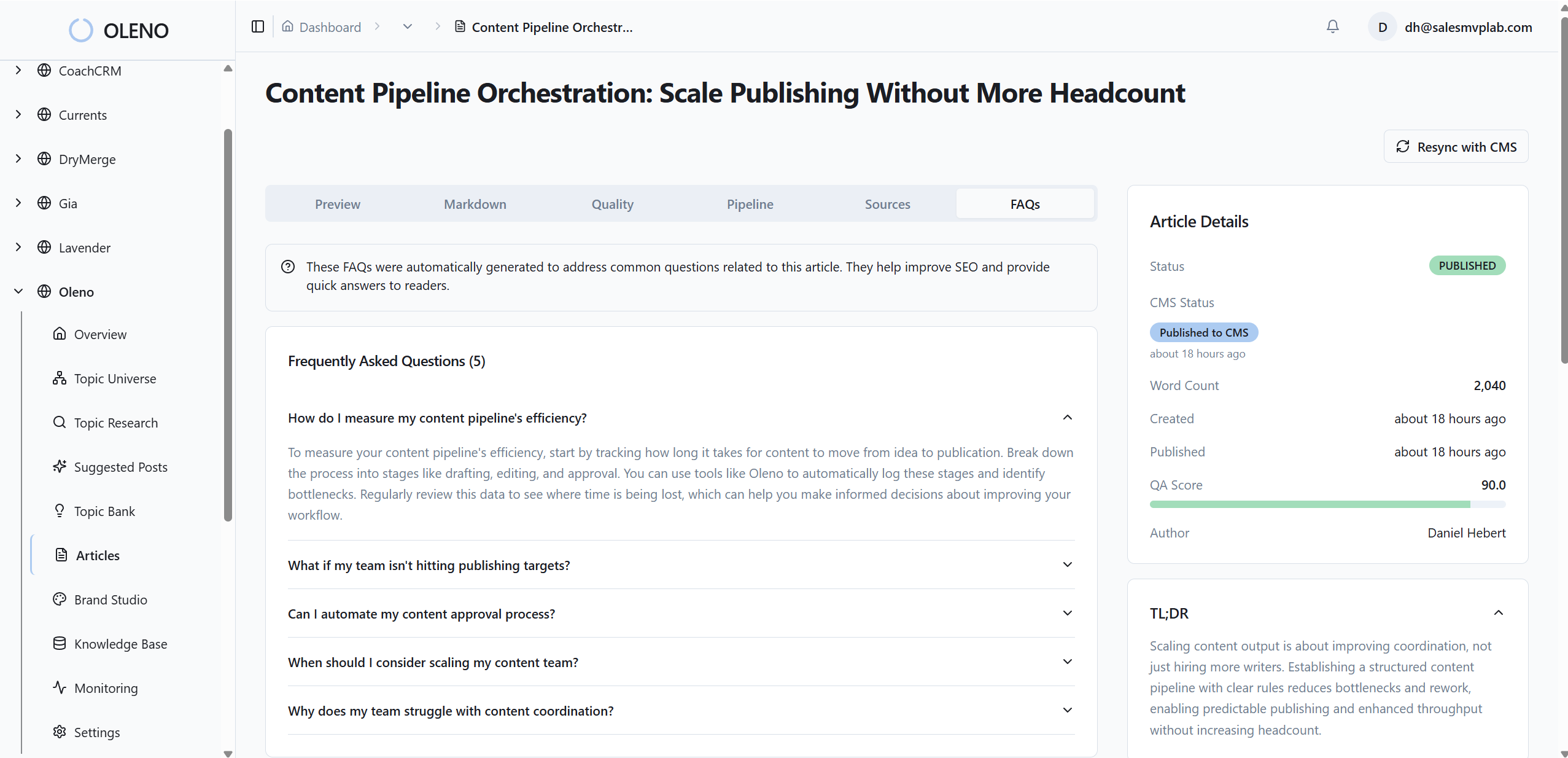
This matters when volume rises. Manual copy-paste, missed fields, and botched schema are death by a thousand cuts. Oleno encodes the handoff, so your team isn’t chasing ghosts in the CMS or fixing slugs after the fact. The pipeline does the boring parts perfectly, which is the point.
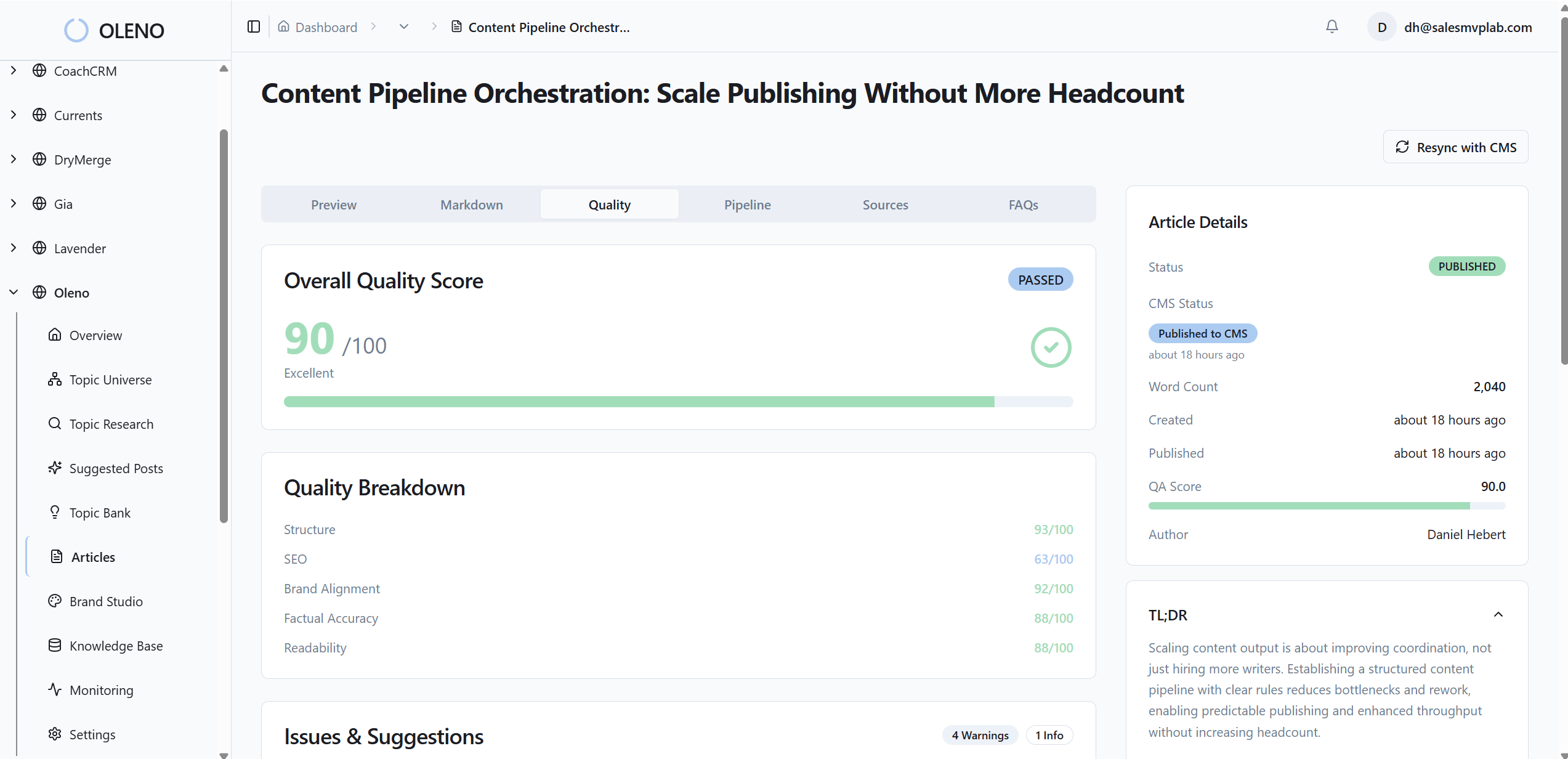
Oleno also enforces a QA gate before publishing. Nothing moves forward unless it meets configured checks for narrative structure, clarity, grounding, and SEO. If a draft fails, Oleno routes revisions until it passes. That’s how you reduce coordination tax and the “we almost shipped the risky claim” panic. You keep humans focused on story, not structure.
Operational visibility rounds it out. Oleno shows output volume and quality trends over time, and supports sampling to catch what automation might miss. Use these signals to coach writers, tighten rules, and refine SLOs. It’s about operational reliability, not vanity analytics. The goal is fewer surprises and cleaner feedback loops.
If you’re ready to turn governance into a system that ships, not a doc nobody reads, let Oleno run the execution layer. Try Oleno For Free.
Conclusion
Freelancers don’t break content engines. Ungoverned systems do. When you codify voice, product truth, structure, and acceptance criteria, and enforce them automatically, you turn “more writers = more chaos” into “more writers = steady output.” You get fewer late-night edits. Fewer risky claims. More publishable drafts on first pass.
The playbook isn’t complicated. Write the rules. Share the examples. Align incentives. Automate the checks. Then let a small team operate like a bigger one without pretending you hired a newsroom. That’s the shift, from activity to a system that runs, week after week.
About Daniel Hebert
I'm the founder of Oleno, SalesMVP Lab, and yourLumira. Been working in B2B SaaS in both sales and marketing leadership for 13+ years. I specialize in building revenue engines from the ground up. Over the years, I've codified writing frameworks, which are now powering Oleno.
Frequently Asked Questions