From Topic to Traffic: Align Content Clusters to Demand-Generation in SaaS

Most teams celebrate traffic. I get it. The chart goes up and to the right, including the rise of dual-discovery surfaces:, dashboards look pretty, and someone says “great work, content team.” But if the calls aren’t moving, that traffic is a cost center. You paid for attention and didn’t convert it into momentum. That’s not marketing. That’s a hobby.
I learned this the hard way. At Proposify, we ranked for big topics. The graphs were fantastic. The pipeline? Not as much. Great writing and design — no argument there — but the narrative sat too far from our product outcomes. The fix wasn’t “write better.” It was “tie clusters to the buyer’s next step and make the bridge obvious.” Sounds simple. It isn’t.
Key Takeaways:
- Tie clusters to pipeline, not pageviews; track SQL rate by entry page and demo-starts from MOFU content
- Build clusters around pains and outcomes, then embed stage-bridging solution sections with product links
- Decide internal link targets and CTAs in the brief so you don’t rework drafts later
- Quantify leakage: small clickthrough drops compound into six-figure missed pipeline
- Use deterministic rules for links, stage labels, and solution sections to remove ad hoc decisions
Why Traffic Without Demand Is A Cost Center
Traffic without demand costs real money because it burns production time, design cycles, and expectation bandwidth without contributing to pipeline. The gap is usually narrative, not volume or ranking. For example, you can win “best proposal tips” and still miss demos if there’s no bridge to your product’s outcome.
The metrics that actually prove content works
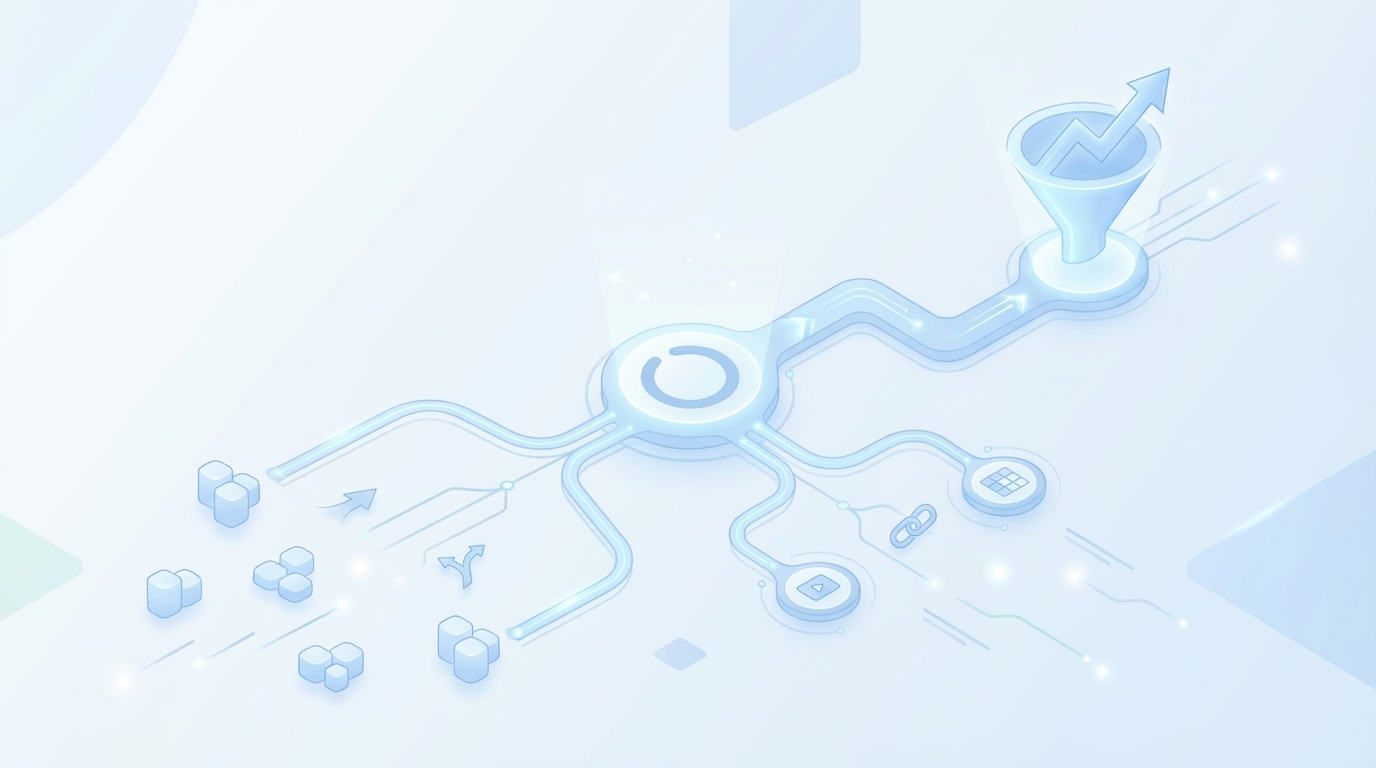
If content doesn’t create opportunity or accelerate deals, it’s overhead. You don’t need a 40-metric dashboard; you need a short, unforgiving stack that ties pages to revenue movement. Assisted pipeline, SQL rate by entry page, demo-start rate from MOFU articles, and influenced revenue for last-touch pages cover 90% of what matters.
Here’s how this shows up in practice. Pick a cluster and identify its intended stage. Now ask: which entry pages from that cluster produced SQLs last quarter, and at what rate versus site average? If you can’t answer, you’re optimizing for traffic shape, not commercial outcomes. I’ve seen teams improve SQL rate by simply aligning the “next step” on-page to the likely buyer task.
Keep it binary. If a cluster can’t be traced to one of those metrics, pause it. That’s not a punishment; it’s focus. Reallocate cycles to topics with a provable path to demo-start or late-stage reassurance. For a deeper look at how clusters are organized conceptually, skim this overview of topic cluster content strategy, then layer your revenue lens on top.
Why ranking-focused clusters fail demand-gen
You can climb the SERP ladder and still starve the funnel. The miss is narrative. Informational clusters are fine for awareness, including the shift toward orchestration, but if they don’t earn the right to introduce your approach — and then your product — you’re educating for the category, not your pipeline.
What fixes this is adding solution sections on purpose, one per implied stage. Early sections translate pain into evaluation criteria. Middle sections show your approach and where the product naturally fits. Late sections reduce risk with integration, pricing, and proof. None of this is “hard sell.” It’s a humane bridge from problem to path to proof.
The second failure mode is sideways linking. MOFU articles linking to more MOFU is a loop. It keeps readers busy without giving them an off-ramp to act. Deterministic internal linking solves this: a product or feature link at each stage transition, placed where the decision moment actually happens in the narrative.
What is demand-generation content and why does it matter?
Demand-gen content moves buyers forward. It does more than answer questions; it helps people make a decision. Early-stage earns trust by clarifying pain and stakes. Mid-stage reframes toward your approach and ties capabilities to outcomes. Late-stage removes risk with quick proofs, integration clarity, and transparent pricing.
Why this matters: your content isn’t a library, it’s a route. Each piece should have a clear “next step” that advances stage, even if the reader isn’t ready to talk to sales yet. In my experience, this removes the anxiety that your best content “never leads to demos” — because the path is intentional, not implied.
If your cluster doesn’t advance a stage, it’s a detour. Detours are fine in editorial calendars; they’re expensive in demand-generation. I’d rather publish half as much with b2b saas content marketing strategies and give every piece a clean bridge than ship a calendar full of “good reads” that end in dead ends. That’s the real trade.
The Root Cause Hiding In Your Topic Clusters
Clusters fail demand-gen when they stop at surface-level intent and ignore journey choreography. Buyers blend intents inside one query, so your content has to both answer the question and move them one step closer to a decision. A “best software” keyword might be curiosity, shortlist, or validation. Design for that complexity.
What do traditional playbooks miss about buyer journeys?
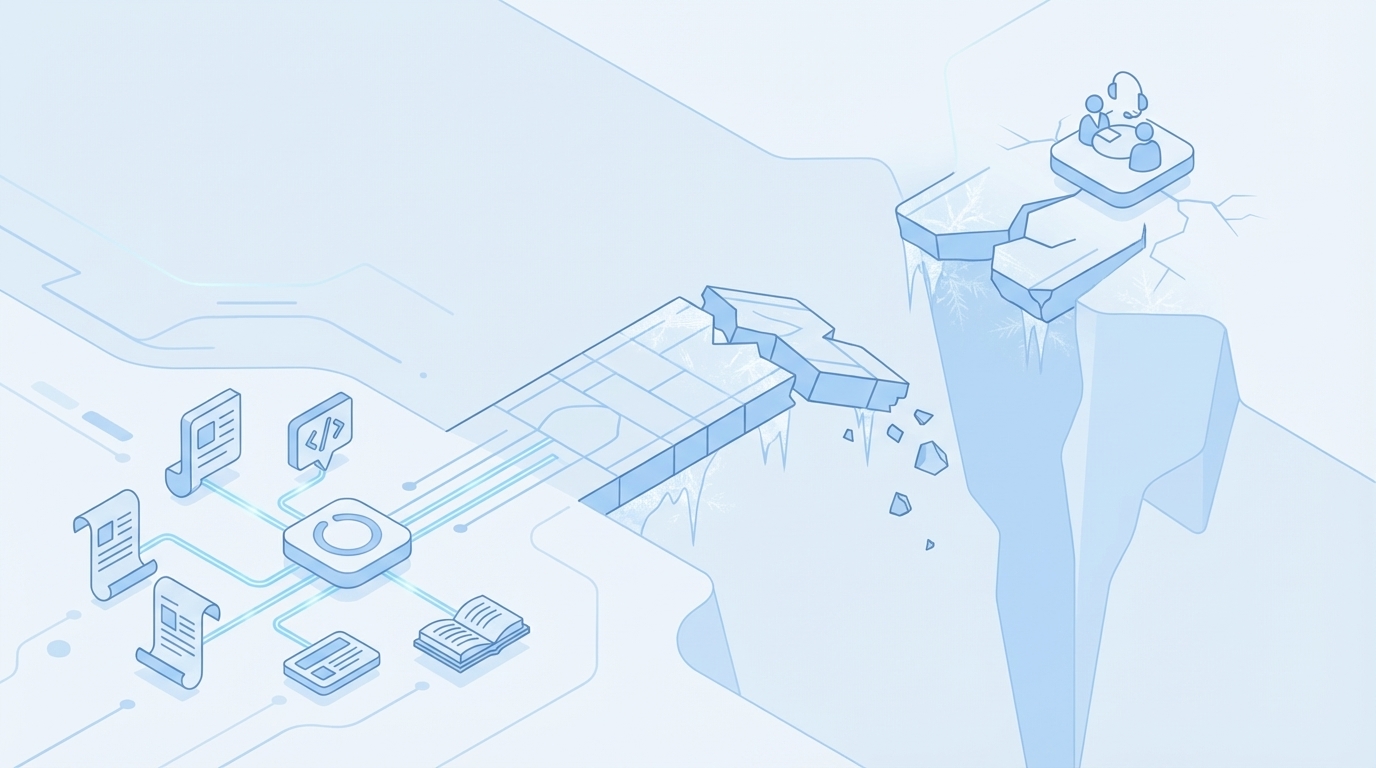
Most models slap an “informational” or “transactional” label on a keyword and call it strategy. Reality isn’t that clean. One query can span three micro-intents. If you write thin pieces for each micro-intent, you fragment attention and never earn the right to connect to your product.
A better move: map each topic to a stage and a next-stage bridge. Then design the bridge as a short solution section and explicit product link path. You’re not forcing product in; you’re anticipating the buyer’s next task. This keeps people in your world instead of pushing them back to Google for pricing, alternatives, or integration checks.
From there, draft with visible stage markers. I’ll often use subheads like “Problem,” “Approach,” “How we solve it,” and “Proof” to make the transition obvious. That structure lets scanners self-select and lets serious readers move linearly. It also reduces rework later, because the bridge isn’t bolted on post-edit.
Map product outcomes to pain-led clusters
Start at the end: outcomes your product reliably delivers. Then reverse-map to the pains that trigger buying. Build pillars around the pains, not features. Inside each cluster, escalate from symptoms to solution criteria to product-fit proof. Product relevance should feel earned, not injected.
Here’s where teams slip. They try to show the whole product everywhere. Don’t. Put small walkthroughs exactly where the reader needs them to move forward, then link to the one feature or pricing page that makes the next step obvious. It’s okay if readers bounce to a feature page quickly. That’s not a “bounce.” That’s progress.
If you want a pragmatic framing, think in terms of bridges: pain-to-criteria, criteria-to-approach, approach-to-product, product-to-proof. Each bridge is short, visual if possible, and tied to a specific destination page. For a practical overview of orchestrating these transitions across channels, read up on demand generation strategies.
The Real Cost Of Content That Never Converts
Content that doesn’t convert drains time, erodes morale, and confuses planning. You’ll rewrite to “add CTAs,” rebuild images to fit a late-stage narrative, and chase down product assets after publishing. Each fix feels small. In aggregate, it’s a lost sprint and a muddled pipeline story.
Engineering and editorial hours lost to rework
Let’s be blunt. “We’ll add the CTA after” is code for rework. Writers repoint intros to set up a bridge that wasn’t planned. Designers redo hero images to match a later-stage angle. PMMs chase screenshots that should have been selected in the brief. Multiply that across dozens of posts and you’ve blown a sprint.
The antidote is upstream decisions: stage label, solution section placement, link targets, and visual cues decided before drafting. I’ve run both ways. The “decide later” path always looks faster in the moment and always costs more by the end. If you plan the bridge, you publish once. If you don’t, you publish twice.
There’s an invisible tax here too: context switching. Every time you reopen a published piece to “fix” the path, including why ai writing didn't fix, you’re paying a focus penalty. The work feels like progress, but it’s just debt service from a weak brief. Choose the bridge in the brief and that tax evaporates.
Pipeline leakage from misaligned internal links
When MOFU links to more MOFU, readers loop. Late-stage buyers exit to find pricing, alternatives, or integration details on their own. You lose both attention and context. Deterministic internal linking rules keep people moving: 5–8 links per article, one explicit product or feature link per stage, anchors matching target titles, and placements at natural decision triggers.
The rule that surprises teams most: link placements at sentence boundaries where the reader is making a judgment. You’ll see clickthrough lift by simply moving a feature link up a paragraph, putting it right after a quantified pain or a short visual. It’s not trickery. It’s respect for attention.
We ran a similar audit for a friend’s SaaS and found half the MOFU content linked sideways. Once we re-anchored transitions to feature and pricing pages, demo-starts rose without changing traffic. If you want to audit your own patterns, start with a simple rule: every MOFU page must have one unmissable next-stage link. “Nice to have” doesn’t move numbers.
Let’s pretend we quantify the missed pipeline
Let’s pretend you’ve got 20 MOFU posts driving 1,000 visits a month each. With a 1% click-to-demo, that’s 200 demo-starts monthly. If broken bridges and misaligned links drop clickthrough to 0.4%, you lose 120 demo-starts a month. At a 20% SQL rate and a conservative $15k ACV, that’s roughly $360k in annualized pipeline signal that never materialized.
Now, argue with the assumptions if you want. That’s fair. But the shape holds: tiny percentage shifts at MOFU compound. Especially when your traffic is healthy and narrative is off by a little, not a lot. It’s the most frustrating version of waste — the kind that looks successful on dashboards you don’t sell with.
The point isn’t to scare you with math. It’s to convince you to make the bridge non-negotiable. Decide it in the brief. Write toward it. Link to it with purpose. If your team is still “adding CTAs after,” you’re paying for content twice. And you’re not getting the pipeline you already earned with the click.
For a short primer on aligning strategy and execution without bloat, I like this take on B2B SaaS content marketing strategies. Take the principles, then bolt on your revenue rules.
The Moment It Breaks For CMOs In SaaS
It breaks when sales says, “They read three posts and came in cold.” Translation: content informed but didn’t equip. The bridge to product never appeared, so discovery calls start from zero. Boards feel this as traffic without SQL lift. You feel it at 3 a.m. when you need a story that ties clusters to revenue.
When sales says leads read, then bounce
You’ll hear it in pipeline review. “They liked the blog, then had basic questions.” That’s a signal, not an indictment. It means your content answered the what but missed the how and the how-with-you. The fix is simple in concept: short solution explainers with visuals and a clear link to the exact feature or pricing page that sustains the conversation.
I like to place this explainer after the reframe, before proof. The reader has context and urgency, and they’re ready to see how an approach would look in practice. A screenshot, a diagram, a three-sentence walkthrough — just enough to make the next click a choice, not a hunt.
And yes, you’ll get better discovery calls. Not because you “pre-sold” them, including why content broke before ai, but because you removed the “wait, do you do X?” dance. Sales starts on the right problem, with the right expectations. Less friction. More signal.
A quick story from the trenches
At Proposify, we ranked for topics our buyers loved: sales management, SDR tips, prospecting. Great reads. But too far from proposal wins, velocity, and e-signature — where we actually helped. We shifted to pains tied to those outcomes, baked the bridge to product into the outline, and linked to feature and pricing pages where it made sense.
The content didn’t get louder. It got closer. Sales felt it quickly. Discovery calls referenced the exact sections we added, and we didn’t have to “reset” as often on calls. That’s the tell: when content makes sales easier, not noisier, your clusters are working.
Could we have done it sooner? Sure. We were proud of our storytelling — and we should’ve been — but pride without a bridge is a nice essay. Focus on the bridge.
Align Clusters To The Buyer Journey And Pipeline Signals
Align clusters by stage, design a repeatable solution section, and enforce deterministic link rules. Label every topic early, middle, or late, then decide the next-stage bridge in the brief. For example, an early-stage “how to” should point to approach criteria and one relevant feature page, not the homepage.
Classify every topic by funnel stage with clear rules
Stage labels aren’t decoration. They drive structure, visuals, links, and CTAs. Early equals problem clarity and solution landscape. Middle equals approach comparison and fit. Late equals validation, pricing, and integration. If a topic spans stages, call the dominant one and design a bridge to the next. That’s your job as an editor, not the reader’s.
Write the stage label into the brief. List the exact product pages that will be linked. Decide the visual that supports the bridge: a diagram at early, a 30-second product GIF at middle, a table or integration screenshot at late. When it’s in the brief, you won’t be “adding it later.” You’ll be writing to it from the first sentence.
Reporting gets saner too. Entry page to CTA click to demo-start, and SQL rate by article. You don’t need a measurement platform for this story; you need intentionality. The signal pops when the path is designed. If you’re still guessing which pages produce SQLs, it’s a symptom of loose planning, not a data shortage.
Design solution sections that naturally bridge to product
Your solution section is the hinge. Keep it tight. Translate the pain into product capabilities using buyer nouns, not internal names. One small walkthrough, one visual, one link to the most relevant feature or pricing page. Place it after the reframe and before proof so momentum builds, not stalls.
I like a consistent pattern here so writers don’t reinvent it: 3–5 sentences to tie pain to capability, a micro visual, and a link at a natural sentence boundary. If the reader’s ready, they’ll click. If not, they keep reading and hit proof next. Either path is progress. What you can’t accept is a dead end.
Structure helps. Use scannable subheads so the section is easy to find, including why content now requires autonomous, even for scanners. And write it like a coach, not a closer. We’re showing a path, not pressing a button.
Make internal links deterministic to product and features
Adopt rules that remove guesswork. Five to eight internal links per article. One product or feature link per stage transition. Anchor text must match the target page title. Links placed at natural sentence boundaries near decision triggers. And crucially, only verified URLs from your sitemap. No invented links. No “we’ll fix anchors later.”
You can do this manually with a checklist. Or you can build it into your system so it ships correctly by default. The point is consistency. Determinism prevents leaks and compounds trust. If you want a broader perspective on structuring strategy for growth while avoiding content sprawl, this piece on a growth-minded SaaS content strategy is a useful counterbalance.
Want to see how this feels when it’s automated end-to-end? When stage labels, bridges, and links aren’t “remembered,” they’re enforced? If that’s where you want to go, you can Try Using An Autonomous Content Engine For Always-On Publishing.
How Oleno Turns Clusters Into Pipeline, Not Just Pageviews
Oleno operationalizes the “bridge-first” approach by baking stage labels, differentiation, visuals, links, and structure into the pipeline. It doesn’t track performance; it ensures what ships is grounded, on-brand, and citable. For example, Topic Universe prioritizes outcome-tied gaps while publishing connectors deliver CMS-ready HTML without manual cleanup.
Topic Universe maps clusters to outcomes
Oleno’s Topic Universe organizes your landscape into clusters, tracks saturation, and prioritizes gaps tied to your focus areas. You can label clusters by stage and product outcome so coverage builds authority where it matters, not where volume is easy. This prevents over-publishing side topics and keeps your pipeline story coherent across pillars.
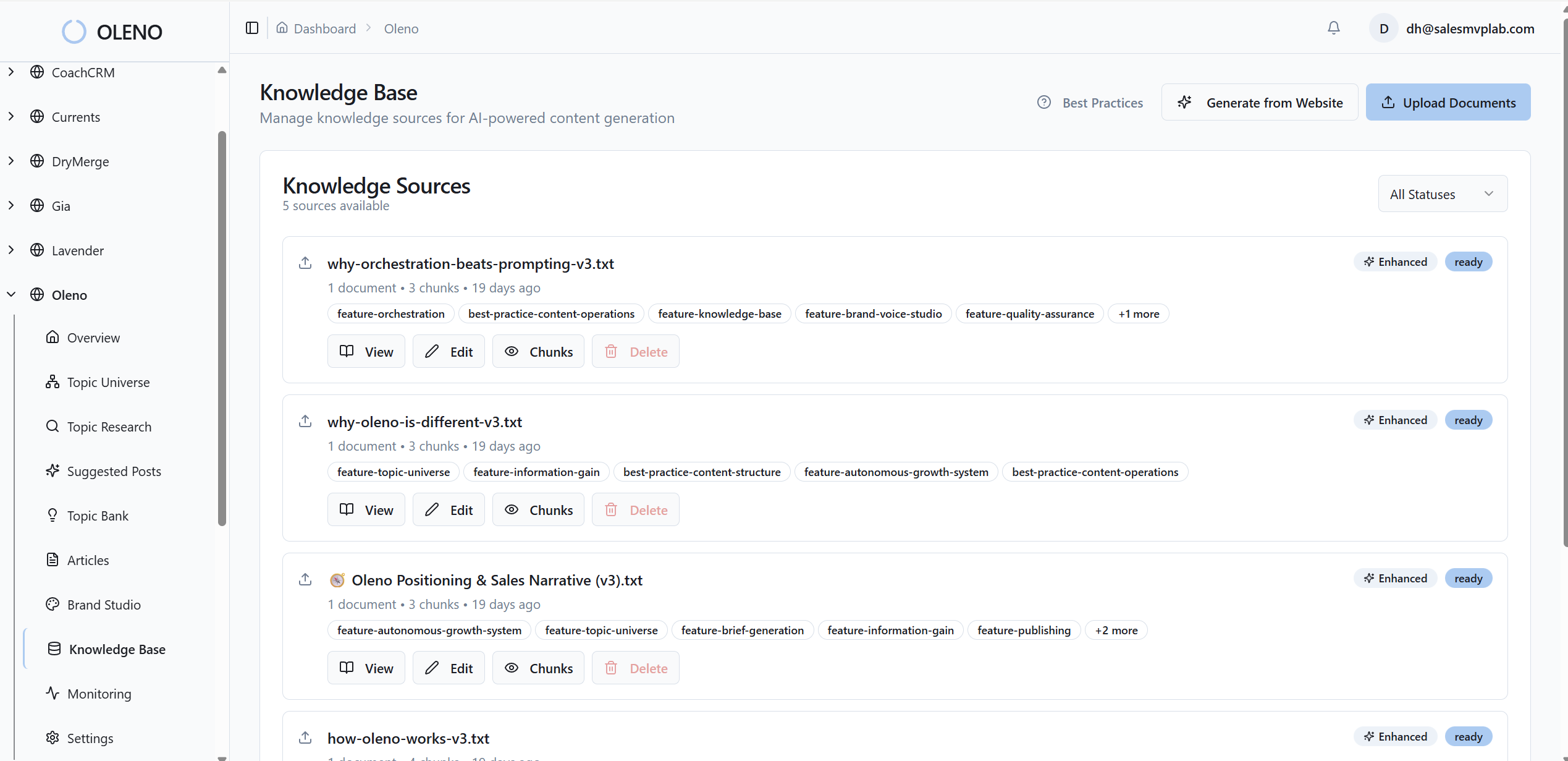
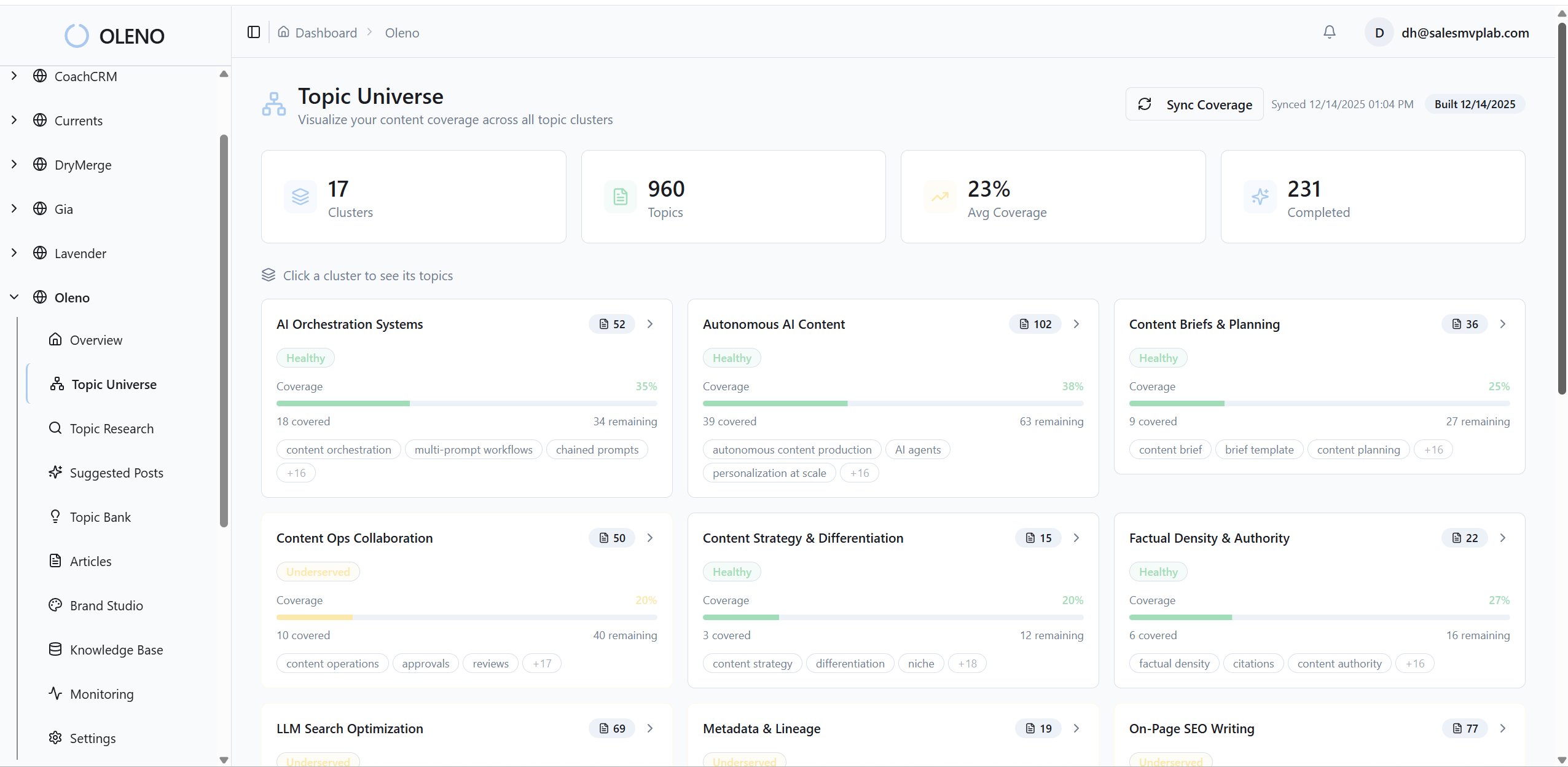
Under the hood, Topic Universe pulls from your knowledge base, sitemap, and configured focus areas, then groups topics into clusters with live coverage states: underserved, healthy, well-covered, or saturated. A 90-day cooldown prevents re-covering the same topic just to hit a quota. That’s how the calendar stops being a guess and starts being a system.
Here’s the shift you’ll feel. Suggestions flow from gaps, not whims. Approval moves items directly into generation. And because clusters are labeled by stage and outcome, the bridge is built into what gets written — not bolted on later. Oleno makes that intentionality normal.
From brief to publish: differentiation, links, visuals, schema, QA, and delivery
Every approved topic in Oleno becomes a structured brief. Stage labels, solution sections, and product link targets are decided before a draft exists. Competitive research during brief generation surfaces common coverage and missing angles; Information Gain Scoring guards against me-too content. Low-gain outlines get flagged early, so you’re not polishing sameness.
Then Oleno writes the draft to your voice and structure, with snippet-ready openings that make each section stand on its own. Deterministic internal linking injects verified URLs with exact-match anchors at natural boundaries. Visual Studio attaches brand-consistent images and maps product screenshots to solution sections. JSON-LD schema is generated automatically. A QA gate checks structure, tone, KB grounding, and snippet readiness before anything ships.
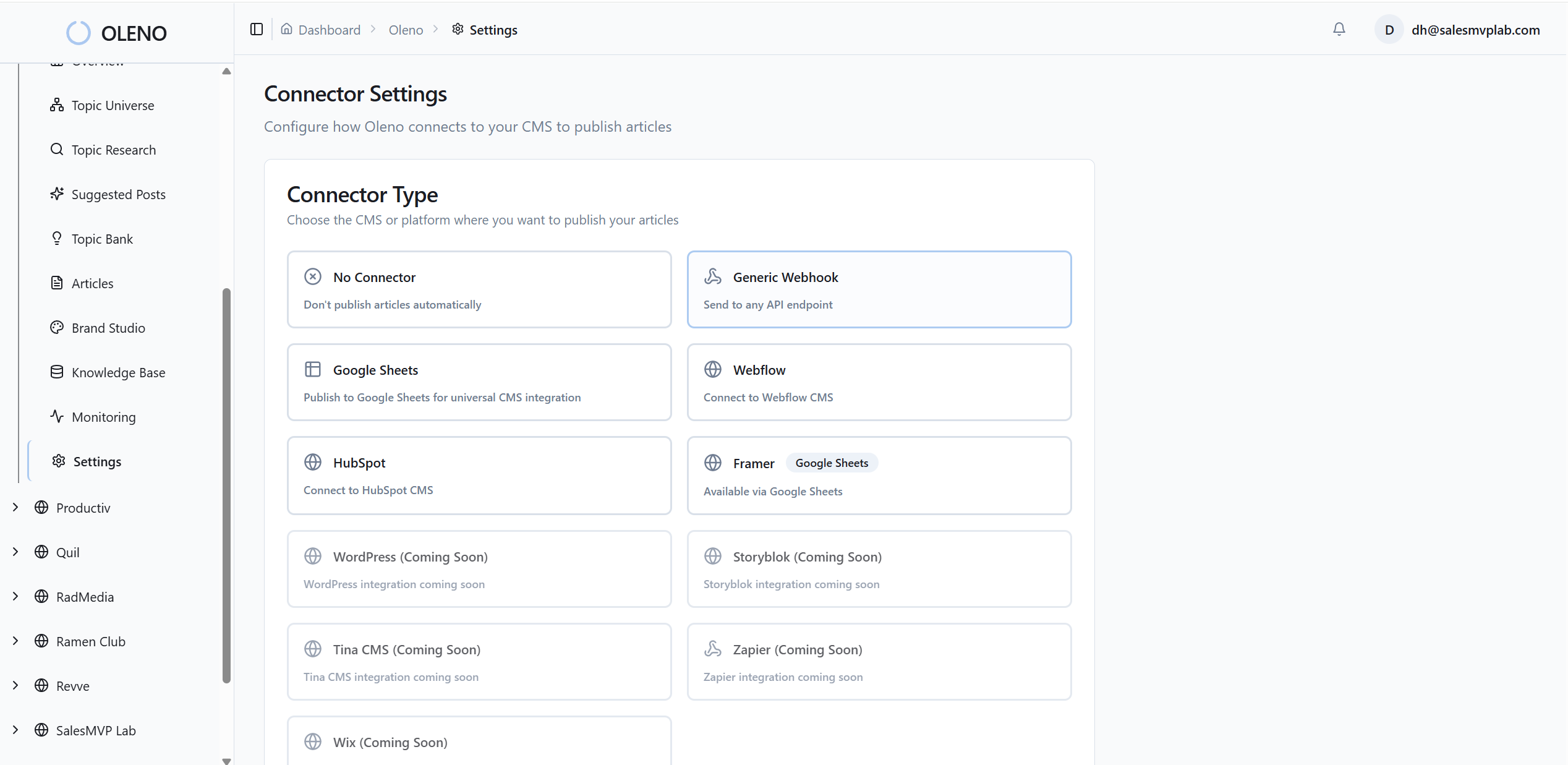
Finally, publishing connectors deliver CMS-ready HTML, embed visuals and metadata correctly, and prevent duplicate posts. No prompt chains. No design handoffs. No manual link fixing. Oleno isn’t an analytics tool and it isn’t monitoring your traffic — it’s the engine that ensures what ships is correct, differentiated, and ready to be referenced. If you want to experience the pipeline lift that comes from removing rework and leakage, Try Oleno For Free.
Conclusion
Traffic is not the win. Movement is. When clusters are tied to pains and outcomes, when solution sections earn the bridge, and when links and visuals are deterministic, you stop celebrating visits and start reporting SQLs by entry page. That’s the narrative you can defend at 3 a.m. and feel good about at 3 p.m.
You don’t need more content. You need a system that turns topics into decisions. Whether you build it with rigor or let Oleno run it for you, the rules are the same: label stages, design the bridge, and ship structure that guides buyers forward. That’s how content compounds into pipeline, not just pageviews.
About Daniel Hebert
I'm the founder of Oleno, SalesMVP Lab, and yourLumira. Been working in B2B SaaS in both sales and marketing leadership for 13+ years. I specialize in building revenue engines from the ground up. Over the years, I've codified writing frameworks, which are now powering Oleno.
Frequently Asked Questions