How Aligned Content Positioning Builds Brand Authority in Crowded Markets

Most teams think content positioning brand authority comes from publishing more. It doesn’t. It comes from saying the same sharp thing, clearly, across enough surfaces that buyers, search engines, and LLMs start to connect your brand to that point of view. That’s really what content positioning brand authority is. Not random output. Signal consistency at scale.
I learned this the hard way. More than once. Back when I was running Steamfeed, traffic didn’t really compound until we had both depth and breadth. Later, inside smaller SaaS teams, I saw the reverse. Smart people. Strong product. Good ideas. But the content got slower, softer, and less believable as more people touched it. That’s usually where content positioning brand authority starts to slip.
Key Takeaways:
- Content positioning brand authority is built through consistency, not random volume
- Most teams don’t have a content problem, they have a clarity and coordination problem
- Brand authority grows when your point of view, product truth, and audience framing stay aligned across every piece
- GEO makes content positioning brand authority even more important because LLMs reward repeated, clear signals
- Founder insight still matters, but it needs a system around it
- Small SaaS teams usually lose authority when context lives in people instead of process
Why Content Positioning Breaks Before Brand Authority Ever Shows Up
Most teams don’t lose momentum because they stop publishing. They lose it because the message changes from draft to draft, channel to channel, person to person. That’s when content positioning brand authority starts breaking down. And once the signal drifts, content stops compounding. It just kind of floats around.

Publishing more doesn’t fix a blurry position
A lot of teams treat authority like a volume problem. So they add more. More freelancers. More briefs. More prompts. More blog posts. More agencies. On paper, that sounds reasonable.
In practice, it usually creates a bigger mess.
Because if the underlying position is fuzzy, you’re not multiplying authority. You’re multiplying inconsistency. One article sounds founder-led. Another sounds like generic SEO copy. Another reads like a product page. Another sounds like someone got a loose brief and tried to patch something together fast.
That’s where content positioning brand authority leaks out. Not because the team is bad. Because the market can’t tell what you actually stand for.
The market notices inconsistency faster than you think
Back in the Steamfeed days, we saw real traffic lift as page count climbed. 500 pages. 1000 pages. 2500 pages. 5000 pages. Then 10000 pages. But that growth wasn’t just about volume. There was substance underneath it. We had lots of contributors, sure, but each piece still had an actual point of view.
That’s the part people miss.
Small SaaS teams usually have the opposite setup. Fewer people. Less time. More pressure. One person knows the product deeply. Another owns SEO. Another owns demand gen. Another is helping with content between five other priorities. So context gets lost in the handoff.
You feel it pretty quickly. Rewrites pile up. Reviews drag. The content sounds okay, but not convincing. And okay does not build brand authority. Okay gets skimmed and forgotten.
GEO raises the price of weak positioning
Humans will sometimes forgive inconsistent content. LLM-driven discovery is less forgiving. If your articles, landing pages, comparison pages, and thought leadership all frame the problem differently, you don’t look nuanced. You look unsure.
That’s why content positioning brand authority matters even more now. Search engines and AI systems reward repeated, credible signals. If your market story keeps moving around, your authority signal gets weaker every time it shows up.
The Real Problem Is Fragmented Execution, Not a Lack of Ideas
Weak content positioning brand authority usually comes from fragmented execution. Teams blame writing quality, AI, freelancers, or lack of time. Those things matter. But most of the time they’re not the root cause. The real issue is that no system keeps positioning, audience context, and product truth together from brief to publish.
Great ideas die between strategy and execution
Most leadership teams can explain the company clearly in a live conversation. Put the founder on a sales call and the story is sharp. Put the PMM in a customer interview and the positioning is there. Put the demand gen lead in a planning meeting and they know exactly what angle matters.
Then the article comes out flat.
Why? Because strategy usually lives in heads, call notes, and decks. Execution lives in docs, prompts, Slack threads, review comments, and vendor handoffs. Those two worlds barely touch. So the team rebuilds context from scratch every single time.
That gets expensive fast. Not just in budget. In lost momentum. In rework. In all the weird little delays that make content feel heavier than it should.
AI made output faster, not more authoritative
This is where people get fooled. AI can absolutely make drafting faster. That part is real. But fast drafts do not create content positioning brand authority by themselves. If anything, they expose how weak the operating model already was.
Prompting helps with isolated tasks. Demand gen is not an isolated task. It’s a repeated system that has to stay coherent across months, audiences, channels, and funnel stages. Without that system, speed just creates more review burden.
We saw this ourselves. More drafts meant more things to check, more places for tone drift, more places for product drift, more watered-down positioning. Faster output. Slower trust.
Brand authority is really a signal consistency problem
Brand authority rarely comes from one brilliant article. It comes from the market hearing the same credible signal from you over and over again. Same category framing. Same problem definition. Same buyer language. Same product boundaries. Same opinion.
Some marketers push back here because repetition sounds boring. Fair. But strong positioning doesn’t make content boring. It gives it a stable lens. You can still create new examples, different formats, different angles. You just stop changing your core story every week.
That’s why the brands that feel authoritative usually aren’t the noisiest ones. They’re the clearest.
What Weak Positioning Actually Costs Over Time
Weak content positioning brand authority costs traffic, conversion, speed, and trust. It also creates a hidden internal tax that nobody really budgets for. Every unclear message forces someone to reinterpret, rewrite, soften, or approve with caution. Over time, that tax becomes the work.
You lose time in places no one tracks
Most teams measure output. Maybe pageviews. Maybe conversions if they’re disciplined. They rarely measure rework. But it’s everywhere.
A writer drafts from incomplete context. Then PMM rewrites the positioning. Then product fixes a claim. Then demand gen asks for stronger commercial framing. Then leadership says it doesn’t quite sound like the company. None of those edits look dramatic on their own. Stack them together and you’ve burned hours on one piece.
When I was the sole marketer at a SaaS company, I could crank out 3 or 4 strong posts a week because all the context lived in my head. As the team grew, that broke. The writer had less product and customer context than I did. I had less time to write because I was in meetings, managing, doing the exec thing. Quality went down while effort went up. Very normal scaling trap.
You lose trust because the market can’t place you
If a buyer reads five pieces from your company and gets five slightly different stories, they don’t think wow, what nuance. They think, I’m not really sure what these people do.
That uncertainty is expensive. It weakens conversion. It hurts sales follow-up. It makes outbound harder. It lowers the odds that someone remembers or cites you. And yes, it also affects how LLMs interpret your authority because the signals are scattered.
A clear position lowers decision friction. A blurry one creates it.
You lose leverage when every piece starts from zero
This is the big one. Without a system, content never compounds. Every article becomes a fresh negotiation over angle, voice, claims, examples, and CTA. So instead of building an asset base that reinforces content positioning brand authority, you keep publishing isolated pieces that have to fight for relevance on their own.
That’s why some teams publish for a year and still feel like they’re starting over every quarter.
Because they are.
How to Build Brand Authority That Actually Compounds
Content positioning brand authority grows when you lock the fundamentals first, then scale execution around them. Not the other way around. You don’t start with prompts and hope authority appears later. You start with a clear position, clear audience framing, and clear product truth. Then you repeat it with discipline.
Define the point of view before you scale production
Your team needs a sharp answer to a few basic questions. What do you believe that the market gets wrong? What category are you actually in? What old way are you pushing against? What problem do you solve better than the alternatives?
Simple questions. Most teams skip them.
They go straight to keyword lists and editorial calendars. Then they wonder why the output feels generic. Of course it does. If the point of view isn’t explicit, the writer fills the gap with average internet language. So does the AI. So does the freelancer. Everybody improvises. Nobody aligns.
Start with the opinion. Then scale the expression of that opinion.
Turn audience knowledge into reusable context
Good positioning lands harder when it’s tied to a specific buyer reality. A Head of Content at a growth-stage SaaS does not think about the problem the same way a VP Marketing at a larger company does. Same broad category. Different pressure. Different language. Different urgency.
This matters a lot. You can’t build content positioning brand authority with generic reader copy. You build it by showing you understand the actual workflow, pain points, and stakes of the person reading. That’s what makes the content feel credible instead of padded.
In my experience, this is where a lot of teams quietly fail. They know their audience in conversation, but they never operationalize that knowledge. So the nuance disappears by the time the article gets written.
A practical way to handle it:
- Define your core audience segments clearly
- Document buyer goals, objections, and language patterns
- Map those segments to real use cases and trigger events
- Reuse that context in every brief and draft
That sounds simple because it is. It’s also one of the most overlooked parts of content positioning brand authority.
Separate product truth from marketing spin
Brand authority dies fast when content makes shaky claims. One invented feature. One overstated capability. One sloppy comparison. Trust drops.
That’s why product truth needs to be structured, not implied. Approved descriptions. Supported use cases. Unsupported use cases. Pricing context. Boundaries. The team needs one source for what can and cannot be said.
Some people think this slows content down. I’d argue the opposite. Lack of grounded product context is what actually slows everything down because every draft turns into a risk review.
And if you’re publishing product-led content, competitive pages, or use case guides, this part is non-negotiable.
Build structure that enforces repetition without drift
This is where content positioning brand authority starts to compound. Once your point of view, audience context, and product truth are defined, you need structure around creation. Brief patterns. Draft patterns. Review patterns. Publishing rules. Quality rules. The content doesn’t need to sound robotic. It needs guardrails.
Back in smaller teams, this is exactly what made the difference for me. When I had a writing framework, I could move fast because I wasn’t reinventing the article every time. The structure held the quality. It also held the positioning.
Most people think creativity and structure fight each other. Not really. Structure gives creativity a lane.
Discover how leading teams systemize content execution without losing their point of view.
Treat authority as a system output, not an article outcome
One article can create interest. Brand authority comes from accumulation. Repetition. Coverage. Coherence over time. This is why GEO changes the equation so much. LLMs don’t just evaluate one page. They synthesize across many signals.
So if you want content positioning brand authority, you need enough content to create a pattern. Enough consistency for the market to recognize your stance. Enough breadth for your perspective to show up across adjacent searches, category questions, evaluation queries, and use case problems.
That means thinking in systems:
- what story repeats
- where it repeats
- who it is framed for
- how quality gets checked
- what gets published next
That’s the work. And honestly, it gets a lot easier when a system is carrying the load instead of humans trying to coordinate everything manually.
How Oleno Turns Positioning Into Repeatable Brand Authority
Oleno turns content positioning brand authority into a repeatable operating model by encoding the inputs that usually live in people’s heads. That matters because authority is not about writing one decent article. It’s about making sure the same sharp market signal keeps showing up across your content without constant rebriefing, cleanup, and second-guessing.
Governance keeps the message from drifting
Oleno starts where most teams don’t. With governance. Brand Studio holds how you sound, what language fits, and what patterns to avoid. Marketing Studio holds your category framing, key messages, and point of view so the content doesn’t collapse into generic education. Product Studio holds approved product descriptions, boundaries, and claims so drafts stay grounded in what’s actually true.
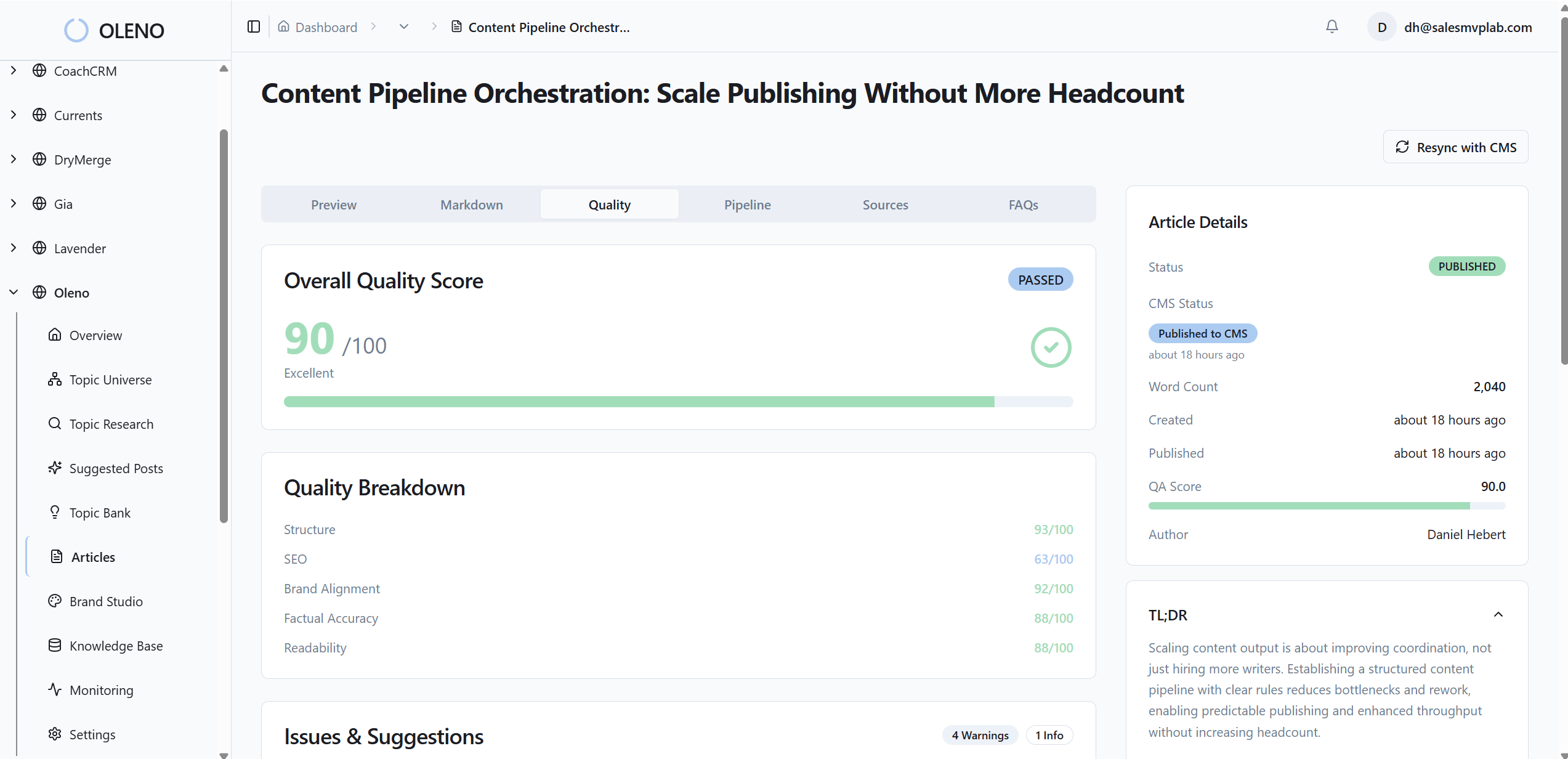
That combination matters. You’re not asking a writer or an AI system to guess what your brand believes. You define it once, then reuse it. So when content gets produced, the odds of drift drop hard.
That’s a big deal for small B2B SaaS teams. Less rewriting. Less second-guessing. Less late-stage feedback saying, this isn’t quite us.
Audience context and planning create stronger authority signals
Oleno also connects positioning to the people you’re actually trying to reach. Audience & Persona Targeting stores the context that usually gets lost, like role goals, objections, pains, and language preferences. Use Case Studio models what users are actually trying to get done, so the examples and framing aren’t abstract. Then Storyboard allocates content across those dimensions based on gaps and priorities instead of letting the calendar drift toward whatever topic feels easiest that week.
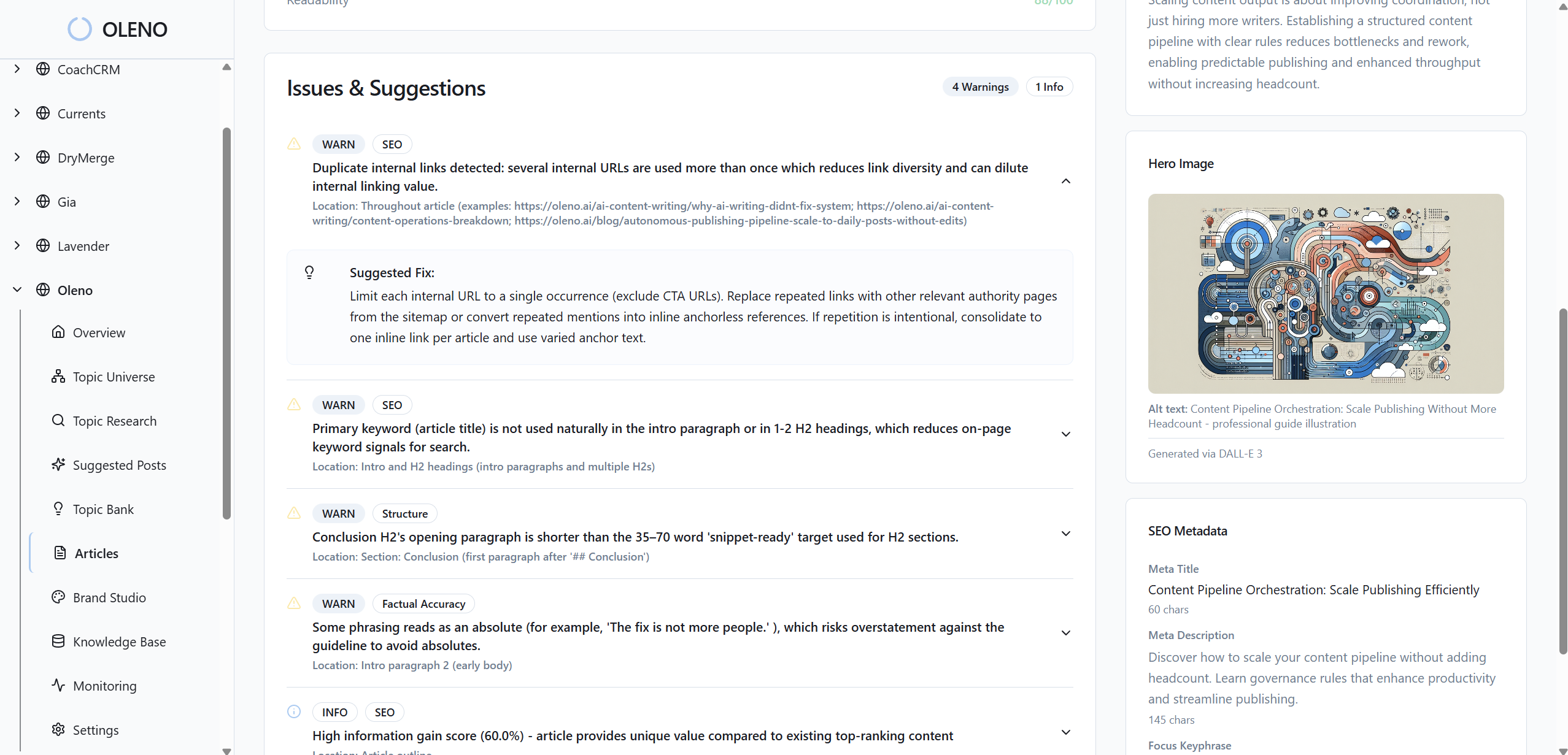
That’s how content positioning brand authority gets stronger over time. The same core position keeps showing up, but it’s expressed in ways that fit different buyers and use cases. Not random variation. Intentional variation.
And then the system keeps moving. Programmatic SEO Studio handles acquisition content at scale with a locked-outline pipeline. The Orchestrator runs approved topics through production flow based on quotas and cadence. Quality Gate checks voice, structure, clarity, grounding, and SEO before anything goes live.
What used to be hours of prompting, rewriting, reviewing, and coordinating becomes a governed process.
Start building a repeatable content engine with Oleno.
Why Consistency Wins and Noise Loses
Content positioning brand authority does not come from publishing whatever the team can get out the door. It comes from clear positioning, repeated with discipline, across enough content that the market starts to trust the pattern. True for buyers. True for search. Definitely true for LLM-driven discovery.
Most teams do not need more ideas. They need a system that keeps voice, audience context, and product truth aligned while content scales. That’s the shift. Less ad hoc production. More governed execution.
Next Steps
If your content feels busy but not believable, this is probably the gap. Not effort. Not talent. Not even tools. The gap is alignment. Content positioning brand authority is what happens when your point of view stays clear from strategy through execution, again and again, long enough for the market to recognize it. That’s when content starts compounding instead of just shipping.
About Daniel Hebert
I'm the founder of Oleno, SalesMVP Lab, and yourLumira. Been working in B2B SaaS in both sales and marketing leadership for 13+ years. I specialize in building revenue engines from the ground up. Over the years, I've codified writing frameworks, which are now powering Oleno.
Frequently Asked Questions