Why LLMs Misread Conflicting Audience Messages

how llms interpret conflicting audience messages becomes a visibility problem when your brand says slightly different things to slightly different people across pages, channels, and campaigns. Demand-generation execution software is a governed marketing system that turns strategy, audience context, and product truth into consistent multi-channel execution by putting narrative rules, targeting logic, and production workflows into one repeatable system. Unlike content automation tools, demand-generation execution software keeps the core message fixed while letting teams adapt how they explain it to different audiences.
This is built for marketing leaders running scaling SaaS teams, where content, PMM, demand gen, SEO, and outside writers all touch the story. And that’s usually where the real problem starts. Not because your team is bad. Because Fragmented Demand Generation feels normal when everyone owns a piece of the message but nobody owns the whole signal.
Key Takeaways:
- LLMs don’t get tripped up by one page. They lower confidence when patterns across pages don’t line up.
- Audience variation is fine. Audience contradiction is the real risk.
- Fragmented Demand Generation turns small message gaps into diluted positioning, rework, and weaker visibility.
- Strong teams separate fixed truths from flexible expression.
- Repeated clarity across assets is what makes authority easier for machines to interpret.
- A governed system matters more than better prompts once output starts scaling.
Why Conflicting Audience Messages Break LLM Confidence
LLMs do not get confused by one page, they get confused by patterns. They pull from lots of sources, compare how you describe the same problem, and infer what your brand actually stands for from repetition. If one page says you sell workflow automation, another says you sell strategic content guidance, and a third says you sell SEO efficiency, the model has to make a judgment call. That’s where confidence drops.
LLMs Read Across Assets, Not In Isolation
LLMs synthesize. They don’t just inspect a single page and call it a day. They look for repeated definitions, repeated audience framing, repeated product meaning, and repeated point of view across your site and beyond it. So when marketers ask why their brand isn’t showing up in AI-generated answers, they often assume the problem is prompt quality or lack of content volume.
Usually it’s not.
The issue is that the market is hearing multiple versions of the same company. One team writes for practitioners. Another writes for executives. An agency writes for traffic. PMM writes for launches. Sales writes for objections. Each asset might be decent on its own. Put them together and the pattern gets messy.
That’s what makes Fragmented Demand Generation such a problem. Audience knowledge lives in one place. Product truth lives somewhere else. Positioning sits in a deck. Writers work from partial context. Reviewers try to patch it at the end. You still publish. But the signal doesn’t compound.
Mixed Audience Signals Hurt Before Rankings Slip
Most teams notice this late. They see rankings flatten, pipeline attribution look weird, or AI search visibility stay thin. But the damage starts earlier, at the interpretation layer. LLMs are trying to figure out whether your company has a clear point of view and a stable definition of what it does. Mixed audience messages weaken that confidence before they hurt traffic.
A simple example makes this easier to see. Let’s say one article says your buyer is a hands-on SEO lead who cares about output. Another says your buyer is a CMO who cares about board-level reporting. Both can be true. But if the product itself gets reframed around each buyer instead of just the pain and proof changing, you start signaling two different categories.
That’s a problem.
Because GEO doesn’t reward isolated good assets. It rewards coherent repeated signals. The brands that tend to get surfaced are the ones whose positioning, audience specificity, product definitions, and point of view line up over and over again.
Fragmented Demand Generation Turns Small Gaps Into Big Ambiguity
Back in 2012-2016 I ran a website called Steamfeed. At our peak, we hit 120k unique visitors a month. We had 80 regular contributors and over 300 guest contributors. Volume mattered. Depth mattered too. But what really made that machine work was that each piece added to a bigger body of coverage. The catalog compounded.
I’ve also seen the opposite.
When I was the sole marketer at PostBeyond, I could write 3-4 solid posts a week because I had the context in my head. As the team grew, output got slower and weaker, not faster. Not because the writer wasn’t smart. They just didn’t have the same product context, customer context, and positioning context. So quality drifted. Review time went up. Momentum dropped.
That same thing happens with audience messaging. A small gap here. A wording change there. A different product framing for one segment. Another tweak for another channel. Over time, the market doesn’t get precision. It gets ambiguity.
Why The Problem Is Drift, Not Personalization
Personalization isn’t the enemy. Drift is. You should absolutely tailor examples, objections, proof points, and emphasis for different audiences. But your category definition, product reality, and strategic point of view can’t change every time a different person touches the brief.
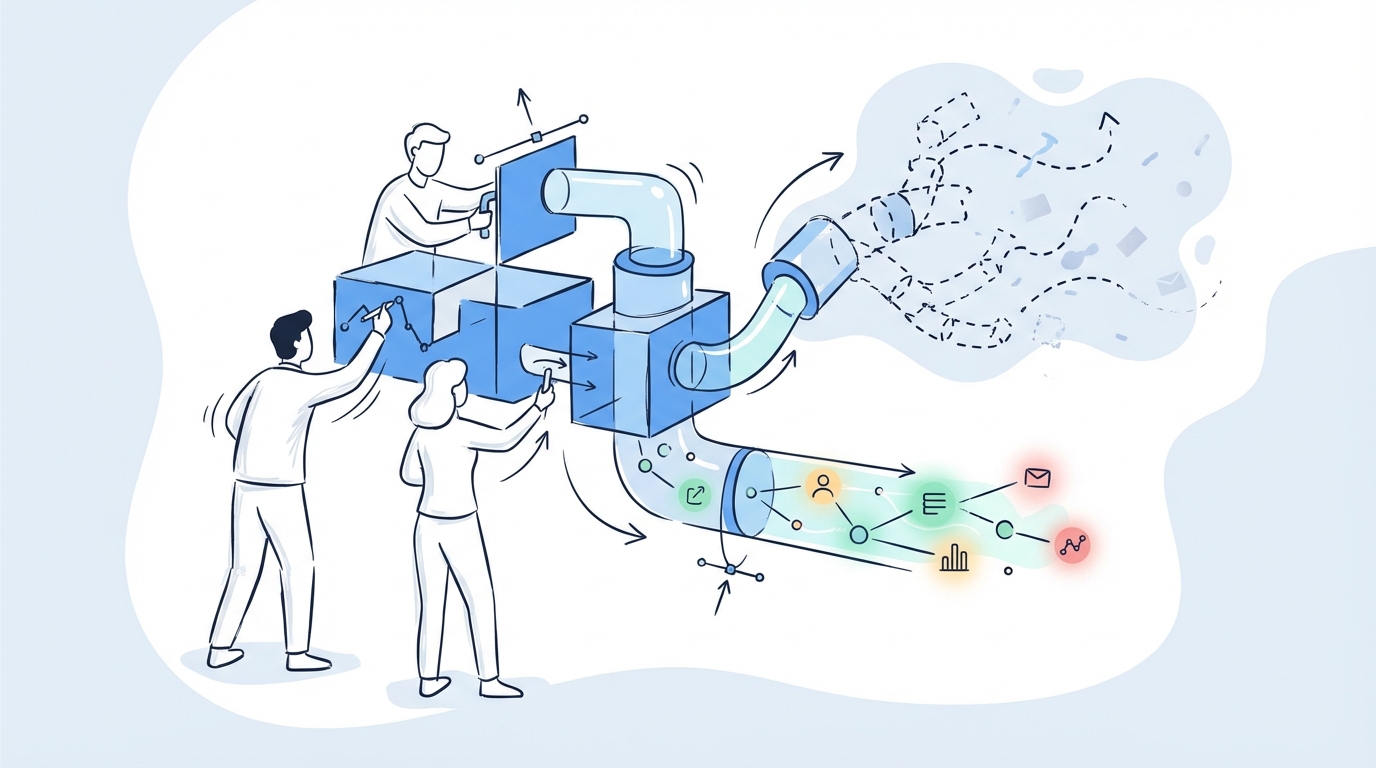
Audience Adaptation Works When The Story Stays Fixed
Healthy segmentation keeps the center steady. You’re changing the angle, not the truth. A CMO may care about coordination cost and ROI. A content lead may care about rewrites and output. A PMM may care about accuracy. Those are different entry points into the same problem.
The mistake is letting each audience-specific asset redefine the company from scratch.
Prompting makes this worse. Honestly, this caught a lot of teams off guard. Prompt-based workflows treat every asset like a fresh event. A writer opens a doc, asks the model for a new take, tunes it for the audience, and moves on. Then another writer does it again next week. The output might sound polished. But the system underneath is unstable.
Demand gen is not standalone work. It’s cumulative work. That’s why repeated clarity matters more than isolated customization.
Local Relevance Often Gets Mistaken For Precision
A lot of teams think they’re being precise when they’re really just being inconsistent. They make one version for enterprise buyers, one for growth-stage teams, one for technical evaluators, one for executives. All reasonable. But then each version uses different language for the problem, different language for the category, and different language for the product.
That isn’t precision. That’s message sprawl.
At LevelJump, we were stuck at $20k MRR because we were an everything software. Our messaging was generic because our positioning was broad. Then we found the entry point. Sales onboarding. Once we leaned into that, everything tightened up fast. In 90 days, we were at $35k MRR.
Same product. Better frame.
That lesson matters here. Your audiences may be different. Your core frame still needs to hold. If you’re everything to everyone, LLMs don’t have a stable reference point for where to place you.
GEO Favors Coherence More Than Extra Output
You can publish a lot and still send a weak signal. I’ve seen that too.
At Proposify, we had a very strong content team. Great writing. Great design. Strong rankings. But too much of the content lived far away from the actual solution. We could rank for broad topics and still miss the demand-gen narrative that tied the problem back to product fit. Good content was happening. Compounding demand gen wasn’t.
That’s the hidden issue with conflicting audience messages. They don’t just create inconsistency. They also break the bridge between visibility and pipeline, especially when evaluating how llms interpret conflicting.
If one part of your site teaches the market one thing, and another part implies something else, GEO has less to hold onto. Search might still send visits. LLM visibility gets harder because contradiction is a stronger negative signal than extra volume is a positive one.
What Signal Collision Actually Costs You
Signal collision sounds abstract until you look at what it does day to day. It lowers confidence in your authority, creates frustrating rework, and makes performance look random. None of those happen in isolation. They stack.
Lower Confidence Means Lower Visibility
Every conflicting message forces LLMs to lower confidence in your authority. Not because the content is bad. Because the pattern is unstable. Models surface brands that seem easy to summarize. If your company can’t be summarized cleanly, you’re harder to cite.
That’s why how llms interpret conflicting messages matters so much. They don’t just read claims. They compare them. They look for stable definitions. They weigh repeated signals. When those signals collide, your brand becomes harder to classify and easier to ignore.
Let’s pretend you publish 30 articles in a quarter. Ten frame your product as an SEO system. Ten frame it as content operations. Ten frame it as thought leadership support. Each article might be useful. Collectively, they water each other down.
Rework Tax Is Message Conflict In Operational Form
Rework tax is what conflicting audience strategy looks like in real life. A writer drafts for one persona. PMM says the framing is off. Demand gen says the CTA doesn’t line up with campaign goals. A leader says the category language drifted. SEO wants the page to target a different search intent. So the piece loops.
Again.
And again.
When teams scale without shared narrative rules, coordination cost exceeds creation cost. I’ve watched this happen enough times that I’m a little opinionated about it. Most content bottlenecks are not writing bottlenecks. They’re meaning bottlenecks. People are trying to reconcile conflicting interpretations of who the audience is, what the problem is, and what the product really does.
That’s expensive. In hours. In momentum. In trust.
Strong Assets Still Fail When They Don’t Agree
The worst part is that your best content may still not compound. You can have smart articles, good rankings, and a decent editorial process, but if the body of work does not agree with itself, visibility stays weaker than it should.
That’s the big miss.
At Steamfeed, lots of pages got under 100 views a month. Most of them, honestly. But the library worked because breadth and depth were reinforcing each other. At other companies, I’ve seen solid individual posts go nowhere strategically because they sat beside content telling a slightly different story.
Nothing compounds when the signal keeps resetting.
Why This Feels So Bad Inside The Team for How llms interpret conflicting
You feel this before you can name it. One team says the buyer is strategic. Another says technical. One page frames the product one way. Another frames it another way. Every review turns into a debate about meaning instead of an improvement to the actual strategy.
Review Cycles Turn Into Meaning Fights
You end up reviewing for meaning instead of improving strategy. That’s exhausting. You’re not editing for clarity or tightening the argument. You’re policing drift. You’re catching inconsistent product definitions. You’re fixing audience assumptions that should have been settled long before drafting started.
If you’re a CMO or VP Marketing, you’ve probably had that moment where the piece is well written and still wrong. Those are the hardest reviews. Because the writer did their job. The system didn’t do its job.
Busyness Hides A Broken System
The team feels busy because the system keeps resetting itself. More edits. More comments. More handoffs. More “quick syncs” to align. It looks like work. It is work. It just isn’t compounding work.
That’s debt.
And to be fair, some teams blame personalization when this happens. I wouldn’t. The real issue is that there are too many cooks in the content kitchen and no shared operating rules keeping the center stable.
How Strong Teams Handle Conflicting Audience Messages
Category leaders translate for audiences without changing the truth. They know some things must stay fixed, and other things should flex. That’s the whole game.
- Narrative Anchors: Define the non-negotiable truths about category, product, audience, and positioning that must remain consistent across every asset.
- Controlled Variation: Adapt examples, objections, proof points, and emphasis by segment without changing the underlying strategic message.
- Systemic Enforcement: Put those rules into planning, creation, review, and publishing so consistency survives scale.
Stable Definitions Create Flexible Messaging
Strong brands vary the framing while keeping the definition stable. They don’t rewrite the category every time they talk to a new segment. They keep the core story fixed, then tune the proof and language around that core.
That means you define a few things once. What category you’re in. What problem you solve. What the old way gets wrong. What your product is and is not. Who you’re for. Those become anchors.
Then your audience-level variation happens around those anchors. For a CMO, you stress ROI, coordination cost, and repeated market signal. For a content lead, you stress rewrites, backlog, and consistency. For PMM, you stress factual accuracy and narrative control. Same truth. Different emphasis, especially when evaluating how llms interpret conflicting.
That’s how llms interpret conflicting inputs more favorably too. They see repetition underneath the variation.
If you want to see what this looks like in practice, request a demo and walk through how a governed narrative system holds the center while audience language changes.
Audience Context Should Shape Emphasis, Not Truth
Audience targeting should change emphasis, not product truth. That distinction matters more than most teams think. You can alter examples, objections, workflow details, and proof points based on who you’re speaking to. You should. But the product should not become a different thing for each persona.
A simple rule works well here. Split your messaging into fixed truths and flexible expression.
Fixed truths usually include:
- your category definition
- product boundaries
- strategic point of view
- core differentiators
- enemy framing
Flexible expression usually includes:
- examples
- pain wording
- objection handling
- proof points
- channel-specific tone
One sentence matters here. Really matters. If the flexible layer starts rewriting the fixed layer, you are no longer segmenting. You are drifting.
Repetition Across Contexts Builds Machine-Readable Authority
Repetition across contexts is how authority becomes machine-readable. Humans do this too, by the way. Buyers trust what they hear consistently. LLMs just do it at scale and without sympathy for your messy internal workflow.
That’s why a comparison between the old way and the category way is useful:
| Dimension | Old Way | Category Way |
|---|---|---|
| Audience messaging | Each team or vendor reframes the audience differently | Shared audience definitions guide all content variations |
| Product truth | Claims shift by asset, writer, or channel | Approved positioning and product boundaries stay fixed |
| Execution model | Prompts, handoffs, reviews, and resets drive output | Shared rules and workflows coordinate execution end to end |
| LLM signal | Mixed definitions reduce confidence and visibility | Repeated clarity creates stronger machine-readable authority |
The market shift behind this is pretty straightforward. LLM discovery got added on top of search, not instead of it. So now your content has to work for humans, search engines, and LLMs at the same time. That pushes you back toward fundamentals. Clear category. Clear audience. Clear product truth. Repeated often.
You can request a demo if you want to see how teams move from prompt-by-prompt content production to a system that keeps those rules intact.
Where Oleno Fits When You Need Consistency To Survive Scale
Oleno is what demand-generation execution software looks like when you put this operating model into practice. It starts with the fixed layer first. marketing studio holds the category framing, key messages, and point of view. audience & persona targeting holds who you’re talking to and how different segments should be addressed. product studio keeps product truth, boundaries, and approved claims from drifting as more assets get produced.
That matters because most teams don’t actually need more drafts. They need fewer contradictions.
Oleno Keeps Audience Nuance From Turning Into Audience Drift
Oleno keeps audience nuance from becoming audience contradiction by separating central truth from audience-level framing. stories studio brings founder stories, customer anecdotes, and sales context into the content so it sounds lived-in instead of generic. use case studio maps what users are actually trying to get done, which keeps messaging tied to real workflows instead of vague feature talk.
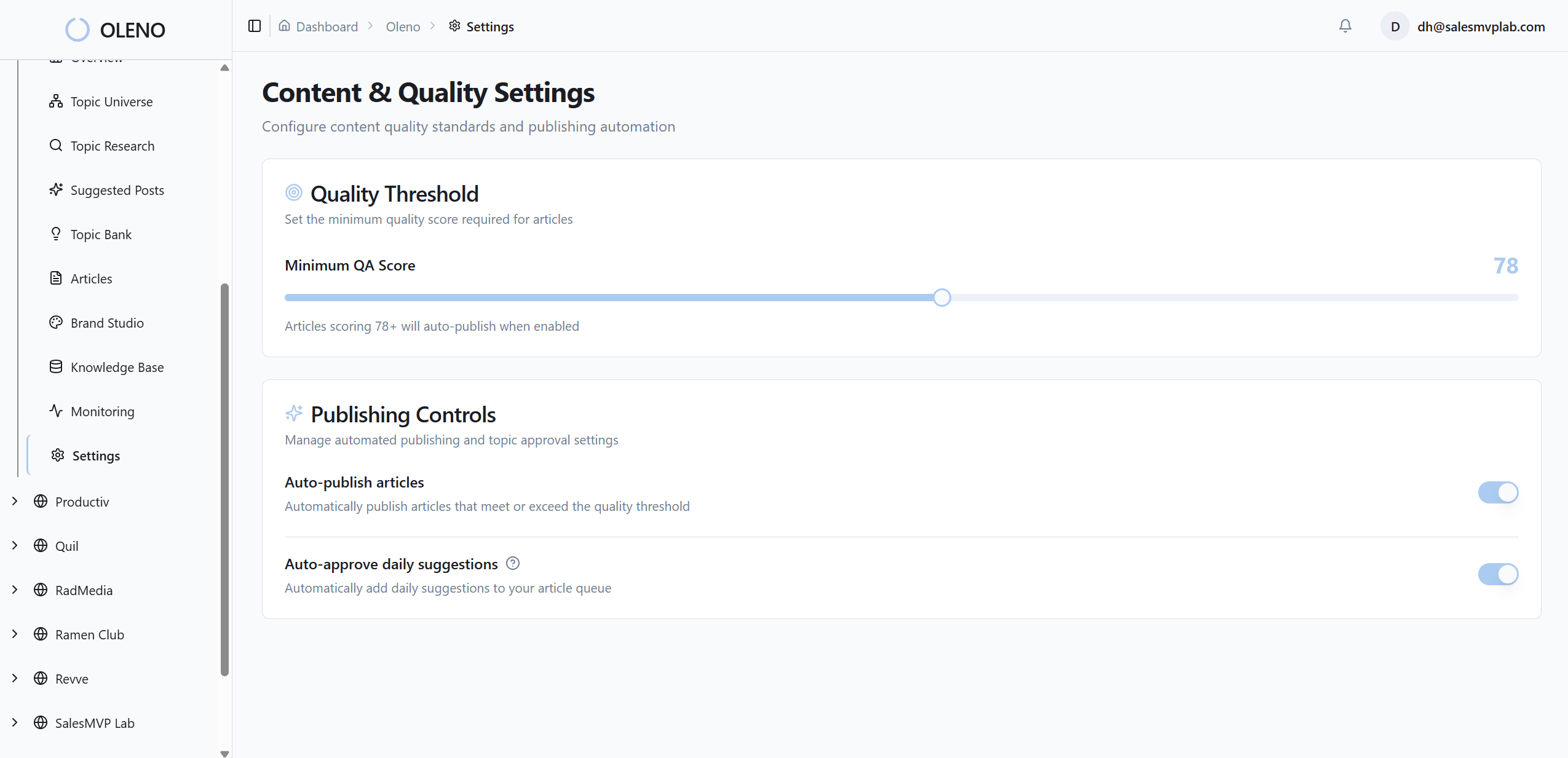
Then the work moves through a system. programmatic seo studio, category studio, competitive studio, and product marketing studio each produce different job types, but they pull from the same central definitions. So a top-of-funnel article, a category piece, and a product-led page don’t have to sound identical. They just need to agree on what the company is, who it serves, and what it’s arguing.
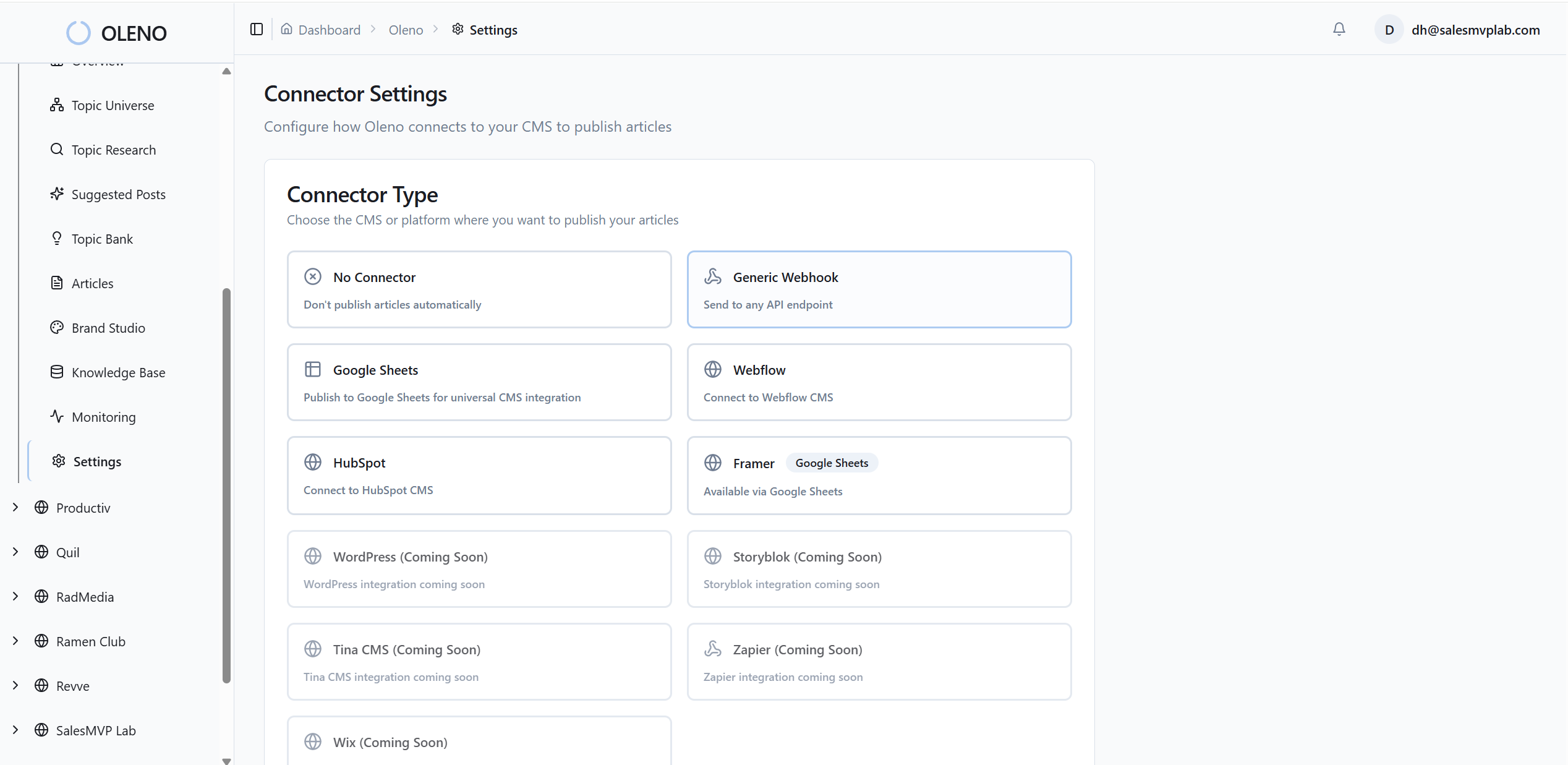
That agreement is the point.
Consistency In Practice Requires Rules, Checks, And Publishing Discipline
The other half is execution discipline. orchestrator runs approved topics through the pipeline and enforces cadence. quality gate blocks output that fails objective checks. cms publishing closes the loop so approved work actually gets live without another messy handoff.
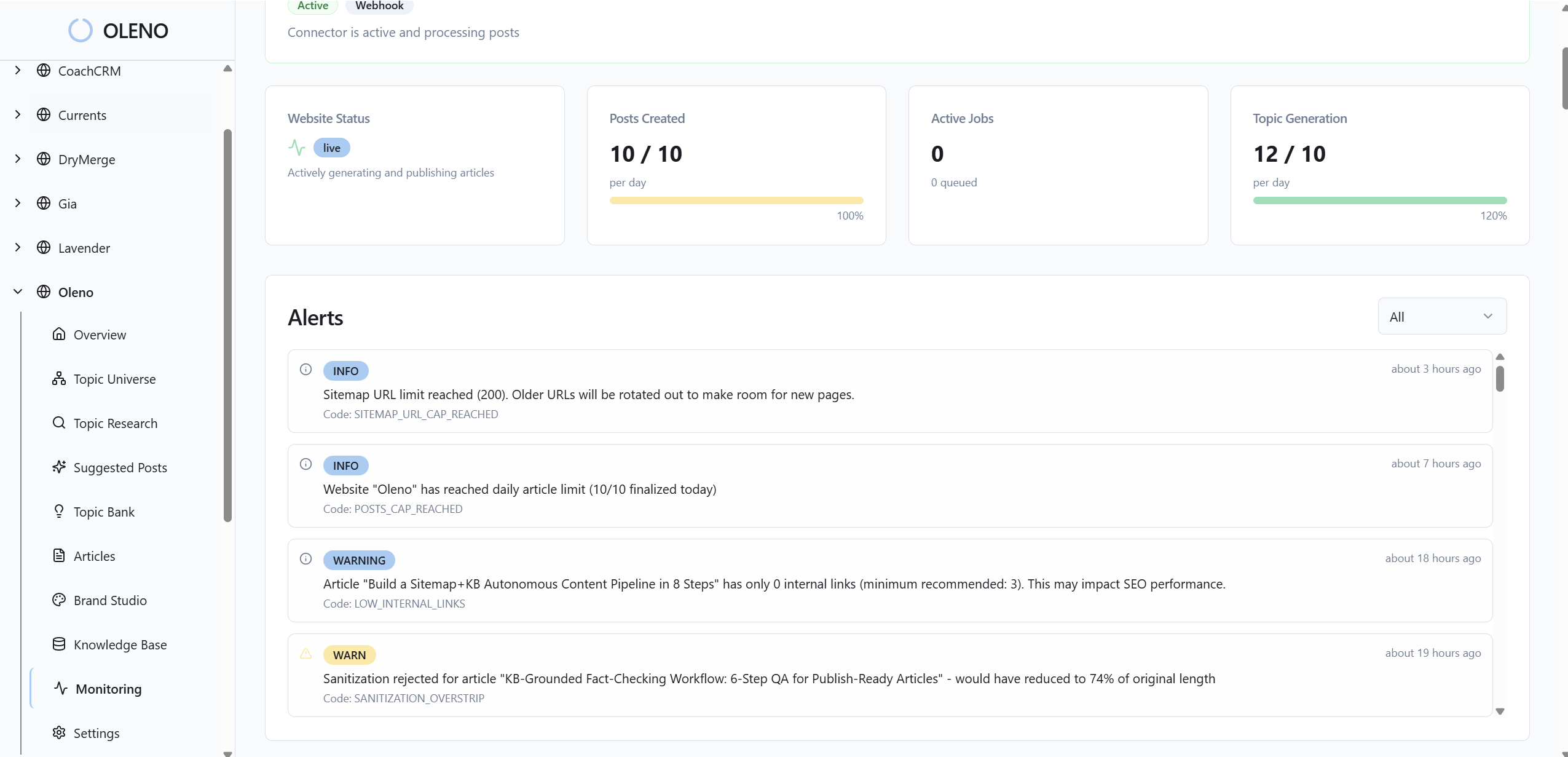
I like this model because it reflects what goes wrong in real teams. Back when the founder built the first version for a B2C app, the problem wasn’t that GPTs couldn’t produce text. The problem was the 3-4 hours a day of prompting, copy-pasting, QA, and manual CMS work. That grind is exactly where systems break and message drift sneaks in.
See how Oleno puts audience targeting, product truth, and publishing into one governed workflow, book a demo.
The Brands LLMs Can Summarize Usually Win More Often
LLMs need a stable story to repeat. So do buyers. When your audience messages conflict, the issue isn’t that the market needs more personalization. The issue is that your company is teaching multiple versions of itself at once.
Fragmented Demand Generation creates that problem. A system fixes it.
If your team wants stronger GEO visibility, less rework, and a tighter connection between content and pipeline, start by deciding what must never change. Then decide what can flex by audience. Then make those rules operational. That’s usually where clarity starts compounding.
About Daniel Hebert
I'm the founder of Oleno, SalesMVP Lab, and yourLumira. Been working in B2B SaaS in both sales and marketing leadership for 13+ years. I specialize in building revenue engines from the ground up. Over the years, I've codified writing frameworks, which are now powering Oleno.
Frequently Asked Questions