How Marketing Agencies Scale Competitive Content With Oleno

How marketing agencies use competitive content is usually where margin starts leaking. Not because the work isn't valuable, but because once you get past 3 or 4 active client accounts, comparison pages and alternatives pages start dragging everyone into a messy review loop.
A writer misses a product nuance. A strategist rewrites the positioning. The client wants the tone sharpened. Legal gets nervous about one line. Then the whole thing comes back around again. That's the real headache. Not writing. Translation loss across people, tools, and accounts. Oleno comes into that part of the workflow.
If you're running agency delivery today, you probably don't need more drafts. You need a way to keep each client's truth isolated while still producing competitive content at a pace that makes the account profitable.
Key Takeaways:
- Competitive pages usually break before other content types because they carry more factual risk, more positioning risk, and more client sensitivity.
- Agencies don't usually lose margin on first drafts. They lose it on the second, third, and fourth round of frustrating rework.
- A governed workflow matters more than raw drafting speed when you're managing multiple B2B SaaS accounts at once.
- Oleno Competitive Studio uses client-specific inputs from tools like marketing studio, product studio, and audience & persona targeting to keep each account's positioning separated.
- Agencies can often test this on one client account first, then decide whether the workflow is strong enough to scale across the book of business.
Why Competitive Content Breaks First for Agencies
Competitive content breaks first when agencies add more client accounts because it has the tightest tolerance for mistakes. A blog post with a soft positioning miss is annoying. A comparison page with the wrong framing, weak evidence, or a sloppy claim can create client risk fast.
Competitive Content Breaks First When Agencies Add More Client Accounts
An agency can usually survive some looseness in top-of-funnel content. You can fix a soft intro. You can tighten a CTA. Competitive content is different. Every page has more pressure on it. You're handling buyer objections, competitor framing, product nuance, and client politics in the same asset.
Let's pretend you've got three SaaS clients. One sells sales onboarding software. One sells security automation. One sells a product analytics tool. All three want bottom-of-funnel pages. All three have different competitors, different approved language, and different tolerance for how direct you can be. If one strategist holds all that in their head, it works for a while. Then that person gets busy. Or leaves. Or hands the brief to a freelancer. That's when the cracks show.
I've seen this pattern before in a different form. Back in 2012-2016 I ran a website that got to 120k monthly visitors because we had breadth and depth at scale. But scale only works when context holds. Once context gets thin, volume stops compounding and starts drifting.
Context Loss Turns Comparison Pages Into a Margin-Killing Review Loop
Context loss is what really costs agencies money. Not the act of writing. The review tax after the draft exists.
A pretty normal day-in-the-life version looks like this. An account strategist pulls notes from a kickoff doc, an old competitor sheet, a Slack thread, and two client calls. A writer turns that into a draft by Thursday afternoon. Friday morning, the client says the voice feels too generic, a claim about a competitor needs softening, and one feature explanation isn't quite right. So the strategist rewrites sections manually. The writer waits. Delivery slips. Margin shrinks.
The nasty part is that this usually doesn't show up as one giant failure. It shows up as 45 minutes here, 90 minutes there, one extra call, one extra QA pass, one extra approval round. If you burn even 2 extra hours per competitive page and ship 12 of them a month across accounts, that's 24 hours gone. Nearly three working days. On rework alone.
Some agencies will say that's just the cost of premium service. Fair point. High-touch work does require judgment. But if the same types of errors repeat across every account, that's not premium service. That's a broken operating model.
If you want to see how this kind of system problem compounds across content operations more broadly, request a demo and look at it through one client account first.
Why Governed Execution Beats Faster Drafting
Governed execution matters more than drafting speed in competitive content because the real job isn't generating words. The real job is preserving each client's approved truth while content gets produced at scale.
Governance Matters More Than Drafting Speed in Competitive Content
Most people still think the bottleneck is getting a draft on the page. I'd argue that's outdated now. Drafting got cheap. Review didn't.
That's why the old prompt-by-prompt model falls apart. It feels productive because text appears quickly. But competitive content isn't a one-off writing task. It's a controlled argument. You need the right voice, the right market framing, the right product truth, and the right level of directness about competitors. If even one of those slips, the client catches it. And they should.
There's a useful rule here. If a content type can create legal, brand, or sales-risk exposure, speed should rank second and controls should rank first. Competitive pages sit squarely in that bucket.
Research from McKinsey has been pointing to the same broad issue in AI adoption: value doesn't come from isolated output alone, it comes from embedding AI in repeatable workflows with controls and oversight (McKinsey on generative AI and workflow redesign). That's especially true for agencies, where you're not protecting one brand. You're protecting several.
Isolated Client Truth Is What Lets Agencies Scale Without Voice Bleed
The core idea is simple. Each client needs its own lane.
That means client voice, approved claims, audience language, product boundaries, and competitive framing can't live in a strategist's memory or a folder full of half-updated docs. They need to be encoded once and then applied consistently. Not because humans aren't capable. Because humans get interrupted. And agency environments are basically interruption factories.
I learned some version of this at PostBeyond. I could write 3-4 strong posts a week because I had the context in my head and a structured framework behind me. As the team grew, output didn't really get easier. It got slower. The context gap between the person with the strategy and the person writing widened. That's what agencies live with every day across multiple clients.
The agencies that scale this well usually follow what I'd call the Isolated Truth Model. One account, one set of approved inputs, one competitive frame, many outputs. If those truths are isolated, you can scale. If they bleed together, revisions multiply.
And that's the setup for the actual mechanics.
How Oleno Competitive Studio Runs a Repeatable Agency Workflow
Oleno Competitive Studio turns competitive research into a repeatable workflow by combining client-specific setup with automated execution layers. The platform separates what must stay fixed for each website from what can run continuously, which is why teams can increase output without letting brand voice, positioning, or product truth drift.
Oleno Turns Competitive Research Into a Repeatable Agency Workflow
This is where Oleno shows up by name. And the important part is not just Competitive Studio by itself. It's how Competitive Studio sits on top of the rest of the system.
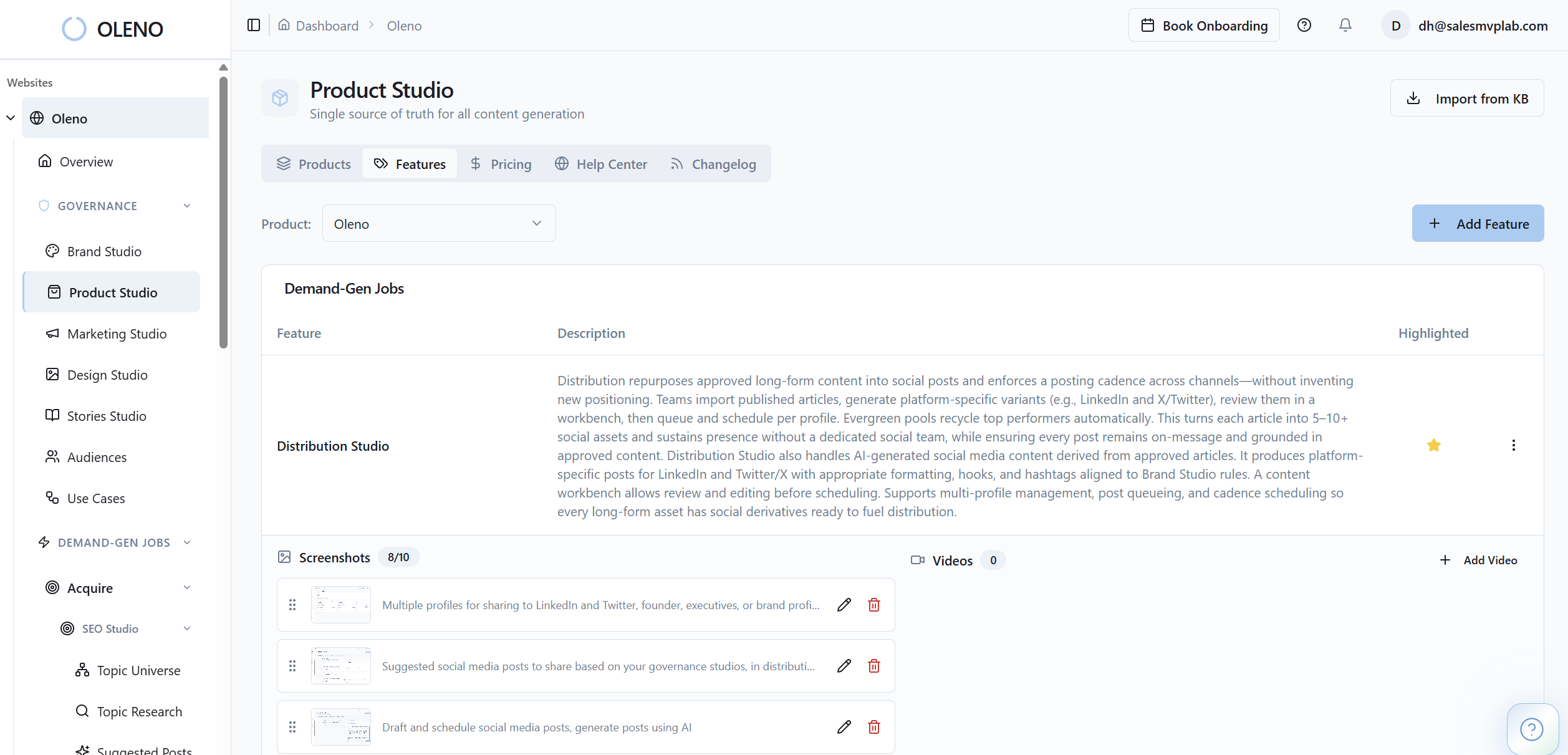
A team sets up the website with the inputs that matter. Brand Studio defines how that brand should sound. Marketing Studio captures the point of view and market framing. Product Studio holds approved product descriptions, approved claims, and boundaries. Audience & Persona Targeting defines who the content is for. Use Case Studio maps the jobs the buyer is trying to get done. Then Competitive Studio works from that governed base.
From there, the workflow becomes much more repeatable:
- Competitors are defined once for the website.
- Competitive Studio analyzes positioning, features, and messaging to build a competitive knowledge base.
- Structured briefs and drafts are created for evaluation content with the brand's framing and product truth already loaded in.
- Quality Gate checks voice, structure, and factual compliance before content reaches review.
- Approved articles can move into CMS Publishing.
One thing matters here: the system is reducing translation loss. That's the whole job.
Google's own documentation around helpful content and people-first quality keeps circling back to the same thing, even if it uses different language: original value, clear expertise, and consistency matter more than mass-produced generic text (Google Search guidance on creating helpful, reliable, people-first content).
A Governed Setup Keeps Competitive Content Consistent
The upside comes from separation. Not from trying to mash every brand into one universal process.
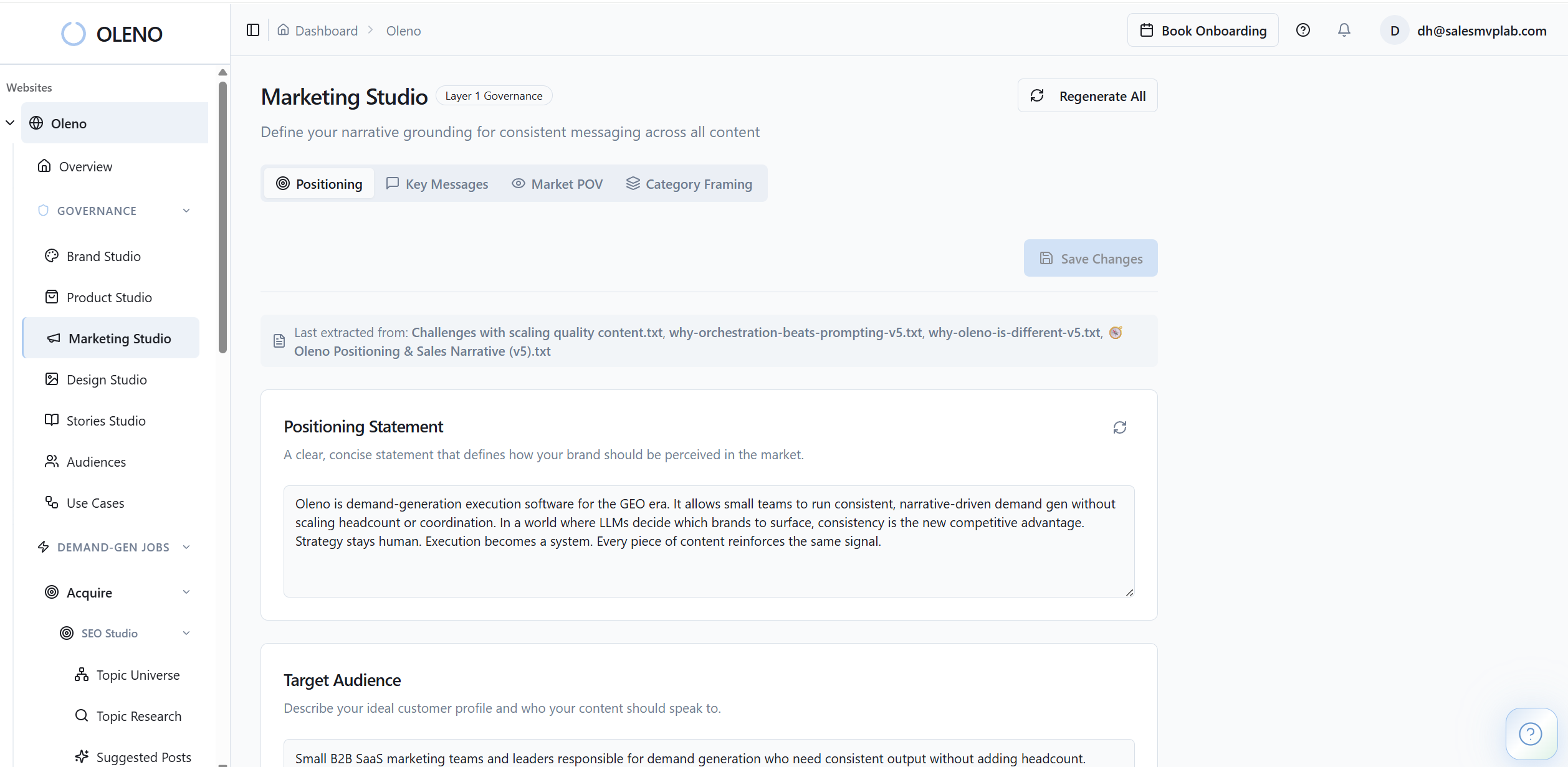
Oleno supports multiple audiences, personas, and use cases, and that matters a lot because a growth-stage SaaS CMO and an enterprise buyer don't want the same argument, even if the topic looks similar on paper. The same goes for competitors. One brand might need a direct alternatives page. Another might need a softer evaluation page with more factual comparison and less confrontation. That distinction has to be built into the setup.
So the repeatable model looks less like "one template for everyone" and more like "one operating model shaped by governed inputs." That's a big difference. It means the team can reuse the method without reusing the wrong voice.
There is a concession worth making here. If your team only does a handful of highly bespoke strategy projects per quarter, a tightly governed content system may feel like more setup than you need. That's fair. But once you're delivering recurring content and competitive pages on an ongoing basis, the threshold changes fast. Past that, manual control starts turning into manual drag.
Midway through evaluation, most teams want to pressure-test the workflow against one live website and one live competitor set. That's the smart move. If you want to see that flow with your own delivery model in mind, request a demo.
What This Looks Like Across Three Client Accounts
A three-client agency can scale competitive pages without tripling headcount when each account has its own governed setup and the execution pattern stays consistent. The gain isn't just faster drafting. It's fewer rewrites, fewer approval surprises, and more confidence before the client ever sees the draft.
A Three-Client Agency Can Scale Competitive Pages Without Tripling Headcount
Let's make this concrete.
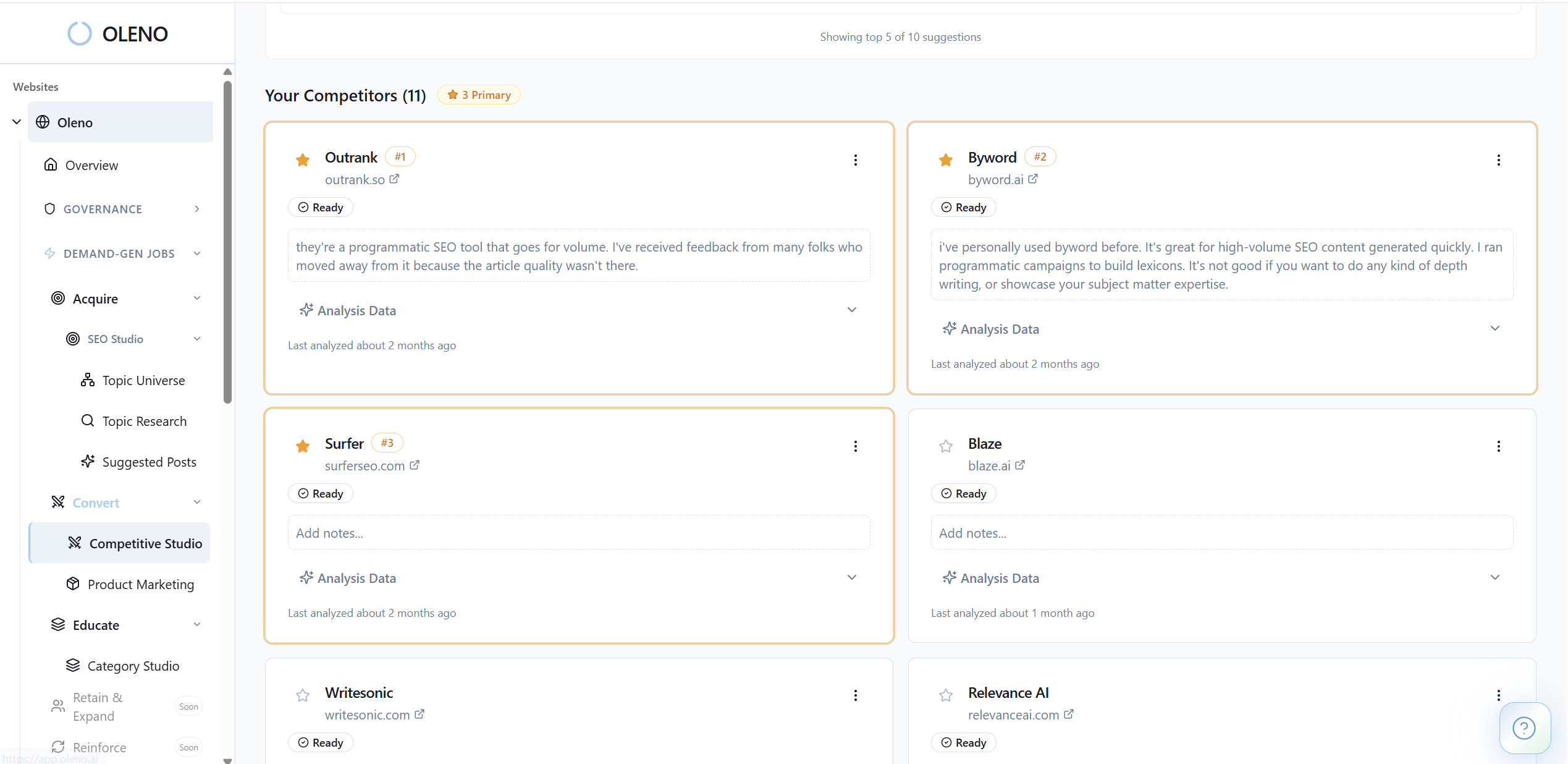
Picture an agency with three B2B SaaS clients. Client A wants comparison pages against two established incumbents. Client B wants alternatives pages because buyers are already searching that way. Client C needs evaluation content for a newer category where tone matters a lot and direct attacks would backfire.
Without a governed system, the team usually rebuilds context every time. Strategist writes a brief. Writer drafts from scattered notes. Editor checks for voice. Strategist rechecks product nuance. Client asks for changes. Repeat. Across three accounts, that can chew up a shocking amount of time. Not because the team is weak. Because each asset starts too close to zero.
With a governed setup, the agency can establish the client's market position, voice, audience, product facts, and competitor context once, then let the execution pattern repeat. Same model. Different account truths. That changes the economics. The desired outcome from the agency context is pretty clear: scale delivery 3-5x without proportional hiring. Not every agency will hit the top end of that range, obviously. But the direction is the point.
Governed Workflows Reduce Rewrites Before Content Reaches The Client
The biggest win might be what the client never sees.
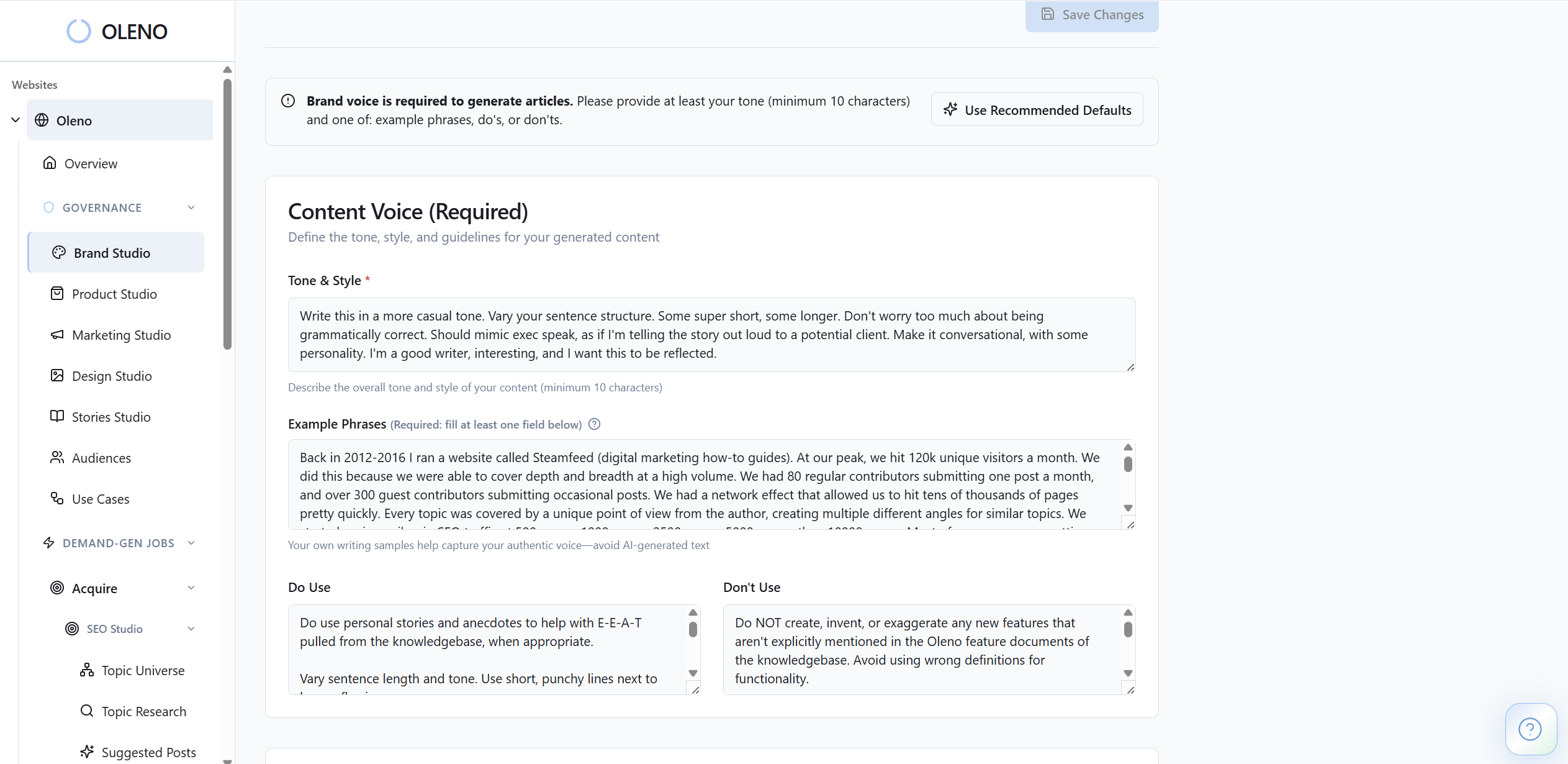
A lot of agencies think the client experience starts when the draft lands in their inbox. It doesn't. It starts with all the messy internal work before that. If you can catch off-brand language, unsupported claims, structural issues, or product drift before the strategist touches it, you've already protected margin.
There's a parallel here with another Oleno story that stuck with me. An experienced SEO consultant reviewed output and said it passes the slop test. I like that phrase because everybody in content knows what slop feels like the second they read it. The opposite of slop isn't prettier wording. It's governed specificity.
So let's pretend a manual competitive page takes 6 hours across research, briefing, drafting, editing, and revisions. If governed setup and automated checks cut even 90 minutes to 2 hours of rework, and you do that across 10 to 15 pages a month, you're getting back serious delivery time. That's time the agency can use for strategy, upsells, or just keeping the account healthy instead of scrambling.
And more importantly, you stop sending clients drafts that make them nervous.
Where Agencies Still Need Human Judgment
Competitive Studio strengthens execution but doesn't replace strategic judgment. Agencies still need approved claims, current client input, and final review for sensitive comparisons, because the system can work inside boundaries but it shouldn't invent the boundaries for you.
Competitive Studio Strengthens Execution But Does Not Replace Strategic Judgment
This boundary matters. A lot.
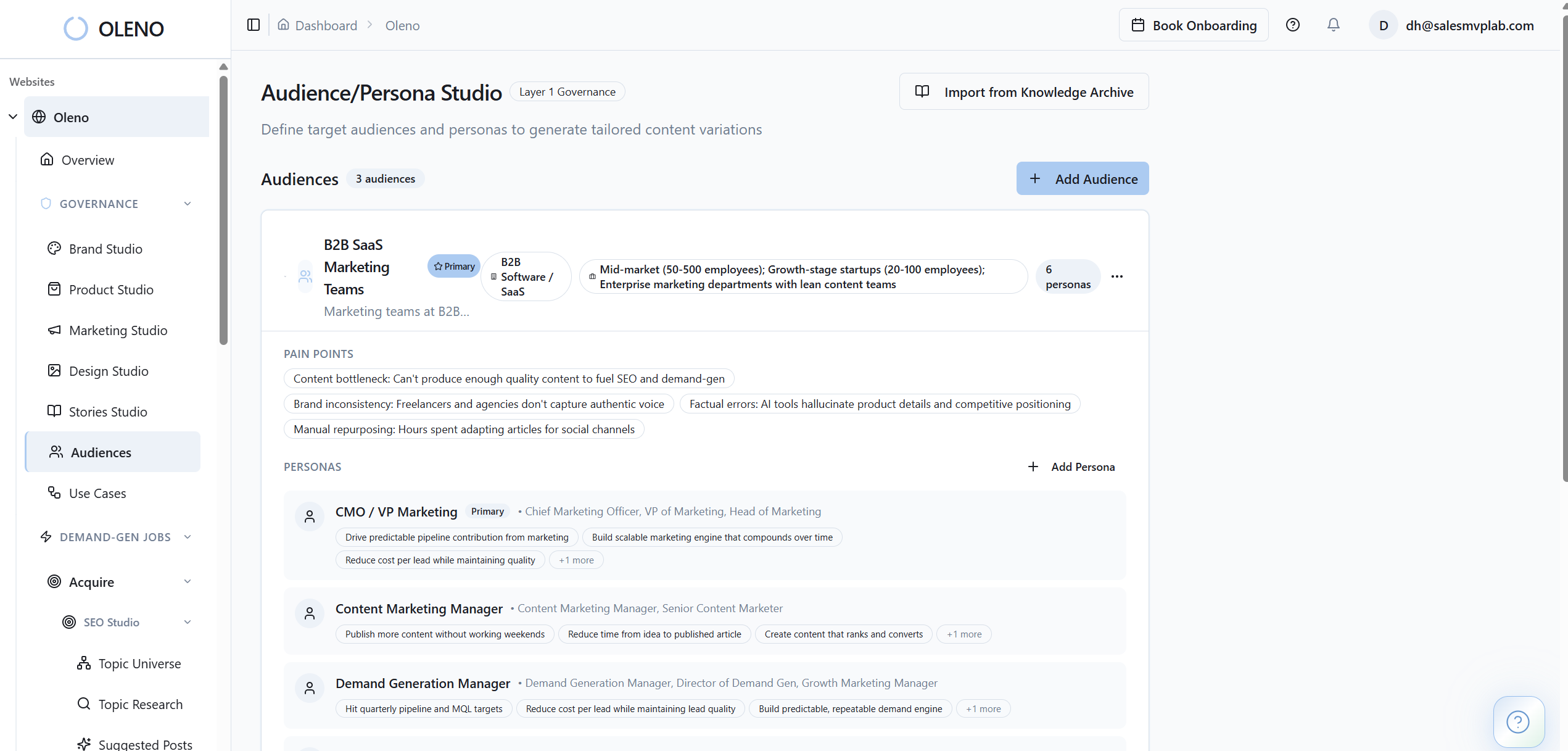
Oleno can help structure and execute competitive content from approved inputs. It does not replace the agency's job of deciding what the client should actually stand for in the market. It also does not invent defensible positioning out of thin air. If the client hasn't clarified the claim, the proof, or the line they won't cross, that ambiguity still exists.
That's not a weakness. That's good discipline.
The way I think about it is this: strategy is upstream. Execution is downstream. If upstream is muddy, downstream gets muddy too. Oleno can reduce drift, enforce rules, and keep the workflow moving. But it still depends on accurate setup in brand studio, marketing studio, product studio, and the rest of the client-specific inputs.
Agencies Still Need Approved Claims, Client Input, And Final Review On Sensitive Comparisons
Agencies remain in control, especially on politically sensitive or legally sensitive pages. That means you still want client approval on bold comparison language, sensitive product claims, or pages targeting especially visible competitors.
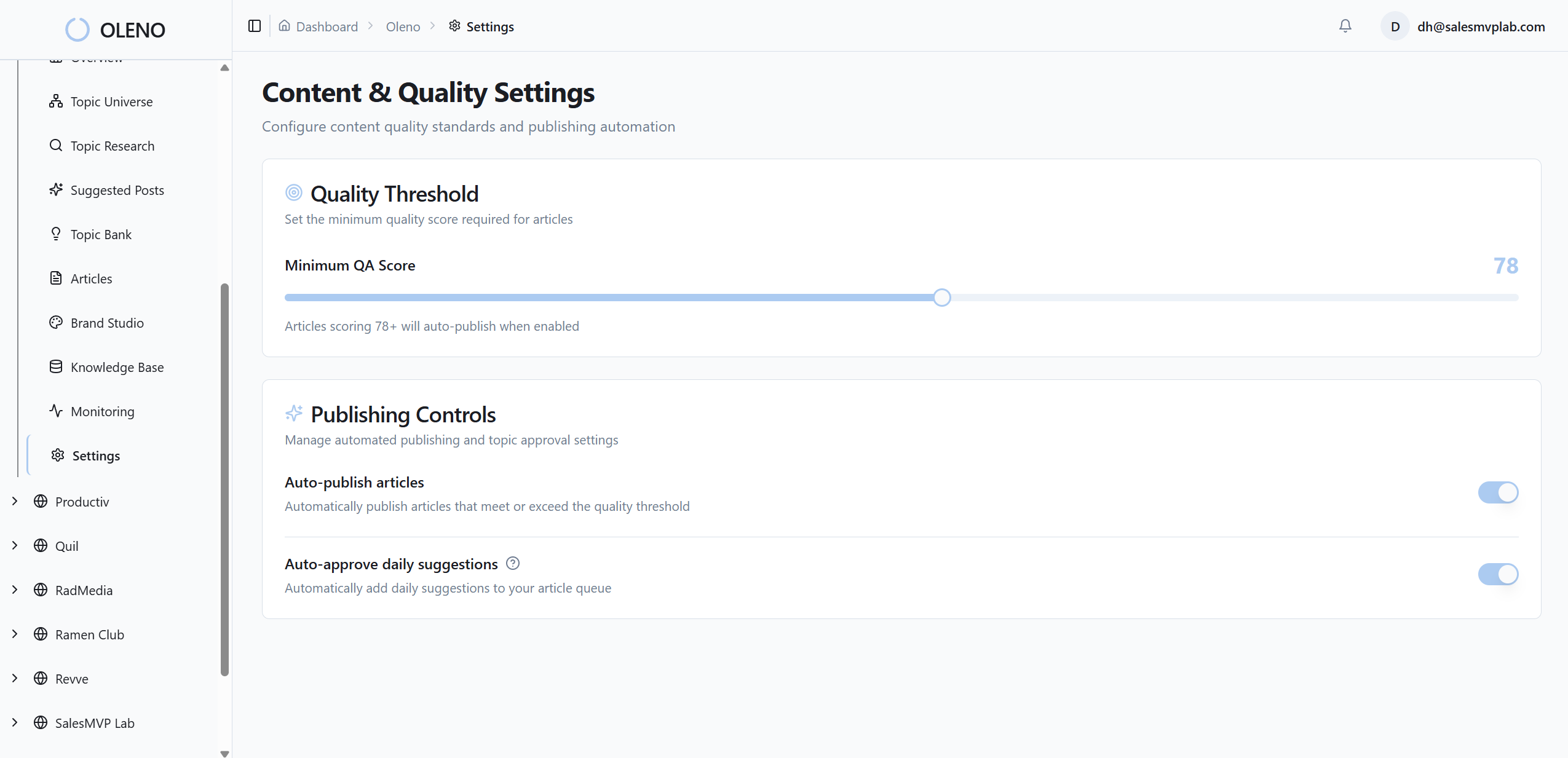
There are also practical limits. Competitive information changes. Client positioning evolves. A product team ships something new. A pricing page changes. That's why accurate setup and ongoing maintenance still matter. Content refresh & drift monitoring exists in Oleno more broadly to flag content that drifts from current truth, which tells you something important about the philosophy behind the product. The system assumes truth changes over time and content has to keep up.
Some teams won't like that because they want software to make the whole problem disappear. I don't think that's realistic. Especially in agency work. The better goal is to remove repetitive coordination while keeping judgment where it belongs.
The Best Next Step Is One Client, One Competitor Set, One Workflow
Agencies that want more output usually don't need more coordination. They need a cleaner operating system for competitive content delivery. The lowest-risk way to test that is to run one real client account through a governed setup and see whether revisions drop before you try to scale it across the rest of the book.
Agencies That Want More Output Need A System, Not More Coordination
If you're managing multiple B2B clients, you're probably already feeling the pattern. Drafts are not the main issue anymore. Review load is. Context gaps are. Margin leak is.
That's why I'd start small and judge hard. Take one account that already has recurring demand for comparison pages or alternatives pages. Set the voice rules. Set the market framing. Set the product boundaries. Define the competitor set. Then see what happens to briefing time, rewrite time, and strategist involvement over the next few pieces.
That kind of pilot tells you more than a broad abstract evaluation ever will.
The Next Step Is Proving Governed Competitive Content On One Client Account
You don't need to overhaul your whole agency model on day one. You just need proof that the workflow holds under real client pressure.
A useful first-success milestone would be simple: one client account, one competitor set, three competitive pages, and fewer internal rewrites before client review. If that happens, you've got something. If it doesn't, you'll know exactly where the setup or process needs tightening.
If you want to test whether Oleno competitive studio can support agency delivery without the usual review tax, book a demo.
About Daniel Hebert
I'm the founder of Oleno, SalesMVP Lab, and yourLumira. Been working in B2B SaaS in both sales and marketing leadership for 13+ years. I specialize in building revenue engines from the ground up. Over the years, I've codified writing frameworks, which are now powering Oleno.
Frequently Asked Questions