How small marketing teams can consistently produce engaging content

Your team can publish 4 posts this month and still feel like you're starting from zero every Monday. Producing engaging content consistently doesn't break because marketers run out of creativity — it breaks because the system asks them to invent the topic, angle, proof, product story, draft, review path, and reuse plan from scratch every single cycle.
I've seen this happen a lot with small B2B SaaS teams. One person owns SEO, demand gen, product launches, sales enablement, and maybe the newsletter too. They don't need another blank page. They need a tighter content workflow that makes the next piece easier because the last piece created reusable inputs.
Key Takeaways:
- Engaging content consistently comes from better source inputs, not constant net-new ideas.
- Small teams need systems that reduce restart work, not just faster drafting.
- Product-grounded content is a core requirement for trustworthy AI-assisted marketing.
- A defined content quality checklist beats subjective taste when output is scaling.
- Content repurposing works when one strong asset becomes many channel-specific pieces, not when someone copy-pastes the same thing everywhere.
- Adding more writers alone doesn't automatically build authority.
- Publishing fewer stronger pieces usually beats chasing volume for its own sake.
Why Engaging Content Consistently Breaks on Small Teams
Engaging content consistently breaks when the team rebuilds the operating system for every article. The visible symptom is slow output, but the root cause is weak inputs, unclear review loops, and product messaging that lives in someone's head. Once the senior marketer becomes the cleanup crew, cadence becomes fragile.

The Draft Was Never the Hard Part
A blank Google Doc at 8:47 AM Monday. A messy AI output the demand gen manager pastes into Notion, hoping it's close enough. A freelancer draft that sounds fluent but misses the point by the third paragraph. So the instinct is to find a faster writer or a better prompt.
That's understandable. If you're the only marketer, shaving an hour off drafting feels like progress. The bigger waste usually happens before the draft exists. The topic is too broad, the angle is borrowed from competitors, and the product proof is missing. The review cycle starts late, so the article gets rewritten after everyone has already mentally moved on.
Here's the test I use: pull your last 5 published pieces and ask, for each one, whether the first 30 minutes of work was about deciding what to say or how to say it. If 4 out of 5 were the first, you don't have a content engine. You have weekly improvisation with a publish button attached. That gets exhausting fast.
Generic Prompting Creates Generic Engagement
A demand gen manager opens a doc on Tuesday morning with sales-call notes, three product screenshots, a few customer objections, and a keyword pulled from last month's SEO list. Slack is already moving. Product wants the launch page updated by lunch. Sales wants a one-pager by Friday. The marketer asks AI for an article and gets something that sounds fine but says nothing only that company could say.
That's the real engagement constraint. Source material quality beats clever prompting every time. If your inputs are customer language, product truth, actual objections, founder POV, and sales notes, the article has somewhere to go. If the inputs are "write a blog post about X," the model averages the internet and hands you beige.
Here's the rule I'd lock in: if your prompt to AI doesn't contain at least one direct quote from a customer, one product specific, and one internal POV, don't expect engagement on the output. The model can't invent specificity it was never given. It can only rearrange what's there.
If the team wants a content system that doesn't collapse under pressure, the work has to move upstream.
More Writers Don't Automatically Build Authority
I learned this one the hard way. At PostBeyond, I was the sole marketer and I could write 3 to 4 strong posts a week because I had the context in my head. Product nuance, customer pain, sales objections, founder opinions — all of it sitting in one brain.
Then the team grew. The new writer was talented, but they didn't have the same context. They took longer to produce a weaker draft, not because they were bad, but because we hadn't turned my brain into a repeatable editorial process. That's the trap small teams fall into. They hire or outsource before they've defined the inputs that make content sound credible.
There's a fair counterpoint. More writers genuinely help when you already have clear positioning, strong briefs, source material, and a quality bar. Without those, you're just multiplying interpretation. And interpretation is where consistency goes to die.
A small content team doesn't need more hands first. It needs fewer ways for the work to restart.
If your team wants the system built before the draft keeps drifting, the cleanest next step is to see how that production path works in practice and request a demo.
How to Build a Lean System for Engaging Content Consistently
Small teams produce engaging content consistently by narrowing the decisions that happen on every piece. The system needs clear inputs, reusable briefs, product grounding, repurposing rules, and a checklist that survives multiple reviewers. The goal is not more process. The goal is less rework.
Diagnose Where the Restart Work Happens
Before you change anything, run this diagnostic on your last 5 pieces. For each one, mark the first place where the work went sideways: topic, source material, brief, outline, draft, review, CMS handoff, or repurposing. Then ask yourself these 5 questions:
- Where did the first major rewrite happen?
- Which missing input caused that rewrite?
- Who had the information earlier but joined too late?
- Which decision should have been made before drafting?
- What reusable input did the piece create for the next asset?
The scoring rule is simple. If 3 out of 5 pieces broke before the draft, stop optimizing the writing step entirely — your input layer is the bottleneck. If 3 out of 5 broke during review, your signoff decisions are unclear and you need to assign one owner per review type. If 3 out of 5 broke during repurposing, your source asset wasn't strong enough to carry multiple channels, and adding more distribution won't fix it.
I like this test because it removes the vibes. A lot of content problems get described as "quality" problems, which means everyone has an opinion and nobody has a fix. Restart work gives you a concrete pattern. Once you see where the loop breaks, you can change the system instead of blaming the person holding the doc.
Treat Editorial Inputs Like Inventory
A strong content workflow starts with source material, not a title. The small team advantage is that you're close to sales calls, product changes, founder thinking, and customer objections. The mistake is leaving all of that scattered across Slack, Gong notes, call transcripts, launch docs, and someone's memory.
The threshold I use before approving any topic: 3 buyer phrases, 2 product truths, 1 internal POV, and 1 real objection. If you can't name all 7, the topic isn't ready. Not dead. Just not ready. A weak topic with strong search demand still becomes weak content if it has no company-specific material behind it.
Buyer language matters more than marketers want to admit. You might see phrases like "What do you do as a Demand Generation Manager", "Demand gen leaders - do you manage SDRs?", or "What kind of projects/campaigns/tasks do Demand Gen roles do?" and think they're too raw for content. They're not. They show how buyers and career-switchers actually describe confusion before they know the polished category language.
The same goes for messy internal phrasing. "CEO acts as CMO" says more about the operating reality of a small team than a polished persona doc ever will. "Either validates or amplifies my ideas" tells you what kind of support that person wants from a tool, a manager, or a process. "Expects me to keep quality and motivation up with department" gives you the emotional load. That's fuel.
Build Briefs That Prevent Late Rewrites
Repeatable briefs are where small teams win back time. A brief doesn't need to be 6 pages — it needs to lock the expensive decisions before someone writes 1,500 words in the wrong direction. Audience, angle, search intent, source material, product claim boundaries, proof, CTA, and review owner. That's enough.
The rule: no draft starts until the brief can answer 6 questions in plain English. Who is this for? What do they already believe? What are we trying to change? What proof do we have? Which product claims are safe? What should the reader do after finishing? If the brief can't answer those, the draft will invent the answers. Sometimes the writer invents them, sometimes AI does. Either way, you pay for it later in a 2-hour rewrite cycle.
A good review loop also separates taste from accuracy. Product should check product truth. The content owner should check angle and voice. Leadership should only weigh in if the POV or positioning is wrong. If everyone reviews everything, the review cycle becomes a committee. Committees are where sharp content goes to get sanded down.
There's a real limitation here. Small teams don't always have time for formal briefing. That's a reasonable read. Even so, spending 15 minutes on a brief beats spending 2 hours rewriting a draft that never had a chance. The brief is not admin work. It's rework prevention.
Ground Product Claims Before Speed Takes Over
Product-grounded content is non-negotiable when AI enters the workflow. The faster you draft, the easier it is to publish claims that are slightly outdated, slightly exaggerated, or slightly wrong. That's the dangerous zone — not obvious fabrication, but subtle drift.
If your product changes quickly, create a product claim source that gets checked before drafting. A simple table works. Feature name, what it does, what it doesn't do, proof, last updated, owner. If a claim isn't in the table, don't let it into the article without review. Sounds basic. Works.
For AI-assisted marketing, product-grounded content matters because the model will fill gaps if you leave them open. It may describe a feature your roadmap discussed but never shipped. It may turn a manual handoff into an automated one. It may imply an integration because similar tools have one. None of that feels dramatic in the draft. Then a prospect reads it, sales repeats it, and product has to clean up the trust problem three weeks later.
The rule I'd use: speed is only valuable after accuracy is protected. If the article is about product-led topics — product marketing, comparisons, integrations, or buyer objections — every claim needs a source of truth. If the piece is pure thought leadership, the product check can be lighter. Different risk profile. Same discipline.
If product truth keeps showing up too late in the review cycle, it's worth seeing how a controlled research, brief, outline, and draft path keeps the accuracy work upstream, so your team can request a demo.
Repurpose From a Strong Asset, Not a Finished Draft
Content repurposing works when the original asset has a strong point of view. If the blog post is generic, the LinkedIn posts will be generic. The email will be generic. The sales snippet will be generic. You can't squeeze a strong campaign out of a weak source asset.
A better system treats one article as the anchor for a small content run. Before drafting, decide what the asset needs to become later: 3 LinkedIn posts, 1 founder post, 1 newsletter section, 2 sales follow-up snippets, and maybe a short product education email. That changes how you write the article. You add sharper claims. You include buyer language. You structure sections so each one can stand alone.
The copy-paste version of repurposing is where people get tired. Someone takes the article, trims the intro, throws it into social, and wonders why it feels flat. Real repurposing changes the shape for the channel while keeping the idea. Blog explains. LinkedIn challenges. Email nudges. Sales copy handles an objection.
One practical rule: every long-form piece should produce at least 5 reusable blocks. A sharp opening claim, a buyer symptom, a before-and-after contrast, a product explanation, and a checklist. If you can't pull those 5 blocks out, the article probably wasn't concrete enough in the first place.
Use a Checklist Before Taste Enters the Room
Content quality depends on a defined checklist when output is scaling. Without one, every reviewer brings their own taste. One person wants shorter intros. Another wants more product. Another hates the headline. Nobody is wrong, exactly. The draft gets pulled in 5 directions and nobody can publish.
A simple quality control checklist should test what actually matters. Is the angle clear in the first 100 words? Does the article include source material the company actually owns? Are product claims grounded? Does each section teach something useful? Could a competitor publish the same piece without changing much? If yes, the article isn't specific enough.
I'd keep the checklist to 10 items max. If it has 30, nobody will use it. Mine: (1) Clear buyer problem in the opening (2) Specific point of view (3) At least 3 company-specific inputs (4) Product claims checked against source truth (5) No generic AI phrasing (6) Useful section headings (7) One concrete example per major section (8) CTA fits the argument (9) Repurposing blocks are easy to extract (10) CMS handoff won't create cleanup work.
The hard part is enforcing it when someone senior has a preference. That's a reasonable tension — senior taste can genuinely improve a piece. Taste should come after the checklist, not before it. The checklist protects the baseline. Taste sharpens the edge.
Choose Cadence Based on Reuse Capacity
Publishing fewer stronger pieces usually beats chasing volume for its own sake. If your team can only support 2 strong articles a month, do that. Then turn each one into a real content run across social, email, sales, and product education. Better one strong idea repeated well than 6 rushed posts nobody can remember.
A practical capacity test: for every planned article, count the follow-on assets your team can realistically produce within 10 business days. If the answer is zero, you're not planning content. You're planning isolated blog posts. If the answer is 5 to 8, you've got a better shot at making the idea travel.
Resource allocation gets easier when you stop treating net-new ideation as the only sign of progress. Refresh older pieces. Turn sales objections into articles. Convert product launches into buyer education. Use customer questions as the spine of newsletters. Small teams usually have enough material — the hidden problem is that they keep starting over instead of building from what they already know.
There are exceptions. If you're in a brand-new category and need coverage fast, volume has a role. If you're fixing a thin library, you may need a burst of 8 to 10 pieces in a quarter. Steady-state content should bias toward quality at cadence, not volume for its own sake.
A tiny team wins when each asset creates the next asset.
How Oleno Turns the System Into CMS-Ready Content
Oleno gives small B2B SaaS teams a controlled content production path from source material to CMS-ready article. It doesn't replace strategy, search research, analytics, or distribution. It sits in the middle, where research, brief, outline, draft, quality review, and CMS handoff usually create the most rework.
Strategy Memory Keeps the Inputs From Resetting
Oleno starts with Brand & Voice Memory, Positioning & Messaging Control, Product Truth Library, Customer Stories Library, and Proprietary IP & Frameworks. Those are the inputs small teams keep re-explaining in prompts and docs. Once stored, they become the working context behind the content process.
The practical difference is pretty simple. The marketer shapes the topic, research direction, brief, outline, and draft. Oleno does the production work around those calls. Compose sets the angle and audience. Research pulls relevant material before writing starts. Brief and Outline pause for review before the draft exists. Draft creates the article from approved direction, not a vague prompt.
That matters because restart work usually comes from missing context. Product truth was late. Brand voice drifted. The angle was too broad. Proof was missing. Oleno is built to keep those decisions visible before the writing step, so the draft has less room to wander.
Anders Uhl, CMO at ClickPoint Software, described the appeal well: he hadn't jumped on programmatic content automation because he didn't see the value in producing a mountain of mediocre content. What got his attention was the quality-over-quantity stance. Better thinking and better writing matter more when search and AI discovery reward useful, specific content.
Quality Review and Publishing Reduce the Cleanup Job
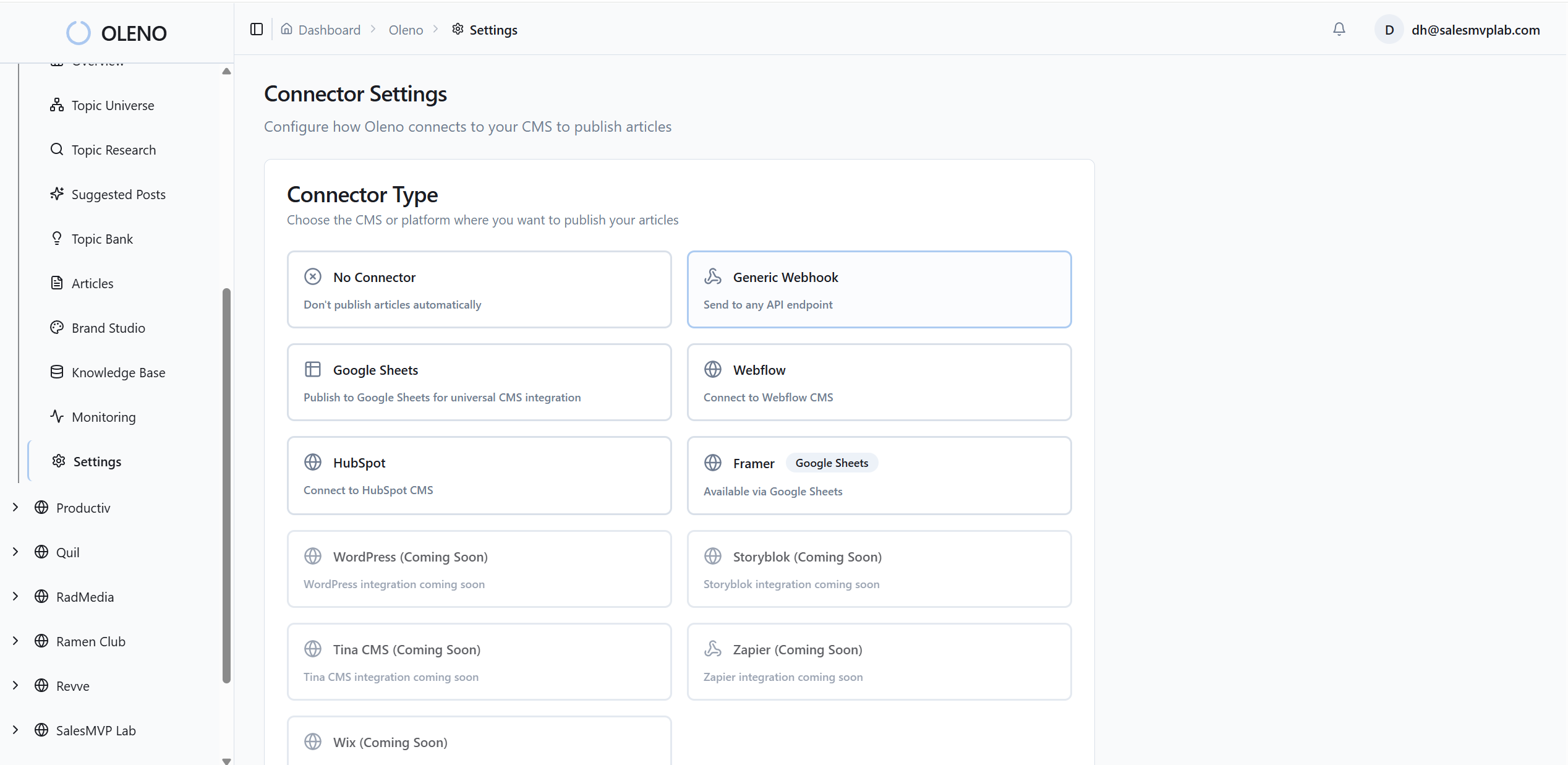
Oleno's Quality Gate checks drafts for factual grounding, voice match, structure, link health, and SEO density before the marketer opens the piece. It doesn't silently approve claims that fall outside Product Truth. It also doesn't publish without review unless the team explicitly overrides the process. That matters for small teams because speed without control just moves the cleanup job later.
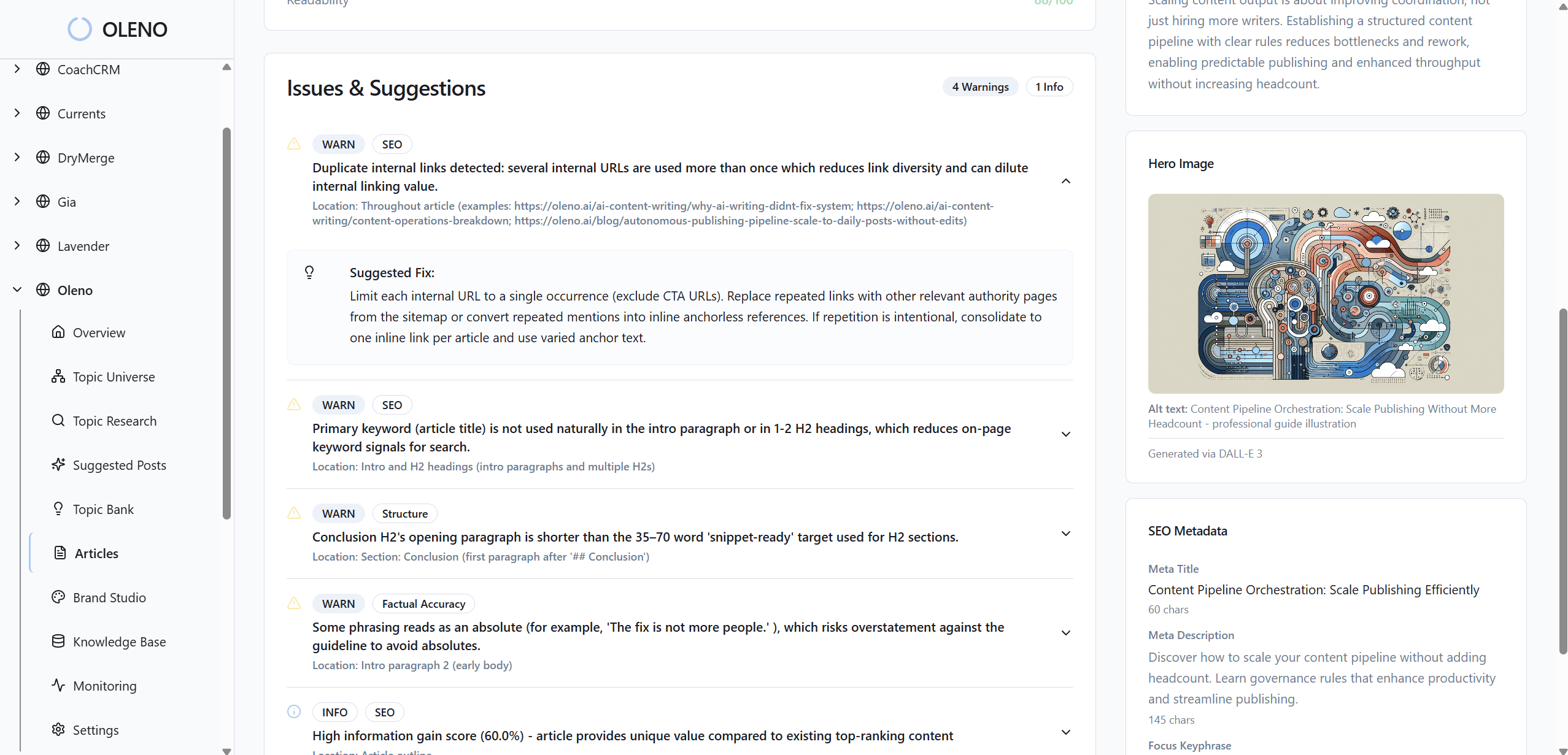
The Publish feature pushes approved content to supported destinations like WordPress, Webflow, Storyblok, HubSpot, Tina, Wix, Framer, Google Sheets, Webhook, and Zapier. The point isn't that the CMS disappears. The point is that the article arrives with the structure, metadata, formatting, and handoff work already handled. Less copy-paste fatigue. Fewer weird formatting chores.
Oleno is also not the fit for teams that want content to run in the background with no human review. That's a real market. Just not this one. For serious B2B SaaS content, the marketer still needs to shape the work. The AI should do the production. The marketer should keep the calls that change whether the piece is worth publishing.
If your current process already has the ideas but keeps losing time between source material, draft cleanup, and CMS handoff, book a demo and see the exact workflow.
Publish Less Random Work and More Repeatable Content
Small teams ship engaging content consistently when they turn each piece into a repeatable operating loop. Start with stronger inputs, lock the brief, ground product claims, repurpose from one strong asset, and use a checklist before subjective review takes over. The system doesn't need to be heavy. It needs to be repeatable.
Stop asking "how do we publish more from scratch?" Ask a better question: which decisions can we stop remaking every week? Once those decisions are locked, the team gets faster without lowering the bar.
That's the whole game. Less restart work. Better inputs. Stronger reuse. More content you'd actually want your name on.
About Daniel Hebert
I'm the founder of Oleno, SalesMVP Lab, and yourLumira. Been working in B2B SaaS in both sales and marketing leadership for 13+ years. I specialize in building revenue engines from the ground up. Over the years, I've codified writing frameworks, which are now powering Oleno.
Frequently Asked Questions