How Storyboard Allocates Topics Across Funnel Jobs

If you want to understand how storyboard allocates topics, start with the real problem. Most marketing teams do not have a topic problem. They have an allocation problem. Too much gets driven by whoever is loudest, whichever request feels urgent, or whatever channel had a bad week.
That sounds manageable for a while. Then the team gets bigger, more people weigh in, and the content mix starts drifting. You publish a lot. But you don't actually know if you're building balanced funnel coverage, reinforcing your point of view, or just feeding random demand from inside the company.
I've seen versions of this before. At PostBeyond, I could write 3-4 strong blog posts a week when I had the full context in my head. As the team grew, output got slower, quality got softer, and more of my time disappeared into meetings and coordination. That's usually where planning starts to break. Not because people are lazy. Because the system isn't there.
Key Takeaways:
- Storyboard allocates topics by turning quarterly priorities into weighted planning choices across funnel jobs, instead of letting content choices drift week to week.
- Teams usually overproduce one type of content and underproduce the rest, which creates missed coverage, duplicate effort, and frustrating rework.
- In Oleno, Storyboard works from a scored topic pool and maps output across audiences, personas, products, and use cases.
- When priorities change mid-quarter, allocation can shift without forcing the team to manually reshuffle every planned piece.
- A balanced plan can redirect a meaningful share of output in one quarter without adding headcount.
Why Content Calendars Drift When Topic Allocation Is Gut-Driven
Content Calendars Break When Funnel Coverage Is Left To Intuition
Content calendars usually don't break all at once. They drift. A demand gen manager needs pipeline support, so evaluation content jumps the queue. SEO wants traffic, so acquisition topics pile up. PMM wants launch coverage, so product-led pieces suddenly take over the month. Each request sounds reasonable on its own.
The trouble is that nobody is really allocating across the whole system. They're reacting inside their own lane. So you end up with a pile of content, not a portfolio. That's a big difference. A pile looks productive in a spreadsheet. A portfolio is balanced on purpose.
This gets expensive faster than most teams expect. Let's pretend you publish 16 pieces in a month and even 4 of them are the wrong job for the quarter. That's 25% of your output pointed in the wrong direction. Add writer time, PMM review, SEO input, edits, approvals, publishing, and distribution. You're not just wasting words. You're wasting operating capacity.
I've seen this with bigger contributor networks too. Back in 2012-2016 I ran Steamfeed and we got to 120k monthly visitors because we had both breadth and depth at scale. But when you're publishing at volume, structure matters a lot. Without it, you don't build coverage. You build noise.
Executive Teams Lose Visibility When Topic Allocation Happens Across Spreadsheets And Handoffs
Once planning gets split across spreadsheets, Slack threads, Notion docs, and hallway conversations, leadership loses the thread. The CMO asks a simple question like, "Are we light on evaluation content for this segment?" and nobody can answer quickly. Everyone has a partial view. Nobody has the whole one.
That's where rework tax shows up. The content team thinks they're covering the market. PMM thinks the messaging is off. Demand gen thinks the funnel is unbalanced. SEO thinks the wrong topics are getting priority. They're all kind of right, which is the annoying part.
For scaling SaaS teams, this usually means coordination cost starts exceeding creation cost. That sounds dramatic, but it happens all the time. The actual writing might take a few hours. The debating, checking, redirecting, and patching takes days. And when that becomes normal, people stop trusting the calendar.
You can feel it in the team too. People get worried about wasting cycles. They start pushing for their own priorities harder. More meetings. More handoffs. More "quick" revisions. That's not a content problem. It's a planning problem.
Why Planning By Job Creates A Better Demand Gen Mix
Demand Generation Improves When Planning Starts With Jobs, Not Channels
Planning works better when it starts with the job the content needs to do, not the channel it will appear in. That's the shift. If you anchor planning in channels, you're always reacting to formats. Blog post. Landing page. LinkedIn post. Email. Fine. But those formats don't tell you what strategic work the content is supposed to perform.
Job-based planning does. Are you trying to drive acquisition? Support evaluation? Teach the market? Reinforce product understanding? Those are different jobs. They need different topic allocation, different framing, and usually different follow-through.
This matters even more in the GEO era. LLMs don't just look for volume. They look for pattern consistency, definitional clarity, and repeated evidence that your company knows what it's talking about. If your acquisition content says one thing, your evaluation content says another, and your product content barely connects to either, you send a weak signal.
I tend to disagree with the idea that better prompting fixes this. It doesn't. Prompting can give you drafts. It doesn't decide what should exist in the first place, or how much of each content job you need across a quarter. That's why teams can get faster and still stay fragmented.
If you want to see that planning layer in action, See how Oleno plans governed execution.
Weighted Planning Creates A Portfolio Instead Of A Pile Of Content
Weighted planning is what turns strategy into output mix. You decide what share of attention each dimension should get, then the system allocates accordingly. Not randomly. Not by mood. Not by who just came out of a bad board meeting.
That creates a portfolio. Say this quarter you want heavier category definition, enough evaluation support to keep pipeline moving, and steady product-led education so buyers don't hit a dead end. That should show up in the plan as proportions, not just vague intent.
A portfolio also makes tradeoffs visible. If you increase one area, something else gets less share. Good. That's real planning. Most teams avoid that conversation and just keep adding requests. Then they wonder why the calendar feels bloated and the narrative feels scattered.
What I've seen work, over and over, is this: once weights exist, debates get cleaner. You can still disagree. You probably should. But you're arguing inside a planning model, not in a free-for-all. Big difference, especially when evaluating how storyboard allocates topics.
How Storyboard Translates Strategy Into Planned Output
Storyboard Turns Quarterly Priorities Into Weighted Topic Allocation
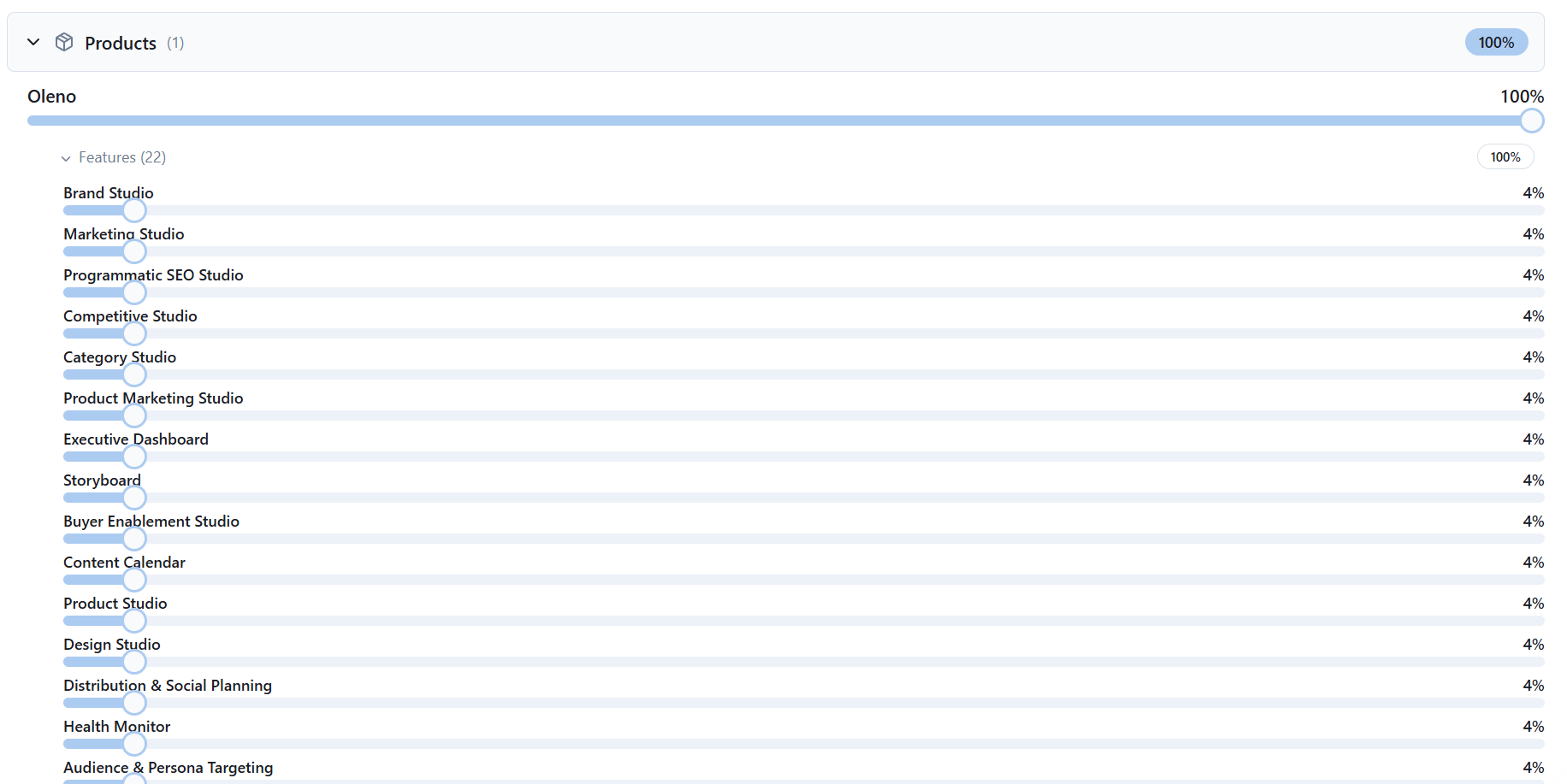
This is where Oleno comes in. Storyboard sits in the planning layer and turns quarterly direction into weighted allocation across dimensions. That includes audiences, personas, products, and use cases.
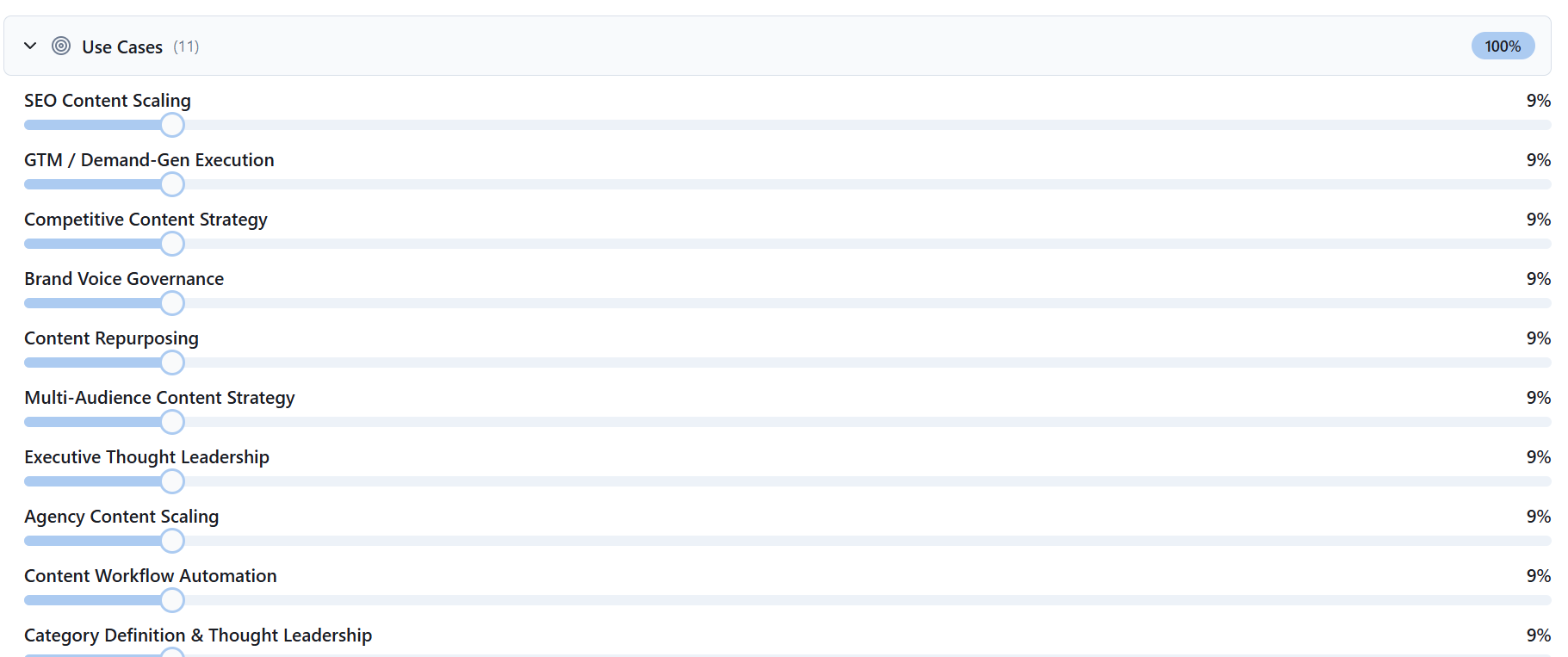
So instead of saying, "We should probably do more category content this quarter," you define that priority in the plan. Storyboard materializes that into a structured content mix by scoring topic bank candidates against coverage gaps and the governance weights you've set.
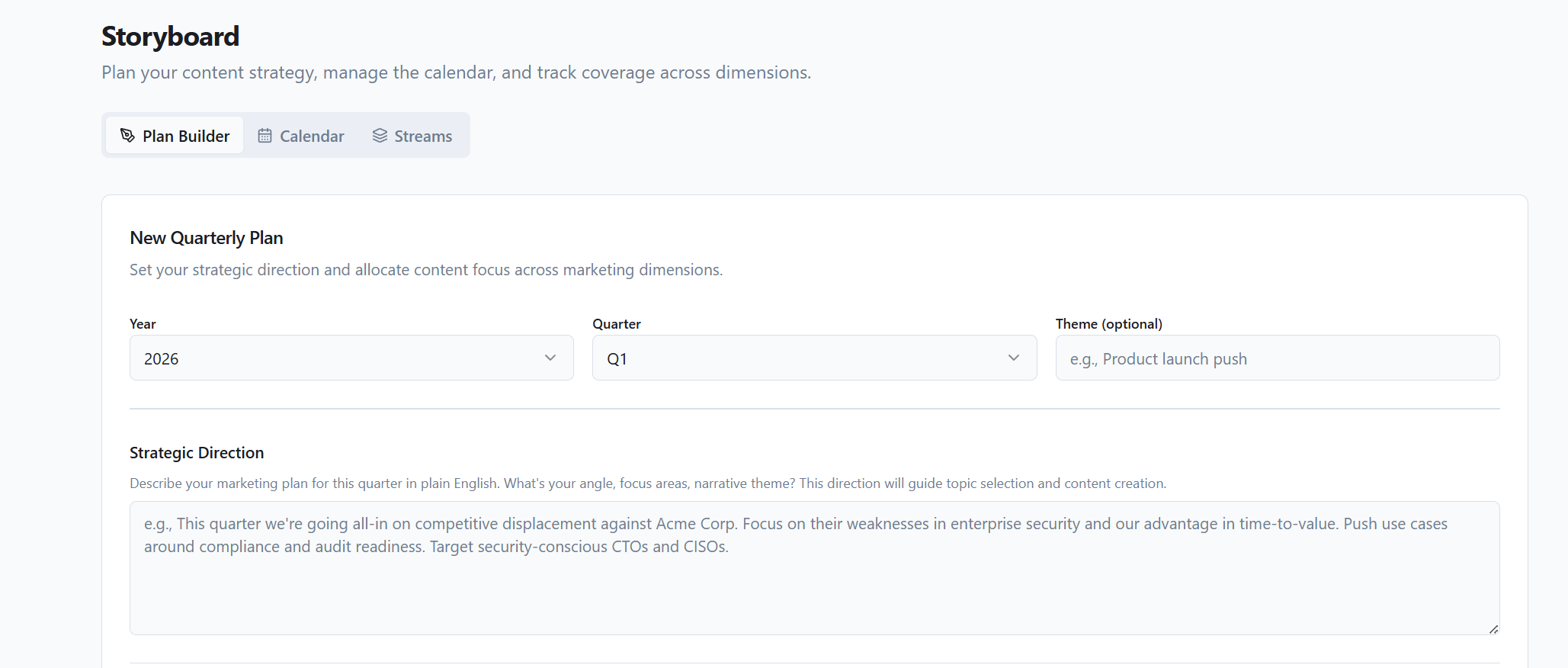
The practical value for a VP Marketing is pretty straightforward. You get a clearer line between strategic intent and planned output. If your plan says you want stronger coverage for a specific audience, product, or use case, the allocation reflects that. If it doesn't, you can see the gap early instead of finding out after six weeks of publishing.
Storyboard Gives The Planner A Balanced Calendar From Existing Topics
Storyboard doesn't work from a blank page. It operates on existing topic bank entries, scoring candidates against dimension coverage gaps and materializing them into a prioritized, balanced content calendar. That is what gives the planner real structure.
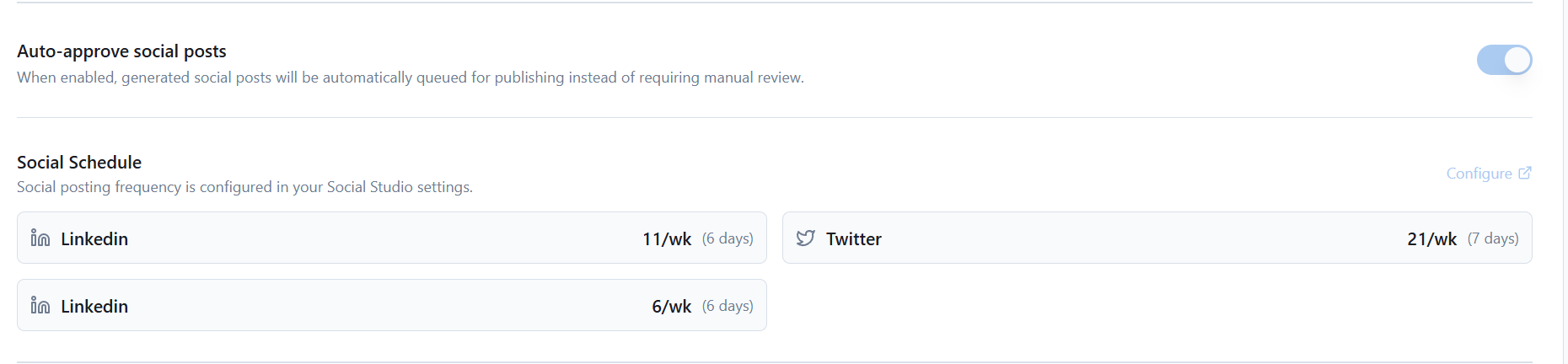
This is important. Because if your topic source is weak, weighted planning still gives you weak output. You need both: a solid pool of candidate topics and a planning model that distributes them intelligently.
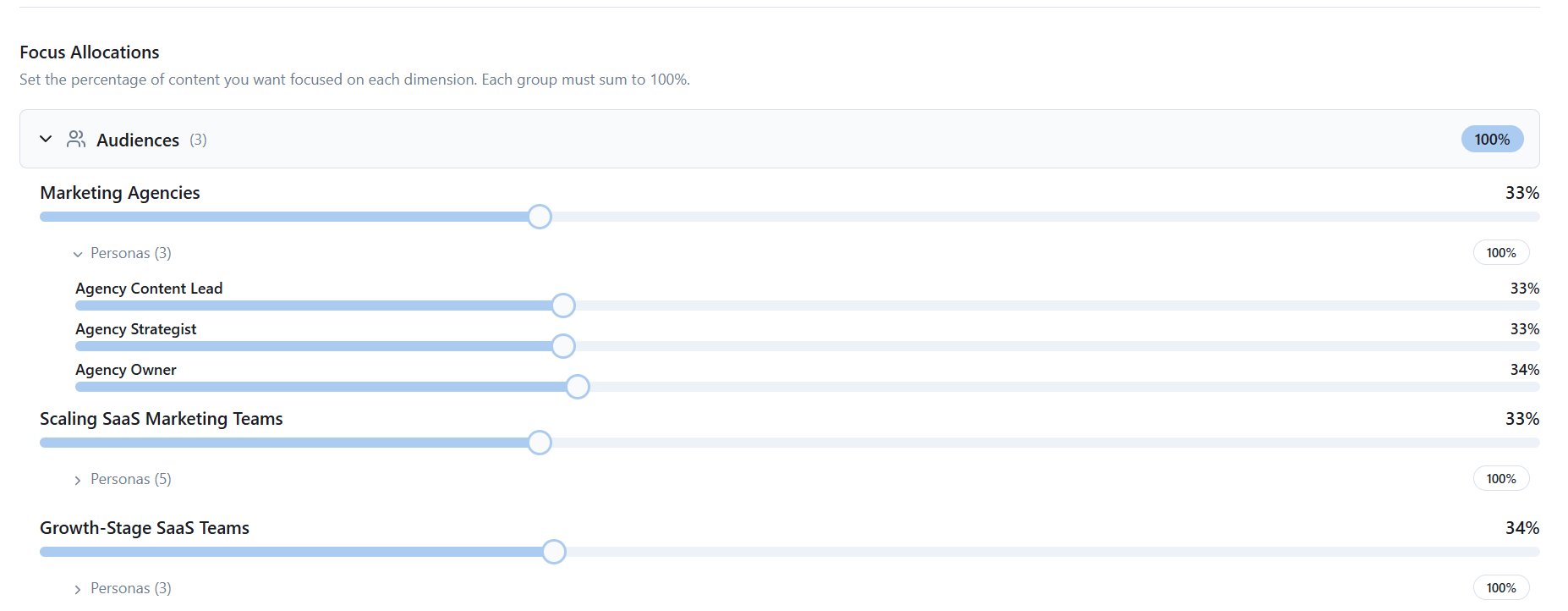
In Oleno, the point isn't that someone sits there all day choosing topics by hand. Storyboard reads governance dimensions and weights, then turns that into a visual calendar with drag-and-drop rescheduling, stream views, status filtering, and dimension-based coverage tracking.
And this is where a lot of content tools fall short. They can give you keywords, drafts, or optimization suggestions. Useful, sure. But they don't usually connect planning logic to an actual calendar in a way that makes coverage easier to see and manage.
Planning Stays Visible As Execution Moves Forward
When planning is manual, even basic calendar management creates churn. People start reshuffling rows in a spreadsheet, moving deadlines, and second-guessing the whole calendar. Storyboard gives teams a visual planning layer built around allocation, approval, and rescheduling instead of a static backlog.
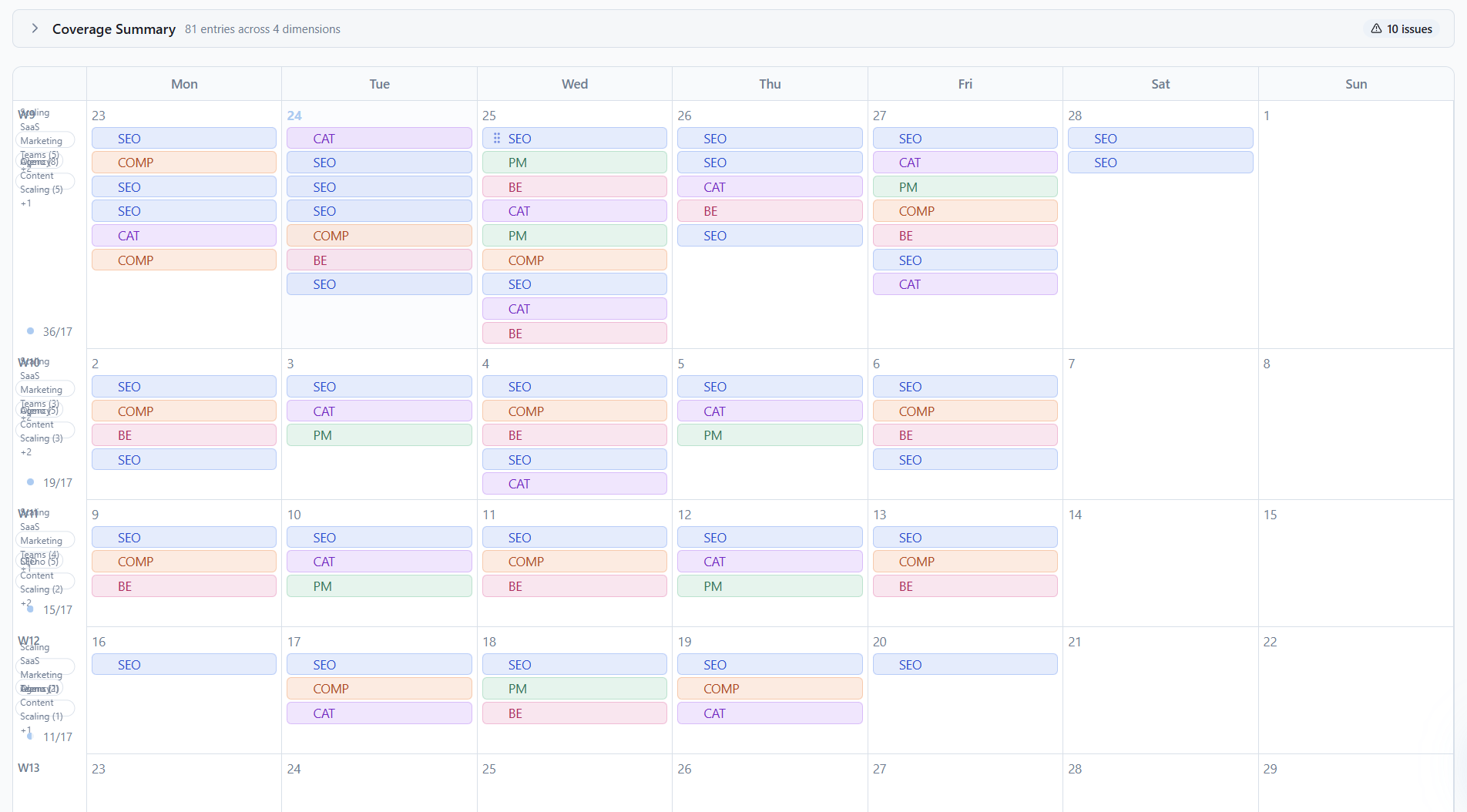
That means the handoff into execution is cleaner too. In Oleno, approved topics can move into the broader pipeline, where the Orchestrator runs jobs against existing approved items and enforces quotas and pacing. The value isn't just speed. It's a more structured path from plan to production.
Back when I built a content engine for my own B2C app, the pain wasn't only writing. It was the repeated decision-making. Prompt, copy, paste, queue, publish, repeat. Three to four hours a day, easy. Once the system handled the flow, the drag dropped hard. Same principle here.
If you want a closer look at how the planning layer connects to the rest of the system, Explore how Oleno maps planning to execution.
What Rebalanced Topic Allocation Looks Like In Practice
A CMO Can Rebalance Category And Evaluation Content Before Gaps Become Expensive
Let's use a realistic example. Say you're a CMO at a mid-market B2B SaaS company. You're trying to establish category authority, but your team keeps defaulting to reactive SEO content and scattered bottom-funnel asks. On paper, output looks healthy. In reality, your market narrative is underfed and your evaluation layer is inconsistent.
Before a planning model like this, teams usually notice the problem late. Maybe branded search isn't moving. Maybe pipeline influenced by content is hard to explain. Maybe sales says the market still doesn't understand the category. So you dig in and realize half the quarter got consumed by urgent but disconnected asks.
With Storyboard, you can rebalance earlier. If category definition needs more share, and evaluation content is too thin for the accounts you're targeting, the plan can shift those weights. Then the topic allocation follows the plan instead of forcing humans to manually police every upcoming piece.
That's a much better operating posture. You aren't waiting for bad outcomes to pile up before changing course. You're watching coverage and adjusting before the gaps become expensive.
One Planning Change Can Redirect A Quarter Of Output Without Adding Headcount
This is where execs usually lean in. Because once you can redirect output without hiring, the economics get more interesting. Let's pretend your team publishes 20 pieces in a quarter. If Storyboard shifts just 5 of those from low-priority acquisition topics into category and evaluation jobs that support the quarter's actual goals, that's 25% of your output reallocated without adding another writer, especially when evaluating how storyboard allocates topics.
And no, that doesn't mean all 5 pieces suddenly print pipeline. Marketing doesn't work that way. But it does mean your content mix starts matching strategy more closely. That gives you a cleaner story internally. It also makes ROI reporting a lot less hand-wavy because you can point to planned distribution, not random accumulation.
We've seen the underlying pattern before in content systems. At Steamfeed, scale worked because there was enough structure to support breadth and depth together. At Proposify, ranking well wasn't enough because the content sat too far from the solution and demand-gen narrative. Volume alone doesn't save you. Alignment does.
For a scaling SaaS team, that alignment can mean steadier publishing cadence, fewer internal collisions, and better visibility into why certain topics are getting produced at all. Which, honestly, sounds basic. But it usually isn't.
What Storyboard Will Not Solve By Itself
Better Allocation Does Not Replace Positioning Decisions
Storyboard can improve allocation. It does not invent your strategy for you. That's a hard boundary, and it's an important one. If your positioning is fuzzy, your category point of view is weak, or your market message keeps shifting, better allocation won't save that.
I think this is where a lot of teams get disappointed with AI content tools in general. They want the machine to fix unclear thinking. It can't. If your company doesn't know what it believes, who it's for, what job it solves, and what makes it different, the output will reflect that confusion.
So yes, planning by funnel job is stronger than planning by instinct. But the quality of that plan still depends on human inputs. You need clear audience definitions, useful personas, grounded use cases, and accurate product truth. Otherwise you're just allocating confusion more systematically.
That's why I like system-based execution more than prompt-based work. The system can carry decisions. It can't replace them.
A Planning Engine Is Only As Strong As The Inputs It Receives
This is the second boundary. Storyboard depends on the rest of the planning and truth layer being set up well. Audience & persona targeting matters. Use case studio matters. Marketing studio matters. Product studio matters. If those inputs are thin or outdated, the allocation model has less to work with.
Put differently, better planning increases reliability. It does not create strategic clarity from scratch.
Some teams won't love hearing that because they want software to remove judgment from the process. But for executive teams, that's actually good news. You keep control over positioning, priorities, and product truth. The system carries the structure and continuity.
And that's probably the right division of labor. Humans decide what matters. The system applies those decisions consistently over time.
See The Allocation Logic In A Full Demand Gen System
Teams That Plan By Funnel Job Create A More Reliable Demand-Gen System
Teams that plan by funnel job tend to build a more reliable demand-gen system because they stop treating topic selection like an ongoing argument. They define priorities, weight them, and let the plan shape output across the quarter.
Oleno supports that model through Storyboard, Topic Universe, and the downstream execution system that carries planned work into production. Storyboard handles the strategic allocation layer. Topic Universe supplies the scored topic pool. The broader platform keeps execution tied to the same planning logic so the quarter doesn't fall apart in week three.
If you're trying to prove content ROI, maintain narrative consistency, and keep the team from drowning in rework, this is usually the part worth seeing live. Start with a storyboard allocation walkthrough.
Seeing Allocation Logic In Context Makes The Operating Model Click
A lot of this sounds obvious once you see it. Before that, it can sound abstract. Weighted planning. coverage gaps. funnel jobs. Fine. But once you see how allocation connects to actual output decisions, the model clicks fast.
That matters for CMOs and VPs because you're not buying another isolated content tool. You're trying to build a system that keeps strategy, topic planning, and execution connected without adding more coordination overhead.
If that's the problem you're dealing with, Book a demo to see storyboard planning live.
About Daniel Hebert
I'm the founder of Oleno, SalesMVP Lab, and yourLumira. Been working in B2B SaaS in both sales and marketing leadership for 13+ years. I specialize in building revenue engines from the ground up. Over the years, I've codified writing frameworks, which are now powering Oleno.
Frequently Asked Questions