How to Build prioritized topic backlog using Topic Bank and Topic Research

You don’t need more ideas. You need a system that tells you what to ship next, and why. If you’re asking how to build a prioritized topic backlog using a Topic Bank and Topic Research, here’s the short version. Tie topics to your positioning, audience, and product truth. Then rank by impact, effort, and coverage gaps. When that clicks, cadence stops wobbling.
I’ve watched teams drown in keyword dumps. Great intentions. Zero leverage. Topic Bank and Topic Research only pay off when they reflect your POV, your buyers, and the jobs your product actually solves. Without that context, the backlog turns into a graveyard of half-baked ideas no one owns.
Key Takeaways:
- Anchor topics to positioning, audiences, and use cases before you score anything
- Build a Topic Bank with structured fields, not a free‑form spreadsheet
- Score topics on business impact, effort, and coverage gaps, not just search volume
- Use Topic Research to validate intent and examples, then tighten the angle
- Rebalance monthly so you cover the full funnel and avoid drift
- Treat review as governance, not taste; lock the queue and ship
Why Topic Lists Fail Without Strategy Alignment
Most content teams treat topic collection like a win, but a backlog without positioning, audience, and product truth is busywork. Generative engines and buyers reward consistent, specific narratives, not random how‑tos. If your topics don’t encode that narrative, they’ll fight your brand. You feel it when everything needs a rewrite.
Volume Without POV Creates Noise
High volume without a point of view just creates noise. Writers pull in different directions. Quality varies. Voice drifts. Even when a post performs, it doesn’t add up to a coherent signal. I’ve been there, shipping weekly and still losing momentum. The problem wasn’t effort. It was direction.
When the backlog carries your market stance, everything tightens. Angles sharpen. Examples feel native to your buyers. Reviews focus on substance, not wordsmithing. You stop chasing clever one‑offs and start stacking pieces that reinforce each other.
What changes immediately:
- Fewer rewrites because writers have a clear spine
- Stronger internal links because topics share a story
- Higher reuse value because the narrative compounds
Why Tool‑First Topic Lists Drift
Tool‑first backlogs look impressive… then drift. A tool can’t guess your enemy, your differentiators, or your product boundaries. You get a shiny pile of “opportunities” detached from go‑to‑market reality. You burn hours forcing them to fit your story, or worse, you publish and attract the wrong reader.
A healthy Topic Bank isn’t a dump of titles. It’s a governed object. Each row says who it’s for, what job it helps, which product feature it maps to, and which message it reinforces. Use tools, but don’t let them lead.
Signs your list is drifting:
- Topics that rank but never influence pipeline
- Repetitive “advice” posts that add nothing new
- Approval cycles that debate fundamentals every time
GEO Raises the Bar for Backlogs
GEO changed the stakes. LLMs summarize across sources and prefer brands that repeat clear, specific claims consistently. Thin, unaligned topics get ignored. Structured, claim‑driven content gets cited. Your backlog has to carry extractable definitions, list‑friendly sections, and direct answers from the start.
Structure isn’t a nice‑to‑have. It’s the difference between content machines can quote and content they skip. Google’s guidance backs this up, favor people‑first clarity and reliable information in how‑to content, definitions, and lists. See Google Search Central’s helpful content guidance for the principles.
The Real Job Is a Prioritized Topic Backlog, Not a Keyword Dump
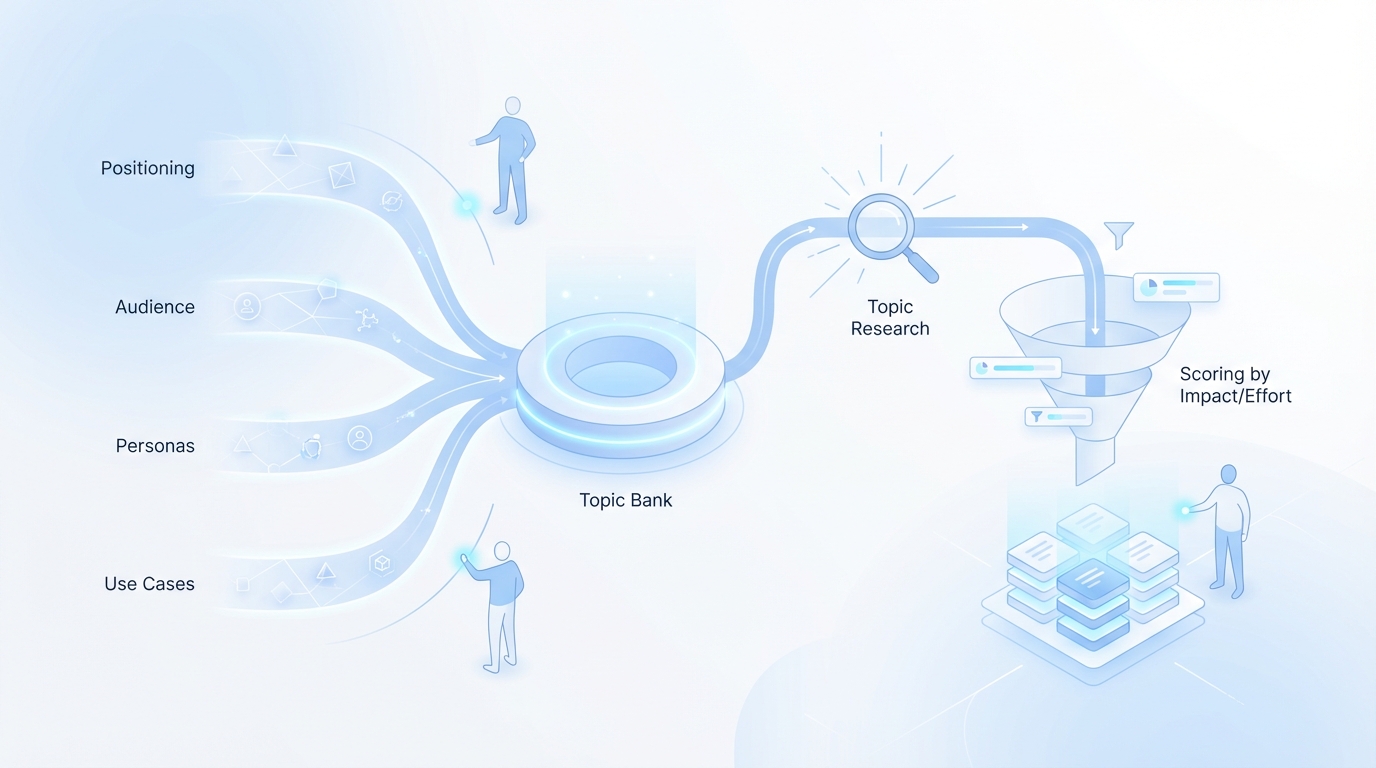
A prioritized topic backlog is a governed queue that encodes your POV, audiences, and use cases, then ranks topics by business impact, effort, and coverage gaps. Keywords feed it; they don’t drive it. The Topic Bank stores truth. Topic Research sharpens angles so drafts move fast and reviews get lighter.
Define the Backbone Before You Add Titles
Backlogs collapse when the backbone is missing. Define positioning, audience segments, personas, and product use cases up front. Map the messages you want the market to absorb. Then create Topic Bank fields that force those connections so every idea lives in the same frame. Otherwise, you risk clever posts that confuse buyers.
I over‑spec topics early, even if it slows week one. It saves months later. Writers see intent on one screen. Editors stop asking for “more context.” Everyone guesses less and strengthens arguments more.
Recommended core fields:
- Audience segment, persona, and funnel stage
- Use case, product feature tie‑in, and old‑way vs new‑way angle
- Primary claim, key takeaways, and sources to cite
Tie Scoring to Business Impact, Not Vanity
Search volume is a clue, not a decision. Score for business reality. What will this topic influence? How hard is it to produce? Where does it fill a coverage gap? When you weight those factors, the list changes. You stop chasing broad terms that never convert and start targeting the jobs buyers actually care about.
Keep scoring simple and transparent. If the team can’t explain why a topic ranks higher, they won’t trust the calendar. When trust breaks, reviews spike and cadence slips. Keep it obvious, revisit monthly, and publish the list so stakeholders see the tradeoffs.
A simple scoring model:
- Impact: pipeline intent, use‑case alignment, and segment fit
- Effort: research depth, SME time, and asset requirements
- Coverage: cluster strength, recency, and internal link value
Treat Topic Research as Angle‑Sharpening
Topic Research is where good ideas become undeniable. Validate searcher intent. Examine SERP patterns. Collect credible sources. Then sharpen your claim so the piece adds something page one missed. If you can’t say the angle in one sentence, you’re not ready to brief.
Don’t rewrite competitors. Readers feel it. Machines detect it. Your differentiator should show up in the first paragraph. Definitions need to be extractable. Lists should be scannable. That takes a clear angle and supporting data.
What to lock before you brief:
- Direct‑answer sentence and definition
- Three proof points with sources
- List structure built for GEO extraction
The Hidden Cost of a Broken Topic Backlog
A broken backlog wastes hours in reviews, increases drift risk across channels, and slows publishing cadence. Each unclear topic adds rewrite loops, creates context gaps, and erodes trust. Over a quarter, the cost compounds into missed quotas, stale clusters, and a team stuck coordinating instead of creating.
Review Loops Eat Your Week
One article’s review loop looks harmless. Twenty will crush you. If every draft triggers “who is this for?” or “why does this matter?” your reviewers become bottlenecks. Writers lose confidence. Timelines slip. Work piles up in WIP. The root cause: the backlog didn’t carry enough context.
Quantify it. If each review adds 30 minutes and you run 30 pieces a month, that’s 15 hours lost to preventable edits. Two workdays you could spend on strategy or distribution. The fix lives upstream, in how you define and prioritize topics.
Common review failure patterns:
- Voice misalignment tracing back to weak angles
- Missing product truth that triggers PMM rewrites
- Off‑stage content shipped to the wrong persona
Drift Creates Waste Across the Funnel
Drift doesn’t stay in one post. It leaks into emails, sales decks, and social. Soon you’re telling three versions of your story. Buyers need repetition to learn. If the repetition is inconsistent, they get confused, and confused buyers don’t move.
Cleaning up drift is expensive. You rewrite, refresh, retrain, or you ship more and make it worse. The durable fix: prevent drift at the topic level and enforce it in briefs and QA.
Why drift happens:
- Topics without explicit old‑way vs new‑way framing
- Undefined feature boundaries that invite over‑claims
- Mixed audience signals that blur language choices
Cadence Breaks When Priorities Are Fuzzy
Cadence breaks when no one trusts the queue. People cherry‑pick easy posts or chase urgent asks. Leaders reshuffle weekly. Writers over‑research because they don’t see the angle. You miss publish targets and lose the compounding benefit of consistency. The backlog should remove friction, not create it.
Fix cadence by:
- Locking a four‑week queue with owner and publish dates
- Freezing inputs during sprints to stop mid‑stream churn
- Reviewing the score model monthly, not daily
What It Feels Like When the Backlog Goes Wrong
You feel stuck, even when you’re busy. Drafts read generic. Reviews nitpick phrasing because the premise is weak. The team is working hard, but the work isn’t moving the needle. And you’re rewriting intros on Friday night to make them sound on‑brand. Not sustainable.
The Frustration of “Almost Right” Drafts
“Almost right” is expensive. The story is off by ten degrees. Examples don’t match your segment. Definitions hedge. Claims play it safe. You can fix it, but at what cost? After the third pass, you’re doing authorial surgery, not editing. The root cause sits in the topic and the angle.
I’ve been on both sides. As a writer, vague briefs feel like a trap. As an editor, you want to say yes, but your gut says no. The fix isn’t more taste. It’s more structure upstream. When the backlog encodes who, what, why, and how, “almost right” turns into “ready to ship.”
Tell‑tale signs:
- You add the direct answer yourself in review
- You rewrite the intro to fit voice and POV
- You ping PMM for a feature boundary after draft one
The Anxiety of a Moving Calendar
A moving calendar creates low‑grade anxiety that never leaves. You’re always behind, always renegotiating, always apologizing. People stop trusting dates. Sales stops planning around content. Leadership asks for updates twice a week. All because the queue wasn’t real.
A real backlog reduces uncertainty. People can plan. You can say no to random asks because the list is visible and scored. That calm shows up in the work.
What settles teams down:
- A shared view of the next four weeks
- A hard rule: topics don’t change mid‑sprint
- Clear exit criteria for “ready to brief” and “ready to draft”
The Cost of Second‑Guessing
Second‑guessing chews through attention. Did we pick the right topics? Are we covering the funnel evenly? Are we ignoring high‑intent clusters? Normal questions, just not every morning. A scored, governed Topic Bank lets you revisit decisions on a schedule, not in Slack at 9 a.m.
Confidence builders:
- Monthly score reviews with clear rule changes
- Quarterly cluster audits with gap lists
- Evidence logs that capture why choices were made
How to Build a Prioritized Topic Backlog That Holds Up
Build a prioritized topic backlog by encoding positioning, audience, personas, and use cases in the Topic Bank, then using Topic Research to sharpen claims and structures. Score by impact, effort, and coverage. Lock a four‑week queue. Publish on a steady cadence. Rebalance monthly.
Model Your Topic Bank Like a Product
Treat the Topic Bank like a product object, not a notes doc. Define required fields that tie each topic to market fundamentals. Force single selections where possible so ambiguity dies early. Make the right thing easy to ship, and the wrong thing hard to start.
When these fields exist, debates shrink. Reviewers critique the strength of the claim, not “who is this for?” Writers see the angle at a glance. PMMs flag product risks before draft. Fewer edits. Faster cycles. Quality intact.
Include fields like:
- Audience segment and persona, with language notes
- Use case, feature tie‑in, and old‑way vs new‑way framing
- Primary claim, direct‑answer sentence, and list outline
- Evidence sources, SME owner, and publish target
- Cluster tag, predecessor links, and target internal anchors
Score Topics With a Simple, Transparent Model
A simple model beats a clever one. Keep three categories, weight them, and make the math visible. Impact rewards buyer intent and best‑fit use cases. Effort covers research, SME time, and design. Coverage reflects cluster strength and gaps. Publish the formula. Teach it once. Use it forever.
When the model is transparent, people accept tradeoffs. They see why a high‑volume, low‑intent post loses to a smaller, high‑intent use case. They understand why a heavy‑SME post moved for a launch. No more relitigating priorities in threads.
Suggested weights:
- Impact (50%): pipeline and use‑case alignment
- Effort (25%): time and assets required
- Coverage (25%): cluster gaps and recency
Run Topic Research to Tighten Claims and Structures
Topic Research isn’t a fishing trip. It’s sharpening. Confirm intent. Pull credible sources. Extract what competitors missed. Write your direct answer first. Define a snippet‑ready definition. Build the list skeleton. Then write. You’ll cut rewrites in half because the angle was set before anyone typed a paragraph.
Cite with care. Use primary docs for definitions and current research for data. LLMs and GEO systems favor precise language and clear structure, which aligns with guidance on scannable, list‑forward content from sources like the Bing Webmaster Guidelines.
Ready to lock a real backlog without constant relitigation? Oleno makes it simple. Request a Demo
How Oleno Operationalizes Topic Bank and Topic Research
Oleno turns your governed Topic Bank and Topic Research into a running system that discovers, scores, briefs, drafts, and publishes on a steady cadence. It encodes your positioning, product truth, and audience definitions so each topic carries the right angle and structure. The result: consistent output that compounds, not chaos.

Programmatic SEO Studio: From Topic Universe to Publish‑Ready
Programmatic SEO Studio eliminates manual wrangling by discovering and organizing topics through the Topic Universe, then running a locked outline from brief to draft. It enriches, deduplicates, and tracks coverage so clusters grow with intent, not drift. Governance guardrails keep voice aligned while QA blocks thin content before it ships.
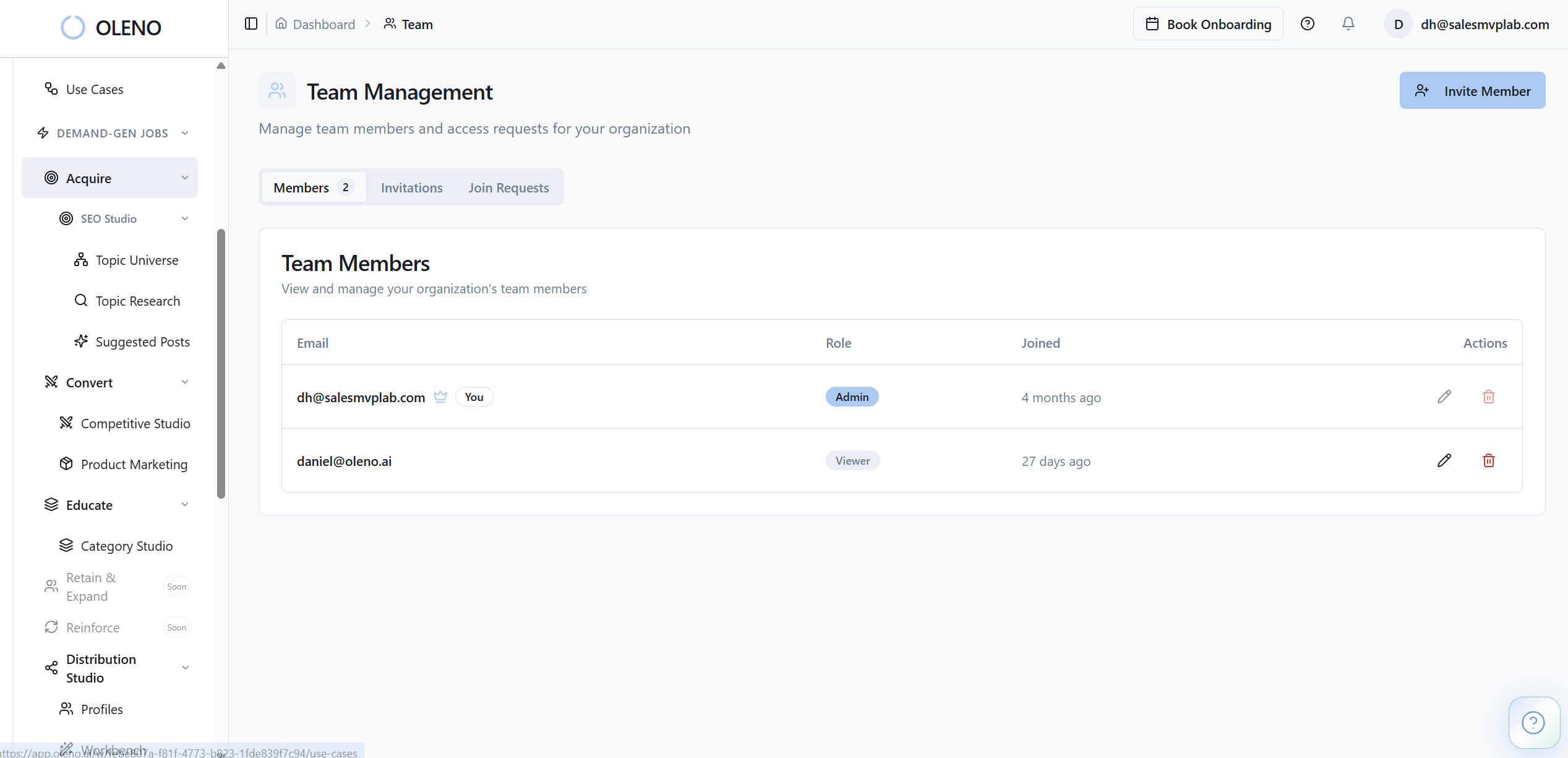
Connect your Topic Bank structure to this studio and stop guessing. Each job uses extractable definitions, direct answers, and lists that match GEO patterns. Writers and reviewers work from the same playbook. Cadence stabilizes because the system handles the heavy lift.
Key capabilities you use here:
- Topic Universe discovery and enrichment across sources
- Locked brief structures with claim‑first openings
- Automated QA that enforces voice and structure
Storyboard and Orchestrator: Cadence Without Micromanaging
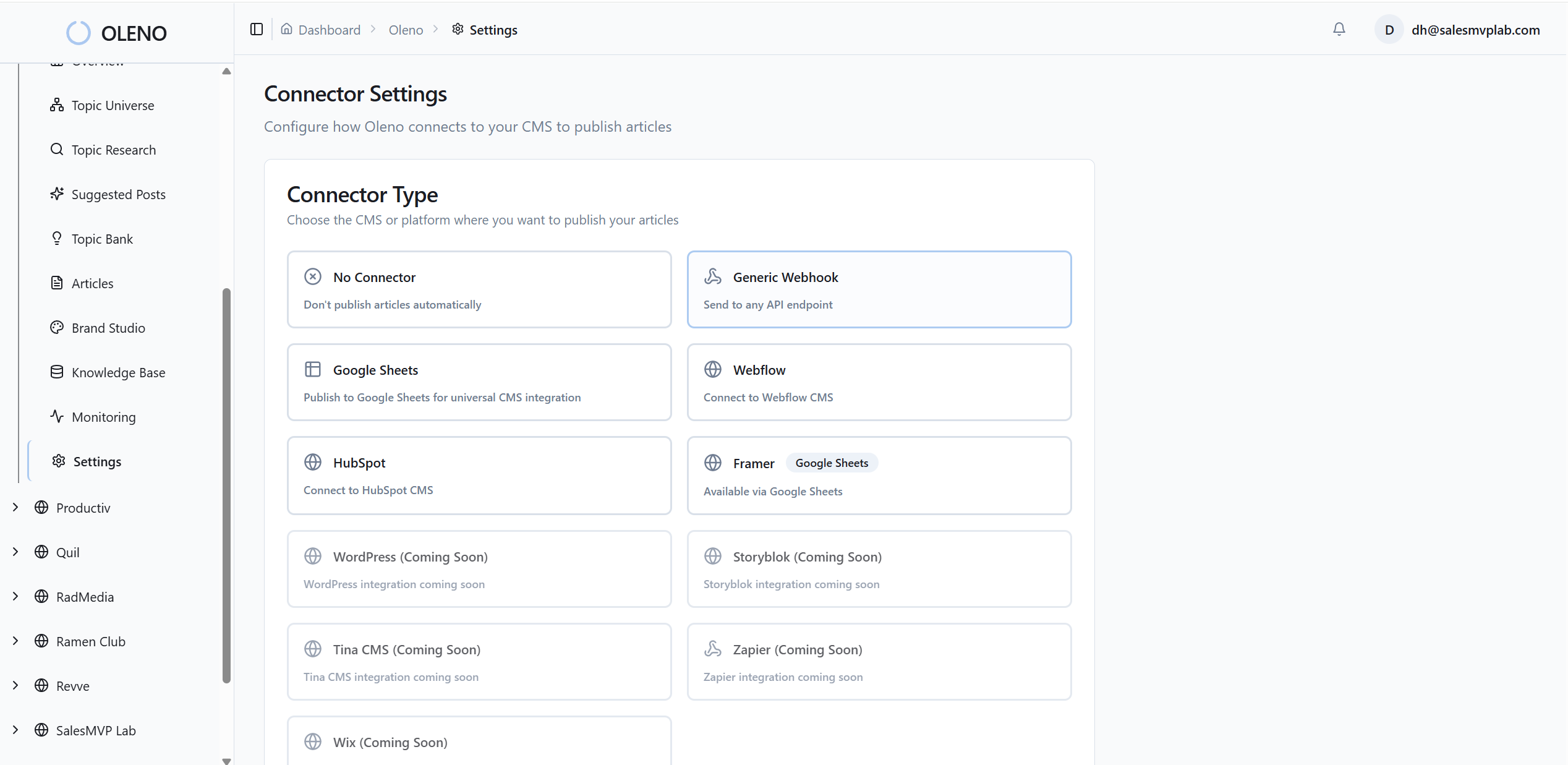
Storyboard reads your governance weights, audience coverage, and use cases, then materializes a balanced calendar from approved topics. The Orchestrator schedules jobs, enforces per‑type quotas, and keeps the pipeline moving. You get a real four‑week horizon that survives the week, not a wish list.
What changes day to day:
- Fewer ad‑hoc requests derail the queue
- Clear owner and publish date on every job
- Catch‑up logic smooths production dips
Product, Marketing, and Audience Studios: Truth Baked In
Product Studio centralizes approved feature descriptions and boundaries so writers don’t invent claims during research or draft. Marketing Studio injects your category narrative and key messages into briefs. Audience and Persona Targeting adds segment and language preferences. Together, they prevent the common failure modes that cost you rewrites.
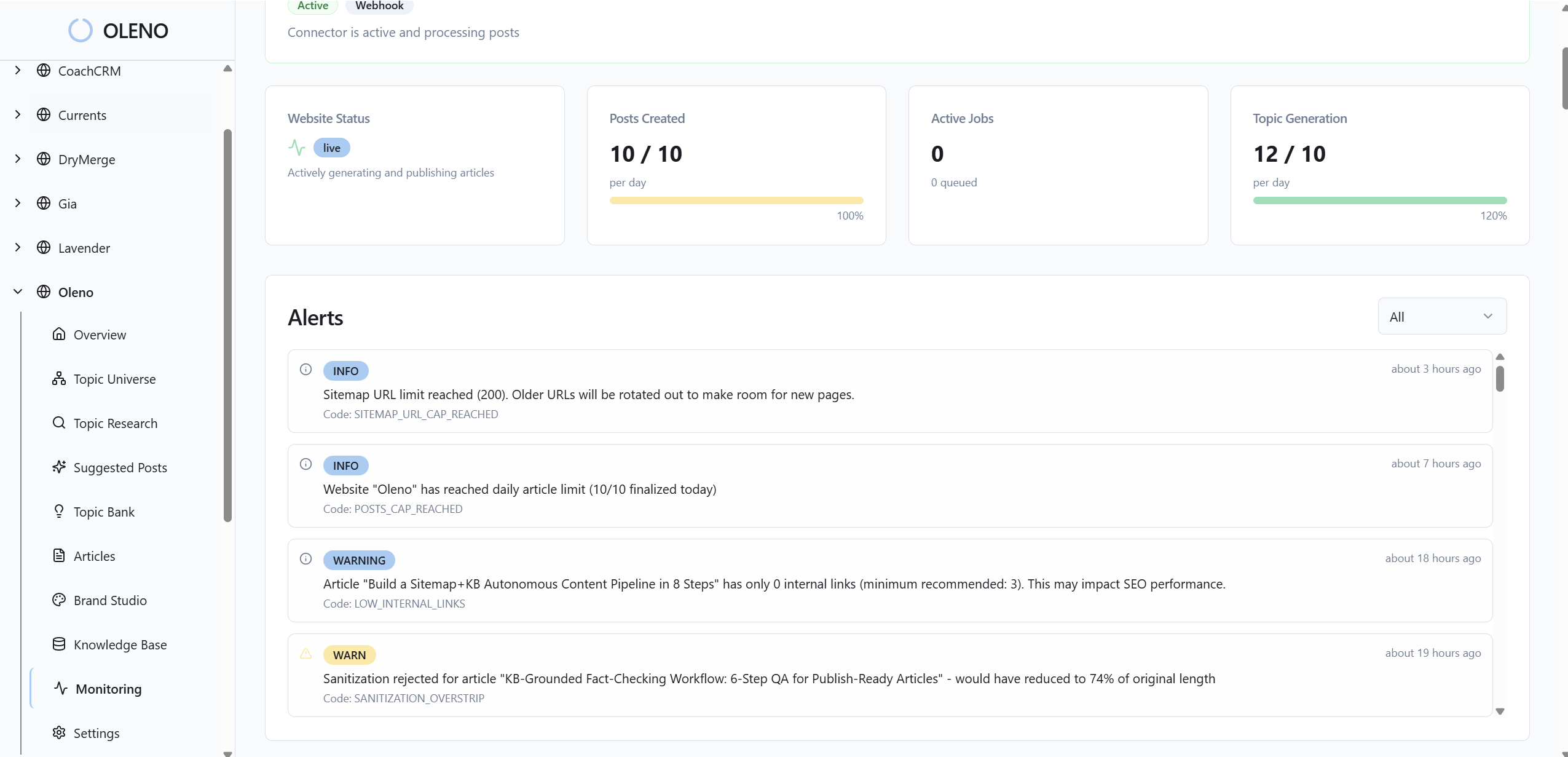
Pair that with the Executive Dashboard for visibility, and you get a system that’s safe to scale. Define the rules once. Oleno applies them everywhere. Quality goes up as volume rises, which is rare in content ops.
What teams report after the switch:
- Fewer PMM edits on product‑led pieces
- Faster brief‑to‑draft cycles with clearer angles
- Steadier weekly output across the funnel
3x faster content velocity with consistent voice and structure. That’s what Oleno delivers when Programmatic SEO Studio, Storyboard, and the Orchestrator run together. Book a Demo
Quality Gate and Article Editor: Block Mistakes, Ship Confidently
Quality Gate evaluates each article against voice, structure, grounding, and SEO checks before review. Articles that fail get auto‑revised or blocked. Article Editor lets you tune sections, track diffs, and finalize metadata without breaking flow. You ship with confidence because the system caught risky stuff upstream.
Tie this back to the earlier costs. Those 15 hours a month lost to preventable edits shrink when briefs are grounded and QA is real. Writers focus on depth, not format fights. Editors coach, not triage. You feel the compounding effect within a quarter.
If you want the Topic Bank, Topic Research, and publishing pipeline to run without constant handholding, Oleno’s Programmatic SEO Studio handles it end to end. Request a Demo
Conclusion
A prioritized topic backlog isn’t a spreadsheet of ideas. It’s a governed system that turns strategy into steady output. Model the Topic Bank like a product, score what matters, tighten angles with research, and lock a four‑week queue. Do that, and cadence holds, drift fades, and every piece reinforces your story.
About Daniel Hebert
I'm the founder of Oleno, SalesMVP Lab, and yourLumira. Been working in B2B SaaS in both sales and marketing leadership for 13+ years. I specialize in building revenue engines from the ground up. Over the years, I've codified writing frameworks, which are now powering Oleno.
Frequently Asked Questions