How to Build Topic Clusters That Map User Intent and Win Snippets

You can crank out keywords all day and still feel invisible. Not because you’re lazy. Because keywords don’t map to how people search or how snippets get awarded. You’re building a noisy library with no sections, including the rise of dual-discovery surfaces:, no signage, and too many books that say the same thing.
Shift the unit of work from keyword to cluster. Not as a tactic, as a constraint. When you treat intent like a contract and clusters like infrastructure, cannibalization drops and snippet eligibility goes up. Usually less work than the endless fixes you’re doing now.
Key Takeaways:
- Start with 3–5 pillars, then build clusters that answer discrete, intent-aligned sub-questions
- Assign one owner for intent classification and codify decision rules for ambiguous queries
- Use a minimal viable cluster spec: target intent, pillar, slug pattern, and 3–5 H2s
- Open every H2 with a direct, snippet-ready paragraph that answers first
- Audit clusters weekly for overlap, then merge or split to prevent cannibalization
- Enforce a 90-day cooldown on near-duplicate topics so authority compounds
- Use deterministic internal links and schema to reinforce hub, spoke, and sibling relationships
Keywords Alone Create Noise, Not Authority
Keywords alone produce scattered pages that compete with each other and confuse crawlers. Authority comes from topic pillars with clear clusters that match searcher intent. Think hub and spokes, not 20 stand-alone posts. A pricing pillar with “what is,” “examples,” and “template” spokes is a simple starting point.
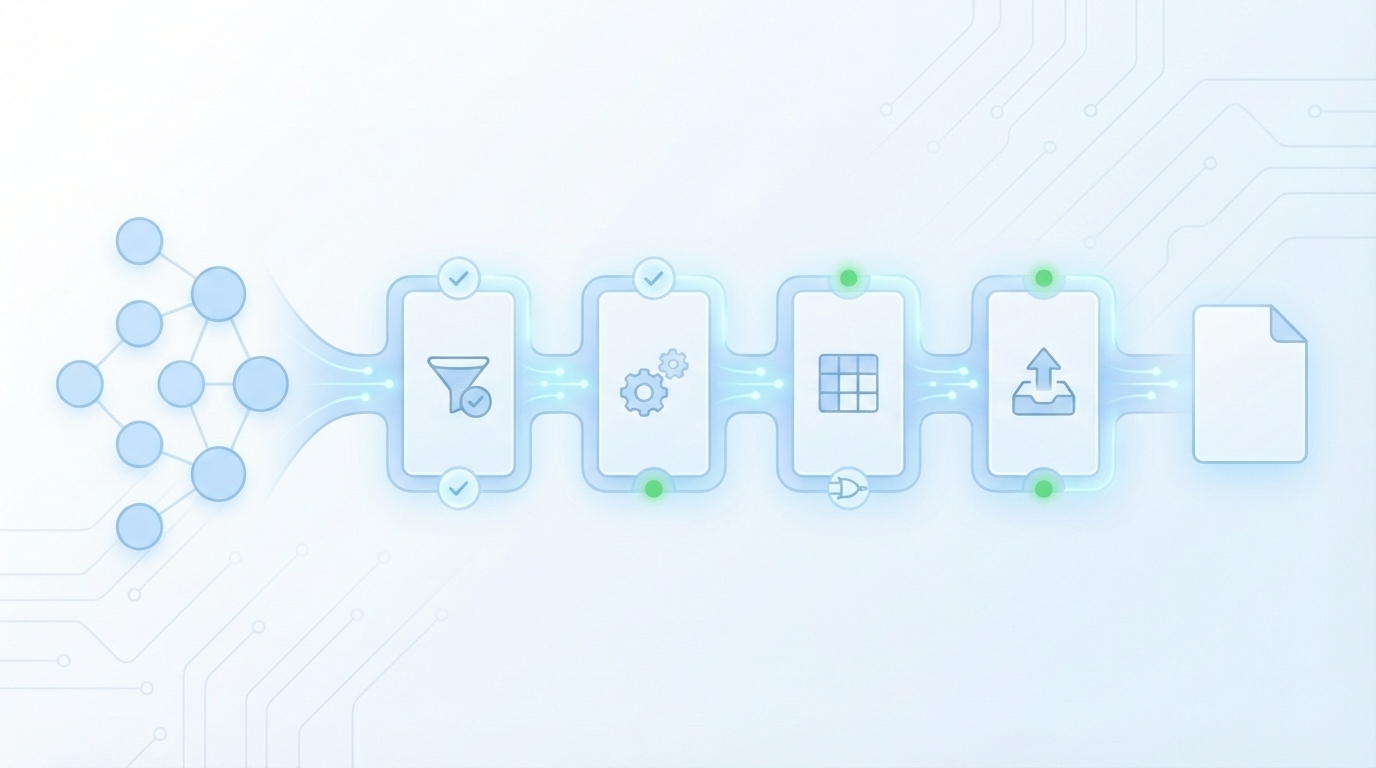
The cluster-first mindset
A cluster-first approach organizes work around 3–5 pillars that mirror your solution space and audience problems. Under each pillar, you publish cluster pages that answer one discrete question cleanly, which gives you depth without duplication. If a new idea doesn’t add information or close a gap in a pillar, park it for later.
Map outcomes to page types before you draft. Pillars frame the decision and provide context. Clusters go deep on how-tos, definitions, comparisons, or examples. It sounds strict. It saves you from the frustrating rework that shows up months later when two pages start fighting for the same query. For broader system context, this is how autonomous content operations stay aligned across time. And here is a tactical content operations breakdown of why keyword-first workflows tend to fragment.
Who owns intent in your process?
Give intent classification to one owner, not the brief writer of the week. They label each idea informational, transactional, or navigational, then attach persona moments like researching, comparing, or implementing. That label locks your structure, your CTA, and your internal links.
Ambiguous queries need rules you can apply in five minutes. “Pricing strategy example” usually leans informational with light commercial context. Decide once whether you split or expand, write it down, and revisit quarterly. Weekly intent reviews at the cluster level keep edges sharp and retire overlap before it becomes a headache.
The minimal viable cluster spec
Capture four fields before anyone writes: target intent, the pillar it supports, the canonical slug pattern, and 3–5 H2s that answer the exact question. Add one more line called unique contribution. Name the data point, example, template, or workflow you will add. If you cannot name one, you do not have a differentiated angle.
Define your default internal-link edges up front. One link to the pillar, one to a sibling cluster, one to a relevant conversion page. The list will evolve, but a default set makes placement deterministic. The simple rule: if you cannot articulate unique intent, do not greenlight.
Intent Mapping Is the Missing Constraint
Intent mapping turns scattered topics into a sequenced journey that search engines can understand. It ties each page to a job to be done and a persona moment, including why content broke before ai, which eliminates depth mismatches and mixed messages. Match the live SERP’s structure, not just the keywords.
Map queries to persona moments
Start with the job to be done. Is the person researching a concept, comparing approaches, or implementing a tactic? Attach the persona moment, like new to topic or tool evaluation. Then choose the page format accordingly. Informational gets thorough explainers and step-by-step guides, transactional leans into comparisons and ROI, navigational routes the user to the specific resource.
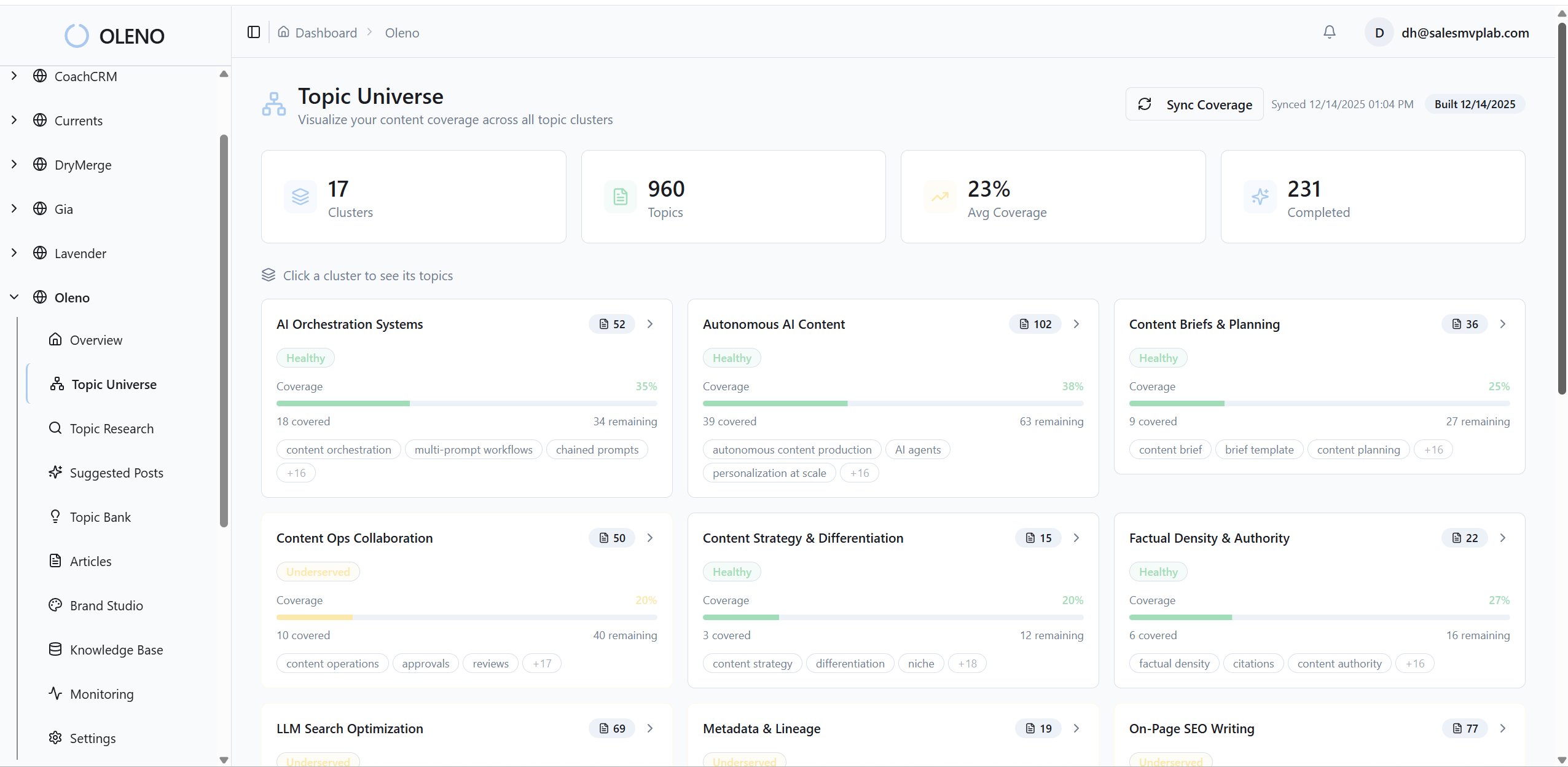
Score coverage by pillar as underserved, healthy, well-covered, or saturated. Push new ideas into underserved zones first. That one constraint reduces cannibalization and spreads internal link equity more effectively across the cluster. If you are shifting from ad hoc to coordinated decisions, this content orchestration shift helps connect the dots. For a tactical playbook, see these intent topic clusters.
Classify queries by intent correctly
Read the live SERP. Not just your tool’s labels. Note the result types, the density of questions, and whether definitions or lists win the snippet. If you see definition paragraphs at the top, open your section with a straight answer and a short example. You are matching expectations.
Write a simple decision rule for compound intent. If more than forty percent of results are transactional, prioritize a comparison or solution page. If the skew is informational, lead with a plain-English definition, then add a short product-fit explainer lower on the page. Google explains how featured snippets work in its own words in Search Central’s featured snippets documentation.
When should you split or merge topics?
Split when the SERP shows distinct sub-topics with their own snippets. “Topic clusters” versus “topic cluster examples” are common candidates. Merge when top results blend them and your two pages would compete. Keep a change log so URL decisions do not drift over time.
Promote sections that rank on their own into focused cluster pages. Update the pillar to link down explicitly. Merge when two existing pages share more than sixty percent H2 overlap or chase the same snippet pattern. Keep the stronger URL as canonical, 301 the other, and update internal links.
Curious what this looks like in practice? You can Request a demo now.
The Hidden Costs of Cannibalization and Shallow Coverage
Duplicate angles and vague pages burn time, dilute signals, and stall momentum. The costs show up as rewrites, link cleanup, and missed snippets. Cleaner clusters prevent most of it. You will still adjust, just less often and with fewer side effects.

Let’s pretend: the model of lost time and revenue
Let’s pretend you publish 20 pages this quarter. Without intent mapping, 6 overlap. Each duplicate burns 4 editorial hours and 2 SME hours to fix later. That is 48 hours you will not recover, plus a few thousand dollars in blended costs, and a calendar that pushes new ideas out another sprint.
Add crawl equity loss. Two URLs with similar signals split internal links and confuse topical clarity. You will need a consolidation project that delays new coverage by weeks. While you are doing surgery, including why content now requires autonomous, a competitor wins the snippet you wanted. It is not dramatic. It is slow, expensive drift.
Crawl equity and duplicate coverage
Run an internal-link audit per pillar. Pillar to cluster links present. Sibling cross-links present. No orphans. If cluster pages have zero inbound links, they rarely earn snippets, even when the content is good. Standardize hub-to-spoke placements in three places so you do not rely on memory every time.
When duplication shows up, pick a canonical URL, 301 the rest, update all internal anchors, and add a one-sentence “why this page exists” clarifier at the top. For consolidation policy details, Google’s own guidance on consolidating duplicate URLs is a useful reference. Here is a practical internal linking audit if you want a checklist. And if you are wondering why “more drafts” did not fix this, the limits of speed are outlined in ai writing limits.
The Frustration You Feel Is Real: Rewrites, Missed Snippets, Orphan Pages
If your week feels like edits, escalations, and emergency cleanups, you are not alone. The pattern is typical when intent is loose and structure drifts. The fix is not heroics. It is a few upstream constraints that make messes rarer and smaller.
A week in the life of a content lead
Monday, a new draft quietly competes with last month’s post. Tuesday, SME edits expand scope. Wednesday, your strongest piece loses a definition snippet. Thursday, you are cleaning up links across three pages. Friday, you sit in a roadmap meeting with no clean data on where the real gaps are. It feels like an endless loop.
We have done versions of this. The only thing that helped was enforcing constraints earlier. Intent labels. Snippet-ready H2 templates. Default internal-link edges. The rework did not disappear, it dropped to a manageable trickle.
What would “good” feel like?
Topics flow from clear gaps. Drafts open with plain-English answers. Every cluster page links to its pillar and one sibling. You ship, and nothing breaks in the CMS. Not perfect. Just consistent. Outcomes stack: fewer cannibalized URLs, higher snippet eligibility, and fewer 6 p.m. rewrites.
You are not worried about “what did we miss” because the system makes misses obvious. Coverage labels tell you where to add. Cooldowns prevent over-publishing. A uniqueness check prevents thin pages. Upstream checks like an automated qa gate reduce the manual edits you dread.
The Pipeline That Turns Keywords Into Intent-Mapped Clusters
A simple pipeline turns ideas into intent-aligned pages without constant oversight. Classify intent, design hub and spokes, author snippet-ready sections, then enforce uniqueness and cooldowns. The final result is easier to publish, easier to maintain, and more citable.
Audit intent signals end-to-end
Label each query informational, transactional, including the shift toward orchestration, or navigational. Tie it to a persona moment, then validate against the live SERP. Note snippet patterns like definitions or steps. People Also Ask themes and related searches often confirm your H2 set and example depth. Document the label in the brief so structure follows intent by design.
Capture supporting signals you will use repeatedly. If page one is heavy on FAQs or tables, plan those formats into the outline. Build an intent matrix for every cluster. Each row is a page. Columns are intent, persona moment, snippet type, and internal-link edges. That sheet becomes your source of truth as the cluster grows. For why repeatable process matters, here is how autonomous content systems compound.
Design pillar and cluster maps without cannibalizing
Pick one canonical pillar URL and define cluster slugs up front. Consistency beats clever. Use clear patterns that match the query language. Avoid vague slugs like /guide or duplicative /what-is-xyz if it already exists in the pillar.
Write short intros in the pillar that introduce each cluster and link down. In the cluster, link back up with consistent anchors and add one sibling cross-link where it helps the reader. Before drafting, check H2 overlap across planned pages. If it is above forty percent, merge or re-scope now. Cheaper to fix on paper.
Author snippet-ready H2s and enforce uniqueness and cooldowns
Open every H2 with a 40–60 word paragraph that follows a three-sentence pattern. Direct answer first, a single line of context, and a short example. Keep that paragraph clean. Add links after the snippet block so the citable unit stays intact. This structure aligns with how snippets get selected and cited.
Set an explicit information-gain threshold in the brief. Name the unique dataset, example, or template you will add. If it is a restatement of common advice, rework the angle or defer. Enforce a 90-day cooldown on the same topic so you can consolidate and upgrade instead of spawning duplicates. The snippet-ready paragraph is small, but it changes outcomes.
Instead of more one-off drafts, see the pipeline run end to end and at a steady clip. If that sounds useful, you can try using an autonomous content engine for always-on publishing.
How Oleno Operationalizes Intent-Mapped Topic Clusters
Oleno operationalizes the pipeline you just read, from brief to published article, using deterministic steps where accuracy matters. It does not introduce analytics or monitoring. It runs a governed sequence that ships complete, on-brand articles with consistent structure and links you do not have to police.
Deterministic internal linking and sitemap verification
Oleno injects 5–8 internal links per article from your verified sitemap after the draft is written. Links land at natural sentence boundaries, use exact-match anchors that mirror your page titles, and do not fabricate URLs. That enforces hub to spoke and sibling relationships consistently across the site without manual cleanup.
Because link placement is post-draft and code-based, writers focus on narrative and examples while crawl equity patterns are handled reliably. When you need a deeper system view, here is how autonomous content operations tie strategy to execution.
Snippet-ready H2 templates built-in
Every section opens with a direct answer paragraph that follows a three-sentence pattern, including ai content writing, then QA validates snippet readiness before anything publishes. Sections that do not meet clarity or structure thresholds are refined automatically. This alone reduces the “fix the intro” comments that tend to waste cycles.
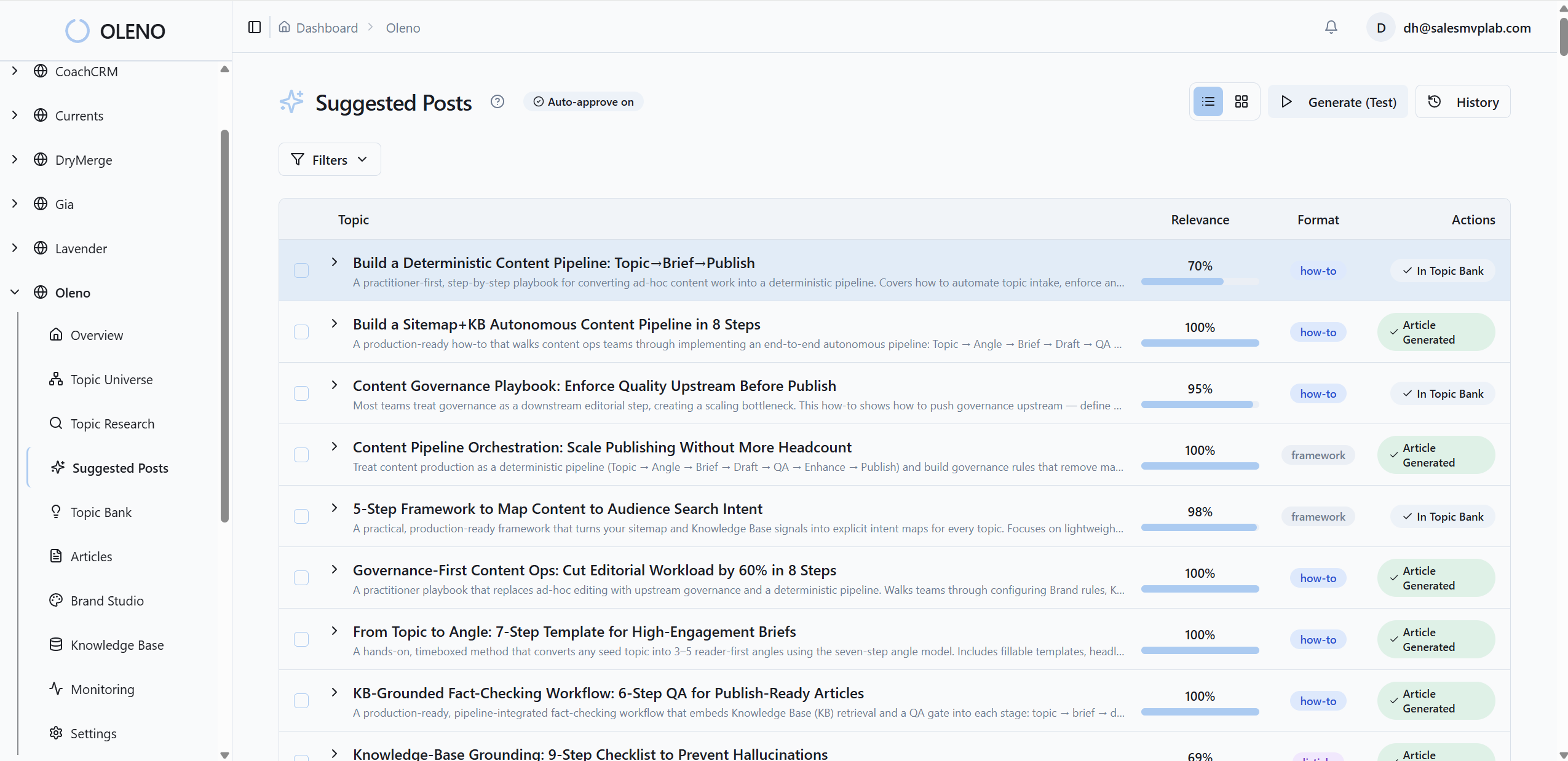
The approach aligns with how featured snippets are awarded and how assistants extract answers. Google’s guidance reinforces the point. The system simply enforces it at scale, section by section, so each piece stands alone cleanly.
Information gain scoring and cooldown enforcement
Briefs receive an Information Gain Score before writing begins. If uniqueness is low, Oleno flags it and encourages a better angle or deeper evidence. This keeps clusters additive instead of repetitive. Topic Universe tracks coverage and saturation across pillars and enforces a 90-day cooldown so you do not over-publish the same idea.
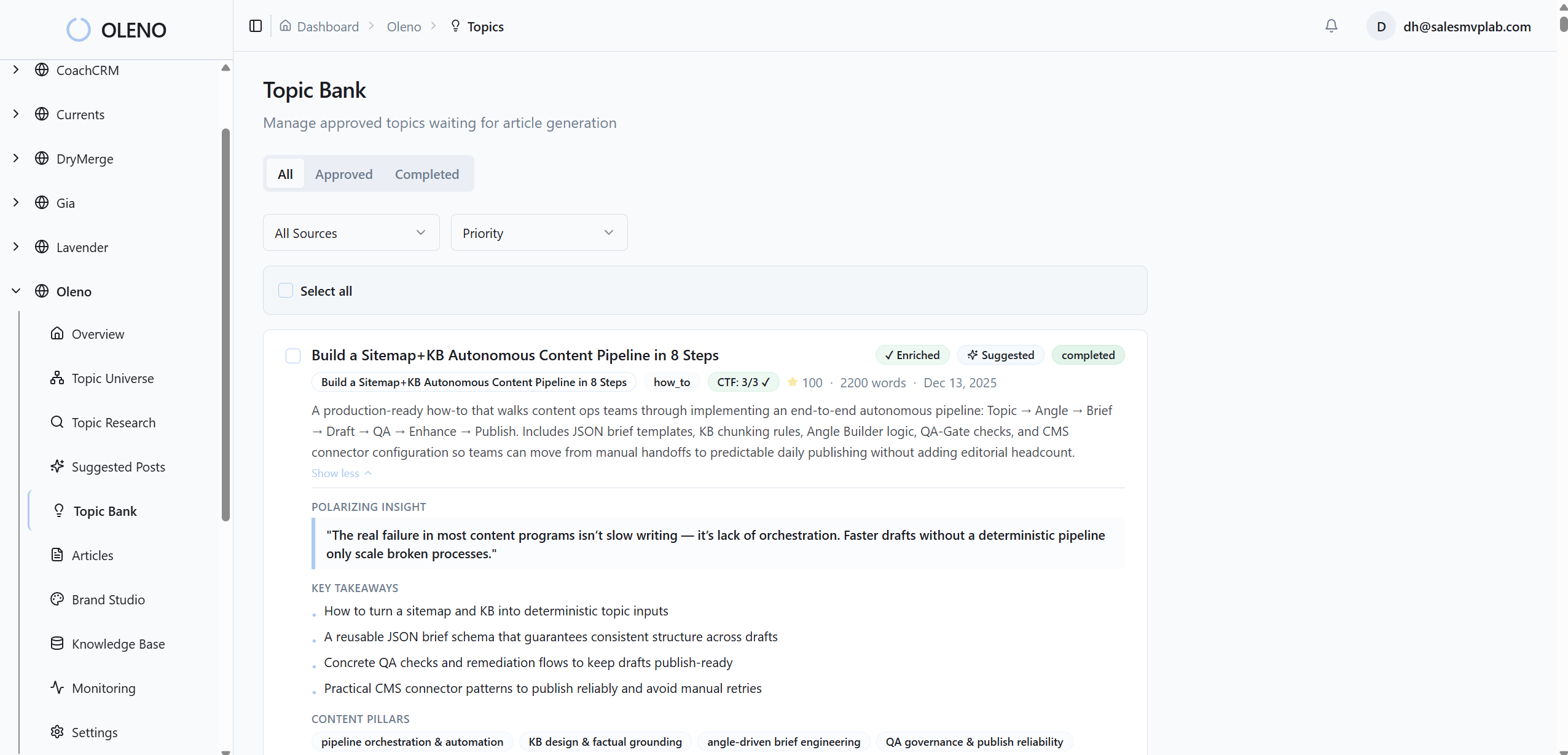
Remember those duplicate pages that cost you 48 hours and momentum. This is where that drift is prevented. Suggestions prioritize gaps, not just volume, so authority compounds rather than spreading thin across near-duplicates.
Publishing and QA complete the loop. QA evaluates drafts against more than eighty checks across structure, voice, snippet readiness, visuals, and metadata, then refines until thresholds are met. Schema is generated automatically for articles, breadcrumbs, and FAQ blocks, and Visual Studio produces brand-consistent hero and inline images using your asset library with alt text and filenames created for you. CMS connectors map fields and prevent duplicate posts. Accuracy lives in code, not hope.
If you want to see this without a big setup or a long meeting, you can Request a demo.
Conclusion
Topic clusters only work when they are grounded in intent and shipped with structure that rewards clarity. That is the difference between a busy library and a useful one. You do not need a massive overhaul. You need a small set of constraints applied early and consistently.
Treat intent labels like contracts. Use a minimal cluster spec to force uniqueness, and open every H2 with a citable paragraph. Run periodic intent reviews to merge or split before pages compete. Then let deterministic links, schema, and visuals do the quiet work of reinforcing your hub and spokes.
If you move on just two fronts this quarter, make it snippet-ready sections and default internal-link edges. Your rewrite load drops. Snippet eligibility rises. And your site starts to read, to humans and machines, like a system with a point of view.
About Daniel Hebert
I'm the founder of Oleno, SalesMVP Lab, and yourLumira. Been working in B2B SaaS in both sales and marketing leadership for 13+ years. I specialize in building revenue engines from the ground up. Over the years, I've codified writing frameworks, which are now powering Oleno.
Frequently Asked Questions