How to Choose ChatGPT or NotebookLM for B2B Marketing

Waiting 30 seconds for a chatgpt answer sounds fast. Waiting 30 seconds for the wrong kind of answer, then rewriting half of it, is where B2B marketing teams lose the week.
If you're comparing chatgpt or notebooklm, you're probably not buying a model. You're buying a workflow decision. And that choice matters more than most teams think, because the real cost isn't subscription price. It's frustrating rework, approval drag, and the headache of trying to turn rough AI output into pipeline content.
For small B2B SaaS teams, this gets painful fast. The Head of Marketing has the strategy. The writer, freelancer, or AI tool doesn't have the full context. Then leadership reviews it, feels something is off, and the piece goes through two or three more rounds. I've seen this movie before. It usually isn't a talent problem. It's a context problem.
By the end of this piece, you'll have a cleaner way to evaluate chatgpt or notebooklm for your team, your use case, and your actual content workflow. Not the demo version of your workflow. The real one, where launch deadlines move, inputs are messy, and someone still has to defend ROI to leadership.
Key Takeaways:
- ChatGPT is usually stronger when your team needs flexible drafting, fast iteration, and broader content generation across many formats.
- NotebookLM is usually stronger when your team needs source-grounded synthesis from a limited set of documents, especially for research and internal briefing work.
- If your content requires 2 or more stakeholder review rounds, the evaluation should focus more on context retention than raw writing quality.
- For a small B2B marketing team, the wrong tool choice can waste 5 to 10 hours per week in rewrites, source checking, and prompt repair.
- The real buying criterion isn't which tool sounds smarter. It's which one fits your content system, approval process, and evidence standards.
The Real Problem With Choosing Between ChatGPT And NotebookLM
Choosing between these tools gets messy because most teams test them in isolation, not in the workflow they'll actually live in. One prompt. One output. Quick gut check. Then a decision. That sounds reasonable, but it misses the part that hurts later: production reality.

In production, content isn't just "write me a post." It's "write me a comparison page from these positioning notes, this sales call feedback, last quarter's ICP shift, and the launch brief someone half-finished at 6 PM." That's a different job. And some tools hold up better than others when context gets weird.
Picture a solo marketer at a 40-person SaaS company on Tuesday afternoon. They've got product notes in a doc, customer language in Gong snippets, old blog posts that don't quite match the new message, and a CEO who wants the draft to sound tighter. They try one AI tool, get something polished but generic. They try another, get something better grounded but slower to shape into final copy. By Friday, the problem isn't AI quality. It's that nobody has a repeatable way to generate, verify, and publish content without starting over.
That's why this decision feels heavier than it should. You're not just testing writing. You're testing whether a tool reduces context loss or quietly adds more of it.
If you want to see what a more structured content workflow looks like, you can request a demo and compare that process against your current stack.
What Actually Matters When B2B Teams Evaluate AI Writing Tools
The right evaluation criteria are pretty boring at first glance. That's fine. Boring criteria usually save you from expensive mistakes.
A Tool's Memory Of Your Context Matters More Than Its First Draft
The first thing to check is whether the tool can stay grounded in the material your team already has. This is the Context Carry Score. I use a simple rule here: if a tool loses your positioning, buyer language, or source facts after one follow-up prompt, it probably won't survive your real workflow.
ChatGPT tends to do well when you need flexible drafting across many formats. Ad copy, outlines, blog sections, email angles, sales enablement snippets. It can move fast. But that flexibility can also create drift. If your prompts aren't tight, the output starts sounding polished in a generic way. Most marketers know that pain. It reads well. It just doesn't sound like you.
NotebookLM tends to hold tighter to source material because that's its whole thing. You give it documents, and it works from those documents. That can reduce hallucination risk in research-heavy tasks. Fair point, it can also feel narrower when you're trying to generate net-new angles or adapt one idea across multiple channels. So the tradeoff is pretty clear: ChatGPT usually gives you range, NotebookLM usually gives you source discipline.
Review Time Beats Output Quality As A Buying Metric
A lot of teams buy based on what they see in the first output. I think that's backwards. Use the Review Compression Test instead: measure how long it takes a human reviewer to get from first draft to approved draft. If Tool A writes an 8 out of 10 draft in 10 minutes but needs 45 minutes of edits, and Tool B writes a 7 out of 10 draft in 15 minutes but needs 10 minutes of edits, Tool B is the better content tool.
Let's pretend your team publishes four substantial pieces a week. If each piece burns an extra 90 minutes across review, rewrites, and fact checks, that's six hours gone. Every week. Over a quarter, you're looking at roughly 78 hours of drag. For a lean marketing team, that's not some abstract efficiency problem. That's campaign work you didn't get to.
This is where a lot of buyers miss the plot. They evaluate the machine and ignore the human cleanup layer.
Source Boundaries Are A Real Buying Criterion, Not A Nice-To-Have
Question worth asking: does your team need generative range, or does it need evidence control? Those are not the same need.
If you publish buyer guides, comparison pages, feature explainers, and FAQ content that leadership or sales will scrutinize line by line, source boundaries matter a lot. NotebookLM has a natural advantage when the task starts with a fixed source set. You can usually trace where the answer came from. That's useful when you're worried about claims drifting beyond the facts.
ChatGPT can still work in those environments, but the burden shifts to your process. You need tighter prompting, clearer source inputs, and stronger review habits. That's not a knock on the tool. It's just the operating model. If your team doesn't have that discipline yet, the flexibility can become expensive.
How To Evaluate These Tools In A Real Buying Process
Most software evaluations fail because teams use broad impressions instead of a test design. You want a tighter process than "we liked this one better."
Run A Three-Task Bakeoff Or You'll Learn The Wrong Lesson
Start with three tasks, not one. I call this the 3-Lane Test.
- Research lane: summarize source docs, pull themes, identify contradictions.
- Drafting lane: generate a first draft for a real campaign asset.
- Adaptation lane: turn that draft into two or three adjacent formats, like email, social, and sales follow-up copy.
This matters because tools often win in one lane and lose in another. NotebookLM may look stronger in the research lane because it's anchored to documents. ChatGPT may look stronger in the adaptation lane because it's more flexible in format changes and tone shifts.
One more thing. Use the same inputs for both tools. Obvious, yes. Still worth saying because people forget and then compare apples to headaches.
Score The Workflow, Not The Interface
A polished interface can fool you. Buyers get impressed by speed, summaries, or neat citations, then ignore the operational question: what happens after the output lands?
Use a five-part scorecard:
- Draft quality after first pass
- Review time to approval
- Factual accuracy against provided sources
- Ease of reusing output across channels
- Prompt effort required from your team
Weight those scores based on your use case. If you're a Head of Marketing producing launch content and buyer enablement assets, I'd weight review time and factual accuracy more heavily than interface feel. If you're generating lots of campaign variations, flexibility may deserve more weight.
And yes, the status quo has merits here. Quick gut feel does catch some things. You can often tell in 20 minutes if a tool is wildly off. But once two tools are both "good enough," your instincts stop being reliable. That's when scoring discipline starts to matter.
If you want a more structured way to test this across your actual content process, not just one-off prompts, you can request a demo.
Check Whether The Tool Fits Your Team's Weakest Link
This is the part buyers skip because it's less fun. Don't evaluate around your strongest operator. Evaluate around your weakest repeatable workflow.
If your best marketer can get strong output from anything, that doesn't prove the tool fits the team. It proves your best marketer is carrying the system. Back when I was the sole marketer on a team, I could write fast because I had all the context in my head. As the team grew, quality dropped because the context didn't transfer cleanly. Same thing happens with AI tools. A high-performing user can brute-force good output. Then everyone else inherits a mess.
So ask a blunt question: if a contractor, junior marketer, or founder with 20 minutes uses this tool, does the output hold up well enough to move forward? If yes, you've got something. If no, you've probably bought a dependency on your best person.
The Common Mistakes Buyers Make In This Comparison
Tool evaluations usually go sideways in predictable ways. Not because the buyer is careless. Because AI tools are easy to demo and harder to operationalize.
Most Teams Test For Writing, When They Should Test For Repeatability
The default instinct is to compare writing samples side by side. Which paragraph sounds better. Which summary feels sharper. That matters a bit, sure. But repeatability matters more.
A tool is useful when it can generate acceptable output across ten runs, ten topics, and two or three team members. If one great prompt produces one great result, that's interesting. It isn't a system. The Repeatability Threshold I use is 7 out of 10 acceptable outputs across a two-week trial. Below that, your team will fall back to manual work whenever deadlines hit.
You can feel this in quarter-end crunch. Everyone's under pressure. Nobody wants to babysit prompts. The team needs something that works when energy is low and time is tight.
Buyers Underestimate Prompt Labor
Prompting is work. Real work. It takes judgment, structure, and cleanup. Some teams talk about prompting like it's free because no invoice shows up for it. But the hours are real.
If a tool needs a senior marketer to build a 500-word prompt every time, you've hidden labor inside the workflow. That's fine if output quality justifies it. Sometimes it does. But don't call that automation. Call it assisted drafting with a senior operator still in the loop.
A simple rule helps here: if prompt creation takes more than 15 minutes per asset on average, the process probably won't hold at scale for a lean team. You might tolerate that for a high-stakes launch page. You probably won't tolerate it for ongoing demand-gen execution.
Buyers Ignore The Approval Chain Until It Breaks
Contrast two scenarios. In the first, a marketer generates a draft, edits it lightly, and ships it. In the second, the marketer generates a draft, the founder rewrites the intro, product fixes terminology, sales changes positioning, and legal asks where a claim came from. Same tool. Very different reality.
If your content passes through 3 or more stakeholder groups, evaluate the tool on auditability and source clarity. That's where research-grounded systems usually earn their keep. Not because they're more creative. Because they reduce arguments later.
Critics of source-bound tools aren't entirely wrong, by the way. They can feel slower and more constrained. But if your main bottleneck is approval friction, constraint can actually be useful. Less drift. Fewer debates. Shorter review cycles.
A Decision Framework B2B Marketing Teams Can Actually Use
You don't need a giant procurement process for this. You need a framework that makes the tradeoffs visible.
The 2x2 Makes The Choice Much Easier To Defend Internally
Use this matrix. Two axes. That's enough.
| Primary Need | Lower Need For Source Control | Higher Need For Source Control |
|---|---|---|
| Higher Need For Flexible Drafting | ChatGPT usually fits better for broad content generation, ideation, and format changes. | Split workflow: use NotebookLM for research, then ChatGPT for adaptation and drafting. |
| Lower Need For Flexible Drafting | Either tool can work, so cost and team preference may decide it. | NotebookLM usually fits better for source-bound synthesis, briefing, and evidence-based content work. |
This framework works because it forces the real question. Are you optimizing for range, or are you optimizing for grounded output? Most teams actually need both, but one usually matters more right now.
Small B2B SaaS teams often land in the top-right box for buyer enablement, product marketing, and comparison content. They land in the top-left box for campaign ideation, repurposing, and fast draft generation. Which means the honest answer is often not "pick one forever." It's "pick the one that matches the job."
A Five-Question Filter Will Expose The Better Fit Fast
Run these five questions with your team:
- Does our content need to stay tightly tied to source material?
- Do we publish more research-heavy assets or more net-new campaign drafts?
- How many review rounds does a typical asset go through?
- Can junior team members get usable output without heavy prompt writing?
- Are we trying to solve for speed, trustworthiness, or both?
If you answer yes to questions 1, 3, and 4, NotebookLM may be a stronger fit for the near-term workflow. If you answer yes to questions 2 and 5, with more emphasis on speed and format flexibility, ChatGPT may fit better.
Short version: the winner changes based on the job.
The Smarter Path For Many Teams Is To Evaluate The System Around The Tool
One thing I've seen over and over: teams buy a tool hoping it will fix a workflow they haven't really designed yet. Then they blame the tool when output feels inconsistent.
The better move is to define the system first. What inputs matter. Who reviews. What counts as publish-ready. How you verify claims. Which content types matter most this quarter. Then pick the tool, or mix of tools, that supports that system.
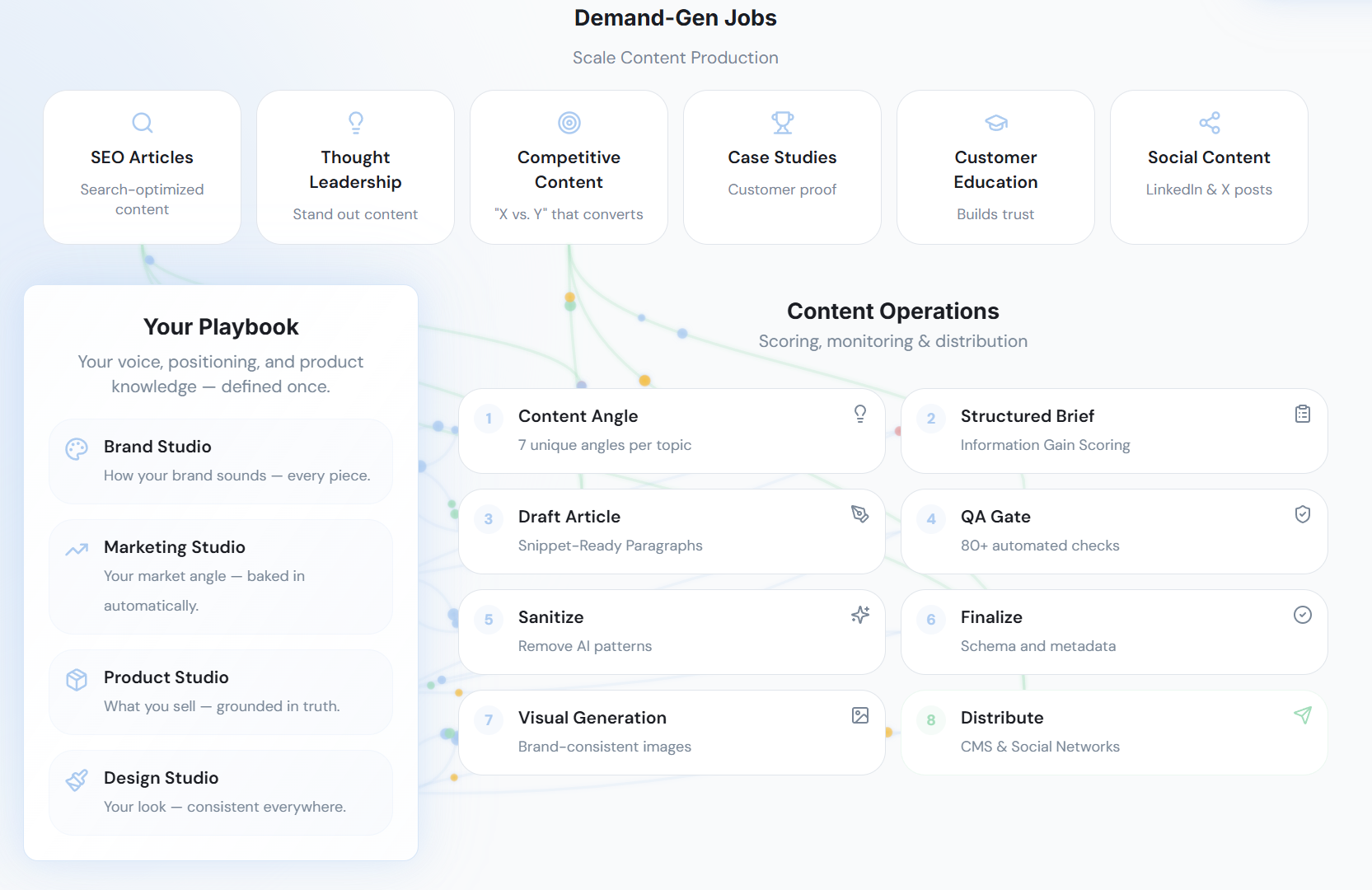
That's also where software like Oleno tends to enter the conversation. Not as "which model is better," but as "how do we turn strategy, source material, and repeatable execution into a working content pipeline?" Oleno is built around planning, publishing, and content operations use cases that matter to lean B2B teams, especially when the issue isn't idea generation but keeping execution consistent. If you want to pressure-test that against your current workflow, book a demo.
Your Next Step Should Match The Risk In Your Workflow
If you're choosing between chatgpt or notebooklm for a B2B marketing team, start by matching the tool to the job, not to the hype cycle. ChatGPT usually makes more sense when range, speed, and content adaptation matter most. NotebookLM usually makes more sense when source grounding, research synthesis, and approval confidence matter most.
For a lot of small SaaS teams, the real issue isn't that either tool is bad. It's that neither one, on its own, fixes the context gap between strategy and execution. That's the part worth solving carefully. Once you see that, the evaluation gets a lot easier.
About Daniel Hebert
I'm the founder of Oleno, SalesMVP Lab, and yourLumira. Been working in B2B SaaS in both sales and marketing leadership for 13+ years. I specialize in building revenue engines from the ground up. Over the years, I've codified writing frameworks, which are now powering Oleno.
Frequently Asked Questions